31/05/2020
- China’s leadership has made it clear to its people that the world will become more dangerous and they must be prepared for hard times
- Beijing’s relatively small stimulus response to Covid-19 suggests it wants to save its economic policy ammunition for a bigger battle
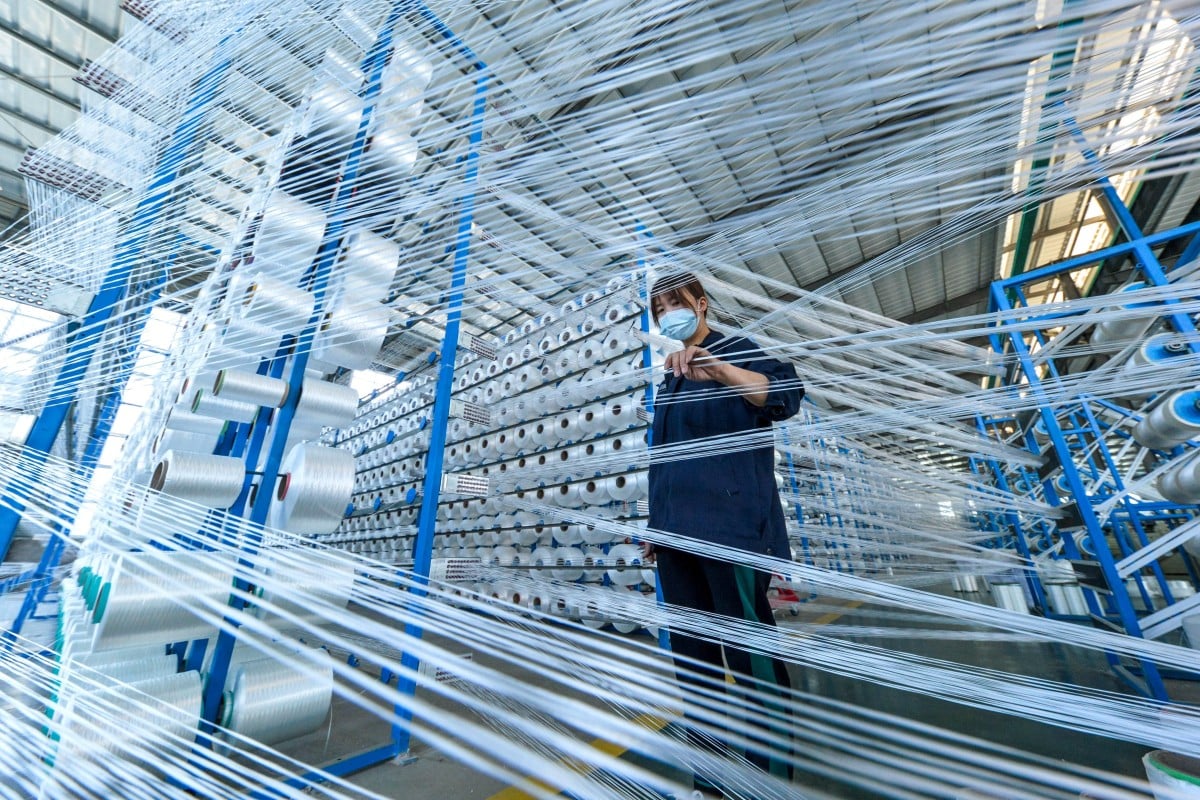
China opted not to set a GDP target for 2020. Photo: Xinhua
Beijing’s decision not to set an annual GDP target for 2020 – for the first time since 2002 – is a sign it is putting stability ahead of growth as part of its preparations for an escalating conflict with the
United States.
Economic development has always been the central theme for Beijing since it established diplomatic relations with the US in 1979. But this year it has given priority to job creation and tackling poverty. The coronavirus outbreak might appear to have been the reason for the shift, but the underlying factor is the tension with the US.
Covid-19 offered a preview of what a decoupling of China and US might look like: aircraft grounded, cargo flows disrupted, value chains broken, goodwill and cooperation lost, blame games started.
Both countries have suffered heavy human and economic losses from the coronavirus, yet that did not inspire them to work together. Instead, hostility and rivalry has thrived, and neither wants to blink first.
The Chinese leadership has made it clear to its people that the world will become more dangerous and they must be prepared for hard times. As such, the government is saving its economic policy ammunition.
While the stimulus plans introduced in the US, Germany, Japan and France exceed 10 per cent of their national GDP and interest rates have been cut to the bone, Beijing stopped at just 1 trillion yuan (US$140 billion) worth of special treasury bonds and 1.6 trillion yuan of additional local government bonds. In total, about 2.6 per cent of GDP.
Interest rates in China – 2.7 per cent on 10-year bonds – are some of the highest among major economies.
China’s 6.6 per cent defence spending boost lowest in three decades
China’s budget fiscal deficit has increased to 3.6 per cent of GDP for 2020, but the larger deficit is mainly from tax and fee cuts instead of increased fiscal expenses, except for an increased military spending.
Beijing is calling on provincial and local authorities to tighten their belts, which is unusual for a government that has huge assets and can increase spending at any time through quantitative easing.
So why is the government, which is known for intervening in the economy, being so restrained?
It is bracing itself for a perceived period of turbulence and hardship as its relationship with the US turns sour. It is putting jobs and social stability on top of its agenda, instead of growth.
Beijing is refraining from excessive spending, eliminating sources of potential instability, making appeals to the most vulnerable social groups, and saving its power for a bigger test.
Against that backdrop, the National People’s Congress passed the national security legislation on Hong Kong. Beijing knew the bill would anger the US, but did it anyway.
Hong Kong is known as China’s gateway to the international capital market and the largest offshore yuan market, but Beijing is ready to trade losses on the financial and economic front for potential gain on a fortified national security fence.
All this points to the suggestion that Beijing is preparing for the possibility of decoupling from the US, even if it doesn’t necessarily want to.
The threat of a new Cold War is clouding the world. The theme of life for one or two generations of people on both sides of the Pacific may shift from growth and prosperity to struggle and confrontation.
China and the US have yet to collide totally, but that moment is drawing near.
Source: SCMP
Posted in 1979, 2020, aircraft grounded, ammunition, ‘new cold war’, be prepared, Beijing, Beijing’s, bigger battle, blame games, cargo flows disrupted, central theme, Chinese leadership, collide, CONFRONTATION, cooperation, coronavirus, coronavirus outbreak, Decoupling, diplomatic relations, Economic development, economic losses, Economic policy, France, from, GDP target, Germany, goodwill, growth, hard times, hostility, Japan, leadership, lost, military spending, more dangerous, National People’s Congress, Pacific, People, preparing, prosperity, rivalry, small stimulus response, struggle, The US, thrived, to decouple, Uncategorized, United States, value chains broken, World |
1 Comment »
26/04/2020
- City at centre of outbreak finally able to declare itself clear of disease after months in lockdown and thousands of deaths
- Risk of infection remains, however, with some patients testing positive for coronavirus that causes disease without showing symptoms
Ferries and other public transport services resumed in Wuhan last week. Photo: Xinhua
The city of Wuhan, the initial epicentre of the coronavirus pandemic, no longer has any Covid-19 patients in hospital after the last 12 were discharged on Sunday.
Their release ended a four-month nightmare for the city, where the disease was first detected in December. The number of patients being treated for Covid-19, the disease caused by a new coronavirus, peaked on February 18 at 38,020 – nearly 10,000 of whom were in severe or critical condition.
“With the joint efforts of Wuhan and the national medical aid given to Hubei province, all cases of Covid-19 in Wuhan were cleared as of April 26,” Mi Feng, a spokesman for the National Health Commission said on Sunday afternoon.
The announcement came only one day after the city discharged the last patient who had been in a severe condition. That patient also was the last severe case in Hubei province.
The last patient discharged from Wuhan Chest Hospital, a 77-year-old man surnamed Ding, twice tested negative for Sars-CoV-2, the virus that causes Covid-19, and was released at noon on Sunday.
“I missed my family so much!” Ding told Changjing Daily.
Another unidentified patient exclaimed as he left the hospital: “The air outside is so fresh! The weather is so good today!”
Wuhan faced a long journey to bring its patient count down to zero.
The city of 11 million, the capital of Hubei province and a transport hub for central China, was put under a strict lockdown on January 23 that barred anyone from entering or exiting the city without official approval for 76 days until it was officially lifted on April 8.
Coronavirus: Wuhan, Los Angeles officials discuss getting back to work after lockdown
22 Apr 2020
Residents were ordered to stay in their apartments as the city stopped public transport and banned private cars from city streets. As the epidemic worsened, more than 42,000 medical staff from across the country were sent to the city and to Hubei province to help ease the burden on the local health care system.
Wuhan was the hardest hit city in China, accounting for 50,333 of the 82,827 locally transmitted Covid-19 cases recorded in China. More than 4,600 died in the country from the disease.
On March 13, the city reported for the first time that there were no new suspected cases of the infection, and five days later there were no confirmed cases.
The number of discharged patients bottomed out at 39.1 per cent at the end of February, gradually climbing to 92.2 per cent by last Thursday.
“Having the patients in the hospital cleared on April 26 marks a major achievement for the city’s Covid-19 treatment,” the Wuhan Health Commission said in a statement.
However, having no severe cases in hospital does not mean all the discharged patients will require no further treatment as they may still need further care.
“Clearing all the severe cases marks a decisive victory for the battle to safeguard Wuhan,” health minister Ma Xiaowei told state broadcaster China Central Television on Saturday.
“Some patients who have other conditions are being treated in specialised hospitals. It has been properly arranged.”
Coronavirus: Chinese writer hit by nationalist backlash over diary about Wuhan lockdown
Ten patients aged between 42 and 85 who have been declared coronavirus-free are still in intensive care at the city’s Tongji Hospital where they are being treated for kidney problems and other complications arising from Covid-19. Some still need ventilators to help them breathe.
These 10 patients are under 24-hour care, with 190 nurses on four-hour rotations. There are other patients in a similar condition in two other hospitals in Wuhan, according to the Hubei Broadcasting and Television Network.
However, the discharge of the last batch of Covid-19 patients does not mean that the risk of infection is gone.
The city reported 20 new cases of people testing positive for Sars-CoV-2, the official name for the coronavirus that causes the disease, but who do not yet show symptoms.
There are 535 such carriers under medical observation. Past data shows some of these asymptomatic carriers will develop symptoms, and so will be counted as Covid-19 patients under China’s diagnosis and treatment plan.
China’s coronavirus infection curve has flattened out with about 694 imported cases of Covid-19 on top of about 800 locally transmitted ones now under treatment.
The national health commission spokesman warned that people still need to be on high alert as the virus is continuing to spread around the globe, with no sign yet of a slowdown.
“[We] must not drop our guard and loosen up. [We] must discover cases in time and deal with them quickly,” Mi said, citing the continued pressure from cases imported by people returning from overseas.
“The next step will be to implement the requirements of the central government and continue to guard against imported cases and a rebound of domestic transmitted cases.”
Source: SCMP
Posted in 10, 10,000, 12, 13, 18, 190, 2020, 22, 23, 24-hour, 26th, 76, 8, 800, able, across the country, after, afternoon, against, air, all cases, announcement, another, Anyone, apartments, approval, April, around the globe, arranged, asymptomatic, banned, barred, bottomed out, breathe, burden, capital, care, carriers, causes, Central China, Central government, centre, Changjing Daily, China Central Television, City, city streets, clear, climbing, complications, condition, conditions, confirmed cases, continuing, coronavirus, Coronavirus pandemic, Country, COVID-19, COVID-19 cases, critical, curve, days, deaths, December, declared, detected, develop, diagnosis and treatment plan, died, discharged, discover, discuss, Disease, domestic, drop, ease, end, ended, entering, epicentre, epidemic, exclaimed, exiting, Family, February, ferries, finally, first time, five days, flattened, four-hour, four-month, free, fresh, from, getting back, given, good, gradually, high alert, Hospital, hospitals, However, Hubei Broadcasting and Television Network, hubei province, implement, imported cases, infection, initial, intensive care, itself, January, joint efforts, kidney problems, last, last week, later, leave, left, lifted, local health care system, locally transmitted, lockdown, longer, loosen up, Los Angeles, March, medical observation, medical staff, million, missed, months, more than, National Health Commission, national medical aid, nearly, negative, new coronavirus, nightmare, no sign, noon, number, nurses, Official, officially, officials, one day, or, ordered, other, our guard, outbreak, outside, overseas, Past data, patients, peaked, People, positive, pressure, private cars, public transport, public transport services, put under, quickly, rebound, recorded, release, released, remains, requirements, residents, resumed, returning, Risk, rotations, Saturday, sent, severe, showing, slowdown, some, specialised, spokesman, spread, statement, stay, stopped, strict lockdown, struggle, Sunday, suspected cases, symptoms, testing, The National Health Commission, their, Thousands, Thursday, to help, to work, Today, Tongji Hospital, transmitted cases, transport hub, treated, twice, Uncategorized, unidentified, ventilators, warned, weather, whom, without, worsened, Wuhan, Wuhan Chest Hospital, Wuhan Health Commission, yet |
Leave a Comment »
17/04/2020
BEIJING (Reuters) – For Zhang Yu, who runs a cafe in one of Beijing’s top tourist spots, business has never been so bad.
To contain the spread of the coronavirus, bars and cafes in the Wudaoying hutong – a top Lonely Planet destination built around a narrow lane – are permitted to provide take-away services only. Non-residents must show proof they have an appointment to enter the area.
Added to which, tourism has plummeted.
“Don’t mention it! This is supposed to be the peak season,” said Zhang, who has run her cafe for five years. “But there are almost no customers as they (authorities) don’t want to have people hanging around here.”
While China’s manufacturing and retail sectors are starting to get back to work as the pace of new infections slows sharply, tourism sites in Beijing remain a shadow of their former and bustling self.
China’s capital city has maintained the highest level of emergency response to the outbreak, so tourist attractions like the Forbidden City remain closed. A 14-day quarantine for new arrivals has stifled travel.
As a result, small business owners running restaurants, souvenir shops and tourism agencies are struggling.
Only a little over 20% of tourism-related businesses in Beijing had resumed operation as of the three-day Qingming national holiday in early April, a survey by on-demand delivery service giant Meituan Dianping showed.
HANGING ON
The only people present in Wudaoying on a recent afternoon were a few elderly residents sitting outside to enjoy the spring sunshine. A cat made its way lazily through empty rooftop bars.
“We used to see more customers in one hour in pre-virus days than we see in a whole day right now,” said a worker at a sandwich restaurant in Wudaoying.
In another popular area, Khazzy, a 32-year-old doctoral student who opened a restaurant last October, has had only four customers all day.
“There are almost no tourists coming to Beijing and the remaining locals have concerns about eating out,” Khazzy said as sunset approached.
Khazzy said he has let five of his 13 staff go and has no idea how long he can stay afloat financially even though his landlord has agreed to waive one month’s rent on the property in Qianmen, near Beijing’s Tiananmen Square.
More than half of the shops in Qianmen remain closed. The manager of a state-backed noodle restaurant said most of the closed stores are privately owned small businesses that can’t secure enough business to support their daily operations.
She said revenues at the noodle restaurant have plunged more than 80%, but staff salaries have not been cut.
Zhang, the cafe owner in Wudaoying, reckoned small businesses could hold on for the next three months.
“But after that, I just don’t know,” she said.
Source: Reuters
Posted in 13, 14-day quarantine, 20, afternoon, agreed, almost, appointment, April, area, authorities, bad, bars, Beijing, Beijing's, Beijing’s, built around, Business, bustling, cafe, cafes, Capital city, cat, China’s, closed, contain, coronavirus, customers, delivery service, destination, doctoral student, elderly, empty, enter, financially, five, Forbidden City, giant, hanging around, highest level, hot-spots, Khazzy, landlord, lazily, Lonely Planet, maintained, Manufacturing, mention, months, narrow lane, national holiday, new arrivals, new infections, Non-residents, noodle restaurant, on-demand, one, operation, ourism agencies, outbreak, Owners, People, permitted, plummeted, present, proof, Property, provide, Qianmen, Qingming, rent, residents, restaurants, resumed, Retail, rooftop, running, runs, sandwich, sectors, shadow, showed, small business, small businesses, souvenir shops, spots, spread, spring, staff, starting, stay afloat, stifled, struggle, struggling, Sunshine, supposed, take-away services, three-day, Tiananmen Square, top, Tourism, tourism-related, tourist, tourist attractions, travel, Uncategorized, waive, Wudaoying, Wudaoying hutong, years |
Leave a Comment »
05/04/2020
- More than 15,000 workers infected as hospitals struggle with a lack of test kits and protective gear
- Chronic shortages are forcing emergency teams to ration equipment and come up with their own makeshift solutions
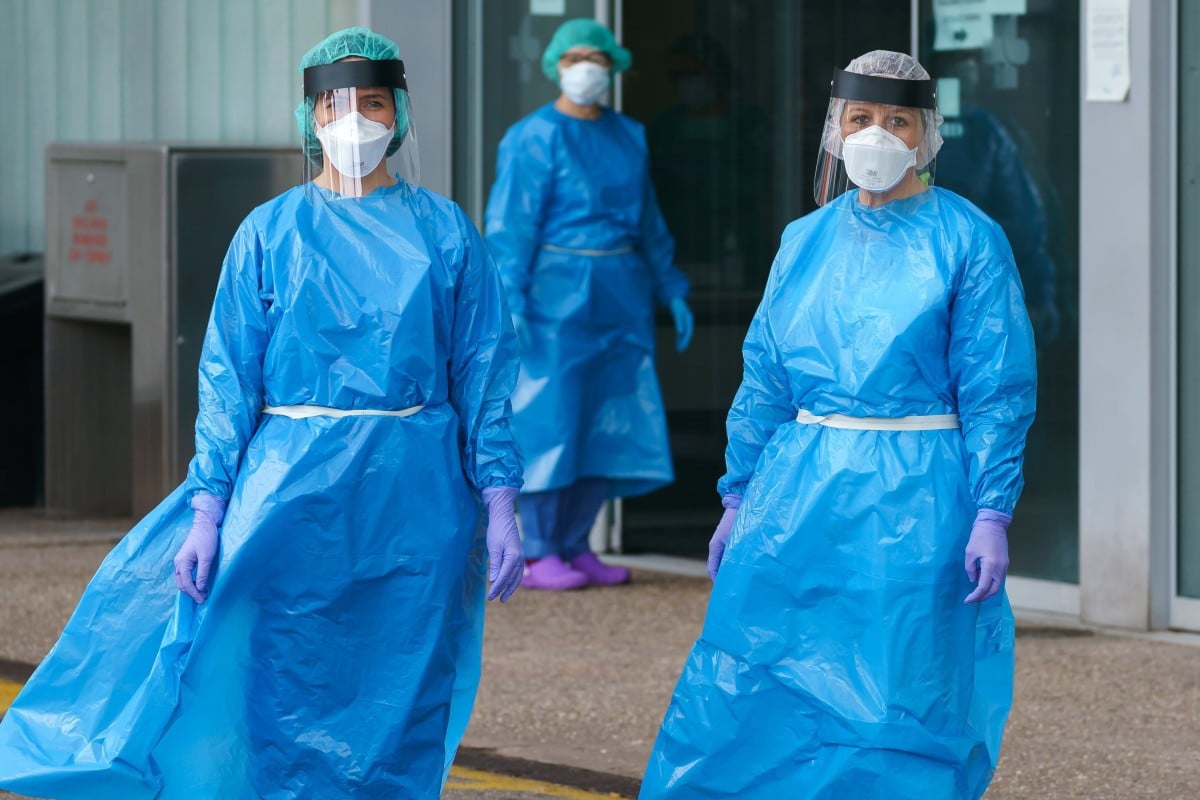
Health workers in protective gear outside an emergency entrance to a hospital in northern Spain. Photo: AFP
Overburdened hospitals and a shortage of protective measures and tests are taking a toll on Spanish medical professionals who are contracting Covid-19 – the illness caused by the new
coronavirus – at an alarming rate.
To date, more than 15,000 health professionals in Spain – about 14 per cent of the national total – have been infected. In contrast, Italy reported that health workers accounted for about 10 per cent of its infections.
“I have tried to be careful, but when you work in a hospital, no one can guarantee that one of your colleagues doesn’t have the virus in the asymptomatic phase,” said ambulance crew member Xevi Mateu, who tested positive for the virus a week ago.
Mateu, who lives and works in Catalonia, said he thought he might have got infected during a meal break at the hospital or while on duty in the cramped space of an emergency vehicle.
Europe faces Easter indoors as Spain’s virus cases surge past 100,000
Information on how to protect himself from the rampaging pandemic was conflicting, he said, and with no guarantee on future supplies he was forced to ration his use of protective equipment as soon as the demand for ambulance services began to exceed capacity.
Albert Gual, another emergency worker in Catalonia, said protocols had changed since he first started transferring Covid-19 patients to hospital, and he believes the shortage of protective equipment is to blame.
“At the beginning of the crisis, we threw away the glasses, the medical suit and the mask after one use. Now we are using one mask per day, until the stock runs out,” Gual said.
“Yesterday I talked to a colleague from the emergency service who told me they are overwhelmed – without material, without resources, without people. The medical suits are reused and sterilised until they have holes,” he said.
There have also been reports of doctors and nurses in Spain making their own protective clothing out of bin liners.
To ease the burden on Spain’s medical workforce, retirees have been asked to return to practice and newly licensed personnel have been recruited to make up the shortfall. One of the new recruits is Candela Lebrero, who completed her medical degree last year and is now a nurse at a hospital in Madrid.
The Spanish capital has seen the country’s largest number of infections – with more than 36,000 – and staff at the Madrid Principe de Asturias Hospital, where Lebrero works have been among those falling ill from the disease.
Reports of an overload of patients were very real, she said, with emergency rooms forced to send less serious cases to “medicalised hotels” and additional hospital wards switched to caring for Covid-19 patients.
As for rapid testing, it “hadn’t arrived yet” at Lebrero’s hospital, which was relying on PCR tests – the swab technique which identifies the presence of any genetic material belonging to the virus – as a diagnostic for both patients and health personnel who presented with symptoms, she said.
Similar problems have been reported across Spain and last week the health ministry’s coordinator for the emergency response, Fernando Simon, acknowledged the difficulties for health care workers to access protective equipment.
On March 25, Simon admitted the jump in infections among medical staff was due to “a market access problem” as supplies “are scarce and there is non availability” – a problem not limited to Spain.
“We are on the way to a solution,” he said. On Monday, Simon also tested positive for the disease.
While equipment shortages are a global problem, Spain was hit particularly hard after its two largest distributors of medical supplies – located in France and Germany – were ordered to stop selling by their governments in early March, fearful of depleted stocks in their own countries as the pandemic spread.
The decision, which was criticised for being contrary to the spirit of the European Union, forced the Spanish government to turn to other measures, including the purchase of €432 million (US$467 million) worth of supplies from China.
A freight corridor was also opened to speed deliveries, and Spanish manufacturers were put on a “war footing” to urgently switch to making medical supplies. The car industry is now turning out respirators and gels, while textile manufacturers have turned their hand to producing gowns and face masks.
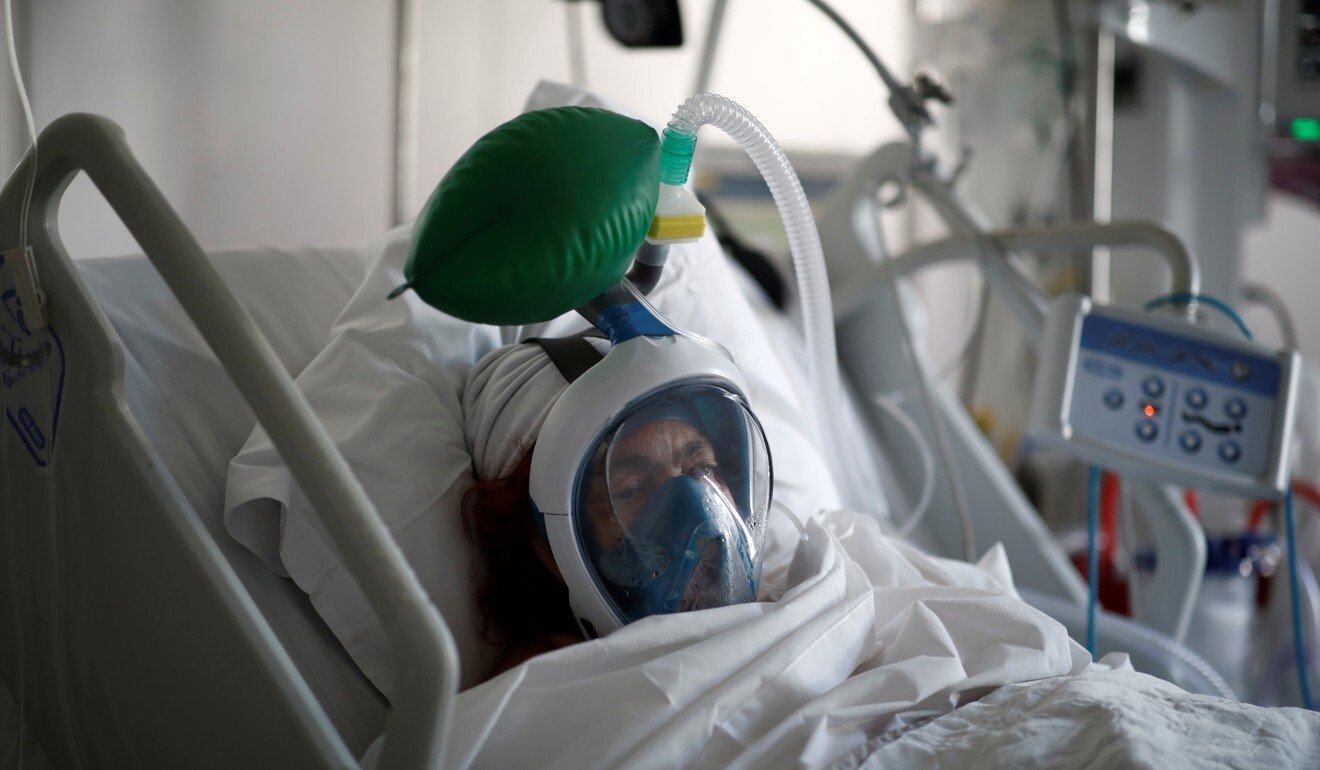
Sports equipment chain Decathlon has even adapted its snorkel goggles for medical use and donated its entire stock to Spanish hospitals.
A Covid-19 patient wears a full-face snorkelling mask which has been converted into a ventilator. Photo: Reuters
The scramble to address shortages in Spain’s overstretched health system has not been without problems. Last week, the government withdrew 58,000 Covid-19 rapid test kits
it bought from a Chinese company, after their accuracy rate was reported to be just 30 per cent.
China said the kits were not approved for sale and not included in supplies sent by Beijing to Spain.
It is not clear if the supplies from China have arrived, but on the ground medical personnel said they had not yet seen the equipment.
“It is assumed that the new ones have already arrived, but they have to pass the approval of the Carlos III Public Health Institute [a Spanish public health research institute], and their use is not yet widespread,” Laura Díez, press officer for the State Confederation of Medical Unions said.
“Their arrival will improve the situation since at least it would be known if someone in contact with the infected could transmit the disease, especially health personnel,” she said.
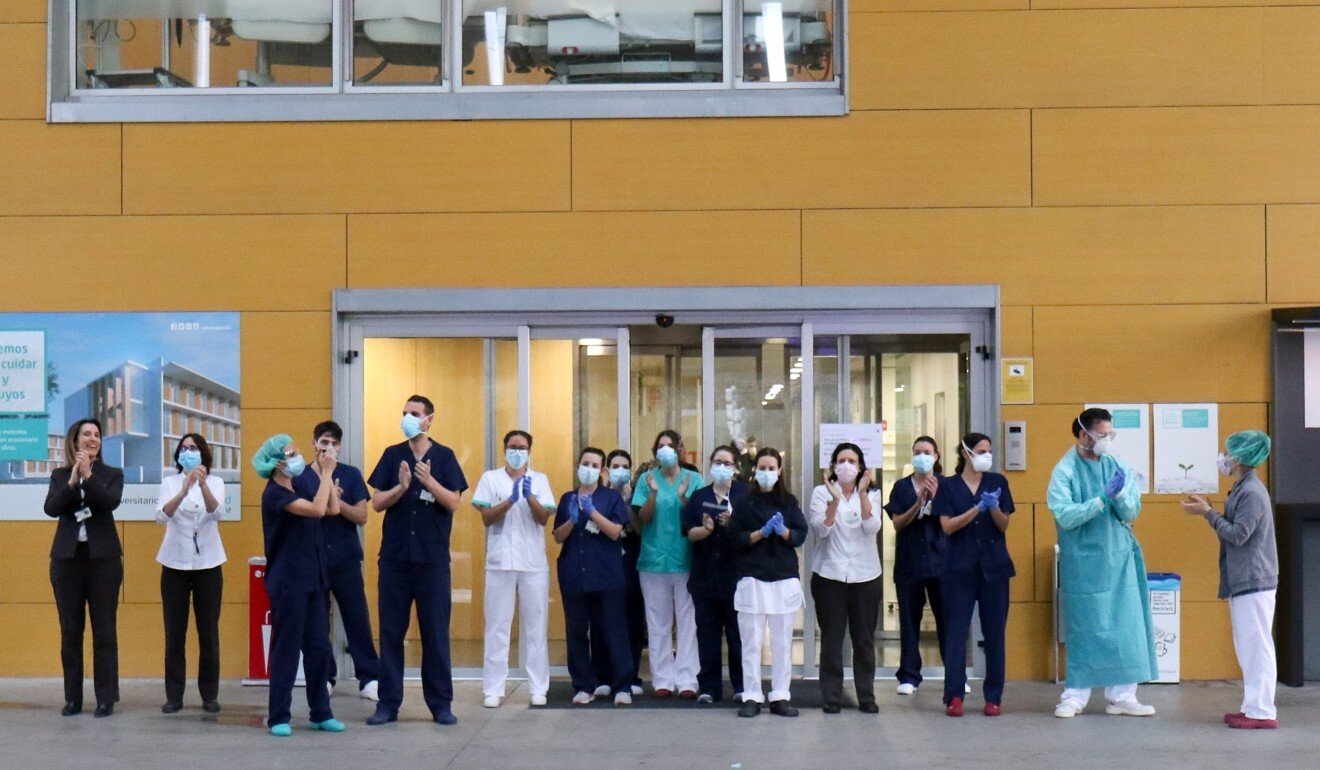
Medical staff in Spain acknowledge the daily applause from the public which has become a feature of the coronavirus pandemic. Photo: DPA
Several health organisations have appealed to the courts in their desperate bid to get hold of protective equipment. A Madrid court did accept the argument by an association of doctors that the authorities should be forced to provide adequate supplies to all health personnel.
But the Supreme Court refused to support the claim, saying it recognised the government was doing everything it could.
“We presented precautionary measures and they were dismissed, we have filed an appeal,” Díez said.
“At the moment we have no answer. Authorities said that planes with the material are arriving, but at the hospitals, they are not seen.”
Spain says Covid-19 can lead to closer ties with Chinese medical suppliers
Meanwhile, the General Councils of Dentists, Nurses, Pharmacists, Doctors, and Veterinarians, which represent more than 700,000 health professionals in Spain, expressed its “absolute rejection” of new guidelines for medical workers set by the health ministry.
In a notice issued on Friday, the ministry said that health professionals that had not been tested for Covid-19 but who took time off should return to work seven days after the onset of symptoms as long as they did not have a fever or respiratory problems.
Once back at work, they should wear a surgical mask for 14 days from the onset of symptoms and avoid contact with other people.
The general councils said some of the guidelines represented “a serious risk” to the health of professionals and their patients.
Ambulance worker Mateu is currently in isolation at home as he recovers from the disease, but his thoughts are with his colleagues and their daily struggle. He said he thanked his supervisors and coordinators for working hard every day.
With so many of the staff themselves sick, there was a lot of stress on those who were still at work, he said.
“I have the feeling that the effort and management is not being done from the top down, but from the bottom up: from us who work directly with the patients, our supervisors and they are continuing the chain of gestures and efforts,” he said.
Source: SCMP
Posted in Carlos III Public Health Institute, Catalonia, Chronic shortages, coronavirus fight, COVID-19, Decathlon, emergency teams, equipment, forcing, General Councils of Dentists, Nurses, Pharmacists, Doctors, and Veterinarians, health workers, hospitals, infected, lack, Madrid, Madrid Principe de Asturias Hospital, makeshift solutions, new coronavirus, overburdened, protective gear, ration, Spain's, State Confederation of Medical Unions, struggle, Supreme Court, test kits, Uncategorized, undersupplied |
Leave a Comment »
27/03/2020
BEIJING/SHANGHAI (Reuters) – Chinese President Xi Jinping told U.S. President Donald Trump during a phone call on Friday that he would have China’s support in fighting the coronavirus, as the United States faces the prospect of becoming the next global epicentre of the pandemic.
The United States now has the most coronavirus cases of any country, with 84,946 infections and 1,259 deaths. Hospitals in cities like New York and New Orleans struggle to cope with the wave of patients.
Xi’s offer of assistance came amid a long-running war of words between Beijing and Washington over various issues including the coronavirus epidemic.
Trump and some U.S. officials have accused China of a lack of transparency on the virus, and Trump has at times called the coronavirus a “China virus” as it originated there, angering Beijing.
In the call, Xi reiterated to Trump that China had been open and transparent about the epidemic, according to an account of the conversation published by the Chinese foreign ministry.
Trump said on Twitter that he discussed the coronavirus outbreak “in great detail” with Xi.
“China has been through much & has developed a strong understanding of the virus,” Trump said. “We are working closely together. Much respect!”.
The World Health Organization has said the United States, which saw 17,099 new coronavirus cases and 281 deaths in the past 24 hours, is expected to become the epicentre of the pandemic.
CHINA CUTS FLIGHTS
Like U.S. hospitals now, China’s medical system struggled to contain the coronavirus just two months ago, but draconian city lockdowns and severe travel restrictions has seen China dramatically ease the epidemic.
Mainland China on Friday reported its first local coronavirus case in three days and 54 new imported cases, as Beijing ordered airlines to sharply cut international flights, for fear travellers could reignite the coronavirus outbreak.
The 55 new cases detected on Thursday were down from 67 a day earlier, the National Health Commission said on Friday, taking the tally of infections to 81,340. China’s death toll stood at 3,292 as of Thursday, up by five from a day earlier.
The central province of Hubei, with a population of about 60 million, reported no new cases on Thursday, a day after lifting a lockdown and reopening its borders as the epidemic eased there.
The commercial capital of Shanghai reported the most new imported cases with 17, followed by 12 in the southern province of Guangdong and four each in the capital Beijing and the nearby city of Tianjin.
Shanghai now has 125 patients who arrived from overseas, including 46 from Britain and 27 from the United States.
In effect from Sunday, China has ordered its airlines to fly only one route to any country, on just one flight each week. Foreign airlines must comply with similar curbs on flights to China, although many had already halted services.
About 90% of current international flights into China will be suspended, cutting arrivals to 5,000 passengers a day, from 25,000, the civil aviation regulator said late on Thursday.
From Saturday, China will temporarily suspend entry for foreigners with valid visas and residence permits, in an interim measure, the foreign ministry added.
Before the new curbs, foreign nationals made up about a tenth of the roughly 20,000 travellers arriving on international flights every day, an official of China’s National Immigration Administration said last week.
As commercial flights dwindle, Chinese students from wealthy families are paying tens of thousands of dollars to fly home on private jets.
International demand for chartered and private flights into China increased 227% in March from a year earlier, said Shanghai-based private jet service provider iFlyPlus.
Notably, requests for flights from the United States to China rose 10-fold in late March, iFlyPlus told Reuters.
Source: Reuters
Posted in airlines, Beijing, borders, Britain, China’s, Chinese President Xi Jinping, city lockdowns, coronavirus, coronavirus epidemic, coronavirus outbreak, draconian, epicentre, fighting, Guangdong, hospitals, hubei province, iFlyPlus, international flights, lockdown, Mainland China, National Health Commission, New Orleans, New York, pandemic, patients, phone call, private jet service provider, reignited, Reuters, Shanghai, struggle, support, Tianjin, travellers, Twitter, U.S. President Donald Trump, Uncategorized, United States, Washington, World Health Organization |
Leave a Comment »
10/09/2019
- Expensive presents are officially discouraged but have become the norm at many schools on day of appreciation for educators
Students at Yangzhou Technical Vocational College form the Chinese characters for “Hello Teacher” to mark China’s Teachers’ Day. Photo: Handout
Despite a decade of official discouragement, parents in China have been struggling with one of the biggest dilemmas of the school year – how to mark the country’s annual Teacher’s Day.
Ellen Yuan agonised for a day and a night before sending her son off to kindergarten on Tuesday with a 1,000 yuan (US$140) gift card in his bag for the teacher.
It was the boy’s second week of attendance and Yuan had given no thought to any Teacher’s Day obligations –until she learned that several of her friends had been busy over the weekend preparing gifts for their children’s teachers.
“It makes me feel that I am being a drag on my son if I don’t do so,” said Yuan, who works for a foreign company in Shanghai.
Respecting teachers has traditionally been a fundamental social norm in China but gift giving on the special day for educators has gone beyond an expression of appreciation by their students, as parents have taken over with ever more expensive gifts – and sometimes cash – which they hope will mean their kids are well taken care of while at school.
What gift, how expensive it should be, and how to deliver it have become the biggest questions for many parents in the run-up to September 10 each year, even though the education ministry and its subordinate bodies have repeatedly issued directives over the past decade to ban teachers accepting gifts.
Yuan said one of her friends had bought a body care set worth more than 600 yuan for each of her child’s three teachers, another had bought an 800 yuan gift card, while a third had given the head teacher a 1,000 yuan bottle of perfume.
Some parents had delivered the presents directly to the school, while others had asked their children to take the gifts to their teachers. Yuan’s plan was to message the teacher and tell her to take the gift card from her son’s bag.
“I know it’s bad. I don’t want my kid to know that,” Yuan said.
Hundreds of teachers protest in China over poor pay
The question of whether parents should give gifts on Teacher’s Day was one of the hottest topics on Weibo, China’s Twitter-like social media platform, attracting more than 15 million views as of Tuesday afternoon.
“Of course we should not, but I don’t dare to ignore it,” one user said, winning more than 10,000 likes.
Chu Zhaohui, a researcher at the National Institute of Education Sciences, said the gift-giving trend had been partly driven by a “keeping up with the Joneses” mentality.
“Everybody has given a gift. Would my child be specially treated if I don’t? This is a common concern,” Chu said. As a result, the purpose of gift giving on Teacher’s Day had become about protecting the children’s interests instead of a sincere expression of gratitude, he said.
But not every teacher gets presents – with gifts usually reserved for those teaching the “main subjects” of mathematics, Chinese and English, which count the most in high school and college entrance examinations.
Emily Shen, an English teacher from a middle school in Hangzhou, in the eastern province of Zhejiang, said she also prepared gifts for the teachers of her two kids. “Some chocolate for them to take to school. And I myself would give a gift card to each of those who teach the main subjects,” she said.
Zhuang Ke, a music teacher at a primary school in Jiaxing, also in Zhejiang province, admitted she was embarrassed by the parents’ different treatment of teachers of “less important” subjects like her’s. “It’s always nice to receive presents. But teachers who teach music, art and PE are often forgotten,” she said.
Chinese kindergarten teacher fired for hot sun punishment
State broadcaster CCTV said in a commentary on its website on Sunday that “all forms of behavior that attempt to ruin normal teaching order and interfere in equality by sending gifts should be resolutely abandoned”. A similar message was run by a series of official media outlets at local level.
“The most fundamental way to stop parents from sending gifts is to treat the students equally and fairly every day, so that parents conclude it makes no difference whether they give a gift,” Rednet.cn, the official news portal of Hunan province, said on Monday.
Although some teachers have made it explicit to students that they will refuse presents on Teacher’s Day, Yuan said her son’s teacher accepted the gift, as did the teachers of her three friends’ children.
Source: SCMP
Posted in Art, bag, body care set, bottle of perfume, Chinese, chinese parents, Chocolate, college entrance examination, commentary, day of appreciation, discouraged, educators, English, Expensive presents, fired, foreign company, forgotten, fundamental way, gift card, gift etiquette, Hangzhou, High school, hot sun punishment, Hunan Province, Jiaxing, keeping up with the Joneses, kindergarten, mathematics, mentality, middle school, music, music teacher, National Institute of Education Sciences, norm, official news portal, officially, PE, poor pay, primary school, Protest, Rednet.cn, schools, Shanghai, sincere expression of gratitude, state broadcaster CCTV, struggle, teacher, Teacher’s Day, Uncategorized, website, Weibo, Yangzhou Technical Vocational College, zhejiang province |
Leave a Comment »





 CHINDIA ALERT: You'll be living in their world, very soon
Chinese parents struggle with Teacher’s Day gift etiquette
Despite a decade of official discouragement, parents in China have been struggling with one of the biggest dilemmas of the school year – how to mark the country’s annual Teacher’s Day.
Ellen Yuan agonised for a day and a night before sending her son off to kindergarten on Tuesday with a 1,000 yuan (US$140) gift card in his bag for the teacher.
It was the boy’s second week of attendance and Yuan had given no thought to any Teacher’s Day obligations –until she learned that several of her friends had been busy over the weekend preparing gifts for their children’s teachers.
“It makes me feel that I am being a drag on my son if I don’t do so,” said Yuan, who works for a foreign company in Shanghai.
Respecting teachers has traditionally been a fundamental social norm in China but gift giving on the special day for educators has gone beyond an expression of appreciation by their students, as parents have taken over with ever more expensive gifts – and sometimes cash – which they hope will mean their kids are well taken care of while at school.
What gift, how expensive it should be, and how to deliver it have become the biggest questions for many parents in the run-up to September 10 each year, even though the education ministry and its subordinate bodies have repeatedly issued directives over the past decade to ban teachers accepting gifts.
Yuan said one of her friends had bought a body care set worth more than 600 yuan for each of her child’s three teachers, another had bought an 800 yuan gift card, while a third had given the head teacher a 1,000 yuan bottle of perfume.
Some parents had delivered the presents directly to the school, while others had asked their children to take the gifts to their teachers. Yuan’s plan was to message the teacher and tell her to take the gift card from her son’s bag.
“I know it’s bad. I don’t want my kid to know that,” Yuan said.
But not every teacher gets presents – with gifts usually reserved for those teaching the “main subjects” of mathematics, Chinese and English, which count the most in high school and college entrance examinations.
Emily Shen, an English teacher from a middle school in Hangzhou, in the eastern province of Zhejiang, said she also prepared gifts for the teachers of her two kids. “Some chocolate for them to take to school. And I myself would give a gift card to each of those who teach the main subjects,” she said.
Zhuang Ke, a music teacher at a primary school in Jiaxing, also in Zhejiang province, admitted she was embarrassed by the parents’ different treatment of teachers of “less important” subjects like her’s. “It’s always nice to receive presents. But teachers who teach music, art and PE are often forgotten,” she said.
Chinese kindergarten teacher fired for hot sun punishment
State broadcaster CCTV said in a commentary on its website on Sunday that “all forms of behavior that attempt to ruin normal teaching order and interfere in equality by sending gifts should be resolutely abandoned”. A similar message was run by a series of official media outlets at local level.
“The most fundamental way to stop parents from sending gifts is to treat the students equally and fairly every day, so that parents conclude it makes no difference whether they give a gift,” Rednet.cn, the official news portal of Hunan province, said on Monday.
Although some teachers have made it explicit to students that they will refuse presents on Teacher’s Day, Yuan said her son’s teacher accepted the gift, as did the teachers of her three friends’ children.
Source: SCMP
Posted in Art, bag, body care set, bottle of perfume, Chinese, chinese parents, Chocolate, college entrance examination, commentary, day of appreciation, discouraged, educators, English, Expensive presents, fired, foreign company, forgotten, fundamental way, gift card, gift etiquette, Hangzhou, High school, hot sun punishment, Hunan Province, Jiaxing, keeping up with the Joneses, kindergarten, mathematics, mentality, middle school, music, music teacher, National Institute of Education Sciences, norm, official news portal, officially, PE, poor pay, primary school, Protest, Rednet.cn, schools, Shanghai, sincere expression of gratitude, state broadcaster CCTV, struggle, teacher, Teacher’s Day, Uncategorized, website, Weibo, Yangzhou Technical Vocational College, zhejiang province | Leave a Comment »