01/05/2020
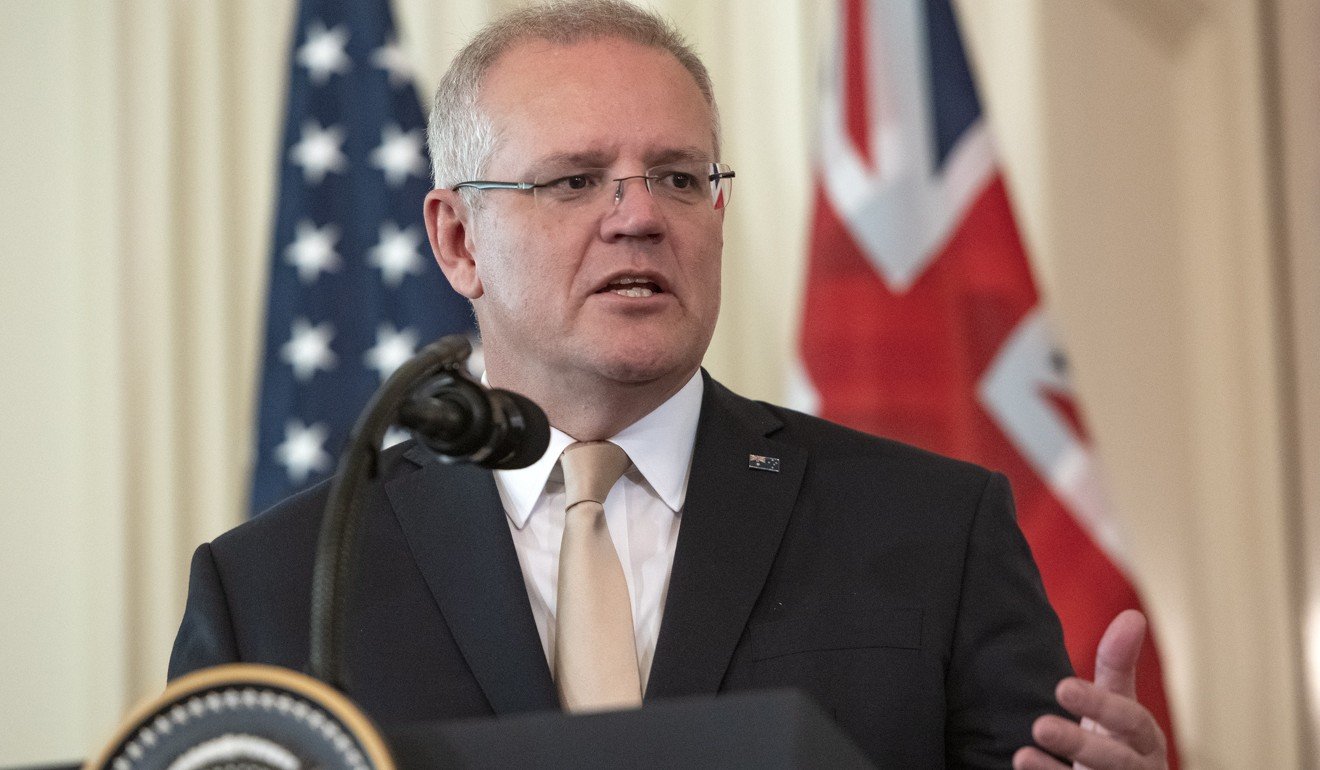
SYDNEY (Reuters) – The Australian government said on Friday it would meet a week ahead of schedule to decide whether to ease social distancing restrictions, as the numbers of new coronavirus infections dwindle and pressure mounts for business and schools to reopen.
Australia has reported about 6,700 cases of the new coronavirus and 93 deaths, well below the levels reported in the United States and Europe. Growth in new infections has slowed to less 0.5% a day, compared to 25% a month ago.
Prime Minister Scott Morrison said it was imperative to lift social distancing restrictions as early as possible as 1.5 million people were now on unemployment benefits and the government forecast the unemployment rate to top 10% within months.
“We need to restart our economy, we need to restart our society. We can’t keep Australia under the doona,” Morrison said, using an Australian word for quilt.
Morrison’s government has pledged spending of more than 10% of GDP to boost the economy but the central bank still warns the country is heading for its worst contraction since the 1930s.
With less than 20 new coronavirus cases discovered each day, Morrison said state and territory lawmakers would meet on May 8 – a week earlier than expected – to determine whether to lift restrictions.
“Australians deserve an early mark for the work that they have done,” Morrison told reporters in Canberra.
Australia attributes its success in slowing the spread of COVID-19 to social distancing restrictions imposed in April, including the forced closures of pubs, restaurants and limiting the size of indoor and outdoor gatherings.
Morrison said 3.5 million people had downloaded an app on their smartphones designed to help medics trace people potentially exposed to the virus, though the government is hoping for about 40% of the country’s 25.7 million population to sign up to ensure it is effective.
Cabinet will also decide next week how to restart sport across the country, the prime minister said.
The government says any resumption of sport should not compromise the public health, and recommends a staggered start beginning with small groups that play non-contact contact sport outdoors.
The recommendations suggests Australia’s National Rugby League (NRL) competition may not get permission to restart its competition as soon as many in the sports-mad country would like.
Source: Reuters
Posted in 10%, accelerates, ahead, APP, April, attributes, Australia, Australian government, boost, Business, Canberra, Central bank, closures, competition, contraction, coronavirus, coronavirus infections, COVID-19, deaths, decide, decision, doona, downloaded, dwindle, ease, economy, Europe, Friday, gatherings, GDP, imperative, indoor, lawmakers, lift, medics, meet, more than, mounts, National Rugby League (NRL), new, Numbers, outdoor, pledged, pressure, Prime minister, pubs, quilt, recommendations, reopen, restaurants, restrictions, schedule, schools, Scott Morrison, smartphones, Social distancing, spending, success, Sydney, trace, Uncategorized, unemployment, unemployment benefits, United States, week, whether |
Leave a Comment »
29/04/2020
- Carrier targets return of daily services to major Asian cities and more frequent long-haul services
- Airline to monitor global situation and adjustments may be made ‘as necessary’
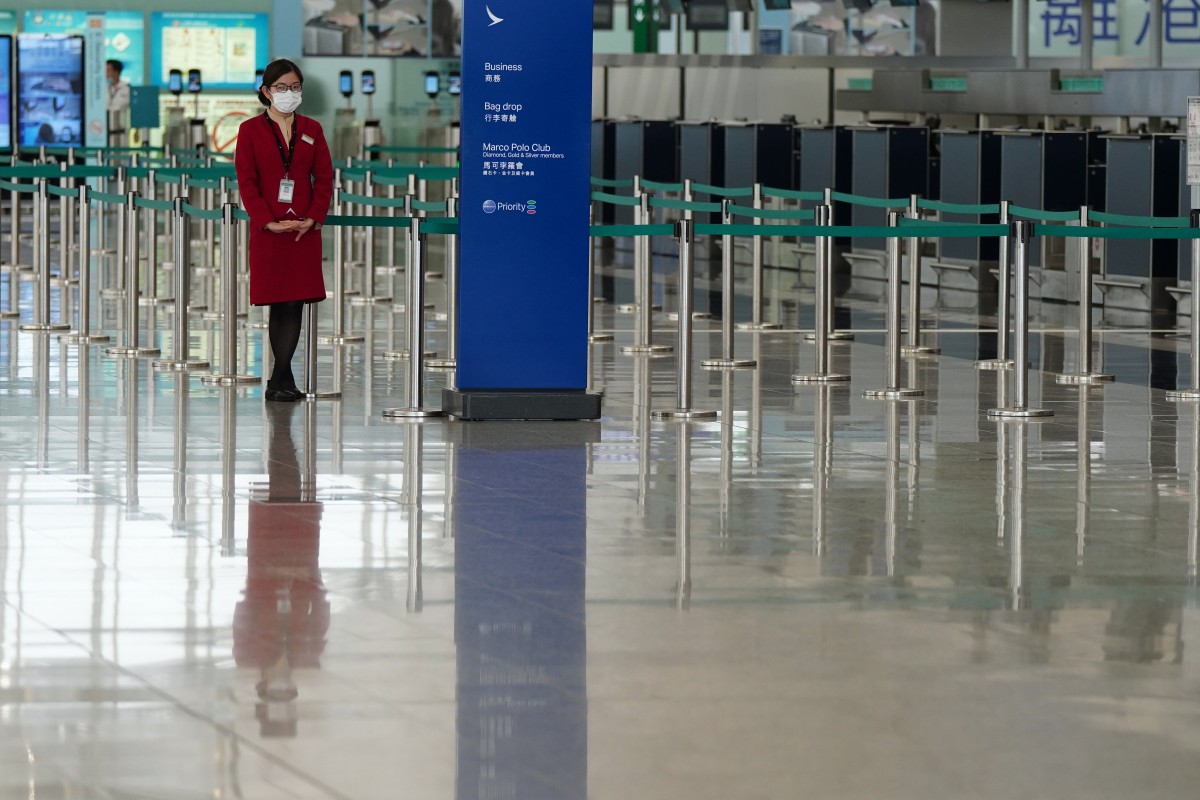
A Cathay Pacific employee stands near the check-in desks at a virtually deserted Hong Kong International Airport. Photo: Sam Tsang
Cathay Pacific Airways has signalled its intent to start reversing its near-total grounding of aircraft because of
the coronavirus pandemic, and plans to start increasing its number of passenger flights in the last week of June.
The airline said it hoped to add more long-haul destinations, make flights more frequent, and reinstate some major Asian cities to its daily schedule for the first time in several months, “subject to government travel restrictions”.
Cathay scaled its operations back to a skeleton schedule of 3 per cent of services in early April, and that was extended until June 20. The newly announced increases would take that up to 5 per cent.
The global airline industry has been rocked by the pandemic, which triggered a collapse in air travel demand amid severe travel restrictions and tough quarantine measures.
Tracking the massive impact of the Covid-19 pandemic on the world’s airline industry in early 2020
Singapore Airlines, another of Asia’s major carriers, said last week it would maintain a 96 per cent reduction in flights until the end of June.
Cathay, which has 236 aircraft, currently operates long-haul flights to London Heathrow, Los Angeles, Vancouver and Sydney twice a week, but will increase that to five times a week.
On top of that, Amsterdam, Frankfurt, San Francisco and Melbourne are among the long-haul destinations set to return three times a week.
With regional routes currently operating three times a week, including Tokyo Narita, Taipei, Beijing and Singapore, Asian routes will increase to a daily service. Osaka and Seoul would also return to the network, too.
“We will continue to monitor the developing situation and further adjustments may be made as necessary,” the airline said.
Coronavirus: ban on non-residents leaves Hong Kong airport virtually deserted
Earlier this month, Cathay’s budget unit HK Express extended its total grounding until June 18, having been on hiatus since March 23.
Meanwhile, Boeing has added to warnings of a very slow recovery in air travel, with Dave Calhoun, its CEO, saying demand may not return to 2019 levels for two to three years.
Cathay Pacific’s daily passenger volume has collapsed from regular previous peaks of 100,000 to less than 1,000 in April. Over the past two months, the company has been running more than 250 extra pairs of cargo-only passenger flights to maintain air freight capacity, much of which is accounted for by passenger services.
In a bid to cut costs, most of the Cathay Pacific Group’s 34,200 staff have taken three weeks of unpaid leave. Also, 433 cabin crew in the US and Canada were told they would be laid off, while about 200 pilots in the UK, Australia have been furloughed.
The International Air Transport Association, which revised down pandemic-related revenue losses for the global sector to US$314 billion (HK$2.4 trillion) two weeks ago, said last week the Hong Kong aviation market would take a US$7.5 billion hit this year, a 27 per cent increase on the previous estimate. That equates to a 59 per cent decline in air travel demand, or a loss of almost 31 million passengers, in 2020.
BOCOM International, a financial services company, forecast in a report on Monday that the city’s aviation sector would lose HK$65.2 billion in revenue in 2020, yet Cathay Pacific could emerge as a winner if it survived largely unscathed, given the weakness of rivals at home and in the region plus its dominant position in Hong Kong.
“Hong Kong aviation is at the most critical juncture in its history. Though calamitous, Covid-19 is set to reshape Hong Kong’s aviation industry for the years, possibly decades, to come,” said transportation analyst Luya You.
“Covid-19’s sweeping blows now offer a blank slate for remaining players to regain lost leadership or gain new markets. If [Cathay Pacific] can survive intact from Covid, the carrier could enjoy winner-takes-all growth trajectory in the years following [2020].”
Source: SCMP
Posted in 200, Amsterdam, April, Asian, Asian routes, Australia, aviation market, Beijing, BOCOM International, Boeing, cabin crew, canada, carrier, Cathay Pacific, Cathay Pacific Airways, Cathay Pacific Group’s, cities, coronavirus, Coronavirus pandemic, COVID-19, daily services, deserted, destinations, eased, Frankfurt, frequent, furloughed, global airline industry, Hong Kong airport, Hong Kong International Airport, increase, June, laid off, late, London Heathrow, long-haul, looks to, Los Angeles, Melbourne, more, passenger flights, pilots, return, San Francisco, Services, Singapore, Singapore Airlines, Sydney, Taipei, targets, The International Air Transport Association, Three, Tokyo Narita, travel restrictions, UK, Uncategorized, unpaid leave, US, Vancouver, weeks, winner-takes-all |
Leave a Comment »
21/02/2020
(Reuters) – Airlines have been suspending flights to China or modifying service in response to the coronavirus outbreak.
Below are details (in alphabetical order):
AIRLINES THAT HAVE CANCELLED ALL FLIGHTS TO MAINLAND CHINA
** American Airlines – Extends suspension of China and Hong Kong flights through April 24
** Air France – Said on Feb.6 it would suspend flights to and from mainland China for much of March
** Air India – Suspends flights to Shanghai, Hong Kong until June 30
** Air Seoul – The South Korean budget carrier suspended China flights from Jan. 28 until further notice.
** Air Tanzania – Tanzania’s state-owned carrier, which had planned to begin charter flights to China in February, postponed its maiden flights.
** Air Mauritius – Suspended all flights to China and Hong Kong
** Austrian Airlines – until end-February.
** British Airways – Jan. 29-March 31.
** Delta Airlines – Feb. 2-April 30
** Egyptair suspended flights on Feb, 1, but on Feb. 20 said it would resume some flights to and from China starting next week.
** El Al Israel Airlines – Said on Feb. 12 it would suspend its Hong Kong flights until March 20 and reduce its daily flights to Bangkok. It suspended flights to Beijing from Jan. 30 to March 25 following a health ministry directive.
** Iberia Airlines – The Spanish carrier extended its suspension of flights from Madrid to Shanghai, its only route, from Feb. 29 until the end of April.
** JejuAir Co Ltd – Korean airline to suspend all China routes starting March 1
** Kenya Airways – Jan. 31 until further notice.
** KLM – Will extend its ban up to March 28
** Lion Air – All of February.
** LOT – Extends flight suspension until March 28
** Oman and Saudia, Saudi Arabia’s state airline, both suspended flights on Feb. 2 until further notice.
** Qatar Airways – Feb. 1 until further notice.
** Rwandair – Jan. 31 until further notice.
** Scoot, Singapore Airlines’ low-cost carrier – Feb. 8 until further notice.
** United Airlines – Feb. 5-April 23. Service to Hong Kong suspended Feb. 8-April 23.
** Vietjet and Vietnam Airlines – Suspended flights to the mainland as well as Hong Kong and Macau Feb. 1-April 30, in line with its aviation authority’s directive.
AIRLINES THAT HAVE CANCELLED SOME CHINA FLIGHTS/ROUTES OR MODIFIED SERVICE
** Air Canada – Extended the suspension of its flights to Beijing and Shanghai until March 27. It also suspended its Toronto to Hong Kong flights from March 1 to March 27, but its Vancouver to Hong Kong route remains active. [bit.ly/39zgmI0]
** Air China – Said on Feb. 12 it will cancel flights to Athens, Greece, from Feb. 17 to March 18
** Air China – State carrier said on Feb. 9 it will “adjust” flights between China and the United States.
** Air New Zealand – Suspended Auckland-Shanghai service Feb. 9-March 29. Reduced capacity on Shanghai route throughout April and Hong Kong route throughout April and May.
** ANA Holdings – Suspended routes including Shanghai and Hong Kong from Feb. 10 until further notice.
** Cathay Pacific Airways – Plans to cut a third of its capacity over the next two months, including 90% of flights to mainland China. It has encouraged its 27,000 employees to take three weeks of unpaid leave in a bid to preserve cash.
** Emirates and Etihad – The United Arab Emirates, a major international transit hub, suspended flights to and from China, except for Beijing.
** Finnair – Cancelled all flights to mainland China and decreased the number of flights to Hong Kong until March 28.
** Hainan Airlines – Suspended flights between Budapest, Hungary, and Chongqing Feb. 7-March 27.
** Korean Air Lines Co. – The national flag carrier suspended eight routes to China and reduced services on nine Chinese routes between Feb. 7 and 22.
** Philippine Airlines – Cut the number of flights between Manila and China by over half.
** Qantas Airways – Suspended direct flights to China from Feb. 1. The Australian national carrier halted flights from Sydney to Beijing and Sydney to Shanghai between Feb. 9-March 29.
** Royal Air Maroc – The Moroccan airline suspended direct flights to China Jan. 31-Feb. 29. On Jan. 16, it had launched a direct air route with three flights weekly between its Casablanca hub and Beijing.
** Russia – All Russian airlines, with the exception of national airline Aeroflot, stopped flying to China from Jan. 31. Small airline Ikar will also continue flights between Moscow and China. All planes arriving from China will be sent to a separate terminal in the Moscow Sheremetyevo airport. Aeroflot reduced the frequency of flights to Beijing, Shanghai and Guangzhou until Feb. 29.
** Nordic airline SAS – Extended its suspension of flights to Shanghai and Beijing until March 29.
** Singapore Airlines – Suspended or cut capacity on flights to Beijing, Shanghai, Guangzhou, Shenzhen, Chengdu, Xiamen and Chongqing, some of which are flown by regional arm SilkAir.
** UPS – Cancelled 22 flights to China because of the virus and normal manufacturing closures due to the Lunar New Year holiday.
** Virgin Atlantic – Extended its suspension of daily operations to Shanghai until March 28.
** Virgin Australia – Said it will withdraw from the Sydney-Hong Kong route from March 2 because it was “no longer a viable commercial route” due to growing concerns over the virus and civil unrest in Hong Kong.
Source: Reuters
Posted in Aeroflot, Air France, Air India, Air Mauritius, Air New Zealand, Air Seoul, Air Tanzania, airlines, American Airlines, ANA Holdings, Australian national carrier, Austrian Airlines, Bangkok, Beijing, British Airways, Budapest, Casablanca, Cathay Pacific Airways, Chengdu, China and Hong Kong flights, China flights, Chongqing, coronavirus outbreak, Delta Airlines, EgyptAir, El Al Israel Airlines, Emirates and Etihad, Finnair, Guangzhou, Hainan Airlines, Hong Kong, Hungary, Iberia Airlines, Ikar, KLM, Korean Air Lines Co, Korean airline, LOT, Lunar New Year holiday, Madrid, Mainland China, Manila, Moroccan airline, Moscow, Moscow Sheremetyevo airport, Nordic airline SAS, Oman and Saudia, Philippine Airlines, Qantas Airways, Qatar Airways, Russia, Rwandair, Shanghai, Shenzhen, SilkAir, Singapore Airlines, suspend, Sydney, Uncategorized, UPS, Vietjet and Vietnam Airlines, Virgin Atlantic, Virgin Australia, Xiamen |
Leave a Comment »
19/10/2019
- Vice-Premier Hu Chunhua will lead delegation at two-day summit that is expected to be attended by 400 officials and 200 businesspeople
- Observers say it is Beijing’s latest effort to regain momentum in the region and will be closely watched in the US
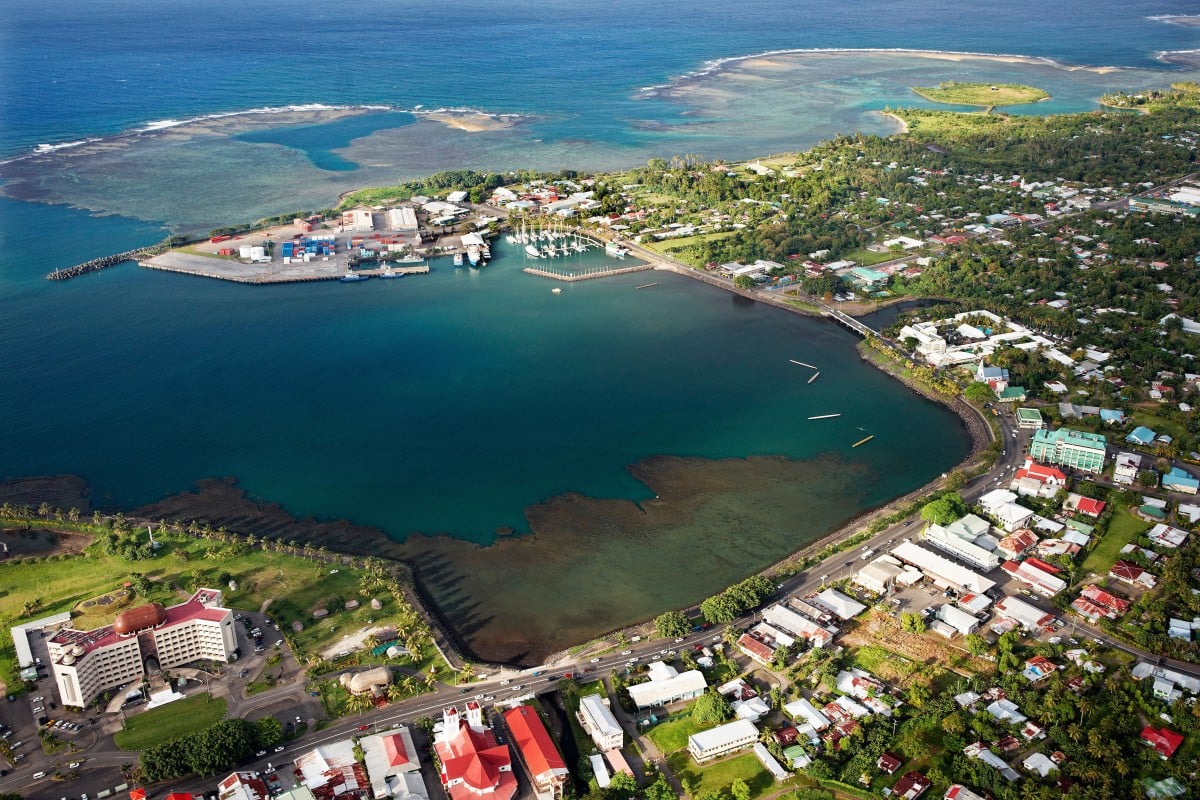
Samoan capital Apia will host the third China-Pacific Island Countries Economic Development Cooperation Forum, which begins on Sunday. Photo: Alamy
China will seek to expand its economic and diplomatic influence in the South Pacific at a forum this weekend, amid growing concern from the US and its allies over Beijing’s push in the strategically important region.
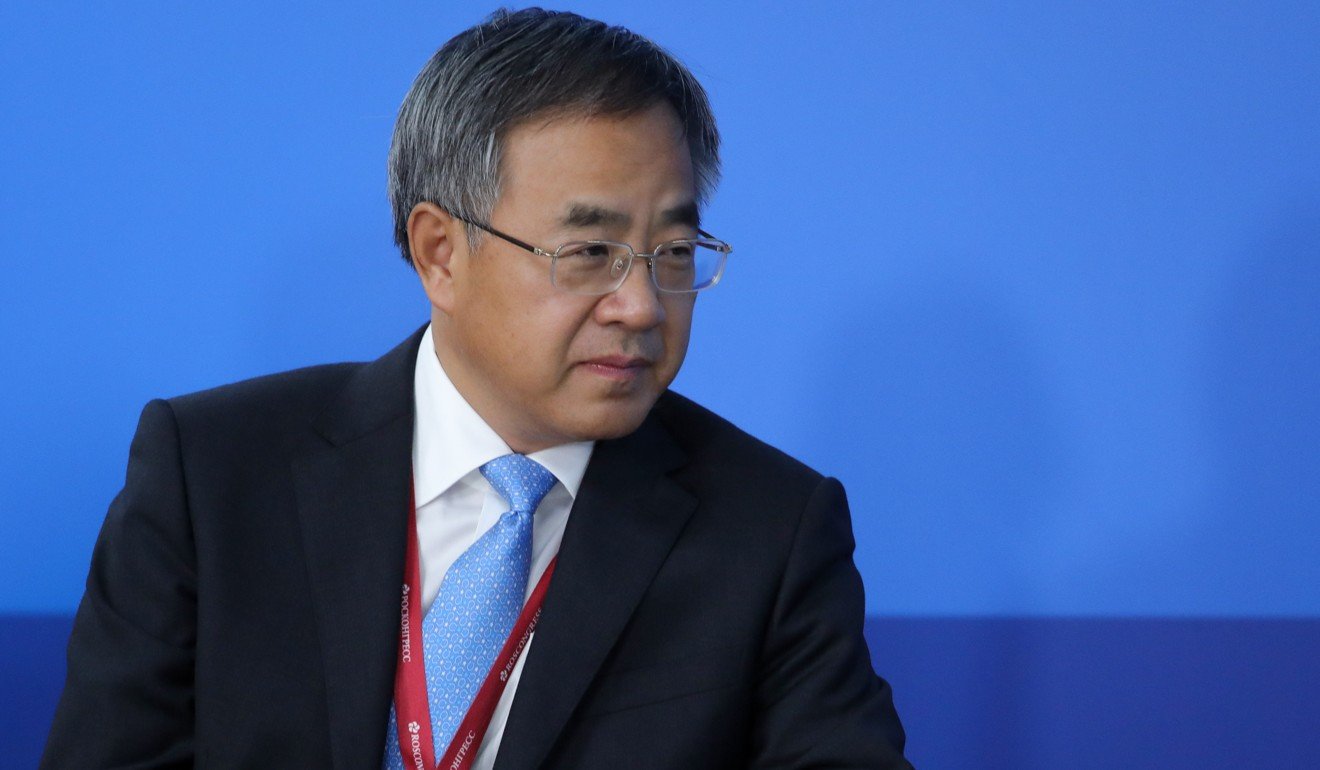
Vice-Premier Hu Chunhua will lead the Chinese delegation at the third China-Pacific Island Countries Economic Development Cooperation Forum in the Samoan capital Apia, which begins on Sunday. It is expected to be attended by 400 officials and more than 200 businesspeople.
Hu, the former Communist Party chief of China’s manufacturing powerhouse Guangdong who now overseas commercial and agricultural affairs, is expected to deliver a keynote speech at the opening ceremony.
Beijing sees the two-day forum as “timely” and “a good opportunity to deepen mutually beneficial cooperation between China and the Pacific”, a commerce ministry spokesperson told the official Economic Daily newspaper.
Trade, agriculture and fisheries, as well as tourism, infrastructure and climate change were at the top of the agenda for the forum, the spokesperson said.
Leaders of all the Pacific nations – except the four that do not have formal diplomatic ties with Beijing – are expected to attend the forum. Australia, which has “observer status” at the summit, will send Ewen McDonald, deputy secretary of the Department of Foreign Affairs and Trade and the head of its Pacific office.
Vice-Premier Hu Chunhua will lead the Chinese delegation at the forum. Photo: EPA-EFE
The forum comes after China hailed a “new breakthrough” in the region following the decision last month by the Solomon Islands and then Kiribati – despite warnings from the US – to cut diplomatic ties with Taipei and switch to Beijing.
They are the latest of Taipei’s allies to be
poached by Beijing as it ramps up pressure on the self-ruled island that it sees as a renegade province to be reunited with the mainland, by force if necessary.
Observers said this weekend’s forum was Beijing’s latest effort to regain momentum in the Pacific.
“Having one of China’s top 25 officials visit the region so soon after [Chinese President] Xi Jinping spent close to three days in Papua New Guinea last November is certainly significant,” said Jonathan Pryke, director of the Pacific Islands programme at the Lowy Institute in Sydney, referring to Hu’s position in the 25-member Politburo.
“It shows clearly China’s attempt to recapture momentum after the West, and in particular Australia, have redoubled their efforts in maintaining and building relationships in the Pacific,” he said.
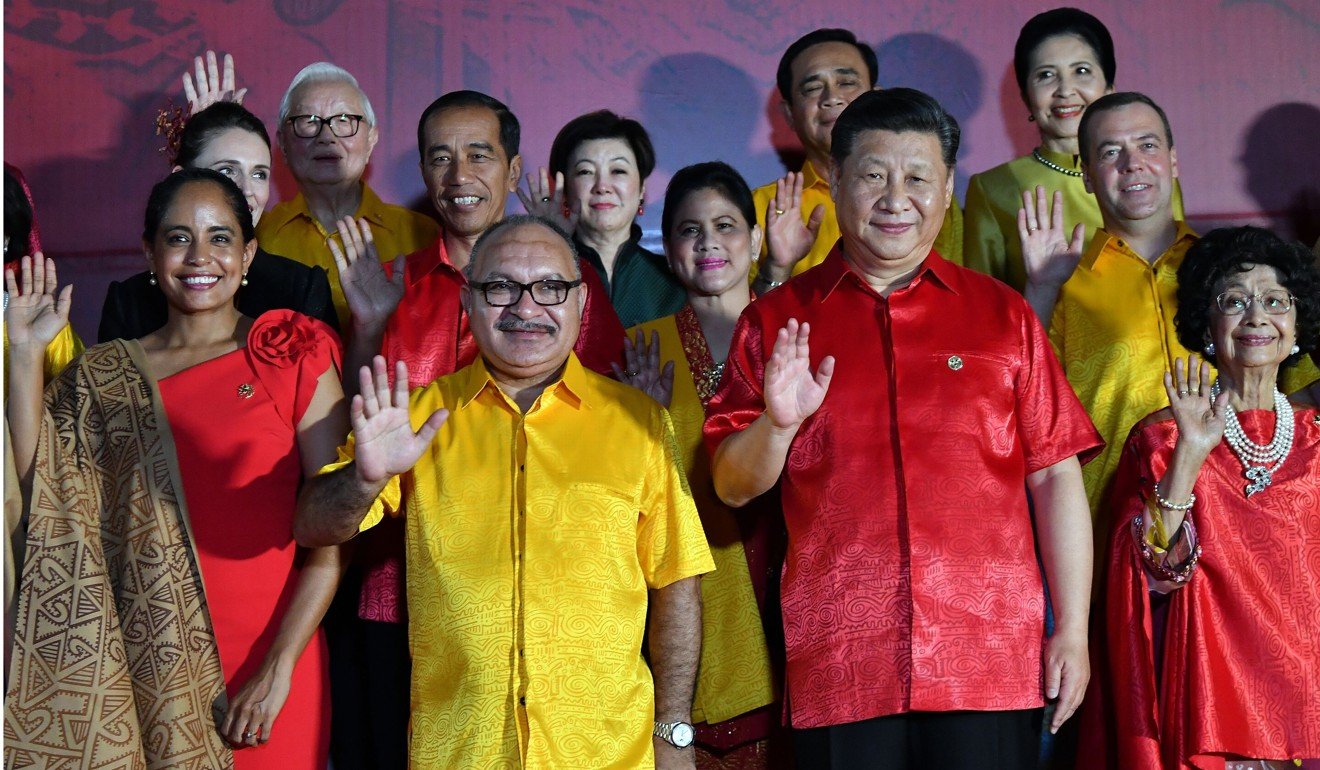
Papua New Guinea’s Prime Minister Peter O’Neill (second from left) and Chinese President Xi Jinping (second from right) pose for a photo during Xi’s visit in November. Photo: AFP
First held in Fiji in 2006, the forum is part of China’s efforts to expand its reach in the resource-rich region.
Back then, premier Wen Jiabao announced 3 billion yuan of concessional loans to Pacific nations and promised to facilitate more trade, medical aid and tourism with the countries. Chinese capital has been pouring into the region – particularly from the mining and fisheries sectors – ever since.
Of note was a 440 million yuan investment, supported by loans from the Export-Import Bank of China, to build a central business centre at Nuku’alofa, the capital of Tonga.
US and allies sideline China in PNG’s Bougainville by helping fund independence vote
As China’s influence grows, the South Pacific – a region traditionally under US hegemony, and on Australia’s doorstep – has “increasingly become a major power that cannot be neglected” and “an important part of China’s greater strategic landscape”, according to Shi Chunlin, an associate professor at Dalian Maritime University.
Trade has increased between China and the eight Pacific nations that have diplomatic ties with Beijing, rising to a combined US$4.32 billion last year – up 25 per cent from 2017.
China has also become the largest trading partner of new ally the Solomons, the second-largest to Papua New Guinea and Fiji, and the third-largest to Samoa.
China’s direct investment in the region has also jumped, reaching US$4.53 billion last year, a more than fourfold increase from the US$900 million of 2013.
Pryke said Beijing was expected to offer new support and loans to the Pacific nations.
“But the Pacific are much more picky about how they want to engage with all partners than they were a decade ago,” he added.
Returning from a trip to China earlier this month, Solomon Islands Prime Minister Manasseh Sogavare confirmed Beijing would provide a US$74 million grant to build a new stadium for the 2023 Pacific Games in the capital Honiara – something its former ally Taipei had committed to fund.
China Sam Group also reportedly signed an agreement on September 22 to lease the island of Tulagi in the Solomons, the site of a former Japanese naval base. The agreement mentioned the development of a refinery on the island, but critics said it could also potentially be used as a military base.
China is now the second-largest donor in the region, only after Australia, which has viewed Beijing’s financial largesse with suspicion.
Last year, in an apparent effort to counter China’s rising influence in the region, Australian Prime Minister Scott Morrison announced that Pacific countries would be offered up to US$2.18 billion in grants and cheap loans to build infrastructure.
Australian Prime Minister Scott Morrison last year announced up to US$2.18 billion in grants and cheap loans for infrastructure in Pacific nations. Photo: EPA-EFE
The US, meanwhile, has also been wary of China’s push in the Pacific, amid an escalating geopolitical competition between the world’s two largest economies across many fronts – from trade to tech supremacy and security. The US has long maintained exclusive defence access in the region through its Guam military base and security pacts with the Federated States of Micronesia, the Marshall Islands and Palau.
Derek Grossman, a senior defence analyst with the US-based Rand Corporation, said this year’s forum in Samoa was likely to be higher profile than previous years after Beijing lured away two more diplomatic allies from Taipei.
He said it would be “closely watched in the US for how Beijing continues to leverage sweet economic deals via its Belt and Road Initiative to potentially entice others to switch”.
“The US, along with close friends Australia, Japan and New Zealand, are becoming increasingly concerned over the prospects for China to one day curry enough influence in these small island states to gain port access that could be used for new naval bases,” he said.
The most important issue at the forum, he said, would be “whether the West assesses that China is making further inroads with these states”.
“The likely answer will be that it is, suggesting that the US and its partners will have to compete with China in this region to ensure that it remains ‘free and open’, per the US Indo-Pacific strategy,” he said.
Source: SCMP
Posted in agriculture, Apia, Australia, Beijing, Beijing’s, Belt and Road Initiative, Belt and Road Initiative (BRI), China alert, China-Pacific Island Countries Economic Development Cooperation Forum, Chinese Vice-Premier Hu Chunhua, climate change, commercial and agricultural affairs, Dalian Maritime University, delegation, Department of Foreign Affairs and Trade, Economic Daily, economic forum, expected, Export-Import Bank of China, Federated States of Micronesia, Fiji, fisheries, Guam, guangdong province, Infrastructure, Japan, Japanese naval base, Kiribati, mainland, Marshall Islands, New Zealand, Nuku’alofa, Pacific Games, Palau, Papua New Guinea, Papua New Guinea (PNG), Prime Minister Manasseh Sogavare, Prime Minister Peter O’Neill, ramp up, RAND Corporation, refinery, renegade province, reunited, Samoa, self-ruled island, Solomon Islands, South Pacific push, Sydney, Taipei, Tonga, Tourism, Trade, Tulagi, Uncategorized, US, US Indo-Pacific strategy |
Leave a Comment »
28/09/2019
- Legal process under way, Beijing says after Foreign Minister Wang Yi tells United Nations China is committed to defending multilateralism
- Any unilateral move to leave weapons control pact will have a ‘negative impact in various areas’, minister says in thinly veiled swipe at United States
China, the world’s fifth-largest weapons supplier, has signed up to a global arms control treaty. Photo: Simon Song
China said it has begun preparations to join an international arms control treaty that the United States has threatened to abandon, while also warning Washington against deploying missiles in the Asia-Pacific region.
Speaking at the United Nations General Assembly in New York on Friday, Chinese Foreign Minister Wang Yi said that signing up to the Arms Trade Treaty (ATT) was further evidence of Beijing’s commitment to defending multilateralism.
said in April that he intended to withdraw from the pact, which regulates the US$70 billion global trade in conventional arms.
The White House said at the time that the ATT “will only constrain responsible countries while allowing the irresponsible arms trade to continue”, as major arms exporters like Russia and China were not part of it.
Wang said on Friday that any unilateral move to leave the treaty would have a “negative impact in various areas”. He stopped short of naming the United States or its president.
China’s foreign ministry said in a statement on Saturday that it had begun the legal process of joining the treaty, adding that it attached great importance to the issues caused by the illegal sale and misuse of arms, and supported the aims of the ATT in seeking to regulate the international weapons trade.
Wang also spoke out against the possible deployment of ground-launched missiles in the Asia-Pacific region.
After withdrawing from the
Intermediate-Range Nuclear Forces Treaty in August, the US said it was planning to deploy such weapons in Asia to counter any possible threat from China or Russia.
“[We] urge the country with the largest nuclear weapons to fulfil its special and prior responsibilities on nuclear disarmament,” Wang said, adding that “China will continue to participate in the international arms control process”.
Wang Yi spoke out against the possible deployment of ground-launched missiles in the Asia-Pacific region at the UN General Assembly in New York on Friday. Photo: AFP
According to figures released in May by the Stockholm International Peace Research Institute, the United States is the world’s largest arms exporter, supplying weapons worth 58 per cent more than those of its nearest competitor, Russia.
Together with France, Germany and China, the five nations accounted for 75 per cent of all weapons sold around the world between 2014 and last year, the institute said.
Although China is among the world’s big five arms suppliers, its sales – most of which go to Asia and Oceania – are dwarfed by those of the US, accounting for just 5.2 per cent of the 2014-18 total, compared to America’s 36 per cent.
Several major arms importers, including India, Australia, South Korea and Vietnam, refuse to buy arms from China for political reasons.
Beijing’s decision to join the ATT is in keeping with the image it has sought to present of China as a defender of multilateralism. The stance is also in sharp contrast to the US’ position under Trump, who has repeatedly scrapped multilateral trade agreements in favour of bilateral deals.
Since taking office in 2016, he has withdrawn the US from the Paris climate accord, the Iran nuclear deal and the Trans-Pacific Partnership.
Military observers said Beijing might seek to pressure on Washington to stay in the deal to try to maintain the strategic and military balance in the region.
Song Zhongping, a Hong Kong-based military affairs commentator, said Beijing might be trying to avoid misuse of conventional weapons.
“Beijing may want to press big exporters, such as the US and Russia, to join the deal because without proper regulations, the risk of illegal trade and misuse of conventional weapons could be running high,” he said.
“This could also threaten regional stability or even trigger unnecessary arms races.”
Adam Ni, a China specialist at Sydney’s Macquarie University, said the treaty would put some limits on the arms trade “but it would not mean that China would not be able to do deals. It will still be able to do [most deals]”.
Retired PLA colonel Yue Gang said the strategy could also improve China’s international reputation.
Source: SCMP
Posted in abandon, arms importers, Arms Trade Treaty, Asia, Asia-Pacific region, Australia, Beijing, China alert, deploying, dwarfed, Foreign Minister Wang Yi, France, General Assembly, Germany, global arms control treaty, India alert, Intermediate-Range Nuclear Forces Treaty, Iran nuclear deal, join, largest nuclear weapons, Macquarie University, military affairs commentator, Military observers, missiles, New York, Paris climate accord, political reasons, President Donald Trump, Russia, South Korea, Sydney, threatened, Trans-Pacific Partnership (TPP), Uncategorized, United Nations, United States, Vietnam, Washington, White House |
Leave a Comment »
13/09/2019
- Operations aimed to caution Beijing that US forces can carry out amphibious campaigns far from home
- Washington has power to intervene directly in territorial disputes between its allies and China
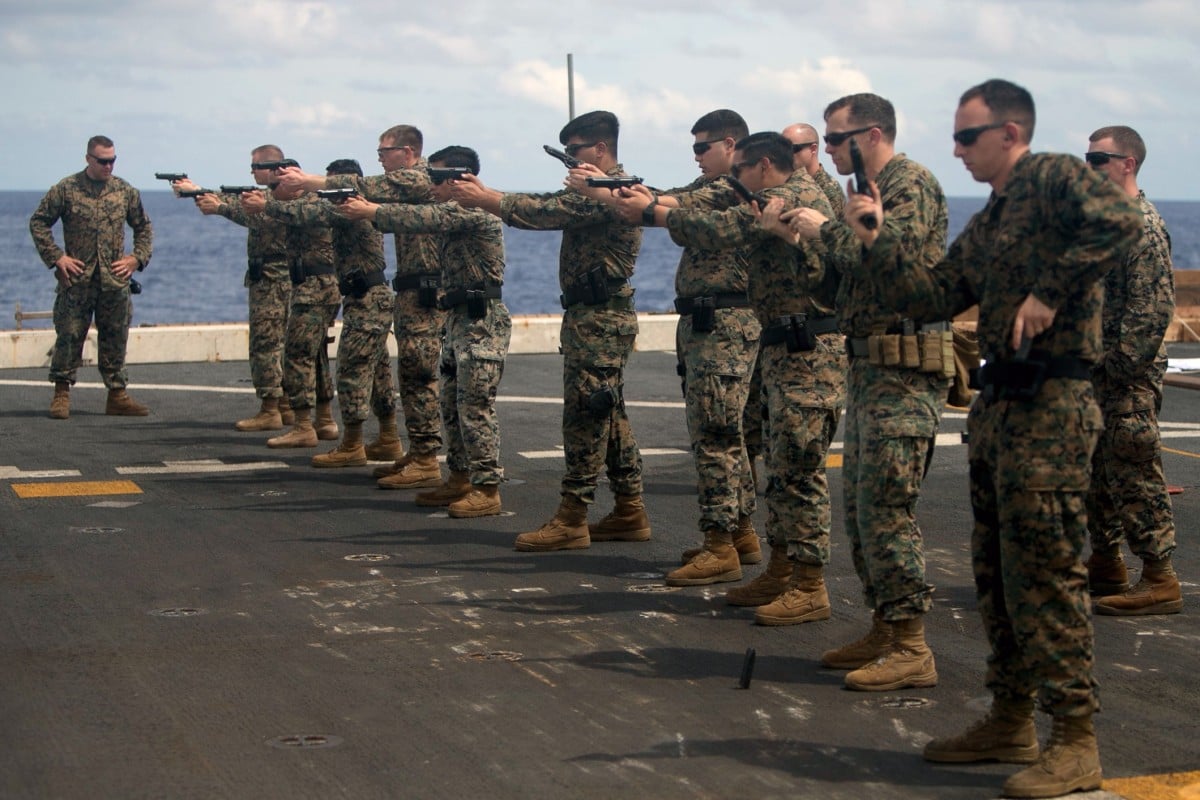
US Marines practise speed reloads on August 9 aboard the USS Green Bay, part of the Wasp Amphibious Ready Group, in the Indo-Pacific region. Photo: Handout
US Marines have conducted airfield- and island-seizure drills in the East and South China seas in what observers say is meant to remind Beijing of US military supremacy in the Asia-Pacific.
The 11-day naval drills were conducted near the Philippines and around the Japanese island of Okinawa by Okinawa-based US marine expeditionary units, the 31st Marine Expeditionary Unit said.
Observers said the operations were meant as a warning to Beijing that the US military could carry out amphibious campaigns far from home if Washington needed to intervene in territorial disputes between China and America’s allies in the region.
The 31st Marine Expeditionary Unit and Amphibious Squadron 11 conducted joint weapons drills from their Wasp Amphibious Ready Group ships from August 9-19, the Okinawa-based marine unit said in a statement.
The activity took place in the Philippine and East China seas and around an American naval base in Japan, it said.
The unit’s Amphibious Reconnaissance Platoon also performed a reconnaissance and surveillance mission through a high-altitude, low-opening parachute jump onto Okinawa.
A tilt-rotor aircraft, which hovers like a helicopter but flies like an aeroplane, afterward sent a landing team from a Wasp ship more than 400km (250 miles) away to establish the arming and refuelling point. The team achieved its objective in just over one hour, the statement said.
“The speed with which the Marines were able to establish the forward arming and refuelling point demonstrates a capability that is critical to conducting expeditionary operations in a contested environment,” the statement quoted Lieutenant Guirong Cai, a FARP officer-in-charge from the Marine Air Traffic Control Mobile Team, as saying.
“Their proficiency in swiftly setting up a refuelling point with 5,500 pounds (2.5 tonnes) of fuel demonstrates the 31st MEU’s ability to rapidly refuel and redeploy our air assets as the mission requires.”
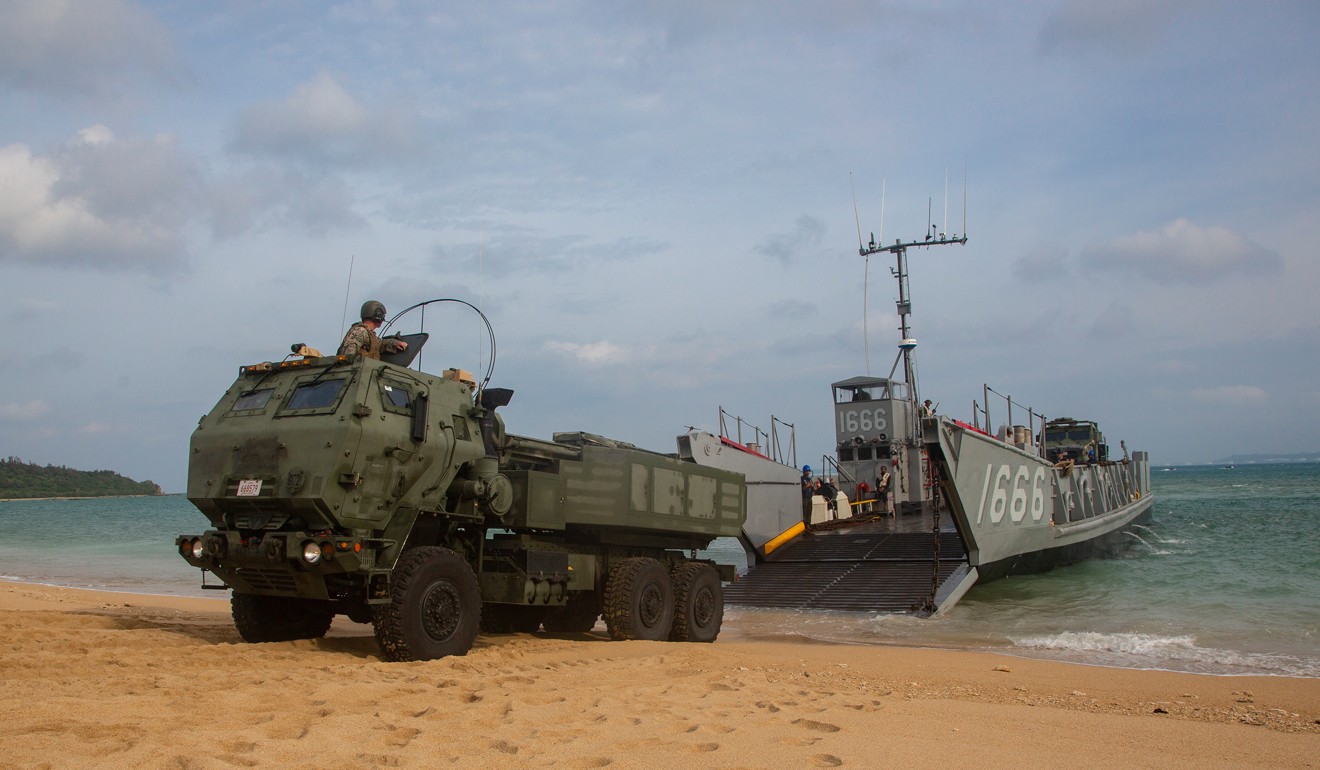
A US landing craft lowers its ramp to unload a high mobility artillery rocket system as part of a simulated amphibious raid at Kin Blue on Okinawa on August 14. Photo: Handout
China has a territory dispute with Japan over Diaoyu Islands, known as the Senkakus in Japan, in the East China Sea, while both Beijing and Manila have put in claims on the Scarborough Shoal – also known in China as Huangyan Dao – in the South China Sea.
Adam Ni, a China specialist at Sydney’s Macquarie University, said the drills near the Philippines and Okinawa showed that such a campaign would encompass a wide area, including the South and East China seas, where the US has joined other countries in the region to conduct freedom of navigation operations since 2015.
Maritime drills between US, Asean coincide with rising tensions
“It is a clear reminder to China of US military supremacy despite the narrowing of gaps in military capability in recent years,” Ni said. “The message is that the US military can still take China-controlled South China Sea features in high-intensity conflict.”
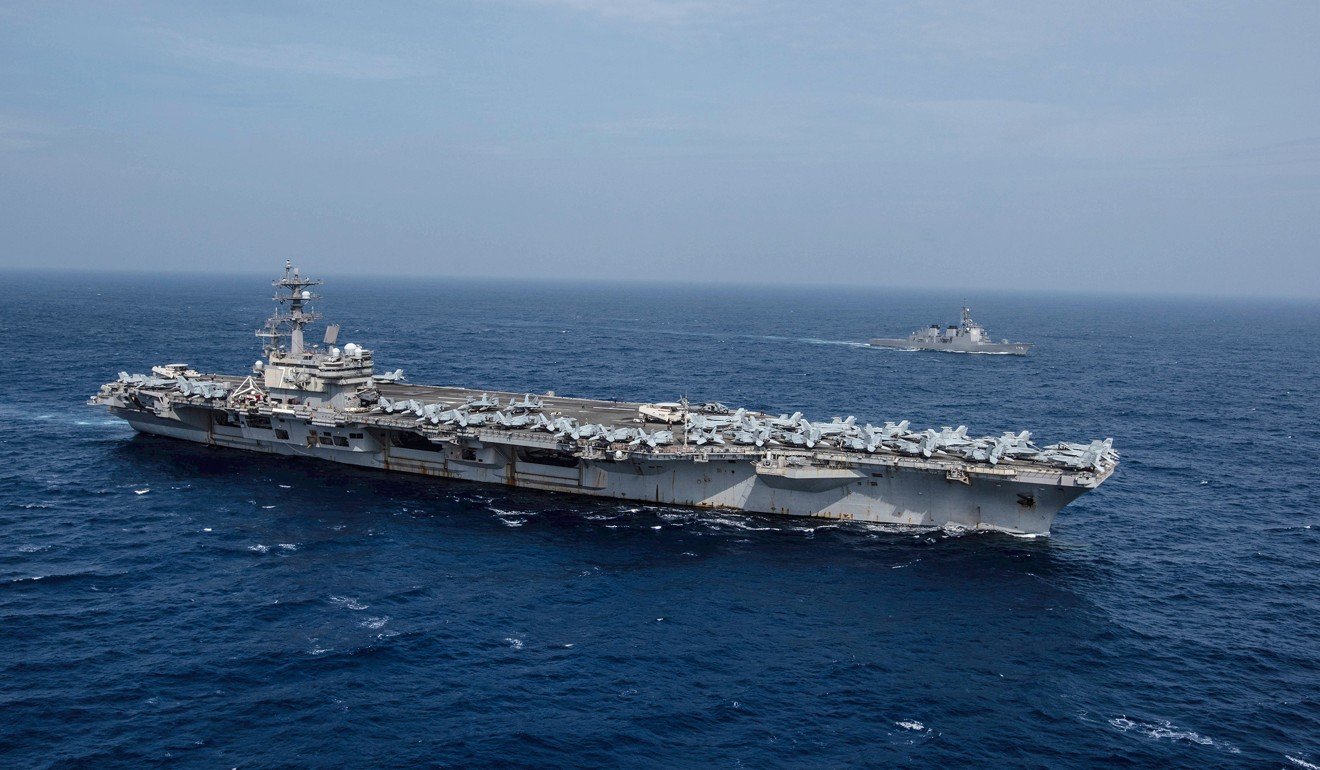
The USS Ronald Reagan aircraft carrier sails alongside a Japan Maritime Self-Defence Force guided-missile destroyer during drills. Photo: Handout
The statement did not say whether the Philippine navy and Japanese maritime self-defence force took part in the drills. But Hong Kong-based military commentator Song Zhongping said the US government would call on its two allies to observe the exercises.
“Whether Washington will intervene in territorial disputes between China and the Philippines as well as China and Japan, the American [military] has used [these drills] to strengthen its island-capture and airfield seizure capabilities in unfamiliar waters and areas,” Song said.
“To show its close relationship with and commitments to Manila and Tokyo, the Americans would invite the two allies to watch the drills. That could also be a good time to sell their amphibious warships and new model aircraft to Japan.”
During the drills, 10 simulated casualties were treated by three medical technicians from the US Air Force’s special operations group and given blood transfusions before being loaded onto a KC-130 transport aircraft for in-flight medical treatment en route to Marine Corps Air Station Futenma on Okinawa, the US Marines said.
Source: SCMP
Posted in 31st Marine Expeditionary Unit, Aircraft carrier, airfield- and island-seizure drills, America’s military edge, American naval base, amphibious campaigns, amphibious raid, Amphibious Reconnaissance Platoon, ASEAN, Asia-Pacific, Asia-Pacific drills, Beijing, China alert, Diaoyu Islands dispute, East China Sea, East China seas, guided missile destroyer, high mobility artillery rocket system, high-altitude, Huangyan Dao, Indo-Pacific region, Japan, Japan Maritime Self-Defence Force, Japanese island, Kin Blue, low-opening parachute jump, Macquarie University, Manila, Marine Air Traffic Control Mobile Team, Marine Corps Air Station Futenma, Marines, Maritime drills, Okinawa, Philippine Navy, Philippines, reconnaissance, remind, Scarborough Shoal, Senkakus, South China Sea, surveillance mission, Sydney, Uncategorized, US, US landing craft, US Marines, US military supremacy, USS Green Bay, USS Ronald Reagan, Washington, Wasp Amphibious Ready Group |
Leave a Comment »
06/06/2019
- Prime Minister Scott Morrison says the visit was reciprocal, while to experts it showed China’s ability to carry out naval operations globally
- The flotilla has also been described as a ‘public relations disaster’, since it followed other controversies involving Australian and Chinese vessels
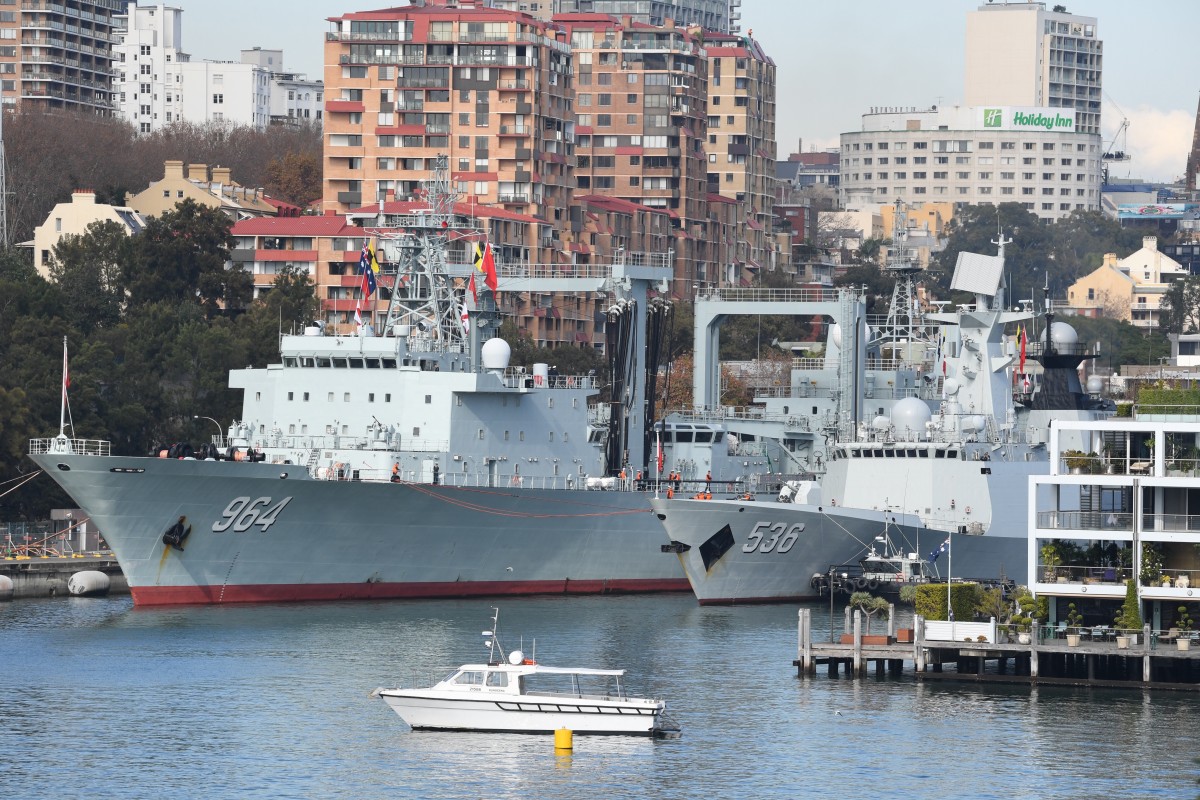
Two warships from the People’s Liberation Army Navy at Garden Island Naval Base in Sydney, Australia. Photo: EPA
The docking of
in Sydney for a publicly unannounced stopover on Monday set off a flurry of speculation about Beijing’s intentions amid rising anxiety about Chinese influence in the southern Pacific.
The visit by a Chinese frigate, auxiliary replenishment ship and amphibious vessel – with some 700 sailors in total – caught social media users and academics by surprise, with some questioning the visit’s timing and why the government had not given them advance notice.
It’s turning into a public relations disaster for ChinaJohn Fitzgerald, Swinburne University
“The People’s Liberation Army (PLA) Navy visit might have been intended as an act of diplomacy but it’s turning into a public relations disaster for China,” said John Fitzgerald, a China scholar at Swinburne University in Melbourne, noting that it followed
The stopover, as the ships returned from the Middle East, came days after reports emerged that an
navy vessel in the South China Sea was tailed by the Chinese navy and Australian navy pilots had been targeted by lasers from Chinese fishing vessels.
Rory Medcalf, the head of Australian National University’s National Security College, said on Twitter that Beijing appeared to be making “a serious show of presence in the South Pacific”.
Medcalf said previous visits by Chinese navy ships typically involved a single vessel and that Sydney was not a convenient stopover for vessels returning from the Gulf of Aden, the body of water bordered by Yemen and Somalia.
Peter Jennings, executive director of the Australian Strategic Policy Institute think tank, told local media the government was remiss for not telling the public about the visit in advance.
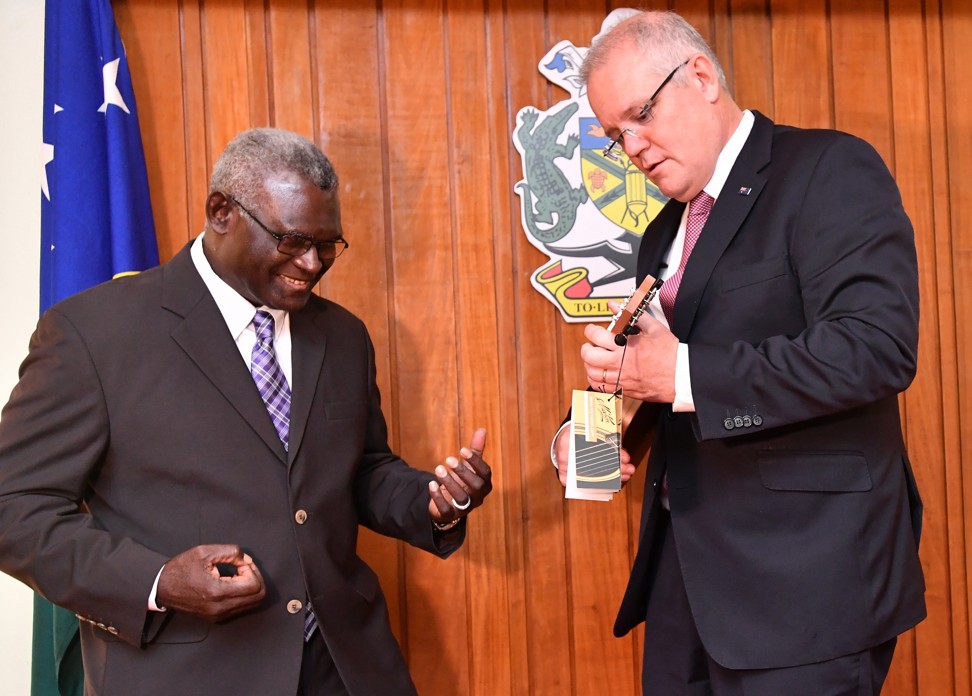
Speaking to reporters from the Solomon Islands, Australian Prime Minister Scott Morrison said the government had “known about [the Chinese navy visit] for some time”.
“This was an arrangement, a reciprocal visit because Australian naval vessels have visited China,” said Morrison as he wrapped up a trip aimed at boosting Canberra’s standing among Pacific island nations and countering Chinese influence in the region.
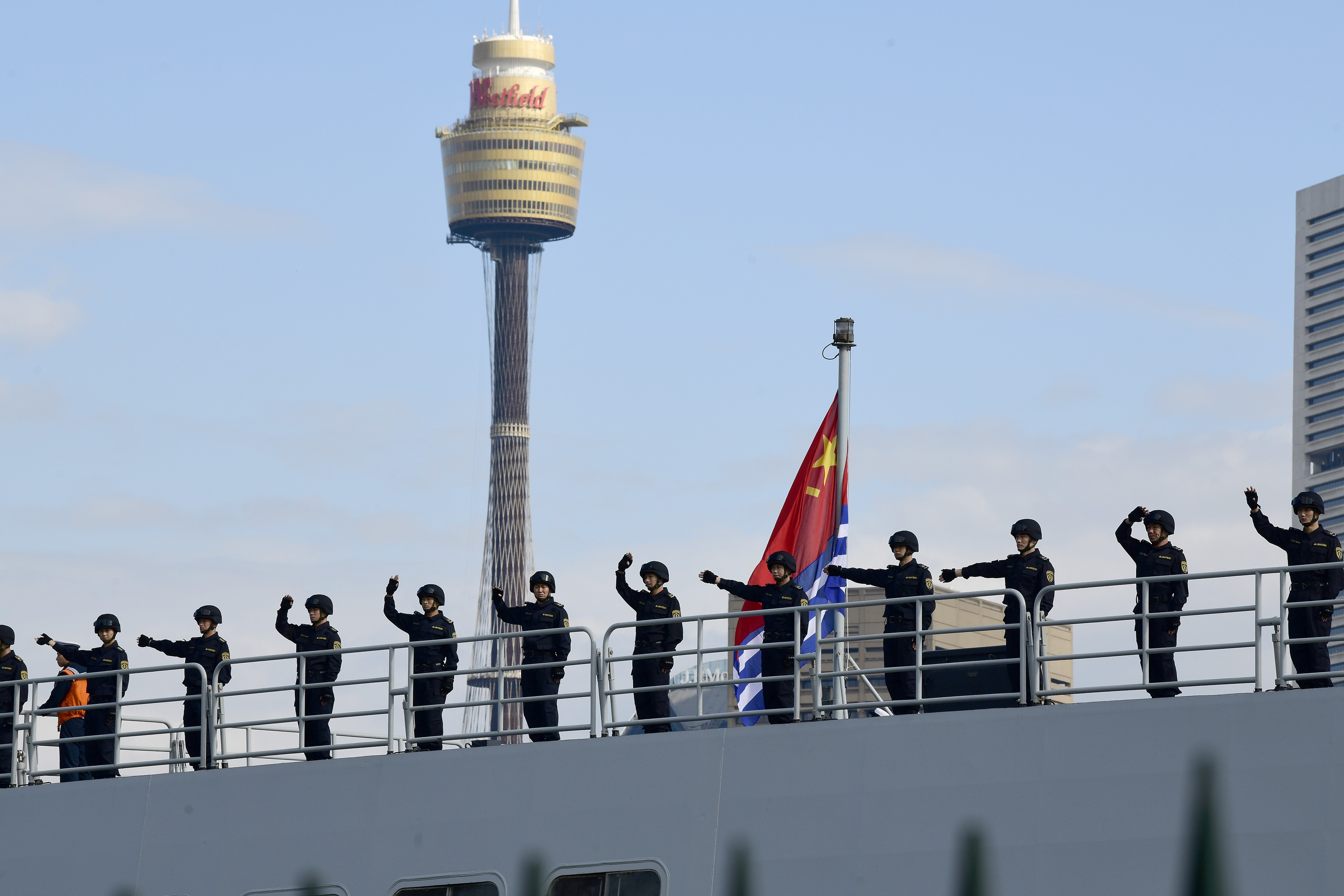
Chinese sailors wave from a PLA Navy ship after it arrives at Garden Island Naval Base in Sydney. Photo: EPA
Collin Koh, a research fellow at the S. Rajaratnam School of International Studies in Singapore, said it was not unusual for naval visits to not be announced in advance, depending on factors such as operational security requirements and expectations in the given country.
“Some visits are pre-announced and made public in the open domain, but some not,” Koh said.
Scholar points to Beijing’s ‘maritime militia’ in the South China Sea after lasers force Australian navy helicopter to land
“It’s not necessarily the case that foreign naval visits need to be publicised, though that, of course, depends on the sociopolitical circumstances of the host country which mandate a specific system of transparency and accountability.”
Morrison, who had earlier announced a A$250 million (US$173.36 million) grants programme for the Solomon Islands, said the Chinese ships were returning after a counter drug-trafficking operation in the Middle East.
Solomon Islands Prime Minister Manasseh Sogavare (left) and Australian Prime Minister Scott Morrison. Morrison is visiting the Solomon Islands on his first post-election overseas trip. Photo: EPA
[The visit] is a further demonstration of the relationship that we have and this had been in train for some time,” he said. “It may have been a surprise to others but it certainly wasn’t a surprise to the government.”
The Australian Defence Force (ADF) said China had asked for the visit in April, and that the government was committed to fostering a “long-term constructive relationship with China”.
“Australia regularly hosts foreign navy vessels in its ports,” said an ADF spokesperson. “Notification to the public is not standard practice and is usually considered on a case-by-case basis.”
Since coming to power in 2012, China’s President Xi Jinping has invested heavily in the PLA Navy in a bid to project Chinese influence across the Pacific and beyond.
Singapore, China deepen defence ties, plan larger military exercises including joint navy drill
Beijing is locked in maritime disputes in the East and South China Seas with a number of countries including the Philippines, Japan, Vietnam and Brunei.
John Blaxland, a professor at the Strategic and Defence Studies Centre at the Australian National University, said it was interesting to consider what the PLA Navy flotilla would be doing after its Sydney port call.
“The Australian Government’s Pacific reset follows a period of some disengagement by Australia and has been, in part at least, triggered by China’s renewed interest in the Pacific – notably the remaining micro states that continue to support Taiwan,” Blaxland said.
The Kunlun Shan amphibious transport dock of the PLA Navy at Garden Island Naval Base in Sydney. Photo: EPA
Singapore-based research fellow Koh said the most significant takeaway from the visit was that it showed China’s emerging capability to carry out naval operations globally.
“The PLA Navy has since December 2008 been making long voyages across the globe – to the Baltic, Mediterranean, Caribbean and Latin America – and it’s been able to gain experience and exposure to such sustained long-duration missions,” he said.
What is the US Navy doing on Japan’s Iwo Jima, nearly 75 years after World War II?
“Hence, this visit to Australia – sailing from the Indian Ocean across to the far eastern end of Australia – represents no mean feat, and the coming of age of a blue-water-capable PLA Navy.”
Asked by reporters whether the stopover was appropriate given that it came on the eve of the 30th anniversary of Beijing’s bloody crackdown in Tiananmen Square in 1989, Morrison said: “No, I think any reading into timing could be subject to a bit of overanalysis.”
Neil James, executive director of the independent watchdog Australia Defence Association, said the timing of the visit appeared to be an “accidental coincidence” and could be awkward for Beijing as it drew further attention to the Tiananmen anniversary.
US warships made 92 trips through the Taiwan Strait since 2007
“The timing is far more of a problem for the PLA Navy than Australia,” James said.
“The Tiananmen anniversary might have been known in China but they either ignored it, or it was a left-hand versus right-hand coordination glitch inside the People’s Republic of China government.”
Source: SCMP
Posted in Australian public, Beijing, Chinese warships, Sydney, Uncategorized |
Leave a Comment »




 CHINDIA ALERT: You'll be living in their world, very soon
China set to join Arms Trade Treaty that Donald Trump threatened to abandon
China said it has begun preparations to join an international arms control treaty that the United States has threatened to abandon, while also warning Washington against deploying missiles in the Asia-Pacific region.
Speaking at the United Nations General Assembly in New York on Friday, Chinese Foreign Minister Wang Yi said that signing up to the Arms Trade Treaty (ATT) was further evidence of Beijing’s commitment to defending multilateralism.
said in April that he intended to withdraw from the pact, which regulates the US$70 billion global trade in conventional arms.
The White House said at the time that the ATT “will only constrain responsible countries while allowing the irresponsible arms trade to continue”, as major arms exporters like Russia and China were not part of it.
Wang said on Friday that any unilateral move to leave the treaty would have a “negative impact in various areas”. He stopped short of naming the United States or its president.
China’s foreign ministry said in a statement on Saturday that it had begun the legal process of joining the treaty, adding that it attached great importance to the issues caused by the illegal sale and misuse of arms, and supported the aims of the ATT in seeking to regulate the international weapons trade.
Wang also spoke out against the possible deployment of ground-launched missiles in the Asia-Pacific region.
According to figures released in May by the Stockholm International Peace Research Institute, the United States is the world’s largest arms exporter, supplying weapons worth 58 per cent more than those of its nearest competitor, Russia.
Together with France, Germany and China, the five nations accounted for 75 per cent of all weapons sold around the world between 2014 and last year, the institute said.
Although China is among the world’s big five arms suppliers, its sales – most of which go to Asia and Oceania – are dwarfed by those of the US, accounting for just 5.2 per cent of the 2014-18 total, compared to America’s 36 per cent.
Several major arms importers, including India, Australia, South Korea and Vietnam, refuse to buy arms from China for political reasons.
Beijing’s decision to join the ATT is in keeping with the image it has sought to present of China as a defender of multilateralism. The stance is also in sharp contrast to the US’ position under Trump, who has repeatedly scrapped multilateral trade agreements in favour of bilateral deals.
Since taking office in 2016, he has withdrawn the US from the Paris climate accord, the Iran nuclear deal and the Trans-Pacific Partnership.
Military observers said Beijing might seek to pressure on Washington to stay in the deal to try to maintain the strategic and military balance in the region.
Song Zhongping, a Hong Kong-based military affairs commentator, said Beijing might be trying to avoid misuse of conventional weapons.
“Beijing may want to press big exporters, such as the US and Russia, to join the deal because without proper regulations, the risk of illegal trade and misuse of conventional weapons could be running high,” he said.
“This could also threaten regional stability or even trigger unnecessary arms races.”
Adam Ni, a China specialist at Sydney’s Macquarie University, said the treaty would put some limits on the arms trade “but it would not mean that China would not be able to do deals. It will still be able to do [most deals]”.
Retired PLA colonel Yue Gang said the strategy could also improve China’s international reputation.
Source: SCMP
Posted in abandon, arms importers, Arms Trade Treaty, Asia, Asia-Pacific region, Australia, Beijing, China alert, deploying, dwarfed, Foreign Minister Wang Yi, France, General Assembly, Germany, global arms control treaty, India alert, Intermediate-Range Nuclear Forces Treaty, Iran nuclear deal, join, largest nuclear weapons, Macquarie University, military affairs commentator, Military observers, missiles, New York, Paris climate accord, political reasons, President Donald Trump, Russia, South Korea, Sydney, threatened, Trans-Pacific Partnership (TPP), Uncategorized, United Nations, United States, Vietnam, Washington, White House | Leave a Comment »