Chindia Alert: You’ll be Living in their World Very Soon
aims to alert you to the threats and opportunities that China and India present. China and India require serious attention; case of ‘hidden dragon and crouching tiger’.
Without this attention, governments, businesses and, indeed, individuals may find themselves at a great disadvantage sooner rather than later.
The POSTs (front webpages) are mainly 'cuttings' from reliable sources, updated continuously.
The PAGEs (see Tabs, above) attempt to make the information more meaningful by putting some structure to the information we have researched and assembled since 2006.
Wuhan, where the first cases of the novel coronavirus were detected, is ending a 76-day lockdown
A day before the lockdown was fully lifted, Tencent announces a slew of initiatives focused on helping to revive the digital industry in the city
Passengers leaving Wuhan city are pictured at the Hankou Railway Station in Wuhan city, central China’s Hubei province, on Wednesday morning, April 08, 2020. Photo: SCMP/Simon Song
A day before China lifted a months-long lockdown of Wuhan city, the initial epicentre of the coronavirus pandemic, Chinese internet giant Tencent Holdings pledged to invest in digital government, online education and artificial intelligence (AI) in the city, among other fields.
“During the epidemic, Tencent has been supporting Hubei and Wuhan’s fight against the virus through funds and technology,” the company best known for its gaming business said in a statement posted on Tuesday on WeChat. “In the future, we will also fully support Wuhan’s post-pandemic reconstruction and continue to support the development of Wuhan’s digital industry.”
China’s major tech companies have played a big role in the fight against the coronavirus, and are now playing their part in the economic recovery of Wuhan and other areas that have suffered under extended travel restrictions and business closures.
and Pinduoduo each announced their own initiatives to help revive sales of farm goods from Hubei as the province emerges from its months-long lockdown.
Popular mobile payments app Alipay also created a dedicated section for Wuhan merchants to allow users to buy from merchants in the city, and offered loans to small local merchants in need of financial support, according to an Alipay statement. Alipay is operated by Ant Financial, an affiliate of Alibaba, which owns the South China Morning Post.
How tech has helped China in its public health battle with coronavirus
23 Mar 2020
Wuhan, an industrial powerhouse for the steel, semiconductors and automotive sectors, is emerging from an unprecedented lockdown which began on January 23 and prevented people from moving in and out of the city.
Since restrictions began easing gradually in late March, business activity has shown signs of recovery: Tencent’s mobile payment platform WeChat Pay recorded a 162 per cent increase in offline transactions in a 10-day period from March 25, compared to the same period the previous month, according to a separate statement by Tencent on Wednesday.
Searches for “work resumption certificates” – which businesses need to submit to local authorities to prove their staff can safely restart work – also increased 320 per cent on Baidu, China’s biggest search engine, in the past month, Baidu said in a report on Wednesday.
Tencent declined to provide specific details regarding the size of its latest investment in Wuhan or a timeline for its implementation, but said in the statement that it will involve closer cooperation with city authorities in the areas of digital government, education, smart mobility, AI and cybersecurity to help the city with its digital industries.
Among these initiatives, it will push ahead with a plan to build a headquarters focusing on digital industries in Wuhan, specifically digitalisation for the government and smart city initiatives.
It will also establish a base in Wuhan for its online education initiatives, set up an AI lab and cybersecurity academy and build a school focusing on smart mobility in collaboration with Chinese carmaker Dongfeng Motor Corporation, the company said in the statement.
BEIJING, April 6 (Xinhua) — Bike riding, bird watching, or simply enjoying the natural scenery against the blue sky. A wild duck lake wetland in suburban Beijing has attracted urbanites during the traditional Qingming festival.
The park imposes a daily limit of 1,680 visitors and workers take body temperatures for visitors and ask them to show their health codes, which are common preventive measures in many scenic spots.
“Our tickets sold out one day in advance on the Internet, “said Liu Xuemei, a park management official. “Through the online booking of tickets, we strictly control the flow of tourists to protect wild birds as it is a season of bird migration.”
Besides paying tribute to the dead, outing is another tradition among Chinese during Tomb-sweeping Day, also known as Qingming Festival which fell on Saturday. Citizens enjoy a three-day holiday for the festival.
As China’s domestic COVID-19 situation continues its improving trend, more parks and scenic sites have reopened across the country, providing places for citizens to have spring outings amid tight prevention measures.
On Saturday, the Juyongguan section of the Great Wall and the Ming Tombs in Beijing reopened to the public after two months of closure in the prevention and control of COVID-19.
The famous Badaling section of the Great Wall in Beijing, which partly opened on March 24, hosted 12,000 tourists on Sunday alone.
Beijing’s major parks, which partly opened to the public, also adopted strict measures to control the number of tourists while cancelling some traditional spring activities such as enjoying flowers to avoid gathering.
Data from several domestic travel companies such as Qunar and Trip.com show that the domestic tourism industry is recovering and the booking volume of tickets for travel, hotels and scenic spots is on the rise.
Since March, some of the business activities of travel agencies have resumed in more than 10 provinces and municipalities. Tours around cities and 1-hour high-speed trips are popular, according to the travel platforms.
“I haven’t been out during the epidemic. It’s fine today. I brought my daughter to the mountain area to breathe fresh air and relax,” said a female tourist surnamed Liu, in the city of Wuhu, east China’s Anhui Province. Liu went to the suburban area of Wuhu with her daughter for an outing on Saturday and said she felt the epidemic prevention measures were reassuring.
At the Balihe scenic area in Yingshang County, Anhui, the number of tourists rose from 1,000 after it reopened on March 15 to about 8,000 per day during the Qingming holiday.
The scenic area implements online real-name booking. Its tourist service center has a body temperature detection area and provides wash-free disinfectant. Staff members wear masks and gloves, according to Wang Longtao, deputy general manager of a company in charge of the Balihe tourism development.
“I am optimistic about the recovery of domestic tourism. People have accumulated a strong desire to consume,” said Liang Jianzhang, co-founder and chairman of Trip.com Group.
Huangshan Mountain, a UNESCO world heritage site in Anhui Province, saw 20,000 tourists on Saturday and Sunday, as pictures of crowded tourists triggered concerns over epidemic prevention.
The scenic area authorities said Monday they increased 20 transfer buses and mobilized a total of 160 buses to prevent overcrowding.
Industry experts warn that as the COVID-19 epidemic has not ended domestically and the pressure of imported cases is growing, scenic spots should make people’s safety and health the top priority and take targeted measures as they reopen.
Buying and paying for meals and supplies online was already second nature for many Chinese before the Covid-19 lockdown
The supply and delivery networks that were already in place were able to work with the authorities in cities like Wuhan
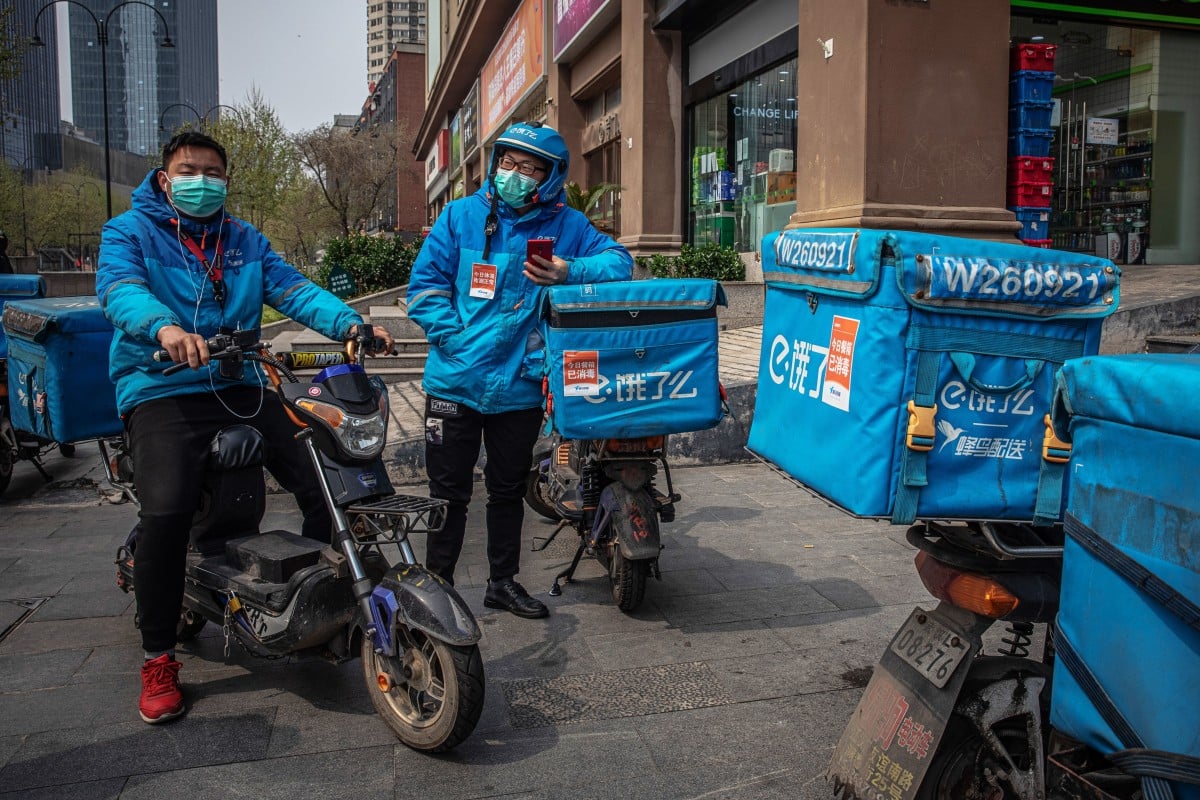
China’s established home delivery system played an important role in getting food and other necessities to residents during the Wuhan lockdown. Photo: EPA-EFE
When Liu Yilin, a retired middle schoolteacher in Wuhan, first heard rumours of a
and shoppers flooded to the markets and malls to snap up supplies.
But as time went on and with residents banned from leaving their homes, he became increasingly concerned about getting hold of fresh supplies of vegetables, fruit and meat until the nation’s vast network of delivery drivers came to the rescue.
“It was such a relief that several necessity purchasing groups organised by community workers and volunteers suddenly emerged on WeChat [a leading social media app] days after the lockdown,” Liu said. “China’s powerful home delivery service makes life much easier at a time of crisis.”
Hu Xingdou, a Beijing-based independent political economist said: “Home delivery played a very important role amid the coronavirus outbreak. To some extent, it prevented people from starving especially in cases when local governments took extreme measures to isolate people.”
According to Liu, people in Wuhan during the lockdown had to stay within their residential communities, with community workers guarding the exits.
Human contact was limited to the internet. Residents placed orders online with farmers, small merchants or supermarkets to buy daily necessities, and community workers helped distribute the goods from deliverymen.
Every morning, Liu passed a piece of paper with his name, phone number and order number to a community worker who would collect the items from a courier at the gate of the residential area.
Thanks to a high population density in urban areas, affluent labour force and people’s openness to digital life, China has built a well-developed home delivery network.
Extensive funding from technology companies has been invested in hardware infrastructure, software to improve logistics and big data and cloud computing to help predict consumers’ behaviour.
Mark Greeven, professor of innovation and strategy at IMD Business School in Lausanne, Switzerland, said: “Whether it is delivery of products, air parcels or fresh food or even medicine or materials for medical use, China has a very well developed system. Much better developed than I think almost any other places in the world.
“Well before the crisis, China had started to embrace digital technology in daily life whether it is in consumption, business, government and smart cities and use of third party payments. All of these things have been in place for a long time and the crisis tested its agility and capability to deal with peak demand.”
China’s e-commerce giants help revive sales of farm goods from Hubei
3 Apr 2020
According to e-commerce giant JD.com, demands for e-commerce and delivery services spiked during the outbreak of Covid-19, the illness caused by the new coronavirus.
It sold around 220 million items between January 20 and February 28, mainly grains and dairy products with the value of beef orders trebling and chicken deliveries quadrupling compared with a year ago.
Tang Yishen, head of JD Fresh, its fresh foods subsidiary, said: “The surge of online demand for fresh merchandise shows the pandemic helped e-commerce providers further penetrate into the life of customers. It also helped upstream farm producers to know and trust us.”
Meituan Dianping, a leading e-commerce platform, said its grocery retail service Meituan Instashopping reported a 400 per cent growth in sales from a year ago in February from local supermarkets.
The most popular items ordered between January 26 and February 8 were face masks, disinfectant, tangerines, packed fresh-cut fruits and potatoes.
The food delivery service Ele.me said that, between January 21 and February 8, deliveries of frozen food surged more than 600 per cent year on year, followed by a nearly 500 per cent growth in delivery of pet-care products. Fresh food deliveries rose by 181 per cent while drink and snack deliveries climbed by 101 per cent and 82 per cent, respectively. Ele.me is owned by Alibaba, the parent company of the South China Morning Post.
Chinese hotpot restaurant chain adapts as coronavirus fears push communal meals off the menu
E-commerce providers used the opportunity to show goodwill and improve their relationship with customers and partners, analysts say.
Sofya Bakhta, marketing strategy analyst at the Shanghai-based Daxue Consulting, said the food delivery sector had made significant headway in reducing physical contact during the outbreak.
Delivery staff left orders in front of buildings, in lifts or temporary shelters as instructed by the clients as most properties no longer allowed them inside.
Some companies also adopted more hi-tech strategies.
In Beijing, Meituan used self-driving vehicles to deliver meals to contactless pickup stations. It also offered cardboard boxes to be used as shields aimed at preventing the spread of droplets among its clients while they ate in their workplaces. In Shanghai, Ele.me employed delivery drones to serve people under quarantine in the most affected regions.
Some companies even “shared” employees to meet the growing labour demand in the food delivery industry that could not be satisfied with their ordinary workforce, Bakhta said.
More employees from restaurants, general retail and other service businesses were “loaned” to food delivery companies, which faced manpower shortages during the outbreak, according to Sandy Shen, senior research director at global consultancy Gartner.
“These arrangements not only ensured the continuity of the delivery service but also helped businesses to retain employees during the shutdown,” she said.
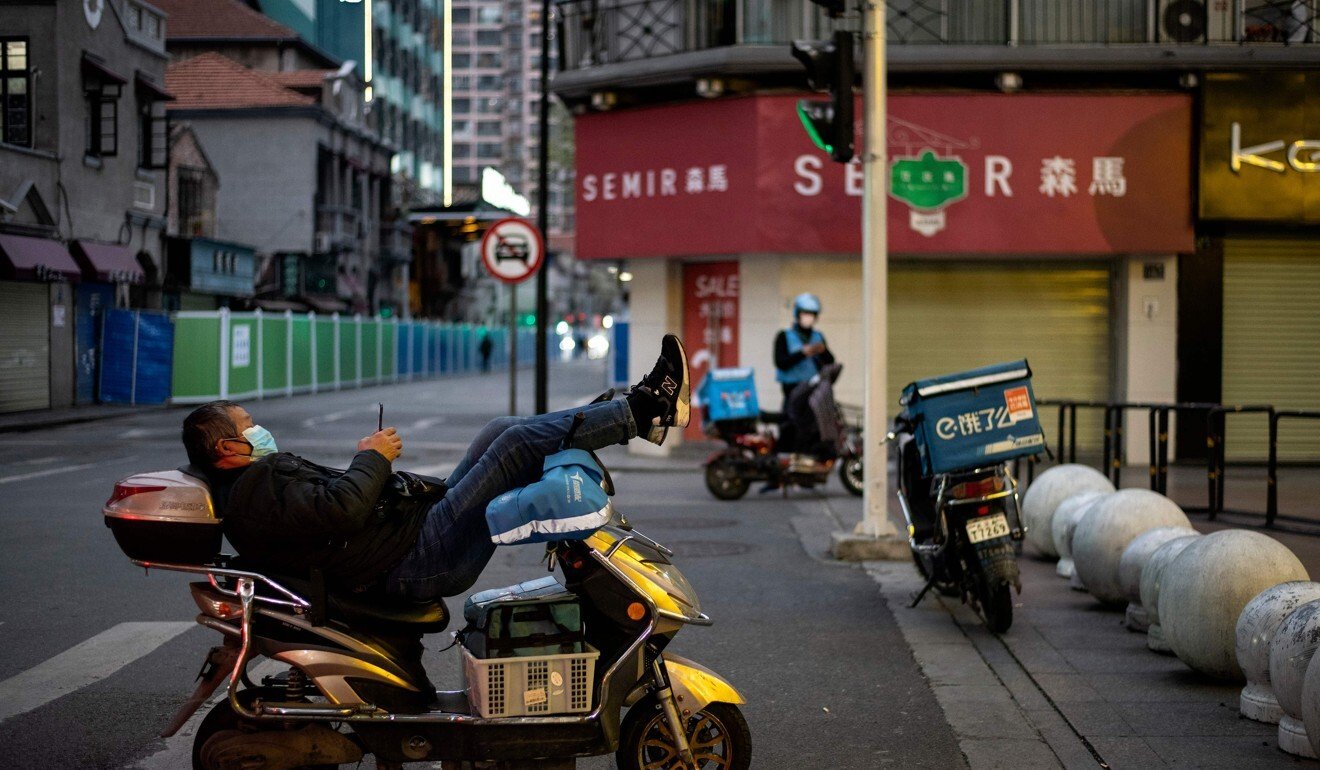
A delivery man takes a break between orders in Wuhan, central China, during the lockdown. Photo: AFP
Mo Xinsheng became one such “on-loan” worker after customers stopped coming to the Beijing restaurant where he worked as a kitchen assistant.
“I wanted to earn some money and meanwhile help people who are trapped at home,” said Mo, who was hired as a delivery man.
But before he could start work he had to go through lengthy health checks before he was allowed into residential compounds.
He also had to work long hours battling the wind and cold of a Beijing winter and carrying heavy loads.
“I work about 10 hours every day just to earn several thousand yuan [several hundred US dollars] a month,” he said.
“Sometimes I almost couldn’t breathe while my hands were fully loaded with packages of rice, oil and other things.
“But I know I’m doing an important job, especially at a time of crisis,” Mo said, “It was not until then that I realised people have become so reliant on the home delivery system.”
Woman uses remote control car to buy steamed buns amid coronavirus outbreak in China
The delivery system has been improved by an effective combination of private sector innovation and public sector coordination, said Li Chen, assistant professor at the Centre for China Studies at Chinese University of Hong Kong.
“[In China,] government units and the Communist Party grass roots organisations have maintained fairly strong mobilisation capabilities to cope with emergencies, which has worked well in the crisis,” he said.
However, Liu, the Wuhan resident, said prices had gone up and vegetables were three times more expensive than they had been over Lunar New Year in 2019.
“There were few varieties that we could choose from, apart from potatoes, cabbage and carrots,” he said.
“But I’m not complaining. It’s good we can still get fresh vegetables at a difficult time. Isn’t it? After all, we are just ordinary people,” he said.
Researchers from Imperial College in London looked at how 11 countries had responded to the crisis and estimated how many lives had been saved by intervention
Some of the worst affected countries such as Italy and Spain would have seen tens of thousands more deaths, according to the model
Empty streets outside the Colosseum in Rome. Photo: AFP
Mass lockdowns and widespread social distancing may have prevented 59,000 Covid-19 deaths, according to a new model from Imperial College in London.
A team of researchers – including Neil Ferguson, whose projections helped inform the British government’s response to the outbreak and Samir Bhatt – estimated that tens of thousands of lives had been saved in 11 countries as a result of measures such as case isolation, school closures, bans on mass gatherings as well as local and national lockdowns.
The measures had a “substantial impact in reducing transmission” for countries with more advanced epidemics, with an estimated 38,000 deaths averted in Italy and 16,000 in Spain, but it is “too early to be sure” about similar reductions for countries in the earlier stages of the outbreak, researchers said.
Most countries in the model – Austria, Belgium, Denmark, France, Germany, Norway, Sweden, Switzerland and the United Kingdom – began their interventions between March 12 and 14.
“While we cannot determine which set of interventions have been most successful, taken together, we can already see changes in the trends of new deaths,” the researchers said.
“We note that substantial innovation is taking place, and new, more effective interventions or refinements of current interventions, alongside behavioural changes will further contribute to reductions in infections.”
The report, published on Monday, also estimated that between 7 and 43 million people had been infected in the 11 countries by late March – somewhere between 1.88 per cent and 11.43 per cent of the population – and said a large number of cases had probably gone unreported.
On average, the proportion of the population infected in the assessed countries was 4.9 per cent, with the highest estimates in Spain and Italy, and the lowest in Germany and Norway.
The coronavirus that causes Covid-19 first began to spread late last year in central China, but has since become a devastating global pandemic, with the most confirmed cases in the United States, Italy, Spain, Germany, France and mainland China.
Life under Italy’s lockdown: the hard lessons other countries must learn
2 Apr 2020
A separate study by Ferguson and other researchers, including Imperial College epidemiologist Azra Ghani, published on Monday in The Lancet found that the overall case fatality ratio for Covid-19 was lower than estimates for the severe acute respiratory syndrome (Sars) and Middle East respiratory syndrome (Mers) coronaviruses, but “substantially higher” than those of recent influenza pandemics such as the H1N1 influenza in 2009.
“With the rapid geographical spread observed to date, Covid-19 therefore represents a major global health threat in the coming weeks and months,” the researchers said.
“Our estimate of the proportion of infected individuals requiring hospitalisation, when combined with likely infection attack rates (around 50–80 per cent), show that even the most advanced health care systems are likely to be overwhelmed.
“These estimates are therefore crucial to enable countries around the world to best prepare as the global pandemic continues to unfold.”
Italy ‘still proud to be part of EU’ amid stronger ties with China and coronavirus pandemic
2 Apr 2020
The study also found that the risk of death increased significantly for individuals in older age groups, although they noted early results indicate children are not at a lower risk of infection compared with adults.
Using data from China, researchers estimated the overall case fatality ratio to be at 1.38 per cent, with a lower ratio of 0.32 per cent for under-60s, compared with 6.4 per cent for over-60s and rising to 13.4 per cent for people who were over 80.
“It is clear from the data that has emerged from China that case fatality ratio increases substantially with age,” they said.
The age gradient was also observed in cases outside China, where the fatality ratio was estimated at 1.4 per cent for people under the age of 60, compared with 4.5 per cent for those 60 and over.
not long ago – unless they have a child addicted to the wildly popular app, on which users make and share short, amusing videos.
It has grown explosively since its 2016 launch, with 800 million monthly active users now – 300 million of them outside China in places such as India (120 million) and the
(37 million). And many have no idea it is owned by a Chinese company, ByteDance.
The first Chinese app to mount a real global challenge to Facebook and Instagram, it is seen as one of the shiniest new weapons in the US-China technology war. And a boost, perhaps, to Chinese soft power.
TikTok, the missing link between Hong Kong and Indian protesters?
9 Feb 2020
It experienced a growth spurt in 2019 that analysts predicted would slow a little this year. That, however, was before the coronavirus, which seems to be giving the app a bump, especially beyond its core teenage fan base.
As pandemic fears rise and millions are stuck indoors, major Hollywood celebrities such as Jennifer Lopez, 50, have taken to posting their own all-singing, all-dancing videos, which then go viral on other media platforms.
Even the World Health Organisation has jumped on the bandwagon, joining the app in late February to share public health advice.
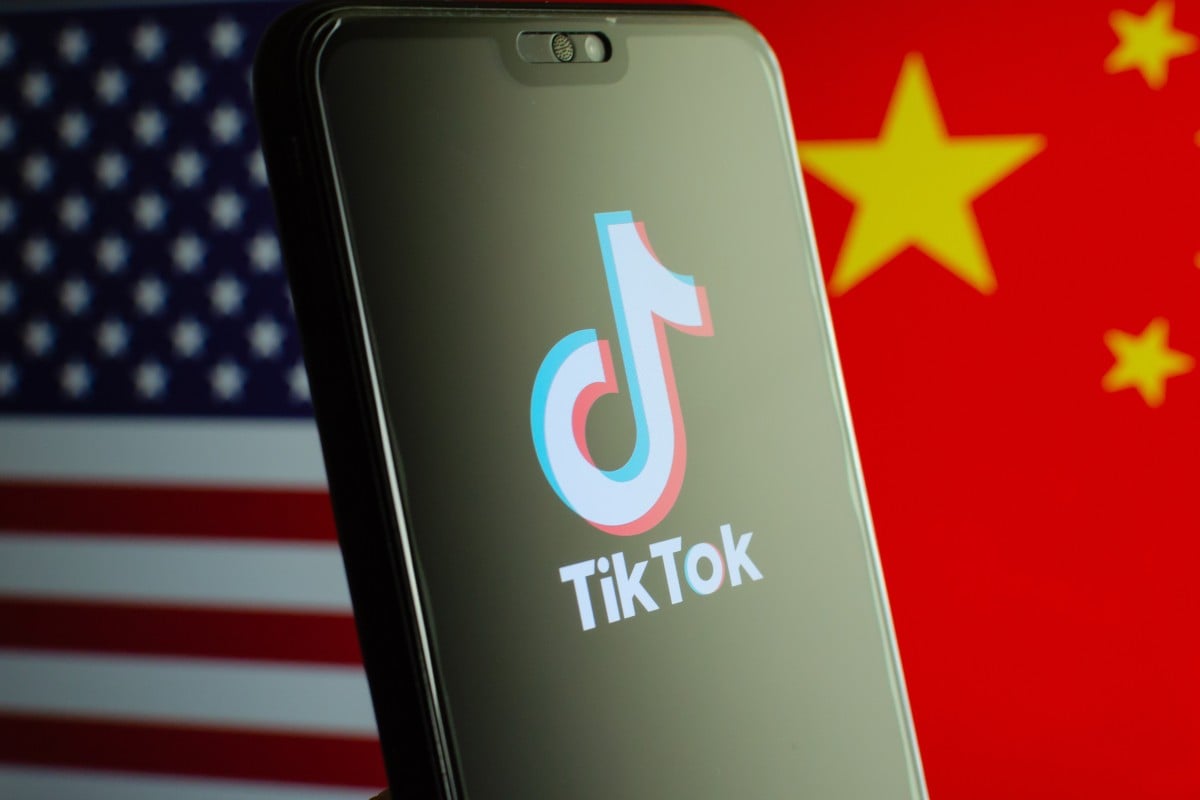
The TikTok logo on a smartphone. Photo: Getty Images
But to some, the growth of TikTok is far from benign.
Privacy advocates and several US congressmen want to rein in the app over concerns it may censor and monitor content for the Chinese government, and be used for misinformation and election interference. This despite the fact that TikTok keeps its servers outside China and swears it will not hand over user data.
Are these fears justified – or fuelled by political and anticompetitive motives?
Thinkers such as Yuval Noah Harari warn that the coronavirus pandemic could be a watershed in the history of mass surveillance.
But Eric Harwit, a professor of Asian studies at the University of Hawaii, does not buy such arguments against TikTok, especially given that 60 per cent of its US users are aged 16 to 24.
“ByteDance has done a pretty good job of having a firewall between TikTok and the Chinese version of it, Douyin.
TikTok, iPhone: all you need to escape Mumbai’s slums – for 15 seconds
1 Nov 2019
“Also, many users in the US are teens and they’re not a particularly useful source of national security information.
“So I’d say the concerns are motivated more by a general fear of any kind of Chinese telecommunication application rather than actual attempts to siphon off valuable US intelligence information.
“And Facebook and other American companies have similar products,” Harwit points out. “US government officials will always want to protect American commercial interests.”
Sarah Cook, a China analyst for Freedom House – the US government-funded think tank – disagrees.
“We have concerns about how Facebook and Twitter deal with information affecting electoral politics, and that’s magnified if you’re talking about a Chinese company that now has a user base that rivals theirs.”
Chinese officials, she argues, have shown a willingness to censor and manipulate information well beyond their country’s borders – for instance, regarding the scale of the initial outbreak in Wuhan, an obfuscation that may have exacerbated its impact abroad.
“For those who think Chinese government censorship is only Chinese people’s problem, this pandemic shows how much that’s not the case.
“And even if it’s not happening right now with TikTok, the concern is that Chinese companies are beholden to their government, whether they want to be or not.
“I’m not saying block TikTok entirely,” she says. “It’s a question of looking at it in a democratic system and deciding on reasonable oversight and safeguards to protect users and information flows when that time comes.”
When it comes to expanding China’s cultural influence, though, neither Cook nor Harwit believes the app is especially effective.
Most people are oblivious to its Chinese origins, which the user experience does not reflect in any way. So there is no goodwill-generating soft power of the sort wielded by, say,
If anything, TikTok often promotes the increasingly homogenous, Western-leaning culture seen on many globally popular social media apps.
So says Morten Bay, a lecturer in digital and social media at the University of Southern California’s Annenberg School for Communication and Journalism.
“A semi-Western culture, with small variations of local culture, is becoming the norm on social media. And Chinese soft power is difficult to assert because there’s no value difference.”
And even if Chinese tech companies keep taking bigger bites of the Western market, he is sceptical of China’s “ability to leverage that for soft power in a geopolitical sense”.
“Because there is a very big apparatus pushing against China in that regard. As soon as TikTok started gaining traction in the US, people came out against it, trying to make everyone aware of the privacy and geopolitical issues.
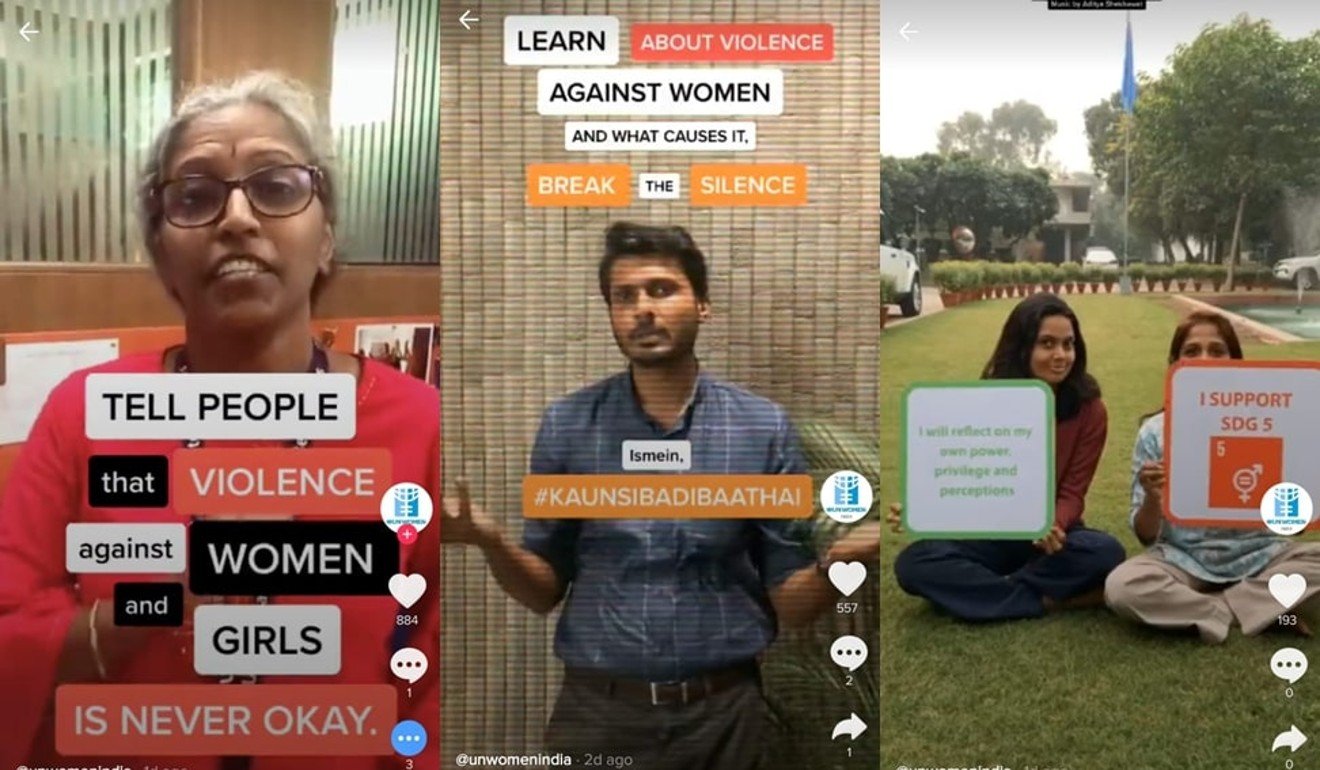
The #KaunsiBadiBaatHai campaign on TikTok aims to raise awareness about women’s safety issues in India. Image: TikTok
“So China faces a lot of resistance,” Bay concludes. “And I’m not sure a social media platform on its own can do much about that.”
Still, if you had to back a horse in this race, TikTok would be it, says Zhang Mengmeng.
When she and her colleagues from global industry analysis firm Counterpoint Research visited the company, they were impressed by its research and development capabilities.
“Because they’re a very young company, their pace for incubating new projects is a lot faster, especially compared to successful but older internet companies in China which have been around for 15 to 20 years.
Indian invasion of Chinese social media apps sparks fear and loathing in New Delhi
28 Apr 2019
“They have lots of little start-up projects within the company and their organisational structure is very flat – it doesn’t matter what your age is, if you have a good idea, you get promoted very quickly.”
TikTok’s rise is also emblematic of a broader role reversal in the US-China tech war, she believes.
“Before, the US was more advanced in terms of internet development and China seemed to just copy its new ideas. Now, this is reversing. There are so many people in China using the internet that start-ups there can test ideas very easily.
“So now it seems like a lot of US companies are trying to see what ideas are coming out of China.” ■
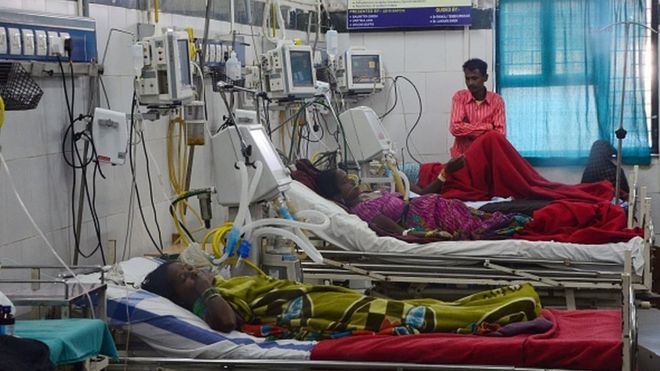
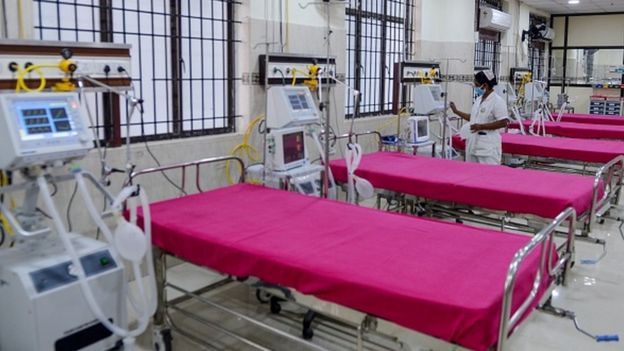
Image copyright GETTY IMAGESImage caption India has an estimated 48,000 ventilators and most of them are already in use
In an 8,000 sq ft (743 sq m) facility in the western Indian city of Pune, a bunch of young engineers are racing against time to develop a low-cost ventilator that could save thousands of lives if the coronavirus pandemic overwhelms the country’s hospitals.
These engineers – from some of India’s top engineering schools – belong to a barely two-year-old start-up which makes water-less robots that clean solar plants.
Last year, Nocca Robotics had a modest turnover of 2.7 million rupees ($36,000; £29,000). The average age of the mechanical, electronic and aerospace engineers who work for the firm is 26.
India, by most estimates, only has 48,000 ventilators. Nobody quite knows how many of these breathing assistance machines are working. But it is a fair assumption that all those available are being used in intensive care units on existing patients with other diseases.
About one in six people with Covid-19 gets seriously ill, which can include breathing difficulties. The country faces seeing its hospitals hobbled as others around the world have been, with doctors forced to choose who they try to save.
At least two Indian companies make ventilators at present, mostly from imported components. They cost around 150,000 ($1,987; £1,612) rupees each. One of them, AgVa Healthcare, plans to make 20,000 in a month’s time. India has also ordered 10,000 from China, but that will meet just a fraction of the potential demand.
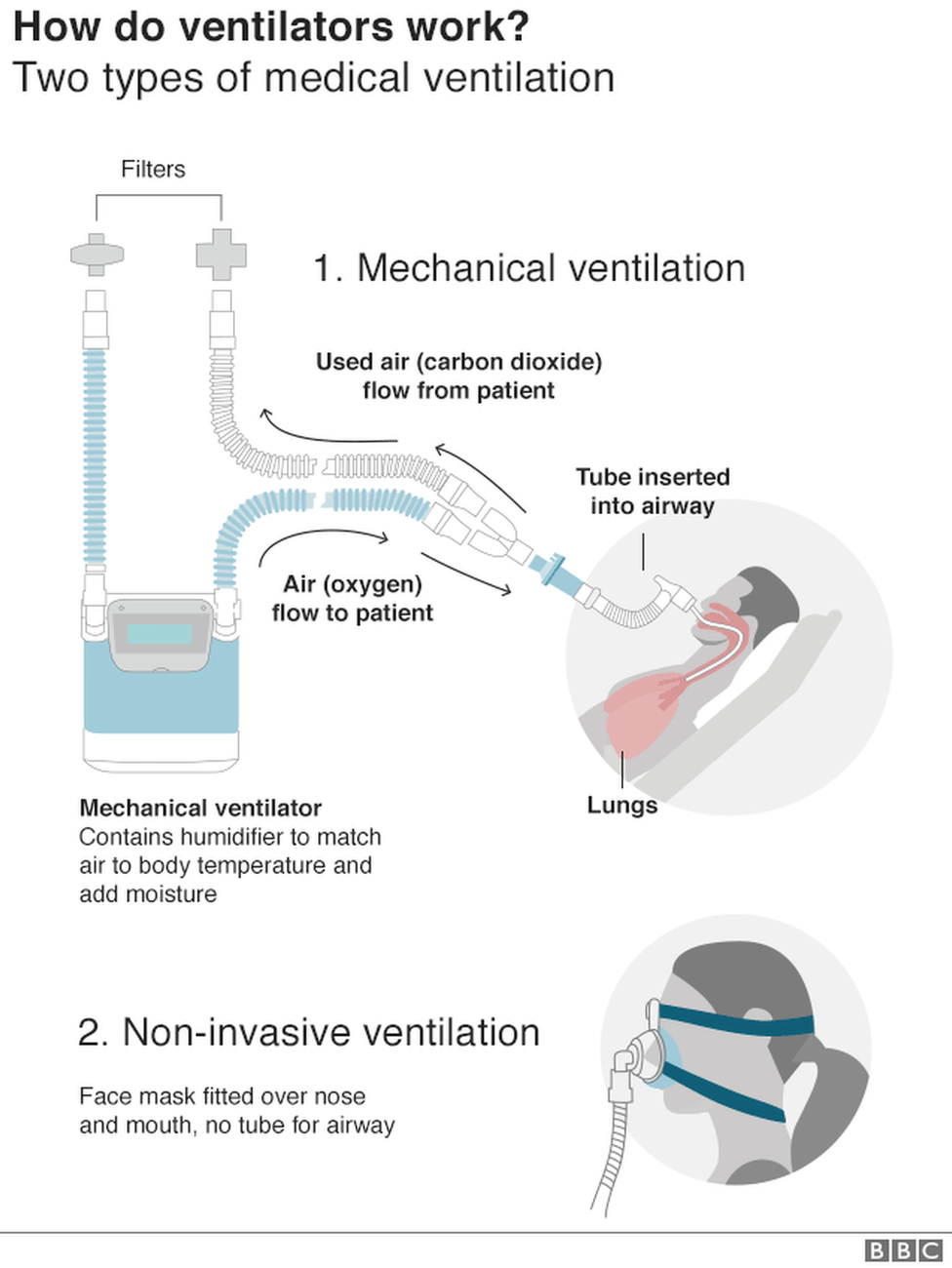
The invasive ventilator being developed by the engineers at Nocca Robotics will cost 50,000 rupees ($662). Within five days of beginning work, a group of seven engineers at the start-up have three prototypes of a portable machine ready.
They are being tested on artificial lungs, a prosthetic device that provides oxygen and removes carbon dioxide from the blood. By 7 April, they plan to be ready with machines that can be tested on patients after approvals.
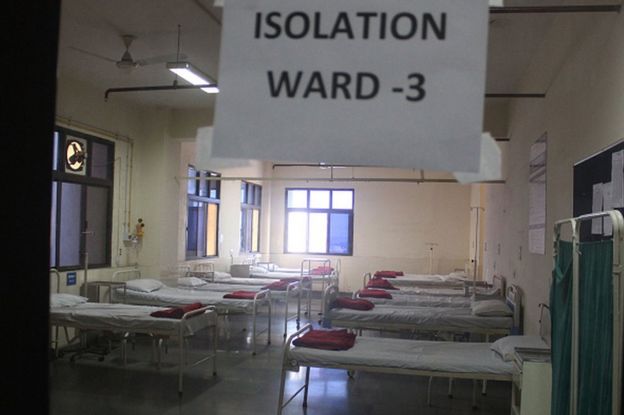
Image copyright GETTY IMAGESImage caption India is beefing up isolation beds in hospitals
“It is most certainly doable,” said Dr Deepak Padmanabhan, a cardiologist at Bangalore’s Jayadeva Institute of Cardiovascular Sciences and Research, and a key advisor on this project. “The simulations on artificial lungs have been done and seem to work well.”
Inspiring story
The race to develop this inexpensive, home-grown invasive breathing machine is an inspiring story of swift coordination and speedy action involving public and private institutions, something not common in India.
“The pandemic has brought us all together in ways I could never imagine,” says Amitabha Bandyopadhyay, a professor of biological sciences and bioengineering at Indian Institute of Technology (IIT), Kanpur, and a key mover of the project.
The young engineers mined open source medical supplies groups on the internet to find information on how to make the ventilators. After securing permissions, it took them exactly eight hours to produce the first prototype. Of particular use, say doctors, were some designs by engineers at MIT. With imports stalled, the engineers picked up pressure sensors – a key component of the machine that helps supply oxygen to lungs at a pressure that doesn’t cause injury – from those used in drones and available in the market.
Image copyright AFPImage caption India needs thousands of ventilators to cope with a possible rush of patients
Local authorities helped open firms that stock components – each machine needs 150 to 200 parts – and made sure that a bunch of engineers who had returned home to Nanded after the lockdown were still able to travel 400km (248 miles) back to Pune to work on the machine.
Some leading Indian industrialists, including a major medical device-making company, have offered their factories to manufacture the machines. The plan is to make 30,000 ventilators, at around 150-200 a day, by the middle of May.
Social media influencers joined the effort. Rahul Raj, a lithium battery-maker and an IIT alumnus, crowd-sourced a group called Caring Indians to “pool resources and experience” to cope with the pandemic. Within 24 hours, 1,000 people had signed up. “We tweeted to the local lawmaker and local police in Pune to help the developers, and made contacts with people who would be interested in the project,” Mr Raj said.
‘No-frills machine’
Expat Indian doctors and entrepreneurs who went to the same school – IIT is India’s leading engineering school and alumni include Google chief Sundar Pichai – held Zoom meetings with the young developers, advising them and asking questions about the machine’s development. The head of a US-based company gave them a 90-minute lecture on how to manage production. A former chief of an info-tech company told them how to source the components.
Lastly, a bunch of doctors vetted every development and asked hard questions. In the end, more than a dozen top professionals – pulmonologists, cardiologists, scientists, innovators, venture capitalists – have guided the young team.
Doctors say the goal is to develop a “no-frills” breathing machine tailored to Indian conditions.
Ventilators depend on pressurised oxygen supply from hospital plants. But in a country where piped oxygen is not available in many small towns and villages, developers are seeing whether they can also make the machine run on oxygen cylinders. “In a way we are trying to de-modernise the machine to what it was barely 20 years ago,” says Dr Padmanabhan.
“We are not experienced. But we are very good at making products easily. The robots that we make are much more complex to make. But this is a life-saving machine and carries risk, so we have to be very, very careful that we develop a perfect product which clears all approvals,” said Nikhil Kurele, the 26-year-old co-founder and chief executive officer of Nocca Robotics.
In just a week’s time, India will learn whether they pulled off the feat.
Mainland China’s coronavirus outbreak exposed a huge digital divide, with some students from poorer regions lacking resources for online learning
Access to the internet is not considered a daily necessity at China’s policy level, unlike in European countries such as Norway and Iceland
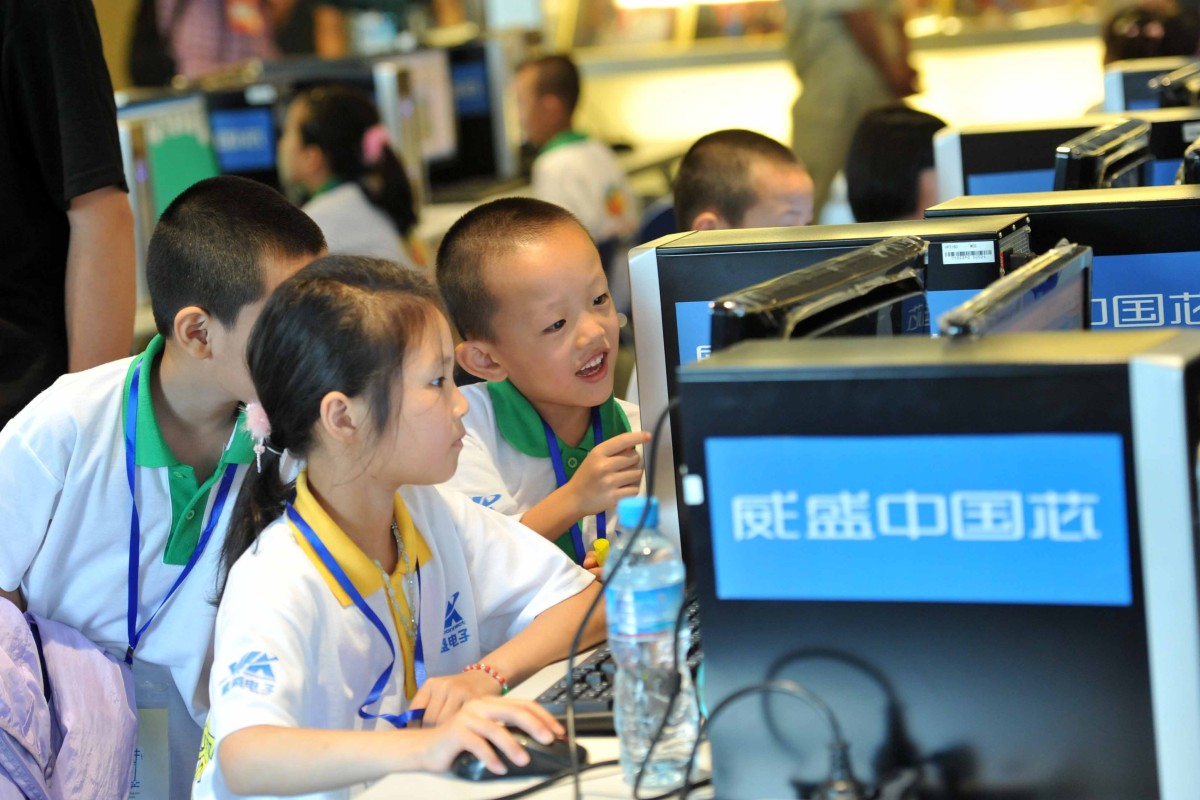
Chinese children attend a computer class in Beijing to learn how to properly use the internet. Those in poorer parts of the country lack sufficient access to the internet, as the switch to online teaching during the coronavirus outbreak in China showed. Photo: AFP
The coronavirus outbreak in mainland China highlighted the huge digital divide that exists between richer and poorer regions.
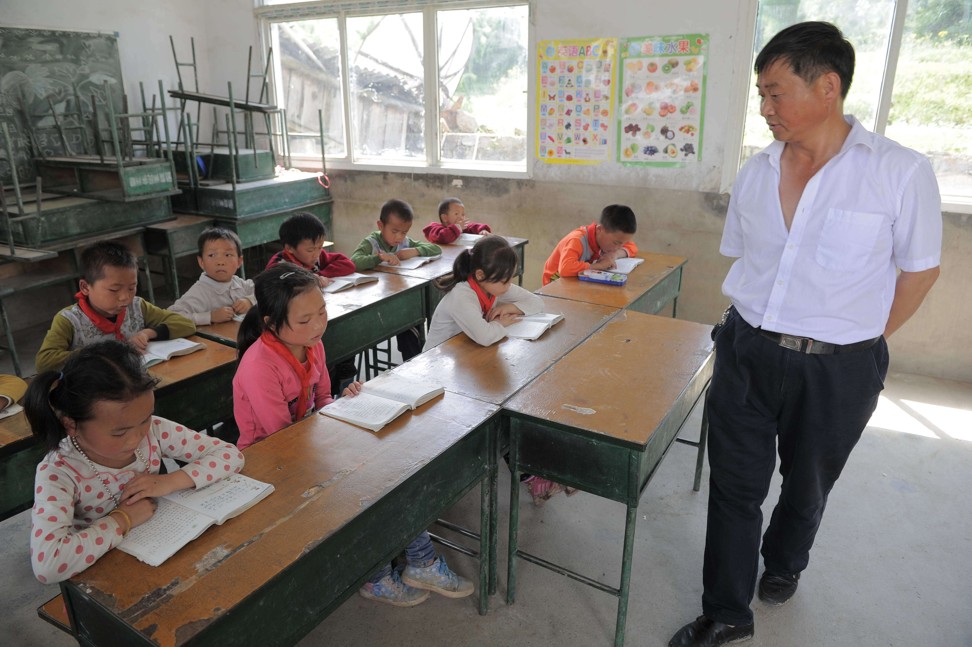
When schools shut and online learning was made compulsory, many students living in remote areas found they didn’t have sufficient internet access.
There were 1.6 billion mobile phone subscribers in China in 2019, with many people having more than one subscription, and optical fibre and 4G covered 98 per cent of the population, according to official data.
These figures fail to show the large regional disparity between the country’s rich and poor provinces, says Jack Chan Wing-kit, associate professor of the school of government at Sun Yat-sen University in Guangzhou province.
“In poor areas, a family [often] has to share one mobile phone among all members,” says Chan, who has done extensive research on China’s social problems.
It is easier for service providers to offer blanket coverage in densely populated cities where most people live in high-rise buildings, Chan explains.
“In rural areas, people live in bungalows that are widely spread out. It is not economically efficient for phone service providers like China Mobile to install transmission stations there, which explain their spotty coverage,” he says.
While the universal social security net in China covers people including the old and disabled, access to the internet is not considered a daily necessity at the policy level. That’s unlike European countries such as Norway and Iceland, who see the internet as a basic human right and ensure their entire populations have proper access to it.
Though some wealthier coastal cities within the Pearl River Delta recently conducted local surveys to identify less-well-off households and handed out tablet computers, inland provinces in central and western China cannot afford these measures, Chan says.
The Chinese government does not encourage [the setting up of] charities – Erwin Huang, founder of WebOrganic and EdFuture
Philanthropic efforts could help address this problem, as shown by Hong Kong’s experience in tackling the digital divide.
About 900,000 kindergarten, primary and secondary students in the city have been affected by school suspensions that are likely to last until at least April 20.
While families of disadvantaged students have received support from the government through Comprehensive Social Security Assistance and other welfare schemes, many children still lack digital resources as their parents don’t see it as a priority, says Erwin Huang, founder of both WebOrganic, a charity promoting computer access to such youngsters, and education alliance EdFuture.
That has left it up to charities to make sure all students have enough resources at home for online learning, Huang says. For instance, this month EdFuture worked with local mobile service provider SmarTone to give out free phone data SIM cards lasting two months to 10,000 students.
“It’s for those who live in subdivided flats and those who have to go to McDonald’s for Wi-fi access,” says Huang, who is also associate professor of engineering at the Hong Kong University of Science and Technology.
Many students in China’s poorer regions have been left at a disadvantage by the shift to online learning. Photo: Getty Images
The Hong Kong Jockey Club also recently launched a HK$42 million (US$5.4 million) scheme to provide free mobile internet data to 100,000 underprivileged primary- and secondary-school students to help with online learning while schools are closed.
Huang says while such charities help fill gaps in the provision of digital resources in Hong Kong, a similar philanthropic culture is lacking in China.
“The Chinese government does not encourage [the setting up of] charities,” he says.
Huang initiated several digital resources projects in China after the Sichuan earthquake in 2008, but says frequent media reports of scandals involving charities such as China’s Red Cross have made it harder forNGOs to operate in the country, with the government preferring to provide social services through its own departments.
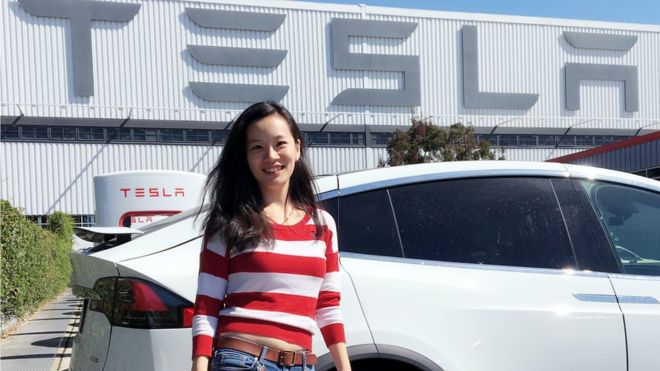
Image copyright HAN ZHUImage caption Choosing an electric car was an easy decision for Shenzhen resident Han Zhu
Han Zhu is on a mission to go green. The 29-year-old data analyst wants her next car to be electric. But her reasons for buying an electric vehicle are in part practical.
In the southern Chinese city of Shenzhen, government restrictions on the number of petrol cars sold each year mean she would have to enter a lottery or auction to be able to buy a petrol vehicle.
“There is a possibility you may never get it. With the electric vehicle green licence, you don’t have to wait in line,” she says.
Shenzhen has become the showpiece capital for the Chinese electric dream. In 2017 it became the first city in the world to introduce a fleet of electric buses. A year later, the government rolled out a plan to replace city taxis with electric cars.
“In Shenzhen, in almost every residential building there are two charging units. One out of 10 cars on the street are Teslas,” she says. “In China if the policy leads in one direction, technology and money goes in that direction too,” she says.
Image copyright GETTY IMAGESImage caption China has the world’s biggest market for electric vehicles
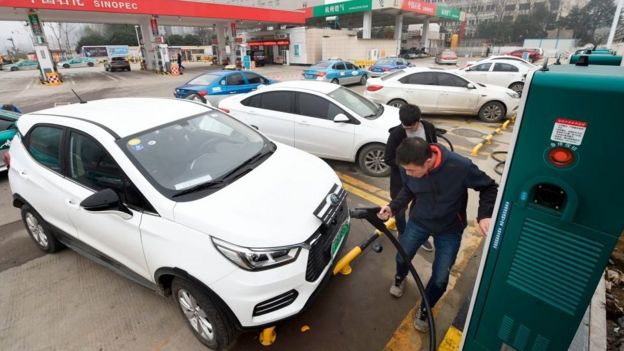
In less than a decade China’s new electric vehicle market has become the largest in the world. In 2018 more than a million electric vehicles were sold in China, more than three times the number sold in the US.
Beijing invested an estimated $50bn (£43bn) in the industry, hoping that today’s dominance of the electric vehicle market would lead to global automobile supremacy tomorrow.
And thus far the policy has been working. Over the last three years the number of Chinese electric vehicle manufacturers has tripled, with more than 400 registered nationwide.
But that breakneck expansion alarmed the government. Last year it decided to put the brakes on by withdrawing approximately half of its financial incentives for buyers.
A slump in sales quickly followed, in the last quarter of 2019 sales for electric vehicles plummeted.
Now the coronavirus has supplied a second punch.
Manufacturers have been forced to halt production lines and close dealerships in a bid to stop the spread of virus.
Overall auto sales in plunged 79% in February compared with the same month in 2019, according to figures from the China Association of Automobile Manufacturers. Sales of new energy vehicles (NEVs) fell for the eighth month in a row.
“China’s auto market was already reeling from a large drop in demand in 2019. In 2020 no carmaker has been immune to the effects of the coronavirus. That includes everyone from the oldest joint ventures producing internal combustion engine SUVs to the most innovative upstarts making connected electric vehicles,” says Scott Kennedy from the Center for Strategic and International Studies.
“The vast majority [of electric car makers] will not survive. But how long they survive and whether industry consolidation occurs through lots of mergers or bankruptcies will depend on the willingness of the government.”
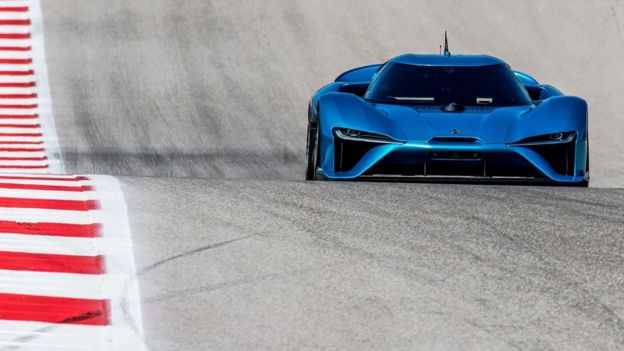
Image copyright NIOImage caption The NIO EP9 is one of the fastest electric cars in the world
After listing on the New York Stock Exchange in 2018 and raising billions of dollars, NIO is perhaps the highest-profile Chinese maker of electric cars.
But in the five years since it was founded it has been beset by problems and has burned through hundreds of millions of dollars. In 2019 the company cut 2,000 jobs on the back of falling revenues. In February it announced it had signed a tentative agreement with a local government that has pledged to fund the company.
“China is a huge market growing at an immense pace. We will adjust and adapt to the market condition,” said an NIO spokesperson.
And it’s not just the car makers. China has some giant makers of components, such as batteries.
In 2018 CATL, a Chinese electric battery maker, became the official supplier of BMW’s electric cars.
Last month Tesla announced it would enter into an agreement with the company to supply batteries for Tesla’s newly built Shanghai mega-plant, capable of producing 500,000 vehicles a year.
Image copyright GETTY IMAGESImage caption China’s BYD is the one of the world’s biggest makers of electric vehicles
But despite that apparent success, analysts have their doubts.
“Chinese auto and battery technology is still not world-class. CATL and BYD are strong battery makers, but they are still somewhat behind technologically from their South Korean and Japanese counterparts. And Chinese automakers are still second-class producers even in their own country and they have barely any sales outside China,” says Mr Kennedy.
For car buyers, that question of quality hangs over China’s electric car makers.
Yi Zhi Yong, a middle-aged entrepreneur, drives a hybrid car made by Chinese manufacturer BYD. Backed by US billionaire Warren Buffett, the company was the third-largest battery-only electric car producer in the world in 2019, according to research by EV-volumes.com. Tesla sold the most, followed by another Chinese firm, BAIC.
He didn’t buy a pure electric vehicle because he is not confident about the quality.
“The quality of domestic pure electric vehicles is not good at the moment,” he says. “No domestic pure electric vehicle is worth buying yet.”
But he feels the progress made by China is a source of national pride. “In the 1990s we couldn’t imagine that China could build cars that can compete with the Japanese,” he says.
Back in Shenzhen, Han Zhu says the rolling back of government subsidies won’t put her off buying an electric vehicle. But rather than buying a Chinese marque, she has her eye on a Tesla.
“I think that they are totally different. I was super excited about Tesla but not other electric cars,” she says.
The government has defeated the first rebellion from its own MPs over plans to allow Huawei to be used in the UK’s 5G mobile network.
Thirty-eight Conservative rebels backed an amendment to end the Chinese firm’s participation in the project by the start of 2023.
Despite promises from the government of a new bill to address their concerns, rebel MPs pushed their plan to a vote.
But with a large Commons majority, the government defeated it by 24 votes.
Culture Minister Matt Warman said the government had heard the points “loud and clear”.
He added: “We will now engage intensively with colleagues across the House to make sure that we will make our case at every possible level…and we will underline that we will always put national security at the very top of our agenda.”
The use of Huawei technology in the 5G network was signed off by No 10 and security experts earlier this year, with the caveats of keeping the kit out of the most sensitive areas and capping its market share at 35%.
But Tory critics say the firm is an arm of the Chinese state and a risk to UK security – claims the firm rejects.
Other countries, including the US and Australia, have banned Huawei from their own networks and criticised the UK’s decision.
After the Commons vote, Huawei vice president Victor Zhang, said: “An evidence-based approach is needed, so we were disappointed to hear some groundless accusations asserted.
“The industry and experts agree that banning Huawei equipment would leave Britain less secure, less productive and less innovative.”
Today’s revolt on Huawei leaves Boris Johnson with one king-sized political headache.
It will likely prompt a bout of teeth gnashing in Downing Street that so many Tories should be ready to defy the PM so soon after he delivered them a whopping election victory.
But it will also sting that their ranks were made up of some of the most senior Tory MPs, including a solid block of former cabinet ministers.
In other words, these are not the sort of MPs who No 10 might expect to be able to bully back into line.
And this matters because the rebellion could pave the way for an even bigger one in the summer that could yet overturn the Huawei decision, with several Tory MPs making clear they are ready to join the rebels once the key 5G legislation comes back to the Commons.
A defeat for Mr Johnson over such a high profile issue would be a deeply wounding blow – all the more so since he went out on a limb to give his personal go-ahead to Huawei despite the fury of the White House and other allies.
Time perhaps for the PM to root out the paracetamol.
A group of Tory MPs, led by the party’s former leader Sir Iain Duncan Smith, put forward an amendment to the Telecommunications Infrastructure Bill to try and stop Huawei’s involvement.
The amendment would have seen firms classified as “high-risk vendors” by the National Cyber Security Centre be banned entirely from the UK’s 5G project by 31 December 2022.
Sir Iain said he and his colleagues were “genuinely concerned that this country has got itself far too bound in to a process in which we are reliant on untrusted vendors”.
Speaking in the Commons, the backbencher accused the Chinese government of spending 20 years “underbidding” other technology firms until Huawei dominated the market, and the outcome was a risk to the UK’s security.
He said using Huawei’s technology was a “statement of absence of thought by any government”, adding: “If defence of the realm is our number one priority, then this becomes demi-defence of the realm, and I am simply not prepared to put up with that.”
Media caption IDS warns UK “in thrall” to untrusted telecoms providers
Culture Secretary Oliver Dowden tried to reassure the group of backbenchers with the promise of bringing forward a Telecoms Security Bill before the summer recess “so all honourable members will be able to debate these points extensively”.
He also said the government wanted to work with its Five Eyes security partners – including the US – on alternative solutions so the UK could “get to a position where we do not have to use high-risk vendors at all”.
But Mr Dowden could not give a timetable for the exclusion of such companies, except to say it would be “in this Parliament” – meaning within the next five years.
As a result, Sir Iain pushed his amendment to a vote, marking the first Tory rebellion against the government since Boris Johnson won the election in December.
However, while 282 MPs from across the House voted in favour of the amendment, 306 MPs voted against, defeating it.
There were 38 Conservative MPs who rebelled against their government by voting for the amendment – including former international trade secretary Liam Fox, ex-Brexit secretary David Davis and former housing minister Esther McVey.
Conservative MP and Foreign Affairs Committee chairman, Tom Tugendhat, also voted in favour of the amendment, saying he did “not get the commitments” he wanted from the government.
“I am sorry that I could not support the government. I hope the policy will change before we come to the main Telecoms Security Bill before the summer.”
The Telecommunications Infrastructure Bill later passed without needing a vote.
Matriarchal and matrilineal communities centred around women have existed for centuries in China, India and Indonesia
But a recent influx of tourism, technology and mainstream patriarchal ideas is rapidly changing their way of life
Khasi women leave their village of Nongtraw in India’s northeastern Meghalaya state to collect herbs from the fields. Photo: AFP
While women’s rights may have become a major topic of discussion around the world in recent years, there are female-centric communities that for centuries have distinguished themselves by carving out their own feminist traditions in places such as China, India
and Indonesia.
But many of these matriarchal and matrilineal societies are now struggling to survive, amid threats posed by the modern world such as mass tourism, technology and the infiltration of ideas from mainstream patriarchal society.
In China, for instance, there is a small Mosuo tribe known as the “kingdom of women”.
“Key to the Mosuo culture is their matrilineal family structure, with a basic building block of only members sharing the same female bloodline making up the family … Any male bloodline is not taken into account,” says Choo Waihong, a former Singaporean corporate lawyer who has researched the community for the past decade.
Lugu Lake in China’s Yunnan province is home to the Mosuo tribe. Photo: hemis.fr
At the top of the hierarchy is the grandmother, who is the head of the household. “Her daughters run the home and look after all the children of the female siblings … The sons and grandsons are expected in their supporting role to shoulder the manual tasks required to maintain the farmstead,” Choo says.
Researchers say that there are about 30,000 to 40,000 Mosuo people – most of whom live in the far eastern foothills of the Himalayas in Yunnan, southwest China. This unique community has come together in a series of villages dotted around a mountain and Lugu Lake, while growing numbers have moved out to work in larger towns and cities elsewhere in the country.
According to Choo, author of the book The Kingdom of Women: Life, Love and Death in China’s Hidden Mountains, the most distinctive facet of this community that sets it apart from mainstream society is the absence of formal marriage arrangements between men and women. Instead, they have “walking marriages”, where the man goes to the woman’s home, spends the night with her and then leaves the following morning.
The Kingdom of Women: China’s ‘lost tribe’ of matriarchs, the Mosuo
15 Mar 2017
The couple can choose to have a temporary or even a permanent arrangement as partners, but they are not bound by marriage ties. If they have children, the baby belongs to the woman’s household. “In fact, the man is not considered part of the matrilineal family and his ties to the baby do not determine the social place of the baby,” the researcher says.
Such a society, where women are not subjected to men and sexual freedom is an intrinsic part of their culture, is so radically different from mainstream patriarchal family structures that the Mosuo tribe has been examined and studied over time. More recently, its unique features have also become an eye-catching selling point for the local tourism industry.
TOURISM INDUSTRY
The Mosuo tribe used to live off the land by farming, herding and hunting. But many families now rely on tourism after the tribe’s culture and Lugu Lake became more popular and widely known.
“Tour buses on fancy freeways and planes arriving at a new airport bring more and more tourists daily to turn the whole area into a busy travel playground,” Choo says. “Every household around the lake is involved one way or another with the hotel, restaurant and tour guide industries.”
While the tourism industry has brought money and better food for most families as well more access to educational opportunities for their children, it is also posing a serious threat to their culture and traditional ways of life.
“The greatest challenge for the tribe is their rapid transition from living a rudimentary subsistence farming way of life right into a burgeoning modern middle-class existence within a short span of 20 or so years,” Choo says.
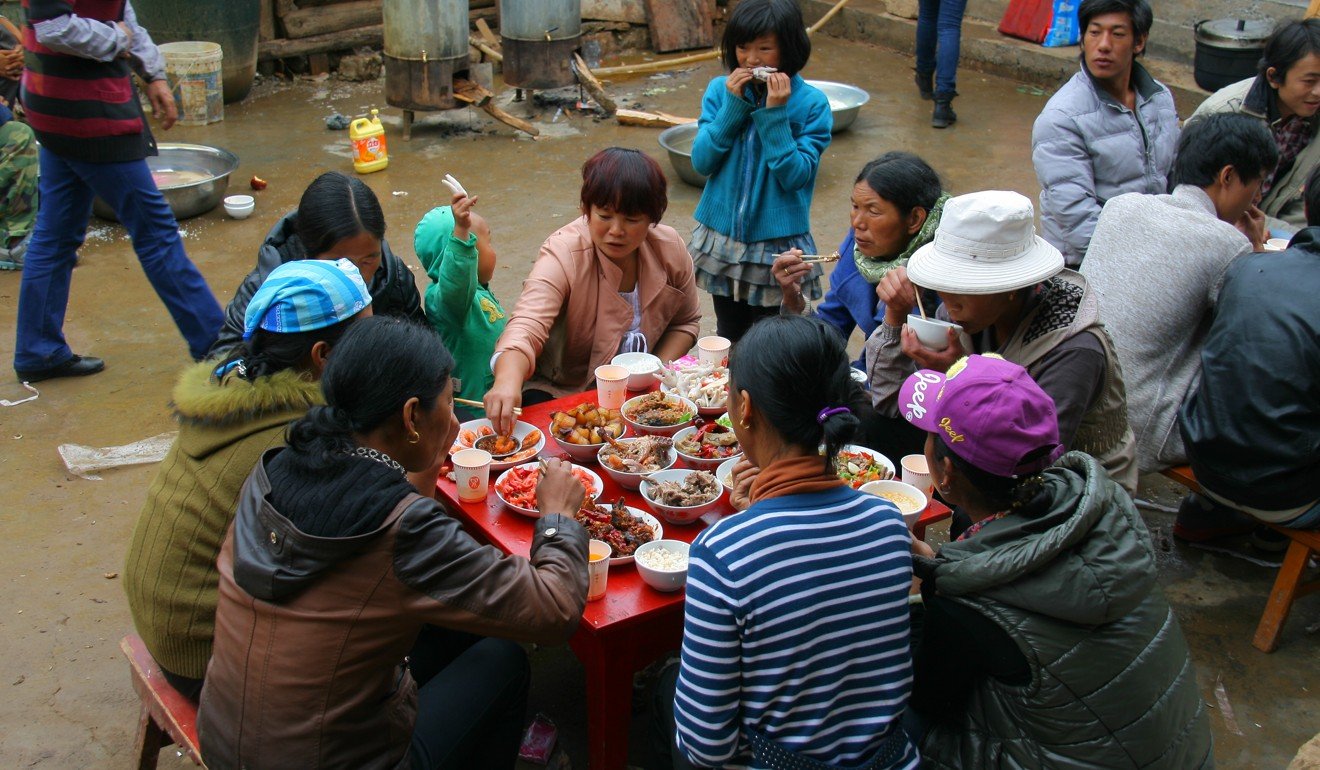
Mosuo people pictured at a wedding ceremony with an all-meat feast in 2013. Photo: Shutterstock
The Mosuo are now being bombarded not only by mainstream traditional Chinese values, but also by new economic values connected to money and the digital economy. “That is a lot to take in for people who had no writing to support their oral language … and only had primary schools for their children not so long ago,” she says.
Older Mosuo are now being pushed to learn Mandarin in order to keep up with the younger generations.
At the same time, the researcher says, “their long-held cultural beliefs and principles are evolving as the young generation gets exposed to the outside world and start to question the old ways of doing things.”
How life is changing for Thailand’s Karen tribe
17 Mar 2017
Walking marriages are not as common, with more youngsters getting married and forming nuclear families. “Large matrilineal families which were the norm are now breaking up into smaller nuclear families. All this dilutes the traditional matrilineal Mosuo family structure,” Choo says.
“The central place of the female in old Mosuo society is slowly being affected, as the male Mosuo are beginning to entertain some patriarchal outlook in the face of outside cultural influences.”
China may have radically reinvented itself in recent decades, but the changes to the Mosuo tribe have been nearly as dramatic. “The world of the Mosuo when I first ventured into their midst 12 years ago is a distant past as I look [today in 2020] at how they have changed,” Choo says.
PATRIARCHY IN DISGUISE
There are dozens of female-centric communities scattered around the world. The Garo and Khasi tribes, which are also traditionally matrilineal societies, can be found mostly in India.
In a Khasi family, the youngest daughter inherits the ancestral property, while in the Garo community, women also inherit property, but don’t necessarily have to be the youngest daughter of the family.
Caroline Marak, former head of the Garo Department at the North Eastern Hill University in India, says that the Garo are female-oriented, but not female-dominated. Women “have no part in the field of administration decision-making”, she wrote in an academic paper.
In recent years, the husbands of Garo women who are property owners have had a greater say over land deals, such as with government. “We are now trying to reclaim our rights from the males,” says Sume Sangma, secretary of the Garo Mothers Union NGO. “Women in the community are self-reliant and we are fighting for their real power.”
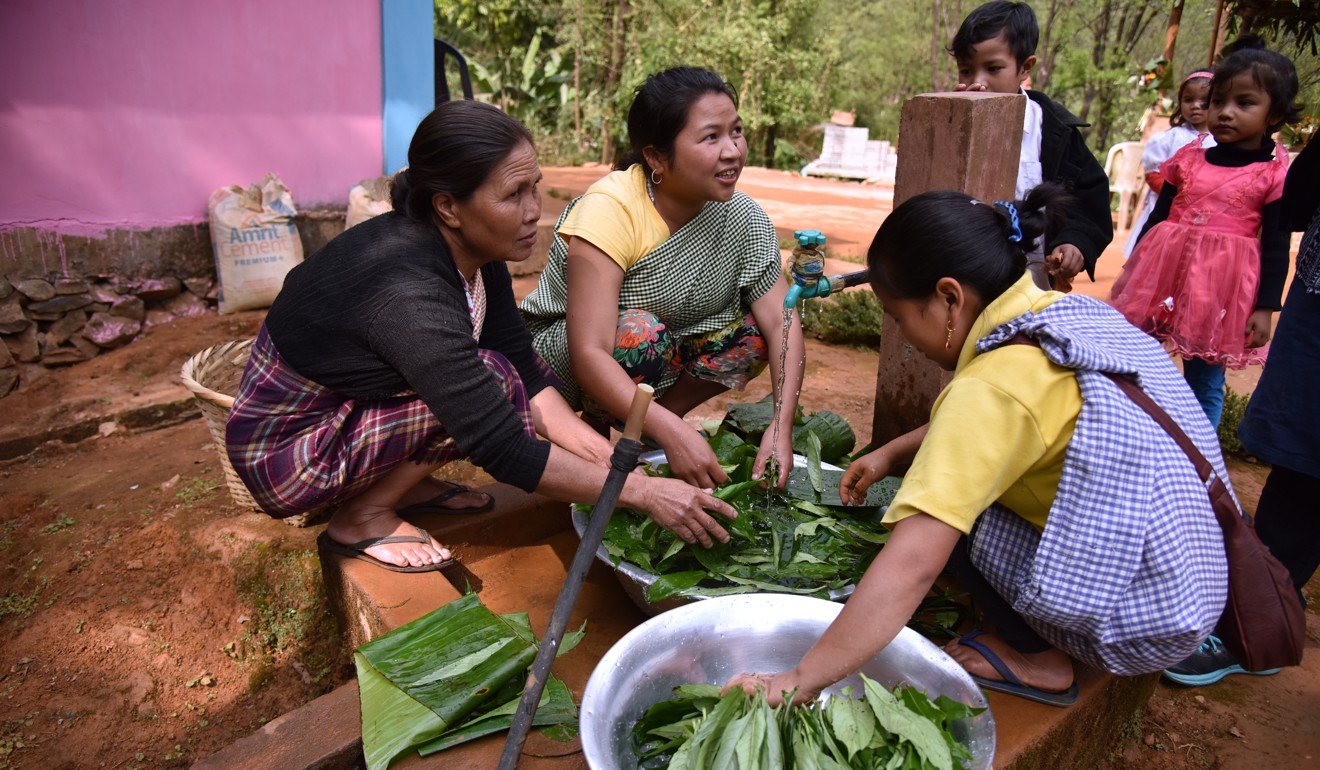
Khasi women wash leaves for cooking in the village of Nongtraw in India’s north-eastern Meghalaya state. Photo: AFP
Tiplut Nongbri, from the Centre for North East Studies and Policy Research at the Jamia Millia Islamia in New Delhi, also says women don’t have much authority in Garo and Khasi societies. “Patriarchy is in disguise in both the communities. The societies are matrilineal only as far as descent, residence and inheritance of property are concerned,” she says. “Women are not allowed to take part in politics.”
RG Lyngdoh, former home minister of Meghalaya – the hilly state in north-eastern India where both communities are based – says inward migration and the presence of Christian missionaries in the state have affected traditional lifestyles. “The old practices of equity between males and females have eroded,” Lyngdoh says.
“This has led to a perception of inadequacy among the males, [creating] discord within the family, which found expression in many negative ways, such as domestic violence and abandonment of wives, which never existed within the Khasi community.”
Gertrude Lamare, a member of the Khasi-Jaintia community now pursuing her PhD in anthropology at the London School of Economics and Political Science, argues that “with families becoming more nuclear, women do have a huge role in the decision-making process”.
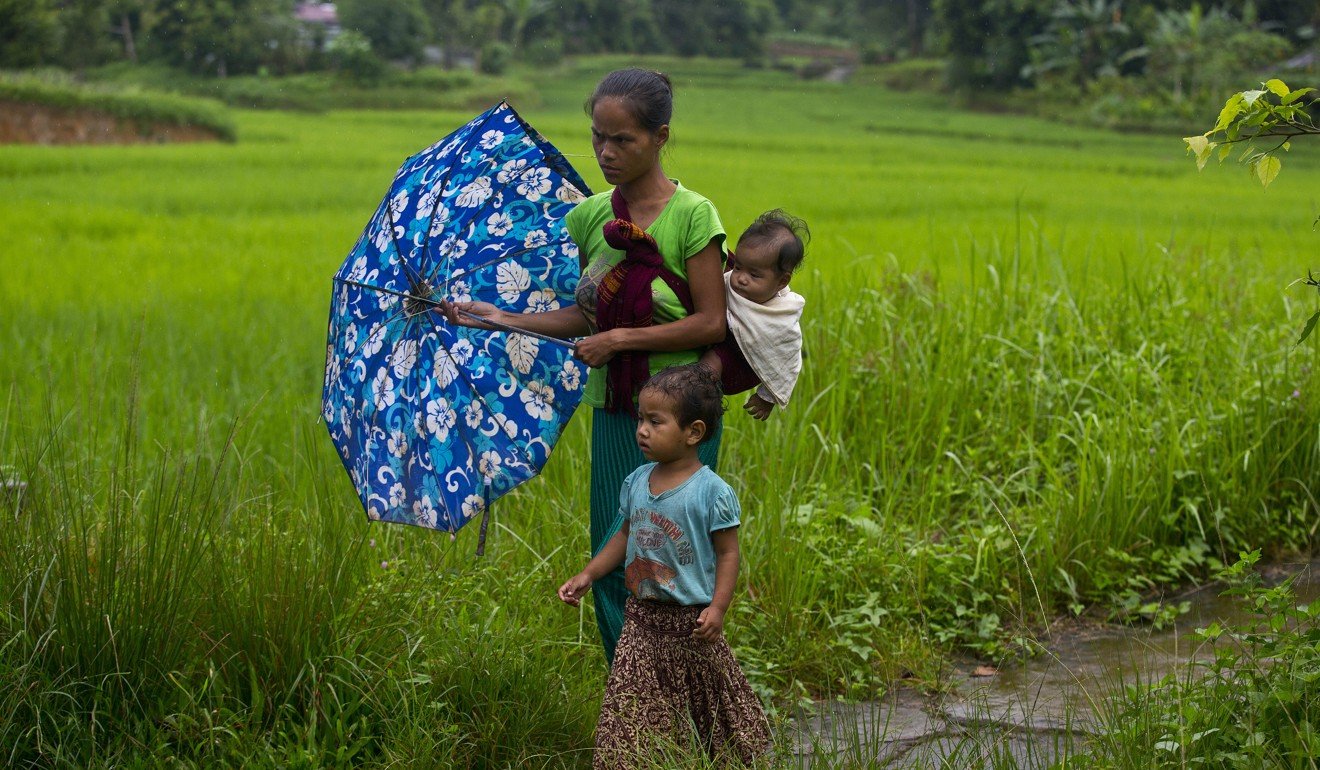
A Khasi woman walks in the rain with children past a paddy field along the Assam-Meghalaya state border in India. Photo: AP
Researchers have estimated that there are 1 million Garo in India and
, and 1.7 million Khasi in the Khasi and Jaintia Hills.
Some of them have become increasingly wary of outsiders preying on their natural resources, which are dwindling, thanks to deforestation and climate change.
Another challenge these communities are facing has to do with the growing trend of mixed marriages. “In recent years, children of a Khasi or Garo mother and non-tribal father [have] not [been] welcomed. The males in the family want their women to marry within the tribal community,” researcher Nongbri says, noting that younger generations are going through an identity crisis.
STILL PROUD
The world’s largest known matrilineal society today is believed to be in Indonesia: the Minangkabau, also known as Minang. Their community of about 8 million is scattered around the world, but most are in Indonesia’s West Sumatra province. While traditionally animist, they were later influenced by Hinduism and Buddhism, and most have since embraced Islam.
But much like the others, their community is also changing.
Nursyirwan Effendi, dean of the Faculty of Social and Political Science at Andalas University, says that many of those who remain in villages and rural areas still hold tight to the tribe’s values.
“Women are central in the distribution of assets, such as rice fields, gardens and [houses], from their ancestors,” he says.
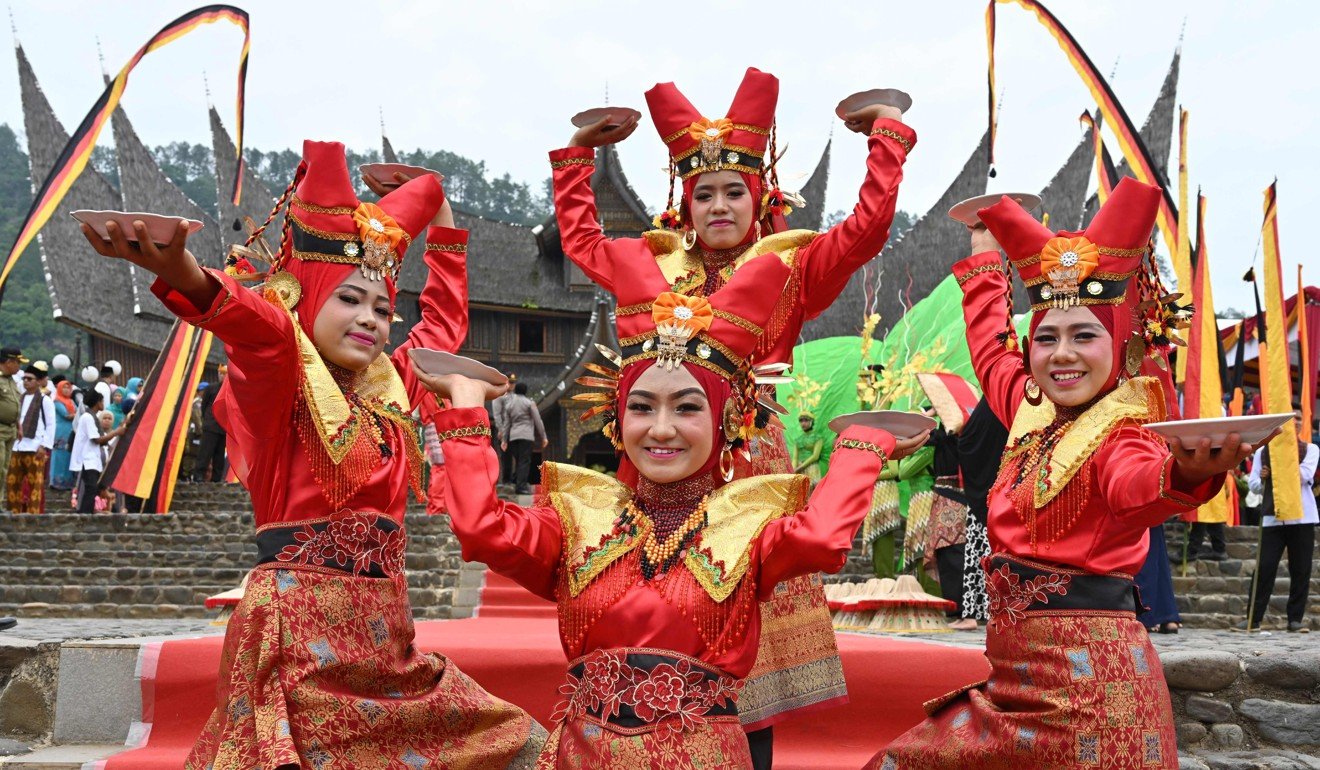
Dancers pose during the 2018 Minangkabau art and culture festival in Batusangkar, West Sumatra. Photo: AFP
Traditionally, Minangkabau women play an essential role in their children’s education and hold inheritance rights, while men are expected to take jobs elsewhere and occupy political and religious positions. When they do get married, the man moves to the woman’s house.
But Nursyirwan, who is of Minangkabau descent, notes that many have left for bigger cities, where they do not closely follow the community’s traditions.
An example of this is Afrianto Sikumbang, a 53-year-old businessman who was born to Minangkabau parents in West Sumatra province but now lives in the capital, Jakarta. Although he married a Minangkabau woman, he says they “don’t really apply” the tribe’s values in their daily life.
Sonya Anggraini, 35, who also works in the capital, has got used to city life, but remains proud of her ancestral roots and hopes that Minangkabau culture will persist for years to come.
“I am a member of my mother’s family, not of my father’s,” she says. ■


















 CHINDIA ALERT: You'll be living in their world, very soon