Chindia Alert: You’ll be Living in their World Very Soon
aims to alert you to the threats and opportunities that China and India present. China and India require serious attention; case of ‘hidden dragon and crouching tiger’.
Without this attention, governments, businesses and, indeed, individuals may find themselves at a great disadvantage sooner rather than later.
The POSTs (front webpages) are mainly 'cuttings' from reliable sources, updated continuously.
The PAGEs (see Tabs, above) attempt to make the information more meaningful by putting some structure to the information we have researched and assembled since 2006.
ZHENGZHOU, Sept. 18 (Xinhua) — Xi Jinping, general secretary of the Communist Party of China Central Committee, urged the development of real economy bolstered by manufacturing, with self-reliance as the basis of all endeavors during his tour to central China’s Henan Province.
Xi also pointed out that although China has the largest manufacturing industry in the world, efforts are still needed in realizing industrial transformation and upgrade through innovation. He called for technical and industrial innovation to move China’s manufacturing up in the industry chain.
An increasing proportion of young people no longer willing to wait tables in China as restaurant owners look to new technology for answers
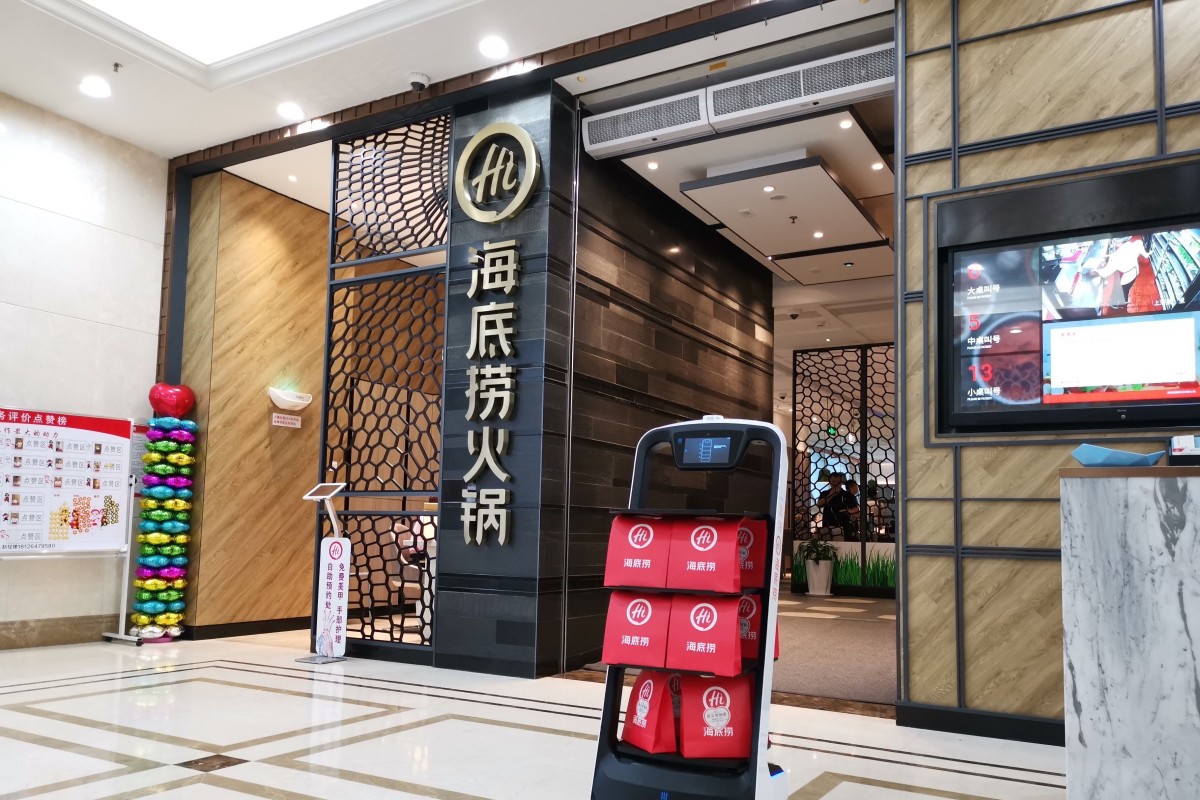
Catering robots developed by Pudu Tech, the three-year-old Shenzhen start-up, have been adopted by thousands of restaurants in China, as well as some foreign countries including Singapore, Korea, and Germany. Photo: Handout
Two years ago, Bao Xiangyi quit school and worked as a waiter in a restaurant for half a year to support himself, and the 19 year-old remembers the time vividly.
“It was crazy working in some Chinese restaurants. My WeChat steps number sometimes hit 20,000 in a day [just by delivering meals in the restaurant],” said Bao.
The WeChat steps fitness tracking function gauges how many steps you literally take and 20,000 steps per day can be compared with a whole day of outdoor activity, ranking you very high in a typical friends circle.
Bao, now a university student in Hangzhou, Zhejiang province, quit the waiter job and went back to school.
“I couldn’t accept that for 365 days a year every day would be the same,” said Bao. “Those days were filled with complete darkness and I felt like my whole life would be spent as an inferior and insignificant waiter.”
Olivia Niu, a 23-year-old Hong Kong resident, quit her waiter job on the first day. “It was too busy during peak meal times. I was so hungry myself but I needed to pack meals for customers,” said Niu.
Being a waiter has never been a top career choice but it remains a big source of employment in China. Yang Chunyan, a waitress at the Lanlifang Hotel in Wenzhou in southeastern China, has two children and says she chose the job because she needs to make a living.
Catering robots developed by Pudu Tech, the three-year-old Shenzhen start-up. Photo: Handout
Today’s young generation have their sights on other areas though. Of those born after 2000, 24.5 per cent want careers related to literature and art. This is followed by education and the IT industry in second and third place, according to a recent report by Tencent QQ and China Youth Daily.
Help may now be at hand though for restaurants struggling to find qualified table staff who are able to withstand the daily stress of juggling hundreds of orders of food. The answer comes in the form of robots.
Japan’s industrial robots industry becomes latest victim of the trade war
Shenzhen Pudu Technology, a three-year-old Shenzhen start-up, is among the tech companies offering catering robots to thousands of restaurant owners who are scrambling to try to plug a labour shortfall with new tech such as machines, artificial intelligence and online ordering systems. It has deployed robots in China, Singapore, Korea and Germany.
With Pudu’s robot, kitchen staff can put meals on the robot, enter the table number, and the robot will deliver it to the consumer. While an average human waiter can deliver 200 meals per day – the robots can manage 300 to 400 orders.
“Nearly every restaurant owner [in China] says it’s hard to recruit people to [work as a waiter],” Zhang Tao, the founder and CEO of Pudu tech said in an interview this week. “China’s food market is huge and delivering meals is a process with high demand and frequency.”
Pudu’s robots can be used for ten years and cost between 40,000 yuan (US$5,650) and 50,000 yuan. That’s less than the average yearly salary of restaurant and hotel workers in China’s southern Guangdong province, which is roughly 60,000 yuan, according to a report co-authored by the South China Market of Human Resources and other organisations.
As such, it is no surprise that more restaurants want to use catering robots.
According to research firm Verified Market Research, the global robotics services market was valued at US$11.62 billion in 2018 and is projected to reach US$35.67 billion by 2026. Haidilao, China’s top hotpot restaurant, has not only adopted service robots but also introduced a smart restaurant with a mechanised kitchen in Beijing last year. And in China’s tech hub of Shenzhen, it is hard to pay without an app as most of the restaurants have deployed an online order service.
Can robots and virtual fruit help the elderly get well in China?
China’s labour force advantage has also shrank in recent years. The working-age population, people between 16 and 59 years’ old, has reduced by 40 million since 2012 to 897 million, accounting for 64 per cent of China’s roughly 1.4 billion people in 2018, according to the national bureau of statistics.
By comparison, those of working age accounted for 69 per cent of the total population in 2012.
Other Chinese robotic companies are also entering the market. SIASUN Robot & Automation Co, a hi-tech listed enterprise belonging to the Chinese Academy of Sciences, introduced their catering robots to China’s restaurants in 2017. Delivery robots developed by Shanghai-based Keenon Robotics Co., founded in 2010, are serving people in China and overseas markets such as the US, Italy and Spain.
Pudu projects it will turn a profit this year and it is in talks with venture capital firms to raise a new round of funding, which will be announced as early as October, according to Zhang. Last year it raised 50 million yuan in a round led by Shenzhen-based QC capital.
To be sure, the service industry is still the biggest employer in China, with 359 million workers and accounting for 46.3 per cent of a working population of 776 million people in 2018, according to the national bureau of statistics.
And new technology sometimes offers up new problems – in this case, service with a smile.
“When we go out for dinner, what we want is service. It is not as simple as just delivering meals,” said Wong Kam-Fai, a professor in engineering at the Chinese University of Hong Kong and a national expert appointed by the Chinese Association for Artificial Intelligence. “If they [robot makers] can add an emotional side in future, it might work better.”
Technology companies also face some practical issues like unusual restaurant layouts.
“Having a [catering robot] traffic jam on the way to the kitchen is normal. Some passageways are very narrow with many zigzags,” Zhang said. “But this can be improved in future with more standardised layouts.”
Multi-floor restaurants can also be a problem.
Dai Qi, a sales manager at the Lanlifang Hotel, said it is impossible for her restaurant to adopt the robot. “Our kitchen is on the third floor, and we have boxes on the second, third, and fourth floor. So the robots can’t work [to deliver meals to downstairs/upstairs],” Dai said.
But Bao says he has no plans to return to being a waiter, so the robots may have the edge.
“Why are human beings doing something robots can do? Let’s do something they [robots] can’t,” Bao said.
Image copyright APPLEImage caption The iPhone 11 Pro is said to last four hours more than before, while the Pro Max is said to last five hours longer
Apple has unveiled its iPhone 11 range of handsets, featuring more cameras and more battery life. But will it be enough to capture one of the world’s only growing smartphone markets?
Samsung has traditionally held dominance in the Indian “premium smartphone” segment, which refers to mobiles that cost 40,000 rupees (£451; $558) or more.
But this year, for the first time ever, Apple surged ahead of the Korean electronics giant in India. It swept up 41.2% of the premium smartphone market in the second quarter of 2019, according to research firm International Data Corporation.
“The Indian smartphone market is a game of changing fortunes,” technology journalist Mala Bhargava told the BBC. “There isn’t a company, no matter how dominant a position it commands, that can afford to sit idle.”
Apple’s latest mobile phones – the iPhone 11, 11 Pro and 11 Pro Max – will be available in India from 27 September.
And the iPhone 11, Ms Bhargava added, is primed to find success in the Indian market.
In recent months, Apple dropped its price for the iPhone 11’s predecessor, the iPhone XR, from 73,900 rupees to 53,900 rupees. The 20,000 rupee price drop was significant enough to make an impact.
“Consumers in India are known to be discount and deal-oriented,” Ms Bhargava said. “Seeing the iPhone as an aspirational product, many snapped up the mobile once prices were slashed.”
Media caption WATCH: Taking a slowfie with the iPhone 11
This, she said, is also what gave Apple the lead for the first time in India in the smartphone market.
The latest iPhones feature more cameras than before and a processor that has been updated to be faster while consuming less power. There are two Pro models, which the company said would last between four to five hours longer than their XS predecessors.
The entry-level iPhone 11 is the “perfect successor” to the iPhone XR, Ms Bhargava said.
It will start at a price of 64,900 rupees – which is not drastically higher than what the iPhone XR currently sells for.
“The discounted iPhone XR played a big part in bolstering sales in India, so it’s likely that with such a price for the iPhone 11, the company can really extend its market share,” she added.
Image copyright APPLEImage caption The entry-level iPhone 11 is said to last up to one hour longer than the earlier XR
Apple also launched the iPhone 11 Pro and iPhone 11 Pro Max, which at 99,990 rupees and 109,900 rupees a piece, will not be a key attraction as consumers will find that unaffordable.
“But at the same time, this gap could still benefit the company, leaving the field open for older iPhones and for the new iPhone 11 to increase Apple’s share in the country,” Ms Bhargava said.
The company is still selling the iPhone XR, along with the older iPhone 8, which will give consumers more choices and prices to choose from.
“With the sales of smartphones falling in the rest of the world, Apple can’t help but look to consolidate its position in India – it is almost the only market growing at an enthusiastic pace,” she added.
In the second quarter of 2019, 36.9 million handsets were shipped in India – up 9.9% from last year.
In comparison, the premium global smartphone market collapsed 8% in the first quarter this year, with much of the decline pushed by a 20% drop in Apple’s shipments.
“India still has millions of first-time phone buyers,” said Ms Bhargava, “and many of those who have been using budget phones are read to buy something better.”
NANNING, Sept. 9 (Xinhua) — South China’s Guangxi Zhuang Autonomous Region on Monday pledged to enhance cooperation with the Association of Southeast Asian Nations (ASEAN) on artificial intelligence (AI).
Chen Wu, chairman of the regional government, said at the First China-ASEAN AI Summit that Guangxi will actively promote technical cooperation, trade, investment and industrial exchange in the AI sector with the ASEAN countries.
Toward this end, the region will speed up the construction of platforms for infrastructure, information sharing and technical cooperation, among others, Chen said.
Guangxi, which boasts both sea and overland links with ASEAN, is building the China-ASEAN Information Harbour to boost digital cooperation with Southeast Asia.
“The summit has sounded the clarion call for the development of AI and big data industry in Guangxi,” said Wang Jingjing, Guangxi regional director of the Chinese AI firm iFlytek.
Hailing the region’s policy and geographical advantages on ASEAN cooperation, Wang said iFlytek hopes to set up an institute on ASEAN languages in Guangxi to facilitate communication between China and ASEAN countries
Luxury car owner who blocked hospital emergency access in criminal detention for identity papers scam
Former driver conned her out of US$280,000
The rare licence plate on this luxury car blocking a hospital emergency access led to a police investigation and criminal detention for the owner and her former driver. Photo: Weibo
A woman who blocked a hospital’s emergency access with her Rolls-Royce two weeks ago lost more than her temper when investigators uncovered a string of unexpected crimes.
Police said on Tuesday that the woman, surnamed Shan, was in criminal detention, along with her former driver, as a result of their investigation. A third man is in administrative detention for fabricating and spreading rumours about the luxury car.
Shan, 31, was originally given five days’ administrative detention for disturbing public order after she argued with a security guard and a police officer in the August 14 incident, which went viral on social media.
The attention of China’s online community was quickly drawn to the rare licence plate on the Rolls-Royce, which blocked emergency access at the Beijing Obstetrics and Gynaecology Hospital for more than an hour.
The licence plate number on the car indicated it had originated from a government agency or from someone who was among the first in China to own a vehicle. Traffic laws ban the transfer of car plate registration, prompting online sleuths to speculate just how Shan had obtained it.
Beijing police were also interested and established a special task force which discovered that Shan had paid her former driver two million yuan (US$280,000) to transfer ownership of the Rolls-Royce to the legal owner of the plate.
Police did not say how much the transfer of the car ownership actually cost, but they were satisfied most of the two million yuan had been spent by the former driver, surnamed Guo. He is now in criminal detention for fraud.
Unfortunately for Shan, police also uncovered her involvement in a scheme to forge, alter and trade identity papers. Details of the enterprise were not disclosed by Beijing police, who said they were working with officers from the location of Shan’s registered permanent residence.
Meanwhile, a 37-year-old man was placed in administrative detention for an unspecified number of days after he fabricated a rumour that Shan’s luxury car had been put up for sale in a second-hand car dealership.
German Chancellor Angela Merkel visits Wuhan Yangtze River Bridge in Wuhan, capital city of central China’s Hubei Province, Sept. 7, 2019. German Chancellor Angela Merkel visited Wuhan on Saturday. (Xinhua/Xiao Yijiu)
WUHAN, Sept. 7 (Xinhua) — Angela Merkel Saturday visited central China’s Wuhan during her 12th trip to the country as German Chancellor since 2005.
Before Wuhan, capital city of Hubei province, Merkel had visited a number of cities besides Beijing during her China trips in the past.
When talking with students of Huazhong University of Science and Technology, Merkel highlighted the importance of international cooperation in the era of globalization, and called on the students to be participants.
Saying that a nation’s prosperity is part of the prosperity of the whole world, she voiced her hope that students should shoulder common responsibilities to combat global challenges.
In the speech, Merkel reviewed her past trips to China. In Shenyang, she witnessed economic upgrading. In Chengdu she learned about development of western China. In Shenzhen she saw remarkable progress brought by the reform and opening-up.
She said quite a few noted German companies including Siemens, and small and medium-sized innovation enterprises are operating business in Wuhan. Wuhan and Duisburg became the first pair of sister cities between China and Germany in 1982.
Merkel exchanged views with students on internet, artificial intelligence, intelligent manufacturing, and environmental protection.
Before wrapping up her trip, Merkel also visited a local hospital and a factory of the German company Webasto.
Researchers bend super-thin sheet using a single electrically charged atom in breakthrough that could eventually pave the way for powerful new computer processors
Success follows decades of fruitless attempts by scientists around the world
The team from the Chinese Academy of Sciences conducted the “world’s smallest work of origami” with a sheet of graphene. Photo: Handout
Chinese scientists have taken the ancient art of origami to the atomic level by finding a way to fold microscopically small graphene, according to a new study.
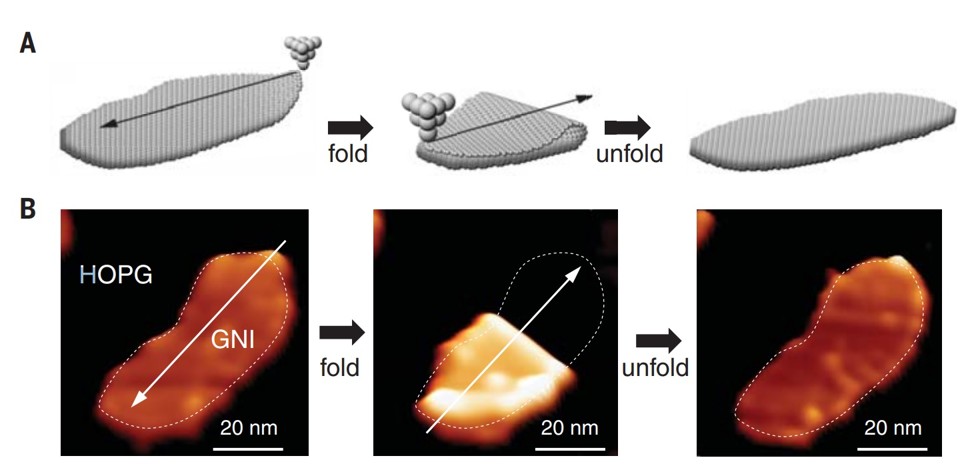
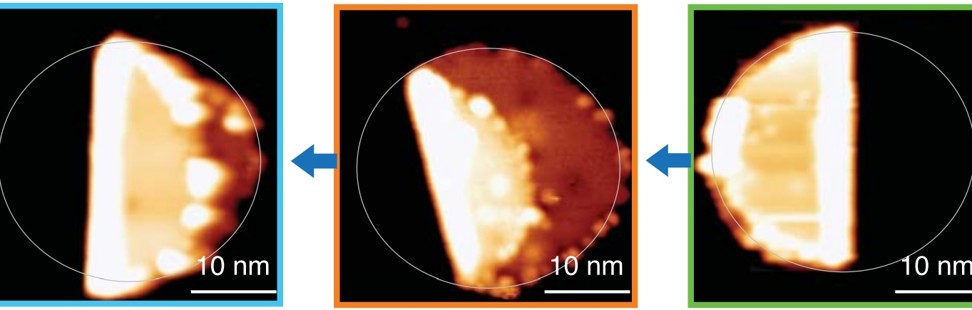
The team managed to fold a 20 nanometre wide sheet of graphene into various shapes and forms using an extremely sharp needle with a single electrically charged atom at the tip, according to a paper published in the latest edition of Science magazine.
The breakthrough could eventually enable a host of technological advances, including the development of faster and more powerful computer processors, the researchers said.
“This is the world’s smallest origami work,” said Dr Du Shixuan, the study’s lead scientist, adding that the team hoped to build on their success by making the graphene equivalent of a paper aeroplane.
Unlike previous experiments, in which the folding occurred randomly or by accident, the new technology allows scientists to control the transformation with atomic-scale accuracy, according to Du, from the Institute of Physics at the Chinese Academy of Sciences in Beijing.
Microscopic images of the graphene folding process. Photo: Handout
Zhang Gengmin, a professor of physics at Peking University, said the team had managed something that other scientists had spent years trying to achieve.
Zhang, who was not involved in the study, said part of the difficulty was that atomic particles were influenced by quantum mechanics, a branch of physics whose laws are counter-intuitive to our daily experience.
In practice this means that folding a graphene sheet in one direction might cause it go in another direction or simply break apart.
Could these crystals be the next leap forward in China’s laser technology?
The new technology developed by Du’s team could have some critical applications, according to Zhang, who works at the university’s nano devices laboratory.
For instance, folding a sheet of graphene – formed from a single layer of latticed carbon atoms – into a “magic angle” will make it superconductive, a unique physical state that allows electrons to pass through without any resistance.
“It is a significant piece of work,” he said.
The 20 nanometre wide sheet was folded into various shapes. Photo: Handout
The paper by Du’s team withheld some of the technical details of their experiment, which means that other scientists may not be able to replicate the process simply by reading the paper.
Du defended the secrecy as a standard practice and necessary measure to maintain China’s lead in this field.
She said that the team’s success was down to many factors – including the hardware used, the strength of the electric current and the experience of the operator – and there were also lessons to be taken from their previous failed attempts.
The researchers said they hoped the technology would be used to improve the design and manufacturing of computer processors.
Chinese, US scientists develop AI technology to help detect submarines in uncharted waters
At present, commercial processors are made using a large piece of silicon board known as a wafer.
But as the size of components such as transistors shrink, it has become increasingly difficult to improve the speed and performance of the computer due to the challenges of controlling the structure and properties of each component on a near-atomic scale
The new technology could give designers more freedom to develop a “dream chip” by building a central processing unit on an atom-by-atom basis from the bottom up.
But Du said the commercial application of the new technology could be years away.
Her team folded the graphene sheets manually, one at a time, but mass production would need the development of new manufacturing methods to do it automatically. At present “we are working on it”, Du added.
The fourth China-Arab States Expo is opened in Yinchuan, capital of northwest China’s Ningxia Hui Autonomous Region, Sept. 5, 2019. (Xinhua/Feng Kaihua)
YINCHUAN, Sept. 5 (Xinhua) — The fourth China-Arab States Expo opened Thursday in Yinchuan, capital of northwest China’s Ningxia Hui Autonomous Region.
The four-day event will feature trade fairs and forums on infrastructure, Internet plus healthcare, high technology, modern agriculture, logistics, tourism, digital economy and industrial cooperation.
Sponsored by the Ministry of Commerce, China Council for the Promotion of International Trade and Ningxia regional government, this year’s event attracts around 12,600 participants from 2,900 regional organizations, commerce chambers, associations and enterprises in 89 countries, according to the organizer of the expo.
ULAN BATOR, Sept. 2 (Xinhua) — A series of cultural events to celebrate the 70th anniversary of the establishment of diplomatic ties between China and Mongolia kicked off at the Mongolian National Modern Art Gallery here on Monday.
Hundreds of people from various fields of both countries, including Mongolian Minister of Education, Culture, Science and Sports Yondonperenlei Baatarbileg and Chinese Ambassador to Mongolia Xing Haiming attended the opening ceremony.
“We will relive the China-Mongolia friendship through more than 20 activities including cultural performances, exhibitions, exchanges of books, watching movies and TV series and free medical exams under a broader theme called ‘Feel China’ for the 70th anniversary of the establishment of diplomatic relations between China and Mongolia,” Xing said at the ceremony.
The ambassador noted that China attaches great importance to China-Mongolia relations and is willing to deepen the alignment of the China-proposed Belt and Road Initiative and Mongolia’s Development Road Program on the basis of equality and mutual benefit.
He expressed hope that the two countries will work together to boost the friendly and mutually beneficial cooperation that brings tangible benefits to the two countries and peoples.
For his part, Baatarbileg said that the culture of any country is a guarantee of independence and the value of its people.
“I have no doubt that the cultural events can give Mongolians a deeper understanding of China’s culture,” he said, noting that the Mongolian government will support any activities aimed at promoting the history and culture of the two countries.
Visitors can partake in martial arts training, craft traditional Chinese embroidery, attend film screenings and taste a variety of Chinese foods.
The events are co-organized by China’s State Council Information Office, China’s Inner Mongolia Autonomous Region, the Mongolian Ministry of Education, Culture, Science and Sports and governor’s office of the Mongolian capital Ulan Bator.
Chinese Vice President Wang Qishan meets with Peruvian Vice President Mercedes Araoz in Beijing, capital of China, Sept. 2, 2019. (Xinhua/Zhang Ling)
BEIJING, Sept. 2 (Xinhua) — Chinese Vice President Wang Qishan met here Monday with Peruvian Vice President Mercedes Araoz, who is in Beijing to attend relevant activities of the Beijing Horticultural Expo.
Wang spoke highly of the current bilateral relationship, saying that China is willing to further advance mutual understanding and trust and deepen cooperation to push the relationship to a higher level.
Araoz congratulated China on the 70th anniversary of the founding of the People’s Republic of China, and said her country is ready to deepen cooperation with China in such areas as trade and economy, investment, agriculture, poverty relief, science, technology and culture.











 CHINDIA ALERT: You'll be living in their world, very soon