18/05/2020
- Details remain scant one day after body of 57-year-old diplomat Du Wei is found at his home in Tel Aviv
- Top Israeli foreign ministry official extends condolences to deputy ambassador Dai Yuming
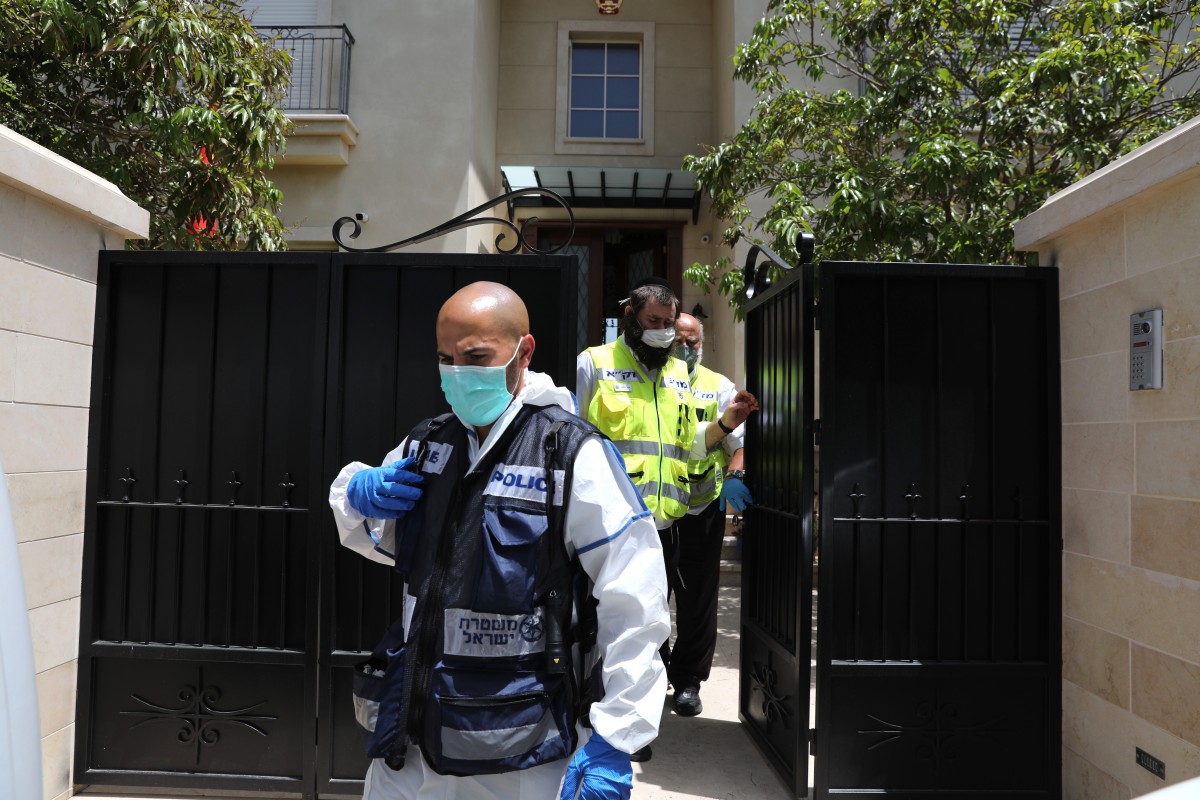
Police, ambulance and embassy staff at the residence where Chinese ambassador Du Wei was found dead on Sunday. Photo: EPA-EFE
China is sending a special investigative team to Israel following
the sudden death of its ambassador Du Wei, whose body was found at his residence on Sunday.
The team, accompanied by a member of Du’s family, was due to travel on Monday, and will handle arrangements for the remains, as well as conducting its own internal investigation, according to Israeli newspaper Haaretz.
Israel’s foreign ministry said its director general Yuval Rotem had spoken with deputy ambassador Dai Yuming to express his condolences. Local police are continuing to investigate at Du’s residence in a suburb of Herzliya, near Tel Aviv.
Details from the Chinese side have been scant. China’s foreign ministry provided a statement to AFP on Sunday which said the preliminary verdict was that Du, 57, had died unexpectedly for health reasons, and details awaited further confirmation. AFP also reported that Du’s wife and son were not with him in Tel Aviv.
“As far as I know, China’s ambassador to Israel Du Wei passed away in ambassador’s residence in Tel Aviv this morning for physical reasons. It happened abruptly,” said Hu Xijin, editor-in-chief of state media tabloid Global Times in a tweet late on Sunday night.
Du was last seen in public on Tuesday in a video conference with an official from Israel’s foreign affairs ministry, according to the embassy website.
James Dorsey, senior fellow at the S. Rajaratnam School of International Studies in Singapore, said Du’s untimely death should be seen as a personal, rather than a political, tragedy for the growing relationship between China and Israel, but he said it came at an important moment for the two countries because of rising US-China tensions.
Dorsey said Israel’s increasing hi-tech cooperation with China, as well as continuing US hostility to Iran – which has close ties with China – were potentially problematic for relations between the two countries.
“I’m not sure that the China-Israel relationship can be seen as independent of the Israel-US relationship. One could argue that the Chinese may be well advised to very quickly replace him soon,” Dorsey said. “Israel could find itself on the fault line of deepening US-China decoupling,” he added.
Israel’s ambassador to China in quarantine after ‘infected’ flight to Seoul
Following a brief trip to Jerusalem on Wednesday – his first foreign visit since March – US Secretary of State Mike Pompeo renewed warnings about China-Israel ties in an interview with Israeli state-owned media outlet Kan News.
“We do not want the Chinese Communist Party to have access to Israeli infrastructure, Israeli communication systems, all of the things that put Israeli citizens at risk,” he said.
China’s embassy in Tel Aviv blasted Pompeo’s comments as “absurd” and “ill-intentioned”. However, the embassy statement was not written by Du, but by a spokesperson.
Du had only served in Israel since February. Just before his arrival,
the Chinese embassy had to issue an apology after then-acting ambassador Dai denounced Israel’s tightened restrictions on Chinese visitors by comparing them to the Holocaust.
During his brief tenure, Du gave frequent interviews to local media, speaking mainly about China’s virus control measures, US-China tensions, and friendship between China and the Jewish people.
Du had worked as a career diplomat since entering China’s foreign service in 1989. Before his appointment in Tel Aviv, he served as China’s ambassador to Ukraine from 2016-2019.
Source: SCMP
Posted in ambassadors, Ambulance, career diplomat, China, Chinese ambassador, chinese communist party, condolences, dead, Death, diplomat, embassy staff, foreign ministry official, Global Times, Holocaust, investigation, Israel, Israeli communication systems, Israeli infrastructure, Jerusalem, Mike Pompeo, Police, quarantine, residence, S. Rajaratnam School of International Studies, sends, Singapore, special, Sunday, team, Tel Aviv, Ukraine, Uncategorized, US Secretary of State |
Leave a Comment »
16/03/2020
- South Africa, Kenya latest to halt arrivals from ‘high-risk’ countries as cases across the continent double over the weekend
- Concerns are growing over whether health care systems in some African nations will be able to cope
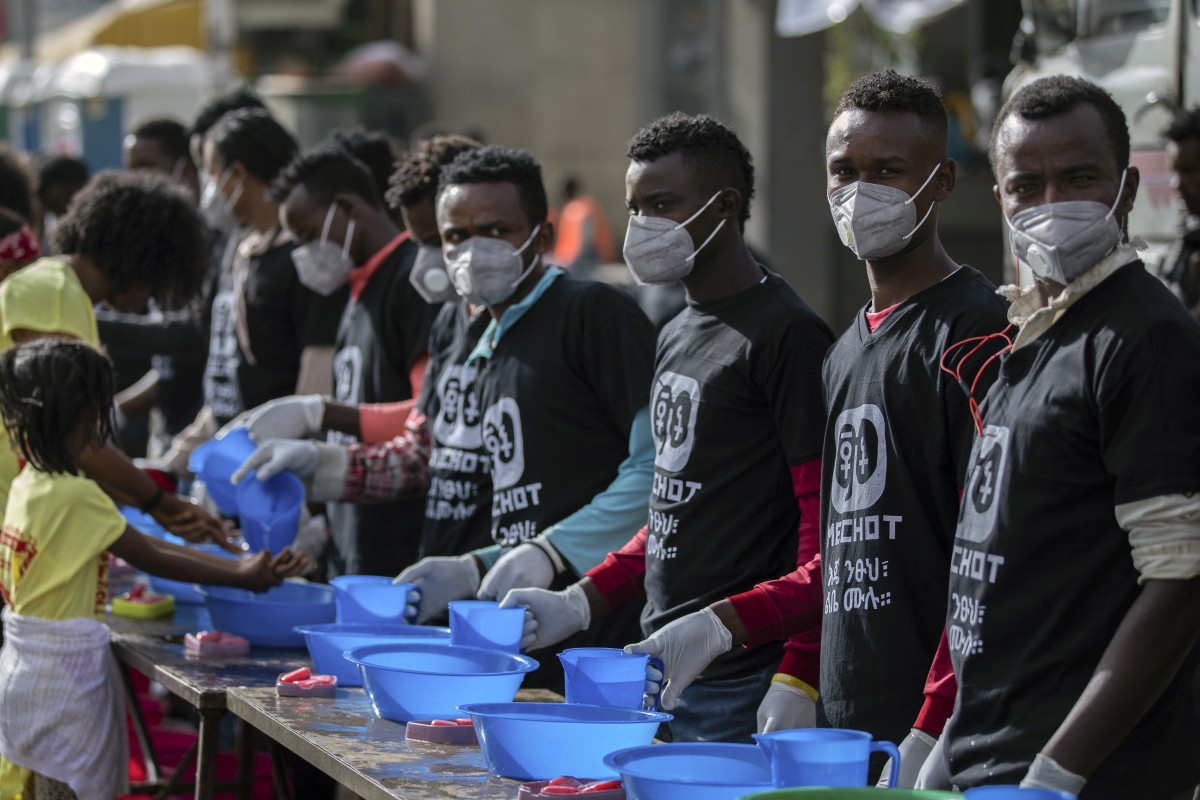
Masked volunteers provide soap and water for participants to wash their hands against the new coronavirus at a women’s 5km fun run in Addis Ababa, Ethiopia on Sunday. Photo: AP
Travel bans and school closures were announced in South Africa and Kenya on Sunday, as concerns grew over the capacity of the continent’s fragile health systems to cope with the spread of the deadly new
coronavirus, with more than a dozen countries reporting their first cases.
South African President Cyril Ramaphosa declared a national state of disaster, banning arrivals by foreign nationals from high-risk countries including Italy, Iran, South Korea, Spain, Germany, the United States, Britain and China, effective Wednesday.
“We have cancelled visas to visitors from those countries from today and previously granted visas are hereby revoked,” Ramaphosa said in a televised address on Sunday evening, adding that any foreign national who had visited high-risk countries in the past 20 days would be denied a visa.
South African schools will also be closed from Wednesday until after the Easter weekend. Gatherings of more than 100 people have been banned and mass celebrations for Human Rights Day and other events cancelled. “Never before in the history of our democracy has our country been confronted with such a severe situation,” Ramaphosa said.
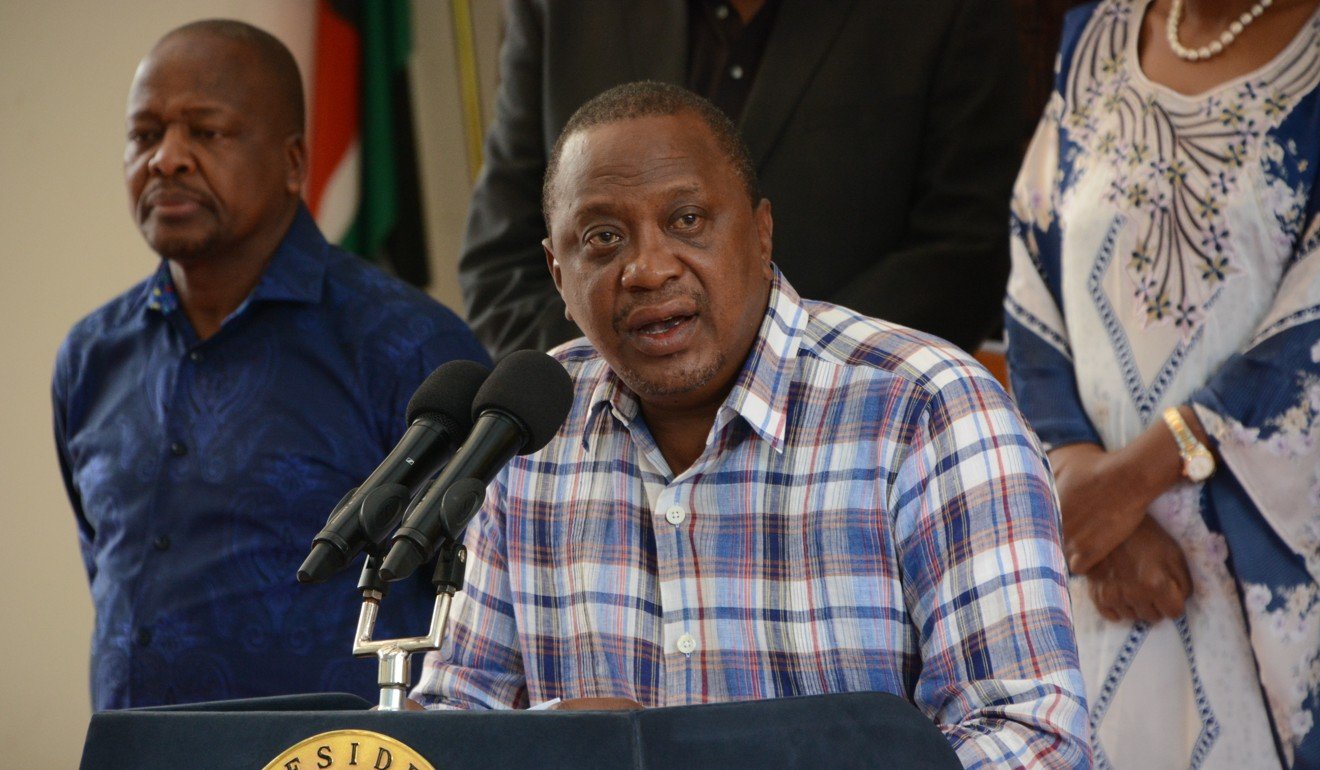
In Kenya, where three cases of Covid-19 – the disease caused by the new coronavirus – have now been confirmed, President Uhuru Kenyatta suspended travel from any country with reported infections. Only Kenyan citizens and foreigners with valid residency permits would be allowed entry, provided they proceeded to self-quarantine or a government-designated quarantine facility, he said.
Kenyan President Uhuru Kenyatta reports two more cases of coronavirus in the country, bringing its total number of cases to three. Photo: DPA
Kenyatta also suspended learning in all educational institutions with immediate effect. “Some of the measures may cause inconvenience, but I want to assure you they are designed to ensure that we effectively contain the spread of the virus,” he said.
Kenya and South Africa join Ghana, Rwanda and Morocco in implementing travel restrictions or outright bans, while others are closing churches, museums, sporting activities, nightclubs and tourist attractions in a bid to curb the spread of the disease.
The continent was largely spared in the early days of the outbreak but has now recorded more than 300 cases and six deaths. Algeria, Morocco, Senegal and Tunisia all reported more new cases over the weekend, which saw numbers of new infections across Africa more than double in just two days.
As numbers rise, the Africa Centres for Disease Control and Prevention (CDC) has said there are around a dozen countries on the continent without the capacity to do their own testing.
They will have to send samples to countries like South Africa, which itself is struggling to contain the virus, with confirmed cases doubling to 61 on Sunday, a day after 114 of its citizens were repatriated from the central Chinese city of Wuhan, the original epicentre of the outbreak and the first to be placed in lockdown.
John Nkengasong, director of the Africa CDC, warned that the risk of other African countries detecting new cases of Covid-19 remained high. “Our strategy is clear: we want to capacitate the member states, so they can quickly detect and mitigate the effects of the disease in Africa, and, if widespread transmission occurs, prevent severe illness and death,” he said.
The World Health Organisation has already warned that critical gaps remain in the capacity of many African nations to trace, detect and treat the disease. On Friday, the WHO Africa office said it was “striving to help member states fill these gaps” but warned of global shortages in personal protective equipment (PPE) including gloves, masks and hand sanitiser.
Major coronavirus outbreak in Africa ‘just a matter of time’
WHO said its first blanket distribution of PPEs, to 24 African countries, had been completed and another wave of distributions was planned.
“With Covid-19 officially declared a pandemic, all countries in Africa must act,” said Dr Matshidiso Moeti, WHO regional director for Africa. “Every country can still change the course of this pandemic by scaling up their emergency preparedness or response.
“Cases may still be low in Africa and we can keep it that way with robust all-of-government actions to fight the new coronavirus.”
The 55 member states of the African Union have suspended meetings until May, while the six countries that make up the East African Community have suspended all planned meetings until further notice.
Coronavirus delays Nigeria’s US$1.5 billion Chinese-built rail project
In Algeria – one of the worst-hit North African countries, with 48 cases and four deaths, as of Monday morning – all schools and universities have been closed, while Senegal, with 24 cases to date, has closed schools and cancelled its Independence Day festivities on April 4, which this year marks 60 years since its independence from France. Cruise ships have also been banned from docking in Senegal.
On Sunday, Rwanda closed all its places of worship and suspended large gatherings such as weddings and sporting activities. Schools and universities in the central African country are also closed. National airline RwandAir has also suspended flights between the capital Kigali and Mumbai until April 30.
This is in addition to earlier suspensions of its routes with Tel Aviv and the southern Chinese city of Guangzhou, which remain in place until further notice.
While most African airlines have suspended flights to cities in mainland China, Ethiopian Airlines has continued flying to most of its destinations, describing its China routes as among its most profitable. Nevertheless, chief executive Tewolde GebreMariam last week said coronavirus fears had cut demand by a fifth on most of its routes.
Source: Reuters
Posted in Addis Ababa, africa, Africa Centres for Disease Control and Prevention (CDC), Algeria, Britain, capital, China, Chinese-built rail project, churches, closures, contain, continent, coronavirus, countries, COVID-19, Disease, East African Community, Ethiopia, Ethiopian Airlines, Fears, France, Germany, Ghana, gloves, Guangzhou, hand sanitiser, iran, Italy, Kenya, Kenyan president, Kigali, masks, Morocco, move, mumbai, museums, National airline RwandAir, Nigeria’s, nightclubs, pandemic, personal protective equipment (PPE), places of worship, quickly, routes, Rwanda, schools, Senegal, South Africa, South Korea, Spain, sporting activities, spreads, Tel Aviv, TRAVEL BANS, Tunisia, Uhuru Kenyatta, Uncategorized, United States, universities, Weddings, World Health Organisation, Wuhan |
Leave a Comment »




 CHINDIA ALERT: You'll be living in their world, very soon