Archive for ‘Tesla’

01/02/2020

Coronavirus declared global health emergency by WHO

The new coronavirus has been declared a global emergency by the World Health Organization, as the outbreak continues to spread outside China.

“The main reason for this declaration is not what is happening in China but what is happening in other countries,” said WHO chief Tedros Adhanom Ghebreyesus.

The concern is that it could spread to countries with weaker health systems.

Meanwhile, the US has told its citizens not to travel to China.

The state department issued a level four warning – having previously urged Americans to “reconsider” travel to China – and said any citizens in China “should consider departing using commercial means”.

China has said it will send charter plans to bring back Hubei province residents who are overseas “as soon as possible”.

A foreign ministry spokesman said this was because of the “practical difficulties” Chinese citizens have faced abroad. Hubei is where the virus emerged.

At least 213 people in the China have died from the virus, mostly in Hubei, with almost 10,000 cases nationally.

The WHO said there had been 98 cases in 18 other countries, but no deaths.

Most international cases are in people who had been to Wuhan in Hubei.

However in eight cases – in Germany, Japan, Vietnam and the United States – patients were infected by people who had travelled to China.

People wearing masks

Getty Coronavirus outbreak outside China
  • 18 The number of countries with cases
  • 14 Cases in Thailand and Japan
  • 13 Singapore
  • 11 South Korea
  • 8 Australia and Malaysia
  • 5 France and USA

Source: WHO and local authorities

Speaking at a news conference in Geneva, Dr Tedros described the virus as an “unprecedented outbreak” that has been met with an “unprecedented response”.

He praised the “extraordinary measures” Chinese authorities had taken, and said there was no reason to limit trade or travel to China.

“Let me be clear, this declaration is not a vote of no confidence in China,” he said.

But various countries have taken steps to close borders or cancel flights, and companies like Google, Ikea, Starbucks and Tesla have closed their shops or stopped operations.

The US Commerce Secretary, Wilbur Ross, has said the outbreak could “accelerate the return of jobs to North America”.

Presentational grey line

Preparing other countries

Analysis box by James Gallagher, health and science correspondent

What happens if this virus finds its way into a country that cannot cope?

Many low- and middle-income countries simply lack the tools to spot or contain it. The fear is it could spread uncontrollably and that it may go unnoticed for some time.

Remember this is a disease which emerged only last month – and yet there are already almost 10,000 confirmed cases in China.

The 2014 Ebola outbreak in West Africa – the largest in human history – showed how easily poorer countries can be overwhelmed by such outbreaks.

And if novel coronavirus gets a significant foothold in such places, then it would be incredibly difficult to contain.

We are not at that stage yet – 99% of cases are in China and the WHO is convinced the country can control the outbreak there.

But declaring a global emergency allows the WHO to support lower- and middle-income countries to strengthen their disease surveillance – and prepare them for cases.

Presentational grey line

How unusual is this declaration?

The WHO declares a Public Health Emergency of International Concern when there is “an extraordinary event which is determined… to constitute a public health risk to other states through the international spread of disease”.

It has previously declared five global public health emergencies:

  • Swine flu, 2009 – The H1N1 virus spread across the world in 2009, with death toll estimates ranging from 123,000 to 575,400
  • Polio, 2014 – Although closer than ever to eradication in 2012, polio numbers rose in 2013
  • Zika, 2016 – The WHO declared Zika a public health emergency in 2016 after the disease spread rapidly through the Americas
  • Ebola, 2014 and 2019 – The first emergency over the virus lasted from August 2014 to March 2016 as almost 30,000 people were infected and more than 11,000 died in West Africa. A second emergency was declared last year as an outbreak spread in DR Congo

Media caption Inside the US laboratory developing a coronavirus vaccine

How is China handling the outbreak?

A confirmed case in Tibet means the virus has reached every region in mainland China. According to the country’s National Health Commission, 9,692 cases have tested positive.

The central province of Hubei, where nearly all deaths have occurred, is in a state of lockdown. The province of 60 million people is home to Wuhan, the heart of the outbreak.

The city has effectively been sealed off and China has put numerous transport restrictions in place to curb the spread of the virus.
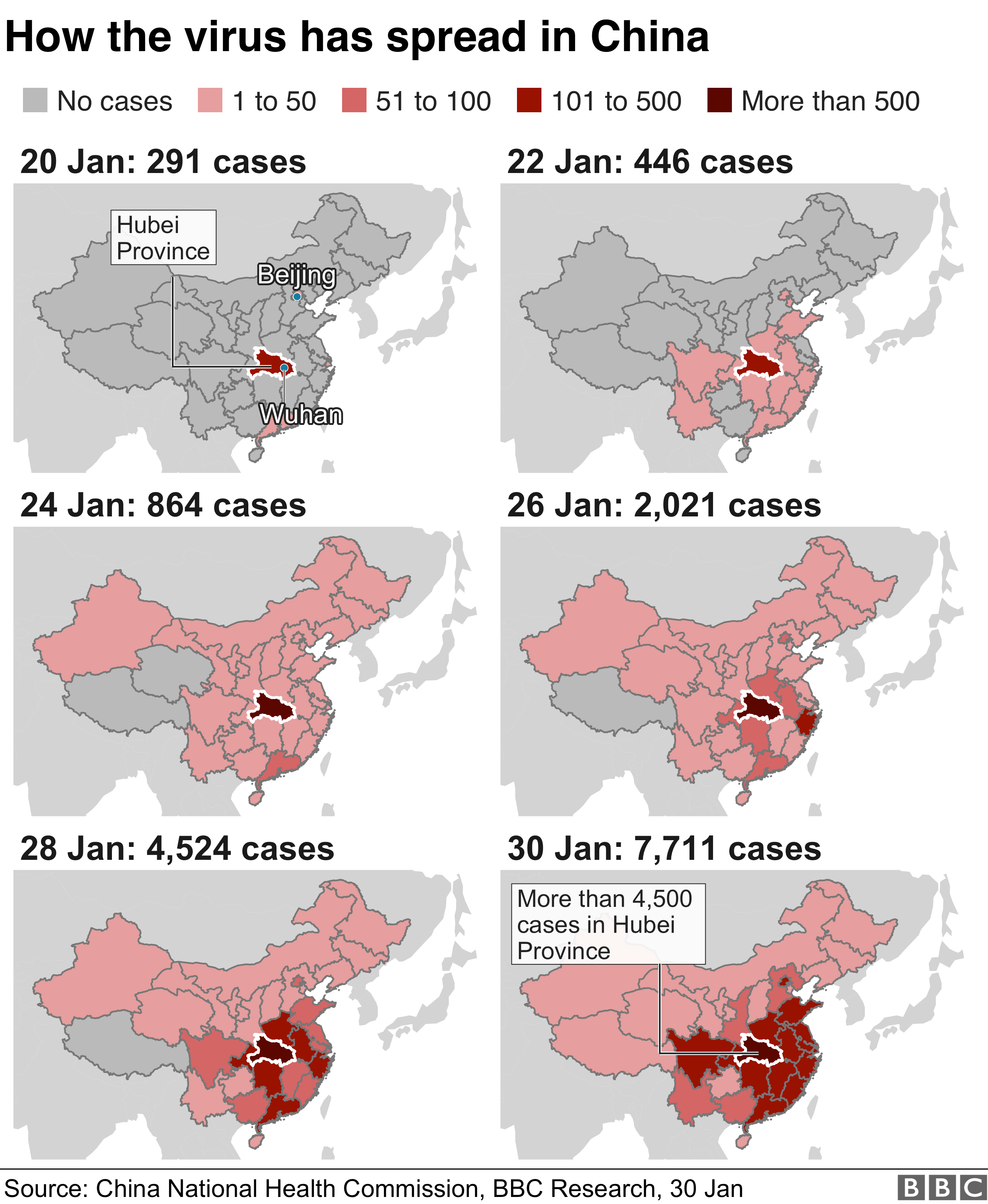
Coronavirus cases have spread to every province in China. There are now 7711 cases compared to 291 on 20 Jan. Hubei province has more than 4500 cases.
People who have been in Hubei are also being told to work from home until it is considered safe for them to return.

The virus is affecting China’s economy, the world’s second-largest, with a growing number of countries advising their citizens to avoid all non-essential travel to the country.

How is the world responding?

Voluntary evacuations of hundreds of foreign nationals from Wuhan are under way.

The UK, Australia, South Korea, Singapore and New Zealand are expected to quarantine all evacuees for two weeks to monitor them for symptoms and avoid contagion.

Australia plans to quarantine its evacuees on Christmas Island, 2,000km (1,200 miles) from the mainland in a detention centre that has been used to house asylum seekers.

In other recent developments:

  • Italy suspended flights to China after two Chinese tourists in Rome were diagnosed with the virus; earlier 6,000 people on board a cruise ship were temporarily barred from disembarking
  • In the US, Chicago health officials have reported the first US case of human-to-human transmission. Around 200 US citizens have been flown out of Wuhan and are being isolated at a Californian military base for at least 72 hours
  • Russia has decided to close its 4,300km (2,670-mile) far-eastern border with China
  • Two flights to Japan have already landed in Tokyo. Japan has now raised its infectious disease advisory level for China
  • Some 250 French nationals have been evacuated from Wuhan
  • India has confirmed its first case of the virus – a student in the southern state of Kerala who was studying in Wuhan
  • Israel has barred all flight connections with China
  • Papua New Guinea has banned all visitors from “Asian ports”
  • North Korea will suspend all flights and trains to and from China, said the British ambassador to North Korea

Source: The BBC

23/12/2019

Exclusive: Tesla to take new $1.4 billion loan from Chinese banks for Shanghai factory: sources

BEIJING/SHANGHAI (Reuters) – U.S. electric vehicle maker Tesla Inc (TSLA.O) and a group of China banks have agreed a new 10 billion yuan (1.08 billion pounds), five-year loan facility for the automaker’s Shanghai car plant, three sources familiar with the matter said, part of which will be used to roll over an existing loan.

China Construction Bank (0939.HK) (601939.SS) (CCB), Agricultural Bank of China (1288.HK) (601288.SS) (AgBank), Industrial and Commercial Bank of China (601398.SS) (1398.HK) (ICBC) and Shanghai Pudong Development Bank (600000.SS) (SPDB) are among the banks which have agreed to give Tesla the financial support, one source with direct knowledge said.

The Chinese banks earlier this year already offered Tesla a 12-month facility of up to 3.5 billion yuan, which is due to be repaid on March 4, 2020, according to a filing the automaker made to the U.S. Securities and Exchange Commission.

That new loan will be partially used to roll over the previous 3.5 billion yuan debt, according to the first source. The second source said the rest will be used on the factory and Tesla’s China operations.

The new loan’s interest rate will be pegged at 90% of China’s one-year benchmark interest rate, the same as the 3.5 billion yuan loan, the first source said. This is a rate that China banks offer to their best clients.

Tesla, CCB, AgBank, ICBC and SPDB did not immediately respond to Reuters’ requests for comment.

Tesla broke ground on the factory in January and has started producing vehicles from its Shanghai plant. It aims to build at least 1,000 Model 3 cars a week by the end of this year.

The factory, which is Tesla’s first car manufacturing site outside the United States, is the centerpiece of its ambitions to boost sales in the world’s biggest auto market and avoid higher import tariffs imposed on U.S.-made cars.

The Shanghai government has also thrown its support behind the Tesla project, which would be China’s first wholly foreign-owned car plant and a reflection of the government’s broader shift to open up its car market.

($1 = 7.0119 Chinese yuan)

Source: Reuters

24/09/2019

European firms are on the lookout for tangible incentives before embracing Shanghai’s expanded free trade zone in Lingang

  • Shanghai’s authorities have doubled the free-trade zone to 240 square kilometres by including part of Lingang, a previously untapped area linked to the Yangshan deep water port
  • The expansion reflected the city’s renewed efforts to build a free marketplace that can rival regional business hubs such as Hong Kong and Singapore
Aerial photo taken on March 9, 2017 shows the Shanghai free trade zone (FTZ). Photo: Xinhua

Shanghai’s ambitious plan to turn Lingang into a Hong Kong-style free-trade port has yet to impress European companies due to a slow pace of enforcement with a series of liberalisations subject to Beijing’s approval.

The European Union Chamber of Commerce in Shanghai said on Tuesday that the business lobby group was expecting concrete measures to be implemented at the 119.5-square kilometre newly expanded free-trade zone (FTZ), which would whet European companies’ investment appetite, but it also vented dismay towards the slow progress.

It was advisable for the government to carry out planned reforms sooner to convince foreign investors of the golden opportunities inside the zone, said Carlo Diego D’Andrea, the chamber’s Shanghai chairman, who is also vice-president of the EU business chamber in China.

“After so many years [of waiting], we would like to see reform happen soon, not just the talks,” he said in an interview with South China Morning Post.

Shanghai doubled the size of the free-trade zone last month to about 240 sq km by including part of Lingang, a previously untapped area that is linked to the Yangshan deep water port.

The expansion reflected the city’s renewed efforts to build a free marketplace that can rival regional business hubs such as Hong Kong and Singapore.

Where is China’s Silicon Valley? SCMP Graphics
Hong Kong’s ongoing street protests against a controversial extradition bill have wreaked havoc on the city’s economy and brought an opportunity to mainland metropolises such as Shanghai and Shenzhen to catch up with the special administrative region.
Shanghai plans to impose zero tariffs on imported goods inside the Lingang FTZ, but the reform measures cannot be implemented unless the General Administration of Customs gives a green light.

Shanghai’s city government had proposed a series of incentives aimed at building Lingang into a world-class investment magnet, the free-trade zone’s deputy director Wu Wei said at a Friday press conference, without elaborating on when the policies might be endorsed by the relevant ministry-level authorities.

Professor Zhou Zhenhua, president of Shanghai Academy of Global Cities, said the central government was still cautious of taking drastic steps in quickly liberalising the Lingang FTZ amid worries of rampant capital and cargo flows.

Interactive Infographics: China’s tiered city classifications
US bestselling electric vehicle maker Tesla has built its Gigafactory 3 at the Lingang FTZ after it secured an approval from Beijing to establish a wholly owned assembly plant late last year.
The approval for the first wholly-owned foreign car factory on mainland China coincided with a sales drop in the country’s automobile market, the first contraction in nearly three decades.
“Why could not you have opened the market before when the market was booming,” said D’Andrea.
He said that the timing of scrapping the foreign ownership cap amid the first negative growth of the domestic car market in three decades was not enough to show Beijing’s determinations in drawing overseas funds.
Beijing has been harping on its resolution in further opening up the markets to foreign businesses as a way of amid the US-China trade war that began in 2018.
Source: SCMP
18/09/2019

Explainer: Why Asia’s biggest economies are backing hydrogen fuel cell cars

TOKYO (Reuters) – China, Japan and South Korea have set ambitious targets to put millions of hydrogen-powered vehicles on their roads by the end of the next decade at a cost of billions of dollars.

But to date, hydrogen fuel cell vehicles (FCVs) have been upstaged by electric vehicles, which are increasingly becoming a mainstream option due to the success of Tesla Inc’s (TSLA.O) luxury cars as well as sales and production quotas set by China.

Critics argue FCVs may never amount to more than a niche technology. But proponents counter hydrogen is the cleanest energy source for autos available and that with time and more refueling infrastructure, it will gain acceptance.

AMBITIOUS TARGETS

China, far and away the world’s biggest auto market with some 28 million vehicles sold annually, is aiming for more than 1 million FCVs in service by 2030. That compares with just 1,500 or so now, most of which are buses.

Japan, a market of more than 5 million vehicles annually, wants to have 800,000 FCVs sold by that time from around 3,400 currently.

South Korea, which has a car market just one third the size of Japan, has set a target of 850,000 vehicles on the road by 2030. But as of end-2018, fewer than 900 have been sold.

WHY HYDROGEN?

Hydrogen’s proponents point to how clean it is as an energy source as water and heat are the only byproducts and how it can be made from a number of sources, including methane, coal, water, even garbage. Resource-poor Japan sees hydrogen as a way to greater energy security.

They also argue that driving ranges and refueling times for FCVs are comparable to gasoline cars, whereas EVs require hours to recharge and provide only a few hundred kilometers of range.

Many backers in China and Japan see FCVs as complementing EVs rather than replacing them. In general, hydrogen is seen as the more efficient choice for heavier vehicles that drive longer distances, hence the current emphasis on city buses.

THE MAIN PLAYERS

Only a handful of automakers have made fuel cell passenger cars commercially available.

Toyota Motor Corp (7203.T) launched the Mirai sedan at the end of 2014, but has sold fewer than 10,000 globally. Hyundai Motor Co (005380.KS) has offered the Nexo crossover since March last year and has sold just under 2,900 worldwide. It had sales of around 900 for its previous FCV model, the Tucson.

Honda Motor Co Ltd’s (7267.T) Clarity Fuel Cell is available for lease, while Daimler AG’s GLC F-CELL has been delivered to a handful of corporate and public sector clients.
Buses are seeing more demand. Both Toyota and Hyundai have offerings and have begun selling fuel cell components to bus makers, particularly in China.
Several Chinese manufacturers have developed their own buses, notably state-owned SAIC Motor (600104.SS), the nation’s biggest automaker, and Geely Auto Group, which also owns the Volvo Cars and Lotus brands.

WHY HAVEN’T FUEL CELL CARS CAUGHT ON YET?

A lack of refueling stations, which are costly to build, is usually cited as the biggest obstacle to widespread adoption of FCVs. At the same time, the main reason cited for the lack of refueling infrastructure is that there are not enough FCVs to make them profitable.

Consumer worries about the risk of explosions are also a big hurdle and residents in Japan and South Korea have protested against the construction of hydrogen stations. This year, a hydrogen tank explosion in South Korea killed two people, which was followed by a blast at a Norway hydrogen station.

Then there’s the cost. Heavy subsidies are needed to bring prices down to levels of gasoline-powered cars. Toyota’s Mirai costs consumers just over 5 million yen ($46,200) after subsidies of 2.25 million yen. That’s still about 50% more than a Camry.

Automakers contend that once sales volumes increase, economies of scale will make subsidies unnecessary.

HOW FUEL CELLS WORK

(GRAPHIC: How fuel cell vehicles work: here)

Reuters Graphic
Source: Reuters
31/08/2019

AI face-off: Alibaba’s Jack Ma sees new human chapter while Tesla’s Elon Musk frets about machine control

  • Shanghai AI conference has attracted executives from nearly 300 companies including US firms Intel, IBM, Microsoft and Qualcomm
  • Ma is mainly an AI optimist, whereas Musk has sounded several warnings on the topic
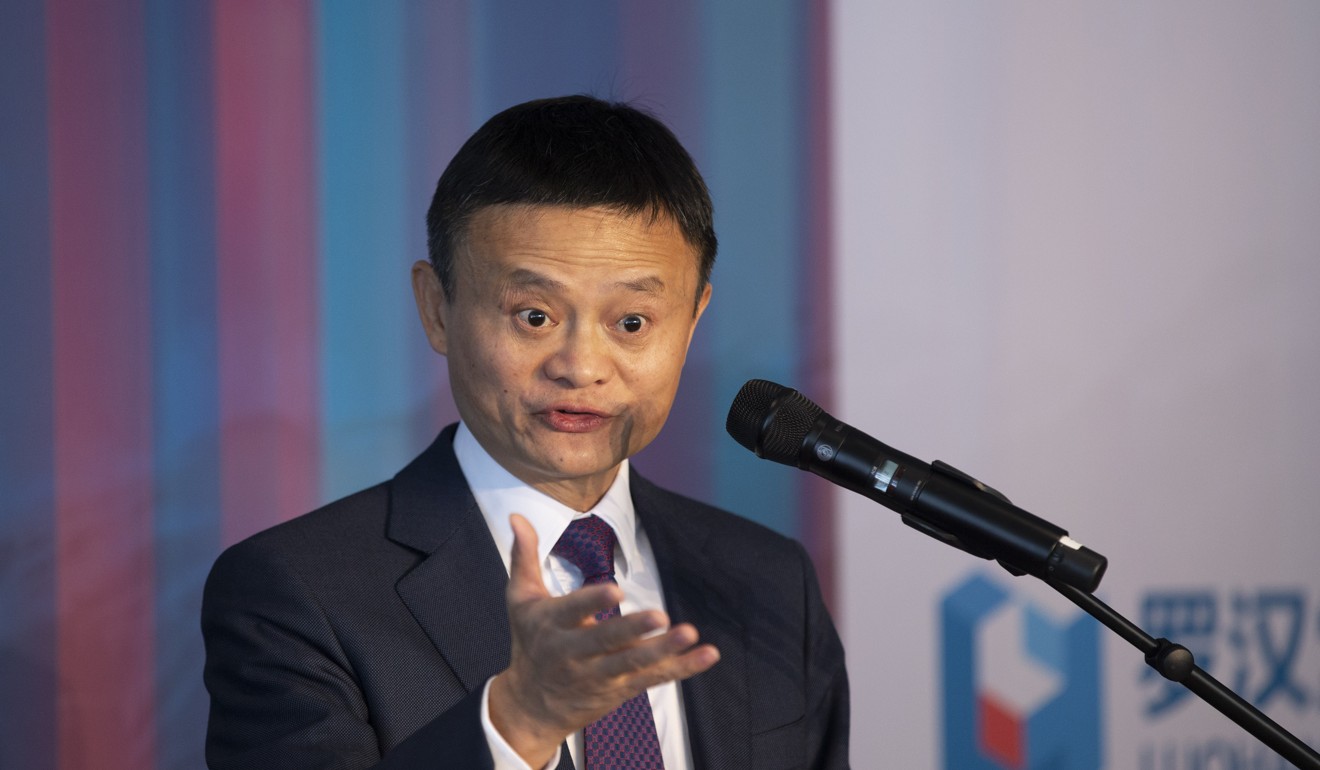
Elon Musk and Jack Ma face off over AI at the 2019 Shanghai WAIC. Photo: SCMP

Billionaire techpreneurs Jack Ma and Elon Musk faced off over AI in a much-anticipated morning session at the Shanghai World Artificial Intelligence Conference on Thursday, and although sparks didn’t actually fly it was clear to the packed audience that they each have a different vision of the future.

“AI will open a new chapter so that humans will know themselves better,” said Jack Ma, Alibaba Group Holding founder. “Most of the projections about AI are wrong … people who are street-smart about AI are not scared by it.”

The conference has attracted executives from nearly 300 companies including US firms Intel, IBM, Microsoft and Qualcomm as well as scientists and scholars from across the world. Both men had to condense their visions of the future into a compact 45-minute session, which also included answering a series of pre-prepared questions from Chinese netizens.

“Due to AI, people will have more time to enjoy themselves as a human being … forget long days, we could end up with 12-hour work weeks,” said Ma. “I don’t worry too much about the impact of AI on jobs … in the future we will not need a lot of jobs.”

Musk, who has founded a string of tech ventures including SpaceX, Boring Company and Neuralink aside from his role as co-founder and CEO of Tesla, said he had heard that “AI sounds like love in Chinese” but in a more cautious tone described AI as “much more than just a smart human”.

“Humans may become too slow. A millisecond is an eternity to a computer today,” said Musk, who has championed everything from electric cars to Mars colonies. “Computers are already smarter than human beings in many aspects,” he said, adding that while humans write AI software today, in the end the machine will do this itself.

Alibaba co-founder and chairman Jack Ma speaks at the 2019 World Economic Forum (WEF) annual meeting in Davos. Photo: Xinhua

The comments from the two executives, who are both engaged in industries [e-commerce and autonomous driving] where AI is essential – were largely in line with what they have said before on the topic. Ma is mainly an optimist, seeing AI as an inevitable agent of change in a digital world, whereas Musk has sounded several warnings.

In 2017, Musk – along with 100 robotics and AI leaders – urged the United Nations to take action against the dangers of autonomous weapons, known as “killer robots”. He has also described AI as humanity’s “biggest existential threat”, comparing it to “summoning the demon”.

AI cannot replace me yet, says Esquire magazine editor
Earlier in the week, Ma said that amid an escalating trade and technology war between the US and China, both countries needed to make a concerted effort to work together on technology for the world to benefit from the digital era.
“In the smart era, it is almost impossible for anyone to strike out on their own,” Ma said in a speech at the Smart China Expo in Chongqing on Monday. “Only if China and the US work together on technology, can we enter the digital era together.”
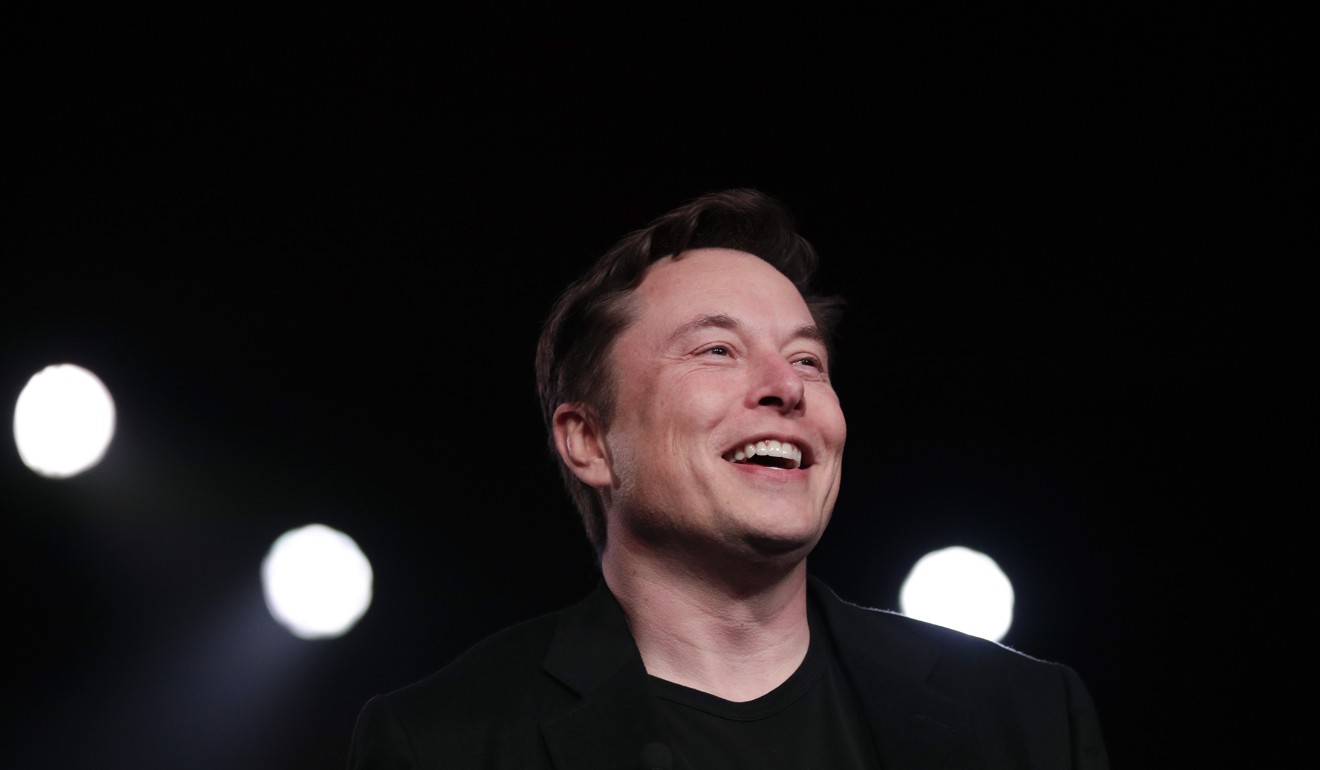
Tesla CEO Elon Musk, 2019. Photo: AP

Chinese Vice-Premier Liu He, Beijing’s top trade negotiator said on Monday at a conference that an escalation of the trade war was not in anyone’s interests. US tariffs on some US$300 billion worth of Chinese imports – mostly consumer goods – are expected to increase from 10 to 15 per cent later this year, in retaliation to China’s decision last week to impose tariffs of between 5 to 10 per cent on US$75 billion worth of American products including soybeans, pork and crude oil.

Automobiles is one of the most high-profile sectors to be affected by the trade war, and US President Donald Trump has highlighted the tariff gap between the US and China on imported cars in earlier comments.

Minority Report-style crime prevention is fast becoming reality

Founded in 2003, Tesla is currently building its first overseas factory in Shanghai, which is nearing completion and expected to start production by the year end with an initial annual output of 250,000 vehicles.

China is Tesla’s second largest market after the US. The California-based electric car-maker reported an over 40 per cent year-on-year surge in sales generated in the country to nearly US$1.5 billion in the first six months of the year.

Musk is expected to visit the US$5 billion production facility in Lingang, part of Shanghai’s free-trade zone, amid his China trip and launch a China unit for his infrastructure start-up Boring, as announced earlier on Twitter.

Source: SCMP

04/07/2019

China’s top talent now wants to work for rising domestic tech stars, not big brand multinationals

  • China’s talent is turning away from multinationals and towards domestic tech champions in the search for a more fulfilling career
  • Change in sentiment comes amid raging US-China tech war and perceptions of ‘bamboo ceiling’ in the West
An increasing number of Chinese jobseekers are looking towards domestic tech firms. Image: SCMP
Molly Liu left her hometown Beijing to pursue a master’s degree in the United States in the 1990s.
After graduation, she fought hard to win an entry-level position at a US-based consultancy and after a period was later sent back to China to help the company’s expansion.
In the land of opportunity, the ambitious US firm showered her with avenues to pursue her career and she ended up working in Hong Kong as well as being one of the first people on the ground for the consultancy in Shanghai, Beijing, Taipei and Singapore.
Times have changed, though. Recently, her only son, Ben Zhang, turned down a hard-to-get job offer from a Boeing subsidiary in the US after gaining a master’s degree in computer science from Carnegie Mellon University in Pittsburgh, Pennsylvania.
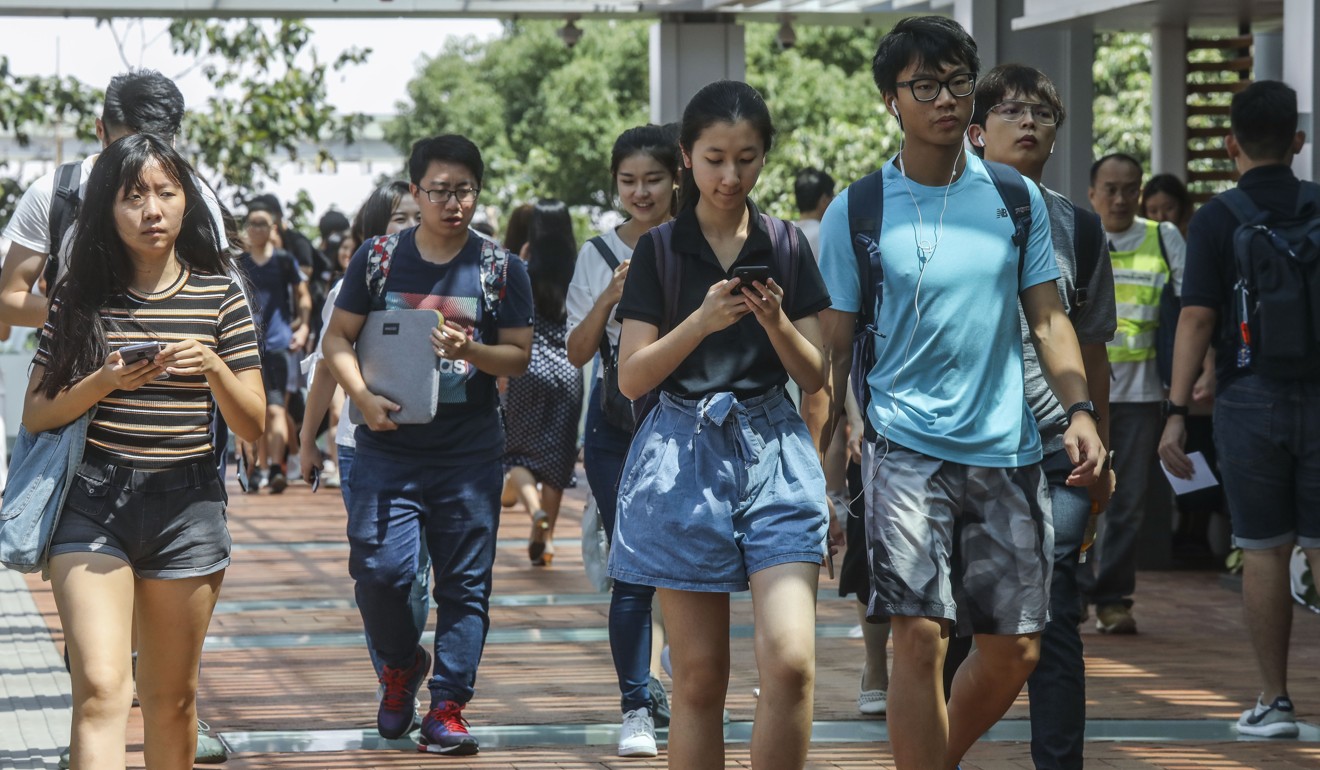
Chinese students educated in the US are now looking more at jobs in China. Photo: SCMP

He decided to return to Beijing in 2018 and now works as a product manager at Chinese smartphone maker Xiaomi. He is convinced that the start-up turned tech major can offer him the same sort of opportunities today that the US tech consultancy offered his mother in the 1990s.

This family story about the career choices of two different generations of US-educated Chinese students reflects a wider trend. Once upon a time, US corporations could cherry-pick top Chinese talent from American universities with the promise of large salaries, generous benefits and the chance to work at market-leading organisations.

Today, China’s cutting-edge technology companies – often referred to as China Tech Corporation (CTC) – are the most sought-after employers among many Chinese students, who want more than just a cushy life.

This marks another blow for multinational corporations (MNCs) already struggling to do business in China amid a myriad of restrictions and growing hostility towards them as the US-China trade and tech war gathers pace.

“What I look for in a job is not money. My parents are not counting on me to support them,” says 28-year-old Zhang, whose team in Xiaomi is working on a wide array of connected devices, from televisions to lamps to smart locks. “What I care about most is personal improvement and access to the best resources a company can offer.”

“In Boeing, I could probably work on a new product once every two to three years. But at Xiaomi, every three months, we can roll out a new product,” he added. “You can bring so many things into people’s everyday lives in China, like using your voice to control a TV or an air conditioner – things you can only imagine in the US.”

Zhang is not alone and many Chinese today perceive a “bamboo ceiling” in the US, where they are more often seen as engineers rather than executives.

One Chinese executive who now oversees the technology unit of a listed finance and insurance firm in China said that he used to lead a team of 20 engineers at one of the world’s most valuable tech companies in Silicon Valley.

“My job was to keep optimising the performance of a product [in Silicon Valley],” he said.

“But within three years in China, I was promoted to the chief scientist of our entire company, leading a team of 1,000,” said the man, who asked to remain anonymous as some of his family still reside in the US.

How Trump’s assault on Huawei is forcing the world to contemplate a digital iron curtain

According to an April survey by professional networking site LinkedIn, an increasing number of Chinese jobseekers share Zhang’s outlook. LinkedIn compiled a list of the top 25 most desired employers in China, and about 60 per cent were local Chinese companies, with 13 of them internet firms.

CTC bagged four of the top five spots, with e-commerce giant Alibaba, search giant operator Baidu and Bytedance – which operates short video hit TikTok – taking the lead.

Tesla ranked sixth behind its Chinese challenger Nio. Amazon, the only other foreign company in the top ten, ranked eighth.

Alibaba is the owner of the South China Morning Post.

Li Qiang, executive vice-president of Zhaopin, one of China’s largest online recruiters, described the rising status of CTC among jobseekers as “the dawning of a new era”.

“Nowadays, there is nothing a multinational can offer that a domestic firm cannot, be it a compensation package or the chance to be part of international expansion,” said Beijing-based Li.

“Jobseekers are not particularly looking for domestic firms or multinational firms. They are after good firms and most of the good firms in China these days happen to be domestic tech firms,” said Li.

Li’s comments reflect the wider opportunities within the domestic economy for Chinese jobseekers today, after the rise of many successful private-sector companies and a thriving start-up scene over the past 10 years, meaning it’s not just a one-way street to a state-owned enterprise (SOE) any longer.

A survey by Zhaopin in late 2018 found that 28 per cent of Chinese university students said MNCs were their employer of choice, down from 33.6 per cent in 2017.

Even on pay and benefits, CTC is catching up with multinationals. Zhang said Xiaomi matched the offer from the Boeing unit in the US and many leading tech firms offer benefits such as gym memberships and childcare facilities.

And the rags-to-riches stories of many leading China tech entrepreneurs, some of whom have become billionaires, continue to grab media attention and inspire the younger generation.

To be sure, Chinese students would still rather work for an MNC than an SOE – but the rise of CTC can be seen in company rankings and in the total number of CTC companies in the top employer list, according to Zhaopin.

For a growing number of Chinese students, the doors to America are closing

William Wu, China country manager of global employer brand consultancy Universum, said that the one element Chinese jobseekers pay most attention to these days is whether or not a job can be “a good reference point for a future career”. And a growing number of private Chinese companies now have global brand recognition.

A recent survey by Universum shows that Apple and Siemens were the only two Western names in the top 10 ideal employers for Chinese students in the engineering sector this year, while there were four foreign firms in the top 10 list in 2017.

Huawei Technologies, the Chinese telecoms giant that has been put on a US trade blacklist after the Trump administration said it was a national security risk, ranked top in the Universum list. Xiaomi, the smartphone maker Ben Zhang works for, ranked second while Apple, one of the most valuable tech firms in the US, ranked seventh.

It seems that China’s rising clout in the world is now an attractive factor for jobseekers.

“Every engineer would like to see the technology they’ve worked on have the potential to change the world one day,” said Li Yan, head of multimedia understanding at Chinese short video major Kuaishou. “In the old times Chinese companies were at the bottom of the global value chain, now they are climbing up, providing more opportunities for talent to create world-changing products.”

At Beijing-based Kuaishou, Li’s 100-strong artificial intelligence algorithm team – many of whom joined from Microsoft Asia Research – is working to make machines understand content better than humans by studying the millions of user-generated videos on the company’s platform every day.

CTC companies do have a strong home advantage, with big Western firms having to navigate a myriad of restrictions.

For example, the “Great Firewall” lets Chinese authorities control the content and information reaching the country’s 800 million-plus internet population. Western firms also face other forms of red tape, such as having to form joint ventures with local partners.

Amazon earlier this year announced the close of its China marketplace, giving up the brutal fight with Chinese online shopping giants such as Alibaba to capture domestic e-commerce market share. Oracle China reportedly laid off 900 people in March as it winds down its research and development center in the country.

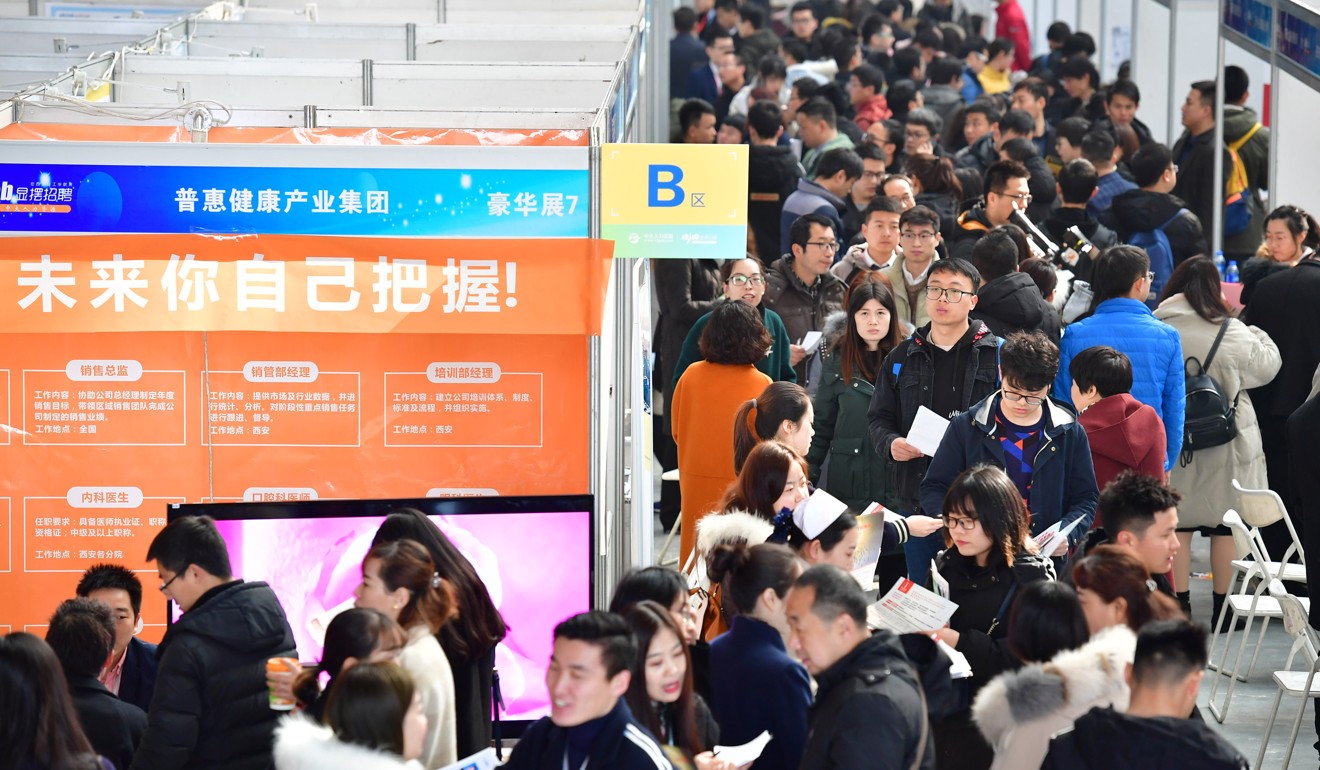
Job applicants visit a provincial job fair at Qujiang International Conference and Exhibition Center in Xian, northwest China's Shaanxi Province in February. Photo: Xinhua
Job applicants visit a provincial job fair at Qujiang International Conference and Exhibition Center in Xian, northwest China’s Shaanxi Province in February. Photo: Xinhua

Oracle has never confirmed the number of lay-offs but said the job cuts formed part of an overall global strategy transformation.

However, there has been little sympathy for those losing their jobs in China, judging by social media posts.

Some people posted that those working for big US tech firms are not “wolf” enough compared with counterparts who work for local tech firms, referring to the long work-hours culture of the domestic tech scene.

A viral story titled “Why there should be no pity for the sacked Oracle China employees” said the company was Beijing’s biggest nursery because of the flexible “work from home” culture and generous compensation package offered to employees.

Oracle said to begin mass lay-offs in China as part of global move to cloud services

“They had every chance to join rising domestic internet firms. But they settled for high salary and low work pressure, which eventually made them frogs in boiling water. Why pity them?” said the article, adding that the earlier people give up on the “glory” of working for MNCs, the quicker they will benefit.

Not all Chinese workers would agree, and there has been a recent backlash against the “996” culture within China’s tech sector, where people routinely work from 9am to 9pm, six days a week.

With geopolitical uncertainty growing day by day, though, many Chinese are asking why leave the family behind for an uncertain fate overseas?

A survey done by consultancy BCG and The Network in 2018 showed that only one in three China residents was willing to move abroad for work, down from 61 per cent in 2014. The country is also the 20th most popular destination worldwide to relocate for a job, compared with 29th in the 2014.

“One of my graduate classmates in the US just gave up a six-digit package at Oracle and joined drone maker DJI in Shenzhen,” said Ben Zhang. “I asked what prompted his return to China. He sent me the viral article and asked, ‘who wants a life that one can see the end of from the very beginning?’”

Source: SCMP

31/05/2019

Tesla announces prices of made-in-China Model 3. At 328,000 yuan it’s 13 per cent cheaper than US imports

  • Deliveries will start in the next six to 10 months, carmaker says
  • Tesla will take on Chinese carmakers such as Geely and SAIC, and electric car start-ups including Nio and Xpeng Motors
Tesla said on Friday that its Model 3 electric car, which will be assembled in China, will be ready for deliveries in six to 10 months. Photo: AFP
Customers can pre-order the Model 3 assembled in China after Tesla announced on Friday that it would be priced 13 per cent lower than the US imports, taking the electric carmaker a step closer in tapping the world’s largest EV market.
The standard range plus Model 3 car that Tesla plans to assemble at the Gigafactory 3 in Lingang, Shanghai, will be priced at 328,000 yuan (US$47,529), 49,000 yuan cheaper than the same model currently imported from the US.
Tesla’s US-built cars are now subject to a 25 per cent import duty in China. The bestselling US electric carmaker plans to start deliveries in the next six to 10 months.

“Today we announced that Model 3 Standard Range Plus vehicles built at Gigafactory Shanghai will begin at 328,000 yuan for our customers in China,” Tesla said in a statement.

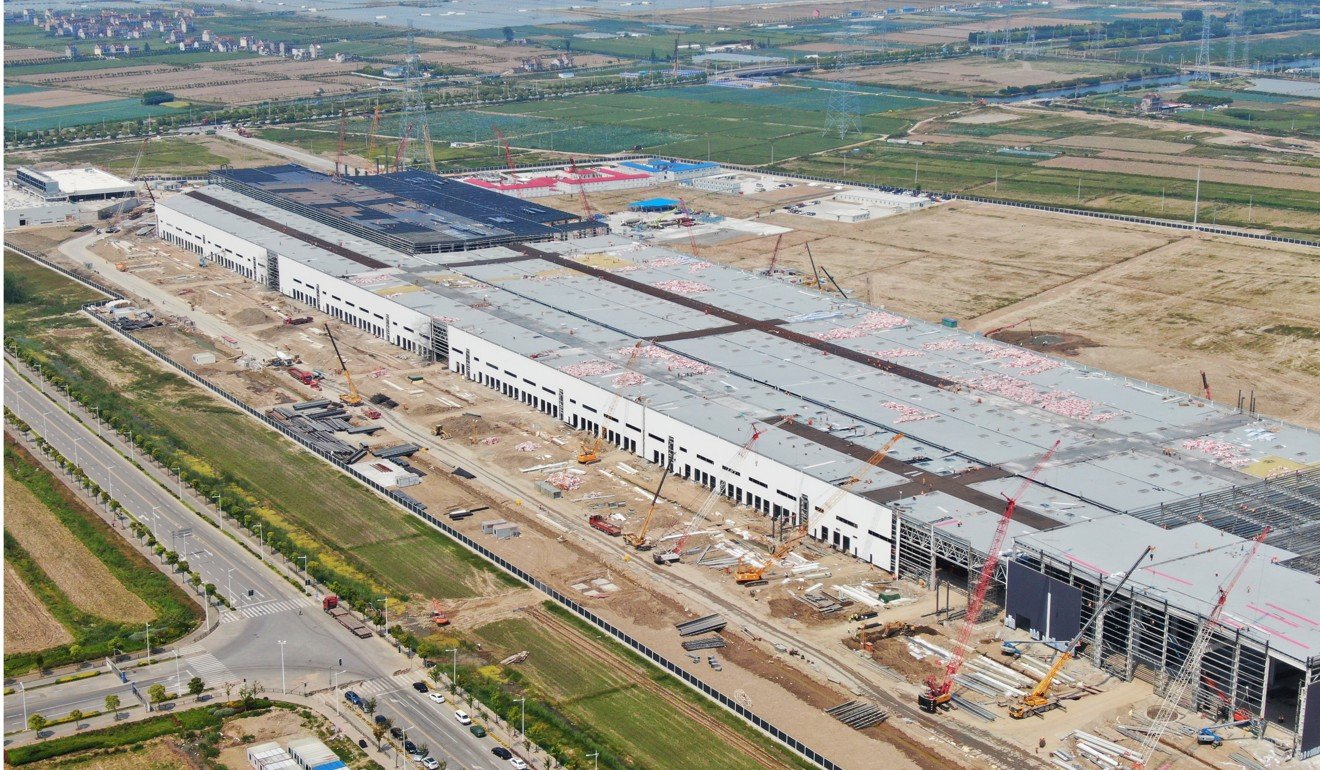
Aerial view of the Tesla Shanghai Gigafactory under construction in Lingang, Shanghai, on May 10, 2019. Photo: Imaginechina

The model has a range of 460km and a top speed of 225km/h.

Industry observers said that the price of the locally made car aimed at the mass market is on the higher side, adding that a 300,000 yuan price tag could attract thousands of Chinese buyers.

“If a Chinese customer can buy a Tesla car for less than 300,000 yuan, many of them will make a decision on the spur of the moment since it is viewed as the best EV in the world,” said Tian Maowei, a sales manager at Shanghai-based Yiyou Auto Service.

Tesla rushes Model 3s to China before trade war truce expires

US President Donald Trump has signed an executive order barring US companies from using telecoms equipment made by companies that pose a threat to national security, a move aimed at shutting out Huawei Technologies.

US technology companies including Google and Microsoft have severed business ties with Huawei to comply with the US trade ban.

Tesla’s Gigafactory 3 is expected to make around 3,000 Model 3 vehicles a week in the initial phase. Photo: AP

In January, Tesla started construction on a US$5 billion wholly-owned plant in Shanghai, the city’s single largest foreign direct investment just three months after it secured a land parcel to make electric cars locally.

The factory will produce Model 3 and Model Y electric vehicles that are seen as affordable to drivers in China.

Podcast: Here’s how the US-China tech war is affecting small electronics companies

Gigafactory 3 is expected to make around 3,000 Model 3 vehicles a week in the initial phase, ramping up to 500,000 per year when it becomes fully operational, Tesla said.

Tesla will take on Chinese carmakers such as Geely and SAIC and electric car start-ups including Nio and Xpeng Motors in China where sales of new-energy vehicles including battery-powered and plug-ins are expected to jump 27 per cent this year to 1.6 million units, according to the China Association of Automobile Manufacturers.

In March Beijing announced a cut in cash subsidies offered to NEV buyers by up to 60 per cent, believing it was time to remove the crutches and cull an industry that had spawned hundreds of small manufacturers.

It is unclear whether Tesla vehicles will receive subsidies from the Chinese government.

Source: SCMP

13/05/2019

China not to compromise on major principles, capable to cope with challenges: think tanks

BEIJING, May 12 (Xinhua) — Facing U.S. tariff hike threats, China has adhered to its bottom line, defended national dignity and people’s interests, experts with domestic think tanks said Sunday at a symposium on China-U.S. trade relations.

Imposing new tariffs goes against the will of the people and the trend of the times. China has the resolution, courage and confidence to rise to all sorts of challenges, they said.

The United States on Friday increased additional tariffs on 200 billion U.S. dollars worth of Chinese imports from 10 percent to 25 percent.

At the 11th round of economic and trade consultations that ended in Washington the same day, the Chinese delegation made clear its consistent and resolute stance: problems can not be solved by increasing tariffs and cooperation is the only right choice for the two sides, but it has to be based on principles. China will never make concessions on major issues of principle.

RAISING TARIFFS MORE DETRIMENTAL TO U.S. ECONOMY

“Increasing tariffs will impact enterprises of both countries, but harm American businesses more,” said Gao Lingyun, a researcher with the Institute of World Economics and Politics under the Chinese Academy of Social Sciences (CASS).

The additional tariffs can not change U.S. demand for Chinese goods and will be eventually passed on to American consumers and retailers by U.S. importers, Gao said.

“If the United States insists on going its way to raise tariffs on all Chinese imports, its domestic prices would be dramatically pushed up, resulting in inflation,” Gao said.

A wide range of U.S. industry associations have expressed strong opposition to imposing additional tariffs on Chinese imports. Raising tariffs to 25 percent could cost nearly one million American jobs and increase volatility of financial market, said the Tariffs Hurt the Heartland campaign.

Of the Chinese goods already under higher tariffs, more than 70 percent are intermediates and investment goods. Such a higher proportion means that the tariffs will be eventually be passed on to American businesses, consumers and farmers, said Chen Wenling, chief economist with the China Center for International Economic Exchanges.

Chen said the trade war provoked by the United States is ineffective. The United States wanted to fix the problem of trade deficit but its trade deficits to China, European Union and other economies rose rather than fell. In addition, the corresponding industry chain restructuring did not benefit the U.S. either. Auto makers Tesla and Ford are moving to the Chinese market instead.

“Some U.S. enterprises may find it difficult to survive if quitting the Chinese market as a very large share of their profits come from China,” said Liang Ming, a researcher with a research institute of the Ministry of Commerce.

Based on an estimate of the effect of having additional tariffs on 200 billion U.S. dollars worth of Chinese goods, Liang said the United States still needs to import a majority of the goods from China. But most of the Chinese products involved are less dependent on the U.S. market, and can be exported to other markets, Liang noted.

Experts said that the spill-over effect of trade wars can reach the whole world, posing severe challenges to the global order, rules, trade systems, supply chains and even bringing negative impact on the peaceful development of the world.

“What China emphasizes, such as avoiding raising tariffs and a balance in the appeals of both sides, is not only the requests of China but also the rational choice for any country when facing unreasonable trade demand,” said Dong Yan, a researcher with the CASS’s Institute of World Economics and Politics.

Analysts agreed at Sunday’s symposium that cooperation benefits China and the Unites States, while conflicts hurt both; cooperation is always the right path to resolve the China-U.S. trade dispute.

NO YIELDING ON PRINCIPLES, FIGHT AND TALK ALTERNATELY

Experts said that the U.S. accusation of China’s “backtracking” for the unsuccessful talks is untenable and irresponsible as the two are still in the process of negotiation. As a matter of fact, the U.S. side is to blame for the negotiating setback as it has been exerting pressure on China and upping the ante.

“The U.S. requests involve China’s core interests and major concerns. They touch the bottom line and China will not compromise,” said Wei Jianguo, executive deputy director of the China Center for International Economic Exchanges.

He noted that a successful agreement must ensure both sides are satisfied for the most part and have both sides to make compromises.

If an agreement satisfies only one side with the concerns of the other side not respected or not taken care of, it can hardly sustain during the implementation and may even be revoked, he said.

After more than a year, both sides have conducted 11 rounds of economic and trade consultations, which experts said fully displays that the consultation is a continuing battle. Taking it easy is necessary while preparations must be fully made psychologically and at working level.

“It’s normal for major countries to have frictions. China must adapt to it,” said Wang Wen, executive dean of the Chongyang Institute for Financial Studies, Renmin University of China.

Chen Wenling said Chinese negotiators have stuck to their principles and stance during the consultation. “It will be normal for both sides to fight and talk alternately. China must not be vague in resolutely safeguarding its core national interests and major concerns and upholding national dignity,” Chen said.

Experts noted that China’s position on upholding the overall interests of the China-U.S. relations and consolidating bilateral economic and trade cooperation remains unchanged. The two countries should meet each other halfway in line with the principles of mutual respect, equality and mutual benefit and resolve their core differences through dialog rather than confrontation.

Dong Yan said that the Sino-U.S. economic and trade friction is a long-term problem, complicated and arduous. Before everything, China and the United States should continue to build mutual trust, step up coordination in bilateral and multilateral areas, and expand common interests.

“We believe that in the face of huge cooperative interests, the U.S. side is also very clear that a trade war will not solve the economic and trade differences between the two countries,” said Liang Ming.

Although the tariff escalation is regrettable, Liang said he believed both sides had hope for the future of their economic and trade relations. A win-win cooperation between China and the United States is in line with the aspirations of the two peoples and the world at large, Liang said.

FACING CHALLENGE WITH CONFIDENCE

“Above 8,000 meters, it is the stratosphere, where the air gets thin. For mountain climbers, this requires extra efforts to overcome, which is similar to the phase that China’s economy has to overcome in order to achieve high-quality development.”

Wang Wen, citing mountain climbing as a metaphor, said the current stage requires China to stay patient and make hard work persistently according to a set route.

With both solid strength and huge potential as well as a strong capability to cope with risks and strikes, China has the confidence, resolution and ability to face all kinds of risks and challenges, said Zheng Shuiquan, deputy secretary of the Party Committee of Renmin University of China.

“No matter how the situation goes in the future, we need to manage our own affairs well,” said Zhang Yansheng, chief research fellow with the China Center for International Economic Exchanges.

Since last year, a series of measures have been taken by the central government to consolidate the growth momentum of the Chinese economy. Wang Jinbin, deputy dean of School of Economics, Renmin University of China, said that stabilizing expectation and confidence is very essential.

Starting this year, transition towards new growth engines from the traditional ones has accelerated, with new industries and businesses constantly emerging, said Yan Jinming, executive director of the National Academy of Development and Strategy of the Renmin University of China.

He said that the Chinese economy has strong resilience and flexibility, a huge market and promising prospect.

“The key is to manage our own affairs now, so as to constantly increase the potential for economic development,” said Yan.

“A win-win cooperation is an unstoppable trend of development. Trade development needs to be aligned with major national strategies. By deepening Belt and Road economic cooperation, China will see its high-quality development path getting broader and broader,” said Chen.

Source: Xinhua

22/04/2019

Tesla says investigating car explosion in Shanghai

Logo of a Tesla Motors store in Hangzhou downtown. Tesla Motors is an American automotive and energy storage company selling luxury electric cars and battery products. It aims to produce its $76,000 and up vehicles in ChinaImage copyright GETTY IMAGES

Tesla said it is investigating a video on Chinese social media that appears to show one of its vehicles bursting into flames in Shanghai.

In a statement, the carmaker said it had sent a team to investigate the matter, and that there were no reported casualties.

The video, which has not been verified by the BBC, showed a stationary car erupting into flames in a parking lot.

Tesla did not confirm the car model but social media identified it as Model S.

“After learning about the incident in Shanghai, we immediately sent the team to the scene last night,” according to a translation of a Tesla statement posted on Chinese social media platform Weibo.

“We are actively contacting relevant departments and supporting the verification. According to current information, there are no casualties.”

The video showed smoke rising from a parked, white vehicle and seconds later it bursts into flames.

The time stamp on the video shows the incident happened on Sunday night, local time (Sunday morning GMT).

Previous incidents involving Tesla vehicles catching on fire seem to have happened while the cars were moving.

In 2018, a Tesla car driven by British TV director Michael Morris burst into flames, following another such incident involving a Model S model in France in 2016.

A series of fires involving Tesla Model S cars took place in 2013.

Source: The BBC

06/03/2019

China to make forced technology transfer illegal as Beijing tries to woo back foreign investors

  • Issue a key demand made by US President Donald Trump as part of the ongoing US-China trade war
  • China expected to pass new foreign investment law next week during National People’s Congress

26 Feb 2019

Foreign direct investment in China amounted to US$135 billion in 2018, an increase of 3 per cent from a year earlier, according to Chinese government data. Photo: EPA

Foreign direct investment in China amounted to US$135 billion in 2018, an increase of 3 per cent from a year earlier, according to Chinese government data. Photo: EPA
Beijing will make it illegal to force foreign investors to transfer their technology to Chinese partners while also lowering market barriers for foreign firms to enter the domestic market, a senior economic planning official said on Wednesday, highlighting an effort to lure overseas investment inflows.
China is expected to pass a new law next week intended to protect the interests of foreign investors, both as a response to demands from the United States that have formed part of the ongoing trade war negotiations, and to help shore up economic growth, which slowed last year to its lowest rate in 28 years.
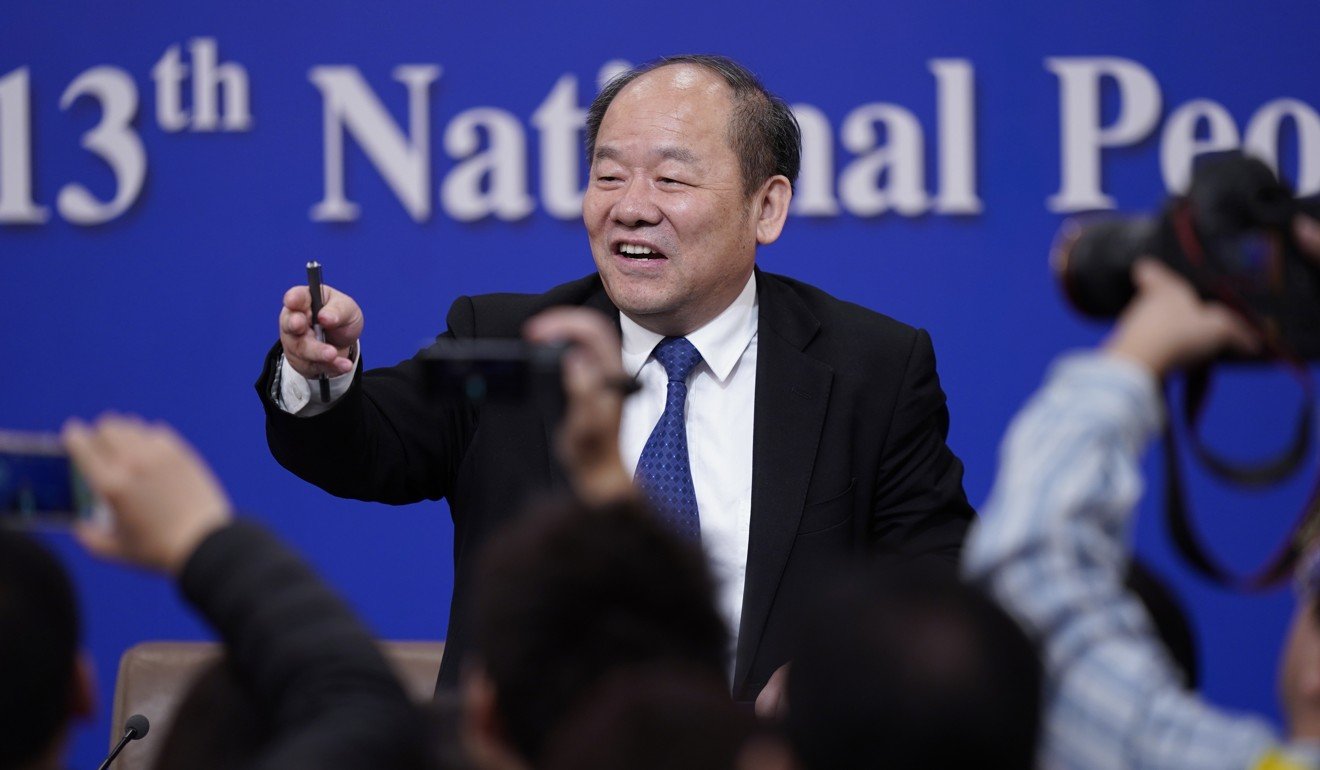
Foreign investors will be allowed to set up ventures in which they have full ownership, instead of being forced into joint ventures with local partners, in more industries, said Ning Jizhe, a vice-chairman of the National Development and Reform Commission, in Beijing on Wednesday during the National People’s Congress.

But foreign investment into the world’s second biggest economy have slowed over last decade, which could deprive China of access to advanced technologies and marginalise the country in the development of future global supply chains.

Beijing is trying to lure more foreign capital and technology to support its plan to upgrade its manufacturing industries and boost the development of new, hi-tech sectors.

“China will roll out more opening-up measures in the agriculture, mining, manufacturing and service sectors, allowing wholly foreign-owned enterprises in more fields,” Ning said.

China law to protect intellectual property, ban forced tech transfer
Since December, China has been rushing to draft legislation for a new foreign investment law, a key clause of which prohibits local government’s from forcing transfer of technology in return for being allowed to conduct business in their jurisdictions.
The National People’s Congress is expected to endorse the new 

“After passing the law, the government will take serious measures to obey and implement it,” Ning added.

He said that China will remove market entry restrictions for foreign investors to ensure that domestic and foreign firms “are treated as equals.”

Ning Jizhe, a vice-chairman of the National Development and Reform Commission. Photo: EPA

However, the jury is still out whether Beijing’s promises of fair treatment, market access and protection for intellectual property rights will be enough to generate a steady inflow of hi-tech investment.

The US has long complained that China has been unwilling to implement previous commitments under the World Trade Organisation to open up its market – allegation Beijing denies.

Shen Jianguang, chief economist at JD Digits, an arm of Chinese e-commerce firm JD.com, said restrictions on foreign investment will exist in China despite the government’s promises.

China’s domestic market remains large and attractive for some foreign investors, he said.

“Foreign investors are still very interested in the Chinese market, if the openness of the economy is sufficient,” Shen added.

Source: SCMP

Law of Unintended Consequences

continuously updated blog about China & India

ChiaHou's Book Reviews

continuously updated blog about China & India

What's wrong with the world; and its economy

continuously updated blog about China & India