Archive for ‘the world’

08/05/2020

China Focus: Return capsule of China’s experimental manned spaceship comes back successfully

(EyesonSci)CHINA-INNER MONGOLIA-RETURN CAPSULE-LANDING-SUCCESS (CN)

Staff members pose for a group photo to celebrate the timely finding of the return capsule of the trial version of China’s new-generation manned spaceship that successfully returned to the Dongfeng landing site in north China’s Inner Mongolia Autonomous Region, May 8, 2020. The return capsule successfully returned to the Dongfeng landing site at 1:49 p.m. (Beijing Time) Friday, according to the China Manned Space Agency (CMSA). (Photo by Wang Jiangbo/Xinhua)

by Xinhua writers Quan Xiaoshu, Yu Fei and Li Guoli

JIUQUAN, May 8 (Xinhua) — The return capsule of the trial version of China’s new-generation manned spaceship successfully returned to the Dongfeng landing site in north China’s Inner Mongolia Autonomous Region at 1:49 p.m. (Beijing Time) Friday, according to the China Manned Space Agency (CMSA).

The test was a complete success, the agency said.

Following the instructions from the Beijing Aerospace Control Center, the experimental spaceship applied the brake and entered the return orbit at 12:21 p.m., and its return capsule separated with its service capsule at 1:33 p.m.

After it re-entered the atmosphere and reached the designated altitude, the two deceleration parachutes and three main parachutes on the return capsule opened, slowing the flight speed of the spacecraft to the driving speed of an urban vehicle. Before touching down, its six airbags were deployed and inflated to help it land softly, according to the China Aerospace Science and Technology Corporation (CASC).

At 1:49 p.m., the return capsule landed safely. The search team found it in a timely manner and confirmed that the capsule structure was intact.

China launched the trial version of the new spaceship without a crew by the Long March-5B carrier rocket from the Wenchang Space Launch Center in southern China’s island province of Hainan on Tuesday.

The experimental spaceship flew in orbit for two days and 19 hours, during which it carried out a series of space science and technology experiments, including space 3D printing, said CMSA.

It also tested key technologies including the heat shielding and control during its re-entry into the atmosphere, as well as multi-parachute recovery and partial reuse, CMSA said.

The new-generation manned spaceship is an advanced space transport vehicle adapted to multiple tasks. It can be used not only in low-Earth orbit missions to support the construction of China’s space station but also for deep-space exploration, such as manned lunar exploration, CMSA said.

INNOVATIVE DESIGN

Developed by the China Academy of Space Technology (CAST) under the CASC, the test spaceship is nearly 9 meters tall and about 4.5 meters at its widest point. It weighs more than 20 tonnes.

Different from the three-capsule structure of Shenzhou spaceships currently in use, the new spacecraft comprises a return capsule, which is the command center and the living place for astronauts, and a service capsule, which provides power and energy, according to the CAST.

In Shenzhou spaceships, astronauts have to go back and forth between two smaller capsules for life and work. The return capsule of the new ship has a larger sealed space. In the future, it can be partitioned to set up a work area, entertainment area, dining area and bathroom, so as to provide a more comfortable living environment for astronauts.

The capsule can also be equipped with large screens for entertainment and display instruments connected with wearable devices so that astronauts can enjoy colorful space travel and be kept informed of the ship’s conditions.

The new design can also shorten the spaceship development cycle and cut the development costs, which will show a significant advantage in the future with space exploration activities more and more frequent, said Yang Qing, a designer of the experimental spaceship with the CAST.

Researchers have integrated the power supply, propulsion, fuel resources and other subsystems all into the service capsule, so that the same return capsule can be paired with different service capsules to meet variant needs of multiple tasks, including the space station operation and subsequent manned space missions.

The return capsule is designed to be reusable. Star sensors, computers and other high-value equipment have been moved from the service capsule to the return capsule so that they can be recycled after returning to Earth.

The return capsule is wrapped in two items of “clothing.” The inner layer is made of new metal materials and acts as a “wall” around the “driving cab.” The outer layer is made of a new type of light heat-resistant material, which can withstand ablation of thousands of degrees Celsius in the process of re-entry and return, according to Guo Bin, a member of the development team of the experimental spaceship with the CAST.

The new heat-resistant materials, adopted for the first time, are lighter than the traditional materials by 30 percent but have a greater heat-shielding capacity. They are also replaceable to improve the reusable rate of the capsule, Guo said.

The return capsule also uses a non-toxic propulsion system, consisting of 12 monopropellant-powered engines with the largest thrust in the world, which are applied for the first time in China to make the capsule safer and reusable, Guo said.

NEW DREAM SHIP

China started its manned space program in 1992 and has so far witnessed 11 astronauts enter space and return safely.

However, when the country eyes on the moon and the deeper space, Shenzhou spaceships and Tianzhou cargo spacecraft are no longer enough to meet its greater dreams.

Engineers started to create the new test spaceship from January 2017 and completed it in just three years after making many technological breakthroughs.

It can transport both people and goods, greatly expanding the capability and application of China’s manned spacecraft, Yang said.

It can be called a “space bus” as it is able to send six to seven astronauts at a time into low-Earth orbit. It can also be converted into a “space truck” according to new mission requirements, delivering a large number of supplies to the space station or bringing back space engineers’ test samples to Earth, Yang said.

The reliability, safety, comfort, economy and intelligence of the new spaceship have been greatly improved.

When in orbit, the ship’s “brain” — the guidance, navigation and control systems — can control the flight independently without relying on instructions from the ground. Through the combination of high-performance computers and sensors, the ship can fulfill emergency orbit entry, orbit raising and lift control autonomously, enabling it to cope with various emergencies quickly and calmly.

If a “health problem” occurs, the new spaceship can make a diagnosis itself through its intelligent system to locate the lesion and remove it temporarily or permanently. It will then share the work of the malfunctioning part by optimizing and recombining the functions of other parts, which can greatly simplify the ground control and support work.

In addition to the non-toxic monopropellant-powered engines, the new spacecraft adopts a series of advanced technologies, including the distributed integrated electronic system, solar cells with high conversion efficiency and multi-terminal human-computer interaction system, which improve its overall performance by leaps and bounds.

The engineers also installed a data acquisition system in the test spaceship, which will help provide scientific reference for the development and optimization of the follow-on versions of the new spaceship.

“The new and old spaceships will compliment each other. Just as trucks, buses and vans are all available on the road, there should be more transport means between space and Earth, and the new ship will enrich the selections,” Yang said.

Source: Xinhua
19/04/2020

Supporting WHO means to safeguard multilateralism: Chinese FM

BEIJING, April 19 (Xinhua) — Chinese State Councilor and Foreign Minister Wang Yi said on Saturday that at the critical moment when the world is combating the COVID-19 pandemic, supporting the World Health Organization (WHO) and its director-general is to safeguard the philosophy and principle of multilateralism.

He made the remarks when holding a phone conversation with WHO Director-General Tedros Adhanom Ghebreyesus, noting that the support is also an act to secure the United Nations’ status and role and maintain the international solidarity in the face of the disease.

Source: Xinhua

13/04/2020

Russian border becomes China’s frontline in fight against second virus wave

SUIFENHE, China (Reuters) – China’s northeastern border with Russia has become a frontline in the fight against a resurgence of the coronavirus epidemic as new daily cases rose to the highest in nearly six weeks – with more than 90% involving people coming from abroad.

Having largely stamped out domestic transmission of the disease, China has been slowly easing curbs on movement as it tries to get its economy back on track, but there are fears that a rise in imported cases could spark a second wave of COVID-19.

A total of 108 new coronavirus cases were reported in mainland China on Sunday, up from 99 a day earlier, marking the highest daily tally since March 5.

Imported cases accounted for a record 98. Half involved Chinese nationals returning from Russia’s Far Eastern Federal District, home to the city of Vladivostok, who re-entered China through border crossings in Heilongjiang province.

“Our little town here, we thought it was the safest place,” said a resident of the border city of Suifenhe, who only gave his surname as Zhu.

“Some Chinese citizens – they want to come back, but it’s not very sensible, what are you doing coming here for?”

The border is closed, except to Chinese nationals, and the land route through the city had become one of few options available for people trying to return home after Russia stopped flights to China except for those evacuating people.

Streets in Suifenhe were virtually empty on Sunday evening due to restrictions of movement and gatherings announced last week, when authorities took preventative measures similar to those imposed in Wuhan, the central Chinese city where the pandemic ripping round the world first emerged late last year.

The total number of confirmed cases in mainland China now stands at 82,160 as of Sunday, and at the peak of the first wave of the epidemic on Feb 12 there were over 15,000 new cases.

Though the number of daily infections across China has dropped sharply from that peak, China has seen the daily toll creep higher after hitting a trough on March 12 because of the rise in imported cases.

Chinese cities near the Russian frontier are tightening border controls and imposing stricter quarantines in response.

Suifenhe and Harbin, the capital of Heilongjiang, are now mandating 28 days of quarantine as well as nucleic acid and antibody tests for all arrivals from abroad.

In Shanghai, authorities found that 60 people who arrived on Aeroflot flight SU208 from Moscow on April 10 have the coronavirus, Zheng Jin, a spokeswoman for the Shanghai Municipal Health Commission, told a press conference on Monday.

Residents in Suifenhe said a lot of people had left the city fearing contagion, but others put their trust in authorities’ containment measures.

“I don’t need to worry,” Zhao Wei, another Suifenhe resident, told Reuters. “If there’s a local transmission, I would, but there’s not a single one. They’re all from the border, but they’ve all been sent to quarantine.”

Source: Reuters

24/03/2020

WHO chief calls for aggressive tactics as coronavirus cases soar across the world

  • ‘Aggressive and targeted’ tactics needed to curb spread of Covid-19 as more than 100,000 new infections recorded in just four days
  • Global political commitment and coordination needed to halt trajectory, agency chief says
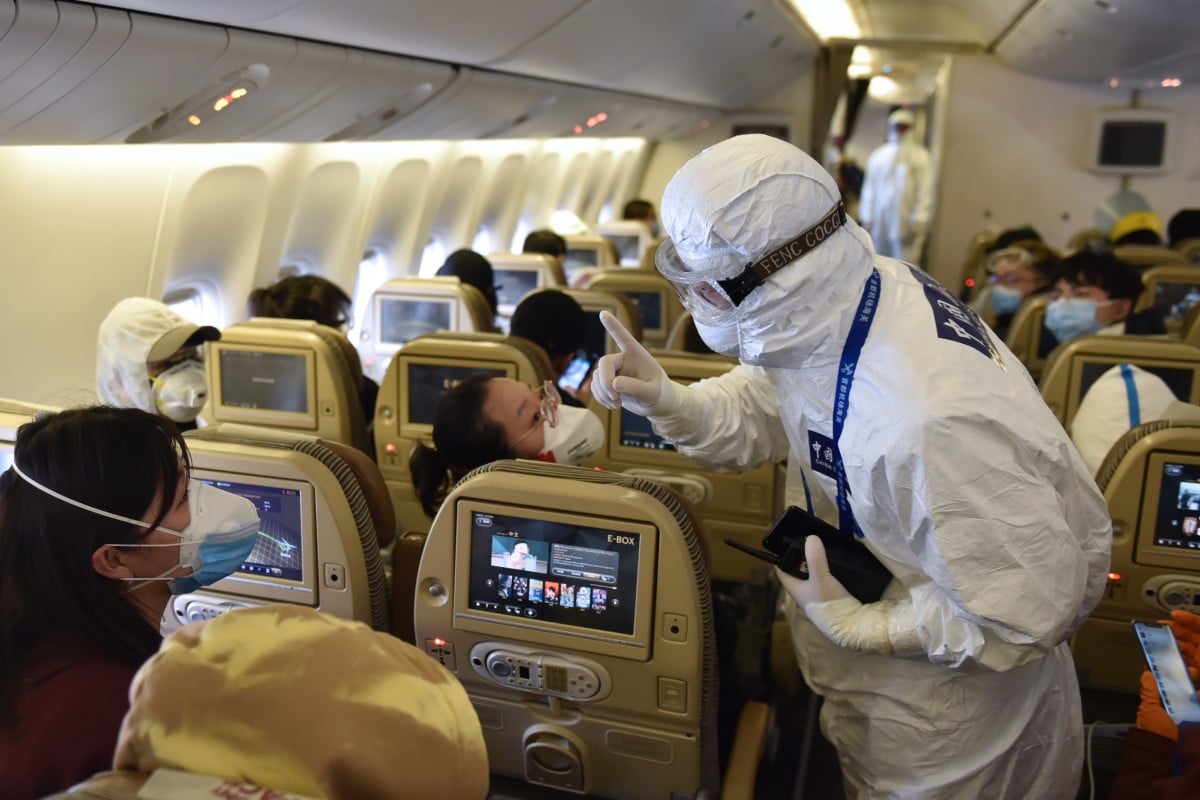
A customs officer speaks to passengers on board an inbound flight at Beijing Capital International Airport. Photo: Xinhua
The World Health Organisation has warned that the Covid-19 pandemic is accelerating, calling for “aggressive and targeted tactics” to curb its spread after more than 100,000 new infections were recorded in just four days.
The warning, by the UN agency chief Tedros Adhanom Ghebreyesus, came as the number of deaths from the disease, caused by the new coronavirus, continued to rise, and as mainland China reported a doubling in new cases.
The outbreak, which was first reported in December in China, is rapidly spreading across the globe. Tedros said it had taken 67 days from the first reported case to the first 100,000 infections, and just 11 days for the number to soar to the second 100,000.

“[It was] just four days for the third 100,000 cases. You can see how the virus is accelerating,” he said on Tuesday.

“But we’re not prisoners to statistics. We’re not helpless bystanders. We can change the trajectory of this pandemic.”

China’s National Health Commission reported 74 imported coronavirus infections on Monday – the highest since March 4, when it began including data on such cases and noted two infections that had originated abroad.

They bring the total number of imported cases on the mainland to 427, as of Monday. The total number of infections there now stands at 81,171, and the death toll has risen to 3,277, with seven new fatalities.

Tedros said political commitment and coordination at the global level were needed to stop the spread, but warned against using untested medicines, saying they could raise false hope.

“To win, we need to attack the virus with aggressive and targeted tactics – testing every suspected case, isolating and caring for every confirmed case, and tracing and quarantining every close contact,” he said.

Italy’s number of new Covid-19 cases dropped to a five-day low on Monday, easing the strain on overstretched hospitals, but the situation in Spain continued to worsen.

Italian health authorities announced 4,789 new cases on Monday, a drop from 5,560 on Sunday and 6,557 on Saturday. Spanish authorities announced 462 deaths on Monday, the country’s worst day since the start of the epidemic.

Italy has a glimpse of hope as new coronavirus cases drop to a 5-day low

24 Mar 2020

The British government said on Monday that another 54 people had died in the previous 24 hours after testing positive for the coronavirus, raising the country’s deaths from the pandemic to 335. The number of confirmed cases in Britain rose to 6,650 on Monday, from 5,683 on Sunday.

Mainland China officials have said the risk facing the nation was to contain imported infections. Among the new imported infections, 31 were recorded in Beijing, 14 in Guangdong and nine in Shanghai.

Beijing has stepped up measures to contain imported infections, diverting all arriving international flights from Monday to other cities, including Shanghai and as far west as Xian, where passengers will undergo virus screening.

Guangzhou also requires all travellers to the city, except for those from Hong Kong, Macau and Taiwan, to undergo the coronavirus test. Beijing has required the test for incoming travellers with symptoms and epidemic history.

The coastal province of Zhejiang, near Shanghai, will also put all arrivals from overseas in centralised quarantine facilities for 14 days, according to media reports.

Source: SCMP

Law of Unintended Consequences

continuously updated blog about China & India

ChiaHou's Book Reviews

continuously updated blog about China & India

What's wrong with the world; and its economy

continuously updated blog about China & India