13/11/2019
- Remains of two of river’s estimated 1,012 porpoises found in less than a week
The finless porpoise found dead in the Yangtze River in Hubei on Monday was the second fatality in a week. Photo: 163.com
Two endangered finless porpoises have been found dead in the Yangtze River in the space of a week, according to mainland Chinese media reports.
One was found on Monday in Jiayu county, central Hubei province, four days after the remains of another were recovered from Dongting Lake, a tributary of the Yangtze in central Hunan province, news website Thepaper.cn reported.
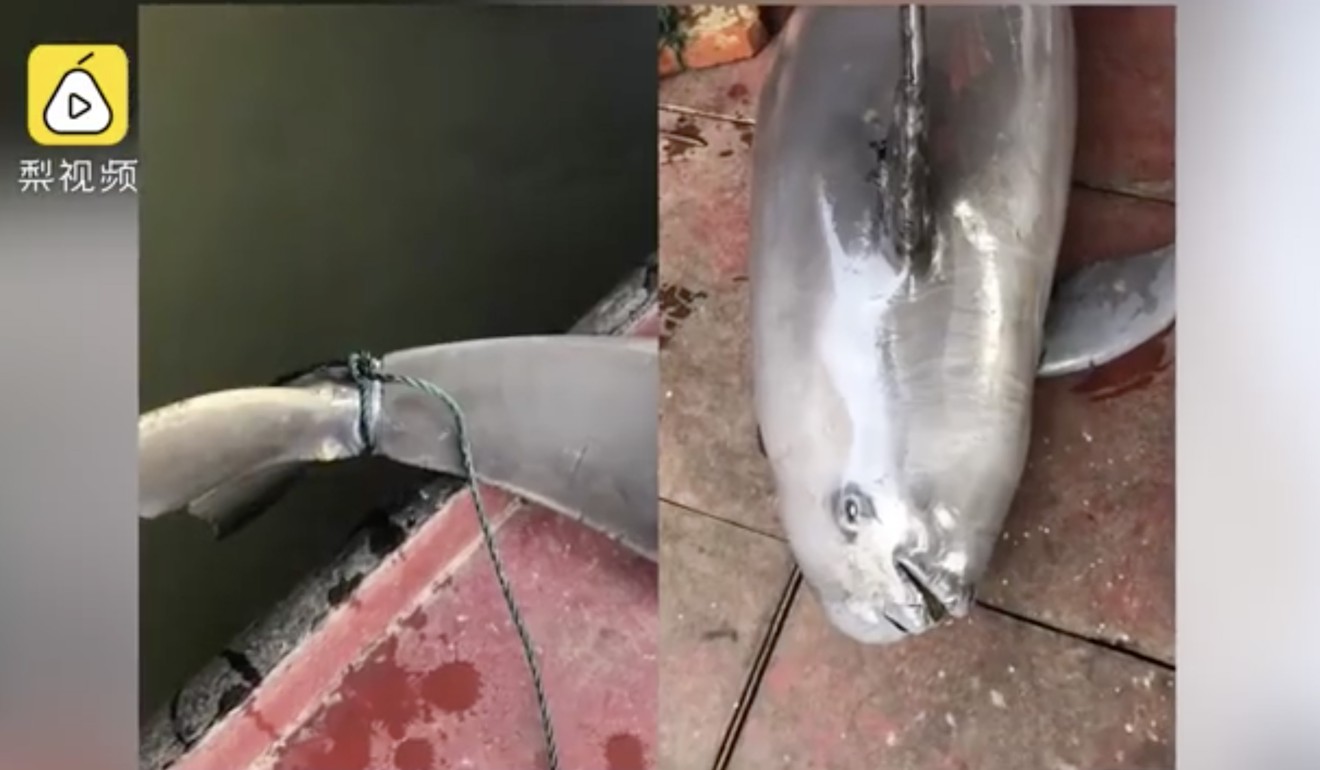
The Dongting Lake carcass was tied with a rope and weighted with bricks, and authorities in Hunan said the creature became tangled in a fishing net. The Hubei death is under investigation.
The Yangtze’s finless porpoises are “extremely endangered”, the Ministry of Agriculture and Rural Affairs said in a 2016 action plan to protect the species. Last year, vice-minister Yu Kangzhen said surveys showed there were about 1,012 of the animals in the river.
The tail of a dead finless porpoise pulled from Dongting Lake in Hunan appears to have been tied to weights. Photo: Pear Video
In 2017, China raised its protection for the mammals to its highest level because of the critical dangers they faced. Experts said that as the river’s “flagship” species, the porpoise was an indicator for the Yangtze’s ecology.
The porpoise discovered in Hubei was small and it had suffered superficial wounds, investigators were quoted as saying. They estimated that it was found soon after its death.
Xiaoxiang Morning Post quoted fisheries authorities in Yueyang, near Dongting Lake, as saying the porpoise in Hunan was found with weights around its tail.
Two porpoise carcasses found on separate Hong Kong shores
Officials said the fishermen who set the net feared they would be blamed for the creature’s death and tied bricks to its tail to sink it.
Other fishermen who witnessed the incident told the authority, leading to the discovery of the body, the report said. The investigation is ongoing and the suspects are still at large.
A fishing authority spokesman told the newspaper that the porpoise’s death showed the difficulty of balancing conservation with the livelihoods of fishermen.
“It’s difficult to figure out a good model to protect the porpoises without affecting fishermen’s business,” he said.
In mainland China, finless porpoises are referred to as “giant pandas in water” because of their endangered status. Their numbers fell from 2,700 in 1991 to 1,800 in 2006, and there were 1,045 finless porpoises in 2012, according to agriculture ministry data.
Source: SCMP
Posted in bricks, Chinese, dead, Dongting Lake, Ecology, endangered, finless, fisheries authorities, fishermen, fishing net, found, giant pandas in water, Hong Kong, hubei province, Hunan Province, investigation, Mainland China, Ministry of Agriculture and Rural Affairs, porpoises, shores, species, struggles, survival, tail, tangled, Thepaper.cn, Uncategorized, Xiaoxiang Morning Post, Yangtze River, Yueyang |
Leave a Comment »
17/09/2019
- Powerful zoom functions can reveal fingerprint details which may be copied by criminals
A cybersecurity awareness campaign in China has prompted a warning about criminals harvesting fingerprint information from a popular pose in pictures uploaded to the internet. Photo: Shutterstock
A popular hand gesture adopted by China’s online community in uploaded pictures could be used by criminals to steal people’s fingerprints, Chinese cybersecurity experts have warned.
The “scissor hand” pose – similar to the peace sign or “V” for victory– could reveal a perfect fingerprint if held close enough to the camera, according to Zhang Wei, vice-director of the Shanghai Information Security Trade Association.
Speaking at an event promoting a national cybersecurity awareness campaign in Shanghai on Sunday, Zhang said photo magnifying and artificial intelligence-enhancing technologies meant it was possible to extract enough detail to make a perfect copy of the sensitive information.
According to a report by online news portal Thepaper.cn, Zhang’s advice was that scissor-hand pictures taken closer than three metres (10 feet) could be vulnerable and should not be published on the internet.
Chinese face-swapping app sparks privacy concerns soon after its release
“A scissor-hand picture taken within 1.5 metres (four feet 11 inches) can be used to restore 100 per cent of people’s fingerprints, while pictures taken about 1.5-3 metres away can turn out 50 per cent of the fingerprints,” he said.
Based on the information extracted from the pictures, criminals could make models of the prints which could then be used to register at fingerprint-based identity recognition checks, such as door access and payment systems, Zhang said.
Feng Jianjiang, a professor on fingerprint identification from the Department of Automation at Tsinghua University, told the South China Morning Post that, theoretically, pictures could show fingerprints clearly enough to be copied, but said he was unsure of what distance would be safe.
“Some people’s fingerprints could not be captured [at any distance] because of skin problems [for example],” Feng said. “But the fingerprint images would be fairly clear if the distance, angle, focus and lighting were all ideal.”
Feng suggested people check the clarity of detail by zooming in on their fingerprints in pictures before uploading them to social media.
Zang Yali, a researcher from the Institute of Automation at the Chinese Academy of Sciences, agreed that the conditions required to be able to harvest sufficiently detailed fingerprint information were “very demanding”, according to a report in China Science and Technology Daily.
The warning had been viewed on China’s Twitter-like platform Weibo 390 million times within 24 hours of Zhang’s address on Sunday, with 49,000 comments left on the website by Monday afternoon.
“It’s horrifying. I always present a scissor hand in photos,” one Weibo user wrote.
“Advanced technology has brought us convenience but meanwhile has also brought us risk and danger. What can we do now?” another commenter wrote.
One social media user had the perfect solution, writing: “No worries. just show the back of your hand to the camera if you are concerned.”
Source: SCMP
Posted in awareness, Camera, campaign, China alert, China Science and Technology Daily, Chinese Academy of Sciences, criminals, cybersecurity threat, Department of Automation, fingerprint information, harvesting, Institute of Automation, scissor-hand, selfie-takers, Shanghai Information Security Trade Association, south china morning post, Thepaper.cn, Tsinghua University, Twitter, Uncategorized, warned, Weibo |
Leave a Comment »
10/09/2019
- Suspects rounded up after people complain of being duped into making donations to support non-existent temples
- One woman says she handed over US$4,600 after being told that charitable gesture would help her live to be 400
One victim of the alleged scams said she was told she could live for 400 years if she handed over her money. Photo: Thepaper.cn
Police in southeast China have detained 100 people on suspicion of being part of a criminal network that cheated members of the public out of 50 million yuan (US$7 million) by preying on their superstitions and generosity.
Authorities in Ningguo, Anhui province launched an investigation in May after receiving a number of complaints about the activities of several groups posing as fortune-tellers on social media platforms like Weibo, financial news outlet Caijing reported on its website on Tuesday.
One of the groups, which operated on the Twitter-like service under the name “Kanxiang Zen Master”, was run by a local man surnamed Zhang and had 12 million followers, the report said.
Adverts for online fortune-telling services are common in China. Photo: Thepaper.cn
In one alleged scam, members of the group were told they would receive good luck if they made a donation to support a “famous temple”. But when a man who gifted 10,000 yuan via WeChat Pay checked on the address of the recipient, he found it was a residential address in the city of Xuancheng and not a place of worship, the report said.
When police investigated, they found Zhang had links to seven criminal groups in Anhui and neighbouring Jiangsu province, which between them operated about 60 fortune-telling accounts on Weibo, several of which had more than 10 million followers. The Kanxiang Zen Master account has since been removed from the platform.
Six Chinese wanted for internet scam arrested in Vanuatu
A number of the gangs were registered as media companies and operated as semi-professional organisations with formal recruiting procedures and regular conferences to plan their fraudulent activities, the report said, adding that they had been operating for at least two years.
Police in July staged a series of raids to round up the suspects and confiscated associated equipment, including computers, vehicles and mobile phones, the report said.
Authorities in Ningguo have appealed for more victims to come forward.
A separate report by Shanghai-based news outlet Thepaper.cn said that some of the suspects also used e-commerce sites such as Taobao and the messaging service WeChat to promote their fortune-telling services.
Taobao is owned by Alibaba Group, which also owns the South China Morning Post.
In one case, a woman from the city of Changshu in Jiangsu said she made multiple payments – totalling about 33,000 yuan – to a fortune-teller she met on WeChat who said the money would be used to buy incense for use in offerings to the gods.
She said she reported the alleged fraud after starting to doubt the fortune-teller’s claims, including one that said if she made the donations she could live for up to 400 years.
Alibaba, Weibo and Tencent, which owns WeChat, have been contacted for comment.
Posted in Adverts, Alibaba Group, Anhui, authorities, Caijing, Changshu, chinese police, complain, detain, duped, e-commerce sites, famous temple, financial news outlet, fortune-tellers, fortune-telling, generosity, gods, incense, Jiangsu, jiangsu province, Kanxiang Zen Master, making donations, messaging service, Ningguo, non-existent temples, offerings, place of worship, promote, residential address, scam, Services, Shanghai-based news outlet, social media platforms, south china morning post, superstitions, Taobao, TENCENT, Thepaper.cn, Uncategorized, Vanuatu, website, WeChat, WeChat Pay, Weibo, Xuancheng, Zhang |
Leave a Comment »
08/09/2019
- Two people from the circus have been detained after the animal managed to get out of its cage and run towards nearby cornfields on Friday evening
- It was found the next morning and police used a tranquilliser to subdue the tiger but it died on the way to the zoo, which believes it had been hit by a car
Video footage shows circus handlers using sticks to try to coax the tiger back inside the cage after it escaped on Friday night. Photo: Thepaper.cn
A circus tiger that escaped from its cage during a show in central China was captured by police after an overnight search, but died while it was being transported to a nearby zoo, according to media reports.
Two people from the circus where the tiger was raised in the county of Yuanyang, Henan province, have been detained, Beijing Youth Daily reported, without elaborating. It said the tiger escaped during the circus’ first public show, which had not been registered with the local authorities.
The tiger was part of a performance for a local school on Friday evening when it managed to get out of its cage and run towards nearby cornfields.
A video posted by news site Thepaper.cn shows the moment it escaped from the cage, with its handlers using sticks to try to coax the animal back inside. The scene is chaotic, as people scream and run from the venue.
A tranquilliser dart was used to subdue the tiger on Saturday morning and it was transported to a zoo in Xinxiang. Photo: Thepaper.cn
The police were called in, and officers used drones, police dogs and thermal imaging equipment to hunt for the tiger, according to the local government.
The authorities also put out an emergency advisory telling residents to stay indoors and contact police if they had any information on the tiger’s whereabouts.
It was spotted the following morning, and a tranquilliser dart was used to subdue the animal at about 10.30am on Saturday. The tiger was then transported to a zoo in the city of Xinxiang.
According to one of its zookeepers, the animal had already died by the time it was delivered to the zoo, China Youth Daily reported on Sunday.
The \jsq, surnamed Feng, said the tiger was hit by a car after it escaped and may have sustained internal injuries. The zoo is conducting an autopsy.
Chinese circus tiger attacks two children after breaking out of cage in middle of performance
Thousands of social media users expressed their sympathy for the tiger’s plight, saying it must have suffered greatly, with many people calling for animal circuses to be banned in China.
“Tigers don’t belong in cages, they belong in the wilderness,” one person wrote on microblog site Weibo.
Chinese circus defends using rare animals in its acts despite poor crowds at shows and criticism of its methods.
Source: SCMP
Posted in Beijing Youth Daily, cage, captured, car, Central China, chaotic, China alert, circus, Circus tiger, cornfields, died, dies, drones, escapes, handlers, Henan province, local authorities, local school, performance, Police, police dogs, registered, scream and run, sent to zoo, show, Thepaper.cn, thermal imaging equipment, tiger, tranquilliser, tranquilliser dart, Uncategorized, venue, Weibo, Xinxiang, Yuanyang, Zoo |
Leave a Comment »
04/09/2019
- Two classrooms on Nanjing campus were chosen for pilot project
- Camera automatically captures students’ faces without their cooperation
Students pass through a facial recognition turnstile at China Pharmaceutical University in Nanjing. Photo: Weibo
A university in eastern China has installed a facial recognition system at its entrance and in two classrooms to monitor the attendance and behaviour of students.
China Pharmaceutical University in Nanjing, Jiangsu province, announced on its website on Thursday that it was one of the first higher education institutions in the country to put such a system in place.
“It can effectively solve the management difficulties and low efficiencies in a traditional attendance system, and make it easier for managers to track their students,” Xu Jianzhen, director of the university’s library and information centre, told news website Thepaper.cn
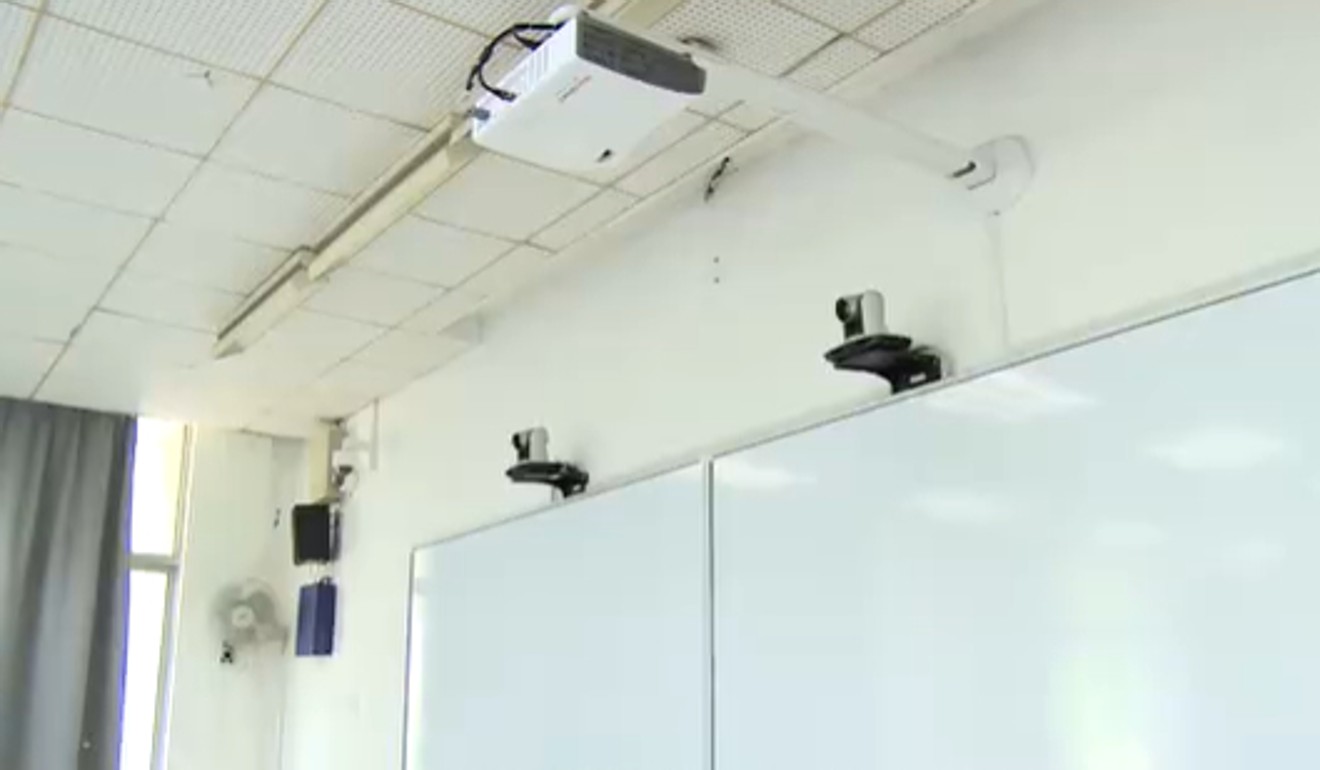
In a pilot project, two classrooms were equipped with an attendance system using facial recognition software, with a camera that automatically captured the faces of students in class without their cooperation, the university said.
“Besides attendance, the system installed in the classroom can provide surveillance of the students’ learning, such as whether they are listening to the lectures, how many times they raise their heads, and whether they are playing on their phones or falling asleep,” Xu told the news website.
“The school is taking action to cut down on students skipping class, leaving classes early, paying for a substitute to attend classes for them and not listening in class,” he said.
The plan was not well received online, with some critics raising privacy concerns for staff and students.
Why are Hong Kong protesters targeting lamp posts?
“What kind of talent are they trying to cultivate?” a user of the Twitter-style Weibo network asked. “I’ve never seen such a method.”
Another wrote: “If this system was being installed in Europe or America, they’d be sued and the school would have to close down.”
But Xu said the university had consulted the police and sought legal advice, and was told the system would not be considered an invasion of privacy as classrooms were public spaces.
“You are complaining about [a system] that’s meant to urge you to learn? Are you a student?” he told the news website.
A spokesman said China Pharmaceutical University was using a facial recognition system to improve class attendance. Photo: Weibo
The university would seek feedback from teaching staff before deciding whether to install facial recognition systems in all of its classrooms, according to the report.
In May last year, a school in Hangzhou, Zhejiang province, installed cameras to monitor pupils’ facial expressions and attentiveness in class as part of a “smart classroom behaviour management system” to give teachers real-time information on their students.
Elsewhere, facial recognition has been used to catch unlicensed drivers in the southern technology hub of Shenzhen, jaywalkers in Shanghai, and criminal suspects at public events across China.
Source: SCMP
Posted in America, attendance, attentiveness, automatically captures, Camera, China alert, China Pharmaceutical University, Chinese university, consulted, cooperation, criminal suspects, Europe, facial expressions, Facial recognition system, Hangzhou, invasion of privacy, jaywalkers, jiangsu province, legal advice, library and information centre, Nanjing, pilot project, Police, public events, Shanghai, Shenzhen, students’ faces, sued, Thepaper.cn, Uncategorized, university, unlicensed drivers, website, Weibo, without, zhejiang province |
Leave a Comment »
09/08/2019
- Tower falls on car outside the Chengdu worksite, killing motorist
A motorist was killed when a construction crane collapsed in Chengdu on Wednesday. Photo: Weibo
Authorities in southwest China are investigating a crane collapse at a construction site that killed one person and injured another.
The crane collapsed in Chengdu, Sichuan province, at around 7pm on Wednesday, falling onto a car parked near the site and killing the driver, the city’s urban renewal authority said in an online statement. A pedestrian also suffered minor injuries, it said.
Police were investigating the cause of the incident.
A crane accident at a construction site in Southwest China killed one person and injured another on Wednesday. Photo: Weibo
Photos and footage posted online showed emergency workers and others trying to move the crane off of a white car.
Shanghai-based news outlet ThePaper.cn quoted a witness as saying that the crane fell through the construction site wall and a number of trees.
By 10pm, the car had been towed away and the road reopened for use, according to reports.
In January, four people were killed and one was injured when a crane collapsed in Changsha, Hunan province, state news agency Xinhua reported.
Source: SCMP
Posted in car, Changsha, Chengdu, construction site, crane collapse, dead, Hunan Province, motorist, sichuan province, Southwest China, Thepaper.cn, Tower, Uncategorized, Xinhua |
Leave a Comment »
05/07/2019
- The city’s ambitious waste and recycling rules took effect on Monday, aiming to emulate successes of comparable policies in Japan, Taiwan and California
- President Xi Jinping has urged China – the world’s second-biggest waste producer after the United States – to sort rubbish better
Recyclables such as plastic must be separated from wet garbage, dry garbage and hazardous waste under the new rules in Shanghai. Photo: AFP
At 9pm, Li Zhigang was sitting in front of his fruit shop on a bustling street in central Shanghai’s Xujiahui area, peeling the thin layers of plastic from rotten pears and mangoes.
“This is so much trouble!” he mumbled to himself while throwing the plastic into one trash can and the fruit into another.
In the past, Li simply threw away what could not be sold with the packaging on, but from July 1 he could be fined up to 200 yuan (about US$30) for doing so.
Like Li, many of the tens of millions of residents in the eastern Chinese city have been complaining in recent weeks that the introduction of compulsory
is making life difficult, but at the same time have been having to learn to do it.
Calls for garbage sorting have brought little progress in China in the past decade, but Shanghai is leading a fresh start for the world’s second-largest waste producer with its new municipal solid waste (MSW) regime, observers have said.
China generated 210 million tonnes of MSW in 2017, 48 million tonnes less than the United States, according to the World Bank’s What a Waste database.
“If we say China is now classifying its waste, then it’s Shanghai that is really doing it,” said Chen Liwen, a veteran environmentalist who has worked for non-governmental organisations devoted to waste classification for the past decade.
“It’s starting late, comparing with the US, Japan or Taiwan, but if it’s successful in such a megacity with such a huge population, it will mean a lot for the world,” she said.
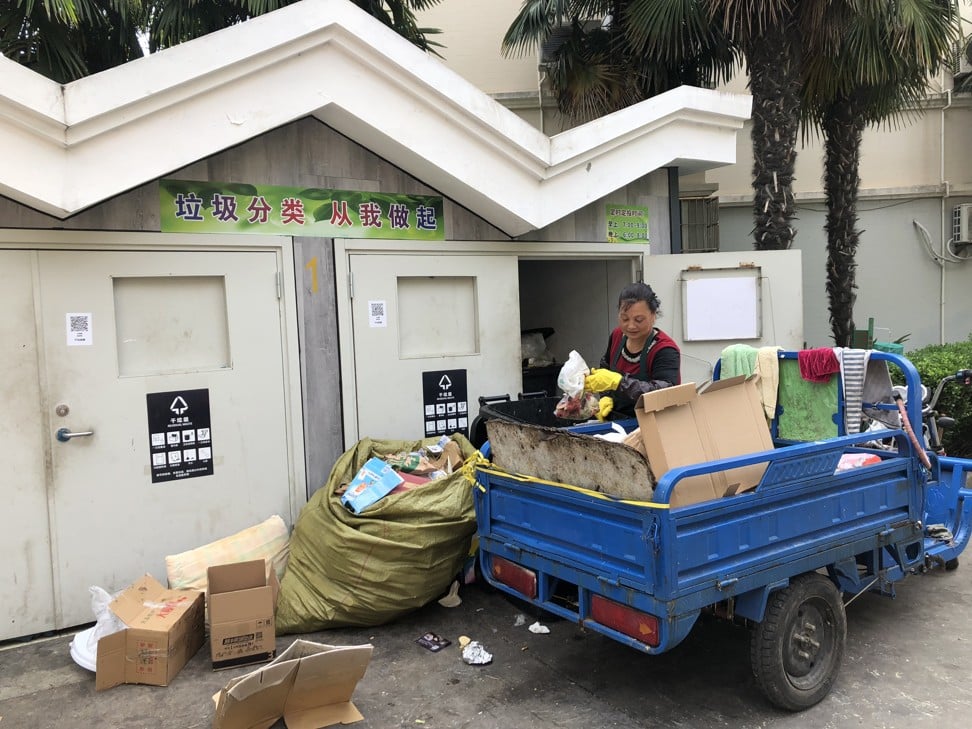
A cleaner re-sorts household waste left at a residential facility in Shanghai. Photo: Alice Yan
Household waste in the city is now required to be sorted into four categories: wet garbage (household food), dry garbage (residual waste), recyclable waste and hazardous waste.
General rubbish bins that had previously taken all types of household waste were removed from buildings. Instead, residents were told to visit designated trash collection stations to dispose of different types of waste during designated periods of the day.
Companies and organisations flouting the new rules could be fined 50,000-500,000 yuan (US$7,000-70,000), while individual offenders risked a fine of 50-200 yuan.
The city’s urban management officers will be mainly responsible for identifying those who breach the rules.
Huang Rong, the municipal government’s deputy secretary general, said on Friday that nearly 14,000 inspections had been carried out around the city and more than 13,000 people had been warned on the issue since the regulations were announced at the start of the year.
As July 1’s enforcement of the rules approached, it became a much-discussed topic among Shanghainese people. A hashtag meaning “Shanghai residents almost driven crazy by garbage classification” was one of the most popular on China’s Twitter-like Weibo platform.
“My daughter took a box of expired medicine from her workplace to the trash collection station near our home yesterday because she couldn’t find the local bin for hazardous waste,” Li said.
While the measures force a change of habits for most people, they bring opportunities for some.
Du Huanzheng, director of the Recycling Economy Institute at Tongji University, said waste sorting was crucial for China’s recycling industry.
“Without proper classification, a lot of garbage that can be recycled is burned, and that’s a pity,” he said. “After being classified, items suitable to be stored and transported can now be recycled.”
G20 set to agree on ways to reduce plastics in oceans
Shanghai’s refuse treatment plants deal with 19,300 tonnes of residual waste and 5,050 tonnes of kitchen waste every day, according to the municipal government. By contrast, only 3,300 tonnes of recyclables per day are collected at present.
Nationwide, the parcel delivery industry used more than 13 billion polypropylene woven bags, plastic bags and paper boxes as well as 330 million rolls of tape in 2016, but less than 20 per cent of this was recycled, according to a report by the State Post Bureau.
Prices of small sortable rubbish bins for home use have surged on e-commerce platforms, while bin makers are also developing smart models in response to new needs.
Some communities are deploying bins that people are required to sign in with their house number to use, and are equipped with a “big data analysis system”. The system records households have “actively participated” and which have not, so that neighbourhood management can publicise their addresses and make house visits, according to a report by Thepaper.cn.
In a residential community in Songjiang district, grocery store owner Nie Chuanguo has found something new to sell: a rubbish throwing service.
He has offered to visit homes, collect waste and throw it into the right bin at a designated time. He charges 30 yuan a month for those living on the ground and first floors, 40 yuan for those on the second and third, and 50 yuan for the fourth and fifth.
“This service will start from July 1. Many people have come to inquire about it,” he said.
According to Du, waste classification is not only about environmental impact or business opportunities. “Garbage sorting is an important part of a country’s soft power,” he said.
For China, it was an opportunity to improve its international reputation, he said. “In the past, Chinese people were rich and travelled abroad, but they threw rubbish wilfully, making foreigners not admit we are a respected powerhouse.”
He added: “It’s also related to 1.3 billion people’s health, since the current waste treatment methods – burying and burning – are not friendly to the environment.”
Shanghai’s part in tackling waste comes amid President Xi Jinping’s repeated calls for the country to sort waste better.
“For local officials, it is a political task,” said Chen, who heads a waste management programme in rural China called Zero Waste Villages.
Huang said the president had asked Shanghai in particular to set a good example in waste classification.
In March 2017, the central government set out plans for a standardised system and regulations for
, with a target for 46 major cities, including Shanghai, to recycle 35 per cent of their waste by then.
In early June, Xi issued a long statement calling for more action from local governments.
However, it was a long process that required input from individuals, government and enterprises, Du said.
“Japan took one generation to move to doing its waste sorting effectively, so we shouldn’t have the expectation that our initiative will succeed in several years,” Du said.
How China’s ban on plastic waste imports caused turmoil
“The lessons we can learn from Japan include carrying out campaigns again and again, and paying close attention to educating young pupils about rubbish classification.”
Chen echoed that Shanghai’s waste sorting frenzy now was only a beginning.
“What we can see now is that people are being pushed to sort waste by regulators, but what’s next? How shall we keep up the enthusiasm?” she asked.
She suggested that how well officials worked on garbage sorting should be included in their job appraisal, and that ultimately people should pay for waste disposal.
“The key to waste classification, going by international experience, is making polluters pay,” Chen said.
Most of Hong Kong and Taiwan’s dumped plastic bottles come from mainland
There is plenty of experience for Shanghai to learn from in California, where unrecyclable waste is charged for at twice the price of recyclables, and Taiwan, where people are charged only for disposal of residual waste, according to Chen.
Taiwan has one of the world’s most impressive recycling rates, with nearly 60 per cent of its waste between January and October last year having been recycled, according to the Taipei government.
The daily amount of garbage produced per person during that period was about 0.41kg – down substantially from 1.14kg in 1997 – the government said.
Hong Kong has tried to copy the Taipei model over the years but failed, with a recycling rate of MSW slightly above 30 per cent in recent years, according to official data.
The city has recently postponed a mandatory
until late 2020 at the earliest. Under its plan, 80 per cent of household waste will have to go into designated bags and will be priced at an average of 11 HK cents (1 US cent) per litre.
On Friday, Shanghai officials admitted that there were plenty of challenges involved in
sorting and transport.
Zhang Lixin, deputy chief of the municipal housing administration, said: “Many property management companies fear the difficulties brought by garbage sorting or are reluctant to implement the new rules.”
The administration trained the heads of more than 200 companies across the city in April, he said.
“We do find that some cleaners and rubbish trucks mix the waste, despite residents being asked to throw different types in different bins,” said Deng Jianping, head of the city’s landscaping and city appearance administration – the government department spearheading the initiative.
In the interests of curbing such practices, they could face fines of up to 50,000 yuan or even have their licences revoked, he said.
Source: SCMP
Posted in ambitious waste and recycling rules, begins, California, China eyes, cleaner image, dry garbage, environmentalist, hazardous waste, Hong Kong, household food, Japan, mainland, municipal solid waste (MSW), new waste sorting era, plastic waste imports, Plastics, President Xi Jinping, recyclables, Recycling Economy Institute at Tongji University, recycling industry, residual waste, second-biggest waste producer, Shanghai, Songjiang, sort rubbish better, Taiwan, Thepaper.cn, Uncategorized, United States, unrecyclable waste, US, wet garbage, Zero-Waste Villages |
Leave a Comment »
26/04/2019
- Property management workers pull to safely elderly woman with Alzheimer’s disease climbing down side of building
The elderly woman with Alzheimer’s climbs down the outside of her residential building in Chengdu, Sichuan province, on Thursday. Photo: Weibo
An 84-year-old woman with Alzheimer’s disease in southwestern China stunned her neighbours by climbing out of a lavatory window in a high-rise building and down from her 14th-floor flat.
The octogenarian was rescued by property management workers, who were waiting near the window of a flat on the fifth floor to intercept her, news website Thepaper.cn reported.
The woman squeezed through the window of her home’s toilet in a residential block in Chengdu, Sichuan province, on Thursday after she was locked in by relatives, a property management employee said.
“She couldn’t open the door from inside. But she wanted to go out as it was so humid and hot today,” the unnamed worker said.
As she climbed down the outside of the building, her neighbours unfolded a bedsheet on the ground, hoping to catch her if she fell.
The elderly woman survived the incident unscathed. Photo: Weibo
Property management workers gave the woman water and food after rescuing her. She was later picked up by her relatives and was reported to have no injuries from her adventure, the report said.
There were 6 million Alzheimer’s disease patients in China in 2015, with around 300,000 new cases reported each year, news portal Sohu.com reported.
Chinese taxi driver takes his wife with Alzheimer’s to work every day
A 2016 white paper released by the Zhongmin Social Assistance Institute, a Beijing-based research NGO, said half a million old people got lost in China each year, with a quarter of them diagnosed with Alzheimer’s.
“China is seriously hit by Alzheimer’s disease based on the country’s rapidly ageing population,” Dr Wang Luning, chairman of the Chinese Alzheimer’s Disease Association, told Legal Daily.
“But many people, even some doctors, have little knowledge about this disease, leading to low rates of people seeking diagnosis, the rate of them being diagnosed and being treated all being low.”
Source: SCMP
Posted in Alzheimer's disease, bedsheet, Chairman, Chengdu, China alert, Chinese Alzheimer’s Disease Association, Chinese Spider-Gran, Dr Wang Luning, elderly woman, ground, heart-stopping, high-rise escape, humid and hot, Legal Daily, NGO, octogenarian, Property management workers, rescued, residential block, sichuan province, Sohu.com, Thepaper.cn, Uncategorized, unharmed, Zhongmin Social Assistance Institute |
Leave a Comment »















 CHINDIA ALERT: You'll be living in their world, very soon