Archive for ‘trees’

22/05/2020

Cyclone Amphan: Survivors return to face destruction left by storm

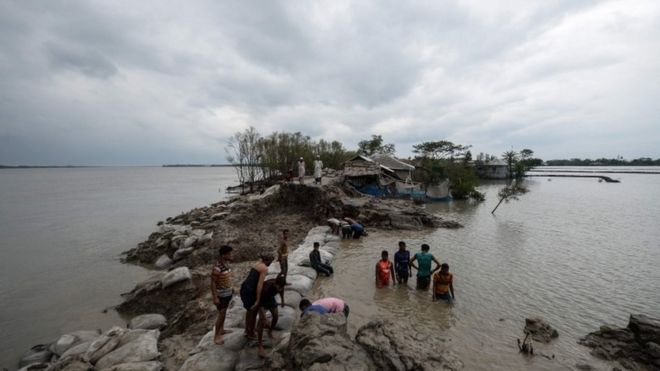
cyclone bangladeshImage copyright AFP
Image caption Embankments have been washed away in Bangladesh

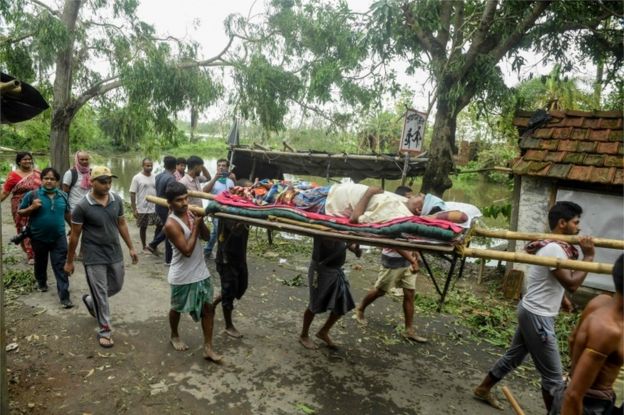
Millions of people across Bangladesh and eastern India are taking stock of the devastation left by Cyclone Amphan.

A massive clean-up operation has begun after the storm left 84 dead and flattened homes, uprooted trees and left cities without power.

India’s Prime Minister Narendra Modi has arrived in West Bengal state to conduct an aerial survey.

Authorities in both countries had evacuated millions of people before the storm struck.

Covid-19 and social-distancing measures made mass evacuations more difficult, with shelters unable to be used to full capacity.

Officials also said people were afraid and reluctant to move to shelters for fear of contracting the virus.

The cyclone arrived with winds gusting up to 185km/h (115mph) and waves as high as 15ft.
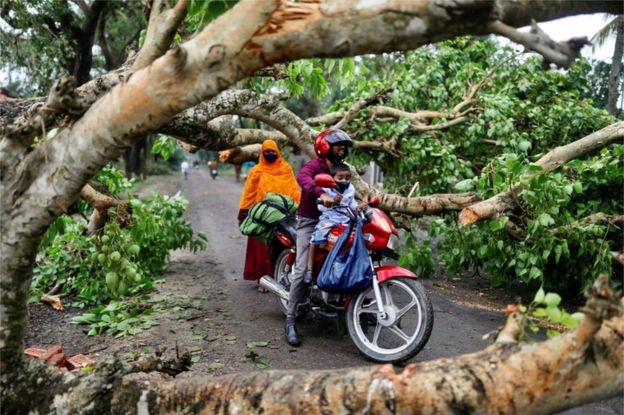
cyclone bangladeshImage copyright REUTERS
Image caption Roads have been blocked by falling trees in Bangladesh
Presentational white space
cyclone west bengalImage copyright AFP
Image caption Many people have been injured in wall collapses in Bengal

It is the first super cyclone to form in the Bay of Bengal since 1999. Though its winds had weakened by the time it struck, it was still classified as a very severe cyclone.

Three districts in India’s West Bengal – South and North 24 Parganas and East Midnapore – were very badly hit.

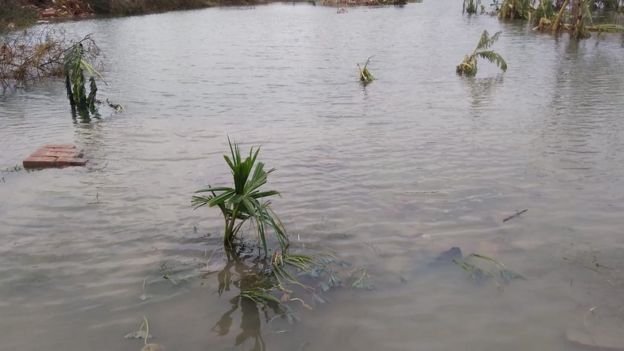
In Bangladesh, there are reports of tens of thousands of homes damaged or destroyed and many villages submerged by storm surges in low-lying coastal areas like Khulna and Satkhira.

The affected areas include the Sunderbans, mangroves spread over an area of more than 10,000 square kilometres that spans both India and Bangladesh – the swampy islands are home to more than four million of the world’s poorest people.
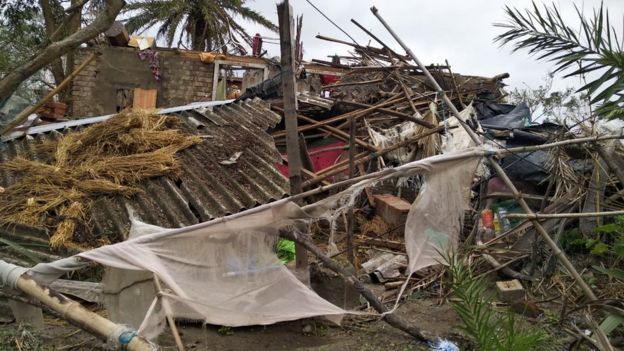
Cyclone leaves a trail of destruction in the SundarbansImage copyright MUKTI
Image caption Many homes, built of brick and mud, have been washed away

Those in the Sunderbans say it is too early to estimate casualties in the area, which is now cut-off from the mainland by the storm.

“There are houses which have collapsed and people could be trapped in them but we don’t know yet,” Debabrat Halder, who runs an NGO in one of the villages, told the BBC.

He recalls cyclone Bulbul in November 2019, which was followed by a huge incidence of fever, diarrhoea and flu, and is afraid that that the same may happen again.

And worse, he adds, is that the flooding from contaminated sea water, has likely destroyed the soil.

“Nothing will grow in this soil,” he says, adding that it will likely take years to convert it into fertile land again.
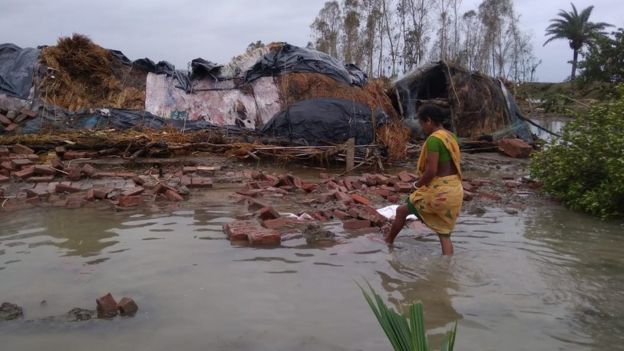
Cyclone Amphan has destroyed many houses in the regionImage copyright MUKTI
Image caption The Sunderbans delta is frequently hit by severe storms
Presentational white space
Flooding from contaminated sea water, has likely destroyed the soil.Image copyright MUKTI
Image caption Crops have all been destroyed by the flooding

Kolkata, the capital of West Bengal, and one of India’s biggest cities has been devastated. Its roads are flooded and the city was without power for more than 14 hours.

The state’s chief minister, Mamata Banerjee, said the devastation in Kolkata was “a bigger disaster than Covid-19”.

But assessment of the damage is being hampered by blocked roads and flooding in all these areas.

Source: The BBC
07/10/2019

Aarey protests: Supreme Court steps in to save Mumbai trees after protests

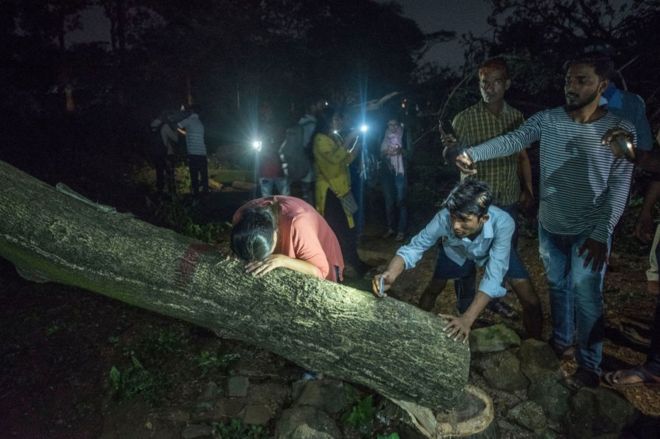
Protesters cry over felled trees in Aarey colony on October 5, 2019 in Mumbai, India.Image copyright GETTY IMAGES
Image caption Protesters cry over felled trees in Aarey colony

India’s top court has asked officials to stop cutting trees in a forested area in Mumbai city after protesters clashed with police over the weekend.

The trees, part of a green strip known as Aarey colony, were being cut to make way for a new metro rail project.

Locals have long opposed the move, and filed petitions seeking Aarey to be declared a protected area.

But a high court dismissed the petitions on Friday, sparking protests as officials began felling the trees.

They planned to cut 2,185 trees, and admitted in the Supreme Court that more than 1,500 had already been cut. But petitioners claim that officials have cut around 2,500 trees.

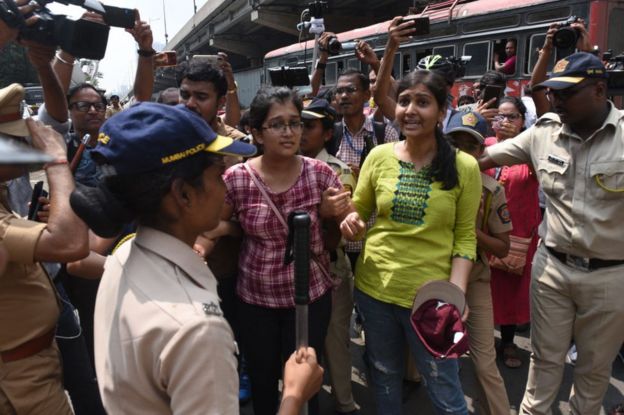
Local residents, students and environmental activists clashed with police on Friday as they took to the streets to stop authorities, and even broke through barricades to enter Aarey colony. More than 50 people were arrested and police imposed restrictions on public gatherings.

The protests grabbed the national spotlight over the weekend, and the Supreme Court took suo moto (without a formal complaint from any party) notice.

What did the Supreme Court say?

A special two-judge bench heard the matter on Monday after students wrote to the chief justice, asking the court to intervene and save the trees.

The court asked the state government of Maharashtra, where Mumbai is located, to not cut any more trees.

Activists were forcefully evacuated from Aarey Checknaka and taken to local Police Station at Goregaon, on October 5, 2019 in Mumbai, India.Image copyright GETTY IMAGES
Image caption Police arrested more than 50 protesters

The court also asked the government to maintain “status quo” – which means that no construction can take place – until 21 October when it will hear the matter again.

The court also ordered the release of all activists who were arrested or detained on bail.

What is Aarey colony?

Spread over 1,300 hectares (3,212 acres), Aarey is a densely forested area dotted with lakes and has the Mithi river flowing through it. It lies at the heart of Mumbai and is often referred to as its last green lung.

It’s locally known as the Aarey “milk colony” because most of the land was given to the department of dairy development in 1951. But they are allowed to grow cattle fodder only on a fraction of the land.

Activists break barricades to stop authorities from cutting at the main gate of Metro car shed , Picnic point, Aarey colony , Goregaon east, on October 5, 2019 in Mumbai.Image copyright GETTY IMAGES
Image caption Protesters broke through barricades and clashed with police on Friday

Earlier this year, officials cleared some 40 hectares of the forested area to build a zoo, complete with a night safari. And now, locals complain, another slice of it is in danger from the metro construction.

They also fear that the government will eventually clear the way for private builders to encroach on the Sanjay Gandhi National Park, which lies to the north of Aarey colony.

Officials, however, dismiss these fears as unfounded and point out that the construction for the metro only requires 30 hectares.

How crucial is the metro rail for Mumbai?

The city badly needs a “mass rapid transport system,” Ashwini Bhide, managing director of the Mumbai metro rail corporation, had told the BBC earlier.

The land in Aarey colony, she said, was “the most suitable land due to its size, shape and location”.

She has also been defending the decision to cut the trees on Twitter.

Presentational white space

India’s financial hub is congested and infamous for its crawling traffic jams.

Its colonial-era local train system ferries some 7.5 million people between the city’s suburbs and its centre on a daily basis.

Officials say that the metro will eventually carry around 1.7 million passengers every day and bring down the number of vehicles on the road by up to 650,000.

Source: The BBC

30/09/2019

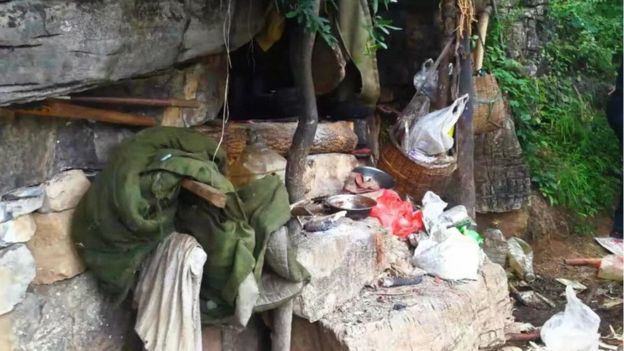
Fugitive on run for 17 years found living in cave by a drone

Fugitive arrested by policeImage copyright YONGSHAN POLICE
Image caption After 17 years, the fugitive was tracked down by a drone

Chinese police have arrested a fugitive who’d been on the run for 17 years, after they used drones to spot his cave hideout.

The 63-year old, named Song Jiang by the police, had been jailed for trafficking women and children but escaped from a prison camp in 2002.

He had been living in a tiny cave cut off from human interaction for years.

Yongshan police received clues about Song’s whereabouts in early September, they said on their WeChat account.

Those clues led them to the mountains behind his hometown in Yunnan province in south-west China.

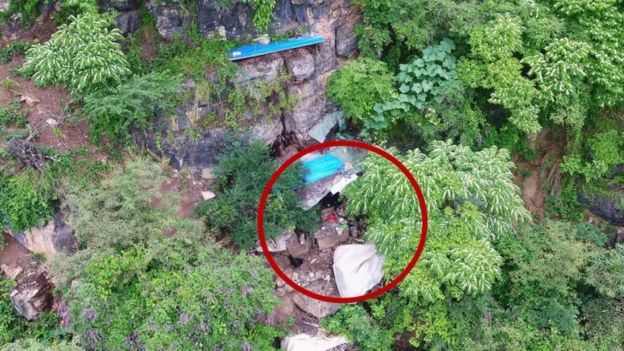
Aerial shot of the cave entranceImage copyright YONGSHAN POLICE
Image caption Drones spotted the cave on a steep hillside

After regular searches failed to find anything, authorities sent additional drones to help the officers.

The drones eventually spotted a blue-coloured steel tile on a steep cliff as well as traces of household rubbish nearby.

Police then moved in on foot and found Song in a small cave where he’d been hiding for years.

According to the police, the man had been living in seclusion for so long that it was difficult for him to communicate with the officers.

State media said Song had used plastic bottles to get drinking water from a river, and branches of trees to make fire.

He has been sent back to jail.

Outside of the caveImage copyright YONGSHAN POLICE
Image caption The inside of the cave was about 2 sq metres (6.6 sq feet)

Source: The BBC

30/07/2019

Punjab: India state launches ‘gun for plants’ scheme


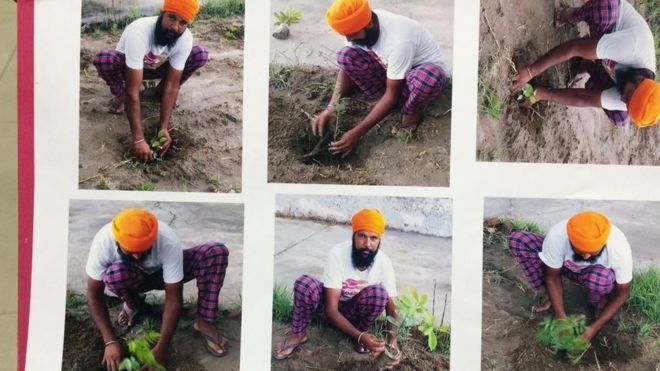
A man poses with plant saplings before applying for a gun licenseImage copyright COURTESY: CHANDER GAIND
Image caption Applicants for gun licenses must plant at least 10 saplings and submit ‘selfies’ as proof

Guns and plant saplings are an odd combination – but in India’s northern Punjab state, the two are now linked.

For a month now, applicants in the state’s Ferozepur district have had to plant at least 10 saplings before applying for gun licences.

“Punjabis are mad about cars, weapons and mobiles. Let them be mad about plantations too,” District Commissioner Chander Gaind told the BBC.

Mr Gaind said applicants would have to submit selfies with the saplings.

“With roads being widened at a [fast] rate, trees are being cut in very large numbers, so this was the need of the hour,” he added.

With 360,000 licensed gun holders, Punjab has the third largest number of licenses in India, government data shows.

But a selfie with a sapling does not guarantee one of the much sought after licences. It merely means the application will be “considered” for processing.

The order was issued on 5 June to coincide with world environment day, but has only now picked up traction in local media as more people have started complying.

Mr Gaind says they have received at least 100 applications – along with selfies – since the order was passed.

But simply planting saplings and taking selfies with them is not enough – applicants also have to submit follow-up selfies a month later, proving that they are nurturing the plants.


Source: The BBC
Law of Unintended Consequences

continuously updated blog about China & India

ChiaHou's Book Reviews

continuously updated blog about China & India

What's wrong with the world; and its economy

continuously updated blog about China & India