Archive for ‘Trump’

26/02/2020

Coronavirus pandemic a question of ‘when’ not ‘if’, warns U.S.

SHANGHAI/SEOUL (Reuters) – Asia reported hundreds of new coronavirus cases on Wednesday, including a U.S. soldier stationed in South Korea, as the United States warned of an inevitable pandemic and outbreaks in Italy and Iran spread to other countries.

World stocks tumbled for the fifth day on fears of prolonged disruption to global supply chains, while safe-haven gold rose back toward seven-year highs and U.S. bond yields held near record lows.

Stock markets globally have wiped out $3.3 trillion of value in the past four trading sessions, as measured by the MSCI all-country index.

The disease is believed to have originated in a market selling wildlife in the central Chinese city of Wuhan late last year and has infected about 80,000 people and killed more than 2,700, the vast majority in China.

The U.S. Centers for Disease Control and Prevention urged Americans to prepare, saying that while the immediate risk there was low the global situation suggested a pandemic was likely.

“It’s not a question of if. It’s a question of when and how many people will be infected,” the CDC’s principal deputy director, Anne Schuchat, said on Tuesday.

World Health Organization (WHO) chief Tedros Adhanom Ghebreyesus, however, advised against referring to a pandemic.

“We should not be too eager to declare a pandemic without a careful and clear-minded analysis of the facts,” Tedros said in remarks to Geneva-based diplomats.

“Using the word pandemic carelessly has no tangible benefit, but it does have significant risk in terms of amplifying unnecessary and unjustified fear and stigma, and paralyzing systems. It may also signal that we can no longer contain the virus, which is not true.”

‘DON’T WAIT’

The United States has reported 57 cases of the virus. U.S. President Donald Trump, back in Washington after a visit to India, said on Twitter that he would meet U.S. officials for a briefing on the coronavirus on Wednesday.

Dr Bruce Aylward, head of a joint WHO-Chinese mission on the outbreak, told reporters on his return to Geneva that countries’ preparations should not wait.

“Think the virus is going to show up tomorrow. If you don’t think that way, you’re not going to be ready,” he said. “This a rapidly escalating epidemic in different places that we have got to tackle super-fast to prevent a pandemic.”

Aylward said China’s “extraordinary mobilization” showed how an aggressive public health policy could curb its spread.

The WHO says the outbreak peaked in China around Feb. 2, after authorities isolated Hubei province and imposed other containment measures.

China’s National Health Commission reported another 406 new infections on Wednesday, down from 508 a day earlier and bringing the total number of confirmed cases in mainland China to 78,064. Its death toll rose by 52 to 2,715.

The WHO said only 10 new cases were reported in China on Tuesday outside Hubei.

South Korea, which with 1,261 cases has the most outside China, reported 284 new ones including a U.S. soldier, as authorities readied an ambitious plan to test more than 200,000 members of a church at the center of the outbreak.

Of the new cases, 134 were from Daegu city, where the virus is believed to have been passed among members of the Shincheonji Church of Jesus, the Korea Centers for Disease Control and Prevention said.

The U.S. military said a 23-year-old soldier based in Camp Carroll, about 20 km (12 miles) from Daegu, had been infected and was in self-quarantine at home.

OLYMPIC WORRIES

In Japan, Prime Minister Shinzo Abe called for sports and cultural events to be scrapped or curtailed for two weeks to stem the virus as concern mounted for the 2020 Tokyo Olympics.

Japan’s professional baseball teams would play matches without spectators until March 15 due to virus concerns, Kyodo news agency reported.

Japan has nearly 170 virus cases, besides the 691 linked to a cruise ship that was quarantined of its coast this month. Six people have died in Japan, including four from the ship.

There have been nearly 50 deaths outside China, including 11 in Italy and 19 in Iran, the most outside China, according to a Reuters tally.

Iran’s deputy health minister – seen mopping his brow at a televised news conference – was among its 139 coronavirus infections. Cases linked to Iran have been reported across the region.

Kuwait said six new coronavirus cases, all linked to travel to Iran, took its tally to 18, while Bahrain said its infections had risen to 26 after three new ones on a flight from Iran.

The United Arab Emirates, which has reported 13 coronavirus cases, is prepared for “worst case scenarios” as it spreads in the Middle East, a government official said.

In Europe, Italy has become a front line in the global outbreak with 322 cases. Italians or people who had recently visited the country, have tested positive in Algeria, Austria, Croatia, Romania, Spain and Switzerland.

Two hotels, one in Austria and one in Spain’s Canary Islands, were also locked down after cases emerged linked to Italy. Spain also reported its first three cases on the mainland.

France, with 17 cases, reported its second death.

Source: Reuters
22/02/2020

Trump in India: A brief history of US presidents’ trips

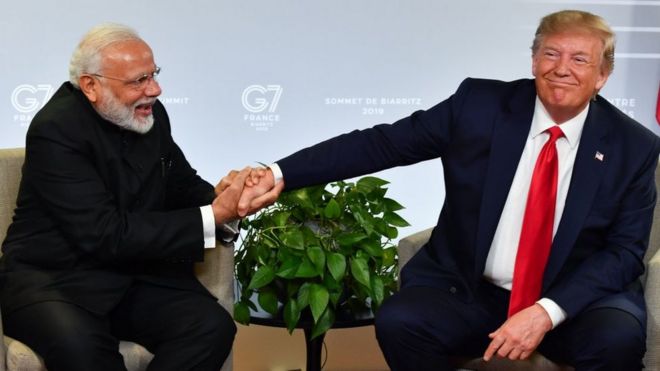
Indian Prime Minister Narendra Modi (L) and US President Donald Trump shakes hands as they speak during a bilateral meeting in Biarritz, south-west France on August 26, 2019.Image copyright GETTY IMAGES
Image caption Mr Trump is making his first official visit to India

US President Donald Trump is expecting a raucous welcome on his first official state visit to India on Monday and Tuesday.

He follows a long line of leaders who have made the journey. Some of his predecessors were greeted enthusiastically; others stumbled through diplomatic gaffes; one even had a village named after him.

Can history be a guide to how this diplomatic tryst might go? Here’s a brief look at past visits, ranked in order of how they went.

The good: President Eisenhower

Let’s begin at the beginning.

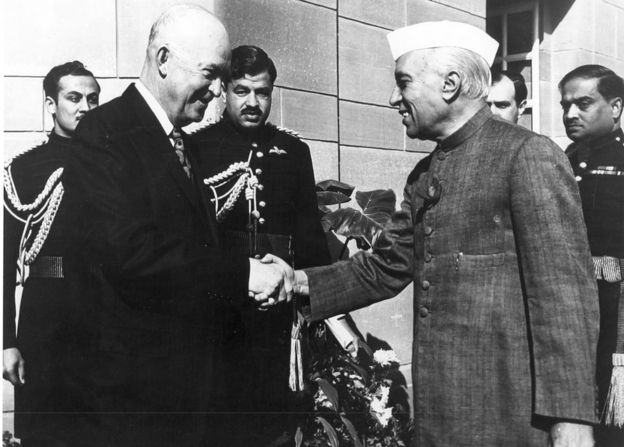
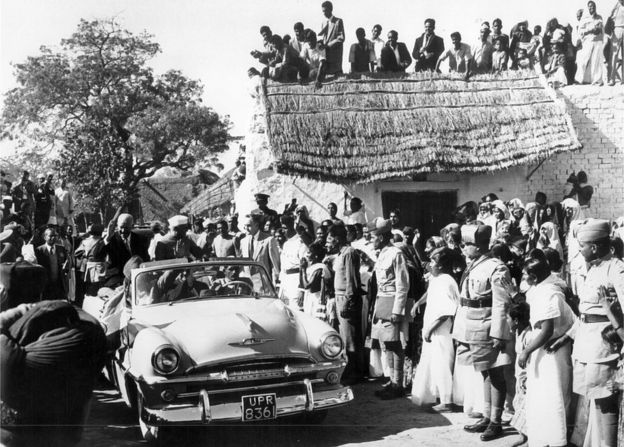
Dwight D Eisenhower, the first US president to visit India, was greeted with a 21-gun salute when he landed in the national capital, Delhi, in December 1959. Huge crowds lined the streets to catch a glimpse of the World War Two hero in his open-top car – Mr Trump is expecting a similar reception in Ahmedabad city, where he will be doing a road show.

President Eisenhower (L) with Prime Minister Jawaharlal NehruImage copyright US EMBASSY ARCHIVES
Image caption Dwight D Eisenhower, pictured with Prime Minister Jawaharlal Nehru, was the first US president to make the trip

The warmth between President Eisenhower and Indian Prime Minister Jawaharlal Nehru helped during what was a rocky phase in US-India ties. This was early in the Cold war, when the US and Pakistan had become become close allies, and India insisted on staying neutral or “non-aligned”. Like today, relations with China were at the core of the India-US equation, with Washington pressuring Delhi to take an aggressive stance with Beijing on the issue of Tibet.

But, on the whole, Eisenhower’s four-day trip was billed a success. And nearly every US president on a state visit to India has emulated his itinerary: he laid flowers at Mahatma Gandhi’s memorial, took in the splendour of the Taj Mahal, addressed parliament and spoke at Delhi’s iconic Ramlila grounds, which, according to one news report, attracted one million people.

When he left, Nehru said he had taken with him “a piece of our heart”.

President Eisenhower drove in open car to small village to get a glimpse of rural India on December 13, 1959.Image copyright US EMBASSY ARCHIVES
Image caption President Eisenhower was greeted by large crowds
Presentational white spaceThe game-changer: Bill Clinton

If there was a game-changing visit, it would be Bill Clinton’s in March 2000 with Prime Minister Atal Bihari Vajpayee. Mr Clinton’s arrival came after a two-decade lull – neither Ronald Reagan nor George Bush Snr made the journey East. It came at a tricky time as Washington had imposed sanctions on Delhi following its 1999 test of a nuclear bomb.

But, according to Navtej Sarna, a former Indian Ambassador to the US, the five-day trip was “a joyous visit”. It included stops in Hyderabad, a southern city that was emerging as a tech hub, and Mumbai, India’s financial capital. “He came and saw the economic and cyber potential of India, and democracy in action,” says Mr Sarna.

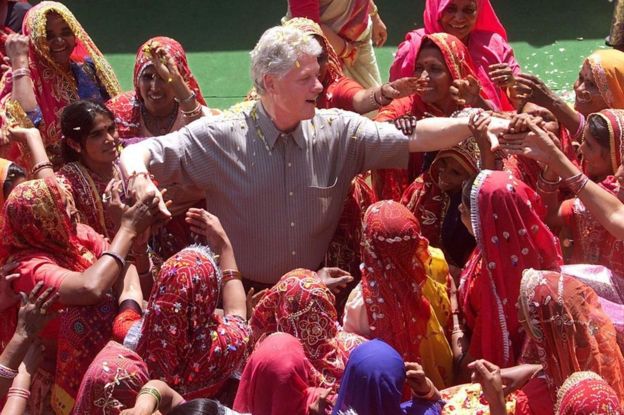
US President Bill Clinton shakes hands with local villagers after touring Nayla Village 23 March 2000.Image copyright GETTY IMAGES
Image caption Bill Clinton’s visit was described as “joyous”
Mr Clinton also danced with villagers, took a tiger safari and sampled Delhi’s famously creamy black dal (lentils) at a luxury hotel that has since been associated with the president.

The country’s reaction is perhaps best expressed in this New York Times headline: “Clinton fever – a delighted India has all the symptoms.”

The nuclear deal: George W Bush

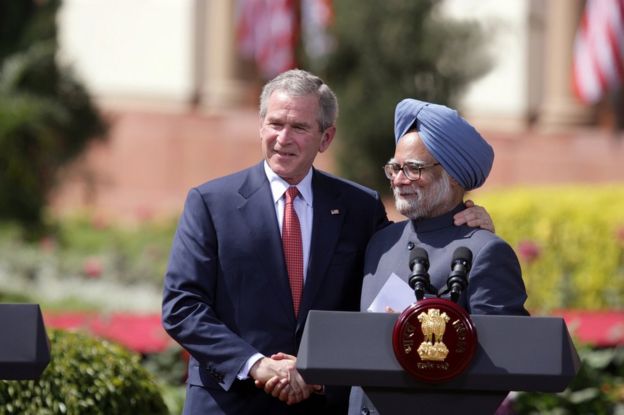
George W Bush, as Forbes magazine once put it, was the “best US president India’s ever had”. His three-day visit in March 2006 was a highlight in the two countries’ strategic relationship – especially in matters of trade and nuclear technology, subjects they have long wrangled over. His strong personal dynamic with Prime Minister Manmohan Singh was hard to miss – after he left office, Mr Bush, a keen artist, even painted a portrait of Mr Singh.

The two leaders are credited for a historic but controversial nuclear deal, which was signed during Mr Bush’s visit. It brought India, which had for decades refused to sign the Nuclear Non-Proliferation Treaty (NPT), out of isolation. Energy-hungry India got access to US civil nuclear technology in exchange for opening its nuclear facilities to inspection.

George W Bush (L) with Manmohan Singh (R)Image copyright US EMBASSY ARCHIVES
Image caption George W Bush and Manmohan Singh had a very good relationship
However, while the visit was substantive, it was not as spectacular as others – there was no trip to the Taj, nor an address to parliament. But the timing was important. Anti-US sentiment over the invasion of Iraq was running high – left-wing MPs had staged a protest against Mr Bush’s visit, and there were demonstrations in other parts of India.

Double visit: Barack Obama

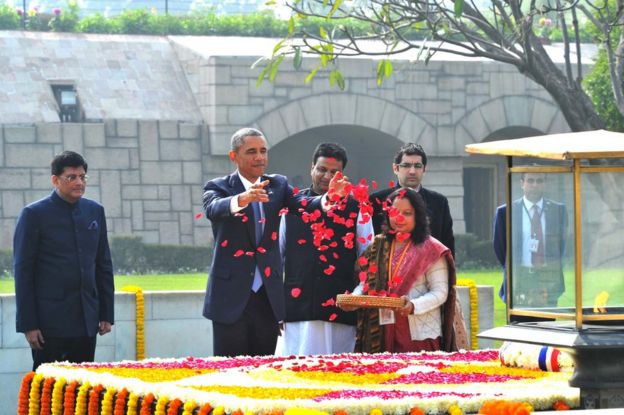
Barack Obama was the only president to make two official visits. First, in 2010 with Prime Minister Manmohan Singh, and then in 2015 with Prime Minister Narendra Modi.

On his first visit – in a break from the past – he landed in Mumbai, instead of Delhi, with a large trade delegation. This was not just about economic ties but a show of solidarity following the Mumbai terror attacks of 2008, which killed 166 people. Mr and Mrs Obama even stayed at the Taj Mahal hotel, one of the main targets.

It was significant that the US president declared support for India to join a reformed and expanded UN Security Council, says Alyssa Ayres, a former US deputy assistant secretary of state for South Asia. “That all these years later nothing has changed in the UN system is another matter, but that was a major policy shift for the United States.”

US President Barack Obama paying floral tributes at the samadhi of Mahatma Gandhi at Rajghat in Delhi.Image copyright US EMBASSY ARCHIVES
Image caption Barack Obama visited India twice
Mr Obama returned in 2015 as chief guest at India’s Republic Day celebrations, at PM Modi’s invitation. Trade, defence and climate change were at the heart of the talks. The trip also emphasised an Indo-Pacific strategy, where both leaders expressed unease over Beijing’s provocations in the South China Sea.

The not-so-good: Jimmy Carter

Although Jimmy Carter’s two-day visit in 1978 was a thaw in India-US relations, it was not free of hiccups.

With some 500 reporters in tow, Carter followed a packed itinerary: he met Prime Minister Morarji Desai, addressed a joint session of parliament, went to the Taj Mahal, and dropped by a village just outside Delhi.

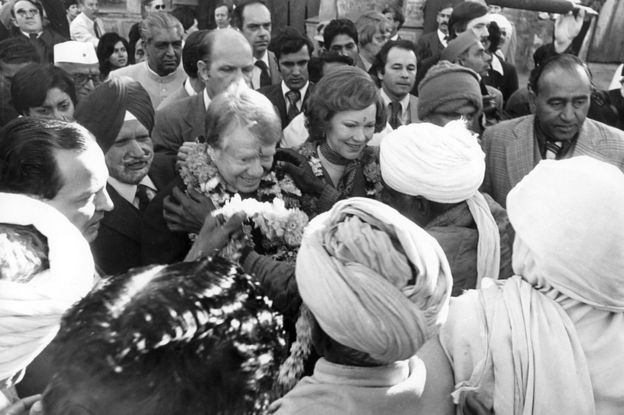
The village, Chuma Kheragaon, had a personal connection: Carter’s mother, Lillian, had visited here when she was in India as a member of the Peace Corps in the late 1960s. So when Carter and his wife, Rosalynn, made the trip, they gave the village money and its first television set. It was even renamed “Carterpuri”, a moniker it still holds.

Jimmy Carter being greeted by villagers of 'Carterpuri'Image copyright US EMBASSY ARCHIVES
Image caption Jimmy Carter being greeted by villagers of ‘Carterpuri’
But beyond the photo-ops, India and the US were sparring. India was building its nuclear programme, and had conducted its first test in 1974. The US wanted India to sign the NPF, which sought to stop the spread of nuclear weapons. But India refused, saying the agreement discriminated against developing countries.

In a leaked conversation that made headlines and threatened to derail the visit, Mr Carter promised his Secretary of State, Cyrus Vance, a “very cold and very blunt” letter to Desai. The two leaders signed a declaration, promising greater global co-operation, but Carter left India without the assurances he had hoped for.

The ugly: Richard Nixon

Richard Nixon was no stranger to India when he arrived in August 1969 for a day-long state visit. He had been here as vice-president in 1953, and before that on personal trips. But, by all accounts, he wasn’t a fan.

“Nixon disliked Indians in general and despised [Prime Minister] Indira Gandhi,” according to Gary Bass, author of Blood Telegram: Nixon, Kissinger and a Forgotten Genocide. And, he adds, the feeling was said to be mutual.

This was also at the height of the Cold War, and India’s non-alignment policy “appalled” American presidents. Mr Bass says that under Gandhi, India’s neutrality had turned into a “noticeably pro-Soviet foreign policy”.

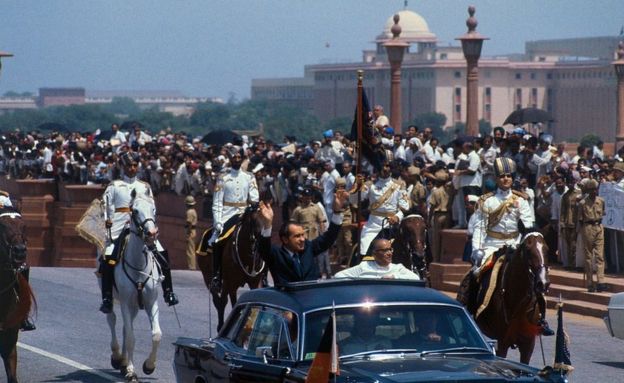
President Richard Nixon waves to crowds as he rides in open car with the acting president of India, Mohammad Hidyatullah, in motorcade from airport upon arrival here July 31.Image copyright GETTY IMAGES
Image caption Richard Nixon waves to the crowds alongside Mohammad Hidyatullah, India’s acting president
The relationship only turned frostier after the trip as India backed Bangladesh (then East Pakistan) in its fight for independence from Pakistan, a close American ally. The differences were laid bare when Gandhi visited the White House in 1971. Declassified state department cables later revealed that Nixon referred to her as an “old witch”.

And the future: Donald Trump

The US and India have certainly had their ups and downs, but during the last official visit in 2015, Mr Obama and Mr Modi signed a declaration of friendship: “Chalein saath saath (Let’s move forward together)…” it began.

President Trump’s visit will take the relationship forward, but it’s unclear how.

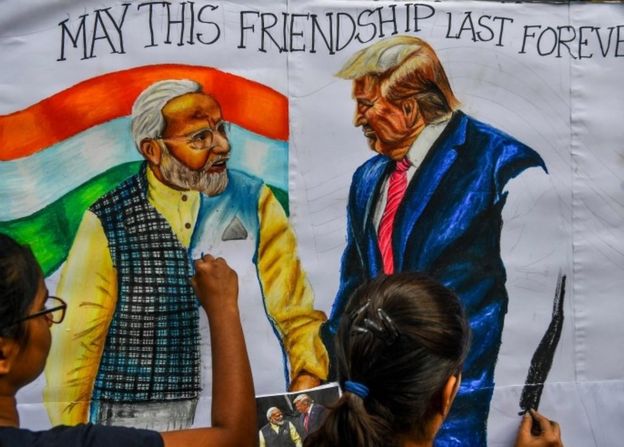
Students paint on canvas faces of US President Donald Trump (R) and India"s Prime Minister Narendra Modi, in the street in Mumbai on February 21, 2020, ahead of the visit of US President in IndiaImage copyright AFP

His arrival in Ahmedabad, the main city in PM Modi’s home state of Gujarat, followed by a big arena event, is expected to draw a massive crowd. It will echo President Eisenhower’s rally in Delhi years ago, perhaps cementing the personal ties between the two leaders.

But while Mr Trump’s trip will be packed with pageantry, it could be light on policy. Unlike other presidential visits, this one is not expected to yield concrete agreements, with the trade deal Mr Trump so badly wants looking unlikely.

Source: The BBC

18/02/2020

Hero worship: India’s Trump superfans gear up for his arrival

KONNEY/NEW DELHI, India (Reuters) – Bussa Krishna first began worshipping Donald Trump four years ago when the U.S. president appeared to him a dream.

Since then, after a run of good fortune, the Indian real estate broker has transformed his modest home into a shrine to the U.S. leader, who is due in India on Monday for a two-day visit.

“My love for him has transformed into reverence. That has given me immense happiness. Hence instead of praying to other gods, I started praying to him,” Krishna told Reuters.

Krishna, who lives alone in a village in the southern state of Telangana, has erected a life-size statue to Trump in his yard, while his walls are scrawled with the leader’s name – to the annoyance of his extended family.

“I am facing difficulties because of my relatives,” Krishna said. “They tell me that I am disgracing them in society. I told them that just like you believe and worship Shiva, I believe and worship Trump. Neither of us can stop the other from doing so.”

Krishna is not the only Indian who reveres Trump.

In New Delhi, members of the Hindu Sena, a right-wing fringe group, have begun rehearsing a welcome song in his honour.

Its members say Trump shares their hatred of Islamic extremism, and it has drawn attention for boisterous celebrations of his birthday, including pretending to feed cake to photos of his face.

“We like Donald Trump because he openly spoke about India’s feelings,” Hindu Sena leader Vishnu Gupta told Reuters. “…He openly said that he would eliminate Islamic terrorism from its roots, that is why I am his fan.”

Trump, who like Indian Prime Minister Narendra Modi has a reputation as an unabashed populist who shows his enemies no mercy, is making his first visit to India.

Trump’s itinerary starts on Feb. 24 in the western city of Ahmedabad, where he will visit the former home of independence hero Mahatma and address an estimated 125,000 people at a rally. He is due in the capital the following day.

Source: Reuters

15/02/2020

Trump thanks Cambodia over ship in rare message to China-ally

SIHANOUKVILLE, Cambodia (Reuters) – U.S. President Donald Trump has thanked Cambodia for taking in the castaway cruise ship MS Westerdam in a rare message to a country that is one of China’s closest allies and has often been at odds with Washington.

Five countries turned away the Westerdam, worried its passengers could be carrying the coronavirus despite it having no known cases before Cambodia’s authoritarian prime minister, Hun Sen, agreed the passengers could disembark there.

“Thank you to the beautiful country of Cambodia for accepting the @CarnivalCruise ship Westerdam into your port. The United States will remember your courtesy,” Trump said in a post on Twitter late on Friday.

The Westerdam, operated by Carnival Corp (CCL.N) unit Holland America Inc, docked in the port of Sihanoukville on Thursday after being shunned for two weeks.

Its 1,455 passengers began to disembark on Friday.

The passengers were tested regularly on the cruise ship and Cambodia also tested 20 once it docked. None were found to have the new coronavirus that has killed more than 1,500 people, the vast majority in China.

Cambodia’s Hun Sen has often sparred with the United States over its accusations of human rights abuses and its condemnation of a crackdown on the opposition since 2017.

He has brought Cambodia much closer to China, which has provided billions of dollars in aid for infrastructure projects and stood by Cambodia in the face of Western criticism.

“We are very grateful that Cambodia opened its port … We hope that other countries can be equally as helpful to people in need,” U.S. Ambassador to Cambodia W. Patrick Murphy told reporters at the Westerdam.

MOUNTING SCRUTINY

The cruise line industry has come under mounting scrutiny amid the virus outbreak after more than 200 people tested positive for the infection onboard a ship quarantined in Japan.

Two ships, German-owned AIDAvita and the Norwegian Jade, were denied entry by Vietnam amid the worries. [L4N2AF052]

These two have, however, docked at Thai ports.

AIDAvita docked at Laem Chabang port on Friday, a Thai Marine Department official told Reuters.

“The ship will leave the port tomorrow.”

The Jade, operated by Norwegian Cruise Line Holdings Ltd (NCLH.N), docked at Ko Samui on Saturday morning, another Thai Marine Department official said.

Health checks show nobody was sick on the ships.

Source: Reuters

01/02/2020

Coronavirus declared global health emergency by WHO

The new coronavirus has been declared a global emergency by the World Health Organization, as the outbreak continues to spread outside China.

“The main reason for this declaration is not what is happening in China but what is happening in other countries,” said WHO chief Tedros Adhanom Ghebreyesus.

The concern is that it could spread to countries with weaker health systems.

Meanwhile, the US has told its citizens not to travel to China.

The state department issued a level four warning – having previously urged Americans to “reconsider” travel to China – and said any citizens in China “should consider departing using commercial means”.

China has said it will send charter plans to bring back Hubei province residents who are overseas “as soon as possible”.

A foreign ministry spokesman said this was because of the “practical difficulties” Chinese citizens have faced abroad. Hubei is where the virus emerged.

At least 213 people in the China have died from the virus, mostly in Hubei, with almost 10,000 cases nationally.

The WHO said there had been 98 cases in 18 other countries, but no deaths.

Most international cases are in people who had been to Wuhan in Hubei.

However in eight cases – in Germany, Japan, Vietnam and the United States – patients were infected by people who had travelled to China.

People wearing masks

Getty Coronavirus outbreak outside China
  • 18 The number of countries with cases
  • 14 Cases in Thailand and Japan
  • 13 Singapore
  • 11 South Korea
  • 8 Australia and Malaysia
  • 5 France and USA

Source: WHO and local authorities

Speaking at a news conference in Geneva, Dr Tedros described the virus as an “unprecedented outbreak” that has been met with an “unprecedented response”.

He praised the “extraordinary measures” Chinese authorities had taken, and said there was no reason to limit trade or travel to China.

“Let me be clear, this declaration is not a vote of no confidence in China,” he said.

But various countries have taken steps to close borders or cancel flights, and companies like Google, Ikea, Starbucks and Tesla have closed their shops or stopped operations.

The US Commerce Secretary, Wilbur Ross, has said the outbreak could “accelerate the return of jobs to North America”.

Presentational grey line

Preparing other countries

Analysis box by James Gallagher, health and science correspondent

What happens if this virus finds its way into a country that cannot cope?

Many low- and middle-income countries simply lack the tools to spot or contain it. The fear is it could spread uncontrollably and that it may go unnoticed for some time.

Remember this is a disease which emerged only last month – and yet there are already almost 10,000 confirmed cases in China.

The 2014 Ebola outbreak in West Africa – the largest in human history – showed how easily poorer countries can be overwhelmed by such outbreaks.

And if novel coronavirus gets a significant foothold in such places, then it would be incredibly difficult to contain.

We are not at that stage yet – 99% of cases are in China and the WHO is convinced the country can control the outbreak there.

But declaring a global emergency allows the WHO to support lower- and middle-income countries to strengthen their disease surveillance – and prepare them for cases.

Presentational grey line

How unusual is this declaration?

The WHO declares a Public Health Emergency of International Concern when there is “an extraordinary event which is determined… to constitute a public health risk to other states through the international spread of disease”.

It has previously declared five global public health emergencies:

  • Swine flu, 2009 – The H1N1 virus spread across the world in 2009, with death toll estimates ranging from 123,000 to 575,400
  • Polio, 2014 – Although closer than ever to eradication in 2012, polio numbers rose in 2013
  • Zika, 2016 – The WHO declared Zika a public health emergency in 2016 after the disease spread rapidly through the Americas
  • Ebola, 2014 and 2019 – The first emergency over the virus lasted from August 2014 to March 2016 as almost 30,000 people were infected and more than 11,000 died in West Africa. A second emergency was declared last year as an outbreak spread in DR Congo

Media caption Inside the US laboratory developing a coronavirus vaccine

How is China handling the outbreak?

A confirmed case in Tibet means the virus has reached every region in mainland China. According to the country’s National Health Commission, 9,692 cases have tested positive.

The central province of Hubei, where nearly all deaths have occurred, is in a state of lockdown. The province of 60 million people is home to Wuhan, the heart of the outbreak.

The city has effectively been sealed off and China has put numerous transport restrictions in place to curb the spread of the virus.

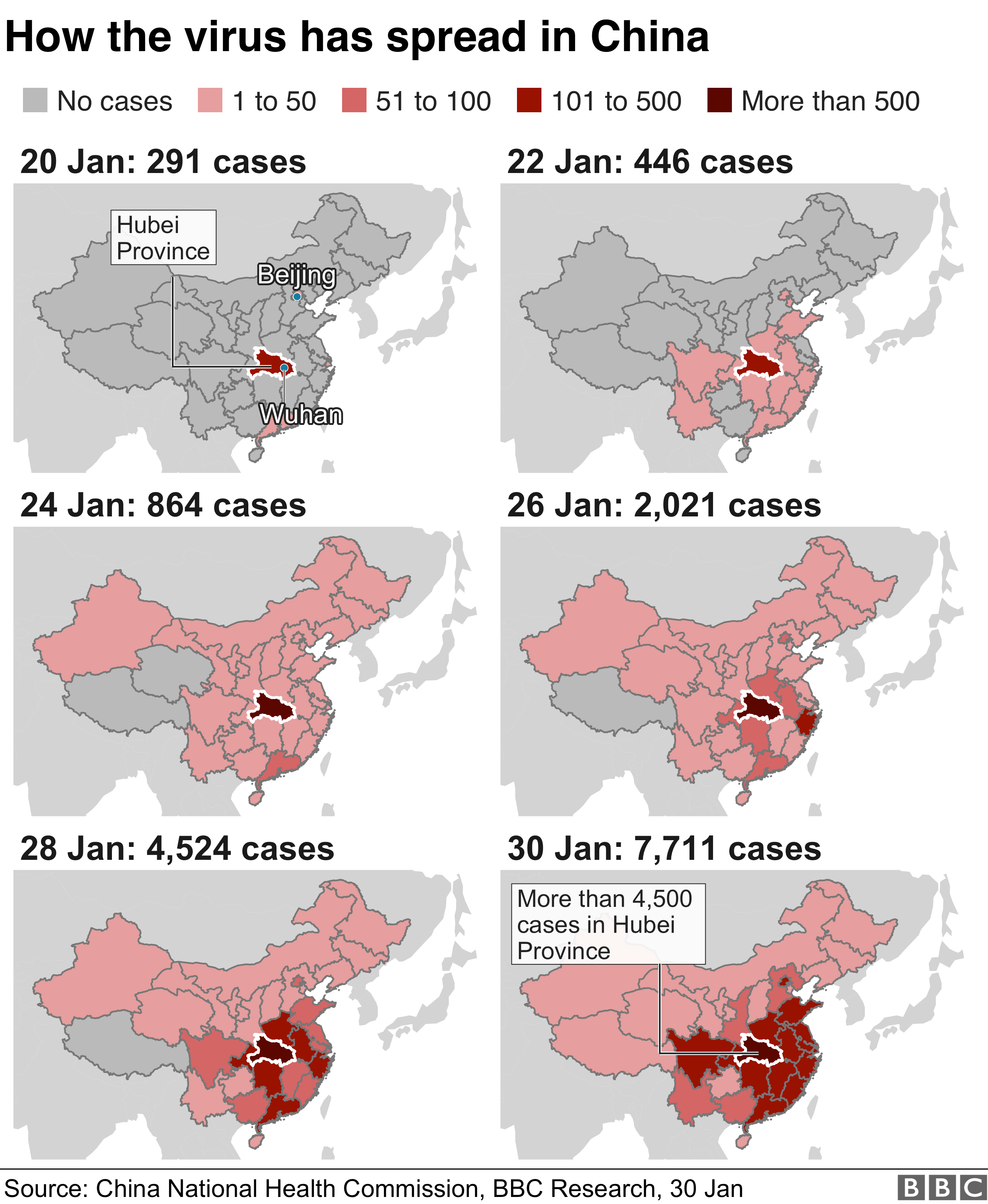
Coronavirus cases have spread to every province in China. There are now 7711 cases compared to 291 on 20 Jan. Hubei province has more than 4500 cases.
People who have been in Hubei are also being told to work from home until it is considered safe for them to return.

The virus is affecting China’s economy, the world’s second-largest, with a growing number of countries advising their citizens to avoid all non-essential travel to the country.

How is the world responding?

Voluntary evacuations of hundreds of foreign nationals from Wuhan are under way.

The UK, Australia, South Korea, Singapore and New Zealand are expected to quarantine all evacuees for two weeks to monitor them for symptoms and avoid contagion.

Australia plans to quarantine its evacuees on Christmas Island, 2,000km (1,200 miles) from the mainland in a detention centre that has been used to house asylum seekers.

In other recent developments:

  • Italy suspended flights to China after two Chinese tourists in Rome were diagnosed with the virus; earlier 6,000 people on board a cruise ship were temporarily barred from disembarking
  • In the US, Chicago health officials have reported the first US case of human-to-human transmission. Around 200 US citizens have been flown out of Wuhan and are being isolated at a Californian military base for at least 72 hours
  • Russia has decided to close its 4,300km (2,670-mile) far-eastern border with China
  • Two flights to Japan have already landed in Tokyo. Japan has now raised its infectious disease advisory level for China
  • Some 250 French nationals have been evacuated from Wuhan
  • India has confirmed its first case of the virus – a student in the southern state of Kerala who was studying in Wuhan
  • Israel has barred all flight connections with China
  • Papua New Guinea has banned all visitors from “Asian ports”
  • North Korea will suspend all flights and trains to and from China, said the British ambassador to North Korea

Source: The BBC

23/12/2019

China presses for nuclear talks in last days till North Korea’s deadline for US

  • Summit between Chinese, South Korean and Japanese leaders could yield results for future of Korean peninsula, analyst says
North Korea has promised an unwelcome “Christmas present” if the US does not show the “right attitude” for talks. Photo: KCNA
Chinese President Xi Jinping has again stressed the need for tensions on the Korean peninsula to be resolved through dialogue, as the deadline looms in North Korea’s threat to give the United States an unwelcome “Christmas gift”
.

With just over a week to go until Pyongyang’s year-end deadline for Washington to change what it says a policy of hostility, Xi held separate talks with South Korean President Moon Jae-in and Japanese Prime Minister Shinzo Abe in Beijing on Monday.

Moon and Abe will also join Chinese Premier Li Keqiang for a trilateral summit in Chengdu, Sichuan province, on Tuesday.

The first trilateral leadership talks took place in 2008, but were not held in 2013 and 2014, or in 2016 and 2017.

Xi said China and South Korea “both insist on maintaining peace and stability on the peninsula, and advocate solving problems through dialogue and consultation”, state news agency Xinhua reported on Monday.
“China supports South Korea in continuing to improve its relationship with

North Korea,

and injecting impetus for the Korean peninsula peace talks,” the report said.

Moon said the suspension of talks between the US and North Korea and heightened tensions along the peninsula “are not beneficial to both our countries and North Korea”, according to South Korean news agency Yonhap.

Moon also said that China had played an “important role” in efforts for the denuclearise the peninsula, the report said.

North Korea has signalled impatience over the stalled talks with the US, and the fading hopes for an end to Washington’s economic sanctions.

In April, North Korean leader Kim Jong-un said that he would “wait” until the end of the year to decide whether the US had the “right attitude” to allow a resumption of negotiations, but no signs of further talks have emerged.

Then earlier this month Pyongyang warned that Washington would receive a “Christmas gift”, and US actions would determine whether the present would be good or bad.

In an apparent sign of frustration with the US, North Korean news agency KCNA reported on Sunday that Kim held a meeting of the Workers’ Party of Korea to “bolster the overall armed forces of the country” to deal with the “the fast-changing situation”.

The US imposed crippling sanctions on North Korea’s economy in 2017, though many countries, including China, South Korea and Japan, have also tightened measures against the North.

South Korea and Japan both scaled back people-to-people links in 2016, China banned coal exports to the North in 2017. Earlier this year, Trump thanked China and Russia for maintaining sanctions against Pyongyang.

As diplomats make last-ditch attempts to stop renewed confrontation, US special envoy for North Korea Stephen Biegun shuttled around the region last week, meeting senior officials in China, South Korea and Japan. Biegun urged North Korea to return to negotiations, and said the US “does not have a deadline” for talks.

China and Russia also proposed last week that the United Nations Security Council 

lift some sanctions

, saying it was necessary to break the deadlock.

Xi’s meeting with Moon also comes as Beijing tries to mend ties with Seoul to prevent neighbouring nations from getting closer to Washington.
Relations between China and South Korea deteriorated in 2017 after Seoul deployed a US-led missile defence system known as THAAD, which Beijing deemed as a security threat to its own territory.
On Monday, both Xi and Moon said in their meeting that they looked forward to improving relations between their countries.
“We have been friends and partners that have continued close cooperation,” Xi said. “We have a wide range of common understandings in various fields, including on further developing bilateral relations, facilitating regional peace, stability and prosperity, and defending multilateralism and a free trade system.”
Sun Xingjie, a North Korea specialist at Jilin University, said the US signal was “very clear” in Beigun’s comments.
“They still want to continue discussions,” he said.
Sun also said the talks in Chengdu on Tuesday would likely play an important role in the future of resolving problems on the Korean peninsula.
“After returning to the platform these last couple years, I believe this will become an important, normalised place for discussions. Whatever problems they run into, the platform should continue to move forward,” Sun said.
Source: SCMP
16/05/2019

Trump administration hits China’s Huawei with one-two punch

WASHINGTON/NEW YORK (Reuters) – The Trump administration on Wednesday took aim at China’s Huawei Technologies Co Ltd, banning the firm from buying vital U.S. technology without special approval and effectively barring its equipment from U.S. telecom networks on national security grounds.

Taken together, the two moves threaten Huawei’s ability to continue to sell many products because of its reliance on American suppliers, and represents a significant escalation in the U.S. government’s worldwide campaign against the company.

The steps also come at a delicate time in relations between China and the United States as the world’s two largest economies ratchet up tariffs in a battle over what U.S. officials call China’s unfair trade practices.

Washington believes the handsets and network equipment for telecommunications companies made by Huawei could be used by the Chinese state to spy on Americans.

Huawei, which has repeatedly denied the allegations, said in a statement that “restricting Huawei from doing business in the U.S. will not make the U.S. more secure or stronger; instead, this will only serve to limit the U.S. to inferior yet more expensive alternatives, leaving the U.S. lagging behind in 5G deployment.”

“In addition, unreasonable restrictions will infringe upon Huawei’s rights and raise other serious legal issues.”

The ban on U.S. suppliers, which appears similar to one on Huawei rival ZTE Corp. last year, could hit the shares of Huawei’s biggest U.S. suppliers, including chipmakers Qualcomm Inc and Broadcom Inc (AVGO.O).

In the first action taken on Wednesday, President Donald Trump signed a long-awaited executive order declaring a national emergency and barring U.S. companies from using telecommunications equipment made by firms posing a national security risk.

The order invoked the International Emergency Economic Powers Act, which gives the president the authority to regulate commerce in response to a national emergency that threatens the United States. It directs the Commerce Department, working with other government agencies, to draw up an enforcement plan by October.

Members of Congress said Trump’s order was squarely aimed at Chinese companies like Huawei, which generated $93 billion in revenue last year and is seen as a national champion in China.

“China’s main export is espionage, and the distinction between the Chinese Communist Party and Chinese ‘private-sector’ businesses like Huawei is imaginary,” Republican Senator Ben Sasse said.

ENTITY LIST

Soon after the White House announced the order had been signed, the Commerce Department said it had added Huawei and 70 affiliates to its so-called Entity List – a move that bans the telecom giant from buying parts and components from U.S. companies without U.S. government approval.

U.S. officials told Reuters the decision would make it difficult, if not impossible, for Huawei, the largest telecommunications equipment producer in the world, to sell some products because of its reliance on U.S. suppliers. It will take effect in the coming days.

Commerce Secretary Wilbur Ross said in a statement Trump backed the decision that will “prevent American technology from being used by foreign owned entities in ways that potentially undermine U.S. national security or foreign policy interests.”

With Huawei on the Entity List, U.S. suppliers will need to apply for licenses to provide the Chinese company with anything subject to U.S. export control regulations. Obtaining such licenses will be difficult because they will have to show the transfer of items will not harm U.S. national security, said John Larkin, a former export control officer in Beijing for the Commerce Department.

The United States in January unsealed a 13-count indictment against Huawei accusing the company and its chief financial officer of conspiring to defraud global financial institutions by misrepresenting Huawei’s relationship with a suspected front company that operated in Iran.

The indictment was unsealed a month after CFO Meng Wanzhou was arrested in Canada on a U.S. warrant for her role in the alleged fraud. Meng, who maintains her innocence, is fighting extradition.

5G NETWORKS

Reuters reported on Tuesday that Trump was expected to sign his long-awaited executive order this week. The order does not specifically name any country or company, but U.S. officials have previously labeled Huawei a “threat”.

The United States has been actively pushing other countries not to use the Chinese company’s equipment in next-generation 5G networks that it calls “untrustworthy.” In August, Trump signed a bill that barred the U.S. government from using equipment from Huawei and another Chinese provider, ZTE Corp.

ZTE was added to the Commerce Department’s Entity List in March 2016 over allegations it organised an elaborate scheme to hide its re-export of U.S. items to sanctioned countries in violation of U.S. law.

The restrictions prevented suppliers from providing ZTE with U.S. equipment, potentially freezing the company’s supply chain, but the restrictions were suspended in a series of temporary reprieves, allowing the company to maintain ties to U.S. suppliers until it agreed to a plea deal a year later.

The status of Huawei and ZTE has taken on new urgency as U.S. wireless carriers rollout 5G networks.

While the big wireless companies have already cut ties with Huawei, small rural carriers continue to rely on both Huawei and ZTE switches and other equipment because they tend to be cheaper. Trump’s order applies to future purchases and does not address existing hardware, officials said Wednesday.

Source: Reuters

02/12/2018

The US-China trade war: from first shots to a truce

  • Washington has agreed to hold off on new tariffs but the core conflicts have yet to be resolved
PUBLISHED : Sunday, 02 December, 2018, 5:44pm
UPDATED : Sunday, 02 December, 2018, 5:44pm
Sarah Zheng

<a class="scmp-icon-cross" onclick="popoverClose(this);"></a><h3 class="popover-title"></h3>

” data-original-title=””> 

1SHARE

Related Articles

China and the United States agreed to a 90-day ceasefire on new tariffs in their trade war at the G20 summit in Buenos Aires, allowing a reprieve after months of threats and stalled talks.

The decision for the US to hold off on planned tariff increases on US$200 billion in Chinese goods from 10 to 25 per cent on January 1 came over a grilled steak dinner in Argentina, the first face-to-face meeting between US President Donald Trump and his Chinese counterpart Xi Jinping since the start of the conflict.

Here is a look back at how it all began.

The first shots

The truce comes almost a year after the two countries began sparring over trade. Trump first slapped 30 per cent tariffs on solar panels and washing machines in February, prompting a complaint to the World Trade Organisation from Beijing. Then in March, the Trump administration imposed steel and aluminium tariffs across the board, including on China, which the Chinese government responded to with tariffs on 128 US products such as wine, fruit, and pork.

But the trade war began in earnest in July with the US levying its first round of punitive tariffs, triggered by an investigation under Section 301 of the Trade Act into Chinese trade and intellectual property practices.

Washington’s duties on US$34 billion in Chinese products was quickly matched by Beijing. The US imposed tariffs on another US$16 billion in August – again matched by China – and then US$200 billion in September. Beijing responded to the third round by targeting US$60 billion in US goods.

Beijing’s US$110 billion total targeted industries that analysts said were aimed at Trump’s political base, including a particularly stinging 25 per cent duty on American soybeans.

While business leaders in both countries called for a resolution, a series of trade talks – including low-level discussions in Washington in late August – failed to yield a breakthrough.

After the Chinese side reportedly cancelled scheduled talks in September, US officials signalled that they would not return to the negotiating table without a concrete proposal from Beijing.

Then just before the G20 summit, Chinese Vice-Premier Liu He, Xi’s top economic aide, called off a planned meeting in Washington at the last minute and pinned everything on talks in Buenos Aires.

Just how bad has it been?

The trade war cast a long shadow over the Asia-Pacific Economic Cooperation forum in Papua New Guinea in November, resulting in the leaders failing for the first time to issue a joint communique. And as the China-US conflict has rolled on, it has spilled over into a broader strategic concern, one some analysts have described as the start of a new cold war.

In October, US Vice-President Mike Pence slammed Beijing not only for unfair trade practices, but for militarisation of the energy-rich South China Sea, domestic repression including massive state imprisonment of ethnic Uygurs in Xinjiang, and expanded global influence through “debt diplomacy”. Without offering evidence, Trump also accused China of meddling in US elections ahead of the November midterms.

As tensions escalated, Washington tightened export restrictions on strategic industries, sanctioned a key department of the Chinese military for purchases from Russia, and increased visa scrutiny for Chinese academics in the US.

Meanwhile, American companies in China have reported increased scrutiny from regulators and delayed approvals for licences.

What’s next?

Xi and Trump initially appeared to hit things off with reciprocal lavish state visits in Mar-a-Lago in Florida and Beijing, but their apparent honeymoon was short-lived. A 100-day plan that outlined ways for China to open its economy failed to address the Trump administration’s fundamental concerns.

Those concerns include US complaints about Chinese intellectual property theft and industrial subsidies, centred on Beijing’s state-backed “Made in China 2025” initiative, a programme to turn China into a leader in a range of advanced technologies.

Despite the ceasefire, analysts are sceptical that a deal can be reached on the wide range of prickly trade issues. Only days before the G20 summit, Trump told The Wall Street Journal that it was “highly unlikely” he would delay the January 1 tariff increases, insisting that the brunt of the existing tariffs were being borne by China.

He also said the US was ready to levy tariffs on the remaining US$267 billion in Chinese imports, including consumer goods such as Apple products.

The White House is insisting on structural reforms to China’s economy, beyond window-dressing measures to close the trade imbalance, but Xi is unlikely to make major concessions given the inevitable domestic political backlash, analysts say.

“Both sides got the time out they wanted, to recalibrate their strategies and figur

e out what to do next,” Patrick Chovanec, managing director and chief strategist at Silvercrest Asset Management, said on Twitter.

“But the underlying issues – some due to China’s protectionist ideology, some due to Trump’s – remain unresolved.”

Law of Unintended Consequences

continuously updated blog about China & India

ChiaHou's Book Reviews

continuously updated blog about China & India

What's wrong with the world; and its economy

continuously updated blog about China & India