Archive for ‘Tsinghua University’

27/03/2020

China describes signing of Taipei Act by Donald Trump as an act of hegemony

  • Legislation ‘blatantly obstructs other sovereignties from developing legitimate diplomatic relations with China’, foreign ministry says
  • US president’s decision could damage efforts by Beijing and Washington to work together in the fight against Covid-19, observers say
The United States’ new Taipei Act aims to discourage Taiwan’s allies from cutting diplomatic ties with the island due to pressure from Beijing. Photo: EPA-EFE
Beijing has condemned US President Donald Trump’s decision to sign into law an act designed to bolster Taiwan’s diplomatic standing in the world, describing it as an act of hegemony.
“China expresses its strong indignation and firmly opposes the bill,” foreign ministry spokesman Geng Shuang told a press conference on Friday.
The legislation, he said, “blatantly obstructs other sovereignties from developing legitimate diplomatic relations with China, which is an act of hegemony” adding that it also “seriously violated the one-China principle … [and] brutally interferes in Chinese domestic affairs”.
Trump signed the Taiwan Allies International Protection and Enhancement Initiative (Taipei) Act of 2019 on Thursday, just hours before speaking to Chinese President Xi Jinping over the telephone to discuss how the two countries can work together to tackle the coronavirus pandemic.
China calls for ‘concrete steps’ from US to cooperate on fighting Covid-19
27 Mar 2020

The legislation aims to discourage Taiwan’s diplomatic allies from cutting ties with the island due to pressure from Beijing. It also requires the US to supplement its own diplomatic presence in countries that support Taiwan and reduce its diplomatic footprint if they side with Beijing.

The bill was written by Republican senator for Colorado Cory Gardner and Democrat senator for Delaware Chris Coons, who said the US should support Taiwan in strengthening its alliances around the world amid increased pressure and “bullying tactics” from Beijing.

It was passed unanimously by the House of Representatives on March 4 after being reconciled with the Senate’s version that was approved in October.

Relations between Beijing and Taipei have been at a low ebb since Tsai Ing-wen, from the independence-leaning Democratic Progressive Party, was elected president in 2016, and re-elected for a further four-year term in January.

Taiwan’s foreign ministry welcomed the legislation, thanking the United States for its support for the island’s “diplomatic space” and right to participate in world affairs.

In the coronavirus fog, tussling over Taiwan goes under the radar
27 Mar 2020

Observers said that while the new act would benefit Taipei on the world stage, it would also be detrimental to its relationship with Beijing, and could be damaging to the commitments made between Xi and Trump to work together to fight Covid-19.

“Given it has been suppressed by Beijing in recent years, the new act will help Taiwan to gain more support from the international community,” said Zheng Zhengqing, an expert on Taiwan affairs at Tsinghua University in Beijing.

He said that Xi believed Taipei’s international role should be decided by Beijing, not Washington.

“What Trump has done comes from the opposite direction … and could hinder engagement and cooperation between [mainland] China and the US amid the coronavirus outbreak and make matters worse,” he said.

Zhu Songling, a professor at the Institute of Taiwan Studies at Beijing Union University, said the Taipei Act had crossed a red line for Beijing and would bring further uncertainty to China-US relations, as well as relations across the Taiwan Strait.

Beijing considers Taiwan part of its sovereign territory awaiting reunification with the mainland, by force if necessary.
Taipei-based political and military commentator Chi Le-yi said that while the new legislation was significant, it remained to be seen how it would affect Taiwan’s global standing or the stability of the Taiwan Strait amid the ongoing strategic gamesmanship between mainland China and the US.
“The bill itself is very meaningful, it has turned the US’s concerns about Taiwan issue into a legal issue,” he said.
“But its impact will depend on how it is implemented by America’s executive units.”
Source: SCMP
22/02/2020

Covid-19 likely to slash US$185 billion off China’s economy in January, February, says ex-IMF official

  • Dips in tourism, consumer spending could reduce first-quarter growth by three or four percentage points, according to Zhu Min, a former deputy managing director of the International Monetary Fund
  • Massive effort now needed to help country rebound, economist says
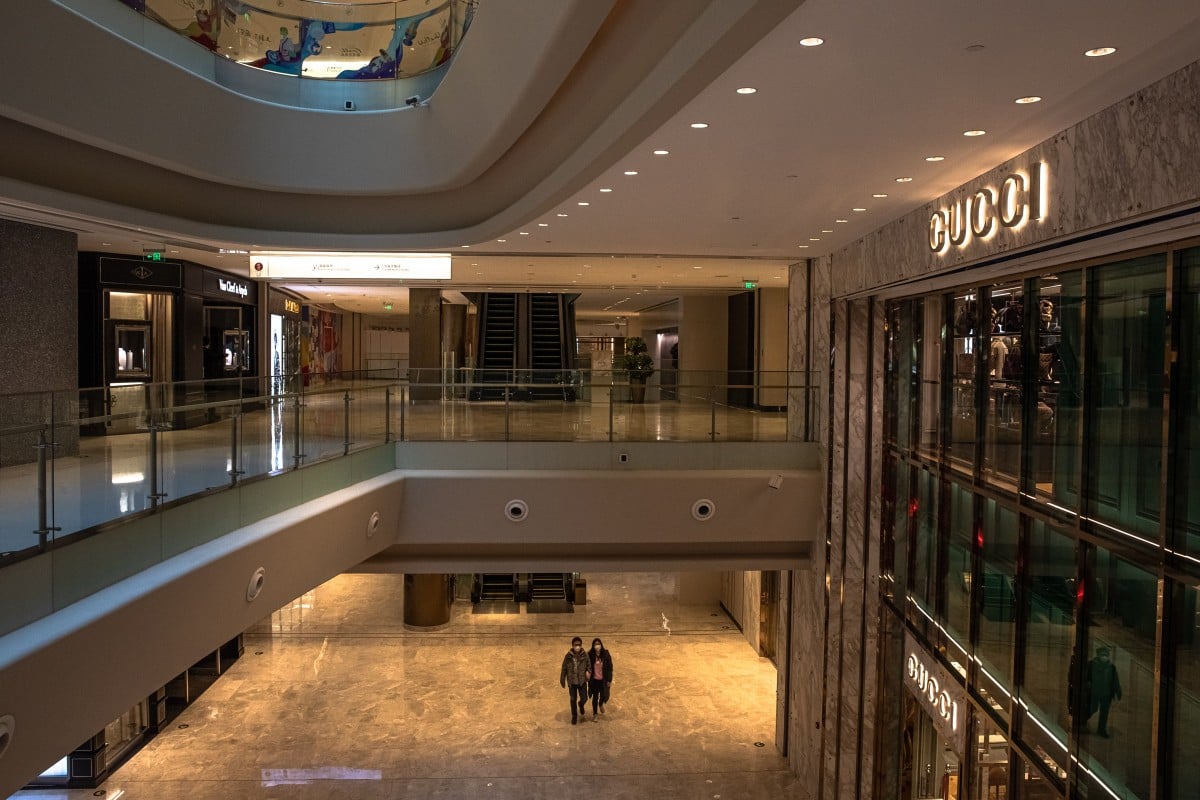
The coronavirus outbreak in China sparked a huge dip in consumer spending. Photo: EPA-EFE
The deadly coronavirus outbreak may have cost China more than 1.3 trillion yuan (US$185 billion) in the first two months of the year because of huge dips in consumer spending and tourism, according to a former senior executive with the

International Monetary Fund.

Zhu Min, who was deputy managing director of the IMF from 2011 to 2016, said during an online presentation on Saturday that the Covid-19 epidemic was likely to have cost the tourism industry about 900 billion yuan in January and February compared with last year, while consumer spending on food and drink was likely to have fallen by about 420 billion yuan.

While online spending – particularly on education and entertainment services – would offset some of the losses, the total drain on the economy over the period could be as much as 1.38 trillion yuan, said Zhu, who is currently head of the National Financial Research Institute at Tsinghua University in Beijing, which organised the presentation.

Based on figures from China’s National Bureau of Statistics, that would represent about 3.3 per cent of the country’s total retail sales in 2019.

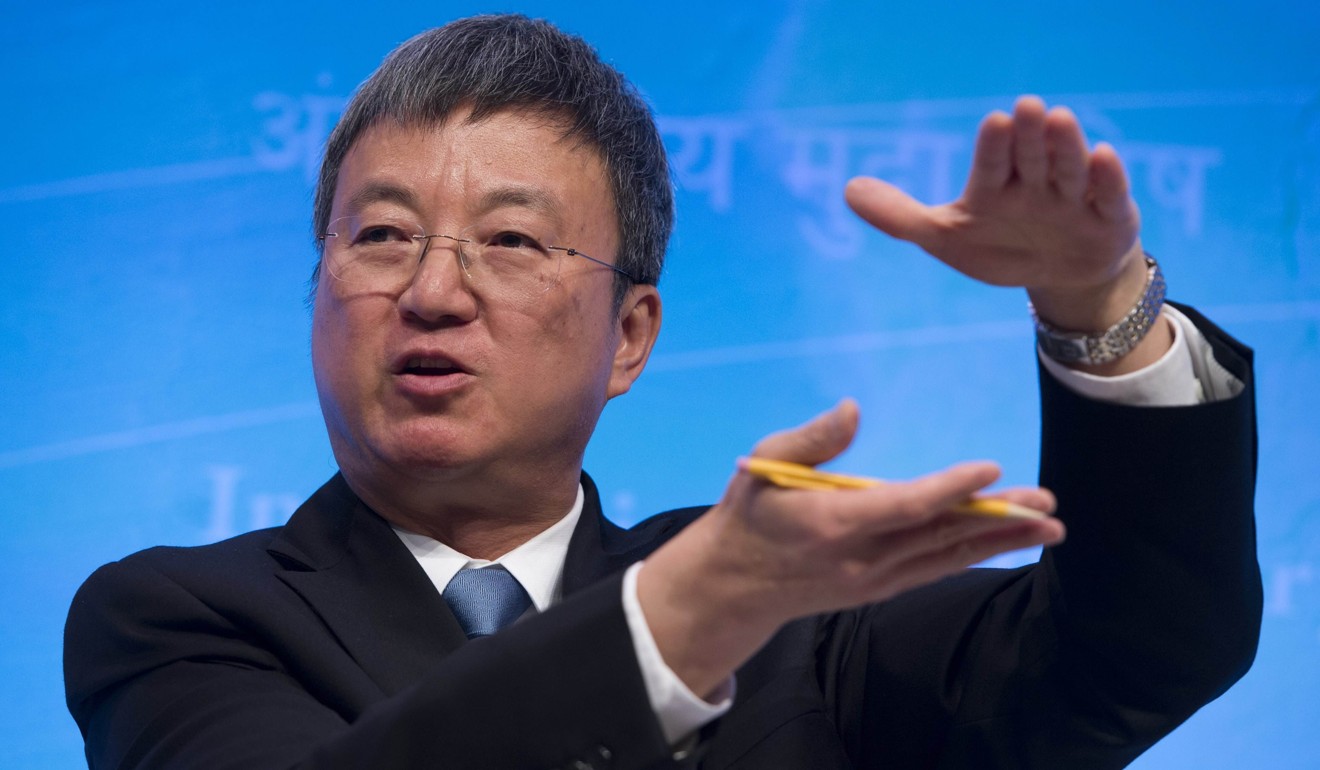
Zhu Min says the Covid-19 epidemic cost China’s tourism industry about 900 billion yuan in January and February. Photo: AFP
“The falling consumption in the first quarter could knock down growth by three or four percentage points,” Zhu said. “We need a strong rebound, and that needs 10 times as much effort.”

Consumer spending is a cornerstone of the Chinese economy, accounting for almost 60 per cent of its growth last year. But with the coronavirus still far from contained, many local governments are reluctant to allow public facilities like cinemas and restaurants to reopen.

Despite the grim estimates provided by Zhu, his figures did not include car sales, which fell by 20.5 per cent year on year in January, their largest monthly dip in 15 years, according to figures from the China Passenger Car Association.

Sales in the first two weeks of February fell 92 per cent from the same period of 2019, mainly due to showroom closures. Over the whole of 2020, the coronavirus epidemic could cost China 1 million car sales, or about 5 per cent of its annual total, the industry group said.

In an effort to minimise that impact, Beijing has told local governments to introduce stimulus measures to boost car sales, including raising licence quotas in areas where numbers had previously been restricted to help fight air pollution.

Commerce ministry official Wang Bin said on Friday that the central government expected consumer spending to bottom out in March before rebounding in the second half of the year.

As for the economy as a whole, Chen Wenling, chief economist at the China Centre for International Economic Exchanges, a Beijing-based think tank, said this week that even if national production returned to 80 per cent by the end of February, first-quarter growth would still be less than 4.5 per cent. By comparison, China’s economy grew by 6.4 per cent in the first three months of 2019.

Economists from French bank Natixis forecast China’s gross domestic product to grow by between 2.5 and 4 per cent in the first quarter, depending on how quickly the situation was stabilised and the effectiveness of the government’s stimulus measures.

Source: SCMP
27/12/2019

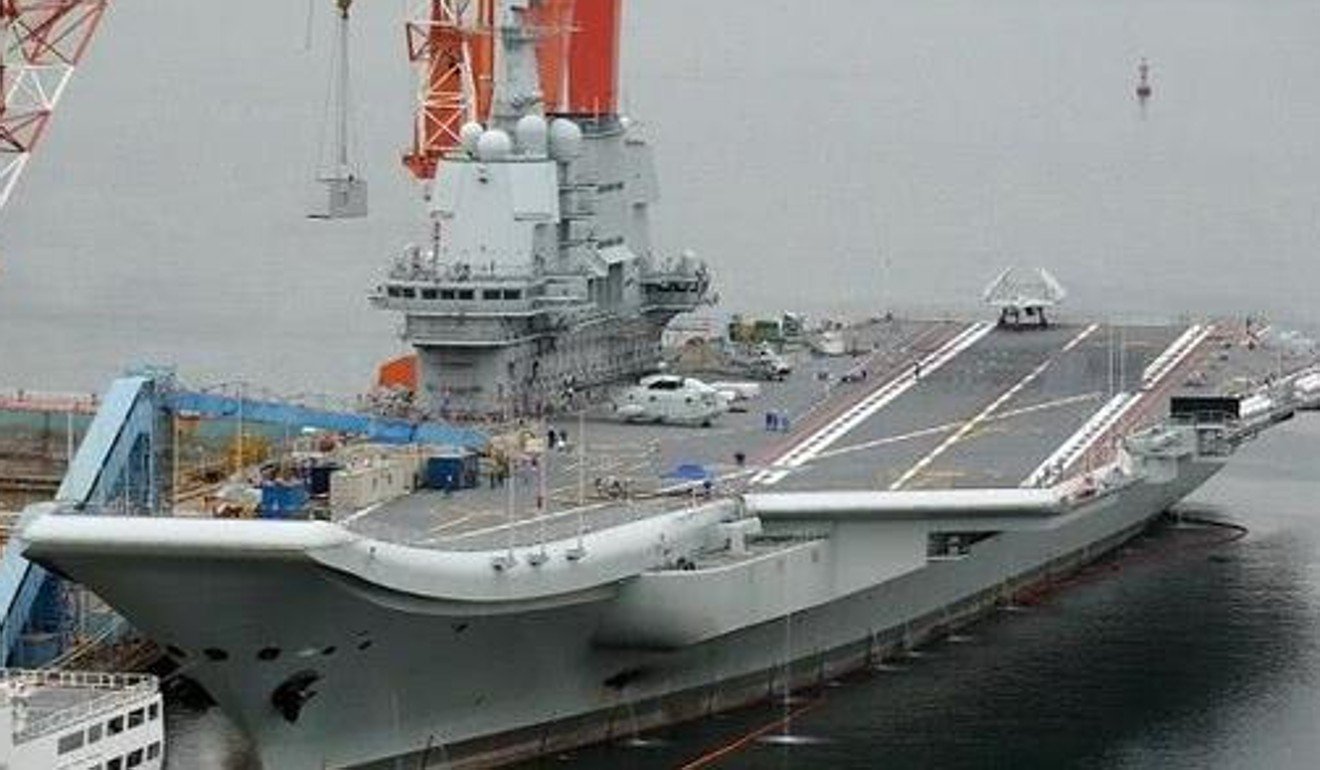
Pilot shortages could ground China’s plans to develop combat-ready carrier fleet

  • The country’s second aircraft carrier, the Shandong, officially entered service this month, but bottlenecks in training could hamper the navy’s effectiveness
  • Plans to build and launch more modern warships mean the need for fully trained pilots will only grow
A pilot based on the Liaoning is seen during a training exercise. China is facing a shortage of trained naval aviators. Photo: Handout

A shortage of naval pilots is holding back Beijing’s ambitions to develop a truly combat-ready fleet, military analysts have said.

China officially commissioned its second aircraft carrier the Shandong last week, which means it will need at least 70 pilots, along with more supporting flight officers.

However, plans to further expand its fleet to five or six carriers – as well as the more advanced technology that will be used on these vessels – mean the need to train more pilots will become more urgent in the future.

Chinese President Xi Jinping has initiated a sweeping modernisation drive across all branches of the People’s Liberation Army and said “the need to build up a strong navy has never been more pressing”.

The Shandong, China’s second carrier, officially entered service earlier this month. Photo: Handout
But Collin Koh, a research fellow at the S Rajaratnam School of International Studies at Singapore’s Nanyang Technological University, said there was a bottleneck in the recruitment and training of naval pilots.

“The implications of carrier-borne aviation are still relatively unfamiliar to the PLA, especially when there’s an urge to scale up training tempo and recruitment in order to fulfil the top directives of building a viable carrier programme,” he said.

China’s training programme for all military pilots is still developing – particularly when it comes to the naval aviation arm, which was only founded in May 2013.

China’s new carrier set to have smaller jet force than expected

20 Dec 2019

China’s first aircraft carrier, the Liaoning, was commissioned in September 2012, but the first successful fighter landing on the ship did not happen until two months later.

The first successful night landing was not reported by state media until May 2018, almost four years later.

It appears to have taken even longer to fully train helicopter pilots, with the first successful day landing taking place in November 2018, according to China’s Naval Aviation University, and the first night landing in June this year.

The training programme has also been marred by a string of fatal accidents along the way, although Koh said these had been unreported to avoid deterring prospective recruits.

Days after China marked the 70th anniversary of the foundation of the People’s Republic with a huge military parade in Beijing on October 1, three airmen were killed when a transport helicopter crashed in central Henan province.

Just eight days later there was another crash on the Tibetan Plateau, where a J-10 fighter jet on a low-altitude flying drill crashed into a mountain. The pilot was reported to have survived.

“The attrition rate of carrier-borne pilot training, including those who might have been injured or killed in the line of duty, isn’t that well publicised by the PLA,” said Koh.

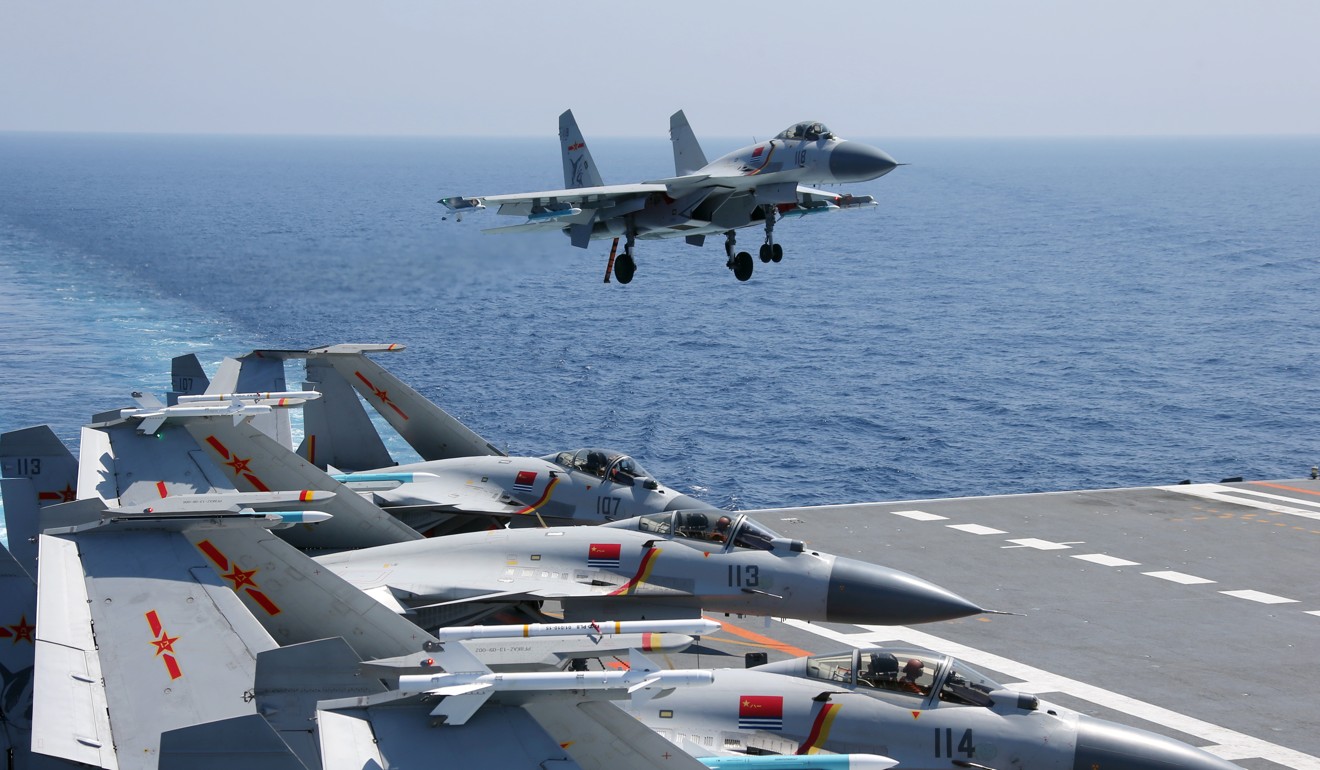
Fighters on the deck of the Liaoning, China’s first carrier. Photo: Xinhua
Li Jie, another Beijing-based military expert, said although the navy is short of pilots now, the problem could be solved within two to three years.
“The insufficient number of carrier-borne warplanes and the substantial training needed for a qualified naval pilot are the two main reasons why China is so short of pilots now. But as China places more and more emphasis on the education and training of the pilots, the problem will be gradually ironed out, ” said Li.
First made-in-China carrier officially enters service
18 Dec 2019

The Naval Aviation University, which is responsible for the training of future naval pilots, has been working with three of the country’s leading universities – Peking, Tsinghua and Beihang – to identify and recruit future pilots.

The authorities have also set up Naval Aviation Experimental Classes in high schools across the country. Each class recruits 50 students, who enjoy a national subsidy and will be put in a priority list to be admitted as a naval pilot.

Source: SCMP

17/12/2019

Beijing’s hopes for AI dominance may rest on how many US-educated Chinese want to return home

  • This is the third instalment in a four-part series examining the brewing US-China tech war over the development and deployment of artificial intelligence tech
  • The US is home to five of the world’s top 10 universities in the AI field, which includes computer vision and machine learning, while China has three
For those Chinese with long-term plans to stay in the US, a major obstacle lies in getting work visas, especially in the current trade war environment. Illustration: Perry Tse

After working in the United States for more than a decade, Zheng Yefeng felt he had hit a glass ceiling. He also saw that the gap in artificial intelligence between China and the US was narrowing.

Last year Zheng, who worked as a researcher at Siemens Healthcare in New Jersey, made a decision that addressed both problems. He accepted an offer to head up the medical research and development team at Tencent’s YouTu artificial intelligence lab in Shenzhen, known as China’s Silicon Valley.

“There was almost no room for promotion if I stayed in the US,” he said, expressing a common dilemma faced by experienced Chinese tech workers in America.

With the US-China trade war leading to tighter scrutiny of Chinese nationals working in the US tech industry, people like Zheng are moving back to China to work in the burgeoning AI sector, especially after Beijing designated AI a national priority. The technology’s varied applications have attracted billions of dollars of venture capital investment, created highly valued start-ups like SenseTime and ByteDance, and sparked a talent war among companies.

That has created an odd symbiotic relationship between the two countries vying for AI supremacy. The US, with its superior higher education system, is the training ground for Chinese AI scientists like Zheng, who obtained a PhD from the University of Maryland after earning bachelor’s and master’s degrees at China’s premier Tsinghua University.

“Many professors in China have great academic ability, but in terms of the number [of top professors], the US is ahead,” said Luo Guojie, who himself accepted an offer from Peking University to become an assistant professor after studying computer science in the US.

Among international students majoring in computer science and maths in US universities, Chinese nationals were the third largest group behind Indians and Nepalese in the 2018-2019 academic year, representing 19.9 per cent, according to the Institute of International Education.

[To build] the best universities is not easy. The university is a free speech space, whereas in China, this is not the case Gunther Marten, a senior official with the European Union delegation to China

The South China Morning Post spoke with several Chinese AI engineers who decided to stay and work in the US after their studies. They only agreed to give their surnames because of the sensitivity of the issues being discussed.

A 25-year-old Beijinger surnamed Lin graduated from one of China’s best engineering schools in the capital before heading to a US university for a master’s degree in computer science in 2017. Like some of his peers, he found the teaching methods in China to be outdated.

“It’s hard to imagine that a final exam of a coding course still asked you to hand write code, instead of running and testing it on a computer,” said Lin, who now works as a software engineer for Google in Silicon Valley.

“Although we still had to take writing tests [in the US], we had many practical opportunities in the lab and could do our own projects,” he added.

A Facebook software engineer surnamed Zhuang had a similar experience at his university in Shanghai.

“Many engineering students [in China] still get old-school textbooks and insufficient laboratory training,” he said. “Engineering practices for AI have been through a fast iteration over the past few decades, which means many Chinese students are not exposed to the most updated knowledge in the field, at least not in the classroom.”

Zhuang also noted out that many classes in China are taught in Chinese, meaning engineering graduates are not fluent in English, the preferred language of the global AI research community.

The US is home to five of the world’s top 10 universities in the AI field, which includes computer vision and machine learning, while China has three. Carnegie Mellon University (CMU) in Pennsylvania ranks No 1 while China’s Tsinghua University is No 2, according to CSrankings, which bases the list on papers published since 2009.

US tech chief: China is threatening US’ lead in global AI race
With its top institutions and an open culture that encourages freedom of speech, including unfettered internet access, the US has become a magnet for the brightest AI students the world over.
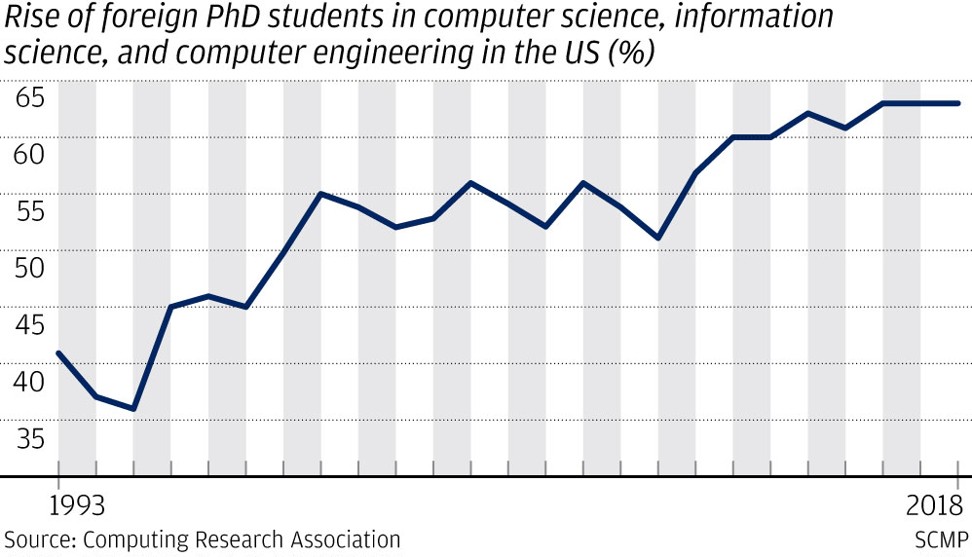
In 2018, 62.8 per cent of PhD degrees and 65.4 per cent of master’s degrees in computer science, information science and computer engineering programmes in the US were granted to “non-resident aliens”, according to a survey by the Computing Research Association.
“[To build] the best universities is not easy,” Gunther Marten, a senior official with the European Union delegation to China, said on the sidelines of the World Internet Conference in Wuzhen in October. “The university is a free speech space, whereas in China, this is not the case.”

When these US-educated AI scientists finish studying, most take advantage of a rule allowing them to stay in the country for three years to gain work experience.

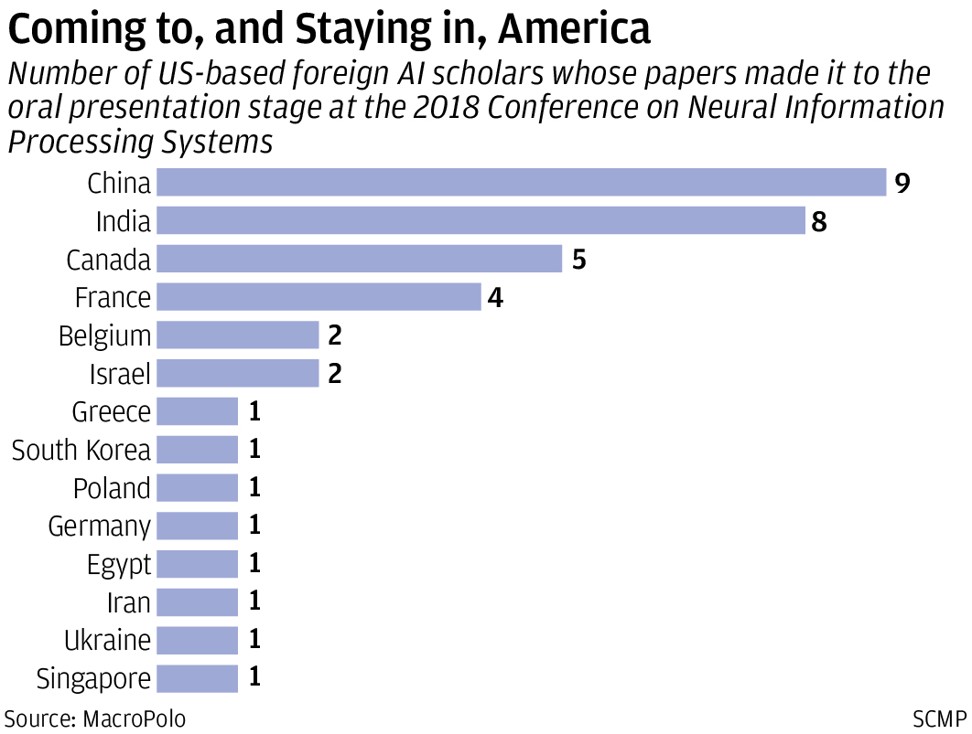
Of the foreign nationals taking part in last year’s Conference on Neural Information Processing Systems (NIPS), a major machine learning event for AI professionals, 87 per cent of those whose papers made it to the oral presentation stage went to work for American universities or research institutes after earning their PhD, according to MacroPolo, a think tank under the Paulson Institute.

“China has many great universities and companies, especially in certain subfields of AI such as computer vision, but many people remain hesitant to move to China due to the political environment, quality of life concerns and workplace issues,” said Remco Zwetsloot, a research fellow at Georgetown University’s Center for Security and Emerging Technology (CSET).

China’s PhD students miserable, yet hopeful: survey

Some of the US-trained Chinese AI engineers told the Post they were scared off by China’s “996” working culture: 9am to 9pm, six days a week. Tech firms in China typically expect their employees to work long hours to prove their dedication.

Lin, the Beijinger who now works for Google, used to be an intern at one of China’s largest internet giants. “I worked from the time I woke up until going to bed,” he said, “At Google, I’ve been confused because many people here only work till 5pm but Google is still a global leader.” Lin said he would be happy to return to China if the 996 work culture eases.

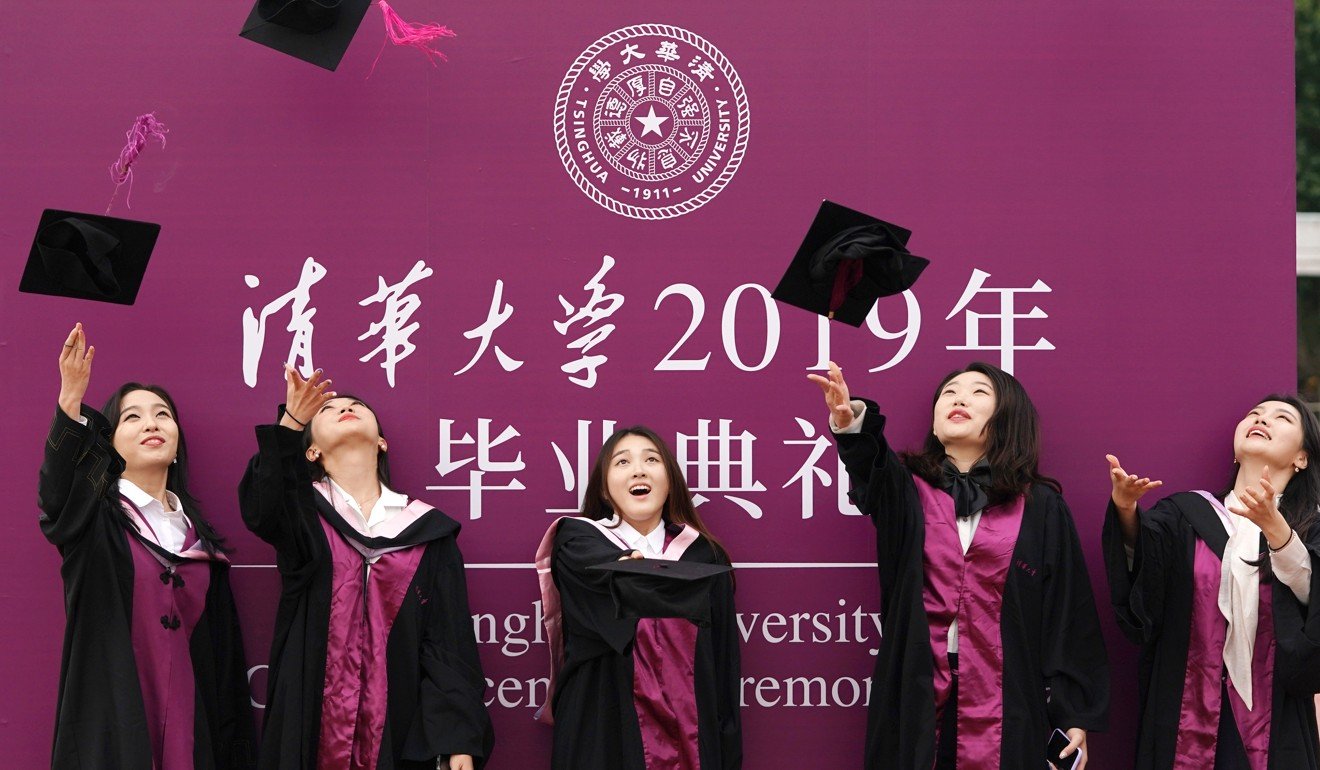
Graduates throw their caps in the air as they pose for a group photo during the 2019 commencement ceremony of Tsinghua University in Beijing. Tsinghua ranks as China’s top university for AI. Photo: Xinhua
Chen, a female postgraduate student at Carnegie Mellon, who recently accepted a job offer from Google, once interned at Beijing-based AI unicorn SenseTime, where she worked from 10am to between 8pm and 10pm most days.
A SenseTime spokesperson said the company has adopted flexible working hours for its employees.
Besides a better work-life balance, Chinese graduates look for jobs in Silicon Valley because of the higher pay.
“If you include pre-tax income, many of us get offers that pay more than 1 million yuan (US$142,000) a year but in China the salaries offered to the best batch of fresh undergraduates are about 200,000 to 300,000 yuan (US$28,000 to US$43,000),” Chen said.
Still, for those Chinese with long-term plans to stay in the US, a major obstacle lies in getting work visas, especially in the current trade war environment. Most AI-related workers are on H-1B visas that allow US companies to employ non-US nationals with expertise in specialised fields such as IT, finance and engineering.
However, the number of non-immigrant H-1B visas granted has started to fall since 2016, when it peaked at 180,000, according to the US Department of State, and US tech companies have complained that a policy shift by the Trump administration has made the approval process longer and more complicated.
In 2017, President Donald Trump requested an overhaul of the H-1B visa programme, saying he did not want it to enable US tech companies to hire cheaper foreign workers at the expense of American jobs. He also wants to give priority to highly skilled people and restrict those wanting to move to the US because of family connections.

Science graduates from overseas countries can stay in the US with their student visas for up to three years while competing for the hard to get work visas, which are granted based on undisclosed mechanisms. Overseas students already working in the US can apply for so-called green cards, which offer permanent residency.

After working for a major US tech company for almost three years on a student visa, one Chinese software engineer, who spoke to the Post on condition of anonymity, said she was relocated to the US firm’s Beijing office last year after failing to obtain a H-1B work visa.

“While there might be individual cases, it seems like the current tensions have not – at least as of a few months ago – led to noticeable changes in the overall number of Chinese students staying in the US after graduating,” said CSET’s Zwetsloot.

Some Chinese AI scientists use Twitter to announce their decision to stay. Chen Tianqi, who just obtained a PhD at the University of Washington in Seattle, and Jun-Yan Zhu, a CMU and UC Berkeley alumnus currently working at Adobe, each tweeted that they would join Carnegie Mellon as assistant professors next year.

To achieve the goal of turning China into “the world’s primary AI innovation centre” by 2030, according to a 2017 blueprint issued the State Council, the central government has stepped up efforts to attract US-educated talent.

The Thousand Talents Plan has seen more than 6,000 overseas Chinese students and academics return since its was established in 2008, but because of escalating tensions with the US, Beijing has played down the initiative.

Longer term, Beijing’s willingness to invest significant sums into the AI sector could see more Chinese return for the better employment opportunities. Between 2013 and the first quarter of 2018, China attracted 60 per cent of global investment in AI, according to a Tsinghua University report.

China’s spending on AI may be far lower than people think

Chinese authorities are investing heavily in the sector, with the city of Shanghai setting up a 10 billion yuan (US$142 million) AI fund in August and Beijing city government announcing in April it would provide a 340 million yuan (US$48 million) grant to the Beijing Academy of Artificial Intelligence.

“More and more senior people like me have come back, and some start their own businesses,” said Zheng, the Siemens Healthcare researcher who joined Tencent. “It’s easier for Chinese to seek venture capital in China than in other countries.”

Source: SCMP

01/11/2019

China’s Communist Party promotes man who shaped the fighting future of PLA Navy’s aircraft carriers

  • Rear Admiral Ma Weiming is seen as pioneer of electromagnetic aircraft launch system
  • Experts say Ma’s full membership of Central Committee shows how important sea power is to China’s strategic planning
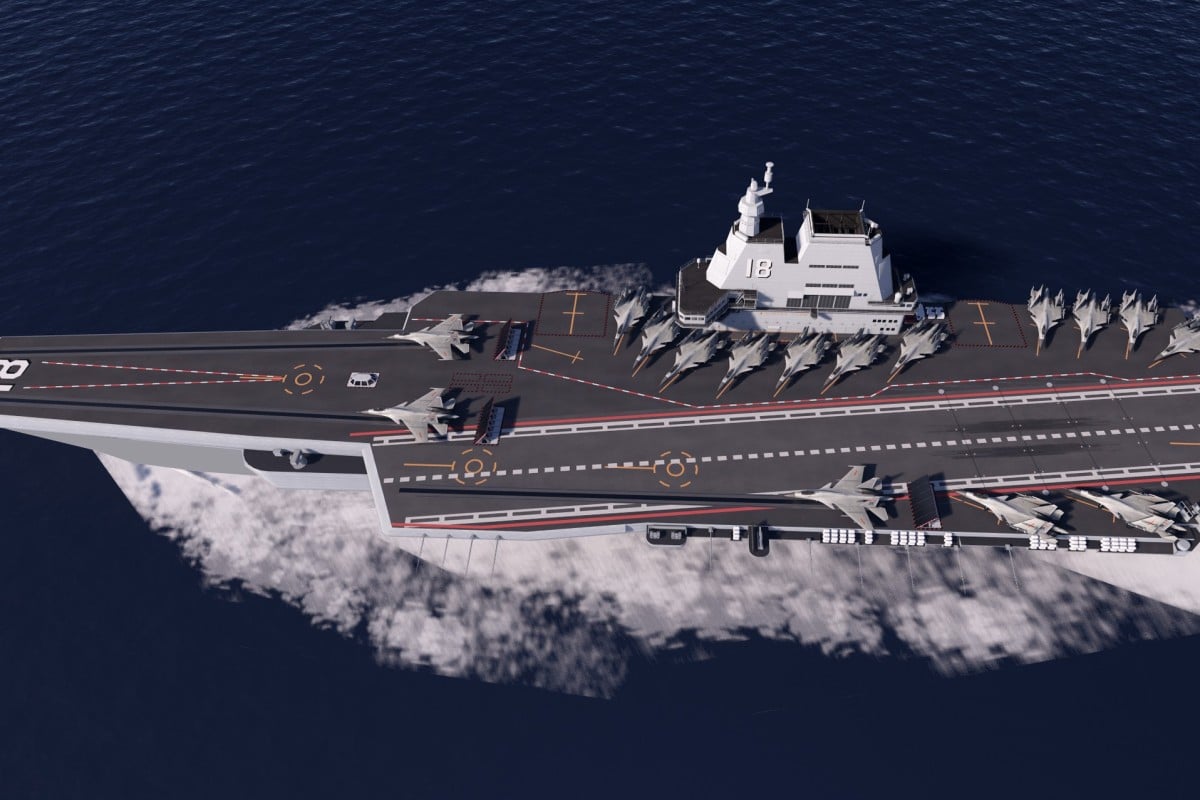
An artist’s impression of China’s third aircraft carrier, the Type 002, which will incorporate an electromagnetic aircraft launch system developed by Rear Admiral Ma Weiming and his team. source: Photo: Handout

China’s Communist Party has elevated the senior naval engineer behind the development of a hi-tech launch system for the country’s next aircraft carriers, showing China’s ambition to increase its naval power.

Rear Admiral Ma Weiming, who is seen as the pioneer of China’s electromagnetic aircraft launch system (EMALS), was named as a full member, from alternate member, of the party’s Central Committee at the party plenary meeting which ended on Thursday.

The plenum sessions – attended by more than 300 full and alternate members of the Central Committee – provide an opportunity for the party’s most senior members to discuss and forge consensus on key policy issues.

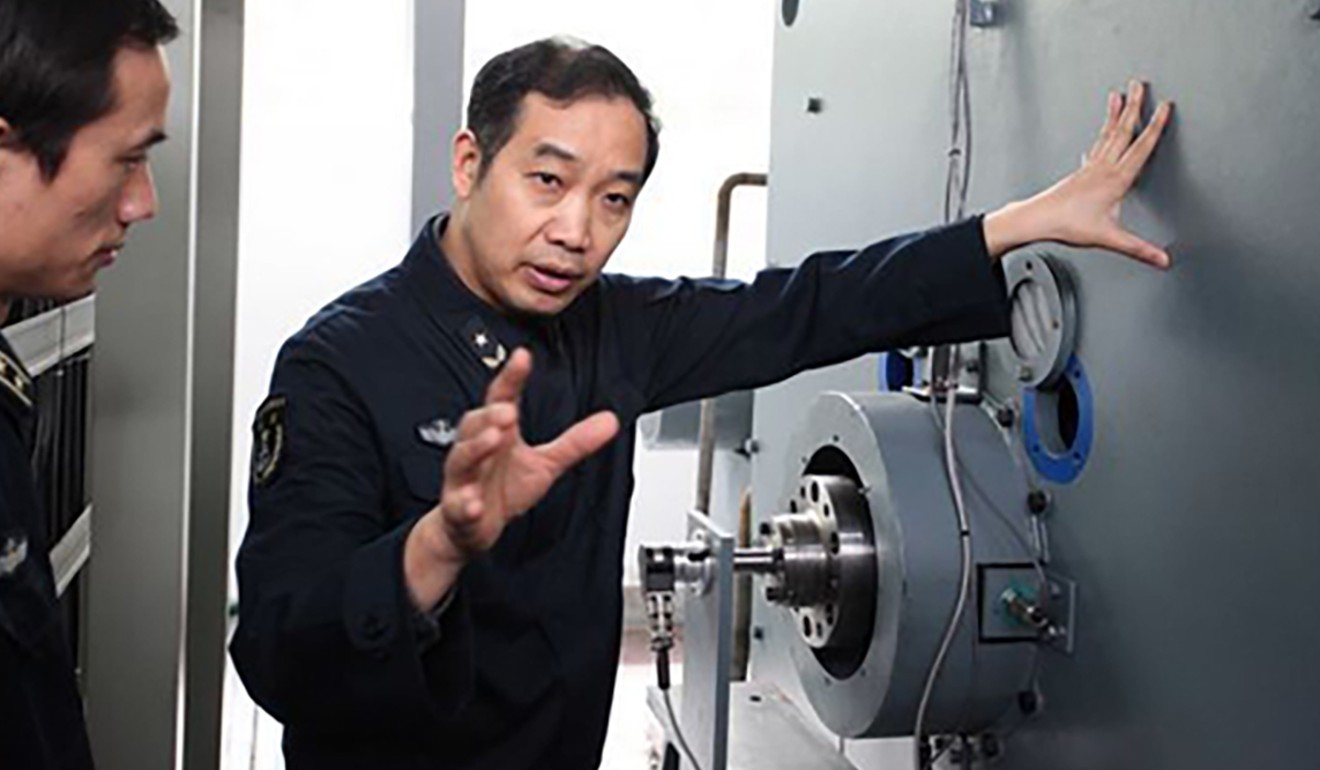
Real Admiral Ma Weiming (right) has been elevated to full membership of the Communist Party’s Central Committee. Photo: SCMP
Rear Admiral Ma Weiming (right) has been elevated to full membership of the Communist Party’s Central Committee. Photo: SCMP
Li Jie, a Beijing-based military specialist, said the move showed China’s ambition to continue expanding its naval military power.
“Ma’s promotion signals that Beijing will devote more resources to developing strategic military hardware like large warships and assault landing ships,” he said.

The EMALS is regarded as a breakthrough for the People’s Liberation Army, as it will enable China’s second home-grown aircraft carrier – known as the Type 002 – to launch larger jets with bigger payloads on longer missions.

The system could result in fuel savings of up to 40 per cent. With a higher launch energy capacity, it will also be more efficient than steam catapults, allowing for improvements in ease of maintenance, increased reliability, and more accurate end-speed control and smoother acceleration.

Why Chinese submarines could soon be quieter than US ones
Ma, who comes from Yangzhou in eastern Jiangsu province, graduated from the PLA Naval University of Engineering in Wuhan in 1987 and earned a PhD in electrical engineering from Beijing’s Tsinghua University in 1996.

A specialist in maritime propulsion, electrical engineering and related fields, he has mentored more than 400 masters and doctoral students at the naval university.

He and his team have often been recognised for their work as greater emphasis has been put on research and development amid the country’s military modernisation.

China’s first home-built carrier will use steam catapults and a ski-jump deck to launch aircraft. Photo: Handout

Ma has twice won the National Science and Technology Progress Award and in 2015 was awarded the science and technology achievement prize by the Hong Kong-based Ho Leung Ho Lee Foundation.

According to news reports, in the 1980s Ma spotted a potential flaw with an electrical component China planned to buy from overseas to use on its submarines that would have made the vessels easier to detect. Though the manufacturer denied any such problem, Ma spent five years tweaking the product so that submarines fitted with the part became harder to spot.

Three catapult launchers spotted in image of China’s new aircraft carrier

Beijing-based military expert Zhou Chenming said Ma’s promotion could be seen as a national endorsement of his work on EMALS.

“Ma was elected as a Central Committee member because the party and the country recognise the strategic importance of his work as China is expanding into a naval power with a huge maritime interest to protect,” he said.

Zhou, however, said Ma’s promotion was made two years ago, but he could not be formally made a full member until a vacancy opened up this year.

Source: SCMP

29/09/2019

China anniversary: The deep cuts of 70 years of Communist rule

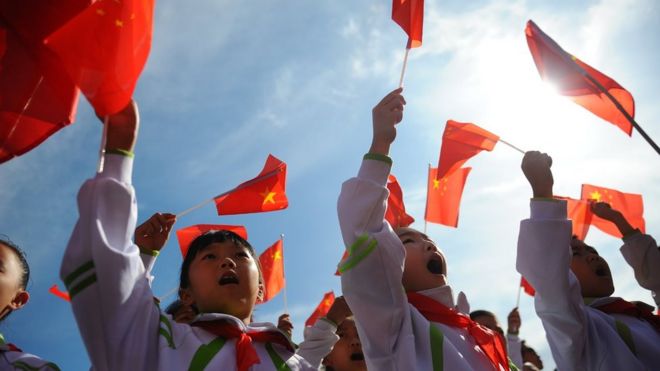
Children waving Chinese flagsImage copyright GETTY IMAGES
Image caption China’s version of its past is a story of prosperity, progress and sacrifice for the common good

China’s extraordinary rise was a defining story of the 20th Century, but as it prepares to mark its 70th anniversary, the BBC’s John Sudworth in Beijing asks who has really won under the Communist Party’s rule.

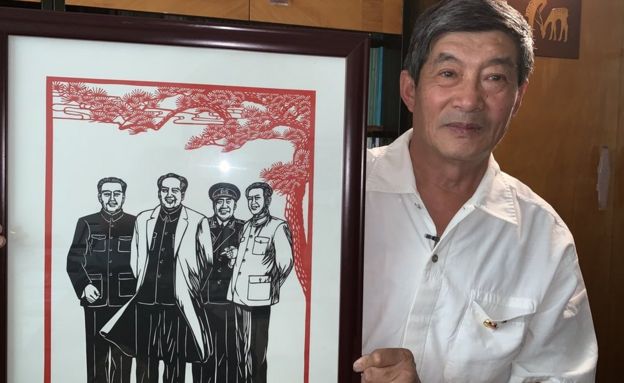
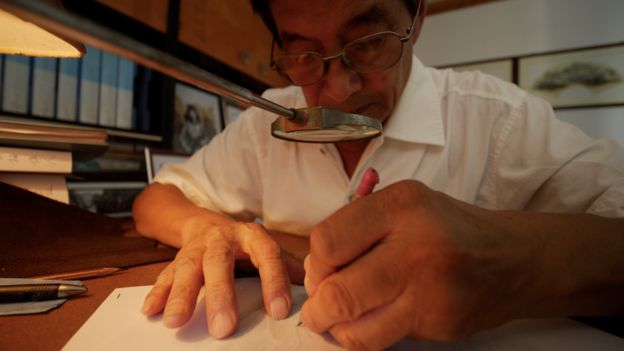
Sitting at his desk in the Chinese city of Tianjin, Zhao Jingjia’s knife is tracing the contours of a face.

Cut by delicate cut, the form emerges – the unmistakable image of Mao Zedong, founder of modern China.

The retired oil engineer discovered his skill with a blade only in later life and now spends his days using the ancient art of paper cutting to glorify leaders and events from China’s communist history.

“I’m the same age as the People’s Republic of China (PRC),” he says. “I have deep feelings for my motherland, my people and my party.”

Zhao Jingjia with a paper cut of Mao Zedong
Image caption For people like Zhao Jingjia, China’s success outweighs the “mistakes” of its leaders

Born a few days before 1 October 1949 – the day the PRC was declared by Mao – Mr Zhao’s life has followed the dramatic contours of China’s development, through poverty, repression and the rise to prosperity.

Now, in his modest but comfortable apartment, his art is helping him make sense of one of the most tumultuous periods of human history.

“Wasn’t Mao a monster,” I ask, “responsible for the deaths of tens of millions of his countrymen?”

“I lived through it,” he replies. “I can tell you that Chairman Mao did make some mistakes but they weren’t his alone.”

“I respect him from my heart. He achieved our nation’s liberation. Ordinary people cannot do such things.”

On Tuesday, China will present a similar, glorious rendering of its record to the world.

The country is staging one of its biggest ever military parades, a celebration of 70 years of Communist Party rule as pure, political triumph.

Beijing will tremble to the thunder of tanks, missile launchers and 15,000 marching soldiers, a projection of national power, wealth and status watched over by the current Communist Party leader, President Xi Jinping, in Tiananmen Square.

An incomplete narrative of progress

Like Mr Zhao’s paper-cut portraits, we’re not meant to focus on the many individual scars made in the course of China’s modern history.

It is the end result that matters.

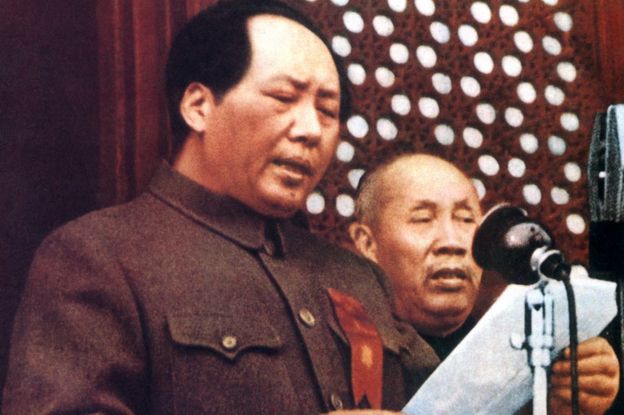
Mao Zedong declares the People's Republic of China in Beijing on 1 Oct 1949Image copyright XINHUA/AFP
Image caption Mao Zedong pronounces the dawn of the People’s Republic of China on 1 October 1949

And, on face value, the transformation has been extraordinary.

On 1 October 1949, Chairman Mao stood in Tiananmen Square urging a war-ravaged, semi-feudal state into a new era with a founding speech and a somewhat plodding parade that could muster only 17 planes for the flyby.

This week’s parade, in contrast, will reportedly feature the world’s longest range intercontinental nuclear missile and a supersonic spy-drone – the trophies of a prosperous, rising authoritarian superpower with a 400 million strong middle class.

It is a narrative of political and economic success that – while in large part true – is incomplete.

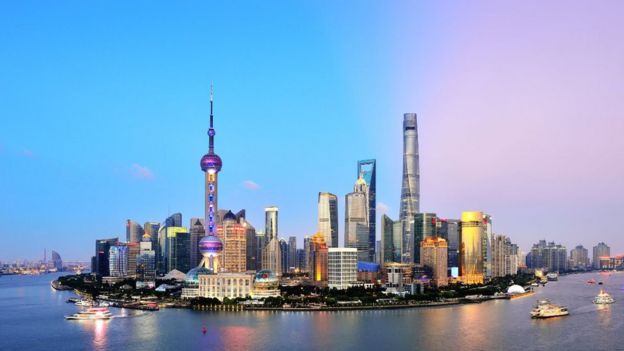
New visitors to China are often, rightly, awe-struck by the skyscraper-festooned, hi-tech megacities connected by brand new highways and the world’s largest high-speed rail network.

Shanghai skylineImage copyright GETTY IMAGES
Image caption Those in China’s glittering cities may accept the trade-off of political freedom for economic growth

They see a rampant consumer society with the inhabitants enjoying the freedom and free time to shop for designer goods, to dine out and to surf the internet.

“How bad can it really be?” the onlookers ask, reflecting on the negative headlines they’ve read about China back home.

The answer, as in all societies, is that it depends very much on who you are.

Many of those in China’s major cities, for example, who have benefited from this explosion of material wealth and opportunity, are genuinely grateful and loyal.

In exchange for stability and growth, they may well accept – or at least tolerate – the lack of political freedom and the censorship that feature so often in the foreign media.

For them the parade could be viewed as a fitting tribute to a national success story that mirrors their own.

But in the carving out of a new China, the knife has cut long and deep.

The dead, the jailed and the marginalised

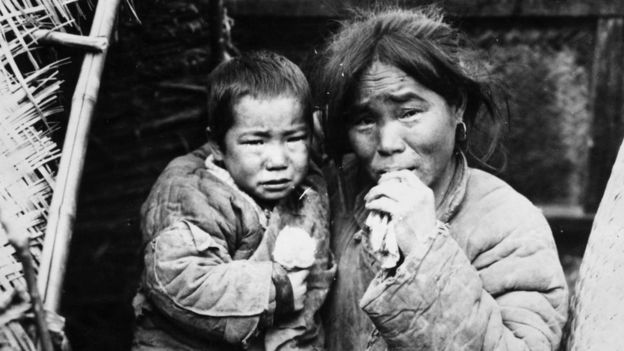
Mao’s man-made famine – a result of radical changes to agricultural systems – claimed tens of millions of lives and his Cultural Revolution killed hundreds of thousands more in a decade-long frenzy of violence and persecution, truths that are notably absent from Chinese textbooks.

Archive image of a starving woman and child during the famine in ChinaImage copyright GETTY/TOPICAL
Image caption Tens of millions starved to death under Mao, as China radically restructured agriculture and society

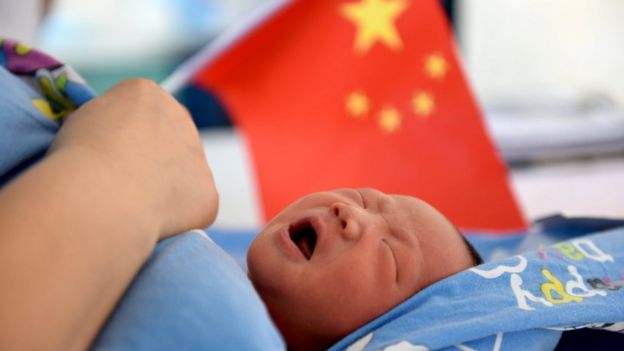
After his death, the demographically calamitous One Child Policy brutalised millions over a 40-year period.

Still today, with its new Two Child Policy, the Party insists on violating that most intimate of rights – an individual’s choice over her fertility.

The list is long, with each category adding many thousands, at least, to the toll of those damaged or destroyed by one-party rule.

Chinese baby in front of Chinese flagImage copyright GETTY IMAGES
Image caption Beijing still regulates how many children families can have

There are the victims of religious repression, of local government land-grabs and of corruption.

There are the tens of millions of migrant workers, the backbone of China’s industrial success, who have long been shut out of the benefits of citizenship.

A strict residential permit system continues to deny them and their families the right to education or healthcare where they work.

And in recent years, there are the estimated one and a half million Muslims in China’s western region of Xinjiang – Uighurs, Kazakhs and others – who have been placed in mass incarceration camps on the basis of their faith and ethnicity.

China continues to insist they are vocational schools, and that it is pioneering a new way of preventing domestic terrorism.

The stories of the dead, the jailed and the marginalised are always much more hidden than the stories of the assimilated and the successful.

Viewed from their perspective, the censorship of large parts of China’s recent history is not simply part of a grand bargain to be exchanged for stability and prosperity.

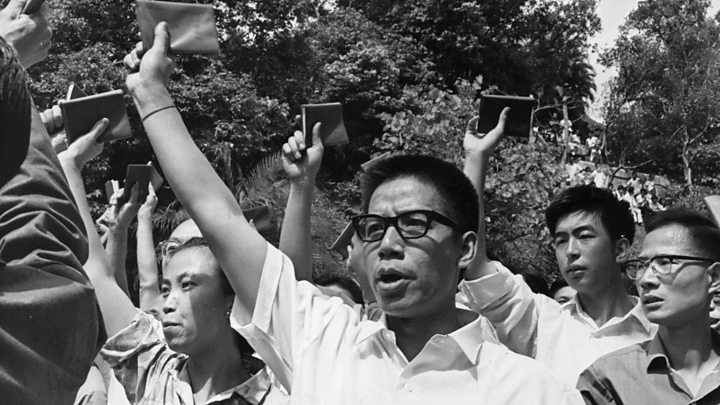
People holding pictures of Mao and the Little Red Book in Tiananmen Square, 1966

Getty
Timeline of modern China

  • 1949 Mao declares the founding of the People’s Republic of China
  • 1966-76 Cultural Revolution brings social and political upheaval
  • 1977 Deng Xiaoping initiates major reforms of China’s economy
  • 1989 Army crushes Tiananmen Square pro-democracy protests
  • 2010 China becomes the world’s second-largest economy
  • 2018 Xi Jinping is cleared to be president for life
It is something that makes the silence of their suffering all the more difficult to penetrate.

It is the job of foreign journalists, of course, to try.

‘Falsified, faked and glorified’

But while censorship can shut people up, it cannot stop them remembering.

Prof Guo Yuhua, a sociologist at Beijing’s Tsinghua University, is one of the few scholars left trying to record, via oral histories, some of the huge changes that have affected Chinese society over the past seven decades.

Her books are banned, her communications monitored and her social media accounts are regularly deleted.

“For several generations people have received a history that has been falsified, faked, glorified and whitewashed,” she tells me, despite having been warned not to talk to the foreign media ahead of the parade.

“I think it requires the entire nation to re-study and to reflect on history. Only if we do that can we ensure that these tragedies won’t be repeated.”

People with poster of Mao ZedongImage copyright GETTY IMAGES
Image caption Can progress really be attributed to the leadership?

A parade, she believes, that puts the Communist Party at the front and centre of the story, misses the real lesson, that China’s progress only began after Mao, when the party loosened its grip a bit.

“People are born to strive for a better, happier and more respectful life, aren’t they?” she asks me.

“If they are provided with a tiny little space, they’ll try to make a fortune and solve their survival problems. This shouldn’t be attributed to the leadership.”

‘Our happiness comes from hard work’

As if to prove the point about how the unsettled, censored pasts of authoritarian states continue to impact the present, the parade is for invited guests only.

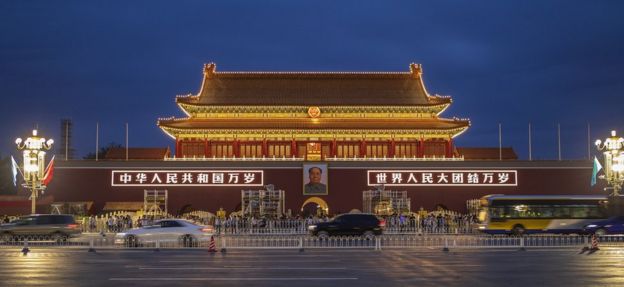
Mao's portrait hanging in Tiananmen SquareImage copyright GETTY IMAGES
Image caption Mao’s portrait will, as it always is, be watching over the events in Tiananmen Square

Another anniversary, of which Tiananmen Square is the centrepiece, is also being measured in multiples of 10 – it is 30 years since the bloody suppression of the pro-democracy protests that shook the foundations of Communist Party rule.

The troops will be marching – as they always do on these occasions – down the same avenue on which the students were gunned down.

The risk of even a lone protester using the parade to mark a piece of history that has largely been wiped from the record is just too great.

With central Beijing sealed off, ordinary people in whose honour it is supposedly being held, can only watch it on TV.

Zhao

Back in his Tianjin apartment, Zhao Jingjia shows me the intricate detail of a series of scenes, each cut from a single piece of paper, depicting the “Long March”, a time of hardship and setback for the Communist Party long before it eventually swept to power.

“Our happiness nowadays comes from hard work,” he tells me.

It is a view that echoes that of the Chinese government which, like him, has at least acknowledged that Mao made mistakes while insisting they shouldn’t be dwelt on.

“As for the 70 years of China, it’s extraordinary,” he says. “It can be seen by all. Yesterday we sent two navigation satellites into space – all citizens can enjoy the convenience that these things bring us.”

Media caption What was China’s Cultural Revolution?

Source: The BBC

17/09/2019

China’s scissor-hand selfie-takers warned of cybersecurity threat

  • Powerful zoom functions can reveal fingerprint details which may be copied by criminals
A cybersecurity awareness campaign in China has prompted a warning about criminals harvesting fingerprint information from a popular pose in pictures uploaded to the internet. Photo: Shutterstock

A popular hand gesture adopted by China’s online community in uploaded pictures could be used by criminals to steal people’s fingerprints, Chinese cybersecurity experts have warned.

The “scissor hand” pose – similar to the peace sign or “V” for victory– could reveal a perfect fingerprint if held close enough to the camera, according to Zhang Wei, vice-director of the Shanghai Information Security Trade Association.

Speaking at an event promoting a national cybersecurity awareness campaign in Shanghai on Sunday, Zhang said photo magnifying and artificial intelligence-enhancing technologies meant it was possible to extract enough detail to make a perfect copy of the sensitive information.

According to a report by online news portal Thepaper.cn, Zhang’s advice was that scissor-hand pictures taken closer than three metres (10 feet) could be vulnerable and should not be published on the internet.

Chinese face-swapping app sparks privacy concerns soon after its release
“A scissor-hand picture taken within 1.5 metres (four feet 11 inches) can be used to restore 100 per cent of people’s fingerprints, while pictures taken about 1.5-3 metres away can turn out 50 per cent of the fingerprints,” he said.

Based on the information extracted from the pictures, criminals could make models of the prints which could then be used to register at fingerprint-based identity recognition checks, such as door access and payment systems, Zhang said.

Feng Jianjiang, a professor on fingerprint identification from the Department of Automation at Tsinghua University, told the South China Morning Post that, theoretically, pictures could show fingerprints clearly enough to be copied, but said he was unsure of what distance would be safe.

“Some people’s fingerprints could not be captured [at any distance] because of skin problems [for example],” Feng said. “But the fingerprint images would be fairly clear if the distance, angle, focus and lighting were all ideal.”

Feng suggested people check the clarity of detail by zooming in on their fingerprints in pictures before uploading them to social media.

Zang Yali, a researcher from the Institute of Automation at the Chinese Academy of Sciences, agreed that the conditions required to be able to harvest sufficiently detailed fingerprint information were “very demanding”, according to a report in China Science and Technology Daily.

The warning had been viewed on China’s Twitter-like platform Weibo 390 million times within 24 hours of Zhang’s address on Sunday, with 49,000 comments left on the website by Monday afternoon.

“It’s horrifying. I always present a scissor hand in photos,” one Weibo user wrote.

“Advanced technology has brought us convenience but meanwhile has also brought us risk and danger. What can we do now?” another commenter wrote.

One social media user had the perfect solution, writing: “No worries. just show the back of your hand to the camera if you are concerned.”

Source: SCMP

09/08/2019

This tiny ‘cockroach robot’ could be the future of search and rescue when disasters strike

  • Chinese and US researchers take inspiration from the hardy insect to design a robot that moves fast and is hard to squash
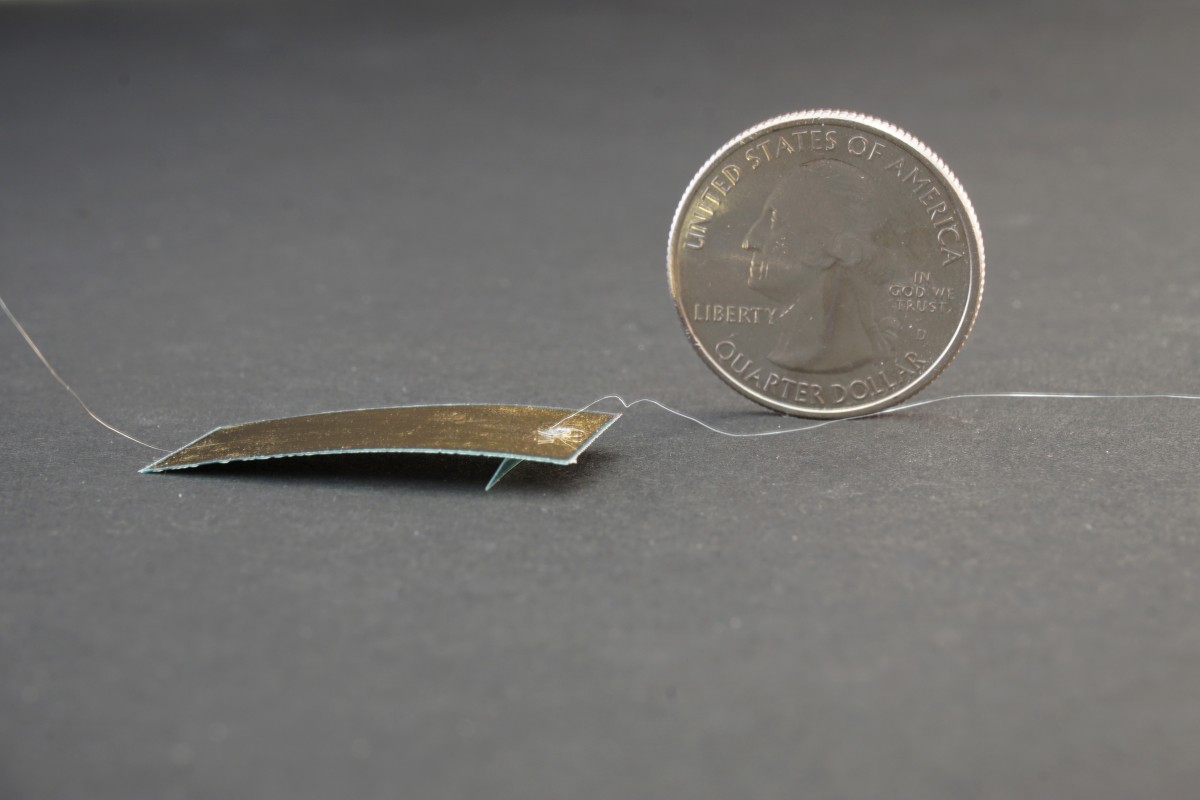
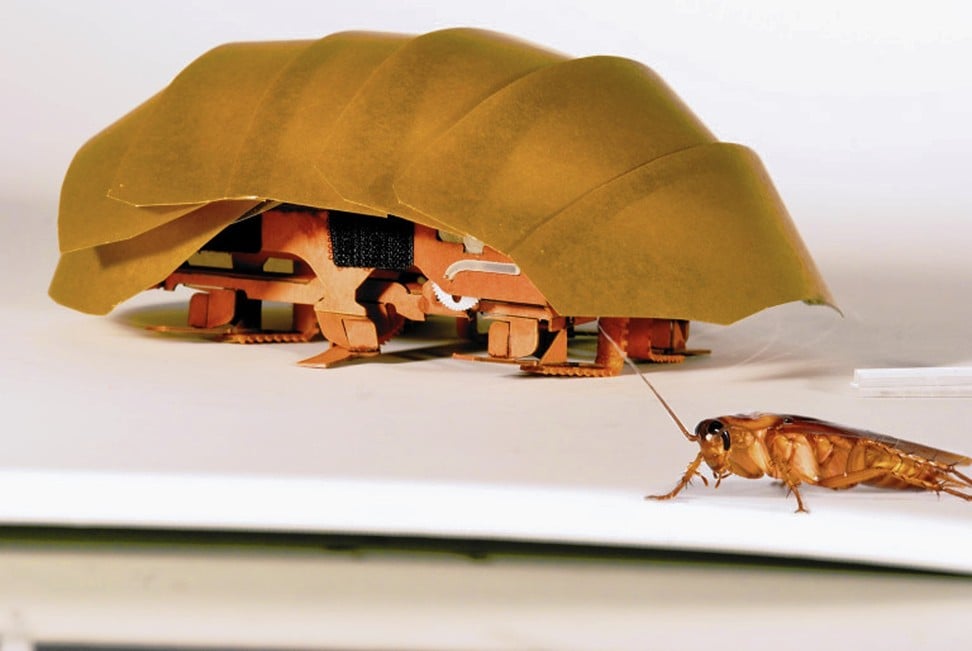
A prototype soft robot, which is about the size of a postage stamp, was developed by a group of researchers from China and the US. Its design was inspired by the capabilities of the hardy cockroach. Photo: Handout
Cockroaches are near-indestructible little creatures. These hardy insects have existed since at least 320 million years ago, outliving dinosaurs. A cockroach can also carry loads of up to 900 times its body weight, shrink to a quarter of its height to fit into small crevices and live for a week without its head.
Inspired by the qualities of this humble bug, a group of researchers from China and the United States have created a prototype of a fast-moving and near-indestructible miniature robot, which could potentially replace sniffer dogs in detecting people trapped in a rubble after a major earthquake or similar disastrous event.
Researchers from China’s Tsinghua University and the University of California, Berkeley, published their study on so-called soft robots in the academic journal Science Robotics last week.
“Although the cockroach is an annoying pest, it has certain interesting features, including the ability to move fast in a narrow space and being hard to squash,” said Zhang Min, an assistant professor at Tsinghua University’s Graduate School in Shenzhen and one of the study’s authors, in an email interview. “These features inspired us to develop a fast-moving and robust soft robot.”

Their work on soft robots was conducted under the Tsinghua-Berkeley Shenzhen Institute partnership, an initiative to collaborate with global researchers on fields such as environmental science and new energy technology.

Scientists have long taken inspiration from insects, including cockroaches, for engineering robots. Researchers from UC Berkeley previously developed a palm-sized, roach-like robot – about 20 times the size of the bug – for rescue use in 2017.

By comparison, the new prototype achieved breakthroughs in terms of size and more importantly, the speed and robustness.

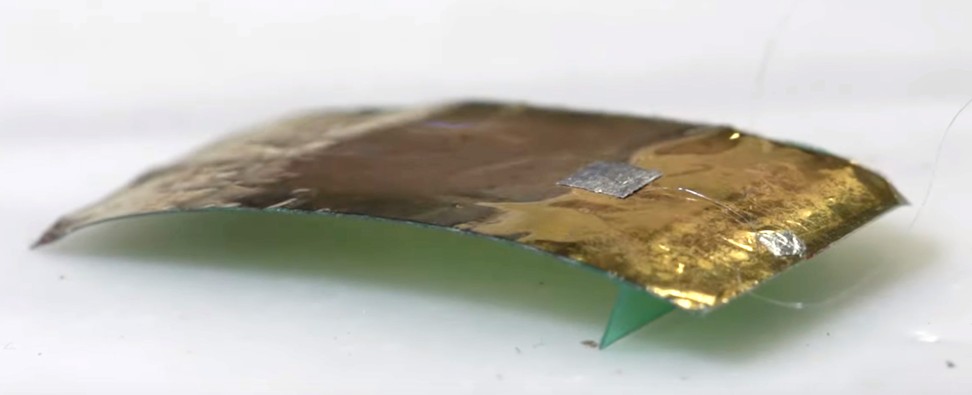
The latest robot, which is about the size of a postage stamp and weighs less than one-tenth of a gram, is composed of a flexible piezoelectric thin film and a polymer skeleton with two legs.

This screenshot from a video provides a closer look at the prototype soft robot developed by a group of researchers from China and the US. Its features were inspired by the sturdy qualities of the humble cockroach. Photo: YouTube

Despite its petite frame, this prototype showed the fastest speed among insect-scale robots in a similar weight range, as well as “ultra-robustness”, according to Lin Liwei, a professor of mechanical engineering at UC Berkeley who directed the research, in a separate email interview.

It can move as fast as a cockroach with speeds of up to 20 body lengths per second. It also continued to move after it was stepped on by an adult human weighting 60 kilograms, which is about 1 million times heavier than the robot, according to the study.

In 2017, researchers of the PolyPEDAL Lab at the University of California, Berkeley, designed a compressible robot, CRAM, that was about 20 times the size of a real cockroach. Photo: Handout

Those features sets up the robot for potential application in disaster relief, a field in which its size, agility and resilience would be invaluable to help detect survivors trapped beneath the rubble in catastrophes, such as major earthquakes.

Earthquakes have caused much devastation in China, a seismically active country with the world’s biggest population. For example, about 87,000 people died and more than 370,000 were injured when a magnitude-8 earthquake struck Wenchuan, a county in southwestern China’s Sichuan province, in 2008.

“The key innovation is the soft materials and structures used in the robot,” Lin said. “If the robot is too soft, it won’t be able to move fast. If the robot is too stiff, it can’t withstand the force of human weight.” The study detailed how the right combination of soft materials and structure enabled the robot to operate efficiently.

While the robot is currently attached to thin cables for power, the researchers are working to integrate a battery and control circuit to get rid of the existing wire in its design, helping expand its use in other applications.

“We want to make the robot carry small sensors, like a gas sensor, to provide it with more functions,” said Zhong Junwen, a researcher at UC Berkeley and one of the authors of the study, in a separate email interview. “With such a sensor, the robot can detect harmful gas leakage.”

Source: SCMP

08/07/2019

World cannot shut China out, vice president says, in jab at U.S.

BEIJING (Reuters) – China and the rest of the world must co-exist, Vice President Wang Qishan said on Monday, in an indirect jab at the United States, with which Beijing is trying to resolve a bitter trade war.

Top representatives of the world’s two biggest economies are trying to resume talks this week to try and resolve their year-long trade dispute, which has seen the two countries place increasingly harsh tariffs on each other’s imports.

The Trump administration has accused China of engaging in unfair trade practices that discriminate against U.S. firms, forced technology transfers and intellectual property rights theft. Beijing has denied all the charges.

“China’s development can’t shut out the rest of the world. The world’s development can’t shut out China,” Wang told the World Peace Forum at Beijing’s elite Tsinghua University.

He also warned against “protectionism in the name of national security”, but without mentioning the United States, and urged major powers to make greater contributions to world peace.

China has also been angered by U.S. sanctions against tech giant Huawei Technologies Co Ltd over national security concerns, and U.S. visa curbs on its students and academics.

In his speech, Wang, who is extremely close to Chinese President Xi Jinping and rarely speaks in public, reiterated China’s commitment to opening up.

“Large countries must assume their responsibilities and set an example, make more contributions to global peace and stability, and broaden the path of joint development,” he added.

“Development is the key to resolving all issues,” Wang, who became vice president last year, after having led Xi’s fight to root out corruption, told an audience that included Western diplomats based in Beijing and former European Council President Herman Van Rompuy.

“NOT A RATIONAL ACTION”

The United States should not blame China for the problems it is facing, Vice Foreign Minister Le Yucheng told the forum later.

“Viewing China as the enemy is not a rational action,” the foreign ministry quoted him as saying, adding that China would not put up “high walls” or “decouple itself from any country”.

China has been nervous that the United States is seeking to sever, or at least severely curb, economic links, in what has been called a “decoupling”.

Tariff, trade, finance and science and technology wars are “turning back the clock on history,” Le said. “The consequences will be extremely dangerous.”

The two sides have communicated by telephone since last month’s summit of leaders of Group of 20 major nations in Japan, at which U.S. President Donald Trump and Xi agreed to relaunch stalled talks.

Talks broke down in May, after U.S. officials accused China of pulling back from commitments previously made in the text of an agreement negotiators said was nearly finished.

The countries have also been at loggerheads over issues ranging from human rights to the disputed South China Sea and U.S. support of self-ruled Taiwan, which China claims as its own.

No matter how the international situation or China developed, Vice President Wang said, the country would follow the path of peace, and not seek spheres of influence or expansion.

“If there is no peaceful, stable international environment, there will be no development to talk of.”

Source: Reuters
Law of Unintended Consequences

continuously updated blog about China & India

ChiaHou's Book Reviews

continuously updated blog about China & India

What's wrong with the world; and its economy

continuously updated blog about China & India