Archive for ‘UN’

02/04/2020

Coronavirus latest: more than 21,000 dead as UN warns of threat to ‘whole of humanity’

  • US$2 trillion rescue package passes US Senate, heads to House
  • Malaysia’s king and queen in ‘self-quarantine’ after staff test positive
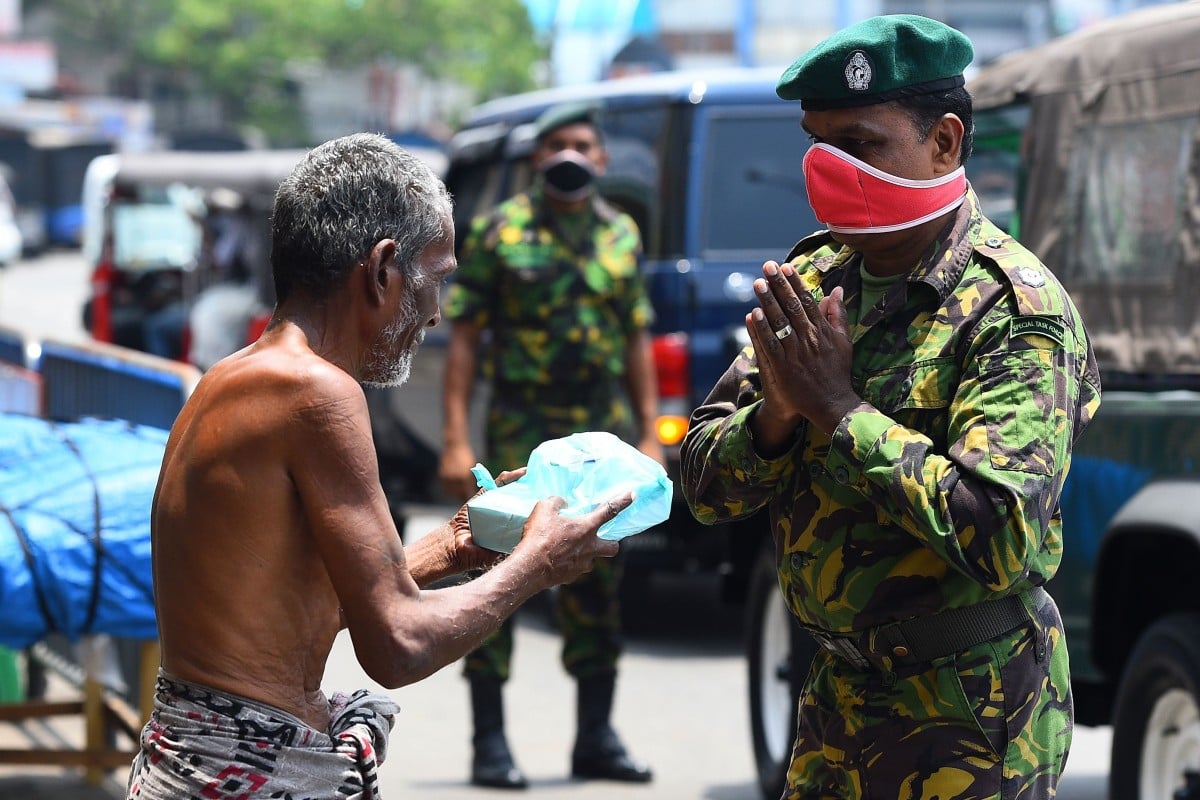
Police commandos in Sri Lanka hand out food to homeless people during a nationwide curfew against the spread of coronavirus. Photo: AFP

More than three billion people are living under lockdown measures as soaring death tolls in Europe and the US underlined a United Nations warning that the coronavirus, which has now infected nearly half a million people globally, threatens all of humanity.

The global death toll from the virus now stands at more than 21,000, with Spain joining Italy in seeing its number of fatalities overtake China, where the virus first emerged just three months ago.

“Covid-19 is threatening the whole of humanity – and the whole of humanity must fight back,” UN Secretary General Antonio Guterres said, launching an appeal for US$2 billion to help the world’s poor.

“Global action and solidarity are crucial. Individual country responses are not going to be enough.”

The G20 major economies will hold an emergency videoconference on Thursday to discuss a global response to the crisis, as will the 27 leaders of the European Union, the outbreak’s new epicentre.

The economic damage of the virus – and the lockdowns – could also be devastating, with fears of a worldwide recession worse than the financial meltdown more than a decade ago.

Here are the developments:

US$2 trillion rescue package passes US Senate

The US Senate passed the nation’s largest-ever rescue package late Wednesday, a US$2 trillion lifeline to suffering Americans, depleted hospitals and an economy all ravaged by a rapidly spreading coronavirus crisis.

The monster deal thrashed out between Republicans, Democrats and the White House includes cash payments to American taxpayers and several hundred billion dollars in grants and loans to small businesses and core industries. It also buttresses hospitals desperately in need of medical equipment and expands unemployment benefits.

The measure cleared the Senate by an overwhelming majority and was headed next to the House of Representatives, which must also pass it before it goes to President Donald Trump for his signature.

US President Donald Trump has voiced hope the US will be “raring to go” by mid-April, but his optimism appeared to stand almost alone among world leaders.

Unemployment benefit filings by Americans workers to surge to 3.3 million last week – the highest number ever recorded, the Labour Department reported on Thursday.

The normally routine report is at the front lines of the economic crisis caused by the outbreak, which has forced widespread closures of restaurants, shops and hotels, and brought airline travel to a virtual halt, prompting the stunning increase in people filing for benefits nationwide in the week ending March 21.

Nearly every state cited Covid-19 for the jump in initial jobless claims, with heavy impacts in food services, accommodation, entertainment and recreation, health care and transport, the report said.

Malaysia’s king and queen in quarantine after staff test positive

The official residence of Malaysia’s monarchy on Thursday confirmed seven of its staff have tested positive for Covid-19 and are currently receiving treatment at the Kuala Lumpur Hospital.

Malaysia’s king, Sultan Abdullah Sultan Ahmad Shah and queen, Tunku Azizah, have also been tested, but their results showed a clean bill of health, a spokesman for the Istana Negara said in a statement.

“Nevertheless, Their Majesties are now observing a 14-day self-quarantine, starting yesterday, ” he said.

Meanwhile, Prime Minister Muhyiddin Yassin, along with all federal ministers and their deputies, announced they will take a two-month pay cut, with the savings to be donated to Putrajaya’s Covid-19 fund.

The Prime Minister’s Office said the decision was made during a cabinet meeting and showed the government’s sincerity in helping those affected by the pandemic.

“The Covid-19 fund was launched on March 11 as part of the government’s efforts to help those who were affected by the disease outbreak,” the office said, adding that 8.5 million ringgit (US$1.97 million) has been collected, including government grants.

Malaysia on Wednesday announced a two-week extension of a national lockdown as part of stepped-up measures to contain the coronavirus outbreak.

The “movement control order,” which requires people to stay home and was originally set to expire on March 31, will now continue until April 14.

Moscow monitors people in coronavirus quarantine with 100,000 ‘under the skin’ surveillance cameras

Russia to ground international flights

Russia will halt all international flights from midnight on Friday under a government decree listing new measures against the coronavirus outbreak.
The decree published on Thursday orders aviation authorities to halt all regular and charter flights, with the exception of special flights evacuating Russian citizens from abroad.
The announcement came after Russia on Wednesday recorded its biggest daily spike in confirmed coronavirus infections so far, with 163 new cases for a total of 658 across the country.
Denis Protsenko, head doctor of Moscow’s new hospital treating coronavirus patients, told President Vladimir Putin that Russia needed to be ready for an “Italian scenario”, referring to what is now the hardest-hit country in the world in terms of deaths.

Singapore boosts stimulus package to 11 per cent of GDP

Singapore reported 52 new coronavirus cases on Thursday, taking its tally to 683 infections.

The health ministry said that out of the 52, 28 were imported while 24 were locally transmitted.

The city state earlier on Thursday unveiled more than $30 billion in new measures to help businesses and households fight the coronavirus pandemic that threatens to push the bellwether economy into a deep recession.

Drawing on national reserves for the first time since the global financial crisis to support an economy heading for recession, the additional spending will push up the government’s virus-related relief to almost S$55 billion, or 11 per cent of gross domestic product, Finance Minister Heng Swee Keat said in a speech in parliament Thursday. It also will widen the budget deficit for the financial year starting April 1 to 7.9 per cent of GDP, from a previous target of 2.1 per cent.

“This extraordinary situation calls for extraordinary measures,” Heng said. “We have saved up for a rainy day. The Covid-19 pandemic is already a mighty storm, and is still growing.”

Coronavirus: Italy’s slowing infection rate boosts case for lockdowns

26 Mar 2020
‘If you catch it, don’t spread it to others’, 1949 flu advice still applies to coronavirus pandemic

Imported cases rise in China

Mainland China reported a second consecutive day of no new local coronavirus infections as the epicentre of the epidemic Hubei province opened its borders, but imported cases rose as Beijing ramped up controls to prevent a resurgence of infections.

A total of 67 new cases were reported as of end-Wednesday, up from 47 a day earlier, all of which were imported, China’s National Health Commission said in a statement on Thursday.

The total number of cases now stands at 81,285.

The commission reported a total of 3,287 deaths at the end of Wednesday, up six from the previous day.

All of the new patients were travellers who came to China from overseas, with the mainland reporting no locally transmitted infections on Wednesday.

Fearing a new wave of infections from imported cases, authorities have ramped up quarantine and screening measures in other major cities including Beijing, where any travellers arriving from overseas must submit to centralised quarantine.

Coronavirus could become seasonal

There is a strong chance the new coronavirus could return in seasonal cycles, a senior US scientist said Wednesday, underscoring the urgent need to find a vaccine and effective treatments.

Anthony Fauci, who leads research into infectious diseases at the National Institutes of Health, told a briefing the virus was beginning to take root in the southern hemisphere, where winter is on its way.

“What we’re starting to see now … in southern Africa and in the southern hemisphere countries, is that we’re having cases that are appearing as they go into their winter season,” he said.

“And if, in fact, they have a substantial outbreak, it will be inevitable that we need to be prepared that we’ll get a cycle around the second time.

“It totally emphasises the need to do what we’re doing in developing a vaccine, testing it quickly and trying to get it ready so that we’ll have a vaccine available for that next cycle.”

There are currently two vaccines that have entered human trials -one in the US and one in China – and they could be a year to a year-and-a-half away from deployment.
British Columbia is testing for Covid-19 faster per head than South Korea
27 Mar 2020

Spain extends emergency by two weeks

Spain’s parliament has voted in favour of the government’s request to extend the state of emergency by two weeks that has allowed it to apply a national lockdown in hopes of stemming its coronavirus outbreak.

The parliamentary endorsement will allow the government to extend the strict stay-at-home rules and business closings for a full month. The government declared a state of emergency on March 14. It will now last until April 11.

Spain’s government solicited the two-week extension after deaths and infections from the Covid-19 virus have skyrocketed in recent days. Spain 47,600 total cases. Its 3,434 deaths only trail Italy’s death toll as the hardest-hit countries in the world.

The parliament met with fewer than 50 of its 350 members in the chamber, with the rest voting from home to reduce the risk of contagion.

Greece locks down Muslim towns

Greek authorities have quarantined a cluster of Muslim-majority towns and villages in the country’s northeast after several cases and a death from the new coronavirus in the area.

The area in Xanthi prefecture was placed in lockdown as of Wednesday evening as nine people in the region overall have tested positive for the virus over the past six days, civil protection deputy minister Nikos Hardalias told reporters.

“All residents have been temporarily confined at home. No exceptions are allowed,” Hardalias said.

The centre of the outbreak appears to be the small Pomak town of Ehinos, a community of about 2,500.

“Ehinos residents will be provided with food and medicine,” Hardalias said.

Police were deployed on Thursday on a bridge leading into town to enforce the lockdown, television footage showed.

One 72-year-old Ehinos man has died from the virus, local mayor Ridvan Deli Huseyin told Antenna television.

“It’s better to take some measures now than to cry about this later,” said Huseyin, the mayor of the local administrative centre of Miki.

The Pomaks are a Muslim group of Slavic origin who live mainly in neighbouring Bulgaria.

They make up part of Greece’s roughly 110,000-strong Muslim minority in the country’s northeast bordering Turkey.

Many of them work as migrant industrial workers in other European countries.

Economy seats go for business-class fares as travellers flee
27 Mar 2020

Colombia goes into lockdown, Chile extends schools closures

Countries across Latin America tightened measures on Wednesday to halt the spread of the deadly novel coronavirus, with more lockdowns, border closings and school closures as well as increased aid to the region’s poorest.

As cases of Covid-19 cases continue to rise – more than 7,400 and 123 deaths up to now – Bolivia and Colombia became the latest countries to impose a total lockdown, while Chile extended its schools closures until the end of April.

Brazil’s President Jair Bolsonaro has warned of possible “chaos” and the “looting” of supermarkets if state shutdowns ordered by the governors of Sao Paulo and Rio de Janeiro aren’t ended.

Bolsonaro, who has repeatedly scoffed at the severity of the deadly pandemic, had previously criticised the closing of schools and businesses in Sao Paulo and Rio states, two of the country’s most populous states.

Germany ramps up testing, approves huge bailout

Germany has boosted its coronavirus test rate to 500,000 a week, Christian Drosten, who heads the Institute of Virology at Berlin’s Charite University Hospital, said on Thursday, adding that early detection has been key in keeping the country’s death rate relatively low.

Drosten also highlighted Germany’s dense network of laboratories spread across its territory as a factor contributing to early detection.

The news came after Chancellor Angela Merkel’s government secured emergency spending, unlocking a historic rescue package designed to cushion the blow of the coronavirus pandemic.

A majority of lawmakers in the Bundestag voted on Wednesday to allow additional borrowing to combat the crisis, according to the legislature’s president. The Bundesrat, or upper house of parliament, will vote on Friday.

The extraordinary authorisation is part of a packet of legislation aimed at protecting German jobs and businesses. The new borrowing of €156 billion (US$169 billion) is equivalent to half of the country’s normal annual spending.

The country, which tightened lockdown measures this week, has about 32,700 cases and more than 150 deaths.

Trump and Widodo back chloroquine treatment, but fake news is deadly

25 Mar 2020

Ukraine declares ‘emergency situation’

Ukraine on Wednesday declared a month-long “emergency situation” to slow the coronavirus outbreak, as the number of confirmed cases jumped to 113.

Ukraine has already closed schools, universities and public spaces to stem the spread of the disease, but the measures were due to expire at the beginning of April.

The emergency situation announced on Wednesday effectively extends existing measures for 30 days until April 24, a government spokesperson said.

“We are extending quarantine and imposing an emergency situation in Ukraine,” Prime Minister Denys Shmygal said.

Unlike an official state of emergency, the initiative announced by the prime minister does not have to be rubber stamped by both the parliament and president. Ukraine has confirmed 113 cases of Covid-19 and four deaths, according to official statistics.

Prince Charles tests positive for coronavirus

Mexican governor says poor are ‘immune’

The governor of a state in central Mexico is arguing that the poor are “immune” to the new coronavirus, even as the federal government suspends all non-essential government activities beginning Thursday in a bid to prevent the spread of the virus.

Puebla Governor Miguel Barbosa’s comment on Wednesday was apparently partly a response to indications that the wealthy have made up a significant percentage of Mexicans infected to date, including some prominent business executives.

Officials say three-quarters of Mexico’s 475 confirmed cases are related to international travel, and the poor do not make many international trips. Some people apparently caught the virus on ski trips to Italy or the United States. The country has seen six deaths so far.

“The majority are wealthy people. If you are rich, you are at risk. If you are poor, no,” Barbosa said of the coronavirus. “We poor people, we are immune.”

Barbosa also appeared to be playing on an old stereotype held by some Mexicans that poor sanitation standards may have strengthened their immune systems by exposing them to bacteria or other bugs.

There is no scientific evidence to suggest the poor are in any way immune to the virus that is causing Covid-19 disease around the world.

No agreement on ‘Wuhan virus’ name as G7 spars over infection source

26 Mar 2020

Japan belatedly bans entry from Europe, Iran

Japanese Prime Minister Shinzo Abe has established a task force under the country’s revised emergency law to deal with the global rise in coronavirus infections and deaths.

In Tokyo on Thursday, Abe said it was necessary for people to act as one to overcome what can be described as a national crisis.

Japan will ban entry from 21 European countries as well as Iran, to take effect from Friday, he added.

The country has already begun asking visitors and its nationals arriving from some countries in Southeast Asia, the Middle East and Africa to self-quarantine for 14 days.

Arrivals from a total of seven Southeast Asian countries and four in the Middle East and Africa are also asked to refrain from using public transport.

Similar steps are in place for visitors from China, South Korea, most of Europe and the United States.

Malaysia to lock down two communities to curb spread

Malaysia on Thursday announced that 3,570 residents in two communities in the country’s south will be placed under complete lockdown due to their high coronavirus infection rates.

Defence Minister Ismail Sabri Yaakob said in a statement that the residents in Kluang district of Johor state are banned from leaving home for two weeks beginning Friday, to enable the health authorities to conduct door-to-door screening.

The tough measure was taken after 73 per cent of the 83 infection cases found in the district were traced to the two small communities of Kampung Dato Ibrahim Majid and Bandar Baru Dato Ibrahim Majid.

Ismail said the residents cannot leave home, not even to buy food, as the welfare department will supply them with two weeks’ worth of food. All businesses must close and all access into the two areas will be sealed. The police and army have been deployed to ensure compliance.

Australia scraps haircut time limit

The Australian government scrapped a time limit on haircuts following a backlash.

The government had imposed a rule on hairdressers and barbers on Tuesday that haircuts should take less than 30 minutes, as part of social distancing restrictions to deal with the coronavirus outbreak.

The restriction put around 40,000 hairdressers at risk, the Australian Hairdressing Council said in response.

“This decision is outrageous,” the council’s chief executive Sandy Chong said in a statement.

“Whilst many barbers can do a male haircut within that time frame, it really isn’t feasible for a majority of hairdressing salons.”

Australian Prime Minister Scott Morrison issued a statement Thursday saying the policy would be reversed with immediate effect.

But salons and barbers must still strictly observe new rules that there may only be one person per four square metres within the premises, Morrison said.

India unveils US$22.6 billion stimulus package

India’s government announced a 1.7 trillion rupee (US$22.6 billion) stimulus package, as it stepped up its response to the coronavirus pandemic.

The measures will include cash transfers as well as steps on food security, Finance Minister Nirmala Sitharaman said in New Delhi on Thursday, adding that the package will benefit migrant workers.

Asia’s third-largest economy joins countries from the US to Germany that have pledged spending to contain the economic fallout of the pandemic. India is on a total lockdown for three weeks from Wednesday in the world’s biggest isolation effort, as Prime Minister Narendra Modi seeks to prevent the virus from spreading locally.

The government will also provide an insurance cover of 5 million rupees to medical workers, Sitharaman said.

Source: SCMP

03/11/2019

Machynlleth crocodile skull raid prompts trade warning

Seized crocodile skullImage copyright DYFED-POWYS POLICE
Image caption Trade in some species, including some types of crocodiles, is banned outright

People buying animal “souvenirs” have been warned they must check they are legal after police seized a number of crocodile skulls imported from China.

Police are investigating the finds after searching two properties in Machynlleth, Powys, on Wednesday.

Dyfed-Powys Police and North Wales Police said they had found “numerous” skulls across the searches.

Animal trade charity Traffic said importers and buyers must make sure they had the correct permits.

Richard Thomas, from Traffic, said some people would buy things such as skulls as a “talking point”.

Trade in some species, including some types of crocodiles, is banned outright, but others can be bought and sold as long as the exporting country issues permits.

Earlier this month, police seized a skull of a critically endangered Siamese crocodile from a man in Chippenham, Wiltshire, after he paid about £30 to a buyer in China.

Wiltshire Police said the man bought it as an “unusual” house ornament and had no idea that it was protected.

No further action was taken against him when police decided he had made an honest mistake.

The Convention on International Trade in Endangered Species of Wild Fauna and Flora is the main worldwide agreement controlling trade in wild animals and plants, and is signed by more than 180 countries.

In 2016, the UN estimated that the annual value of illegal wildlife trade was between $7bn-$23bn (£5.4bn-£17.8bn).

Traffic said demand for such items as horns, ivory, bones and skins was “driving unprecedented wildlife population declines”.

Source: The BBC

30/10/2019

Premier Li meets South African deputy president

CHINA-BEIJING-LI KEQIANG-SOUTH AFRICA-MEETING

Chinese Premier Li Keqiang meets with South African Deputy President David Mabuza at the Great Hall of the People in Beijing, capital of China, Oct. 29, 2019. (Xinhua/Ding Haitao)

BEIJING, Oct. 29 (Xinhua) — Chinese Premier Li Keqiang met with South African Deputy President David Mabuza Tuesday in Beijing, calling on the two sides to promote bilateral relations for new development.

Noting that South Africa is an important African country, Li said the continued development of bilateral relations is beneficial to China-Africa cooperation.

China is ready to work with South Africa to consolidate mutual political trust and promote practical cooperation and people-to-people exchanges to push for new development in bilateral relations, he said.

“Both China and South Africa are developing countries and have broad common interests,” said Li, adding that China stands ready to work with South Africa to closely communicate and coordinate in international and regional affairs and enhance cooperation in multilateral mechanisms such as the UN and BRICS, to jointly safeguard developing countries’ interests and maintain regional and world peace.

Mabuza, who is on an official visit to China and will co-chair the seventh plenary session of the China-South Africa Bi-National Commission with his Chinese counterpart, offered his congratulations for the 70th anniversary of the founding of the People’s Republic of China.

He thanked China for its long-standing support for South Africa and African countries’ development and conveyed his admiration for China’s great development achievements.

Mabuza said his country is willing to learn from China’s development experience, deepen practical cooperation across the board with China and push bilateral relations to reach a new level.

Source: Xinhua

24/10/2019

Essex lorry deaths: 39 found dead ‘were Chinese nationals’

The 39 people found dead in a refrigerated trailer in Essex were Chinese nationals, it is understood.

Police are continuing to question lorry driver Mo Robinson, 25, who was arrested on suspicion of murder.

Officers in Northern Ireland have raided two houses and the National Crime Agency said it was working to identify “organised crime groups who may have played a part”.

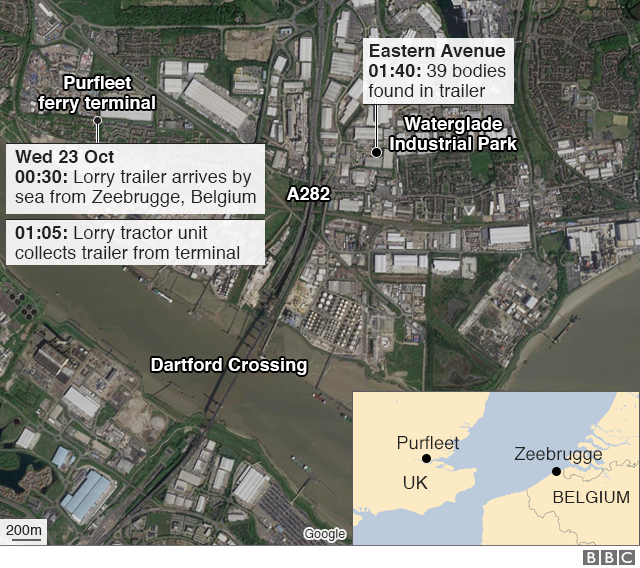
The trailer arrived in Purfleet on the River Thames from Zeebrugge in Belgium.

Ambulance staff discovered the bodies of the 38 adults and one teenager in the container at Waterglade Industrial Park in Grays just after 01:30 BST on Wednesday.

The lorry and trailer left the port at Purfleet shortly after 01:05.

Police said the tractor unit – the front part of the lorry – came from Northern Ireland and picked up the trailer from Purfleet.

Mo RobinsonImage copyright FACEBOOK
Image caption The lorry driver has been named locally as Mo Robinson, from County Armagh

Councillor Paul Berry said the village of Laurelvale in County Armagh, where the Robinson family live, was in “complete shock”.

He said he had been in contact with Mr Robinson’s father, who had learned of his son’s arrest on Wednesday through social media.

“The local community is hoping that he [Mo Robinson] has been caught up innocently in this matter but that’s in the hands of Essex Police, and we will leave it in their professional hands to try to catch the perpetrators of this,” he said.

The Belgian Federal Public Prosecutor’s Office said it had opened a case which would focus on the organisers and others involved in the transport.

A spokesman said the container arrived in Zeebrugge at 14:29 on Tuesday and left the port later that afternoon before arriving in Purfleet in the early hours of Wednesday.

It was not clear when the victims were placed in the container or if this happened in Belgium, he said.

Media caption Essex lorry deaths: CCTV shows arrival at industrial park

St Peter and St Paul’s Church in Grays will be open for people to light candles and say prayers between 12:00 and 14:00.

A vigil is being held at 18:00 outside the Home Office to “call for urgent action to ensure safe passage” for people fleeing war and poverty.

The lorry was moved to a secure site at Tilbury Docks on Wednesday so the bodies could be “recovered while preserving the dignity of the victims”.

Essex Police initially suggested the lorry could be from Bulgaria, but later said officers believed it entered the UK from Belgium.

The force said formal identification of the 39 bodies “could be a lengthy process”.

A spokesman for the Bulgarian foreign affairs ministry said the truck was registered in the country under the name of a company owned by an Irish citizen.

He said it was “highly unlikely” the deceased were Bulgarians.

Graphic of Purfleet ferry channel

Shaun Sawyer, the National Police Chiefs Council lead for modern slavery and human trafficking, said while forces had prevented thousands of deaths, “tragically, for 39 people that didn’t work yesterday”.

He told BBC Radio 4’s Today programme even if there were routes perceived as easier to get through, organised criminals would still exploit people who could not access those.

“You can’t turn the United Kingdom into a fortress,” added Mr Sawyer, who is the Chief Constable of Devon and Cornwall Police.

Media caption I’ve seen people running out of a lorry’

Thurrock’s Conservative MP Jackie Doyle-Price said there needed to be an international response.

“We have partnerships in place but those efforts need to be rebooted, this is an international criminal world where many gangs are making lots of money and until states act collectively to tackle that it is going to continue,” she said.

Richard Burnett, chief executive of the Road Haulage Association, said temperatures in refrigerated trailers could be as low as -25C.

He described conditions for anyone inside as “absolutely horrendous”.

Prime Minister Boris Johnson said it was an “unimaginable tragedy and truly heartbreaking”.

Presentational grey line

How many migrants have died in transit?

The number of migrants who die in transit has been recorded by the UN since 2014.

Since then, five bodies of suspected migrants had been found in lorries or containers in the UK before this tragedy.

Data was not collected in the same way before the migrant crisis began in 2014, but such deaths are not new.

In 2000, 58 Chinese migrants were found suffocated to death in a lorry at Dover.

In 2015, the bodies of 71 people were found in an abandoned lorry on an Austrian motorway. Police suspected the vehicle was part of a Bulgarian-Hungarian human trafficking operation.

Source: The BBC

09/10/2019

US imposes China visa restrictions over Uighur issue

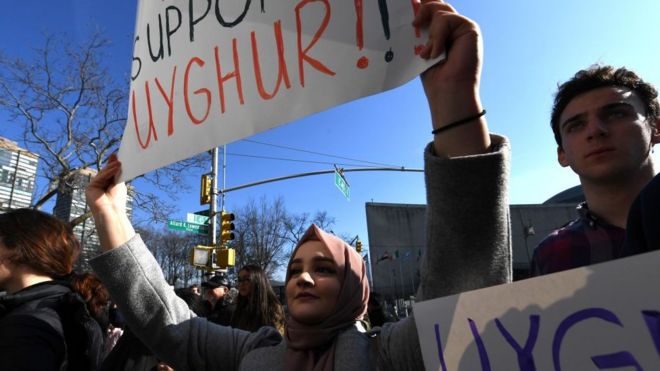
Uighur protesters demonstrating in the US in FebruaryImage copyright GETTY IMAGES
Image caption Protests calling for Uighur freedom have been happening all year

The US has said it will impose visa restrictions on Chinese officials accused of involvement in repression of Muslim populations.

It follows the decision on Monday to blacklist 28 Chinese organisations linked by the US to allegations of abuse in the Xinjiang region.

US Secretary of State Mike Pompeo said the Chinese government had instituted “a highly repressive campaign”.

China has dismissed the allegations as groundless.

In a statement, Mr Pompeo accused the Chinese government of a string of abuses against Uighurs, ethnic Kazakhs, Kyrgyz Muslims and other minority Muslim groups.

These included “mass detentions in internment camps; pervasive, high-tech surveillance; draconian controls on expressions of cultural and religious identities; and coercion of individuals to return from abroad to an often perilous fate in China”.

China has rebuffed the US moves.

“There is no such thing as these so-called ‘human rights issues’ as claimed by the United States,” foreign ministry spokesman Geng Shuang said on Monday.

“These accusations are nothing more than an excuse for the United States to deliberately interfere in China’s internal affairs.”

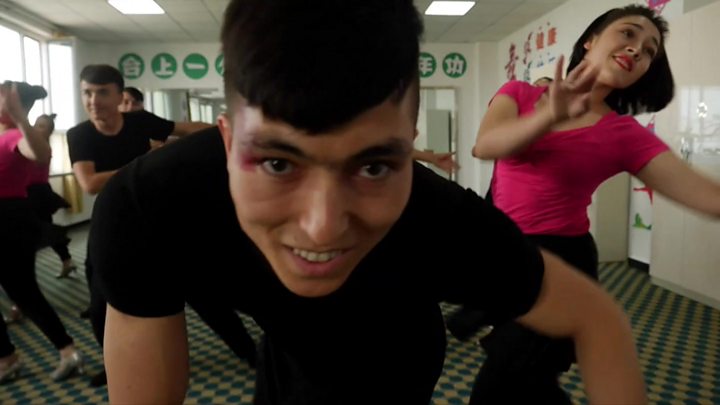
Media caption The BBC visits the camps where China’s Muslims have their “thoughts transformed”

Visa restrictions are to be imposed on Chinese government and Communist Party officials, as well as their family members.

“The United States calls on the People’s Republic of China to immediately end its campaign of repression in Xinjiang, release all those arbitrarily detained, and cease efforts to coerce members of Chinese Muslim minority groups residing abroad to return to China to face an uncertain fate,” the US statement said.

The US and China are currently embroiled in a trade war, and have sent delegations to Washington for a meeting about the tensions later this week.

What is the situation in Xinjiang?

China has been carrying out a massive security operation in Xinjiang, in its far west, in recent years.

Human rights groups and the UN say China has rounded up and detained more than a million Uighurs and other ethnic minorities in vast detention camps, where they are forced to renounce Islam, speak only in Mandarin Chinese and learn obedience to the communist government.

But China says they are attending “vocational training centres” which are giving them jobs and helping them integrate into Chinese society, in the name of preventing terrorism.

Media caption The BBC’s John Sudworth meets Uighur parents in Turkey who say their children are missing in China

There have been increasingly vocal denunciations from the US and other countries about China’s actions in Xinjiang.

Last week, Mr Pompeo alleged that China “demands its citizens worship government, not God” in a press conference in the Vatican.

And in July more than 20 countries at the UN Human Rights Council signed a joint letter criticising China’s treatment of the Uighurs and other Muslims.

Who are the Uighurs?

Uighurs are ethnically Turkic Muslims. They make up about 45% of the Xinjiang region’s population; 40% are Han Chinese.

China re-established control in 1949 after crushing short-lived state of East Turkestan.

Since then, there has been large-scale immigration of Han Chinese and Uighurs fear erosion of their culture.

Xinjiang is officially designated an autonomous region within China, like Tibet to its south.

Source: The BBC

28/07/2019

Chinese FM says BRICS cooperation a strategic choice, urges bigger BRICS role in world affairs

BRAZIL-RIO DE JANEIRO-CHINA-WANG YI-BRICS-MEETING

Chinese State Councilor and Foreign Minister Wang Yi (2nd L) poses for a group photo with Brazilian Foreign Minister Ernesto Araujo (3rd L), Russian Foreign Minister Sergey Lavrov (1st L), South African Foreign Minister Naledi Pandor (2nd R) and India’s Minister of State for External Affairs Vijay Kumar Singh in Rio de Janeiro, Brazil, July 26, 2019. Wang Yi attended the Formal Meeting of the BRICS Ministers of Foreign Affairs in Rio de Janeiro. (Xinhua/Xin Yuewei)

RIO DE JANEIRO, July 27 (Xinhua) — The rise of emerging markets and developing countries, represented by the BRICS countries, has bolstered a more multi-polar world, Chinese State Councilor and Foreign Minister Wang Yi said here on Friday.

At the Formal Meeting of the BRICS Ministers of Foreign Affairs, Wang also said BRICS cooperation is not a band-aid solution for the five countries but a strategic choice that focuses on common and long-term development and harbors bright prospects.

The five countries are Brazil, Russia, India, China and South Africa.

Wang said no matter how the international landscape changes, the direction of the BRICS cooperation must not change. Faced with new challenges, the five countries should let their voices be heard, offer more solutions to pressing global issues and play a greater role in world affairs.

Wang pointed out that unilateralism undermines international rules and challenges the international rule of law, which exacerbates the instability and uncertainty of the world.

The BRICS countries must take the lead in maintaining multilateralism and safeguarding the global governance system with the UN as its core and under international law.

Furthermore, the bloc should safeguard the multilateral trading system represented by the WTO and protect the common interests and development space of emerging market and developing countries, he said.

The five countries together must continue to integrate the interests of other emerging market countries and developing countries through flexible and diverse platforms such as “BRICS Plus.”

At the meeting, the five foreign ministers all agreed to safeguard the purposes and principles of the UN Charter, defend multilateralism and free trade, oppose unilateralism and protectionism, strengthen global governance, and build a community with a shared future for humankind.

They agreed that regional hotspot issues should be resolved through dialogue and consultation and that BRICS cooperation should work to benefit the peoples of the five countries.

The foreign ministers also agreed to maintain vigilance on cybersecurity issues and expressed opposition to the use of cybersecurity to suppress the development of science and technology in other countries. They agreed to strive toward an open and non-discriminatory environment for the application of information technology.

The foreign ministers were tasked with preparing for the BRICS summit to be held in Brasilia in November.

Source: Xinhua

19/07/2019

Chinese peacekeeping helicopter unit to Sudan’s Darfur awarded UN peace medals

SUDAN-DARFUR-CHINESE PEACEKEEPING CONTINGENT-UN PEACE MEDALS

Anita Kiki Gebe, deputy joint special representative of the United Nations-African Union Mission in Darfur (UNAMID), awards UN peace medal to a soldier of the 2nd China Medium Utility Helicopter Unit (CMUHU02) in El-Fashir, Sudan, July 17, 2019. The 140 officers and soldiers of the 2nd China Medium Utility Helicopter Unit (CMUHU02), a peacekeeping contingent to Sudan’s Darfur, were awarded UN peace medals. (Xinhua)

KHARTOUM, July 18 (Xinhua) — The 140 officers and soldiers of the 2nd China Medium Utility Helicopter Unit (CMUHU02), a peacekeeping contingent to Sudan’s Darfur, were awarded UN peace medals.

At the award ceremony on Wednesday, Anita Kiki Gebe, deputy joint special representative of the United Nations-African Union Mission in Darfur (UNAMID), spoke highly of the devotion of the Chinese helicopter unit to the peace and stability of Sudan.

“The second Chinese peacekeeping helicopter unit to Darfur demonstrated their outstanding professionalism and excellent service in their mandate,” said Gebe, also one of the presenters of the UN award.

Their “outstanding work has enhanced the friendship between China and Sudan and the world nations,” she added.

Equipped with four Mi-17 helicopters, the CMUHU02 in UNAMID is mainly tasked with 24-hour air patrol, battleground reconnaissance, personnel movement, casualty evacuation and material transportation.

So far, the Chinese helicopter contingent to Darfur has carried out 636 sorties, rescued more than 280 people and delivered 3,800 passengers, 220 tons of cargo, 16.6 tons of dangerous goods such as weapons and ammunition.

Source: Xinhua

16/06/2019

Beijing sees ‘broad consensus’ with UN on Xinjiang as human rights groups blast envoy’s visit

  • UN counterterrorism chief Vladimir Voronkov not expected to make statement after visiting region last week
  • Trip prompts calls for independent observation in Muslim-majority area where an estimated 1 million people are held in detention facilities
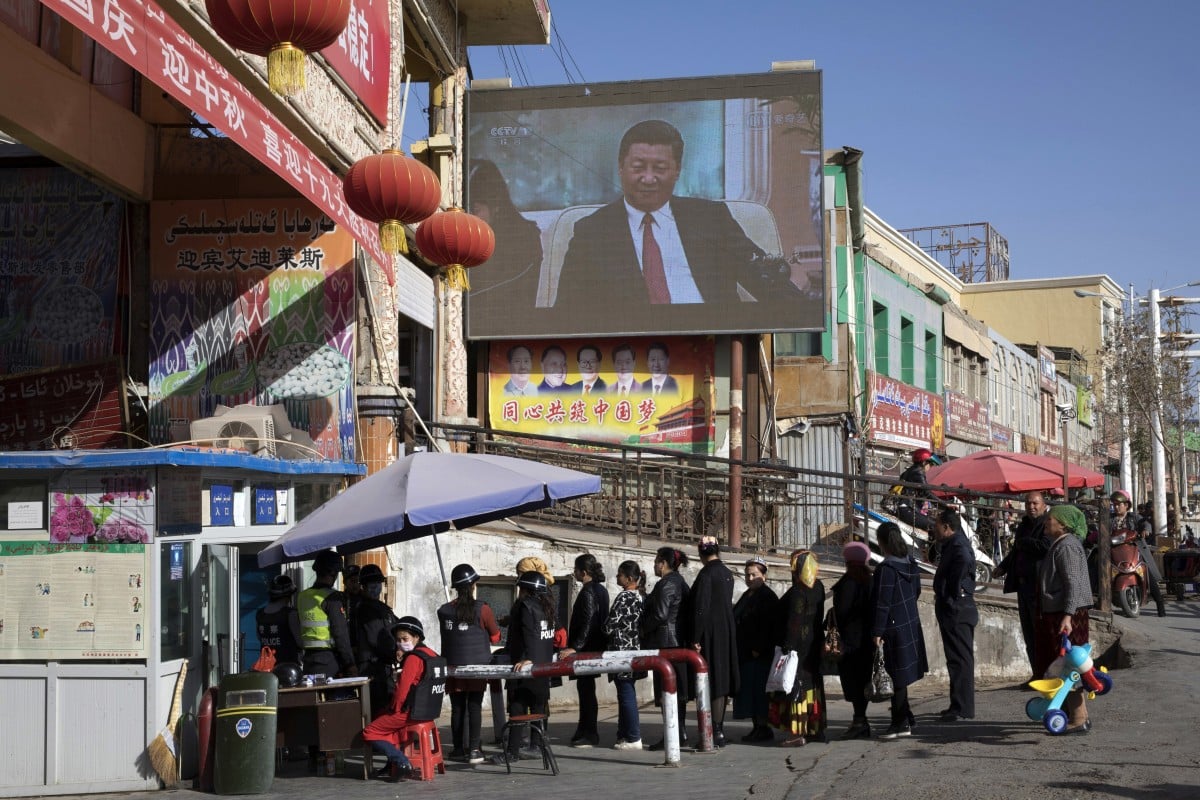
Residents go through a security checkpoint at the entrance to a bazaar in Hotan, Xinjiang. The UN’s counterterrorism chief visited the far western region last week. Photo: AP
Human rights group Amnesty International has joined growing criticism of a top UN official’s visit to China’s 
Xinjiang region

, echoing calls for more independent investigations of detention facilities for ethnic Uygurs.

The invitation to the United Nations envoy to visit was Beijing’s latest attempt to show it has nothing to hide in what it calls “re-education facilities” that hold an estimated 1 million people in the Muslim-majority area in western China.
But critics have warned that state-led media tours and diplomatic visits lack the unfettered access needed to make a proper assessment of alleged rights abuses in the region.
UN counterterrorism chief Vladimir Voronkov 
visited Beijing and Xinjiang

from Thursday to Saturday and met Le Yucheng, the vice foreign minister, according to a statement from the foreign ministry on Sunday. The statement said the two sides had reached a “broad consensus”.

UN human rights chief ‘is welcome to visit Xinjiang’

Voronkov’s visit follows months of pressure to allow the UN to investigate alleged human rights abuses in Xinjiang. China has so far only allowed guided tours of the region for foreign journalists and diplomatic envoys.

Reuters reported on Saturday that Voronkov’s itinerary was planned by China and that his UN office did not expect to make any public statement about the trip, according to an email from Voronkov’s office seen by the news agency.

The United Nations said in August last year it had credible reports that detention facilities in Xinjiang held 1 million Uygurs and other Muslims. Beijing says the facilities are for “vocational training” and tied to deradicalisation and anti-terrorism efforts.

Patrick Poon, a Hong Kong-based researcher with Amnesty International, said he was “very much concerned” about how the UN envoy’s visit had been arranged.

“From what we saw in the previous visits orchestrated by the Chinese government for diplomats, it’s very difficult for anyone to believe how this visit will be able to show any authentic situation on the ground,” Poon said.

“If the Chinese government is sincere, let independent UN experts, such as the special rapporteurs, have independent observation of what’s happening in Xinjiang.”

Xinjiang’s vanishing mosques highlight pressure on China’s Muslims
His remarks followed criticism of the trip from Human Rights Watch on Friday.
“The UN allowing its counterterrorism chief to go to Xinjiang risks confirming China’s false narrative that this is a counterterrorism issue, not a question of massive human rights abuses,” Human Rights Watch UN director Louis Charbonneau told Agence France-Presse.
Also on Friday, US Deputy Secretary of State John Sullivan called UN Secretary General Antonio Guterres to express “deep concerns” about Voronkov’s visit, according to the State Department website. Sullivan called for “unmonitored and unhindered access to all camps and detainees in Xinjiang by UN human rights officials”.
The United States has been increasingly vocal about China’s human rights abuses. Vice-President Mike Pence is due to give a speech on China’s “control and oppression” of citizens on June 24, but according to Bloomberg it could be postponed to avoid inflaming tensions with Beijing ahead of a possible meeting between US President Donald Trump and his Chinese counterpart Xi Jinping at the Group of 20 leaders summit in Japan on June 28-29. The speech was originally scheduled for June 4 but was delayed by Trump, Bloomberg reported, citing sources familiar with the matter.
Source: SCMP
05/06/2019

African swine fever virus is now ‘endemic’ in China’s Tibet and Xinjiang regions, making its eradication harder, UN says

  • The virus that causes the African swine fever is now endemic in Tibet and Xinjiang, the United Nations’ Food & Agriculture Organisation said
  • Diseases that are endemic, or generally present, are harder to stamp out
Piglets are kept in pens at a pig farm in Langfang in Hebei province on Monday, April 1, 2019. Photo: Bloomberg
China’s attempts to control African swine fever have been insufficient to stem further spread of the disease, with the deadly pig contagion now endemic in two regions, a United Nations group said.
The virus that causes the disease is entrenched among pig populations in the autonomous regions of Tibet and Xinjiang, the Food & Agriculture Organisation (FAO) in Rome said in a report Thursday.
Diseases that are endemic, or generally present, are more difficult to stamp out by quarantining and culling diseased and vulnerable livestock.

About 20 per cent of China’s pig inventories may have been culled in the first few months of 2019 amid fears of African swine fever spreading more rapidly, according to the FAO, which is monitoring the disease in cooperation with local authorities and China’s Ministry of Agriculture and Rural Affairs.

China’s pig production will drop by 134 million heads, or 20 per cent, in 2019, the US Department of Agriculture said last month.

“While official sources confirm a rapid spread of the disease, both the speed and severity of the spread could prove more pronounced than currently assumed,” the FAO said in its report. A government investigation in seven provinces found “irrational culling of sows on breeding farms in February, reducing the sector’s core production capacity.”

Thailand launches crackdown to keep out African swine fever

Since the first cases were reported last August, 130 outbreaks have been detected in 32 provinces, autonomous regions, municipalities and special administrative regions across the nation, which raises half the world’s pigs.

SCMP Graphics
SCMP Graphics

The FAO report found:

  • In Jilin province, swine inventory fell 28 per cent from the previous year, with some reports pointing to a larger drop In Shandong province, sow numbers fell 41 per cent from July 2018 to February 2019
  • In Guangdong province, hog inventories slumped 20 per cent from a year earlier and pig-feed sales fell 10 per cent to 50 per cent
  • Production of fresh and frozen meat by meatpackers plunged 17 per cent in January and February, compared with the same months in 2018
  • Source: SCMP
27/04/2019

Xi meets UN chief

(BRF)CHINA-BEIJING-XI JINPING-UN CHIEF-MEETING (CN)

Chinese President Xi Jinping (R) meets with United Nations (UN) Secretary-General Antonio Guterres, who is attending the Second Belt and Road Forum for International Cooperation, in Beijing, capital of China, April 26, 2019. (Xinhua/Ding Haitao)

BEIJING, April 26 (Xinhua) — Chinese President Xi Jinping on Friday met with United Nations (UN) Secretary-General Antonio Guterres, who is attending the Second Belt and Road Forum for International Cooperation in Beijing.

China firmly upholds multilateralism, the international system with the UN at its core, and the international order based on international law, and promotes the building of a community with a shared future for humanity, Xi said.

The more complex and grim the situation is, the more important it is to manifest the authority and role of the UN, Xi said, adding that China will continue to support the UN.

Noting that the Chinese people not only pursue a good life for themselves, but also work for common interest and harmony of the world, Xi said the Belt and Road Initiative (BRI) embodies the idea of mutual benefit, and is in line with the UN’s sustainable development concept.

Describing the UN as an important partner in promoting the BRI, Xi said that China is ready to work with the UN to advance the initiative in an all-round way while following the principle of delivering shared benefits through extensive consultation and joint contribution.

Guterres said President Xi’s speech delivered at the forum on Friday morning is very important, as it elaborates the interrelationship between the BRI and global development agenda.

He spoke highly of China’s major measures for further reform and opening up.

China firmly upholds multilateralism, and safeguards equity and justice, as well as the purposes and principles of the UN Charter, the UN chief said, adding that China has played an important role in stabilizing, and brought certainty, confidence and hope to the world.

Calling on countries around the world to seize the opportunities brought about by the BRI cooperation and achieve win-win outcomes, Guterres said history will prove that China’s development is not only an irresistible historical trend, but also a major contribution to human progress.

Source: Xinhua

Law of Unintended Consequences

continuously updated blog about China & India

ChiaHou's Book Reviews

continuously updated blog about China & India

What's wrong with the world; and its economy

continuously updated blog about China & India