Chindia Alert: You’ll be Living in their World Very Soon
aims to alert you to the threats and opportunities that China and India present. China and India require serious attention; case of ‘hidden dragon and crouching tiger’.
Without this attention, governments, businesses and, indeed, individuals may find themselves at a great disadvantage sooner rather than later.
The POSTs (front webpages) are mainly 'cuttings' from reliable sources, updated continuously.
The PAGEs (see Tabs, above) attempt to make the information more meaningful by putting some structure to the information we have researched and assembled since 2006.
SRINAGAR (Reuters) – Indian forces have killed the leader of an al Qaeda affiliated militant group in Kashmir, police said on Friday, triggering protests in parts of the disputed region.
Zakir Rashid Bhat, 25, was trapped by security forces in a three-storey house in southern Kashmir late on Thursday, said a senior police officer, adding that the house was set ablaze during the operation.
“As we were clearing debris from the house, he tried to get up. Our troops fired at him and he was killed,” said the officer, who declined to be named because he was not authorised to speak to media.
For decades, separatists have fought an armed conflict against Indian rule in Kashmir, with the majority of them wanting independence for the Himalayan region, or to join New Delhi’s arch rival Pakistan.
India has stepped up an offensive against militants in the Muslim-majority region since a suicide attack in February killed 40 Indian troopers in Kashmir and brought India and Pakistan to the brink of war.
Pakistan denies giving material support to militants in Kashmir but says it provides moral and diplomatic backing for the self-determination of Kashmiri people.
Protests by supporters of Bhat broke out in parts of Kashmir on Thursday and there were reports of demonstrations early on Friday, the police officer said.
Fearing more unrest, authorities said schools were closed and railway services suspended in the affected areas.
Any large scale unrest in the region would be a challenge for Indian Prime Minister Narendra Modi as he prepares for a second term after winning a general election on Thursday.
Bhat, a former commander of the Hizbul Mujahideen, the largest of the militant groups fighting against Indian rule in Kashmir, founded his own group and declared its association with al Qaeda in 2017.
Also known as Zakir Musa, he was seen as a successor to Burhan Wani, a popular Hizbul Mujahideen commander whose death in 2016 sparked clashes that left 90 civilians dead.
China’s three biggest airlines are demanding compensation from Boeing over its grounded 737 Max fleet.
Air China, China Southern and China Eastern have filed claims for payouts, according to state media reports.
China’s regulator was the first to ground the fleet in the wake of two deadly crashes involving the US-made aircraft.
It comes on the eve of a meeting of global aviation regulators that will provide an update on the troubled jets.
The Chinese airlines are seeking compensation for losses incurred by the grounded fleet, as well as delayed deliveries of the 737 Max jets, according to reports.
China operates the largest fleet of Boeing 737 Max aircraft and was the first country to take the jets out of service after the Ethiopian Airlines 737 Max 8 crash in March.
The disaster killed all 157 people on board. In October, 189 people were killed in a Lion Air crash involving the same model.
Both crashes were linked to the jet’s Manoeuvring Characteristics Augmentation System, a new feature on 737 Max planes, which was designed to improve the handling of the jet and to stop it pitching up at too high an angle.
The planemaker’s entire global fleet of 737 Max aircraft has been grounded since March and the firm is anxious to prove it is safe to return to the skies.
The move by China’s top airlines to seek compensation comes ahead of a closely watched summit of aviation regulators in Texas on Thursday.
The US Federal Aviation Administration (FAA) is due to provide an update on reviews of Boeing’s software fix and new pilot training.
The meeting in Texas will involve 57 agencies from 33 countries, including China, France, Germany and the UK, as well as the European Union Aviation Safety Agency.
But it is unclear if the planes will be back in the air before the end of the critical summer travel season.
NANJING, May 22 (Xinhua) — The digital economy of east China’s Yangtze Delta region including the provinces of Zhejiang and Jiangsu, and Shanghai Municipality exceeded one trillion yuan (145 billion U.S. dollars) respectively, according to a Tuesday summit in Jiangsu.
Statistics show that Jiangsu, Zhejiang and Shanghai saw their digital economy reach 3 trillion yuan, 2 trillion yuan and one trillion yuan respectively in 2018, reporting record growth in the Yangtze Delta region.
“The digital economy is leading today’s scientific and technological revolution and industrial change,” said Yan Li, vice chairman of Jiangsu provincial political consultative conference. “The Yangtze Delta region should cooperate in building a pilot zone of China’s digital economic development,” said Yan.
The region should enhance cooperation in developing infrastructure and cultivating software talents, said Zhou Hanmin, head of Shanghai Institute of Socialism. “Talents are the pillar for the digital economy and the region’s educational sectors should work together to exploit their strength.”
China’s digital economy reached 31.3 trillion yuan (about 4.6 trillion U.S. dollars) in 2018, accounting for 34.8 percent of the country’s total GDP.
BEIJING, May 22 (Xinhua) — Du Fuguo, a soldier who lost his eyes and arms in an explosion during a mine clearance operation, was honored by the Publicity Department of the Communist Party of China Central Committee on Wednesday.
Du, who was a demining soldier of the People’s Liberation Army (PLA), was awarded the title “role model of our times” at a ceremony in Beijing.
Du’s family members and fellow soldiers, as well as representatives from all walks of life, attended the award ceremony.
The 28-year-old soldier was seriously injured in the landmine explosion trying to protect his fellow soldier during the operation in southwest China’s Yunnan Province in October last year.
Du would have finished his military service in December 2018, just two months after the explosion.
In 2015, Du and over 400 fellow soldiers started clearing mines in the border area in Yunnan, where over 100 minefields were located.
“I couldn’t stay calm after getting to know the villagers living in the area suffered three explosions within 10 years,” said Du, who volunteered to participate in the demining operations in 2015.
Du’s father wished to become a solider at an early age, which was not fulfilled, while Du Fuguo joined the PLA in 2010.
“I am reflecting what kind of life is truly meaningful and valuable, and the only standard is what has been done for the country and for the people,” Du wrote in his application submitted for mine clearance operations.
“When the people are in need and the country is calling upon us, there is not even half a step that I can retreat,” he responded when being told mine clearance was dangerous.
A minefield Du worked has deterred local people from growing crops and picking tea. They beat gongs and sounded drums to welcome the arrival of the mine clearance group.
Over the past three years, Du has entered minefields over 1,000 times, defusing more than 2,400 mines and bombs.
“I feel like it is my destiny to carry out this mission and there was a voice calling me to clear the mines,” he wrote in his application.
While various equipment has been developed for mine clearance, it is believed that manual demining remains the most efficient method, albeit the most dangerous.
The explosion happened in an afternoon when Du and a fellow soldier tried to defuse a bomb, but it suddenly exploded and Du quickly protected his colleague who was left with only bruises.
“Step back and I’ll do the job,” Du said before he started the defusing work in which he lost his forearms and eyes.
One month later, in November last year, Du’s team members confirmed that the minefield where the explosion took place was safe to be used as farmland, meaning that the three-year demining operation had finished.
In the area where Du was injured, people have named tea picked this year as “Fuguo.” They are hoping that Du could come back to have a taste of his eponymous tea.
“Despite my lost hands, I have legs to continue chasing after dreams; despite my lost sight, as long as the sun can rise in my heart, my world remains blazing with color,” Du said.
‘The admissions officers basically do not know who you are’, teenager says in 2017 video in which she also admits her ‘natural IQ isn’t particularly high’
Zhao Yusi is one of the students caught up in a US college admissions scandal; her family paid US$6.5 million to admit her to Stanford University
A 2017 video of Zhao “Molly” Yusi, the Chinese student whose family paid US$6.5 million for her fraudulent admission to Stanford University, has gone viral on social media. Photo: Weibo
A video shot in 2017 of Zhao Yusi, the Chinese student whose family paid US$6.5 million for her fraudulent admission to Stanford University, has gone viral on social media. In it, she claims she was accepted because of her “hard work”.
In the 90-minute video, made when she was 17, Zhao offered viewers advice on getting into prestigious American universities while admitting that her “natural IQ isn’t particularly high”.
“I want to tell everyone that getting into Stanford isn’t just a dream. You just need to have a clear goal and work as hard as you can towards it,” she said.
“Some people think, ‘Did you get into Stanford because your family is rich?’ No, the admissions officers basically do not know who you are.”
Zhao, known as “Molly”, said she was awarded a full grant scholarship to Stanford, whose last publicised acceptance rate from 2017 at 4.65 per cent was lower than those of Harvard and Yale, at 5.2 per cent and 6.7 per cent respectively. In comparison, the acceptance rate for Oxford and Cambridge universities is about 20 per cent.
Zhao is one of the students caught up in a US college admissions scandal that resulted in 33 parents, including celebrities, investors, lawyers and company executives, facing fraud charges.
SUBSCRIBE TO US CHINA TRADE WAR
Get updates direct to your inbox
SUBMIT
By registering for these newsletters you agree to our T&C and Privacy Policy
Chinese family reportedly paid US$6.5 million to ‘fixer’ for admission into Stanford
The fixer and the main architect of the scam, college consultant William “Rick” Singer, admitted laundering their payments through his charitable foundation to bribe university administrators and sports coaches to place students.
The international scheme was revealed by the US Justice Department in March, in what was called the biggest criminal case involving college admissions yet.
The alleged payment by Zhao’s family was by far the largest in the case, but neither Zhao nor her family were charged.
Zhao’s mother, identified as “Mrs Zhao”, released a statement through her lawyer on Friday saying that she was “misled” into donating to Singer’s charity, “which was represented to her as a substantial and legitimate non-profit foundation” funding student scholarships at Stanford.
She said that Singer’s college consultancy “did not guarantee admission into any particular school” and that her daughter was also a “victim”.
Zhao Tao, Zhao Yusi’s father, issued a statement on Friday on the website of his company Shandong Buchang Pharmaceuticals, saying that the financing for his daughter’s US university tuition had no relation to the company and would not influence it in any way.
“Matters concerning my daughter studying overseas in the US count as personal and family conduct,” the notice said.
Fired Morgan Stanley adviser seeks to clear name in college scandal
Stanford suspended Zhao Yusi, a second-year student, in March. Sherry Guo, another Chinese student caught up in the scandal, was expelled from Yale after it emerged that her family paid US$1.2 million to Singer to get her in. Like the Zhaos, neither Guo nor her family were charged in the case.
Singer tried to recruit Zhao Yusi to the Stanford sailing team, prosecutors claimed, and bribed a soccer coach at Yale to recruit Guo. The Stanford sailing coach, John Vandemoer, has pleaded guilty in the investigation.
Zhao Yusi’s 2017 video about her Stanford ambitions is a hit online. Photo: Weibo
Lori Loughlin, Felicity Huffman appear in court over college scandal
In the video, Zhao Yusi said that her early academic performance was “mediocre” and that teachers underestimated her, but through studying hard and believing in herself she scored well on the US college admissions test and her high school final exams.
She went to school in Beijing before transferring to continue her high school studies at Wellington College in Berkshire, one of England’s most exclusive boarding schools, with fees of £13,250 (US$17,300) a term, partly to improve her English.
Zhao Yusi said that getting into Stanford was her “No 1 dream” and that she planned to return to China after graduation.
Now, as a result of the admissions scandal inquiry, her future is not so certain.
Parent posts photos of son’s bruised bottom and it is claimed pupils are too scared to go to school
Education authority says teacher is under investigation
The education authority said the teacher was under investigation. Photo: Shutterstock
A primary school teacher in eastern China has been sacked and detained for hitting a young boy on the bottom with a stick over 100 times, education authorities have said.
The teacher, surnamed Han, was dismissed by No 2 Experimental Primary School in Tancheng county, Shandong, the county’s education and sports bureau announced.
The boy, a first-year pupil surnamed Wang, sustained minor injuries from Han’s corporal punishment, the bureau said on Thursday in a post on Weibo, China’s equivalent of Twitter.
One of the boy’s parents posted pictures of his red and swollen bottom on social media. “It’s a shock to me,” they wrote, according to news outlet The paper. “I wish it were possible to take my son’s place to be beaten 100 times.”
Chinese kindergarten teachers arrested after camera shows beatings
A Weibo post by someone who said they lived in the county claimed the teacher had beaten the boy in a classroom on Tuesday after telling him to bend over so that he could strike the boy’s hip more easily.
One of the boy’s parents posted pictures of his bruises on social media. Photo: Weibo
“Now the students in that class are too scared to go to school,” they wrote.
The paper reported that, at a meeting between school staff and the boy’s parents, the principal blamed Han but acknowledged that the school, too, had been responsible. The principal did not say whether the school would compensate the boy, according to the report.
Han’s actions were being investigated jointly by the local police and education authorities.
Kindergarten teacher accused of stepping on child’s face, abusing two others
It is not rare for allegations to surface about mainland China’s pupils being beaten by teachers for making mistakes at school.
Last December, a primary school teacher from Huating in Gansu province was suspended and investigated for allegedly using a plastic water pipe to beat a third-year pupil who could not remember English words correctly, leaving the boy’s arms swollen and bruised, according to The Beijing News.
A maths teacher in Chenzhou, in Hunan province, was sacked and investigated in 2017 for allegedly lashing the bottom of a 10-year-old boy with a bamboo whip for three consecutive days for not finishing his homework, news portal qq.com reported.
CFC-11 is also known as trichlorofluoromethane, and is one of a number of chloroflurocarbon (CFC) chemicals that were initially developed as refrigerants during the 1930s.
However, it took many decades for scientists to discover that when CFCs break down in the atmosphere, they release chlorine atoms that are able to rapidly destroy the ozone layer which protects us from ultraviolet light. A gaping hole in the ozone layer over Antarctica was discovered in the mid 1980s.
Media caption Twenty-five years of ice loss in the Antarctic
The international community agreed the Montreal Protocol in 1987, which banned most of the offending chemicals. Recent research suggests that the hole in the Northern Hemisphere could be fully fixed by the 2030s and Antarctica by the 2060s.
When was the CFC problem discovered?
CFC-11 was the second most abundant CFCs and was initially seen to be declining as expected.
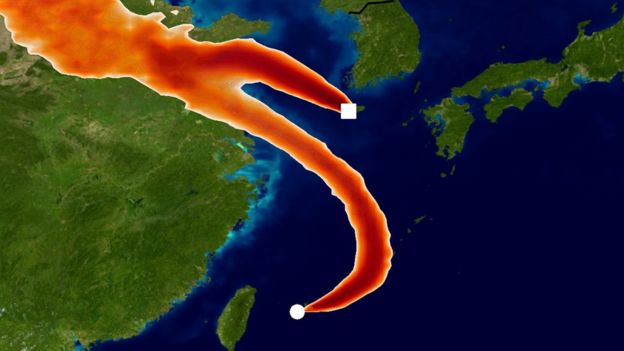
Image caption Monitoring stations in Korea and Japan were key to detecting the mystery sources of CFC-11
That team reasoned that they were seeing new production of the gas, coming from East Asia. The authors of that paper argued that if the sources of new production weren’t shut down, it could delay the healing of the ozone layer by a decade.
What did investigators find on the ground?
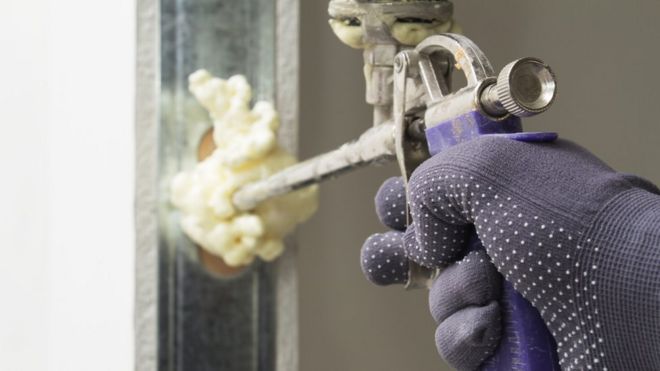
Further detective work in China by the Environmental Investigation Agency in 2018 seemed to indicate that the country was indeed the source. They found that the illegal chemical was used in the majority of the polyurethane insulation produced by firms they contacted.
One seller of CFC-11 estimated that 70% of China’s domestic sales used the illegal gas. The reason was quite simple – CFC-11 is better quality and much cheaper than the alternatives.
So what does this latest study show?
This new paper seems to confirm beyond any reasonable doubt that some 40-60% of the increase in emissions is coming from provinces in eastern China.
Using what are termed “top-down” measurements from air monitoring stations in South Korea and Japan, the researchers were able to show that since 2012 CFC-11 has increased from production sites in eastern China.
Image copyright GETTY IMAGES
They calculated that there was a 110% rise in emissions from these parts of China for the years 2014-2017 compared to the period between 2008-2012.
“This new study is based on spikes in the data on air that comes from China,” lead author Dr Matt Rigby, a reader at the University of Bristol, told BBC Inside Science.
“Using computer simulations of the transport of these gases through the atmosphere we can start to put numbers on emissions from different regions and that’s where we come up with this number of around 7,000 tonnes of extra CFC-11 emissions coming out of China compared to before 2012.
“But from the data, all we just see are the ultimate releases to the atmosphere, we don’t have any information on how that CFC-11 was used or where it was produced, it is entirely possible that it was manufactured in some other region, some other part of China or even some other country and was transported to the place where they are making insulating foams at which point some of it could have been emitted to the atmosphere.”
Where are the rest of the emissions coming from?
The researchers are not sure. It’s possible that the missing emissions are coming from other parts of China, as the monitoring stations just can’t see them. They could also be coming from India, Africa or South America as again there is very little monitoring in these regions.
Does this have implications for climate change?
Yes – the authors say that these CFCs are also very potent greenhouse gases. One tonne of CFC-11 is equivalent to around 5,000 tonnes of CO2.
“If we look at these extra emissions that we’ve identified from eastern China, it equates to about 35 million tonnes of CO2 being emitted into the atmosphere every year, that’s equivalent to about 10% of UK emissions, or similar to the whole of London.”
Will China clampdown on the production?
The Chinese say they have already started to clamp down on production by what they term “rogue manufacturers”. Last November, several suspects were arrested in Henan province, in possession of 30 tonnes of CFC-11.
Clare Perry from the Environmental Investigations Agency (EIA) said that the new findings re-affirmed the need to stamp out production.
“I think with this study, it is beyond doubt that China is the source of these unexpected emissions, and we would hope that China is leaving no stone unturned to discover the source of the CFC-11 production.
“Unless the production of the chemical is shut down it will be near impossible to end the use and emissions in the foam companies.”
The study has been published in the journal Nature.
WASHINGTON (Reuters) – The U.S. military said it sent two Navy ships through the Taiwan Strait on Wednesday, its latest transit through the sensitive waterway, angering China at a time of tense relations between the world’s two biggest economies.
Taiwan is one of a growing number of flashpoints in the U.S.-China relationship, which also include a bitter trade war, U.S. sanctions and China’s increasingly muscular military posture in the South China Sea, where the United States also conducts freedom-of-navigation patrols.
The voyage will be viewed by self-ruled Taiwan as a sign of support from the Trump administration amid growing friction between Taipei and Beijing, which views the island as a breakaway province.
The transit was carried out by the destroyer Preble and the Navy oil tanker Walter S. Diehl, a U.S. military spokesman told Reuters.
“The ships’ transit through the Taiwan Strait demonstrates the U.S. commitment to a free and open Indo-Pacific,” Commander Clay Doss, a spokesman for the U.S. Navy’s Seventh Fleet, said in a statement.
Doss said all interactions were safe and professional.
Chinese Foreign Ministry spokesman Lu Kang said Beijing had lodged “stern representations” with the United States.
“The Taiwan issue is the most sensitive in China-U.S. relations,” he told a daily news briefing in Beijing.
Taiwan’s Defense Ministry said the two U.S. ships had sailed north through the Taiwan Strait and that they had monitored the mission.
Taiwan President Tsai Ing-wen said there was no cause for alarm.
“Nothing abnormal happened during it, please everyone rest assured,” she wrote on her Facebook page.
U.S. warships have sailed through the Taiwan Strait at least once a month since the start of this year. The United States restarted such missions on a regular basis last July.
The United States has no formal ties with Taiwan but is bound by law to help provide the island with the means to defend itself and is its main source of arms.
The Pentagon says Washington has sold Taipei more than $15 billion in weaponry since 2010.
China has been ramping up pressure to assert its sovereignty over the island, which it considers part of “one China” and sacred Chinese territory, to be brought under Beijing’s control by force if needed.
Beijing said a recent Taiwan Strait passage by a French warship, first reported by Reuters, was illegal.
China has repeatedly sent military aircraft and ships to circle Taiwan on exercises in the past few years and worked to isolate it internationally, whittling down its few remaining diplomatic allies.
The U.S. Defense Intelligence Agency released a report earlier this year describing Taiwan as the “primary driver” for China’s military modernization, which it said had made major advances in recent years.
On Sunday, the Preble sailed near the disputed Scarborough Shoal claimed by China in the South China Sea, angering Beijing.
The state-run China Daily said in an editorial on Wednesday that China had shown “utmost restraint”.
“With tensions between the two countries already rife, there is no guarantee that the presence of U.S. warships on China’s doorstep will not spark direct confrontation between the two militaries,” it said.
LONDON (Reuters) – Britain’s biggest mobile operator EE said on Wednesday its 5G network would rely on equipment made by China’s Huawei, at least for the first few years, as it announced plans to switch on the next-generation services on May 30.
However, BT-owned EE joined rival Vodafone in pulling a Huawei smartphone from its 5G launch line-up because of uncertainty about support by Google’s Android after a U.S. move to block the Chinese firm’s access to its technology.
The United States has said Huawei is a security risk and open to spying by Beijing, a claim the Chinese company denies.
The government will rule imminently whether Huawei will be allowed to participate in these new networks.
EE Chief Executive Marc Allera said its planned 5G launch was “the start of the UK’s 5G journey and great news for our customers that want and need the best connections”.
Britain had given the green light for the launch, which will see six cities including London, Cardiff and Edinburgh switched on next week and another 10 by the end of the year, he added.
RELATED COVERAGE
UK’s biggest mobile operator pauses use of Huawei 5G handsets
“We do believe it is important for the UK that we are in the pack of the leading nations (for 5G),” he said. “At the moment we have no instructions [from government] to change our plans.”
EE has said it was already removing Huawei networking equipment from it core network. BT Group’s technology chief Howard Watson, however, said 5G would start before Huawei was totally removed from the core of its network.
“We are launching 5G with Huawei in the radio access network and we are using an upgraded version of that existing core, which will then … be migrated away from,” Watson said.
HUAWEI DROPPED
EE and Vodafone have opened orders for 5G phones, for example from Samsung, to be available when their networks launch.
Apple does not yet have a 5G phone and analysts do not expect it to launch one until 2020 at the earliest.
Users were already regularly achieving speed of 500Mbps in tests networks, Allera said, adding that he was confident speeds of 1Gbps would be reached by the end of the year.
Average speeds at launch would be about 200Mbps, five times faster than typical top 4G speeds, while EE said smartphone tariffs would range from 54 pounds ($68) a month for 10GB of data to 74 pounds a month for 120GB.
It aims to have 1,500 5G sites by the end of 2019, targeting the busiest areas of the busiest cities, he said.
Industry analyst Kester Mann from CCS said he “applauded a realistic launch” that did not over-inflate expectations.
“Although being the first UK network to launch 5G will mean little to consumers, EE clearly see it as an important honor,” he said. Vodafone launches on July 3.
Huawei’s Mate 20X (5G) had been expected to be among the devices available on both company’s superfast networks, but EE dropped the company from a launch line-up that includes Samsung’s Galaxy S10 5G, and devices from Oppo, LG and OnePlus.
“We have put the Huawei devices on pause until we have got a bit some more information,” Allera said, adding that EE needed to be sure the devices it supplies are going to be supported.
Vodafone UK took the same step, stopping pre-orders for the handset before the launch of its network.
Huawei, the world’s second-biggest phone maker runs its devices on Google’s Android platform outside China, but the U.S. Commerce Department blocked Huawei from buying U.S. goods last week, throwing future software updates into question.
Britain was set to allow Huawei some participation in the radio part of 5G networks but bar it from the intelligent core. But a decision has not been announced, and the U.S. and some politicians are pushing for a more far-reaching ban.
Researchers say history of China’s biggest ethnic group is more complex than many believe
DNA study involving 20,000 unrelated people points to three river origins
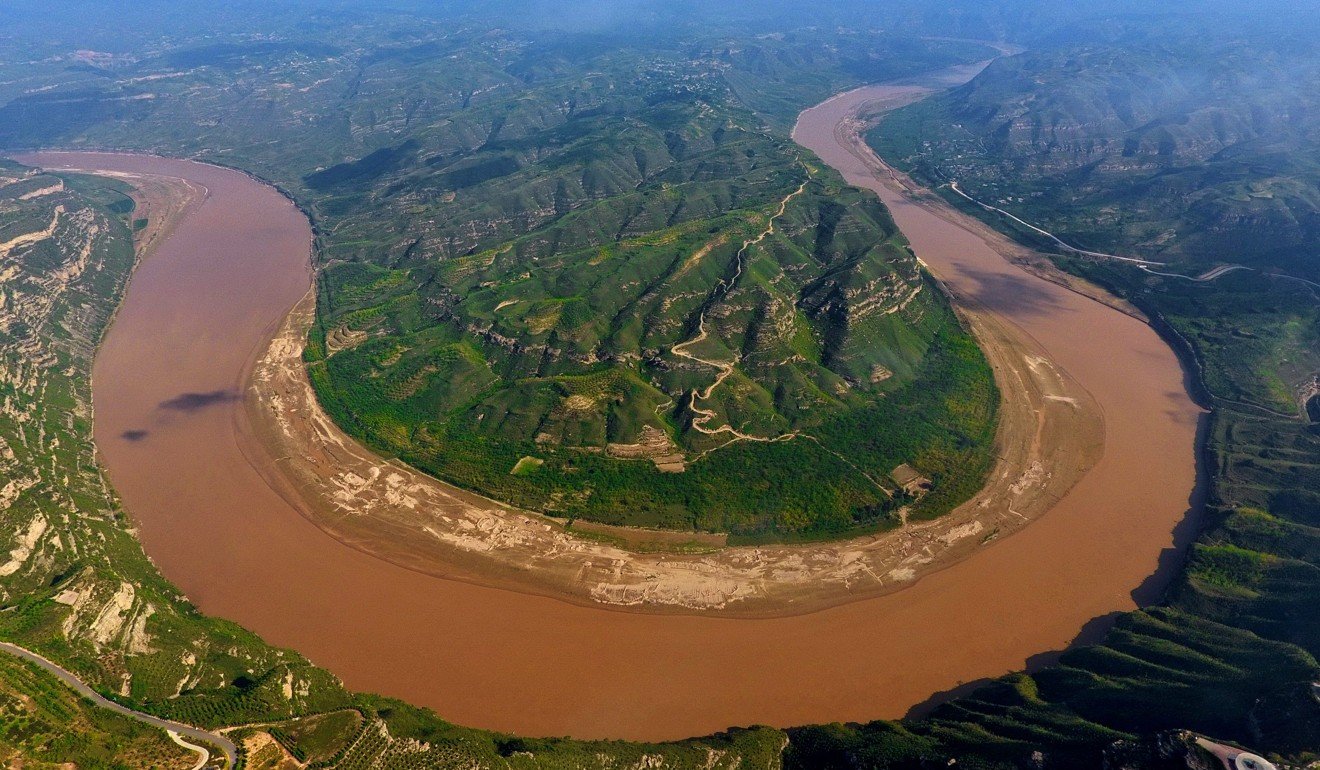
The study of Han DNA by the team from the Kunming institute challenges a long-held view of the early origins of Chinese civilisation. Photo: Xinhua
The origins of China’s biggest ethnic group can be traced back to three river valleys, deposing the Yellow River as the sole cradle of Chinese civilisation, according to a new study.
The Yellow has long been hailed as the mother river of Han Chinese, who make up nearly 92 per cent of the country’s population today.
But research published in the online journal Molecular Biology and Evolution on Wednesday said the Yangtze and Pearl rivers – as well as the Yellow – gave rise to genetically separate groups about 10,000 years ago. Those ancestors then mingled to become the largest ethnic group in the world today, it said.
“The history of Han Chinese is more sophisticated than thought,” said Professor Kong Qingdong, a researcher with the Kunming Institute of Zoology at the Chinese Academy of Sciences and lead scientist in the study. “Many details need investigation.”
A DNA study suggests the Yellow River (above) may have to share its place as a cradle for Han Chinese with the Yangtze and the Pearl. Photo: Xinhua
After analysing DNA samples from more than 20,000 unrelated Han Chinese, examining their dialects and family geography and comparing those to archaeological DNA records, scientists concluded that the Yangtze and Pearl had equal claim with the Yellow to Han origins.
Progenitors from the three river valleys evolved independently, the Kunming team said, and distinctions found in the mitochondrial DNA (the mother’s line) of study volunteers added weight to their assertion.
Who are you? DNA tests help Chinese retrace ancient steps
About 0.07 per cent of the DNA examined in the Han Chinese study differed according to river valley origin. By comparison, the difference was much lower – 0.02 per cent – when the study volunteer data was assessed by dialect, the researchers said.
Earlier studies of genetic markers and microsatellite data that mapped the prevalence of DNA revealed that Han Chinese can be generally divided into two groups: North and South. The latest study found that the genetic variation between North and South Han Chinese is 0.03 per cent, considerably less significant than the distinction by rivers.
Dr Li Yuchun, lead author of the paper, said the findings helped trace the history of Han to the dawn of civilisation, the emergence of agriculture and the sustainable growth of population.
The earliest migrants from Africa to China arrived in what is now the southwest between 60,000 and 100,000 years ago, studies said. The genes of this group of hunter-gatherers were largely unchanged for tens of thousands years.
About 10,000 years ago, agricultural practices began to emerge in the valleys of the three rivers. Archaeologists found evidence of millet cultivation around the Yellow River, rice in the Yangtze, and roots and tubers in the Pearl.
The busy Yangtze River flows through Chongqing in southwest China. Photo: Xinhua
“Increasing food led to a population boom in these areas. We can see it in the separate path of gene evolution,” Li said.
The research also found that women were able to preserve their genetic story better than men as they stayed at home to tend the fields, while men went to explore, trade or wage war.
“Females are resilient to invasion,” she said.
The cultural significance of knowing one’s ancestry
The research team planned to examine the Y-chromosome, which passed from father to son, to study the expansion of the Han civilisation, Li said.
“It will be interesting to hear the story from a male perspective,” she said.
As the Han empires expanded, many ancient ethnic groups such as Huns, Siberians, Khitan in northern China and the Thai-Khadai speaking peoples in the south, passed from the record.
Some researchers think these minorities become extinct, but others believe they were absorbed into the Han Chinese population.









 CHINDIA ALERT: You'll be living in their world, very soon