Archive for ‘Uncategorized’

19/12/2018

China’s staggering 40 years of change in pictures

Forty years ago, China introduced major economic reforms – lifting hundreds of millions of people out of poverty and leading to it becoming the second-largest economy in the world.

Here’s the story of how China changed – in pictures.

1. Wheels and more wheels

This is what Chang’an Avenue – a major street in the capital Beijing – looked like in 1978.

Four decades on, the street looks pretty different.

Car ownership in China has soared – there are now over 300 million registered vehicles in the country – while bike ownership has dropped.

It’s a result of China’s urbanisation and economic growth – but has also come at a price.

Frequent traffic jams in many cities have led to licence plate quotas being imposed.

And the World Health Organization says more than a million people in China die every year due to air pollution.

2. Money money money

Compare a 1978 shop window…

… with one from this decade.

As China’s gross domestic product (GDP) has skyrocketed, its shopping habits have changed too.

Chinese shoppers are among the world’s highest consumers of luxury goods.

President Xi Jinping emphasised China’s economy – and how it had transformed people’s lives – during a long speech on Tuesday marking the anniversary of the economic reforms.

“Grain coupons, cloth coupons, meat coupons, fish coupons, oil coupons, tofu coupons, food ticket books, product coupons and other documents people once could not be without have now been consigned to the museum of history,” he said.

“The torments of hunger, lack of food and clothing, and the hardships which have plagued our people for thousands of years have generally gone and won’t come back.”

Image captionApple is a popular brand in China – though not as popular as Huawei

There’s even a political element to this. As Chinese consumers have grown richer, they’ve become increasingly influential.

Several companies have been forced to apologise after offending Chinese sensibilities, and while foreign brands are generally coveted in China, more and more shoppers are starting to say they prefer local brands.

It’s a sentiment that Mr Xi also touched on in his speech, when he said: “China is increasingly approaching the centre of the world stage.”

“No-one is in a position to dictate to the Chinese people what should or should not be done.”

3. Families and children

Life has changed significantly for children of the 2010s, compared to children of the 1970s.

Image captionA family enjoy tea in a park in Guangzhou, 1978

For starters, they are likely to live longer – China’s life expectancy was 66 back in 1978, and is now about 76.

They’re also more likely to have a better education – literacy rates increased from 66% in the early 1980s to 95% in 2010.

For most Chinese children in the 1970s, going on an overseas holiday would have been almost unthinkable. Today China has the world’s largest number of outbound tourists – who spend billions of dollars while abroad.

Image captionA girl celebrates the golden week national holiday with her dad in October 2018

Chinese students are now also more likely to end up studying abroad.

According to Chinese government figures, China is currently the world’s largest source of international students.

One thing hasn’t changed as much as the government would like though – the birth rate.

In 1979 – a year after starting economic reforms – the government imposed a one-child policy to try and curb population growth.

Birth rates were declining anyway – but the controversial policy was harshly enforced in some cases.

Couples who violated the policy could face punishments ranging from fines and the loss of employment to forced abortions and sterilisation.

China’s population, like those of many other developed countries, is now ageing.

In 2015, the government decided to end the one-child policy and allow couples to have two children.

There is even speculation that the policy may be relaxed further – to allow three or more children – in the near future.

But many Chinese millennials see having more children as too expensive – or a burden on their careers.

4. To market, to market

As economies change, so do people’s diets, and what they want to spend their money on.

Here’s a marketplace in the central city of Xi’an, back in 1978.

And here’s what some of Xi’an’s street markets look like now.

Many of the signs are advertising meat dishes – and statistics show meat consumption in China has risen significantly over the past few decades.

Pork, for example, used to be considered a luxury food reserved for special occasions – now, figures suggest the average Chinese person will consume about 40kg of pork per year.

19/12/2018

How Greenland could become China’s Arctic base

A town in typical Greenland style is pictured - brightly-painted wooden walls and triangular roofs covered in snow are the main features of these sparsely dotted homes
Image captionGreenland’s capital, Nuuk, needs investment – but could it come from China?

China is flexing its muscles. As the second richest economy in the world, its businessmen and politicians are involved just about everywhere in Asia, Africa and Latin America.

Now, though, China is taking a big interest in a very different part of the world: the Arctic.

It has started calling itself a “near-Arctic” power, even though Beijing is almost 3,000km (1,800 miles) from the Arctic Circle. It has bought or commissioned several ice-breakers – including nuclear-powered ones – to carve out new routes for its goods through the Arctic ice.

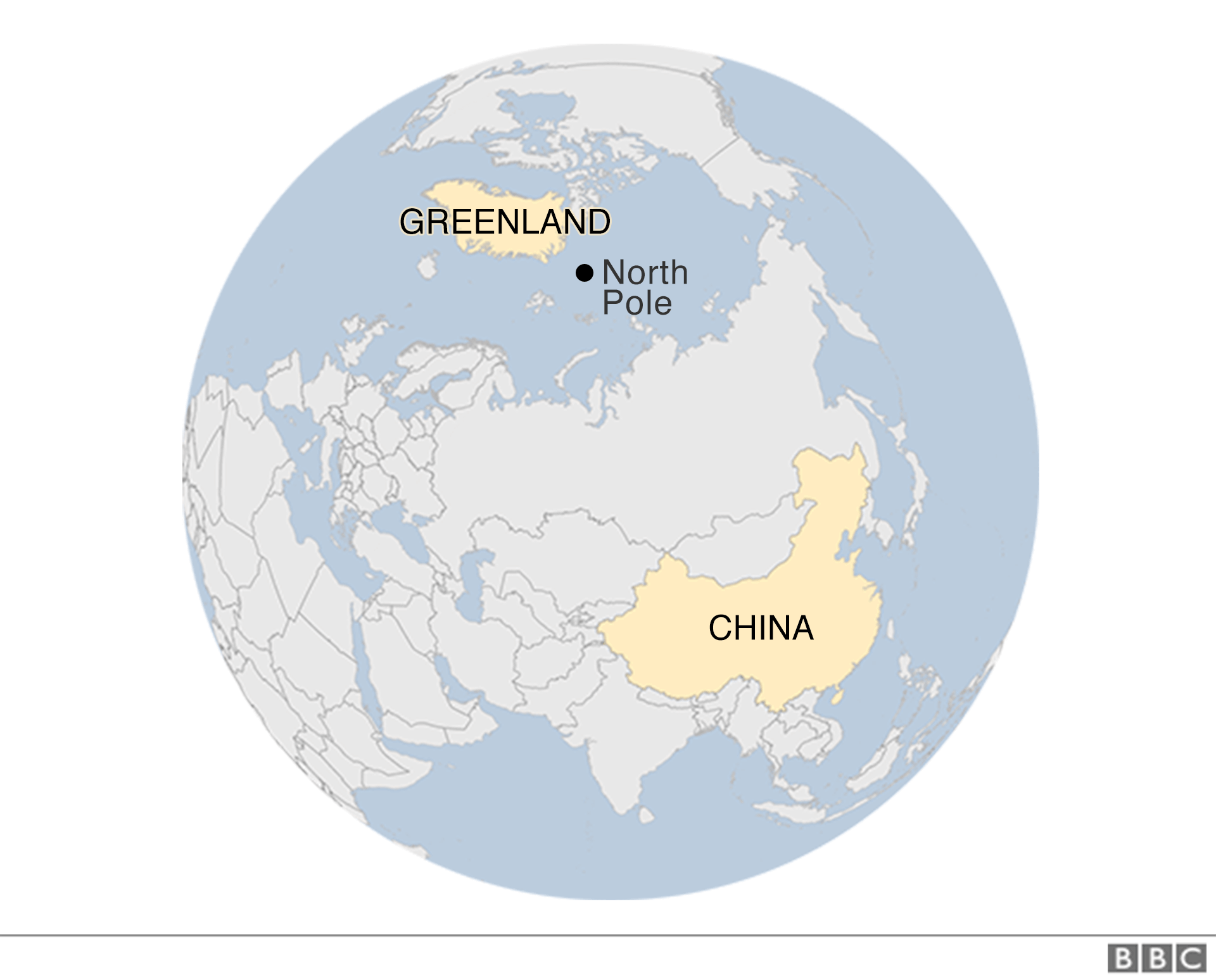
And it is eyeing Greenland as a particularly useful way-station on its polar silk road.

A map is seen on a curved globe surface of the earth -Greenland is marked on the top, just a short distance from the North Pole, also marked - and China's location has two extremely large nations of Mongolia and Russia between it and the pole

Greenland is self-governing, though still nominally controlled by Denmark.

It is important strategically for the United States, which maintains a vast military base at Thule, in the far north. Both the Danes and the Americans are deeply worried that China should be showing such an interest in Greenland.

Least densely populated place on Earth

You’ve got to go there to get an idea of how enormous Greenland is.

It’s the 12th-largest territory in the world, 10 times bigger than the United Kingdom: two million square kilometres of rock and ice.

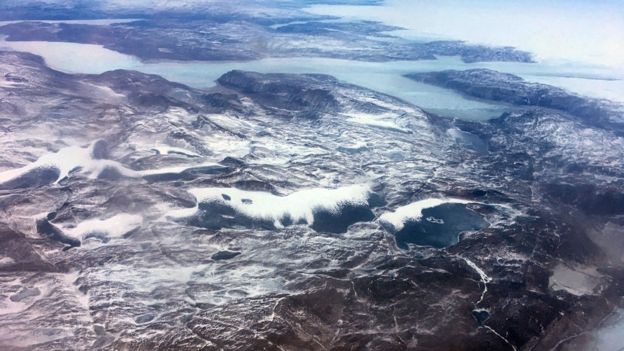
A vast frozen swathe of Greenland is seen in this aerial shot
Image captionMost of Greenland is covered in permanent ice – a vast frozen wilderness

Yet its population is minuscule at 56,000 – roughly the size of a town in England.

As a result, Greenland is the least densely populated territory on Earth. About 88% of the people are Inuit; most of the rest are ethnically Danish.

In terms of investment neither the Americans nor the Danes have put all that much money into Greenland over the years, and Nuuk, the capital, feels pretty poor. Denmark does hand over an annual subsidy to help Greenland meet its needs.

Every day, small numbers of people gather in the centre to sell things that will generate a bit of cash: cast-off clothes, children’s schoolbooks, cakes they’ve made, dried fish, reindeer-horn carvings. Some people also sell the bloody carcases of the big King Eider ducks, which Inuits are allowed to hunt but aren’t supposed to sell for profit.

China’s air power

At present you can only fly to Nuuk in small propeller-driven planes. In four years, though, that will change spectacularly.

The Greenlandic government has decided to build three big international airports capable of taking large passenger jets.

China is bidding for the contracts.

Media captionAirport officials say the planned work is a huge project – but an important one

There’ll be pressure from the Danes and Americans to ensure the Chinese bid doesn’t succeed, but that won’t stop China’s involvement in Greenland.

Interestingly, I found that opinion about the Chinese tended to divide along ethnic lines.

Danish people were worried about it, while Inuits thought it was a good idea.

The Greenlandic prime minister and foreign minister refused to speak to us about their government’s attitude to China, but a former prime minister, Kuupik Kleist, told us he thought it would be good for Greenland.

But the foreign affairs spokesman of the main Venstre party in the Danish coalition government, Michael Aastrup Jensen, was forthright about Chinese involvement in Greenland.

“We don’t want a communist dictatorship in our own backyard,” he said.

Much-needed wealth

China’s sales technique in other countries where its companies operate is to offer the kind of infrastructure they badly need: airports, roads, clean water.

The Western powers that once colonised many of them haven’t usually stepped in to help, and most of these governments are only too grateful for Chinese aid.

But it comes at a price.

Media captionThe former prime minister says someone – anyone – has to invest in Greenland

China gets access to each country’s raw materials – minerals, metals, wood, fuel, foodstuffs. Still, this doesn’t usually mean long-term jobs for local people. Large numbers of Chinese are usually brought in to do the work.

Country after country has discovered that Chinese investment helps China’s economy a great deal more than it helps them. And in some places – South Africa is one of them – there are complaints that China’s involvement tends to bring greater corruption.

But in Nuuk it’s hard to get people to focus on arguments like these.

What counts in this vast, empty, impoverished territory is the thought that big money could be on its way. Kuupik Kleist put the argument at its simplest.

“We need it, you see,” he said.

19/12/2018

Senior CPC official meets Turkish Justice and Development Party delegation

CHINA-BEIJING-YANG JIECHI-TURKISH DELEGATION-MEETING (CN)

Yang Jiechi(R), a member of the Political Bureau of the Communist Party of China (CPC) Central Committee and director of the Office of the Foreign Affairs Commission of the CPC Central Committee, meets with a delegation of the Turkish ruling Justice and Development Party (AKP), which is led by its deputy chairman Cevdet Yilmaz, in Beijing, capital of China, on Dec. 18, 2018. (Xinhua/Ding Lin)

BEIJING, Dec. 18 (Xinhua) — Yang Jiechi, a member of the Political Bureau of the Communist Party of China (CPC) Central Committee, on Tuesday met with a delegation of the Turkish ruling Justice and Development Party (AKP), which was led by its deputy chairman Cevdet Yilmaz.

Yang, also director of the Office of the Foreign Affairs Commission of the CPC Central Committee, said China is willing to work with the Turkish side to implement the consensus reached by the two heads of state during their sideline meeting at the G20 summit in Buenos Aires.

He said the CPC is willing to make joint efforts with the AKP to deepen the exchange on the experiences of managing the party and the country so as to promote bilateral ties.

Hailing China’s achievements since reform and opening-up 40 years ago, Yilmaz said the AKP is ready to enhance communication and exchange with the CPC to promote bilateral cooperation in fields including the economy, trade, tourism, and anti-terrorism.

19/12/2018

World experts hail China’s miracle-like achievements over 40 years

BEIJING, Dec. 18 (Xinhua) — As China celebrated the 40th anniversary of its reform and opening-up policy on Tuesday, the achievements it has made over the last four decades were hailed as a miracle.

Experts said that China’s reform and opening-up not only is a milestone in the country’s history but also holds global significance.

RIGHT PATH

Addressing a grand gathering Tuesday to celebrate the 40th anniversary, Chinese President Xi Jinping said that the past 40 years eloquently prove the correctness of the path, theory, system and culture of socialism with Chinese characteristics.

Robert Lawrence Kuhn, a leading American expert on China who was honored with China Reform Friendship Medal on Tuesday, said China’s direction is clear, that is, socialism with Chinese characteristics, the leadership of the Communist Party of China (CPC) in all areas, putting people and their well-being and happiness first, and the need to further implement and deepen reforms.

Russian Communist Party leader Gennady Zyuganov said the reform and opening-up policy enacted by the CPC at the third plenary session of the 11th CPC Central Committee in 1978 planned China’s development and raised China to heights unimaginable at that time.

“All the achievements that China has made is inseparable from the country’s adherence to the leadership of the CPC and taking the socialist path,” he told Xinhua in a recent interview.

Manoranjan Mohanty, former chairperson of the Institute of Chinese Studies in Delhi, said the reform and opening-up was a great revolution.

At one time it was called a “New Long March,” which has two things in common with the Long March of the Red Army – one is the determination to unite maximum popular forces and the other is to innovate a strategy of revolution, he said.

QUANTUM LEAP

Describing the reform and opening-up as “a great revolution in the history of the Chinese people and the Chinese nation,” Xi said a quantum leap has been made in the cause of socialism with Chinese characteristics.

Stephen Perry, chairman of Britain’s business networking organization 48 Group Club, said China has undergone incredible transformation since its reform and opening-up in 1978 and the country is sure to achieve its long-term target.

Perry, also recipient of the China Reform Friendship Medal, said that he had seen China turning from a backward country where most of the population lived in countryside into a country where nearly 60 percent of the population now dwell in towns and cities.

During the period, China’s grain output has doubled to over 600 million tons and modern technology is being developed in various industries, Perry noted.

William Jones, Washington bureau chief of the U.S. publication Executive Intelligence Review, told Xinhua in an interview that the 40th anniversary of the reform and opening-up is extremely important and is a pivotal moment.

China has moved from a relatively impoverished country to one of the most important economic powers in the world today, Jones said.

What is done has shown that the policy that was laid out in terms of the reform and opening-up has been a resounding success, he added.

China’s reform and opening-up over the past 40 years has proven to be the “golden key” to reviving its society, said Jin Jianmin, a senior fellow at the Fujitsu Research Institute in Tokyo, believing that the ongoing process will never stop.

Shadrack Gutto, a political analyst at the University of South Africa, recalled that when talking about China 40 years ago, people would think of the “kingdom of bicycle.”

But now automobiles made by China have been exported to the world market, said Gutto, adding that both in material and spiritual terms, Chinese people’s standard of living has been significantly improved.

PROPELLING GLOBAL PROSPERITY

The 40 years of reform and opening-up has benefited both China and the world, said Jin, emphasizing that the great demand created by China’s rapid economic growth has offered opportunities to the international community.

Farooq Sobhan, president of Bangladesh Enterprise Institute, said the China International Development Cooperation Agency, along with the Asian Infrastructure Investment Bank and the New Silk Road Fund, represents the country’s “firm commitment to promote and support economic growth, both globally and regionally.”

These institutions will “benefit Bangladesh and other developing countries to meet their growing development and infrastructure requirements,” said Sobhan.

Appreciating the China-proposed concept of a community with a shared future for mankind, Mohanty believed that “people all over the world wish the people of China even greater successes in pursuing the path of equitable and sustainable development.”

(Xinhua reporters Hu Xiaoguang, Zhang Jianhua, Zhao Xu, Wang Huihui, Jin Jing, Gui Tao, Zhu Dongyang, Hu Yousong, Liu Chen, Jiang Qiaomei, Yang Ting, Jing Jing, Liu Chuntao, Yang Shilong contributed to the story)

19/12/2018

Chinese envoy asks for promotion of Israeli-Palestinian peace talks

UNITED NATIONS, Dec. 18 (Xinhua) — A Chinese envoy on Tuesday asked for international efforts to promote the resumption of peace talks between the Israelis and Palestinians.

There is a need for the international community to remain united and renew its efforts to promote peace talks between the two sides, Ma Zhaoxu, China’s permanent representative to the United Nations, told the Security Council.

The parties should meet each other half-way and avoid any action or rhetoric that will aggravate the situation, refrain from any unilateral action that undermines trust, so as to create necessary conditions for the resumption of dialogue, he said.

Curbing violence with violence will not solve any problem. China urges all parties to bear in mind the safety and security of the people in the region and the imperative of peace and stability by exercising restraint to avoid escalation, he said.

The issue of Palestine is the root cause of the Middle East problem and concerns the long-term peace, stability and development of the region, he noted.

He asked for the cessation of all settlement activities on occupied territory, the lifting of the blockade of Gaza as soon as possible, and measures to prevent violence against civilians.

Parties that have influence in the region should play a constructive role, explore new mechanisms of mediation to break the deadlock in talks between Israelis and Palestinians as soon as possible, he said.

Ma also saw the need to uphold the two-state solution and address the root cause of the conflict.

The international community should adhere to relevant UN resolutions, the principle of “land for peace,” and the Arab Peace Initiative, and persevere in resolving the issue in a comprehensive, just and lasting manner through negotiation, he said.

The Chinese ambassador asked to properly address the final status of Jerusalem.

“This issue is complex and sensitive and concerns the future of the two-state solution and peace and security of the region. All parties should proceed with caution, refrain from imposing a solution that might lead to new confrontation.”

Relevant UN resolutions and international consensus should serve as the basis for a solution through negotiation, accommodating interests of all parties, he said.

China firmly supports and promotes the Middle East peace process, the just cause of Palestinians to restore their legitimate national rights and the establishment of an independent state of Palestine with full sovereignty based on the 1967 borders with East Jerusalem as its capital, he said.

China will work with the rest of the international community to explore innovative mechanisms to facilitate peace in the Middle East and promote the resumption of peace talks between the two sides and make tireless efforts to realize comprehensive, just and lasting peace in the region, he said.

19/12/2018

China marks 40th anniversary of reform and opening-up

CHINA-BEIJING-40TH ANNIVERSARY OF REFORM AND OPENING-UP-CELEBRATION (CN)

Chinese President Xi Jinping, also general secretary of the Communist Party of China (CPC) Central Committee and chairman of the Central Military Commission, addresses a grand gathering to celebrate the 40th anniversary of China’s reform and opening-up at the Great Hall of the People in Beijing, capital of China, on Dec. 18, 2018. (Xinhua/Yao Dawei)

BEIJING, Dec. 18 (Xinhua) — China held a grand gathering Tuesday to celebrate the 40th anniversary of the country’s reform and opening-up, a great revolution that has changed the destiny of the Chinese nation and also influenced the world.

President Xi Jinping and other Chinese leaders attended the event which began at around 10 a.m. at the Great Hall of the People in Beijing.

Premier Li Keqiang presided over the meeting.

The celebration started with all participants rising to sing the national anthem.

Wang Huning, a member of the Standing Committee of the Political Bureau of the Communist Party of China (CPC) Central Committee, read a decision to award the personnel who have made outstanding contributions to the country’s reform and opening-up.

The people are “the creators of the great wonder of reform and opening-up” and “the source of power” to drive the campaign started 40 years ago, Wang said.

According to the decision made by the CPC Central Committee and the State Council, 100 Chinese were awarded the medals of reform pioneers and 10 foreigners were honored with China reform friendship medals.

Chinese leaders presented the medals to the prize winners.

18/12/2018

Japan to buy more U.S.-made stealth jets, radar to counter China, Russia

TOKYO (Reuters) – Japan will accelerate spending on advanced stealth fighters, long-range missiles and other equipment over the next five years to support U.S. forces facing China’s military in the Western Pacific, two new government defence papers said.

The plans are the clearest indication yet of Japan’s ambition to become a regional power as a military build-up by China and a resurgent Russia puts pressure on its U.S. ally.

“The United States remains the world’s most powerful nation, but national rivalries are surfacing and we recognise the importance of the strategic competition with both China and Russia as they challenge the regional order,” said a 10-year defence programme outline approved by Prime Minister Shinzo Abe’s government on Tuesday.

The United States, followed by China, North Korea and Russia, are the countries that most influenced Japan’s latest military thinking, the paper said.

China, the world’s second biggest economy, is deploying more ships and aircraft to patrol waters near Japan, while North Korea has yet to fulfil a pledge to dismantle its nuclear and missile programmes.

In Beijing, Foreign Ministry spokeswoman Hua Chunying said Japan was “singing the same old tune” and making “thoughtless remarks” about China’s normal defence activities.

“What Japan is doing here is neither conducive to improving and developing China-Japan relations, nor to the broader picture of regional peace and stability,” Hua told a news briefing.

“China expresses strong dissatisfaction and opposition at this and has already lodged stern representations with Japan,” she added.

Russia, which continues to probe Japan’s air defences, said on Monday it built new barracks for its troops on islands seized from Japan at the end of World War Two.

MORE STEALTH FIGHTERS

Japan plans to buy 45 Lockheed Martin Corp F-35 stealth fighters, worth about $4 billion (3.17 billion pounds), in addition to the 42 jets already on order, according to a separate five-year procurement plan approved on Tuesday.

The new planes will include 18 short take off and vertical landing (STOVL) B variants of the F-35 that planners want to deploy on Japanese islands along the edge of the East China Sea.

The islands are part of a chain stretching past Taiwan and down to the Philippines that has marked the limit of Chinese military dominance east of the disputed South China Sea.

“Japan’s decision to acquire more F-35s is a testament to the aircraft’s transformational capability and its increasing role in promoting regional stability and enhancing the US-Japan security alliance,” Lockheed Martin said in a statement.

The navy’s two large helicopter carriers, the Izumo and Kaga, will be modified for F-35B operations, the paper said.

The 248-metre (814 ft) long Izumo-class ships are as big as any of Japan’s aircraft carriers in World War Two. They will need reinforced decks to withstand the heat blast from F-35 engines and could be fitted with ramps to aid short take-offs, two defence ministry officials told Reuters.

TRADE WAR THREAT

The new F-35 order may also help Japan avert a trade war with the United States.

U.S. President Donald Trump, who has threatened to impose tariffs on Japanese car imports, thanked Abe for buying the F-35s when the two met at a summit in Argentina this month.

Other U.S.-made equipment on Japan’s shopping list includes two land-based Aegis Ashore air defence radars to defend against North Korean missiles, four Boeing Co KC-46 Pegasus refuelling planes to extend the range of Japanese aircraft, and nine Northrop Grumman E-2 Hawkeye early-warning planes.

Japan plans to spend 25.5 trillion yen (179.33 billion pounds) on military equipment over the next five years, 6.4 percent higher than the previous five-year plan. Cost-cutting will free up another 2 trillion yen for purchases, the procurement paper said.

Japan only spends about 1 percent of its gross domestic product (GDP) on defence, but the size of its economy means it already has one of the world’s largest militaries.

“The budget is increasing and there has been an acceleration to deploy capability as soon as possible,” Robert Morrissey, head of Raytheon Co’s unit in Japan, said this month.

Wary of North Korean promises to abandon ballistic missile development, Japan’s military is buying longer-range Raytheon SM-3 interceptor missiles able to strike enemy warheads in space.

The defence papers assessed non-traditional military threats as well. A new joint-forces cyber unit will bolster Japan’s defences against cyber attacks.

More electronic warfare capabilities are planned, and the air force will get its first space unit to help keep tabs on potential adversaries high above the Earth’s atmosphere.

The plans are the clearest indication yet of Japan’s ambition to become a regional power as a military build-up by China and a resurgent Russia puts pressure on its U.S. ally.

“The United States remains the world’s most powerful nation, but national rivalries are surfacing and we recognise the importance of the strategic competition with both China and Russia as they challenge the regional order,” said a 10-year defence programme outline approved by Prime Minister Shinzo Abe’s government on Tuesday.

The United States, followed by China, North Korea and Russia, are the countries that most influenced Japan’s latest military thinking, the paper said.

China, the world’s second biggest economy, is deploying more ships and aircraft to patrol waters near Japan, while North Korea has yet to fulfil a pledge to dismantle its nuclear and missile programmes.

In Beijing, Foreign Ministry spokeswoman Hua Chunying said Japan was “singing the same old tune” and making “thoughtless remarks” about China’s normal defence activities.

“What Japan is doing here is neither conducive to improving and developing China-Japan relations, nor to the broader picture of regional peace and stability,” Hua told a news briefing.

“China expresses strong dissatisfaction and opposition at this and has already lodged stern representations with Japan,” she added.

ADVERTISING

Russia, which continues to probe Japan’s air defences, said on Monday it built new barracks for its troops on islands seized from Japan at the end of World War Two.

MORE STEALTH FIGHTERS

Japan plans to buy 45 Lockheed Martin Corp F-35 stealth fighters, worth about $4 billion (3.17 billion pounds), in addition to the 42 jets already on order, according to a separate five-year procurement plan approved on Tuesday.

The new planes will include 18 short take off and vertical landing (STOVL) B variants of the F-35 that planners want to deploy on Japanese islands along the edge of the East China Sea.

The islands are part of a chain stretching past Taiwan and down to the Philippines that has marked the limit of Chinese military dominance east of the disputed South China Sea.

Slideshow (3 Images)

“Japan’s decision to acquire more F-35s is a testament to the aircraft’s transformational capability and its increasing role in promoting regional stability and enhancing the US-Japan security alliance,” Lockheed Martin said in a statement.

The navy’s two large helicopter carriers, the Izumo and Kaga, will be modified for F-35B operations, the paper said.

The 248-metre (814 ft) long Izumo-class ships are as big as any of Japan’s aircraft carriers in World War Two. They will need reinforced decks to withstand the heat blast from F-35 engines and could be fitted with ramps to aid short take-offs, two defence ministry officials told Reuters.

TRADE WAR THREAT

The new F-35 order may also help Japan avert a trade war with the United States.

U.S. President Donald Trump, who has threatened to impose tariffs on Japanese car imports, thanked Abe for buying the F-35s when the two met at a summit in Argentina this month.

Other U.S.-made equipment on Japan’s shopping list includes two land-based Aegis Ashore air defence radars to defend against North Korean missiles, four Boeing Co KC-46 Pegasus refuelling planes to extend the range of Japanese aircraft, and nine Northrop Grumman E-2 Hawkeye early-warning planes.

Japan plans to spend 25.5 trillion yen (179.33 billion pounds) on military equipment over the next five years, 6.4 percent higher than the previous five-year plan. Cost-cutting will free up another 2 trillion yen for purchases, the procurement paper said.

Japan only spends about 1 percent of its gross domestic product (GDP) on defence, but the size of its economy means it already has one of the world’s largest militaries.

“The budget is increasing and there has been an acceleration to deploy capability as soon as possible,” Robert Morrissey, head of Raytheon Co’s unit in Japan, said this month.

Wary of North Korean promises to abandon ballistic missile development, Japan’s military is buying longer-range Raytheon SM-3 interceptor missiles able to strike enemy warheads in space.

The defence papers assessed non-traditional military threats as well. A new joint-forces cyber unit will bolster Japan’s defences against cyber attacks.

More electronic warfare capabilities are planned, and the air force will get its first space unit to help keep tabs on potential adversaries high above the Earth’s atmosphere.

18/12/2018

China’s pre-Christmas church crackdown raises alarm

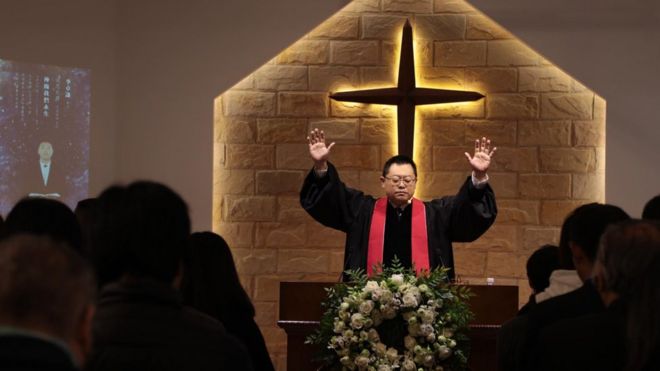
Wang Yi preaching at Early Rain Covenant ChurchImage copyrightFACEBOOK/EARLY RAIN
Image captionWang Yi was the outspoken leader of an influential unofficial church

A recent surge of police action against churches in China has raised concerns the government is getting even tougher on unsanctioned Christian activity.

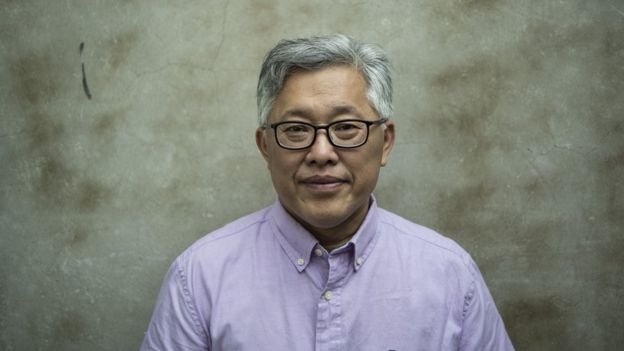
Among those arrested are a prominent pastor and his wife, of the Early Rain Covenant Church in Sichuan. Both have been charged with state subversion.

And on Saturday morning, dozens of police raided a children’s Bible class at Rongguili Church in Guangzhou.

China is officially atheist, though says it allows religious freedom.

But it has over the years repeatedly taken action against religious leaders it considers to be threatening to its authority or to the stability of the state, which, according to Human Rights Watch, “makes a mockery of the government’s claim that it respects religious beliefs”.

The government pressures Christians to join one of the Three-Self Patriotic churches, state-sanctioned bodies which toe the Communist Party line and are led by approved priests.

Silencing of a critic

Despite this, the Christian population has grown steadily in recent years. There are now an estimated 100 million Christians in China, many of them worshipping in so-called underground churches.

Wang Yi is the leader of one such church, the Early Rain Covenant Church in Chengdu, the capital of south-western Sichuan province.

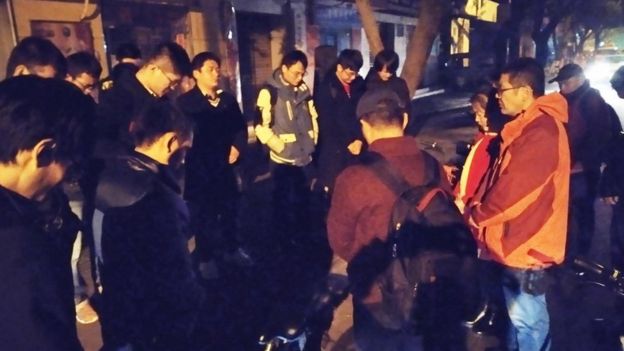
Early Rain members praying in publicImage copyrightFACEBOOK/EARLY RAIN
Image captionEarly Rain Covenant Church had posted pictures on Facebook of their public prayer meetings

The church is unusual in that it worships openly and regularly posts evangelical material online. The church says it has about 800 followers spread across the city. It also runs a small school.

Pastor Wang is also known for being outspoken – he has been fiercely critical of the state’s control of religion and had organised a widely shared petition against new legislation brought in this year which allowed for tighter surveillance of churches and tougher sanctions on those deemed to have crossed the line.

On 9 December, police raided the church and arrested Pastor Wang and his wife Jiang Rong. Over the following two days, at least 100 church members, including Wang’s assistant, were taken away.

One member of the church, who asked not to be identified for fear of reprisals, told the BBC that the lock on the church school had been broken, churchgoers’ homes had been ransacked and some were “under house arrest or are followed all the time”.

Facebook post showing alleged injuries to church members during detentionImage copyrightFACEBOOK/EARLY RAIN
Image captionThe church posted images it said showed injuries inflicted during police detention

She said police and other officials had been going to congregants’ homes to pressure them to sign documents pledging to leave the church and to take their children out of its school.

“On Sunday, some members tried to gather at other places for worship, but got taken away as well. The Church building has been manned with police and plain-clothes officers, not allowing anyone to enter to do worship service.”

The church alleges that some of those detained and then released were mistreated in custody.

Forty-eight hours after he was arrested, Early Rain Covenant Church released a letter from Pastor Wang, which he had pre-written for release in case something like this ever happened to him.

In it, he said he respected the Chinese authorities and was “not interested in changing any political or legal institutions in China”.

But he said he was “filled with anger and disgust at the persecution of the church by this Communist regime”.

“As a pastor of a Christian church, I must denounce this wickedness openly and severely. The calling that I have received requires me to use non-violent methods to disobey those human laws that disobey the Bible and God,” he said.

Pastor Wang and his wife – who have an 11-year-old son – have been charged with inciting subversion of state power, one of the most serious crimes against the state and a charge which is often used to silence dissidents. It carries a potential jail term of 15 years. Several senior members of the church face similar charges.

Jin Mingri, head pastor of the Zion churchImage copyrightGETTY IMAGES
Image captionJin Mingri resisted government pressure to install monitoring cameras in his Zion church in Beijing

Across the country in Guangzhou, the doors have also been sealed on the Rongguili Church, another un-sanctioned community.

On Saturday, a children’s Bible class was interrupted by the arrival of dozens of police officers.

Witnesses said they declared the church an illegal gathering, confiscated Bibles and other materials and shut the doors.

Officers took names and addresses and ordered everyone present to hand over their phones.

In September, the Zion church, one of the largest unofficial churches in Beijing was abruptly shut down. It had recently refused a request from the government to install security cameras to monitor its activities.

“I fear that there is no way for us to resolve this issue with the authorities,” Pastor Jin Mingri told Reuters news agency at the time.

There have also been a string of church demolitions, forced removal of crosses or other arrests over the year.

Human Rights Watch said the raids at Early Rain and at Rongguili Church were a further sign that under President Xi Jinping, China is seeking to tighten control over all aspects of society.

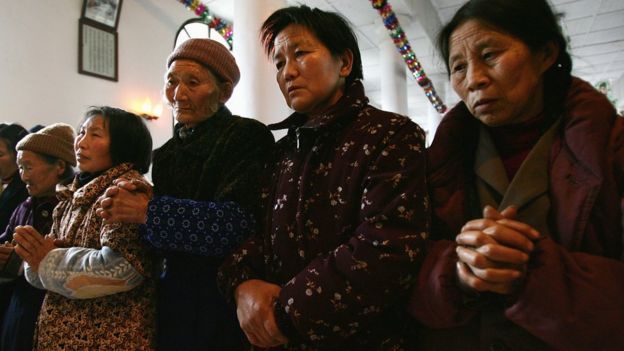
Women worship at a state-sanctioned Catholic church in Sichuan (file image)Image copyrightGETTY IMAGES
Image captionChina wants its Christians to worship at churches that are state-backed and closely monitored

“As major holidays in many parts of the world – Christmas and New Year – are approaching, we call on the international community to continue to pay attention to the situation of China’s independent churches and speak against the Chinese government’s repression,” said the group’s Hong Kong-based researcher Yaqiu Wang.

The Early Rain member who did not want to be identified said the idea of the Three-Self Patriotic churches was “hilarious”, saying they “don’t spread genuine gospel, but spread the thoughts of loving the Party, loving the country”.

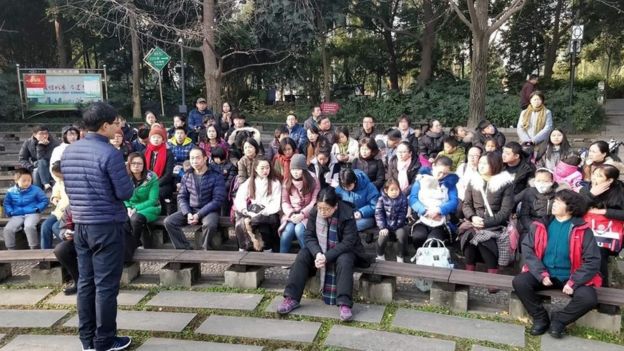
Members of Early Rain Covenant Church worship outside on 16 DecemberImage copyrightEARLY RAIN
Image captionWith their church closed, Early Rain members worshipped outdoors last Sunday

Another Christian in Chengdu told the BBC such churches were “against Jesus, against gospel”.

He described the scale of the operations against Early Rain as “unprecedented” but said more could be expected, adding: “I’m very lucky they haven’t found me yet.”

The Early Rain community would survive, he said, but would now go further underground.

“We will continue the gathering. The church is shut down so it’s impossible to have a big gathering, but there will be small gatherings on Sunday and on Christmas Day.”

Ultimately, he said, repression might even increase the profile of the faith in China.

“Without repression, people may doubt about our religion. But when repression occurs, pastors and members’ reactions will make people who don’t believe in Jesus realise the charm of Christianity.”

18/12/2018

Xi Jinping says China ‘will not seek to dominate’

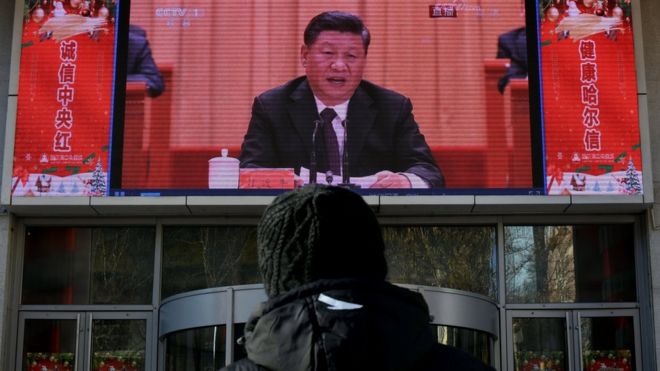
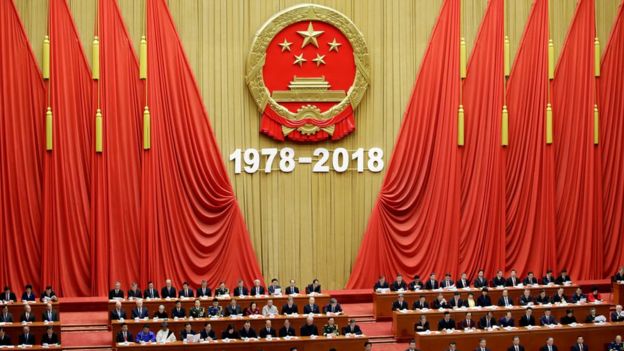
man stands and watches a large screen during President Xi Jinping"s speech at a grand gathering to celebrate the 40th anniversary of China"s reform and opening-up in Beijing on December 18, 2018 in Harbin, ChinaImage copyrightGETTY IMAGES

Chinese President Xi Jinping has vowed that his country will not develop at the expense of other nations, in a speech marking 40 years since China introduced major economic reforms.

However, he also said that the global superpower would not be told what to do by anyone.

Late leader Deng Xiaoping’s campaign of “reform and opening up” began four decades ago.

The resulting growth has made China the second-largest economy in the world.

Hundreds of millions of people have been lifted out of poverty but in recent years China has struggled with mounting debt and slowing economic growth.

Mr Xi said despite his country’s economic achievements, China would “never seek global hegemony” and also highlighted its contributions towards a “shared future for mankind”.

He did not mention the current trade dispute with the United States.

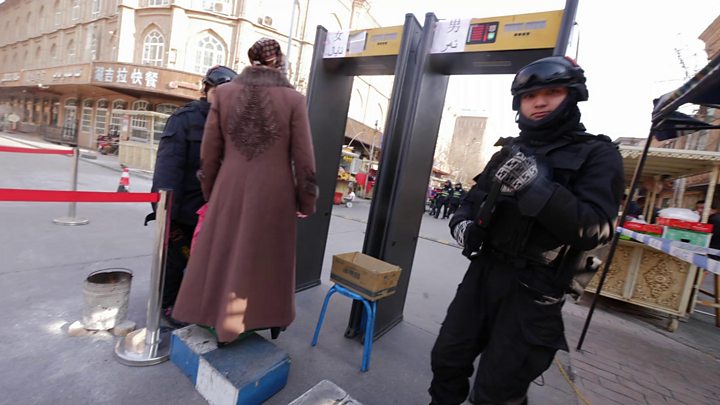
China continues to crack down on political dissent and is accused of locking up hundreds of thousands of Muslims without trial in the western region of Xinjiang.

Its militarisation of islands in the South China Sea – home to vital shipping lanes – has sparked concerns among Asian neighbours that it seeks to dominate the region.

Critics also say that while China is helping to build much-needed infrastructure across Asia and Africa, it is saddling countries with billions in debt in a bid to gain strategic influence.

Mr Xi spent much of his lengthy speech listing examples of China’s progress over the past decades, praising them as “epic achievements that moved heaven and Earth”.

He said that given its success, “no-one is in a position to dictate to the Chinese people what should or should not be done”.

At the same time, he stressed what he described as Chinese efforts to work towards the greater global good, saying Beijing was a “promoter of world peace”, a “defender of international order” and holding “a leading role in dealing with climate change”.

China’s economic reform was initiated by then leader Deng Xiaoping in 1978 and the programme was ratified on 18 December that year.

The reform path turned the country away from the old-style communism of Mao Zedong when collectivisation had led to an impoverished and inefficient economy.

The transformation focussed on agricultural reform, private sector liberalisation, industry modernisation and opening to international trade.

Xi Jinping described the reforms as a “break from the shackles” of previous mistakes.

The audience of Xi Jinping's speech in the Great Hall of the PeopleImage copyrightREUTERS
Image captionChina’s reform process was kicked off in 1978

He said the last 40 years had been a “quantum leap for socialism with Chinese characteristics,” driving China’s “great rejuvenation in modern times”.

The Chinese president made no direct mention of the current trade dispute with the US but stressed his country’s contribution to economic globalisation and international order.

The row with the US has led to a spiral of tit-for-tat tariffs with potentially serious economic consequences for both China and the US should they fail to resolve the dispute.

In October US Vice-President Mike Pence accused China of a raft of illiberal economic policies, saying that “while Beijing still pays lip service to ‘reform and opening’, Deng Xiaoping’s famous policy now rings hollow”.

No political changes

Despite the economic reforms, the past decades have not brought change to China’s rigid one-party system of communist rule.

China’s president gave his speech on Tuesday in the Great Hall of the People in Beijing’s Tiananmen Square, where calls for political reforms were brutally crushed by the military in 1989.

Media captionJohn Sudworth reports from Xinjiang, where all filming and reporting by foreign media is tightly controlled

Xi Jinping is widely seen as China’s most influential leader since Mao Zedong. In 2017, he cemented his power, enshrining his political views in the constitution.

In his address, Mr Xi reiterated his belief in strengthening the party leadership and praised Beijing’s crackdown on corruption.

Critics say the rule of Xi Jinping has been marked by an ever-intensifying crackdown on political dissent and any groups that the Communist Party sees as a threat to its authority, such as unofficial Christian churches and labour activists.

18/12/2018

Chinese vice premier meets Kuwaiti first deputy PM

CHINA-BEIJING-HAN ZHENG-KUWAIT OFFICIAL-MEETING (CN)

Chinese Vice Premier Han Zheng (R), also a member of the Standing Committee of the Political Bureau of the Communist Party of China (CPC) Central Committee, meets with Kuwaiti First Deputy Prime Minister and Defense Minister Sheikh Nasser Sabah Al-Ahmad Al-Sabah at the Great Hall of the People in Beijing, capital of China, Dec. 17, 2018. (Xinhua/Rao Aimin)

BEIJING, Dec. 17 (Xinhua) — Chinese Vice Premier Han Zheng Monday met with Sheikh Nasser Sabah Al-Ahmad Al-Sabah, Kuwaiti first deputy prime minister and defense minister.

Han, also a member of the Standing Committee of the Political Bureau of the Communist Party of China Central Committee, said Chinese President Xi Jinping held talks with Kuwaiti Emir Sheikh Sabah Al-Ahmad Al-Jaber Al-Sabah during his state visit to China in July this year, reaching a series of important consensus.

The establishment of strategic partnership between China and Kuwait during the visit injected great vitality to bilateral ties, Han said.

He called on both sides to “implement consensus reached by both heads of state to enhance political mutual trust, strengthen alignment of development strategies and promote the Belt and Road construction.”

Han also encouraged both countries to intensify people-to-people exchanges and enhance coordination on regional and international issues.

Hailing the traditional friendship between Kuwait and China, Nasser said the two countries had always trusted and supported each other.

“Kuwait admires the remarkable achievements China has scored under the reform and opening-up policy,” Nasser said. “Kuwait looks forward to learning from China’s state governance experience and stands ready to participate in the Belt and Road construction.”

Law of Unintended Consequences

continuously updated blog about China & India

ChiaHou's Book Reviews

continuously updated blog about China & India

What's wrong with the world; and its economy

continuously updated blog about China & India