Archive for ‘Uncategorized’

12/12/2018

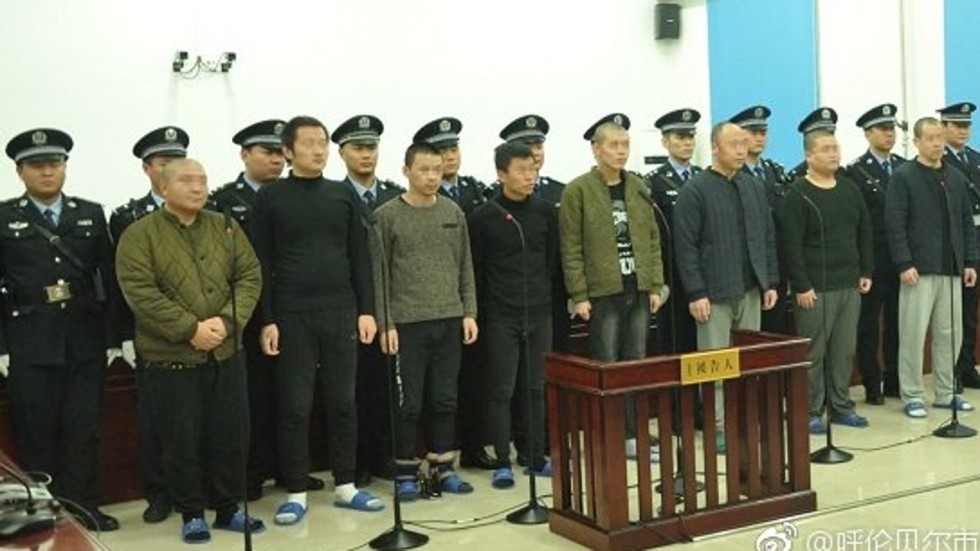
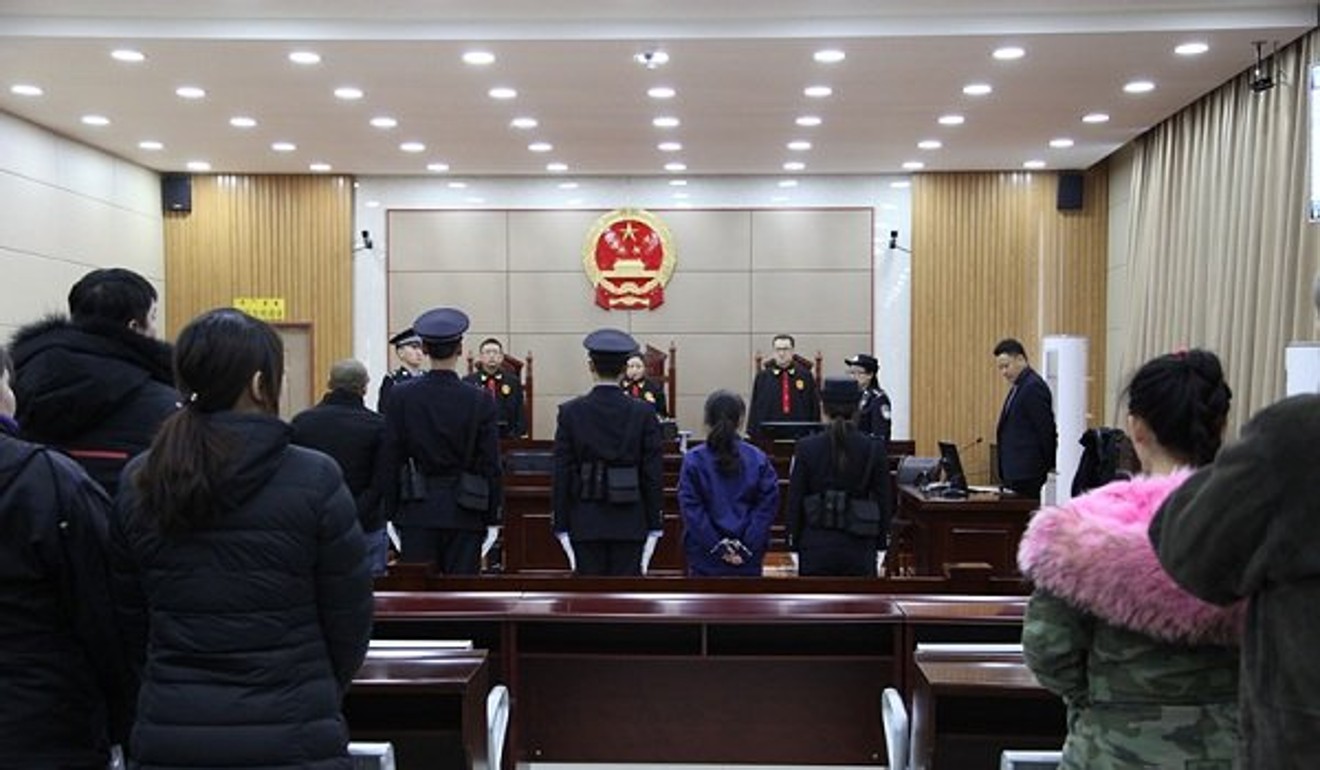
Chinese loan shark who raped victim among 18 jailed for gang crime

Wang Yinan was one of 19 people convicted of various gang-related crimes in Hulunbuir in the Inner Mongolia autonomous region, Beijing Youth Daily reported on Tuesday.

Wang and eight of his associates were tried in the city on Monday charged with illegally providing loans of between 10,000 yuan (US$1,450) and 30,000 yuan to people via a smartphone app since September 2017.

Those who failed to keep up with their repayments were subjected to physical assault, including being made to stand naked in the snow, the report said. One victim was raped as punishment, it said, without providing any further details of the crime.

Wang’s associates were each sentenced to between one and nine years in prison.

The trials followed a nationwide crackdown on organised crime launched at the start of the year.

Among the others given prison sentences on Monday were Lee Yongbin, who led a group of hired thugs that intimidated people involved in construction conflicts and worked as debt collectors for loan sharks, the report said.

Members of the gang were also charged with “creating public disturbances”, the court heard.

Lee was sentenced to 5½ years in prison, and his associates to between 10 and 30 months.

12/12/2018

Book series revealing Japanese Kwantung Army crimes in NE China published

SHENYANG, Dec. 11 (Xinhua) — A volume of books collecting Japanese Kwantung Army secret military files from the early 1930s was published by the September 18 Incident History Museum in Shenyang on Tuesday.

The files, from the second day after the “Sept. 18 Incident” in 1931 to December 1935, were written by the Kwantung Army stationed in northeast China and presented as military reports.

Edited into 20 volumes, it includes more than 560 files, totaling about 9,000 papers.

These historical files serve as comprehensive records of the process that the Japanese Kwantung Army started the “Sept. 18 Incident” and the war of aggression against China.

The files which were edited in chronological order record the Japanese Kwantung Army’s attacks in a number of northeastern Chinese cities including Harbin, Qiqihar, Shenyang, Changchun and Jilin, said Fan Lihong, chief editor of the book and curator of the museum.

The Kwantung Army reported details of the scale, plans, as well as casualties of warfare in northeast China to its superior army, according to Fan.

“The reports were submitted by the Kwantung Army from the second day after Sept.18, 1931 to the end of 1935 without interruption to ensure the central Japanese army knew the progress of the war in northeast China,” Fan said.

“These reports have been well preserved and can serve as authoritative historical evidence, which reflect the Kwantung Army and Japanese army’s crimes in northeast China.”

On Sept. 18, 1931, the Japanese Kwantung Army bombarded Shenyang under the excuse of explosions that occurred on the South Manchuria Railway.

Since the “Sept. 18 Incident,” China waged a war against Japanese aggression for 14 years and finally won the first full victory against foreign invasion since the Opium War in 1840 at the cost of over 35 million military and civilian casualties.

12/12/2018

China issues white paper on human rights progress over 40 years of reform, opening up

BEIJING, Dec. 12 (Xinhua) — China on Wednesday issued a white paper on progress in human rights since its reform and opening up drive.

The white paper, titled “Progress in Human Rights over the 40 Years of Reform and Opening Up in China,” said reform and opening up has helped liberate and develop social productive forces, opened up a path of socialism with Chinese characteristics, and ushered in a new chapter in the development of human rights.

Over the four decades, the Chinese people have worked hard as one under the strong and coherent leadership of the Communist Party of China (CPC), the white paper said. Huge changes have taken place, and living standards have significantly improved.

The CPC has always prioritized the people’s interests, ensuring that reform is conducted for the people and by the people, and that its benefits are shared by the people, it added.

China has showed respect for, protected and promoted human rights in the course of reform and opening up, blazing a trail of human rights development that conforms to the national conditions, and created new experiences and made progress in safeguarding human rights, it said.

China has summed up its historical experience, drawn on the achievements of human civilization, combined the universal principles of human rights with the realities of the country, and generated a series of innovative ideas on human rights, it said.

China has brought into being basic rights that center on the people and prioritize their rights to subsistence and development, and proposed that China should follow a path of comprehensive and coordinated human rights development under the rule of law.

The white paper said China has carried out extensive exchanges and cooperation in the field of human rights and earnestly fulfilled its international human rights obligations.

12/12/2018

Book of Xi’s remarks on Belt and Road Initiative published

BEIJING, Dec. 11 (Xinhua) — A compilation of remarks by President Xi Jinping on the Belt and Road Initiative (BRI) over the past five years has been published by the Central Party Literature Press.

The book contains 42 articles drawn from the speeches and public remarks made by Xi, beginning with a speech he delivered at Nazarbayev University, Kazakhstan, in September 2013 calling for jointly building the Silk Road Economic Belt, and ending with the one he delivered at the opening ceremony of the 8th Ministerial Meeting of the China-Arab States Cooperation Forum in July 2018.

The book, with about 130,000 Chinese characters, was compiled by the Institute of Party History and Literature of the Communist Party of China Central Committee.

The BRI, first proposed by Xi, has received warm responses from the international community, especially the countries along the BRI routes. Jointly pursuing the BRI is becoming a Chinese solution for the country to participate in global opening-up and cooperation, improve the global economic governance, push for common development and prosperity of the world and build a community with a shared future for humanity.

The book will be available nationwide starting Tuesday.

12/12/2018

China Focus: Geothermal heating helps build “smokeless cities” in China

SHIJIAZHUANG, Dec. 11 (Xinhua) — As China seeks to curb air pollution and win the battle for blue skies, more Chinese cities have switched from coal to geothermal heating during this year’s winter heating season, as part of their efforts to become “smokeless cities.”

“My family has replaced coal-fired boiler with geothermal heating this year,” said Sun Shujuan, a villager in Xiongxian County, northern China’s Hebei Province. “Burning coal was dirty and tiring.”

Xiongxian, about 130 kilometers away from Beijing, is part of the Xiongan New Area, another new area of “national significance” established in April 2017 to facilitate the coordinated development of Beijing and the surrounding region.

The county began exploiting its rich geothermal resources, a clean and sustainable energy, in 2009. Now it provides geothermal heating to all its urban areas and is looking to expand in rural households.

“We have provided geothermal heating for about 6,000 households in Xiongxian’s 12 villages this year,” said Chen Menghui, deputy general manager of Sinopec Green Energy Geothermal Development Co., Ltd.

The company, established in 2006, is a joint venture between Arctic Green Energy Corporation of Iceland and Sinopec Star Co., Ltd., a subsidiary of China Petrochemical Corporation (Sinopec), China’s largest geothermal developer.

“Compared with coal-fired boilers, geothermal heating can reduce carbon dioxide emissions by at least half,” Chen said. “It is estimated that we can replace over 10,000 tonnes of coal and cut emissions of more than 40,000 tonnes of carbon dioxide this year in Xiongxian.”

He added that the cost of geothermal heating is about half that of natural gas heating.

Xiongxian is one of the 10 Chinese cities where Sinopec has helped replace coal with geothermal energy, including cities in Shanxi, Shaanxi and Henan provinces.

The company now provides geothermal heating to an area of around 50 square km, and it aims to increase the area by 100 square km by 2023 and help build a total of 20 “smokeless cities” nationwide.

“Local governments are very willing to cooperate with us given the mounting pressure of environmental protection,” Chen said.

China aims to have clean energy replace 74 million tonnes of coal and generate 50 percent of winter heating in northern China by 2019, according to a plan released by Chinese government in 2017.

Rich in resources of geothermal energy, the country now has about 150 square km of geothermal energy heated areas, according to an international forum on geothermal energy held in Shanghai in November.

The areas that have access to geothermal heating or cooling are expected to reach 1,600 square km by 2020, according to a five-year plan for developing geothermal energy released by Chinese government in 2017.

12/12/2018

China establishes governance principle of respecting, protecting human rights: white paper

BEIJING, Dec. 12 (Xinhua) — A white paper released Wednesday by the State Council Information Office said China has firmly established a governance principle of respecting and protecting human rights.

“It is the determination and ultimate goal of the Communist Party of China (CPC) and the Chinese government to respect and protect human rights,” said the document, titled “Progress in Human Rights over the 40 Years of Reform and Opening Up in China.”

Since the launch of reform and opening up in 1978, “respecting and protecting human rights” has been written into the reports to CPC National Congresses, the Constitution of the People’s Republic of China, the Constitution of the CPC, and strategies and plans for national development, becoming an important principle of governance for the CPC and the Chinese government, it said.

According to the white paper, that the state respects and protects human rights has been established as an important principle of the Constitution of China.

Also, the CPC pursues human rights protection in its governance, the document said.

The white paper noted that it has become a core goal of national development to respect and protect human rights.

12/12/2018

China’s top political advisor visits people in Guangxi

CHINA-GUANGXI-NANNING-WANG YANG-VISIT (CN)

Wang Yang, a member of the Standing Committee of the Political Bureau of the Communist Party of China(CPC) Central Committee and chairman of the National Committee of the Chinese People’s Political Consultative Conference(CPPCC), visits a community in Nanning, capital of south China’s Guangxi Zhuang Autonomous Region, Dec. 11, 2018. Wang led a division of a central delegation to conduct the visit. (Xinhua/Liu Bin)

NANNING, Dec. 11 (Xinhua) — China’s top political advisor Wang Yang on Tuesday visited local people in the city of Nanning, south China’s Guangxi Zhuang Autonomous Region, which is marking its 60th anniversary.

Wang, a member of the Standing Committee of the Political Bureau of the Communist Party of China Central Committee and chairman of the National Committee of the Chinese People’s Political Consultative Conference, led a division of a central delegation to conduct the visit.

During their visit to a local hospital, Wang stressed the importance to develop traditional medicine of ethnic minority groups, calling for efforts to promote the local traditional medicine to better serve the people.

Wang also urged improving public service, environmental governance, and education when visiting a community, a wetland park, and Guangxi University.

When addressing a symposium with local cadres and people, Wang said Nanning’s significant progress is a microcosm of Guangxi’s remarkable achievements during the past 60 years, attributing the progress to the Party’s policies concerning ethnic groups, as well as the joint efforts of different ethnic groups.

Wang called for more hard work to unite the cadres and people of all ethnic groups in the city and lead them to achieve greater success in its development in the new era.

Four other divisions of the central delegation visited other areas of Guangxi on Tuesday.

The delegation arrived in Guangxi on Sunday for the anniversary celebrations.

11/12/2018

India state elections: Setback for Modi’s BJP in three key states

Supporters of India's main opposition Congress party celebrate after the initial poll results at the party headquarters in New Delhi, India, December 11, 2018Image copyrightREUTERS
Image captionCongress supporters celebrate initial poll results in Delhi

Indian Prime Minister Narendra Modi and his right-wing BJP party appear to be facing a political setback, with swings against it in three key state elections.

The opposition Congress Party looks set to form governments in Chhattisgarh and Rajasthan, while Madhya Pradesh heads for a photo-finish.

Correspondents say a win for the depleted Congress in at least two states will see it regain credibility.

General elections are due in 2019.

Early results in the central state of Madhya Pradesh put the Congress well ahead, but the BJP has been making a late comeback. It is still unclear which of the parties will eventually form the government there.

However the opposition, headed by Rahul Gandhi, has a clear lead in Rajasthan and Chhattisgarh, which are former BJP strongholds.

Mr Modi, whose brand of Hindu nationalism helped him come to power in 2014, campaigned aggressively in all three states.

A shot in the arm for the opposition?

Soutik Biswas, BBC News, Delhi

This is the last round of state polls before general elections, which will be held in the next few months.

The Congress’s vastly improved performance in the three key heartland states will help change the perception that Prime Minister Narendra Modi’s BJP is invincible, boost the morale of Congress party workers and make it more acceptable to sceptical regional allies in the run-up to general elections. It will also help raise the profile of the Congress leader, Rahul Gandhi, who led a spirited campaign in the three states.

In 2014, the BJP won 62 of the 65 parliamentary seats in these three states.

Tuesday’s performance will be a shot in the arm for the Congress, which has consistently lost state elections since 2014 – the party rules in only two major states.

But state polls are often a poor predictor for the general elections.

It will take a lot more – including a powerful counter narrative and wider voter acceptability – for the Congress to mount a serious challenge to Mr Modi next year.

The good news is that politics in India is beginning to look competitive again.

Election results are also being declared for the southern state of Telangana and the north-eastern state of Mizoram.

Regional parties – the Telangana Rashtra Samiti (TRS) and the Mizo National Front (MNF) – are headed for a landslide victory in these states.

Image captionThe regional Telangana Rashtriya Samiti has won a landslide in the southern state

The Congress was widely expected to win in the northern state of Rajasthan, while Madhya Pradesh was always seen as a close contest between the two parties.

But results in Chhattisgarh, where the Congress appears poised to win by a wide margin, have been the most surprising.

“The reason behind the Congress victory is anti-incumbency because people feel that there is a lack of development in most parts of the state despite 15 years of the BJP governing there,” reports BBC Hindi’s Salman Ravi from the state capital Raipur. “Farmers in particular, who have been angry about what they see as a lack of state support for their profession, voted for the Congress in large numbers. People in the state were clearly looking for change this time,”

An anti-incumbency vote against the BJP in the three key states had been predicted, and some analysts point out people vote differently at state and national level.

But the results so far suggest a very visible setback for the BJP, which had steadily increased its state footprint since coming to office in 2014.

And issues of rural discontent – such as unemployment, lack of development and farming distress – are being seen as issues that could affect ballots next year.

BBC Hindi’s Nitin Srivastava who is in Rajasthan, has been posting photos of the starkly different atmospheres at the BJP and Congress party offices in the state.

11/12/2018

India’s government faces a tough re-election battle next year but first it must deal with an opponent as wily as any political rival, troops of monkeys that have become a big threat around its offices in New Delhi.

Red-faced rhesus macaques have spread havoc, snatching food and mobile telephones, breaking into homes and terrorising people in and around the Indian capital.

They have colonised areas around parliament and the sites of key ministries, from the prime minister’s office to the finance and defence ministries, frightening both civil servants and the public.

“Very often they snatch food from people as they are walking, and sometimes they even tear files and documents by climbing in through the windows,” said Ragini Sharma, a home ministry employee.

Ahead of Tuesday’s start of parliament’s winter session, an advisory to members of parliament last month detailed ways they could keep simian attacks at bay. Don’t tease or make direct eye contact with a monkey, the advisory said, and definitely don’t get between a mother and her infant.

The rapid growth of cities has displaced macaques, geographically the most widely distributed primates in the world after humans, driving them into human habitats to hunt for food.

A monkey sits on a pavement outside India’s Parliament building in New Delhi, India, November 15, 2018. Picture taken November 15, 2018. REUTERS/Anushree Fadnavis

Many in Hindu-majority India revere and feed the animals they consider to be connected to the demigod Hanuman, who takes the form of a monkey.

“This socio-religious tradition of feeding has created a vicious cycle,” said ecology researcher Asmita Sengupta.

“They become used to being fed by humans and lose their sense of fear,” said Sengupta, of the Ashoka Trust for Research in Ecology and the Environment.

“They start actively seeking supplementary food and if we don’t feed them, they turn aggressive.”

‘APE REPELLERS’

The monkeys have hardly proved an ally for Prime Minister Narendra Modi.

Hundreds of macaques feasting on optic fibre cables strung along the banks of the river Ganges derailed his plan to roll out wifi in his constituency, the crowded 3,000-year-old holy city of Varanasi, in 2015.

Men were hired to swat the monkeys away with broomsticks and slingshots, when then U.S. President Barack Obama toured New Delhi that year, media said.

In 2007, monkeys pushed the deputy mayor of Delhi, S.S. Bajwa, off his balcony to his death. Last month, one of the animals snatched a 12-day-old boy from his mother and killed him in Agra, home to the famed monument to love, the Taj Mahal.

Monkeys have bred rapidly in Delhi and neighbouring states as they have protected status, but there is no official estimate of their numbers.

India has tried several strategies to fight the menace.

Authorities stumbled on a partially successful solution four years ago, after hiring 40 men to disguise themselves as langurs and squeal monkey-like to try and terrify the macaques away.

“We call them ‘ape repellers’ and they are contract employees,” said a government official, who asked not to be identified. The stratagem works temporarily as the monkeys flee on hearing the calls, but they return once the men depart.

Primatologist S.M. Mohnot recommends sterilisation and moving the animals to forests, as well as lifting a ban on their capture for biomedical research and resuming exports of the macaques, as components of a solution.

“The monkey menace can be checked only by a multi-pronged approach,” said Mohnot, the chairman of the Primate Research Centre, a federal institute in the western city of Jodhpur.

11/12/2018

Assembly election result 2018: Countdown for 2019 begins, says Mamata Banerjee on BJP’s setback in state elections

Assembly election result 2018: The leaders decided to lay a roadmap for the 2019 Lok Sabha elections to oust the BJP from power by evolving a common strategy.

BJP,Congress,Telangana Assembly election Results 2018
Assembly election result 2018: West Bengal chief minister Mamata Banerjee was among the 21 opposition party leaders who on Monday agreed to work together to defeat the BJP.(AP)

It was people’s verdict and their victory, West Bengal chief minister Mamata Banerjee tweeted as the Congress was ahead in three states with votes being counted in the assembly elections, billed as the semi-final before next year’s Lok Sabha polls.

All three states — Madhya Pradesh, Rajasthan and Chhattisgarh — were won last time by the BJP, which had also won 60 of the 65 total parliament seats in these states in the 2014 general elections.

Click here for Telangana election results 2018 LIVE

Votes are also being counted in Telangana, where K Chandrashekhar Rao’s Telangana Rashtriya Samiti (TRS) has raced to a massive lead, validating his decision to call early elections. In Mizoram, the Congress’ last bastion in the state, the Mizo National Front is ahead.

“Semifinal proves that BJP is nowhere in all the states. This is a real democratic indication of 2019 final match. Ultimately, people are always the ‘man of the match’ of democracy. My congrats to the winners,” she said.

Click here for Madhya Pradesh election results 2018 LIVE

The leaders decided to lay a roadmap for the 2019 Lok Sabha elections to oust the BJP from power by evolving a common strategy.

“In the course of the next few months, we will place before the people of the country, a comprehensive programme of work anchored in complete transparency and accountability,” read a joint statement issued after the meeting.

The parties also appealed to all “liberal, progressive and secular forces to join them in their battle to save the Constitution and protect parliamentary democracy”.

Law of Unintended Consequences

continuously updated blog about China & India

ChiaHou's Book Reviews

continuously updated blog about China & India

What's wrong with the world; and its economy

continuously updated blog about China & India