Archive for ‘Uncategorized’

11/12/2018

China, U.S. discuss road map for next stage of trade talks

BEIJING (Reuters) – China and the United States discussed a road map for the next stage of their trade talks on Tuesday, during a telephone call between Vice Premier Liu He and U.S. Treasury Secretary Steven Mnuchin and Trade Representative Robert Lighthizer.

U.S. President Donald Trump and Chinese President Xi Jinping agreed at a Dec. 1 meeting in Argentina to a truce that delayed the planned Jan. 1 U.S. increase of tariffs to 25 percent from 10 percent on $200 billion (157 billion pounds) worth of Chinese goods.

Lighthizer said on Sunday that unless U.S.-China trade talks wrapped up successfully by March 1, new tariffs would be imposed, clarifying there was a “hard deadline” after a week of seeming confusion among Trump and his advisers.

China’s commerce ministry said in a statement Liu had spoken to Mnuchin and Lighthizer on Tuesday morning, Beijing time, on a pre-arranged telephone call.

“Both sides exchanged views on putting into effect the consensus reached by the two countries’ leaders at their meeting, and pushing forward the timetable and roadmap for the next stage of economic and trade consultations work,” the ministry said.

It did not elaborate.

A U.S. Treasury spokesman confirmed that the call with Liu took place, but offered no further details. The U.S. Trade Representative’s office did not immediately respond to a query about the call.

The Wall Street Journal, citing people familiar with the issue, said Liu planned to go to Washington after the new year.

The Harvard-education Liu, Xi’s top economic adviser, is leading the talks on the Chinese side.

In comments reported separately by China’s Foreign Ministry, the government’s top diplomat, State Councillor Wang Yi, said if China and the United States cooperated, it would benefit the whole world.

“If China and the United States are antagonistic, then there are no winners, and it will hurt the whole world,” Wang told a forum.

The United States should look at China’s development in a more positive light, and constantly look to “expand the space and prospects for mutual benefit”, he said.

Global markets are jittery about a growing clash between the world’s two largest economic powers over China’s huge trade surplus with the United States and Washington’s claims that Beijing is stealing intellectual property and technology.

The arrest of a top executive at China’s Huawei Technologies Co Ltd [HWT.UL] has also roiled global markets amid fears that it could further inflame the China-U.S. trade row.
11/12/2018

Huawei: The life of Chinese tech heiress Meng Wanzhou

Meng Wanzhou, Huawei Technologies Co Ltd"s chief financial officer (CFO), is seen in this undated handout photo obtained by Reuters December 6, 2018.Image copyrightREUTERS
Image captionMeng Wanzhou was arrested in Vancouver on 1 December

A high-flying Chinese executive has been caught in the centre of a growing geo-political dispute between two of the world’s largest economies.

Meng Wanzhou is the chief financial officer of Huawei and the elder daughter of the telecom giant’s founder.

She was arrested in Canada last week for allegedly breaking US sanctions on Iran and faces extradition to the US.

China and Huawei insist that she has not broken any laws but she could be jailed for up to 30 years if found guilty.

So who is she?

Ms Meng, also known as Sabrina Meng and Cathy Meng, has risen up the ranks of Huawei, China’s largest private company.

The 46-year-old started her career as a receptionist in 1993, and after graduating with a master’s degree in accountancy from the Huazhong University of Science and Technology in 1999, she joined Huawei’s finance department.

She became the company’s chief finance officer (CFO) in 2011 and was promoted to vice-chair a few months before her arrest.

In 2018, she was ranked 12th on Forbes’ list of top Chinese businesswomen, four spots lower than where she ranked the year before.

Image captionMs Meng has met world leaders like Russia’s Vladimir Putin in 2014

Ms Meng’s links to her father, billionaire Ren Zhengfei, were not known to the public until a few years ago.

At the age of 16, in a practice highly unusual in Chinese tradition, she took the surname of her mother, Meng Jun, who was Mr Ren’s first wife.

What is she charged with?

Ms Meng was taken into custody in Vancouver while she was changing planes on 1 December.

Prosecutors say she conspired to defraud banks by telling banks a Huawei subsidiary was a separate company – thereby helping Huawei circumvent US trade bans.

The US has been investigating the world’s largest smartphone maker since 2016, which it believes used a subsidiary to bring US manufacturing equipment and millions of dollars in transactions to Iran.

Ms Meng’s arrest has now sparked an escalating diplomatic incident between China, Canada and the US.

Life revealed in court

In documents filed in the Supreme Court of British Columbia, where Ms Meng’s case is being heard, details have emerged revealing the CFO’s personal life.

She is a thyroid cancer survivor who suffers from hypertension and a sleep disorder, her lawyers said, in need of daily doses of medication.

“I continue to feel unwell and I am worried about my health deteriorating while I am incarcerated,” she said in the filing. “I currently have difficulty eating solid foods and have had to modify my diet to address those issues.”

Her lawyers are seeking bail for the mother of four, who, they say, is not a flight risk because of her “strong roots” in Vancouver.

She told the court she was a Canadian resident until 2009, after which she returned to China.

Image captionMs Meng and her husband have put up two homes in Vancouver as collateral for bail

However, she bought a six-bedroom house with her second husband in the city and would return regularly to visit him and her children, some of whom attended Canadian schools until 2012.

That home is now reported to be worth C$5.6m (£3.3m, $4.2m), according to property records and an affidavit Ms Meng read out in court.

In 2016, the couple bought a second property, a mansion worth C$16.3m – both homes have been put up as collateral for bail.

Why Vancouver?

The court papers give a fascinating insight into the life of a senior Chinese executive, says BBC World Service Asia-Pacific editor Michael Bristow.

“Vancouver has for some years been a destination of choice for wealthy Chinese people; as a place to live, educate their children, or as an insurance policy against the uncertainties of life back in China.

“People will be intrigued to find out Ms Meng has not one but two homes in Vancouver, and wonder at how she was able to hold seven passports at the same time.”

How does she have seven passports?

This remains somewhat of a mystery.

According to media reports, the tech boss has at least four Chinese passports and three Hong Kong passports.

Chinese rules dictate that if citizens want to get a passport from another country or region, they must give up their Chinese one.

Hong Kong immigration officials would not comment on Ms Meng’s case but stated no passport holder would be “in possession of more than one” at a time.

According to arrival and departure records of US Customs and Border Protection, Ms Meng used three different HK passports to enter the US on 33 occasions between 2014 and 2017.

Her second son is said to be studying at a school in Massachusetts but Ms Meng has not been back to the US since March 2017.

Canadian police told the court Huawei executives appeared to have “altered their travel plans” to avoid the US, since becoming aware of a criminal investigation into the company in April 2017.

11/12/2018

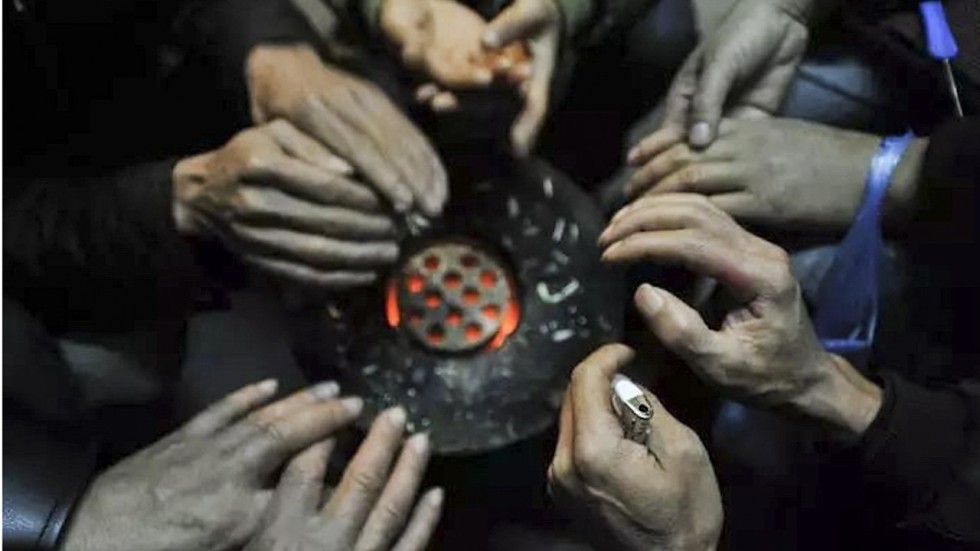
Men ‘detained for burning low-quality coal’ in northern China amid winter crackdown

  • But county government denies environment department statement, saying the men were ‘criticised and educated’ for using the banned heating fuel

That is according to the local environment department, which said in a statement on Saturday that the men, both surnamed Zhao, were detained by police in Quyang, Hebei province, last week.

But later in the day, the local government denied the department’s statement, saying it was “misinformation” and that the authorities had only “criticised and educated the men who burned low-quality coal”.

The environment department’s statement was later removed from its official account on social network WeChat.

China’s push to clean up its toxic air saw many local governments across the north of the country rush through a coal ban last winter. But a shortage of natural gas to replace coal heating systems left many households shivering in freezing temperatures, forcing the authorities into a U-turn on the ban. Without a reliable energy supply, the ban was relaxed and people in low-income areas were instead asked to choose high-quality coal over the low-end product to reduce emissions.

Ahead of winter this year, Quyang – located about 230km south of Beijing – is one of the local governments in northern China that has again cracked down on heating fuel used by families and businesses with a total ban on low-grade coal since late October.

It vowed to put a stop to pollution caused by low-quality coal and sent 30 law enforcement officers to villages in the county without central heating in late November to check that people were sticking to the ban, according to a statement on the local government’s website.

“Anyone who burns low-quality coal and pollutes the air will be detained and their image will be broadcast on TV so that others can learn a lesson from them,” the Quyang government said on November 27.

Since then, county authorities have confiscated 1,147 tonnes of low-quality coal and warned 13 households that have burned it, according to the local government.

It is not the first time Chinese have been detained for burning low-end coal or other fuel that is prohibited. In early November, Quyang authorities detained a Xiguo man for five days after police found him burning grass and hay on a hillside in the village.

“The hay burning was producing a lot of smoke and polluting the air … so Quyang police decided to detain him for five days,” the local environment department said.

County police said the detention was in line with the Security Administration Punishment Act, which states that “residents who do not obey government regulations in emergency or special times shall be detained for up to 10 days”.

In a case last winter, a man in Kaifeng, in central Henan province, was detained for eight days in December for burning low-quality coal, according to Bianliang Evening Post.

Beijing has said it will be less severe with its pollution curbs this winter as it grapples with slower economic growth and the trade war with the United States.

Last winter, it imposed blanket bans on industrial production in the Beijing-Tianjin-Hebei region, which is often the worst affected by choking smog. But in September the environment ministry said it would let steel plants continue producing as long as their emissions met standards.

11/12/2018

Chinese vice president attends 2018 Imperial Springs International Forum

CHINA-GUANGZHOU-WANG QISHAN-FORUM (CN)

Chinese Vice President Wang Qishan delivers a keynote speech during the opening ceremony of the 2018 Imperial Springs International Forum in Guangzhou, south China’s Guangdong Province, Dec. 10, 2018. (Xinhua/Zhang Ling)

GUANGZHOU, Dec.10 (Xinhua) — Chinese Vice President Wang Qishan on Monday said China will follow the trend of history, adapt to and lead economic globalization while eliminating its side effects, maintain the rules-based multilateral trading system, enhance equal consultation and cooperation, and jointly build an innovative, inclusive and open world economy.

The remarks came as Wang attended the opening ceremony of the 2018 Imperial Springs International Forum in China’s southern city of Guangzhou.

Some 200 former world leaders, renowned scholars and business elites gathered here to exchange their views on “Advancing Reform and Opening-up, Promoting Win-win cooperation”.

This year marks the 40th anniversary of China’s reform and opening-up, which, according to Wang, is a glorious chapter for the Chinese nation’s great rejuvenation history, and not only profoundly changed China, but also deeply influenced the world.

Reviewing China’s reform and opening-up, Wang stressed that the process is linked to the exploration and practices of socialism carried out 30 years before 1978, the history of Chinese people’s struggle for national rejuvenation since 1840, as well as the sufferings and glory of the Chinese nation over the past 5,000 years.

“The sufferings and glory of history are the source of the present,” said Wang, adding that socialism with Chinese characteristics has entered a new era and the Chinese nation is closer to the goal of great rejuvenation than any other time in history.

He said the door to China will never be closed and will only be opened wider and wider, and this is a strategic choice based on China’s development needs.

China will firmly adhere to its own path, work in a down-to-earth way on its own tasks, continue mutual learning and cooperation with other countries, build a peaceful world, contribute to global development and maintain international order, Wang said.

Noting that the interests of countries around the world are deeply intertwined nowadays, Wang said China will be committed to the path of peaceful development, uphold new forms of international relations featuring mutual respect, fairness, justice and win-win cooperation, and build a community with a shared future for humanity featuring lasting peace and common prosperity.

11/12/2018

China, Germany agree to further intensify bilateral ties

CHINA-BEIJING-XI JINPING-GERMAN PRESIDENT-TALKS (CN)

Chinese President Xi Jinping (L, front) holds a welcoming ceremony for German President Frank-Walter Steinmeier before their talks at the Great Hall of the People in Beijing, capital of China, Dec. 10, 2018. (Xinhua/Wang Ye)

BEIJING, Dec. 10 (Xinhua) — Chinese President Xi Jinping and visiting German President Frank-Walter Steinmeier agreed Monday to further intensify the all-round strategic partnership between the two countries, to make bilateral cooperation yield more fruits that benefit both nations, both peoples, and the world peace and prosperity.

Noting that the world is undergoing complicated and profound changes, Xi said China and Germany share the same or similar views on many issues.

The two nations need to continue enhancing bilateral and multilateral cooperation to benefit both peoples as well as bring more stability to the world, said Xi.

He made several proposals for future China-Germany cooperation.

Mutual understanding and trust are the basis of deepening bilateral ties, said Xi.

It is the mainstream view of both governments and all circles in both countries to have win-win cooperation, he said.

Xi called on both nations to summarize the successful experiences of bilateral cooperation and continue to surpass ideological differences and respect each other’s development paths.

China stands ready to maintain close high-level exchanges and make the best of various dialogue mechanisms to enhance policy communication, he said.

The two nations need to stick to openness and innovative cooperation to maintain the vitality of bilateral ties, said Xi.

This year marks the 40th anniversary of China’s reform and opening up policy.

German enterprises have grasped the opportunities of China’s new round of reform and opening-up, said Xi.

China is willing to continue to share its dividend of development and at the same time hopes Germany will remain open to Chinese investment, said the president.

On expanding cooperation, Xi said the Belt and Road construction could provide a major platform.

China would like to discuss trilateral cooperation with Europe and Germany and promote the synergy of the Belt and Road Initiative with the EU-proposed connectivity plan, said Xi, adding that China will further cooperate on the China Railway Express with Germany and countries along the route.

He also encouraged both sides to promote people-to-people exchanges and provide more platforms for exchanges in areas including culture, education, youth, and sports.

Xi called on both nations to forge ahead with global governance, jointly build an open world economy, uphold the multilateral free trade system, implement the Paris Agreement on climate change, promote the robust, sustainable, balanced and inclusive growth of the world economy and jointly safeguard multilateralism with the United Nations as the core.

He suggests China and Europe coordinate and support each other to safeguard the international order and promote global governance, adding that he hopes Germany can continue to play an active role to this end.

Steinmeier, who is on his first state visit to China as president, said that his visit to various parts of China has made him admire more the achievements China has made in the past four decades of reform and opening-up, especially the success of getting several hundreds of millions of people out of poverty.

The economic and social development of the areas in the southwestern Chinese province of Sichuan which were hit by an 8.0-magnitude earthquake 10 years ago was very impressive, said Steinmeier.

He said Germany is satisfied with the development of Germany-China relations and willing to enhance dialogue and mutual understanding, expand consensus, narrow differences, intensify coordination in international affairs and uphold free trade.

Germany opposes protectionism in any form, said Steinmeier, adding that the country will continue to promote cooperation between Europe and China and boost connectivity between Eurasia and China.

Before the talks, Xi held a welcoming ceremony for Steinmeier.

Steinmeier’s state visit to China lasts from Dec. 5 to 10. Prior to Beijing, he went to the southern city of Guangzhou and southwestern city of Chengdu.

10/12/2018

VIPs arrive at pre-wedding bash for daughter of India’s richest man

NEW DELHI (Reuters) – Dozens of chartered planes carrying celebrities, including former U.S. secretary of state Hillary Clinton, flew into a sleepy airport in western India for the lavish pre-wedding festivities for the daughter of India’s richest man.

Former U.S. Secretary of State Hillary Clinton poses with Mukesh Ambani, Chairman of Reliance Industries, and his wife Nita Ambani after her arrival in Udaipur to attend pre-wedding celebrations of their daughter Isha Ambani in the desert state of Rajasthan, India, December 8, 2018. Reliance Industries/Handout via REUTERS

Isha Ambani, 27, daughter of Reliance Industries chairman Mukesh Ambani, will marry Anand Piramal, 33, in the financial capital of Mumbai next Wednesday, but the celebrations began this weekend in the desert city of Udaipur, with feasts, singing and dancing, and other pre-wedding rituals.

Security was beefed up as the high-profile guests started arriving at Udaipur’s airport, said a source at the scene, who asked not to be identified. Outside, they were awaited by luxury sedans driven by chauffers wearing white uniforms and colourful Rajasthani turbans.

The Clintons and the Ambanis have an association that goes back more than 18 years and have met several times both in India and abroad, according to Indian media reports.

Then President Bill Clinton held meetings in India with the Ambanis, including deceased founder and Mukesh’s father Dhirubhai Ambani, just before and after he left the presidency in 2000-2001.

In March this year, when Hillary Clinton visited India to deliver a keynote speech at a conference in Mumbai, she dined with the Ambanis at their 27-floor Antilia residence – one of the world’s most expensive homes, according to local media.

Many other top industrialists, politicians, sports and Bollywood stars descended in Udaipur on Saturday to join what has been dubbed locally “the big, fat Indian wedding.”

Indian steel magnate Lakshmi Mittal, Maharashtra Chief Minister Devendra Fadnavis, cricket legend Sachin Tendulkar and newly-weds, actress Priyanka Chopra and singer Nick Jonas were among the guests joining the bash.

Former head of advertising giant WPP, Martin Sorrell, BP Group CEO Bob Dudley, Huffington Post founder Arianna Huffington, 21st Century Fox CEO James Murdoch and Saudi Energy Minister Khalid Al-Falih are also invited.

Guests for the celebrations, which will bring together two of India’s most influential families, have access to an app mapping out the activities, which include a private concert by Beyonce.

Many in India, where millions live in dire poverty, have closely followed the preparations, including the Ivy League-graduate couple’s engagement at the luxury Villa D’Este hotel on Italy’s Lake Como, attended by more than 600 guests, and featuring a private performance by singer John Legend.

10/12/2018

Vijay Mallya should be extradited to India, London court rules

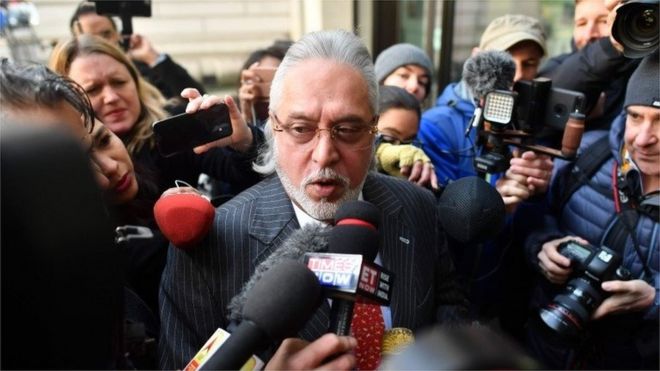
Vijay MallyaImage copyrightAFP/GETTY

Indian business tycoon Vijay Mallya should be extradited from the UK to India where he faces fraud charges, a London court has ruled.

The extradition ruling will be passed to the Home Secretary for approval.

Mr Mallya, whose business empire once included Kingfisher beer, left India in March 2016 after defaulting on debts of more than $1bn (£785m).

He denies “fleeing” from India, and says he made an “unconditional” offer to pay back the sum in full in July.

Mr Mallya attended Westminster Magistrates Court for the hearing.

The businessman’s fall from grace is being avidly tracked in India, where he was once listed as one of India’s wealthiest people.

Mr Mallya built his fortune from Kingfisher beer, before branching out into Indian cricket and Formula 1 racing. He set up the now defunct Kingfisher Airlines in 2005.

He faces a raft of charges relating to financial irregularities at Kingfisher Airlines. His monetary affairs are being investigated by India’s Central Bureau of Investigation and the Enforcement Directorate, which handles financial crimes.


Paul Blake, BBC Business Reporter, Westminster Magistrates Court

Vijay Mallya entered the court surrounded by a scrum of reporters shouting questions in English and Hindi.

As we stood in line for our turn at the x-ray machine, Mr Mallya told me that he believed “clearly this is extremely political, it’s really obvious”.

While awaiting his hearing, Mr Mallya paced around the corridors, intermittently sitting among reporters in the public gallery.

When his case was called, Mr Mallya heard a detailed judgement against him, which concluded with the judge saying he should be extradited to stand trial in India.

From the scrum to the judgement, Mallya appeared calm – relaxed even.

The case is now in the hands of Home Secretary, Sajid Javid.


In 2012, he sold a majority stake in his United Spirits group to UK drinks giant Diageo. The deal was supposed to help Mr Mallya reduce United Spirits’ debts and free up funds for Kingfisher Airlines.

But the airline, which was grounded in 2012, lost its flying permit the following year. It made annual losses for five years in a row and finally collapsed after lenders refused to give it fresh loans.

Mr Mallya’s total debts, including unpaid wages and operating costs, are estimated to exceed $1bn.

He is a high-profile figure who has in the past been called “India’s Richard Branson” and the “King of Good Times” for his lavish lifestyle.

10/12/2018

Urjit Patel: India’s central bank governor resigns

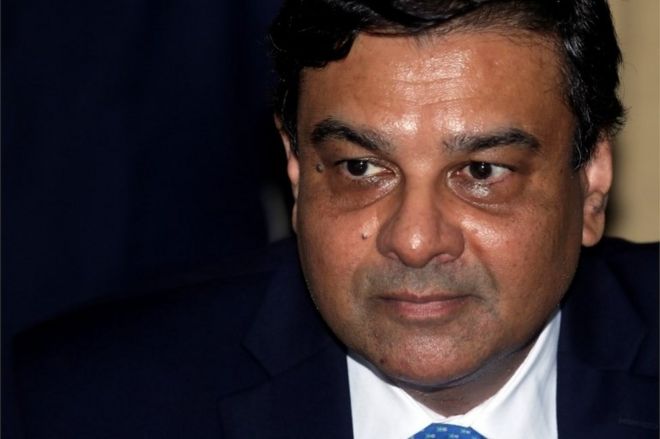
The Reserve Bank of India (RBI) Governor Urjit Patel arrives to attend a news conference after a monetary policy review in Mumbai, India, October 5, 2018. REUTERSImage copyrightREUTERS
Image captionRumours that Mr Patel was going to quit have been swirling around for weeks

India’s central bank governor Urjit Patel has resigned from his post citing “personal reasons”.

His resignation comes amid reports of a rift between the Reserve Bank of India (RBI) and Prime Minister Narendra Modi’s government,

This marks a rare case of a serving governor leaving his job midway through his five-year term.

Correspondents say the move is likely to undermine confidence in the economy and cause the rupee to fall.

In a statement, Mr Patel thanked his staff and officers, calling them the reason for the “bank’s considerable accomplishments in recent years”.

But speculation has been mounting for weeks that Mr Patel could resign over government pressure on the bank.

In late October, the RBI’s Deputy Governor Viral Acharya fired what appeared to be a broadside against attempts to undermine the bank’s independence.

“Governments that do not respect central bank independence will sooner or later incur the wrath of the financial markets, ignite economic fire, and come to rue the day they undermined an important regulatory institution,” he said.

The government reportedly wants the RBI to allow ailing state-owned banks, groaning under bad loans to industries, to resume lending to small businesses. It also wants the regulator to lower interest rates to inject much-needed liquidity into the economy.

Reports say the government also wants to access the RBI’s surplus reserves.

Fears for economy

Prime Minister Modi and Finance Minister Arun Jaitley have issued statements voicing appreciation for Mr Patel’s work.

Mr Modi tweeted that Mr Patel left behind a “great legacy” while Mr Jaitley described a “deep sense of appreciation” for him.

However, others have responded with concern.

A former governor of the RBI, Raghuram Rajan, said that Mr Patel’s resignation should be seen as a statement of protest. Former Finance Minister Yashwant Sinha said “the resignation is a clear sign of the government trying to interfere with the working of the RBI”.

“Although India’s $2.6tn (€2.3tn; £2tn) economy has recently been boosted by a strong performance in consumer spending and manufacturing, the rupee has fallen by about 15% against the surging dollar so far this year, private investment remains slack and there are doubts on whether the economy will accelerate further,” says the BBC’s Soutik Biswas.

“The trade deficit, inflation, and high oil and commodity prices are a major concern,” our correspondent adds.

10/12/2018

Violent veterans rally in China leads to 10 arrests

Ten suspects have been arrested for organising a “serious attack” on police officers during a veterans’ protest in northern China in October, according to state media.

According to People’s Daily, the accused organised a protest by 300 people from across the country, calling for better benefits for veterans, at a major public square in Pingdu, Shandong province.

During the assembly, some of the rally participants, led by the 10 suspects, acted violently towards the police and smashed police vehicles, the provincial police authority said, adding that their actions had caused injuries and led to substantial economic losses.

The report said 34 people, including an unknown number of police officers, were wounded in the violence, including two senior people officers who were seriously injured. In addition, a police bus and three private cars were destroyed.

More than 100 shops were forced to close during the rally and 11 buses had to change their routes to avoid the violence. Direct economic losses were estimated to have reached 8.2 million yuan (US$1.1 million).

The incident, on October 6, attracted the attention of the Ministry of Public Security as one of only a few large-scale examples of social unrest on the mainland over the past few years.

The People’s Daily report did not say if the 10 suspects were veterans, but local police said they had “complicated backgrounds” including criminal records in some cases.

All of the arrested are residents of Pingdu.

They are alleged to have used social media to contact people across the country and to have encouraged them to file petitions in Beijing during the “golden week” holiday, at the start of October, while posing as tourists.

They are also accused of spreading fake messages on social media after their plans were thwarted by authorities in Pingdu.

The suspects are reported to have told their followers they had been beaten up by government officials and encouraged them to support them by coming to the city.

At noon on October 6, about 300 people appeared at the People’s Hall square in Pingdu, waving banners and chanting slogans, although the report was unclear what they were calling for.

Two of the accused are said to have addressed the event, inciting people to use violence against the government.

One of the suspects, surnamed Ge, 46, was quoted as saying: “Bring wooden sticks and iron shovels with you. Hit their heads and beat them to death.”

Another suspect, surnamed Ji, 55, is alleged to have said: “We should kill more people to shock the whole nation”, according to the report.

Police said the suspects hired cars to take 105 sticks, 60 hammers, 16 dry powder extinguishers and a bag of talcum powder to the assembly site.

According to a local government statement, offers to negotiate with the protesters were rejected. The demonstrators also refused to leave the square until they received financial compensation from the government.

The conflict is believed to have been triggered when police tried to stop people crossing a cordon to join the 30 protesters originally within the square.

A tussle ensued and eight people were taken to a police bus parked nearby.

Several minutes later, three of the suspects are said to have led 60 protesters in an attack on the police. The windows of the police bus were smashed and the fire extinguisher was discharged into the vehicle, forcing police officers and the eight detained protesters to climb on to the roof of the bus to escape the fumes.

According to the report, the protesters threw stones at the police officers while also continuing to spray them with the fire extinguisher.

The police officers behaved in accordance with the law throughout the riot, which lasted for 11 minutes, the report said.

The report did not say how many people who took part in the rally were veterans.

Police said one of the suspects, surnamed Zheng, had previously been jailed for obstructing police and provoking trouble. Another suspect, surnamed Yang, had previously been caught with drugs.

Police also said a suspect surnamed Liu had been jailed for two years for theft, while another, surnamed Ge, had previously been sentenced to two years in jail for fraud.

Veterans have been an important issue for the mainland authorities this year, with the establishment in April of the new Ministry of Veterans Affairs.

The ministry has been collecting personal information from veterans across the country between August and December, as a “first step” in developing a policy on what packages veterans will receive from China’s governments in future, according to officials.

Last month the ministry and the Communist Party’s Central Propaganda Department spearheaded a nationwide role model campaign in which the nation’s 10 “most beautiful veterans” were selected.

10/12/2018

Rivals and neighbours: China and India count down to joint military drill

In addition, Chinese State Councillor and Foreign Minister Wang Yi will visit India later this month to launch a forum for high-level exchanges between China and India.

But there is still various sources of friction, including a growing maritime rivalry.

Long Chunxing, a visiting scholar and Southeast Asian affairs specialist at the S. Rajaratnam School of International Studies in Singapore, said the military exchanges would not resolve mistrust but could help prevent differences from escalating into another conflict.

“China’s reluctance to allow India into the Nuclear Suppliers Group and refusal to agree on a US ban to list Masood Azhar as a terrorist have upset India,” Long said, referring to the founder and leader of Jaish e-Mohammed, designated by the United Nations as a terrorist group and active mainly in Pakistan-administered Azad Kashmir.

At the same time, China and India are strengthening their capacity to project power at sea.

Indian media reported last week that the Indian Navy was planning to add ships, helicopters and fixed-wing planes, and expand its base in Chennai to bolster its presence in the southern part of the Bay of Bengal.

China, meanwhile, has expanded its military presence in the Indian Ocean to help safeguard its growing interests overseas.

In a report in April, the US-based think tank the Centre for Strategic and International Studies said those interests included defending vital trade routes, particularly for energy supplies.

Collin Koh, a research fellow also at the S. Rajaratnam School of International Studies, said the Indian Navy’s build-up increased the chance of interaction between Indian and foreign forces, including those from China.

Koh said these interactions were generally professional and safe but there was a chance of confrontation.

“The risk of untoward incidents would largely tie in with broader bilateral tensions, such as over the land border issue or if there are upheavals in the neighbouring Indian Ocean littoral states, and it has been reported the People’s Liberation Army Navy [of China] has monitored Indian Navy warships traversing those waters in the South China Sea too,” he said.

But Rajeev Ranjan Chaturvedy, a research associate at the Institute of South Asian Studies at the National University of Singapore, said India’s naval build-up would not directly affect China’s growing military presence.

He also said the Indian navy’s reliability and confidence would grow further in handling regional security challenges.

Law of Unintended Consequences

continuously updated blog about China & India

ChiaHou's Book Reviews

continuously updated blog about China & India

What's wrong with the world; and its economy

continuously updated blog about China & India