Archive for ‘United States’

25/02/2019

Huawei says Trump ‘clear and correct’ on 5G as trade deadline looms

(This Feb. 24 story corrects paragraph 12 to show Huawei was world’s third-largest smartphone vendor last year, not second largest)

BARCELONA (Reuters) – China’s Huawei welcomed comments from President Donald Trump about the future of U.S. mobile communications on Sunday and asserted its position as a world-leading smartphone producer as Washington and Beijing seek a trade war ceasefire.


At the center of the imbroglio is Huawei Technologies, accused by Washington of sanctions busting, intellectual property theft and facilitating Chinese state espionage operations.

Speaking ahead of the mobile industry’s biggest global event which begins in Barcelona on Monday, Huawei Chairman Guo Ping reiterated his company’s position that it has never and would never allow any country to spy through its equipment.

Guo, who holds Huawei’s rotating chairmanship, said Trump’s recent assertion that the United States needed to get ahead in mobile communications through competition rather than seeking to block technology was “clear and correct”.


Trump’s tweets on Thursday did not specifically mention Huawei, the world’s largest producer of mobile network equipment, but appeared to soften earlier U.S. statements that it should be barred from Western networks on security grounds.

“I have noticed the president’s Twitter, he said that the U.S. needs faster and smarter 5G, or even 6G in the future, and he has realized that the U.S. is lagging behind in this respect, and I think his message is clear and correct,” Guo said, speaking through an interpreter.

He said the United States did not represent the whole world and called for equipment makers, network operators and governments to work together to devise trustworthy standards to manage cyber security risks.

The Huawei logo is displayed ahead of the Mobile World Congress (MWC 19) in Barcelona, Spain, February 24, 2019. REUTERS/Sergio Perez

“We need to have unified standard that should be verifiable. It should not be based on politics,” Guo said.

FOLDING PHONE, RIGID PRICE TAG

Huawei also sought to reaffirm its position as one of the world’s leading technology companies, unveiling a folding 5G smartphone to an audience of media and analysts in Barcelona.

Huawei, the world’s third-largest smartphone vendor after Samsung and Apple, said it had taken the lead in developing phones for 5G – which promises super-fast internet speeds – because it was also involved in developing the networks.

Folding phones?
Makers pray you’ll want one
The new Huawei Mate X will have two back-to-back screens which unfold to become an eight-inch tablet display, and goes on sale later this year priced at 2,299 euros ($2,607), setting a new upper limit for consumer smartphones.
Samsung had unveiled its own folding smartphone last week, priced at nearly $2,000, as part of a bid to top the technology of Chinese rivals and Apple Inc.
Thomas Husson, principal analyst at Forrester Research, said the Mate X showed Huawei was an innovative technology company and no longer trailing American and Korean competitors.
“The fact that Huawei is not just a network equipment provider but also a smartphone manufacturer … gives them a competitive advantage for 5G. It is also a double-edge sword as some argue the security risks are higher,” Husson said.
China’s Xiaomi, the world’s fourth-largest smartphone maker, also unveiled a 5G handset on Sunday, but without the folding screen or high price tags touted by the Huawei and Samsung devices. Xiaomi’s offering will start at 599 euros ($679) when it hits the market in May.
Source: Reuters
23/02/2019

Trump says he’s inclined to extend China trade deadline and meet Xi soon

WASHINGTON (Reuters) – President Donald Trump said on Friday there was “a very good chance” the United States would strike a deal with China to end their trade war and that he was inclined to extend his March 1 tariff deadline and meet soon with Chinese President Xi Jinping.

“I think that we both feel there’s a very good chance a deal will happen,” Trump said.

Liu agreed there had been “great progress”.

“From China, we believe that (it) is very likely that it will happen and we hope that ultimately we’ll have a deal. And the Chinese side is ready to make our utmost effort,” he said at the White House.

The Republican president said he probably would meet with Xi in March in Florida to decide on the most important terms of a trade deal.


Optimism that the two sides will find a way to end the trade war lifted stocks, especially technology shares. The S&P 500 stock index reached its highest closing level since Nov. 8. Oil prices rose to their highest since mid-November, with Brent crude reaching a high of $67.73 a barrel. [.N] [O/R]

CURRENCY AGREEMENT

Trump and Treasury Secretary Steven Mnuchin said the two sides had reached an agreement on currency. Trump declined to provide details, but U.S. officials long have expressed concerns that China’s yuan is undervalued, giving China a trade advantage and partly offsetting U.S. tariffs.

Announcement of a pact aimed at limiting yuan depreciation was putting “the currency cart before the trade horse,” but would likely be positive for Asian emerging market currencies, said Alan Ruskin, global head of currency strategy at Deutsche Bank in New York.

“How can you agree to avoid excessive Chinese yuan depreciation or volatility if you have not made an agreement on trade that could have huge FX implications?” Ruskin asked in a note to clients.

In a letter to Trump read aloud by an aide to Liu at the White House, Xi called on negotiators to work hard to strike a deal that benefits both country.

Trump said a deal with China may extend beyond trade to encompass Chinese telecommunications companies Huawei Technologies and ZTE Corp.

The Justice Department has accused Huawei of conspiring to violate U.S. sanctions on Iran and of stealing robotic technology from T-Mobile US Inc.

Chinese peer ZTE was last year prevented from buying essential components from U.S. firms after pleading guilty to similar charges, crippling its operations.

MEMORANDUMS NO MORE

Trump appeared at odds with his top negotiator, U.S. Trade Representative Robert Lighthizer, on the preliminary terms that his team is outlining in memorandums of understanding for a deal with China. Trump said he did not like MOUs because they are short term, and he wanted a long-term deal.

“I don’t like MOUs because they don’t mean anything,” Trump said. “Either you are going to make a deal or you’re not.”

Lighthizer responded testily that MOUs were binding, but that he would never use the term again.

Reuters reported exclusively on Wednesday that the two sides were drafting the language for six MOUs covering the most difficult issues in the trade talks that would require structural economic change in China.

Negotiators have struggled this week to agree on specific language within those memorandums to address tough U.S. demands, according to sources familiar with the talks. The six memorandums include cyber theft, intellectual property rights, services, agriculture and non-tariff barriers to trade, including subsidies.

An industry source briefed on the talks said both sides have narrowed differences on intellectual property rights, market access and narrowing a nearly $400 billion U.S. trade deficit with China. But bigger differences remain on changes to China’s treatment of state-owned enterprises, subsidies, forced technology transfers and cyber theft of U.S. trade secrets.

Lighthizer pushed back when questioned on forced technology transfers, saying the two sides made “a lot of progress” on the issue, but did not elaborate.

The United States has said foreign firms in China are often coerced to transfer their technology to Chinese firms if they want to operate there. China denies this.

The U.S. Chamber of Commerce on Friday urged the U.S. government to ensure the deal was comprehensive and addressed core issues, rather than one based on more Chinese short-term purchases of goods.

China has pledged to increase purchases of agricultural produce, energy, semiconductors and industrial goods to reduce its trade surplus with the United States.

China committed to buying an additional 10 million tonnes of U.S. soybeans on Friday, U.S. Agriculture Secretary Sonny Perdue said on Twitter. China bought about 32 million tonnes of U.S. soybeans in 2017. The commitments are a “show of good faith by the Chinese” and “indications of more good news to come,” Perdue wrote.

China was the top buyer of U.S. soybeans before the trade war, but Beijing’s retaliatory tariffs on U.S. soybeans slashed business that had been worth $12 billion annually.

Source: Reuters

22/02/2019

“Don’t mess with Pakistan,” India is told amid Kashmir tension

RAWALPINDI, Pakistan (Reuters) – Pakistan will respond to any attack by India with “full force”, the army’s spokesman said on Friday, amid heightened tensions between the two nuclear-armed neighbours over Kashmir.

Major General Asif Ghafoor was speaking a week after a Pakistani-based militant group claimed responsibility for a suicide car bomb attack that killed 40 Indian paramilitary policemen the Himalayan region disputed between India and Pakistan.

India’s top military commander in the region has alleged Pakistan’s main Inter-Services Intelligence (ISI) spy agency was involved.

“We have no intention to initiate war, but we will respond with full force to full spectrum threat that would surprise you,” Ghafoor told reporters in the garrison city of Rawalpindi. “Don’t mess with Pakistan.”

The army’s response came two days after Prime Minister Imran Khan urged India to share any actionable evidence, offering full cooperation in investigating the blast.

He also offered talks with India on all issues, including terrorism, which India has always sought as a pre-requisite to any dialogue between the two arch-rivals.

India and Pakistan have fought two wars since independence in 1947 over Kashmir, which both the countries claim entirely.

Ghafoor also reiterated the talks offer.

“Kashmir is a regional issue,” he said. “Let us talk about it. Let us resolve it.”

India blames Pakistani Islamist militant groups for infiltrating into its part of Kashmir to fuel an insurgency and help separatist movements.

Washington and Delhi allege that the Pakistani army nurtures the militants to use them as a foreign policy tools to expand power in neighbouring India and Afghanistan. The army denies that.

One such group is Lashkar-e-Taiba (LeT), which India blamed for attacks in Mumbai in 2008 which killed 166 people, saying its founder, Hafiz Saeed, was the mastermind.

The United States has offered a $10 million reward for information leading to his conviction over the Mumbai attacks.

Pakistan has put him under house arrest several times and banned his Islamist groups, Jamaat-ud-Dawa (JuD) and Falah-e-Insaniat Foundation (FIF), which the United States and the United Nations say are terrorist fronts for the LeT.

Islamabad reinstated the ban on the groups yet again on Thursday, but Saeed remains free, allowed to roam the country and make public speeches and give sermons.

Source: Reuters

20/02/2019

China to deepen reforms of agriculture sector to boost rural areas

  • Policy statement outlines broad goals including plan to revive domestic soybean production
A farmer picks tea leaves in Mianxian county, Shaanxi province. Beijing’s policy document reiterated a strategy to improve income levels and living standards in China’s countryside. Photo: Xinhua
China will deepen reforms of its agriculture sector to promote its rural economy, the government said in its first policy statement of 2019, as it seeks to bolster growth and offset trade challenges.

Beijing’s statement, released late on Tuesday, comes after the world’s second-largest economy saw its weakest growth in 28 years in 2018 and remains entangled in a trade war with Washington.

“Under the complicated situation of increasing downward pressure on the economy and profound changes in the external environment, it is of special importance to do a good job in agriculture and rural areas,” the government said in the document issued by the State Council and published by official news agency Xinhua.

The biggest winners in Shenzhen, ‘China’s Silicon Valley’? Pig and chicken farmers

Known as the “No 1 document”, this year’s policy reiterated a rural rejuvenation strategy first laid out in 2017 to improve income levels and living standards in China’s countryside.

It also highlighted a plan to boost domestic soybean production but did not offer further details.

Chinese President Xi Jinping visits a farm in northeastern Heilongjiang province during an inspection tour in September. Photo: Xinhua via AP

Industry analysts said on Wednesday they were eagerly awaiting further details to assess the impact of the plan, which had already been flagged by Agriculture Minister Han Changfu earlier this month.

China has been overhauling its crop structure in recent years, reducing support for corn after stocks ballooned, and seeking to promote more planting of oilseeds that it mostly imports.

That goal has become increasingly important since a trade war with the United States, which led China to slap tariffs on soybean imports, tightening domestic supplies.

Han has previously urged authorities in China’s northeast to support soybean production through subsidies and called for rotating of soybeans with other crops including corn and wheat.

Beijing also aims to support the production of rapeseed in the Yangtze River Basin, according to the document.

The garlic case that foreshadowed the US-China trade war

As in previous years, it also called for stable grain production, but also an increase in imports of agriculture products where there are shortages in the domestic market.

“The focus now is on retaining production capacity, in the form of high quality farmland, and using the international market to make up production shortfalls,” said Even Rogers Pay, an agriculture analyst at China Policy, a Beijing-based consultancy.

The reference to imports is positive for trade partners like the United States, said Cherry Zhang, analyst with Shanghai JC Intelligence, who said it raised the likelihood that China will buy more US agriculture products.

China’s DJI turns its eye to enterprise uses like agriculture after conquering global commercial drone market

Shares of Chinese livestock companies, along with pig and poultry breeders, rose on Wednesday following the release of the policy paper.

The document also outlines plans to accelerate development of a new farm subsidy policy system and further crack down on the smuggling of agriculture products.

Additionally, the government said it plans to strengthen the monitoring and control of African swine fever outbreaks, after more than 100 cases were reported in China since August.

Other plans include continuing to tackle rural pollution and promoting recycling of agricultural waste such as manure and agricultural film.

Source: SCMP

15/02/2019

Seizing on Huawei’s troubles, Samsung bets big on network gear

SEOUL (Reuters) – Samsung Electronics is pouring resources into its telecom network equipment business, aiming to capitalize on the security fears hobbling China’s Huawei, according to company officials and other industry executives.

Those efforts include moving high-performing managers and numerous employees to the network division from its handset unit, two Samsung sources said.
Potential customers are taking notice of Samsung’s efforts to reinvent itself as a top-tier supplier for 5G wireless networks and bridge a big gap with market leader Huawei and industry heavyweights Ericsson and Nokia.
French carrier Orange’s chief technology officer, Mari-Noëlle Jégo-Laveissière, visited Japan last year and was impressed with the pace of 5G preparations using alternative equipment makers including Samsung, a company representative told Reuters.

Orange, which operates in 27 markets and counts Huawei as its top equipment supplier, will run its first French 5G tests with Samsung this year.

Underscoring the growing importance of the business, South Korean Prime Minister Lee Nak-yeon visited Samsung’s network division in January. In a closed-door meeting during that visit, Samsung heir Jay Y. Lee asked for government help with recruiting high-level engineers.
Huawei is battling allegations by the United States and some other Western countries that its equipment could enable Chinese spying and should not be used in 5G networks, which will offer higher speeds and a host of new services.
Australia and New Zealand have joined the United States in effectively barring Huawei from 5G, and many other countries, especially in Europe, are considering a ban. Huawei denies that its gear presents any security risk.
Its woes have presented Samsung with a rare opportunity. Telecom firms would ordinarily stick with their 4G providers for 5G upgrades as they can use existing gear to minimize costs, but many firms may now be under political pressure to switch.

“We’re bolstering our network business to seize market opportunities arising at a time when Huawei is the subject of warnings about security,” said one of the Samsung sources.

The sources, who did not disclose specific figures for the employee moves, declined to be identified as they were not authorized to speak on the matter.

Keen to seek new growth, particularly as sales of its mainstay chips and smartphones have begun to drop, Samsung plans to invest $22 billion in 5G mobile technology and other fields over three years. It declined to break down how much will go to 5G and the other areas – artificial intelligence, biopharma and automotive electronic parts.

“Samsung is focused on building trust with our partners and leading the global 5G markets, regardless of other companies,” it said in an emailed statement to Reuters.

Asked about Samsung’s big push into network equipment, Huawei said in a statement that it welcomed competition in the market.

INDIA OPPORTUNITY

In India, Samsung is now in talks with Reliance Jio to upgrade its network to 5G, looking to build on what has perhaps been its biggest network success – becoming the key supplier for the upstart carrier.

“We don’t think 5G is far away in India,” a Samsung official with direct knowledge of the matter told Reuters. He declined to be named due to the sensitivity of the matter.

Samsung’s clients include U.S. firms AT&T Inc, Verizon Communications Inc and Sprint Corp and it has 5G network contracts with all three, though it was not clear how extensive those contracts are. It also sells to South Korean carriers and has partnered with Japanese mobile carriers to test its 5G equipment.

In many cases, Samsung supplies only small pieces of networks. According to market tracker Dell’Oro Group, the South Korean firm holds just 3 percent of the global telecom infrastructure market compared with 28 percent for Huawei.

Its network business made 870 billion won ($775 million) in operating profit last year, according to Eugene Investment & Securities. Filings show Nokia’s network business made about 1.2 billion euros ($1.4 billion) while Ericsson’s network operations made 19.4 billion Swedish crowns ($2.1 billion). Figures for Huawei were not available.

FINDING THE PEOPLE

One major hurdle for Samsung will be attracting talent amid a dearth of software engineers in South Korea.

“We need more software engineers and want to work with the government to find that talent,” Lee was quoted as saying by government officials at his meeting with the prime minister.

Samsung’s network business unit employs roughly 5,000 people, according to a government official in the southern city of Gumi where Samsung operates its manufacturing plants.

Kim Young-woo, an analyst at SK Securities, expects Samsung to hire 1,000-1,500 people for 5G network equipment this year. Samsung declined to comment on network employee levels and hiring plans.

But Samsung’s bet remains risky as the long-term nature of telecom network investment means change comes slowly.

Sweden’s Ericsson and Finland’s Nokia, which acquired the remnants of once-powerful network equipment companies Alcatel-Lucent and Nortel, have as yet seen little sales growth from Huawei’s problems, company executives said.

Both are in cost-cutting mode, even in the face of the 5G opportunity and the problems confronting their biggest rival.

Indeed, some network operators in Europe are warning that a Huawei ban – now under consideration in France, the UK, Germany and other countries – could push back deployment of 5G by as much as three years.

Others warn Samsung may struggle to develop a global sales and support organization.

“The way telcos purchase products and services from their suppliers demand a lot of time and resources, which is why Ericsson and Nokia have around 100,000 employees and Huawei almost twice as many,” said Bengt Nordstrom, CEO of telecom consultancy Northstream.

But Samsung is taking the long view. In December, it agreed to extend its Olympic partnership with the International Olympic Committee through to 2028 and expand its sponsorship to 5G technology.

The company did not want to leave its sponsorship spot open to Chinese rivals, a separate source with knowledge of the matter said.

“If Samsung dropped the top mobile sponsorship for the Olympic games beyond 2020, then who would have taken that spot? It would only have been China, Huawei.”

($1 = 1,122.8000 won)

Source: Reuters

14/02/2019

Pakistan and China build friendship ties at Aman – 19 multinational naval exercise but no room for India on the guest list

  • Chinese naval commander says war games strengthened mutual understanding and trust
  • Drills included protection of strategic projects such as China-Pakistan economic corridor
PUBLISHED : Thursday, 14 February, 2019, 8:02pm
UPDATED : Thursday, 14 February, 2019, 8:02pm

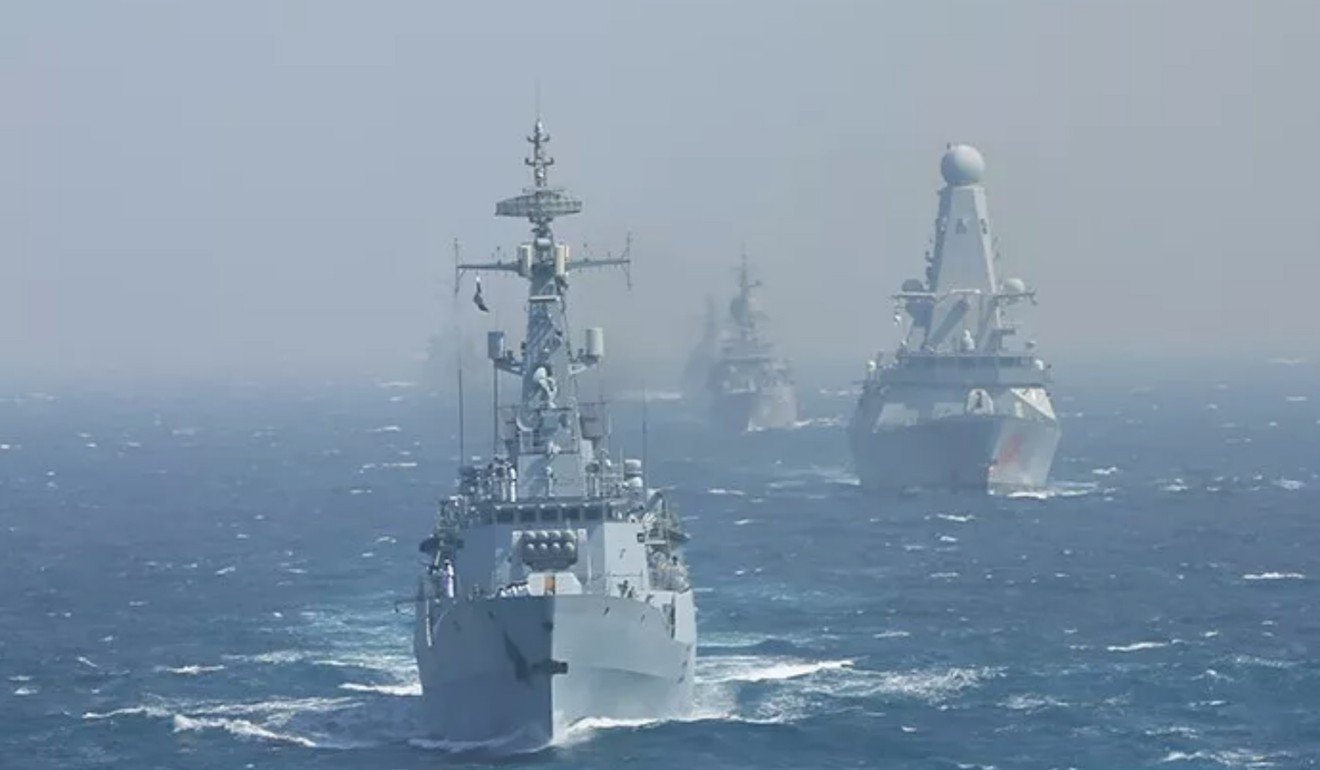
Pakistan’s multinational naval drill involving 46 nations has wrapped up in the Indian Ocean and, once again, India was not invited.

The Pakistan Navy has hosted the Aman – which means “peace” – exercises every two years since 2007 to promote regional cooperation and stability. India has never been invited, in a sign of the long history of strained ties between the neighbours.

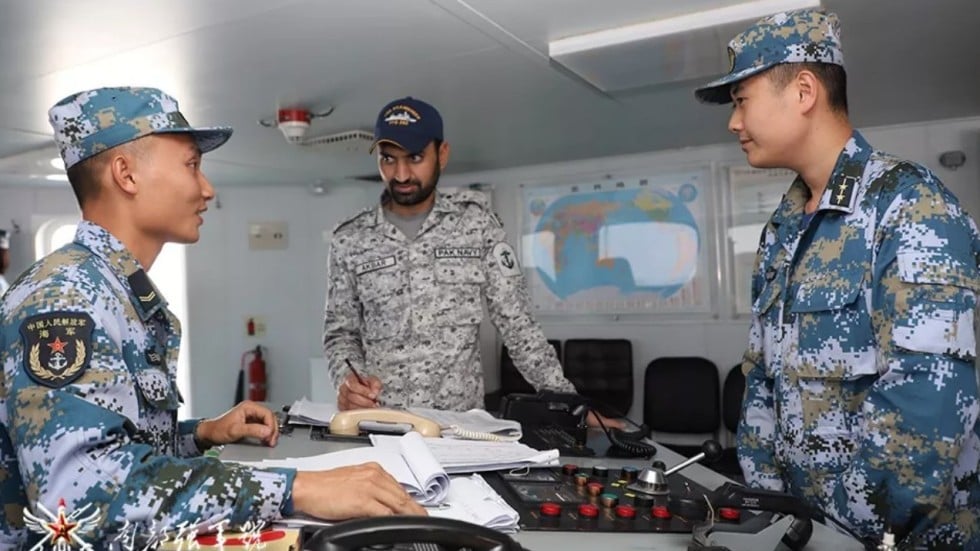
China, Japan and the United States were among the countries taking part in Aman-19, from February 8 to 12, which included maritime conferences, seminars and cross-ship visits, as well as 23 sea operations with main-gun firing, formation movement and replenishment-at-sea.

Shao Shuguang, commander of the People’s Liberation Army Navy’s 998 Fleet, was quoted on a Chinese military social media account as saying the exercise had strengthened mutual understanding and trust between the participating navies.

China sent one of its biggest warships, the Kunlun Shan amphibious landing vessel, to the exercise, signalling its close relationship with Pakistan and the key role both nations hold in the Indian Ocean, according to analysts.

“The Pakistan-China relationship is very strong, and this is one more illustration of the strength of the Pakistan-China relationship,” said Madhav Das Nalapat, honorary director of the department of geopolitics and international relations at Manipal University in India.

“China is also now becoming an important maritime power, especially in the Indo-Pacific. By aligning with China, Pakistan hopes to get the synergy of that.

“India by itself cannot have any primacy in the Indian Ocean. But along with the United States, the two countries together can have primacy in the Indian Ocean. India is positioning itself to be allied with the US, but has not yet reached there.”

Tridivesh Singh Maini, assistant professor with the Jindal School of International Affairs in India, said the exercises should be a cause for alarm for India. “They will keep an eye on what’s going on, but they don’t need to be too concerned,” he said.

The military exercise also centred on maritime security to protect strategic economic projects such as the China-Pakistan Economic Corridor, as well as sea lanes from the Persian Gulf.

The US$62 billion China-Pakistan Economic Corridor (CPEC) is designed to connect China’s far west region of Xinjiang with Gwadar Port in Pakistan via a network of motorways, railways, oil pipelines and trading hubs.

The project is expected to be finished by 2030, and will provide China with an important trading route to the Middle East and Africa.

“India has very strenuously objected to the name CPEC being given to the part that goes through Pakistan-occupied Kashmir, but so far nothing has been done,” Nalapat said.

Kashmir has long been a hotbed for competing territorial claims between India and Pakistan. The two countries have fought three wars against each other since their independence from Britain in 1947, and two of those conflicts have centred on the Kashmir territorial dispute.

Source: SCMP

Law of Unintended Consequences

continuously updated blog about China & India

ChiaHou's Book Reviews

continuously updated blog about China & India

What's wrong with the world; and its economy

continuously updated blog about China & India