Archive for ‘universities’

27/03/2020

Across China: Chinese universities adopt online dissertation defense to ensure on-time graduation

CHANGSHA, March 26 (Xinhua) — Du Xu, a postgraduate from Central South University of Forestry and Technology (CSUFT), turned on his laptop and prepared for his dissertation pre-defense online.

While at home in eastern China’s Shandong Province, Du presented his dissertation to five professors for the first time through the remote video connection.

“Half a month ago, the university informed us to prepare an online pre-defense, find out the tutors’ opinions on the first draft and then revise it,” the 26-year-old said. Although he had experience with an opening thesis defense and other face-to-face forms, he was not familiar with the process of online defense, which made him feel nervous.

According to the CSUFT, all the postgraduate dissertations must be pre-defended before being submitted for examination to ensure the quality. The graduate school of the university adjusted the arrangement amid the epidemic. Online defense started on Feb. 10 to ensure that the graduate students could graduate on time.

“Since our defense is open and anyone can click the link to join, there were 55 students online when I spoke,” Du said. The open online defense can help us check missing key points and learn from each other. Some students also recorded the defense process to follow up on the comments of the tutor to further modify their dissertation, according to Du.

The university said the pre-defense would be submitted via the Internet, and the degree management office has set up an online platform for it.

Feng Jiajin, a graduate of the Hunan Railway Professional Technology College (HRPTC), who works as an intern at the Nanchang Railway Bureau in eastern China’s Jiangxi Province, also needs to demonstrate his graduation project through an online defense.

On March 18, Feng launched a video conference for his final project defense in the office via software on his mobile phone during his lunch break. More than 10 teachers from his college attended the meeting.

In front of the camera, Feng talked about his graduation project “Ultrasonic Ranging and Reversing System” and displayed the slides on the screen with explanations.

When displaying his final product, he showed the results of the graduation project in different situations.

“Vocational schools focus on students’ practical ability. Before the formal defense, the instructor first reviewed the students’ graduation projects and the statements. Only when the work is qualified are the students are allowed to participate in the defense and display,” said Xiong Yi with HRPTC.

According to the college, members of the dissertation defense committee ask questions about the relevant theoretical knowledge and the design methods, which the students should answer one by one. Finally, the members of the defense committee discuss the defense process and results. The results will be announced after a secret ballot. The entire process of the dissertation defense will be recorded, screenshot and saved as the defense record.

“The outbreak of coronavirus won’t affect the students’ graduation and seeking employment. Before the start of the new semester, the university will use online defense to ensure their graduation on time,” said Zhang Ying, vice president of HRPTC, adding that in March, the school will have more than 600 graduates participate in online defense.

Source: Xinhua

26/03/2020

Over 800 people stranded in Hubei return to Beijing

CHINA-BEIJING-HUBEI-STRANDED PEOPLE-RETURN (CN)

People returning from Hubei arrive at the Beijing West Railway Station in Beijing, capital of China, March 25, 2020. The first batch of over 800 people stranded in virus-hit Hubei Province has arrived in Beijing Wednesday afternoon after Hubei lifted outbound travel restrictions in all areas except the capital city Wuhan starting from Wednesday. (Xinhua/Zhang Chenlin)

BEIJING, March 25 (Xinhua) — The first batch of over 800 people stranded in virus-hit Hubei Province has arrived in Beijing Wednesday afternoon after Hubei lifted outbound travel restrictions in all areas except the capital city Wuhan starting from Wednesday.

The transport of the people was carried out in a well-organized and spot-to-spot way, said Chen Bei, deputy secretary-general of the Beijing municipal government, at a press conference Wednesday.

There are still more than 20,000 teachers and students from Beijing schools and universities stranded in Hubei, according to Chen.

Chen said those who have a fixed residence in Beijing can apply to return to their homes while those who do not still need to wait for further arrangements after the announcement of school and university reopening.

Source: Xinhua

25/03/2020

Coronavirus: India enters ‘total lockdown’ after spike in cases

People panicked after the prime minister said everyone should “forget about” leaving their homes for any reason

India’s Prime Minister Narendra Modi has imposed a nationwide lockdown in an attempt to slow the spread of the coronavirus.

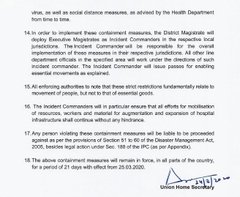
The restrictions came into force at midnight local time (18:30 GMT) and will be enforced for 21 days.

“There will be a total ban on venturing out of your homes,” Mr Modi said in a televised address.

He appealed for people not to panic – but crowds quickly mobbed stores in the capital, Delhi, and other cities.

Correspondents say it is not clear how – or even if – people will now be allowed out to buy food and other essentials.

The new measures follow a sharp increase in cases in recent days. There have been 519 confirmed cases across India and 10 reported deaths.

India – which has a population of 1.3bn – joins a growing list of countries that have imposed similar measures.

Nearly 400,000 people have tested positive for the virus worldwide, and around 17,000 have died.

Banner image reading 'more about coronavirus'
Banner

“The entire country will be in lockdown, total lockdown,” Mr Modi said on Tuesday.

He added: “To save India, to save its every citizen, you, your family… every street, every neighbourhood is being put under lockdown.”

Mr Modi warned that if India does not “handle these 21 days well, then our country… will go backwards by 21 years”.

“This is a curfew,” he said. “We will have to pay the economic cost of this but [it] is the responsibility of everyone.”

Media caption We explain why staying in is a matter of life and death

Mr Modi later warned that panic-buying would only spread the disease. He said the government would ensure supplies.

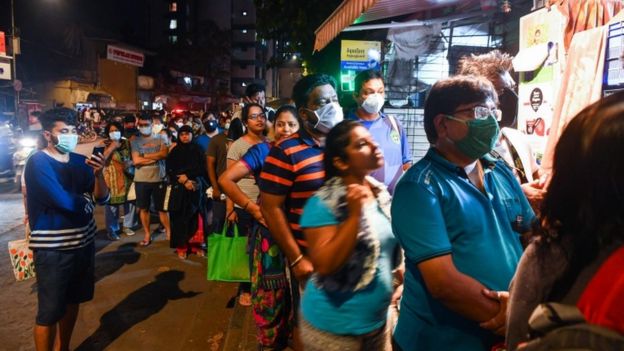
But in Delhi and the financial capital, Mumbai, people fearing shortages quickly thronged shops and pharmacies.

“I have never witnessed such a chaos in my life,” the owner of one store in the Shakarpur district of Delhi said, quoted by the Press Trust of India.

“All our stocks, including rice, flour, bread, biscuits, edible oils, have been sold out.”

Police in the busy city of Ghaziabad, in Uttar Pradesh state, patrolled the streets with megaphones to tell residents to stay indoors.

People line up outside a store in Mumbai on March 24, 2020.Image copyright AFP
Image caption People in Mumbai rushed to stock up on essentials following Mr Modi’s address

Under the new measures, all non-essential businesses will be closed but hospitals and other medical facilities will continue to function as normal. Schools and universities will remain shut and almost all public gatherings will be banned.

Anyone flouting the new rules faces up to two years in prison and heavy fines.

In his address, Prime Minister Modi also:

  • Stressed that the 21-day lockdown was “very necessary to break the chain of coronavirus”
  • Emphasised the seriousness of the situation and said that even developed countries had faced problems in combating it
  • Said that “social distancing was the only way to stop” the virus spreading
  • Announced that nearly $2bn (£1.8bn) would be made available to boost the country’s health infrastructure
  • Called on people not to “spread rumours” and to follow instructions

His announcement came after several Indian states introduced measures of their own, such as travel restrictions and the closure of non-essential services.

India has already issued a ban on international arrivals and grounded domestic flights. The country’s rail network has also suspended most passenger services.

Presentational grey line
Analysis box by Rajini Vaidyanathan, South Asia correspondent

Many parts of India, including cities such as Delhi and Mumbai, are already under tight restrictions. But this move extends those provisions to every corner of the country.

An earlier one-day curfew, which was seen as a trial, was flouted by many.

Mr Modi called on Indians to clap and cheer the emergency services from their balconies on Sunday. But many misunderstood the call and congregated in the streets as they danced and chanted.

“It’s impossible to fathom the cost that India may have to pay if such irresponsible behaviour continues,” Mr Modi warned at the time. “Social distancing is the only option to combat coronavirus.”

The implications of a total lockdown in India are huge, not just economically, but socially.

This is a nation where community is everything. Going to worship at a temple, mosque or church is an essential part of daily life for so many.

This is a seismic cultural shift but – like the rest of the world facing similar restrictions – a necessary one.Presentational grey line

What’s the latest from around Asia?

  • Neighbouring Pakistan has almost twice as many confirmed cases – 878 as of Monday evening. Sweeping restrictions are in place although the government has stopped short of imposing a nationwide lockdown. However, several provinces have announced them independently. The army is being brought in to help enforce the restrictions
  • Bangladesh, which has reported 33 cases and three deaths, is also deploying its armed forces to help maintain social distancing and boost Covid-19 preventive measures. The soldiers will also monitor thousands of quarantined expatriate returnees. Across South Asia, there are concerns that the actual number of cases could be much higher than is being reported.
  • Indonesia, which has 49 confirmed Covid-19 deaths – the highest in South East Asia – has converted an athlete’s village built for the 2018 Asian Games into a makeshift hospital for coronavirus patients. A state of emergency was declared in Jakarta on Monday
  • In Thailand, a month-long state of emergency which will include curfews and checkpoints will begin on Thursday. The government has been criticised for failing to take strong action so far. Four people have died and nearly 900 tested positive
  • The most populous country that was without a case until now – Myanmar – has announced two cases

And what about the rest of the world?

  • Elsewhere, governments are continuing to work to stem the spread of the virus which has now affected more than 190 countries worldwide
  • More than 2.6 billion people are in lockdown now India has introduced its new measures, according to a tally by the AFP news agency
Media caption Reality Check tackles misleading health advice being shared online
  • Europe remains at the epicentre of the pandemic. On Tuesday, the death toll jumped by 514 in a single day in Spain and other European countries also reported sharp increases
  • Italy is the worst affected country in the world in terms of deaths. The virus has killed almost 7,000 people there over the past month
  • The UK, meanwhile, is spending its first day under tight new restrictions. Prime Minister Boris Johnson announced unprecedented measures on Monday and ordered the immediate closure of shops selling non-essential goods
  • And in the US, New York’s governor has said the federal government is not sending enough equipment to combat the crisis. The state has been hit especially hard by the virus
  • The World Health Organization (WHO) has warned that the US has the potential to become the new epicentre of the pandemic
  • In other developments, Japanese Prime Minister Shinzo Abe said the International Olympic Committee has agreed that the 2020 Tokyo Olympics should be postponed by a year
  • Source: The BBC
16/03/2020

As coronavirus spreads in Africa, countries move quickly to contain disease with travel bans, closures

  • South Africa, Kenya latest to halt arrivals from ‘high-risk’ countries as cases across the continent double over the weekend
  • Concerns are growing over whether health care systems in some African nations will be able to cope
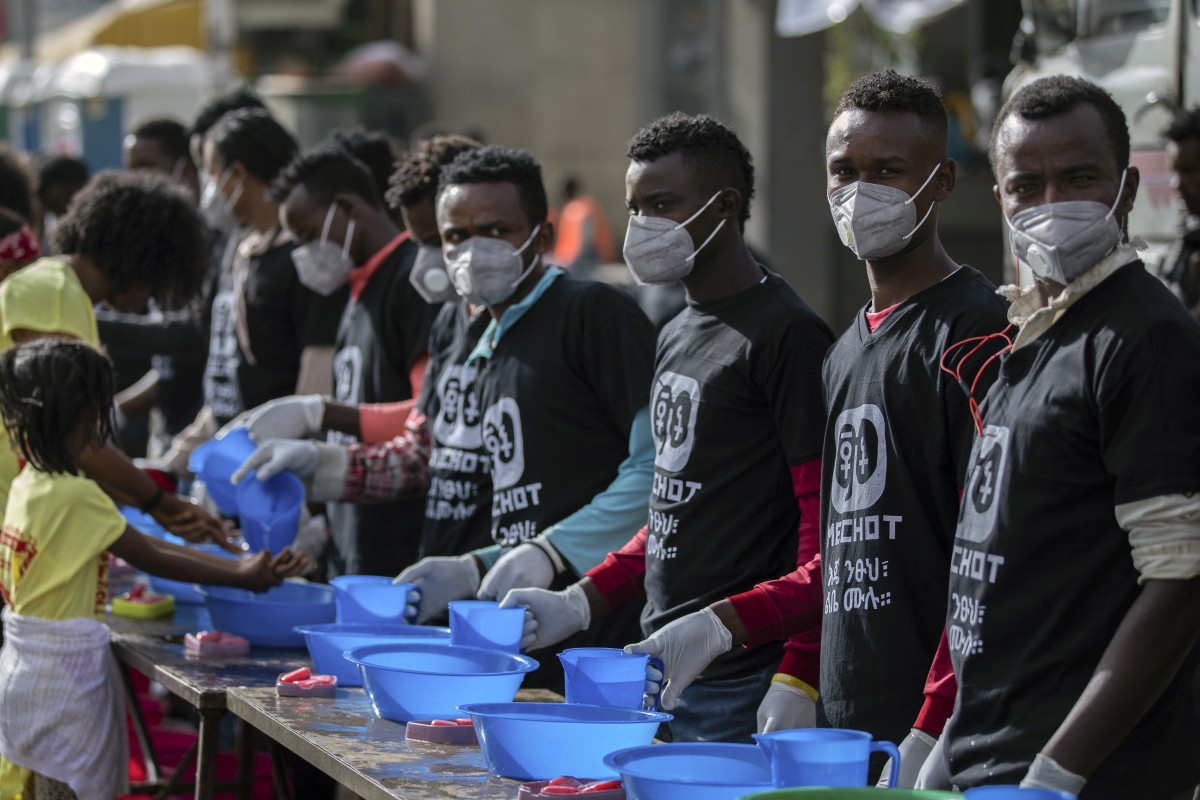
Masked volunteers provide soap and water for participants to wash their hands against the new coronavirus at a women’s 5km fun run in Addis Ababa, Ethiopia on Sunday. Photo: AP
Travel bans and school closures were announced in South Africa and Kenya on Sunday, as concerns grew over the capacity of the continent’s fragile health systems to cope with the spread of the deadly new coronavirus, with more than a dozen countries reporting their first cases.

South African President Cyril Ramaphosa declared a national state of disaster, banning arrivals by foreign nationals from high-risk countries including Italy, Iran, South Korea, Spain, Germany, the United States, Britain and China, effective Wednesday.

“We have cancelled visas to visitors from those countries from today and previously granted visas are hereby revoked,” Ramaphosa said in a televised address on Sunday evening, adding that any foreign national who had visited high-risk countries in the past 20 days would be denied a visa.

South African schools will also be closed from Wednesday until after the Easter weekend. Gatherings of more than 100 people have been banned and mass celebrations for Human Rights Day and other events cancelled. “Never before in the history of our democracy has our country been confronted with such a severe situation,” Ramaphosa said.

In Kenya, where three cases of Covid-19 – the disease caused by the new coronavirus – have now been confirmed, President Uhuru Kenyatta suspended travel from any country with reported infections. Only Kenyan citizens and foreigners with valid residency permits would be allowed entry, provided they proceeded to self-quarantine or a government-designated quarantine facility, he said.
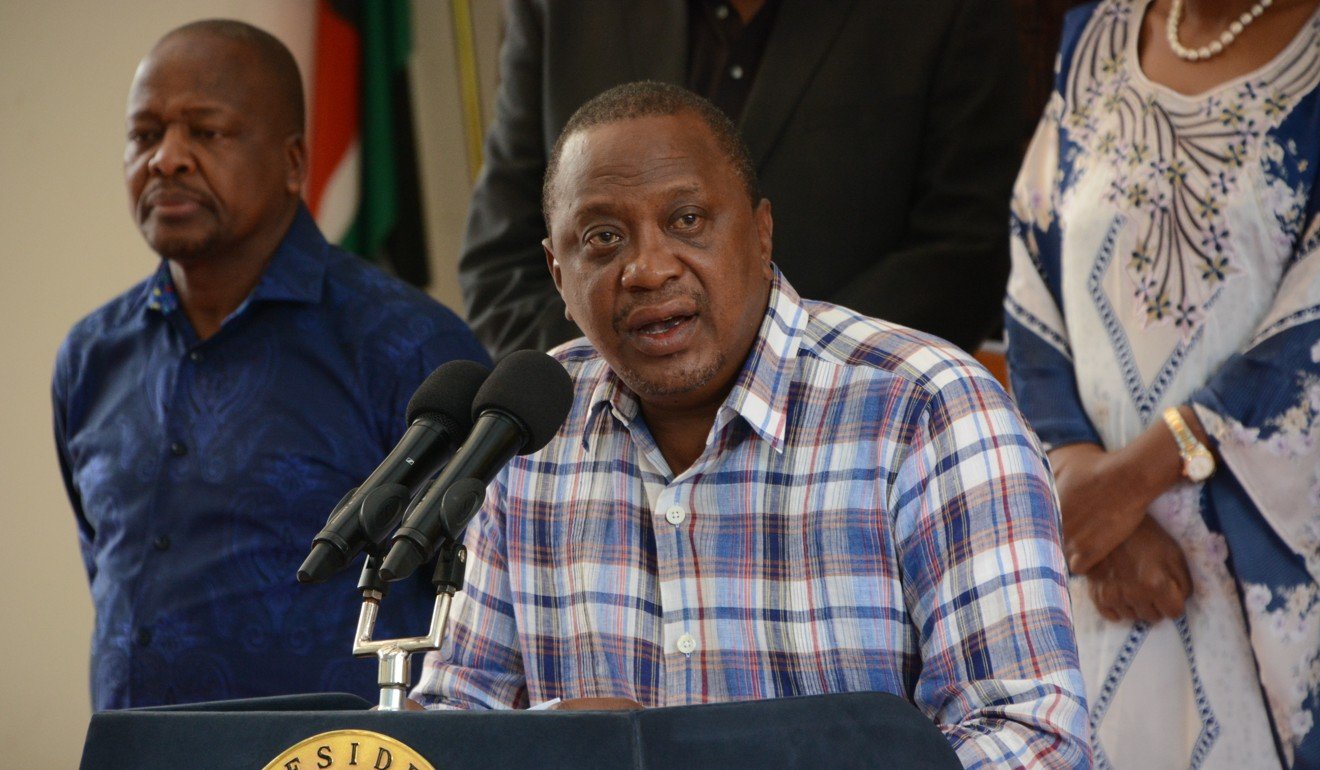
Kenyan President Uhuru Kenyatta reports two more cases of coronavirus in the country, bringing its total number of cases to three. Photo: DPA
Kenyatta also suspended learning in all educational institutions with immediate effect. “Some of the measures may cause inconvenience, but I want to assure you they are designed to ensure that we effectively contain the spread of the virus,” he said.

Kenya and South Africa join Ghana, Rwanda and Morocco in implementing travel restrictions or outright bans, while others are closing churches, museums, sporting activities, nightclubs and tourist attractions in a bid to curb the spread of the disease.

The continent was largely spared in the early days of the outbreak but has now recorded more than 300 cases and six deaths. Algeria, Morocco, Senegal and Tunisia all reported more new cases over the weekend, which saw numbers of new infections across Africa more than double in just two days.

As numbers rise, the Africa Centres for Disease Control and Prevention (CDC) has said there are around a dozen countries on the continent without the capacity to do their own testing.

They will have to send samples to countries like South Africa, which itself is struggling to contain the virus, with confirmed cases doubling to 61 on Sunday, a day after 114 of its citizens were repatriated from the central Chinese city of Wuhan, the original epicentre of the outbreak and the first to be placed in lockdown.

John Nkengasong, director of the Africa CDC, warned that the risk of other African countries detecting new cases of Covid-19 remained high. “Our strategy is clear: we want to capacitate the member states, so they can quickly detect and mitigate the effects of the disease in Africa, and, if widespread transmission occurs, prevent severe illness and death,” he said.

The World Health Organisation has already warned that critical gaps remain in the capacity of many African nations to trace, detect and treat the disease. On Friday, the WHO Africa office said it was “striving to help member states fill these gaps” but warned of global shortages in personal protective equipment (PPE) including gloves, masks and hand sanitiser.

Major coronavirus outbreak in Africa ‘just a matter of time’

13 Mar 2020

WHO said its first blanket distribution of PPEs, to 24 African countries, had been completed and another wave of distributions was planned.

“With Covid-19 officially declared a pandemic, all countries in Africa must act,” said Dr Matshidiso Moeti, WHO regional director for Africa. “Every country can still change the course of this pandemic by scaling up their emergency preparedness or response.

“Cases may still be low in Africa and we can keep it that way with robust all-of-government actions to fight the new coronavirus.”

The 55 member states of the African Union have suspended meetings until May, while the six countries that make up the East African Community have suspended all planned meetings until further notice.

Coronavirus delays Nigeria’s US$1.5 billion Chinese-built rail project

7 Mar 2020

In Algeria – one of the worst-hit North African countries, with 48 cases and four deaths, as of Monday morning – all schools and universities have been closed, while Senegal, with 24 cases to date, has closed schools and cancelled its Independence Day festivities on April 4, which this year marks 60 years since its independence from France. Cruise ships have also been banned from docking in Senegal.

On Sunday, Rwanda closed all its places of worship and suspended large gatherings such as weddings and sporting activities. Schools and universities in the central African country are also closed. National airline RwandAir has also suspended flights between the capital Kigali and Mumbai until April 30.

This is in addition to earlier suspensions of its routes with Tel Aviv and the southern Chinese city of Guangzhou, which remain in place until further notice.

While most African airlines have suspended flights to cities in mainland China, Ethiopian Airlines has continued flying to most of its destinations, describing its China routes as among its most profitable. Nevertheless, chief executive Tewolde GebreMariam last week said coronavirus fears had cut demand by a fifth on most of its routes.

Source: Reuters

23/02/2020

Korea raises alert to highest level as coronavirus cases jump

SEOUL/SHANGHAI (Reuters) – South Korea raised its disease alert to the highest level on Sunday after a surge in coronavirus infections and two more deaths, while China state media warned the outbreak there had yet to reach a turning point despite some signs of easing.

South Korea’s president said he was putting the country on “red alert” due to the rapid rise in new cases, which are largely being traced back to church services. Health officials reported 169 new infections, bringing the total to 602, having doubled from Friday to Saturday.

The escalation in the alert level allows the government to send extra resources to Daegu city and Cheongdo county, which were designated “special care zones” on Friday.

South Korea’s Yonhap News Agency said it also enables the government to forcibly prevent public activities and order the temporary closure of schools, though the government gave no immediate details on what steps could be taken.

In China, the health commission confirmed 648 new infections – higher than a day earlier – but only 18 were outside of Hubei province, the lowest number outside of the epicenter since authorities started publishing data a month ago and locked down large parts of the country.

But the number of cases continued to climb elsewhere.

Japanese Prime Minister Shinzo Abe instructed government agencies on Sunday to urgently prepare medical provisions and draft a comprehensive plan to curb the spread of the virus, after it reported 27 more cases a day earlier.

The U.S. State Department raised its travel advisory level one notch for South Korea and Japan to Level 2 on a scale of 1 to 4.

Concern about the reach and rapid spread of coronavirus also grew in Europe and the Middle East.

Cases in Italy, Europe’s worst hit country, more than quadrupled to 79 on Saturday, with two deaths.

Iran reported a total of 43 infections, with eight deaths – all since Tuesday – forcing some of its neighbors to announce travel and immigration curbs.

The World Health Organization on Saturday stressed that the number of cases outside of China was still relatively few, but it was worried by the detection of infections without a clear link to China.

The disease has spread to some 26 countries and territories outside China, killing more than a dozen people, according to a Reuters tally. It has been fatal in 2% of reported cases, with the elderly and ill the most vulnerable, according to the WHO.

The potential economic impact of coronavirus was prominent at a meeting of G20 finance ministers in Riyadh, at which the International Monetary Fund chief said China’s 2020 growth would likely be lower at 5.6%, down 0.4 percentage points from its January outlook, with 0.1 percentage points shaved from global growth.

Graphic: Online site for coronavirus news here

Graphic: Tracking the novel coronavirus here

CHURCH CONTAGION

The last time South Korea raised the alert to the highest was 11 years ago during the Influenza A or H1N1 outbreak.

Many of South Korea’s new cases were linked to the Shincheonji Church of Jesus congregation in Daegu after a 61-year-old woman known as “Patient 31” tested positive for the virus last week. The woman had no recent record of overseas travel.

Catholic churches in Daegu and Gwangju have suspended mass and other gatherings, while churches elsewhere saw declines in attendance on Sunday, especially among the elderly.

“If the situation gets worse, I think we’ll need to take more measures. Currently, we’re limiting personal gatherings within the church except for Mass,” said Song Gi-young, 53, wearing a face mask at church.

Heo Young-moo, 88, expressed frustration.

“Devotees shouldn’t go to any risky places … Hasn’t it become so widespread because those people didn’t get checked?”,” he said.

Outside of the church was a sign that said: “All Shincheonji followers are strictly prohibited from entering”.

The foreign ministry said South Koreans aboard a plane to Israel had been denied entry there on Saturday due to concerns about the virus spread.

China said the number of new deaths on Saturday from COVID-19, as the disease caused by the virus is known, was 97, all but one of which were in Hubei.

Eighty-two of those were in the provincial capital Wuhan, where Xinhua news agency said nucleic tests were being carried out on the backlog of cases to try to contain the spread.

In total, China has reported 76,936 cases, and 2,442 deaths. The WHO says the virus is severe or critical in only a fifth of infected patients, and mild in the rest.

Graphic: Reuters graphics on the new coronavirus here

NOT OVER YET

Beijing, Zhejiang, Sichuan had no new infections on Feb. 22 for the first time since the outbreak was detected. There were signs of street life in Shanghai, with some cafes serving take-out food and families wearing masks walking their dogs.

State run television on Sunday urged people to avoid complacency, drawing attention to people gathering in public areas and tourist spots without wearing masks.

Analysts have been closely watching out for any signs of a secondary wave of infections as transport restrictions are eased and many migrant workers return to factories and offices. Business activity in the world’s second-biggest economy is only gradually returning to normal after widespread disruptions.

Japan’s health minister apologized on Saturday after a woman who was allowed to leave the coronavirus-struck Diamond Princess cruise ship tested positive despite having underwent quarantine.

At least 623 cases have been reported on the vessel, the biggest outbreak outside China, involving more than a dozen nationalities.

In Italy, schools and universities were closed and some soccer matches postponed in Lombardy and Veneto, the country’s industrial heartland.

Saudi Arabia, Kuwait, Iraq have travel and immigration curbs on Iran, while Oman on Sunday urged its citizens to steer clear of countries with high infection rates and said arrivals from those nations would be quarantined.

Source: Reuters

28/05/2019

Chinese universities asked to improve scientific research administration

BEIJING, May 27 (Xinhua) — China’s Ministry of Education has asked universities to improve administration to boost scientific research.

In a circular, the ministry required simplifying procedures for reimbursement of expenses on research activities which include attending meetings, counseling, purchasing equipment and services, among others.

Internet-based reimbursement is encouraged and approval will also be streamlined, according to the circular.

It also demanded universities improve the system of appointing academic assistants and financial assistants for researchers, and allocate more funds to raise researchers’ bonuses.

The interference with scientific research must be reduced to a minimum, the circular said.

Source: Xinhua

10/03/2019

Wuhan to invest 40 bln yuan in high-tech infrastructure

WUHAN, March 9 (Xinhua) — The city of Wuhan, capital of central China’s Hubei Province, will invest 40 billion yuan (about 6 billion U.S. dollars) to provide key support to the development of high-tech infrastructure by 2022, local authorities said.

The province and its capital will forge ahead with high-tech industries by raising a 10-billion-yuan fund per year for major projects, platforms, industrial parks, equipment and talent teams, from 2019 to 2022.

So far, a research facility of precise gravity measurement, a national major science and technology infrastructure, is under construction in the Huazhong University of Science and Technology in Wuhan.

In the past few years, the city has completed a pulsed high magnetic field facility and opened China’s first national bio-safety level four lab, which requires the highest level of biological safety.

Wuhan will work with universities, institutes and enterprises to achieve great breakthroughs in various fields including integrated electromagnetic energy, optoelectronics, microelectronics, geomatics, and new materials, as well as build national laboratories.

Data released at the city’s science and technology conference for 2019 on Friday showed that the value added of the hi-tech industries in Wuhan exceeded 300 billion yuan last year, accounting for 20.56 percent of the city’s gross domestic product.

With 3,536 high-tech enterprises in total, the city is making efforts to build itself into a tech hub of the country.

Source: Xinhua

14/02/2019

State Council releases vocational education reform implementation plan

BEIJING, Feb. 13 (Xinhua) — China has vowed to cultivate more quality laborers and skilled workers by reforming its vocational education systems, according to a plan for implementing the reform issued by the State Council, or China’s cabinet.

Vocational education and training systems will be reformed to match with science and technology development trends and market demands and to promote economic modernization and higher quality employment, the official documents note.

All sectors of society, especially enterprises, are encouraged to support the country’s vocational education, it says, adding that major companies are welcome to run vocational schools and offer high-quality programs.

The plan details measures to improve national systems and policies relating to vocational education and lift the quality of both secondary and higher vocational education in the country.

Moreover, China will establish national standards for vocational education and ensure standards regarding teaching, education materials and teachers are well met, aiming to nurture and pass down “craftsmanship,” according to the document.

Under a trial system set to be implemented from 2019, students at vocational colleges, as well as universities that mainly offer undergraduate programs in applied areas, will be awarded an academic certificate plus diplomas of vocational skills of various levels.

In five to ten years, operators of China’s vocational education institutions, which are now mostly government-run, will be diversified and include more entities or personnel from non-government sectors, according to the plan.

Source: Xinhua

Law of Unintended Consequences

continuously updated blog about China & India

ChiaHou's Book Reviews

continuously updated blog about China & India

What's wrong with the world; and its economy

continuously updated blog about China & India