Archive for ‘urban’

14/05/2020

China relocates villagers living in 800m-high cliffs in anti-poverty drive

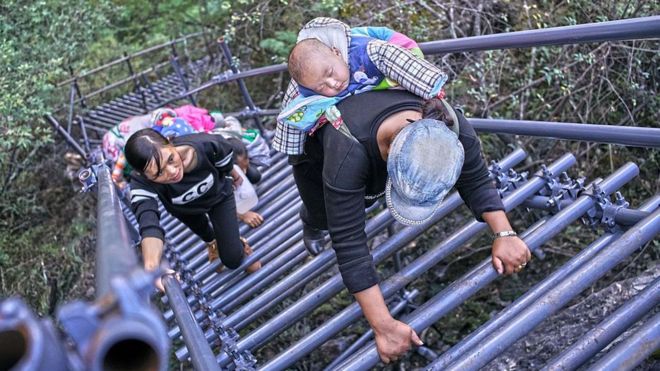
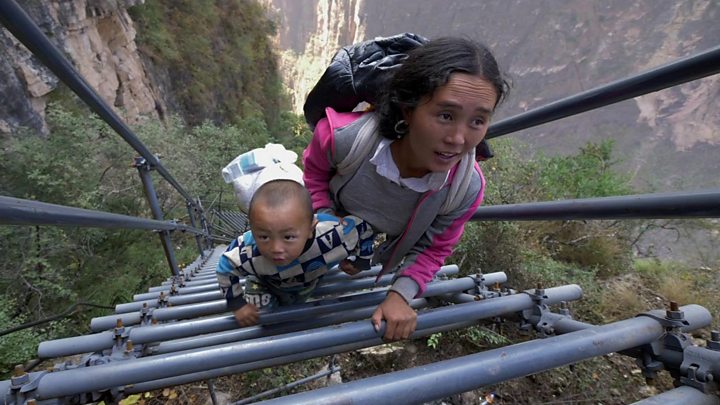
People climb on the newly-built metal ladder with hand railings to Ahtuler village on a cliff on November 11, 2016Image copyright GETTY IMAGES
Image caption The village made headlines after photos showed people scaling ladders to get home

They used to call an 800m-high cliff home, but dozens of villagers in China’s Sichuan province have now been relocated to an urban housing estate.

Atulie’er village became famous after photos emerged showing adults and children precariously scaling the cliff using just rattan ladders.

Around 84 households have now been moved into newly built flats as part of a local poverty alleviation campaign.

It’s part of a bigger national campaign to end poverty by the end of 2020.

‘So happy I got a house’

Atulie-er village made headlines in 2016 when it was revealed that its villagers had to scale precarious ladders to get home, carrying babies and anything the village needed.

Soon afterwards the government stepped in and replaced these with steel ladders.

The households have now been moved to the county town of Zhaojue, around 70km away.

They will be rehoused in furnished apartment blocks, which come in models of 50, 75 and 100 sq m – depending on the number of people in each household.

It’ll be a big change for many of these villagers, who are from the Yi minority and have lived in Atulie-er for generations.

Photos on Chinese state media showed villagers beaming, one of them telling state media outlet CGTN that he was “so happy that I got a good house today”.

‘Big financial burden’

According to Mark Wang, a human geography professor at the University of Melbourne, such housing schemes are often heavily subsidised by the government, typically up to 70%. However, in some instances families have been unable to afford the apartments despite the subsidies.

“For some really poor villages, the 30% may still be difficult for them to pay, so they end up having to borrow money – [ironically] causing them even more debt,” he told BBC News.

“For the poorest, it’s a big financial burden and so in some instances, they might have to stay.”

According to Chinese state media outlet China Daily, each person will have to pay 2,500 yuan ($352; £288) for this particular move – so for a family of four, the cost would come up to 10,000 yuan.
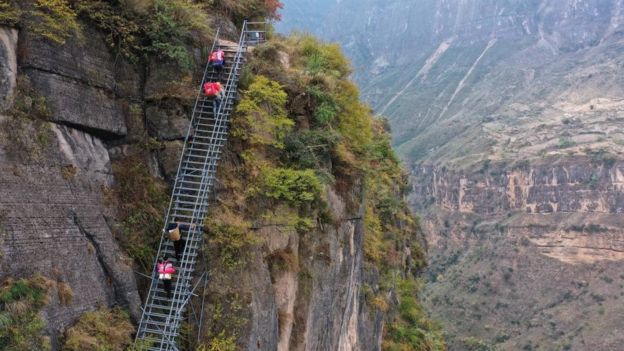
Villagers Living On Cliff Shop Online In LiangshanImage copyright GETTY IMAGES
Image caption This is the journey the villagers had to make to get home

This is quite a low price, says Mr Wang, as he had heard of people having to pay up to 40,000 yuan for other relocation projects.

Mr Wang says in most poverty resettlement campaigns, villagers are given a choice whether or not to move, and are not usually moved into cities from the countryside.

“In most instances it’s a move to a county town or a suburb. So it’s not like they’re moving to a big city. Not everyone wants an urban life and most of those who do would have already left these villages and moved to the big cities,” he says.

“Usually the government [puts a limit] on the resettlement distance. This is in most people’s favour because it means they can keep their farm land, so that’s very attractive.”

The Atulie’er villagers will share this new apartment complex with impoverished residents across Sichuan province.
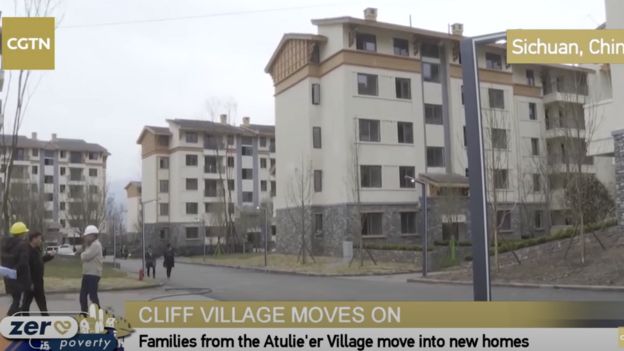
The new apartment blocksImage copyright CGTN/YOUTUBE
Image caption The villagers will be living in these apartment buildings

Around 30 households will remain in the Atulie’er village- which is set to turn into a tourism spot.

According to Chinese state media outlet China Daily, these households will effectively be in charge of local tourism, running inns and showing tourists around.

The county government has ambitious plans – planning to install a cable car to transport tourists to the village and to develop some surrounding areas. An earlier report said there were plans to turn the village into a vacation resort, with state media saying the state would pump 630 million yuan into investment.

Though these developments are likely to bring more jobs to the area, it’s not clear what safeguards are in place to make sure that the site’s ecological areas are protected and not at risk of being overdeveloped.
Media caption Do people in China’s rural communities think poverty reduction can work?

Chinese President Xi Jinping has declared that China will eradicate poverty in China by 2020.

There’s no one standard definition of poverty across all of China, as it differs from province to province.

One widely quoted national standard is 2,300 yuan ($331; £253) net income a year. Under that standard, there were around 30 million people living in poverty across the whole of China in 2017.

But the 2020 deadline is approaching fast – and Mr Wang says the plan could be derailed by the virus outbreak.

“Even without Covid-19 it would be hard to meet this deadline and now realistically, it has made it even more difficult.”

Source: The BBC
20/04/2020

China resumes major water conservancy projects

BEIJING, April 20 (Xinhua) — China has resumed construction of major water conservancy projects amid its further containment of the novel coronavirus disease (COVID-19) epidemic.

Construction has resumed so far on 143 of the 172 major water conservancy projects, with the scale of investment under construction reaching over 1 trillion yuan (around 141 billion U.S. dollars), according to the Ministry of Water Resources.

The ministry said 30 conservancy projects have completed construction and produced benefits.

As the situation of epidemic control and prevention continues to improve, China is speeding up construction on major infrastructure projects to mitigate the economic impact of the novel coronavirus epidemic.

Construction has resumed on about 85 percent of the housing and urban infrastructure projects in China as of April 1, with about 158,700 housing and urban infrastructure projects across the country cranking up work, according to the Ministry of Housing and Urban-Rural Development.

Source: Xinhua

01/10/2019

China anniversary: How the country became the world’s ‘economic miracle’

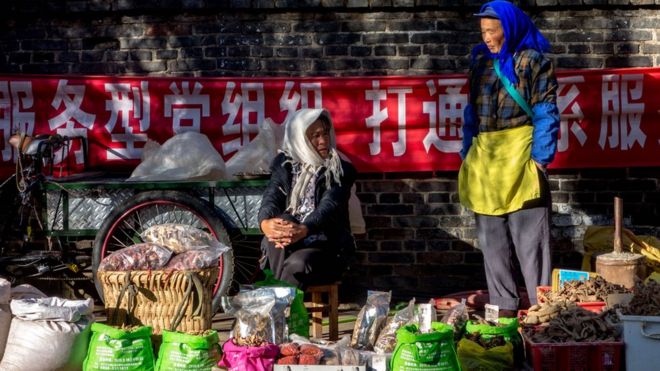
Local women sell produce in the market. Zhongyi market, located at the southern gate of Dayan ancient city, in Lijian, Yunnan Province in ChinaImage copyrightGETTY IMAGES

It took China less than 70 years to emerge from isolation and become one of the world’s greatest economic powers.

As the country celebrates the anniversary of the founding of the People’s Republic of China, we look back on how its transformation spread unprecedented wealth – and deepened inequality – across the Asian giant.

“When the Communist Party came into control of China it was very, very poor,” says DBS chief China economist Chris Leung.

“There were no trading partners, no diplomatic relationships, they were relying on self-sufficiency.”

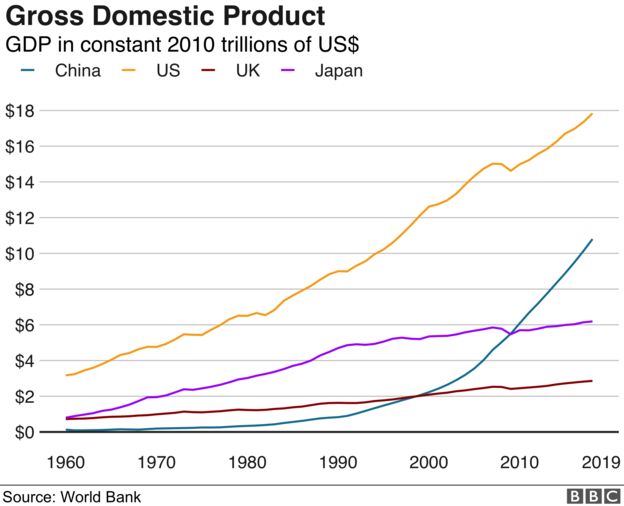
Over the past 40 years, China has introduced a series of landmark market reforms to open up trade routes and investment flows, ultimately pulling hundreds of millions of people out of poverty.

Chart showing gross domestic product of US, China, Japan and the UK

The 1950s had seen one of the biggest human disasters of the 20th Century. The Great Leap Forward was Mao Zedong’s attempt to rapidly industrialise China’s peasant economy, but it failed and 10-40 million people died between 1959-1961 – the most costly famine in human history.

This was followed by the economic disruption of the Cultural Revolution in the 1960s, a campaign which Mao launched to rid the Communist party of his rivals, but which ended up destroying much of the country’s social fabric.

‘Workshop of the world’

Yet after Mao’s death in 1976, reforms spearheaded by Deng Xiaoping began to reshape the economy. Peasants were granted rights to farm their own plots, improving living standards and easing food shortages.

The door was opened to foreign investment as the US and China re-established diplomatic ties in 1979. Eager to take advantage of cheap labour and low rent costs, money poured in.

“From the end of the 1970s onwards we’ve seen what is easily the most impressive economic miracle of any economy in history,” says David Mann, global chief economist at Standard Chartered Bank.

Through the 1990s, China began to clock rapid growth rates and joining the World Trade Organization in 2001 gave it another jolt. Trade barriers and tariffs with other countries were lowered and soon Chinese goods were everywhere.

“It became the workshop of the world,” Mr Mann says.

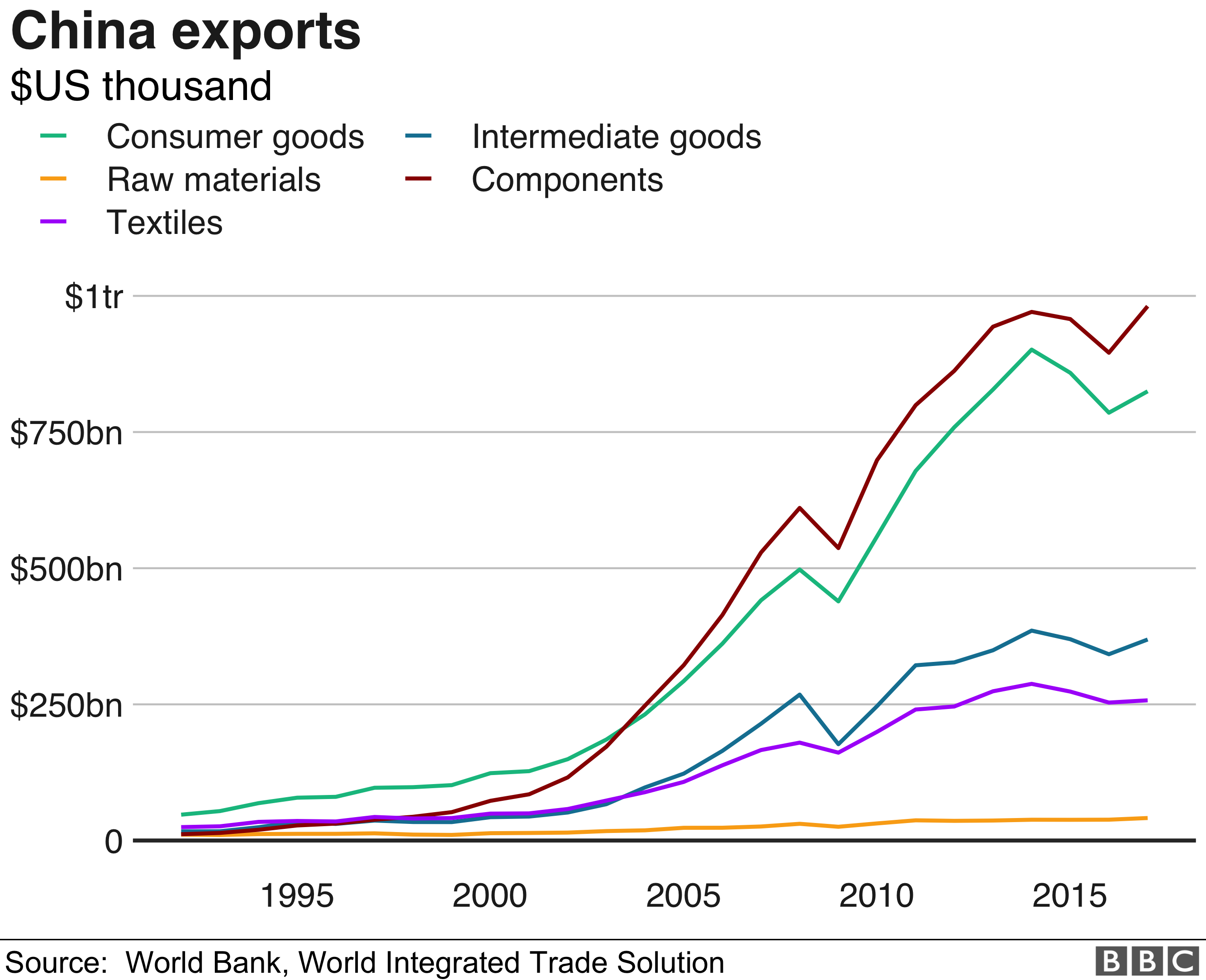
Chart showing China exports

Take these figures from the London School of Economics: in 1978, exports were $10bn (£8.1bn), less than 1% of world trade.

By 1985, they hit $25bn and a little under two decades later exports valued $4.3trn, making China the world’s largest trading nation in goods.

Poverty rates tumble

The economic reforms improved the fortunes of hundreds of millions of Chinese people.

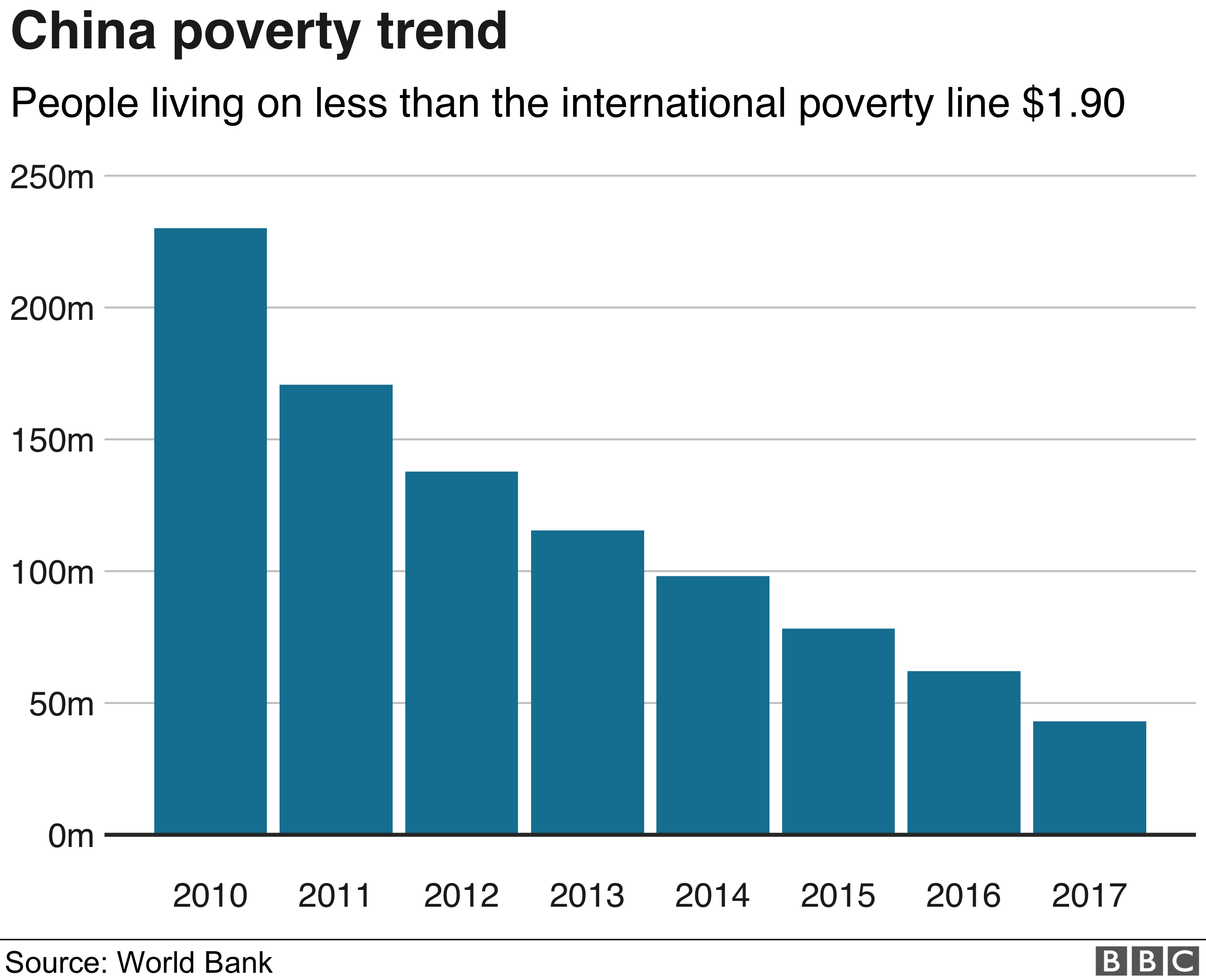
The World Bank says more than 850 million people been lifted out of poverty, and the country is on track to eliminate absolute poverty by 2020.

At the same time, education rates have surged. Standard Chartered projects that by 2030, around 27% of China’s workforce will have a university education – that’s about the same as Germany today.

China poverty rates

Rising inequality

Still, the fruits of economic success haven’t spread evenly across China’s population of 1.3 billion people.

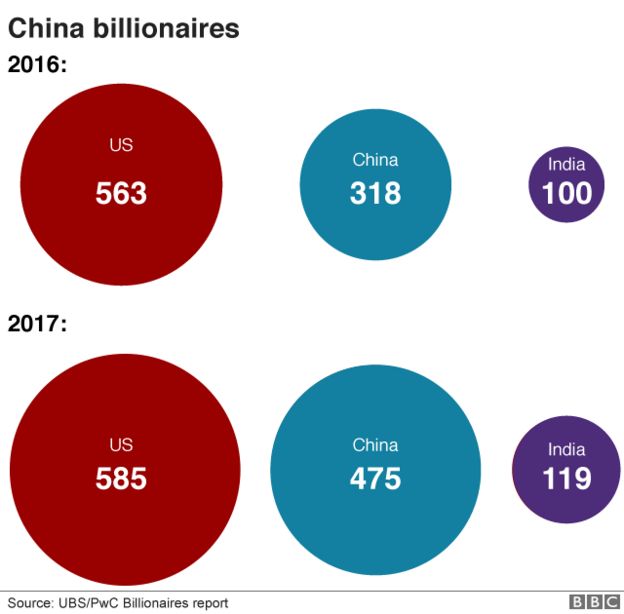
Examples of extreme wealth and a rising middle class exist alongside poor rural communities, and a low skilled, ageing workforce. Inequality has deepened, largely along rural and urban divides.

“The entire economy is not advanced, there’s huge divergences between the different parts,” Mr Mann says.

The World Bank says China’s income per person is still that of a developing country, and less than one quarter of the average of advanced economies.

China’s average annual income is nearly $10,000, according to DBS, compared to around $62,000 in the US.

Billionaires in China, the US and India

Slower growth

Now, China is shifting to an era of slower growth.

For years it has pushed to wean its dependence off exports and toward consumption-led growth. New challenges have emerged including softer global demand for its goods and a long-running trade war with the US. The pressures of demographic shifts and an ageing population also cloud the country’s economic outlook.

Still, even if the rate of growth in China eases to between 5% and 6%, the country will still be the most powerful engine of world economic growth.

“At that pace China will still be 35% of global growth, which is the biggest single contributor of any country, three times more important to global growth than the US,” Mr Mann says.

The next economic frontier

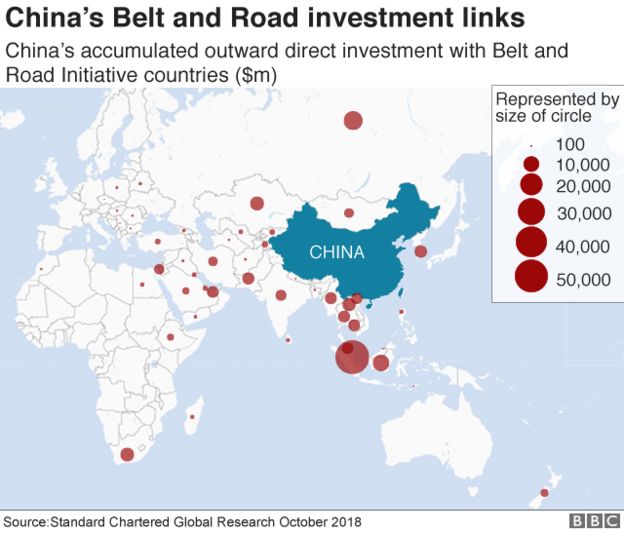
China is also carving out a new front in global economic development. The country’s next chapter in nation-building is unfolding through a wave of funding in the massive global infrastructure project, the Belt and Road Initiative.

Map showing Chinese investment as part of the Belt and Road initiative

The so-called new Silk Road aims to connect almost half the world’s populations and one-fifth of global GDP, setting up trade and investment links that stretch across the world.

Source: The BBC

Law of Unintended Consequences

continuously updated blog about China & India

ChiaHou's Book Reviews

continuously updated blog about China & India

What's wrong with the world; and its economy

continuously updated blog about China & India