Chindia Alert: You’ll be Living in their World Very Soon
aims to alert you to the threats and opportunities that China and India present. China and India require serious attention; case of ‘hidden dragon and crouching tiger’.
Without this attention, governments, businesses and, indeed, individuals may find themselves at a great disadvantage sooner rather than later.
The POSTs (front webpages) are mainly 'cuttings' from reliable sources, updated continuously.
The PAGEs (see Tabs, above) attempt to make the information more meaningful by putting some structure to the information we have researched and assembled since 2006.
American destroyer’s mission comes a week before Taiwanese president officially starts second term in office
Increased military activity in the region could have unintended consequences but unlikely to lead to direct conflict, observer says
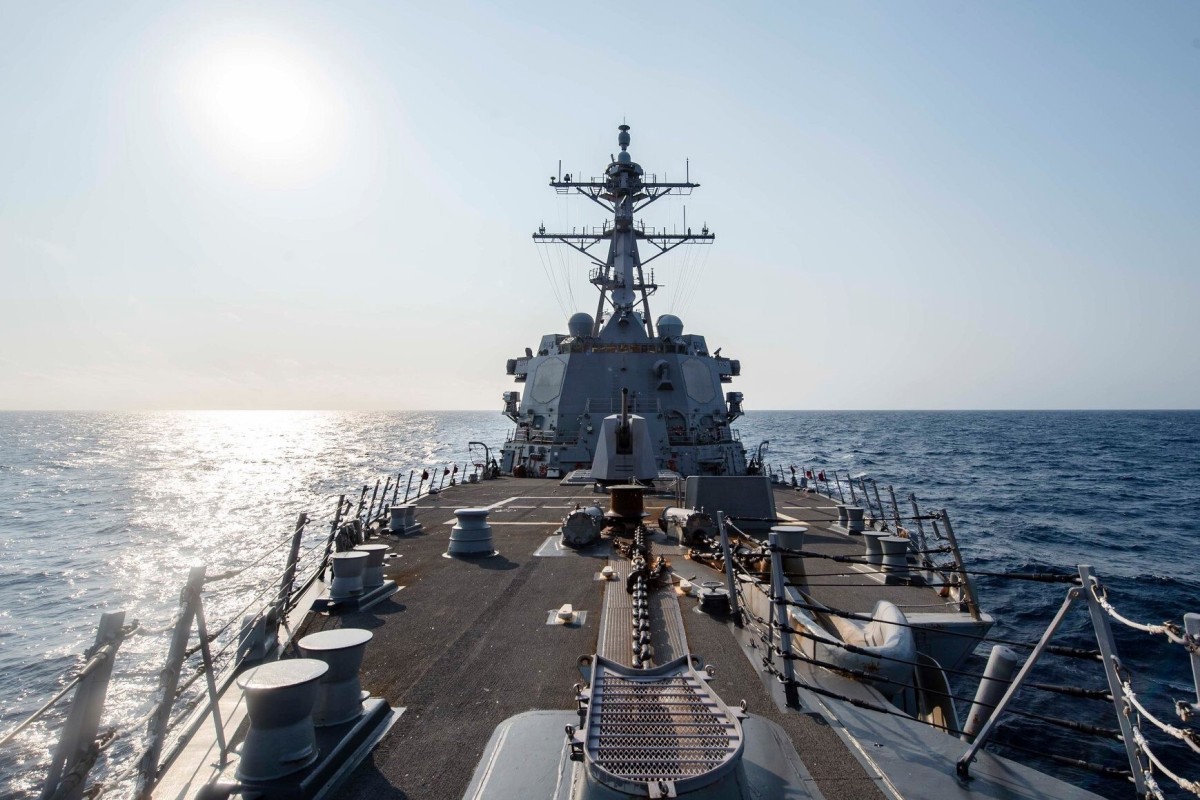
The guided-missile destroyer USS McCampbell made a transit through the Taiwan Strait on Thursday. Photo: US Navy
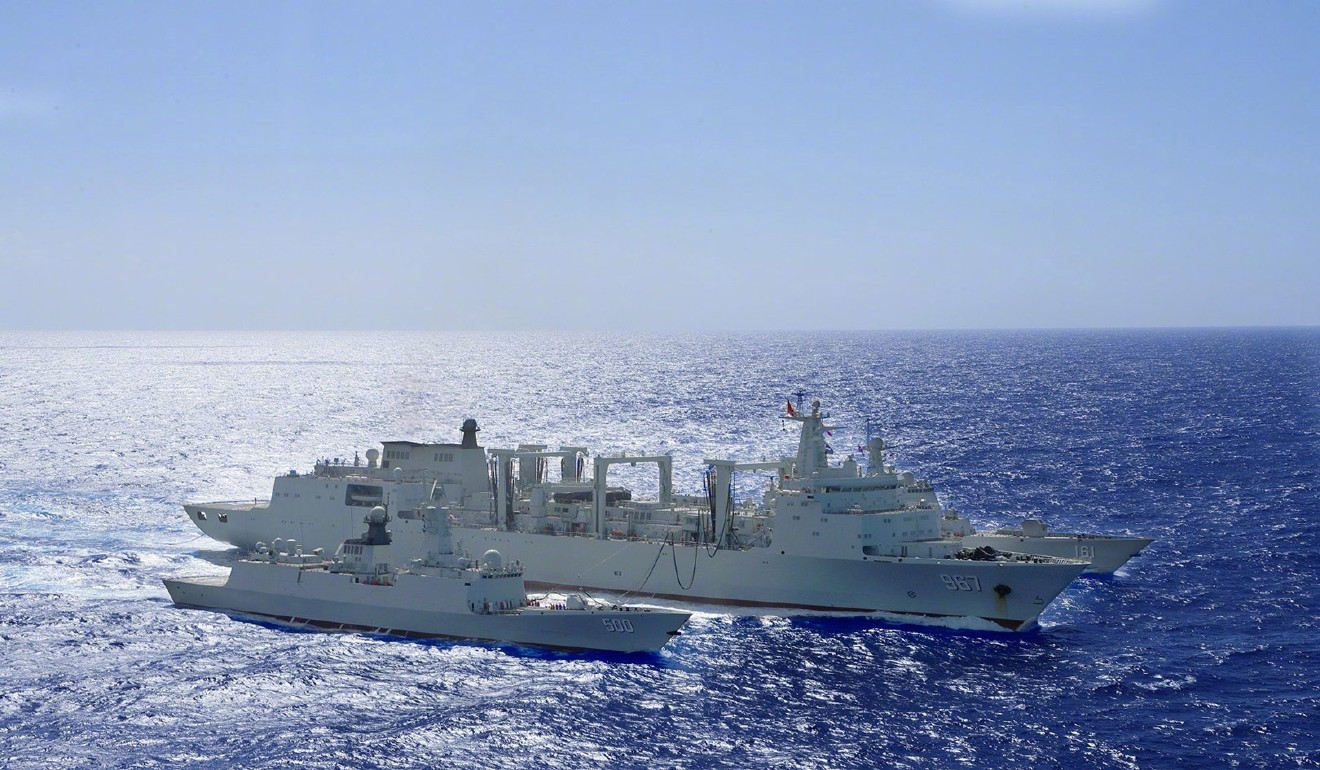
The United States sent a warship through the Taiwan Strait on Thursday as the Chinese military embarked on more than two months of live-fire naval drills off the mainland’s northern coast.
According to Taiwan’s defence ministry, the Arleigh Burke-class guided-missile destroyer transited the narrow body of water separating Taiwan from mainland China from north to south “in a routine mission”.
“It is continuing its southward voyage and the military is monitoring its movement through the intelligence it has gathered,” the ministry said.
In a statement on its Facebook page, the US Pacific Fleet said the McCampbell transited the Taiwan Strait as part of ongoing operations in the Indo-Pacific.
Analysts said the passage was a response to the People’s Liberation Army’s increasing military activity near Taiwan and in the wider region.
“This will become a new routine as a kind of US security commitment to maintain stability in the Indo-Pacific region,” said Soong Hseik-wen, professor of strategic studies and international relations at National Chung Cheng University in Taiwan.
Beijing urges France to cancel contract to sell arms to Taiwan
13 May 2020
The PLA has staged a series of war games, including fly-bys and warship transits through the strait, in recent months in response to what Beijing sees as growing pro-independence moves by the Tsai government and her party. China has also warned the US against supplying weapons to the island, which Beijing considers to be a wayward province that must return to the mainland fold, by force if necessary.
Mainland China has suspended official exchanges with Taiwan since Tsai was first elected president in 2016 and refused to accept the one-China policy, which Beijing says must be the foundation for any talks.
The PLA has embarked on 11 weeks of naval exercises off the coast of Tangshan in northern China, barring all other vessels from a 25km (15 mile) radius of the drill area, according to the China Maritime Safety Administration.
Taiwanese support closer ties with US over China, few identify as solely Chinese, Pew Research survey finds
13 May 2020
Both Beijing and Washington have ramped up military activities near Taiwan in recent months during the coronavirus pandemic, moves that some observers say run the risk of miscommunication.
Alexander Huang Chieh-cheng, professor of strategic studies and international relations at Tamkang University in Taipei, said no one could exclude the possibility of unintended incidents when both the US and the mainland were stepping up their presence in the region.
“Rational analysts would however argue that the two nuclear powers are not likely to engage in or escalate to direct military conflict,” he said.
Huang said he believed cross-strait relations would worsen during Tsai’s second term in office, which begins on May 20.
“The already damaged relationship between Taiwan and mainland China has worsened since the pandemic mainly due to travel bans and Taiwan’s increased international visibility,” he said.
On Tuesday, Japan’s Kyodo News reported that the PLA was planning a large-scale beach landing exercise near Hainan province in August, simulating a takeover of the Pratas Islands, which are controlled by Taiwan and also known as the Dongsha Islands.
In Taipei, Major General Lin Wen-huang said Taiwan was monitoring the PLA movements and “has contingency plans in place for the South China Sea to strengthen combat readiness and defence preparedness on both the Spratly and Pratas islands”.
Taiwan’s coastguard also announced on Wednesday that its Pratas Islands Garrison was scheduled to conduct an annual live-fire exercise in June to ensure the “effectiveness of various mortar and machine-gun positions”.
Taiwan shows off its military power after presidential election
Shanghai-based military commentator Ni Lexiong said that both the US Navy and PLA were increasing activities during the pandemic because neither side could afford to show weaknesses that the other might take advantage of.
The destroyer’s passage and the PLA’s drills were all part of such efforts, Li said.
But he agreed that both countries were unwilling, unable, and unlikely to have a real conflict.
“They are both bluffing. It’s a fake crisis,” he said. “A pandemic always ends or prevents a war if you look at history.
“I also don’t believe the PLA would want to take over the Dongsha or Taiping islands [in the South China Sea], because these islets alone are not worth a military campaign and all the consequences of that. The only target valuable enough for the PLA is Taiwan.”
US Pacific Fleet calls the action last week ‘unsafe and unprofessional’ and a breach of code of conduct
Analyst describes it as a ‘serious provocation’ that could have posed a navigational hazard
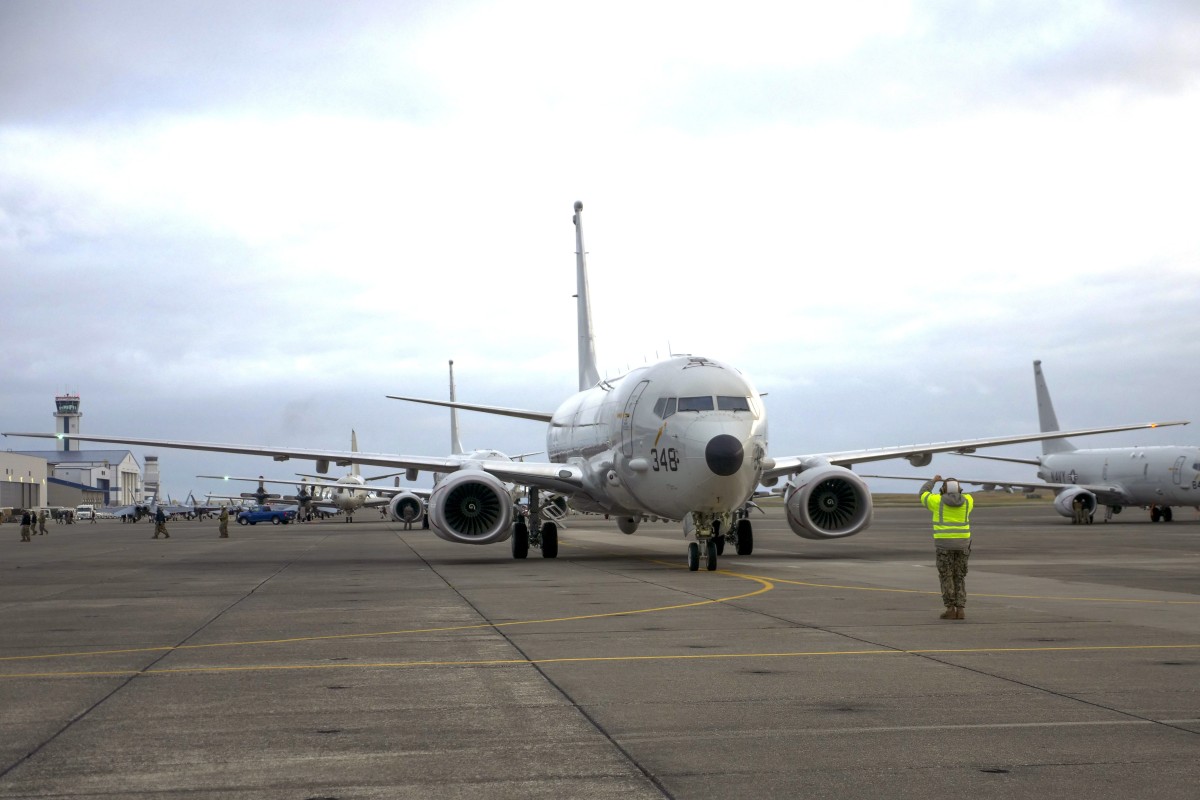
The US said a P-8A Poseidon maritime patrol aircraft was targeted as it flew over international waters in the western Pacific last week. Photo: AP
A Chinese destroyer pointed a laser at an American maritime patrol aircraft over the western Pacific Ocean last week, the US Navy said, calling the incident “unsafe and unprofessional”.
The US Pacific Fleet said in a statement on Friday that the destroyer targeted the P-8A Poseidon aircraft as it flew over international waters about 610km (380 miles) west of Guam on February 17.
“The laser, which was not visible to the naked eye, was captured by a sensor on board the P-8A,” the statement said. “Weapons-grade lasers could potentially cause serious harm to aircrew and mariners, as well as ship and aircraft systems.”
It said the action by the Chinese warship had breached the multilateral Code for Unplanned Encounters at Sea, which “specifically addresses the use of lasers that could cause harm to personnel or damage to equipment”.
China’s arms industry back in business despite disruption by coronavirus
23 Feb 2020
The action was also “inconsistent” with a memorandum of understanding reached between the US and Chinese defence ministries on rules of behaviour for safety during air and maritime encounters, the US Pacific Fleet said.
The P-8A is deployed to the Kadena Air Force Base in Okinawa, Japan, and is part of a squadron that conducts routine operations, maritime patrols and reconnaissance in the US 7th Fleet area of operations, according to the statement.
China and the United States have exchanged tough words as tensions simmer over their military activities in the Asia-Pacific region, particularly over the South China Sea and Taiwan.
A Chinese destroyer is said to have pointed a laser at a US Navy aircraft near Guam.
Photo: Weibo The Chinese South Sea Fleet completed a 41-day drill in the western Pacific earlier this week, according to state media, in a move to show its military exercises were continuing even as the country battles the coronavirus epidemic.
Collin Koh, a research fellow with the S Rajaratnam School of International Studies at Singapore’s Nanyang Technological University, said the latest incident was a “serious provocation”, noting that the Chinese military had also pointed lasers at the US in Djibouti.
The South China Sea dispute explained
“Use of lasers is as dangerous as manoeuvring one’s aerial or naval asset too close to another to cause the potential of collision – the lasers can pose a serious navigational hazard,” Koh said.
“While both [the Chinese and US navies] have the legitimate right to carry out their activities on the high seas out there in the western Pacific – including the use of these platforms to monitor each other – the use of lasers to endanger navigation in fact represents a serious provocation,” he said.
“The US Navy P-8A might have flown lower for closer observation, but I don’t think it went to the point of risking a collision with the [Chinese] warship.”
The incident was likely to further undermine trust and military stability between China and the United States, Koh said.
Conflict prevention in the South China Sea depends on China abiding by the existing rules of navigation
27 Feb 2020
“It also wouldn’t be the first time the [Chinese navy] formations would have had ‘company’ from US military assets keeping tabs on them,” he said.
But Hong Kong-based military commentator Song Zhongping rejected the US Navy’s claim that the Chinese warship had violated the code of conduct, saying its action was just a routine warning.
“The US is unhappy because the Chinese fleet was very close to Guam, and it saw the Chinese fleet as taking an unfriendly measure against the US,” he said.
“But it’s normal for a naval fleet and aircraft to send warnings to each other,” Song said. “If the other side’s reconnaissance plane gets too close to vessels, it can be a security risk. So they take self-defence measures.”




 CHINDIA ALERT: You'll be living in their world, very soon