Chindia Alert: You’ll be Living in their World Very Soon
aims to alert you to the threats and opportunities that China and India present. China and India require serious attention; case of ‘hidden dragon and crouching tiger’.
Without this attention, governments, businesses and, indeed, individuals may find themselves at a great disadvantage sooner rather than later.
The POSTs (front webpages) are mainly 'cuttings' from reliable sources, updated continuously.
The PAGEs (see Tabs, above) attempt to make the information more meaningful by putting some structure to the information we have researched and assembled since 2006.
American destroyer’s mission comes a week before Taiwanese president officially starts second term in office
Increased military activity in the region could have unintended consequences but unlikely to lead to direct conflict, observer says
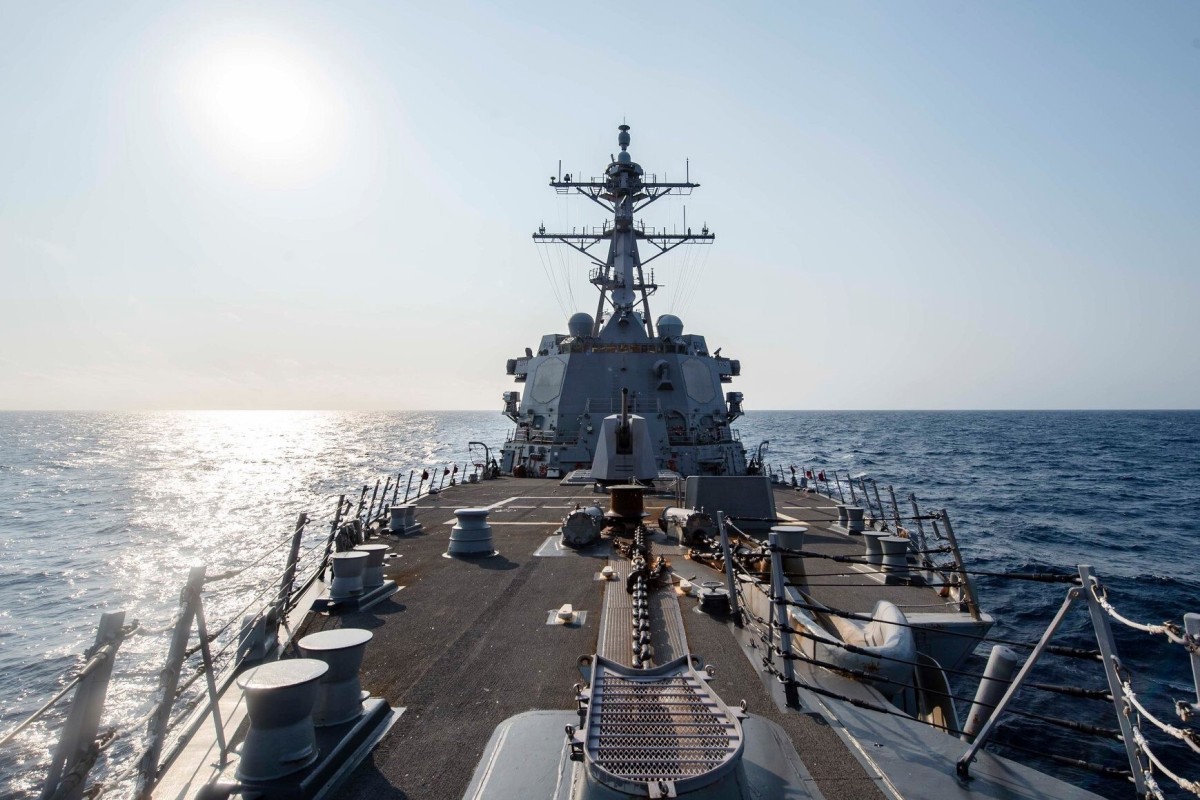
The guided-missile destroyer USS McCampbell made a transit through the Taiwan Strait on Thursday. Photo: US Navy
The United States sent a warship through the Taiwan Strait on Thursday as the Chinese military embarked on more than two months of live-fire naval drills off the mainland’s northern coast.
According to Taiwan’s defence ministry, the Arleigh Burke-class guided-missile destroyer transited the narrow body of water separating Taiwan from mainland China from north to south “in a routine mission”.
“It is continuing its southward voyage and the military is monitoring its movement through the intelligence it has gathered,” the ministry said.
In a statement on its Facebook page, the US Pacific Fleet said the McCampbell transited the Taiwan Strait as part of ongoing operations in the Indo-Pacific.
Analysts said the passage was a response to the People’s Liberation Army’s increasing military activity near Taiwan and in the wider region.
“This will become a new routine as a kind of US security commitment to maintain stability in the Indo-Pacific region,” said Soong Hseik-wen, professor of strategic studies and international relations at National Chung Cheng University in Taiwan.
Beijing urges France to cancel contract to sell arms to Taiwan
13 May 2020
The PLA has staged a series of war games, including fly-bys and warship transits through the strait, in recent months in response to what Beijing sees as growing pro-independence moves by the Tsai government and her party. China has also warned the US against supplying weapons to the island, which Beijing considers to be a wayward province that must return to the mainland fold, by force if necessary.
Mainland China has suspended official exchanges with Taiwan since Tsai was first elected president in 2016 and refused to accept the one-China policy, which Beijing says must be the foundation for any talks.
The PLA has embarked on 11 weeks of naval exercises off the coast of Tangshan in northern China, barring all other vessels from a 25km (15 mile) radius of the drill area, according to the China Maritime Safety Administration.
Taiwanese support closer ties with US over China, few identify as solely Chinese, Pew Research survey finds
13 May 2020
Both Beijing and Washington have ramped up military activities near Taiwan in recent months during the coronavirus pandemic, moves that some observers say run the risk of miscommunication.
Alexander Huang Chieh-cheng, professor of strategic studies and international relations at Tamkang University in Taipei, said no one could exclude the possibility of unintended incidents when both the US and the mainland were stepping up their presence in the region.
“Rational analysts would however argue that the two nuclear powers are not likely to engage in or escalate to direct military conflict,” he said.
Huang said he believed cross-strait relations would worsen during Tsai’s second term in office, which begins on May 20.
“The already damaged relationship between Taiwan and mainland China has worsened since the pandemic mainly due to travel bans and Taiwan’s increased international visibility,” he said.
On Tuesday, Japan’s Kyodo News reported that the PLA was planning a large-scale beach landing exercise near Hainan province in August, simulating a takeover of the Pratas Islands, which are controlled by Taiwan and also known as the Dongsha Islands.
In Taipei, Major General Lin Wen-huang said Taiwan was monitoring the PLA movements and “has contingency plans in place for the South China Sea to strengthen combat readiness and defence preparedness on both the Spratly and Pratas islands”.
Taiwan’s coastguard also announced on Wednesday that its Pratas Islands Garrison was scheduled to conduct an annual live-fire exercise in June to ensure the “effectiveness of various mortar and machine-gun positions”.
Taiwan shows off its military power after presidential election
Shanghai-based military commentator Ni Lexiong said that both the US Navy and PLA were increasing activities during the pandemic because neither side could afford to show weaknesses that the other might take advantage of.
The destroyer’s passage and the PLA’s drills were all part of such efforts, Li said.
But he agreed that both countries were unwilling, unable, and unlikely to have a real conflict.
“They are both bluffing. It’s a fake crisis,” he said. “A pandemic always ends or prevents a war if you look at history.
“I also don’t believe the PLA would want to take over the Dongsha or Taiping islands [in the South China Sea], because these islets alone are not worth a military campaign and all the consequences of that. The only target valuable enough for the PLA is Taiwan.”
Indian defence officials have reported a coronavirus outbreak at a key naval base in the western city of Mumbai.
Twenty-one personnel have tested positive for Covid-19 at INS Angre, which is the seat of the force’s western command, the navy said in a statement on Saturday.
It added that there are no infections aboard any ships or submarines.
India has 11,906 active infections and 480 deaths, according to the latest data from the ministry of health.
The Navy said that they had tested a number of personnel who had come into contact with a soldier who had tested positive earlier this month. Many of those who had tested positive for the virus, the statement added, were asymptomatic.
All 21 personnel live in the same residential block, which has been declared a containment zone and has been placed under lockdown.
In a video message to personnel last week, Navy Chief Admiral Karambir Singh stressed the importance of keeping ships and submarines free of the virus.
“The coronavirus pandemic is unprecedented and it has never been seen before. Its impact has been extraordinary across the globe, including India,” he said.
The navy has been playing an active role in India’s response to the Covid-19 outbreak.
It has set up isolation facilities to treat patients at one of its premier hospital units and is also running quarantine camps.
The outbreak aboard the Indian naval base follows reports of outbreaks aboard vessels belonging to other nations.
More than 500 sailors on the USS Roosevelt have tested positive for the virus and one of them died earlier this week. And nearly a third of the sailors serving with France’s aircraft carrier Charles de Gaulle – 668 out of nearly 2,000 – have been infected with coronavirus.
HANOI (Reuters) – Vietnamese and Chinese ships have been embroiled in a weeks-long standoff near an offshore oil block in disputed waters of the South China Sea, which fall within Vietnam’s exclusive economic zone, two Washington-based think-tanks said on Wednesday.
China’s U-shaped “nine-dash line” marks a vast expanse of the South China Sea that it claims, including large swathes of Vietnam’s continental shelf where it has awarded oil concessions.
The Haiyang Dizhi 8, a ship operated by the China Geological Survey, on Monday completed a 12-day survey of waters near the disputed Spratly Islands, according to separate reports by the Center for Strategic and International Studies (CSIS) and the Center for Advanced Defense Studies (C4ADS)
One of the oil blocks it surveyed is licensed by Vietnam to Spanish energy firm Repsol, which was forced last year and in 2017 to cease operations in Vietnamese waters because of pressure from China.
As the Haiyang Dizhi 8 conducted its survey, nine Vietnamese vessels closely followed it. The Chinese ship was escorted by three China Coast Guard vessels, according to data from Winward Maritime, compiled by C4ADS.
In a separate incident days earlier, the China Coast Guard ship Haijing 35111 manoeuvred in what CSIS described as a “threatening manner” towards Vietnamese vessels servicing a Japanese-owned oil rig, the Hakuryu-5, leased by Russian state oil firm Rosneft in Vietnam’s Block 06.1, 370 km (230 miles) southeast of Vietnam.
That block is within the area outlined by China’s “nine-dash line”. A series of dashes on Chinese maps, the line is not continuous, making China’s claims often ambiguous.
Last year, Reuters exclusively reported that Rosneft Vietnam BV, a unit of Rosneft, was concerned that its drilling in Block 06.1 would upset China.
“On July 2 the vessels were leaving the Hakuryu-5 when the 35111 manoeuvred between them at high speed, passing within 100 metres of each ship and less than half a nautical mile from the rig,” CSIS said in its report.
It was not clear on Wednesday if any Chinese ships were still challenging the Rosneft rig.
In 2014, tension between Vietnam and China rose to its highest levels in decades when a Chinese oil rig started drilling in Vietnamese waters. The incident triggered boat rammings by both sides and anti-China riots in Vietnam.
‘READY TO FIGHT’
In response to reports of this month’s standoff, which first emerged on social media, Chinese foreign ministry spokesman Geng Shuang said on July 12 that China’s position on the South China Sea was “clear and consistent”.
“China resolutely safeguards its sovereignty in the South China Sea and maritime rights, and at the same time upholds controlling disputes with relevant countries via negotiations and consultations,” Geng said, without elaborating.
On Tuesday, Vietnam’s foreign ministry released a statement in response to unspecified “recent developments” in the South China Sea.
“Without Vietnam’s permission, all actions undertaken by foreign parties in Vietnamese waters have no legal effect, and constitute encroachments in Vietnamese waters, and violations of international law,” foreign ministry spokeswoman Le Thi Thu Hang said.
Neither statements confirmed or elaborated on the standoff.
Neither Rosneft nor Repsol immediately responded to an emailed request from Reuters for comment.
In a new statement on Wednesday, China’s foreign ministry spokesman Geng acknowledged that there had been an incident with Vietnam.
“We hope the Vietnam side can earnestly respect China’s sovereignty, rights, and jurisdiction over the relevant waters, and not take any actions that could complicate the situation,” Geng told a regular news conference.
On July 11, as China was conducting its survey of the blocks, Vietnam’s prime minister, Nguyen Xuan Phuc, visited the headquarters of the Vietnam Coast Guard in Hanoi.
State media did not mention the incident, but showed Phuc speaking to sailors on board vessels via a video link.
Phuc told the sailors to “stay vigilant and ready to fight” and to be aware of “unpredictable developments”, the Vietnam Coast Guard said in a statement on its website.
On the same day, Vietnam’s national assembly chairwoman, Nguyen Thi Kim Ngan, met her Chinese counterpart, Li Zhanshu, in Beijing, China’s Xinhua news agency reported.
The two officials agreed to “jointly safeguard peace and stability at sea”, Xinhua said.




 CHINDIA ALERT: You'll be living in their world, very soon