Chindia Alert: You’ll be Living in their World Very Soon
aims to alert you to the threats and opportunities that China and India present. China and India require serious attention; case of ‘hidden dragon and crouching tiger’.
Without this attention, governments, businesses and, indeed, individuals may find themselves at a great disadvantage sooner rather than later.
The POSTs (front webpages) are mainly 'cuttings' from reliable sources, updated continuously.
The PAGEs (see Tabs, above) attempt to make the information more meaningful by putting some structure to the information we have researched and assembled since 2006.
In his “verbal message of thanks”, Mr Xi said he highly appreciated Mr Kim’s support during China’s outbreak and “showed his personal attention to the situation of the pandemic and people’s health” in North Korea, according to state media.
Mr Xi called for more efforts to strengthen co-operation in preventing the spread of the coronavirus, and said China was “willing to continue to provide assistance within its own capacity for [North Korea] in the fight against Covid-19”.
On Friday, North Korean state media reported that Mr Kim had sent a verbal message to the president that “congratulated him, highly appreciating that he is seizing a chance of victory in the war against the unprecedented epidemic”.
Image copyright REUTERSImage caption Kim Jong-un disappeared from public view for 20 days, before visiting a factory on 2 May
Mr Kim recently went 20 days without appearing in public, and missed the celebration of his grandfather’s birthday – one of the biggest events of the year.
Some media reports claimed he was “gravely ill”, or even dead.
But he then appeared at a fertiliser factory on 2 May – apparently in good health.
On Wednesday, South Korea’s National Intelligence Service told a parliamentary committee that there had been no signs the health rumours were true.
“He was performing his duties normally when he was out of the public eye,” a member of the committee, Kim Byung-kee, told reporters afterwards.
The lawmaker said the North Korean leader’s absence could have been down to a Covid-19 outbreak that the authorities in Pyongyang had not reported.
Analysis
By Celia Hatton, Asia Pacific Editor, BBC World Service
For months, North Korea-watchers have questioned Pyongyang’s claims that it has managed to isolate itself from Covid-19.
Admittedly, North Korea was the first country to suspend travel in response to the virus. There are unconfirmed reports that North Korean guards have been ordered to shoot at those who try to cross the lengthy border the North shares with China. However, it will be difficult to completely seal that dividing line for long. North Korea’s underground economy relies on illicit trade with Chinese entrepreneurs.
Beijing has a few good reasons for wanting to help North Korea. On a practical level, China needs to suppress a possible Covid-19 outbreak there if it wants to keep its own population healthy. Beijing also worries about what might happen inside North Korea if the virus takes hold. The North’s decrepit health system would quickly be overwhelmed by an outbreak of Covid-19, and that could threaten the fragile Kim Jong-un regime. Beijing has been Pyongyang’s biggest aid donor for decades, and it will continue to do what it can to keep Mr Kim in power. The alternatives to Kim Jong-un are much riskier for China, which does not want change on its doorstep.
China’s global political interests are also at play. Diplomatically, Mr Xi’s public exchange with Kim Jong-un underlines the seemingly close ties between China and North Korea. Pyongyang has been slow to accept public offers of help from the United States, and peace talks with Washington have stalled. If North Korea appeared to accept Beijing’s help, China would reassert itself as North Korea’s “true” ally in a time of need.
South Korea itself reported 18 new confirmed cases of Covid-19 on Saturday.
Seventeen of them are linked to a 29-year-old man who tested positive after spending time at five nightclubs and bars in Seoul’s Itaewon leisure district last weekend, the Yonhap news agency said.
Mayor Park Won-soon ordered nightclubs, bars and hostess venues across the capital to suspend business in response.
“Carelessness can lead to an explosion in infections – we clearly realised this through the group infections seen in the Itaewon club case,” Mr Park said.
Health officials have urged people who have visited the five venues in Itaewon to self-isolate and get tested to prevent additional transmissions. At least 1,500 people signed their entry logs, according to Yonhap.
The new infections brought the nationwide total to 10,840, while the death toll remained unchanged at 256.
Beijing’s Chaoyang district remains the last high-risk area in China, with virus preventive measures continuing to impact on travel and shopping plans
China faces the dilemma of preventing a re-emerge of the pandemic, while also pushing to get its economy back to normal
China’s continued pandemic prevention measures, coupled with still hesitant consumer demand, will inevitably lead to persistent limitations on the nation’s economic recovery, analysts said. Photo: Bloomberg
After nearly three months of being quarantined by herself in Beijing, Mary Zhao was looking forward to the upcoming long weekend at the start of May to be able to finally reunite with her parents.
But Zhao was forced to abandon her plan for the Labour Day holidays as Beijing’s upmarket Chaoyang district, where she lives, remains the only high-risk zone for coronavirus in the entire country.
If she travelled the five hours by car, or two hours via bullet train, to the neighbouring Hebei province, she would first have to undergo a 14-day quarantine before seeing her parents. Her parents would also have the same two week quarantine to look forward to once they returned home if they came to visit their daughter in Beijing.
These strict controls to prevent a re-emergence of the coronavirus outbreak are making a return to normal life impossible for many, and mean the final economic and social cost
from China’s draconian preventive measures could be much larger than expected.
Wuhan declares ‘victory’ as central Chinese city’s last Covid-19 patients leave hospital
It underscores the dilemma facing China’s leaders on how to balance the need to
and to avoid a fresh outbreak. On the surface, China may be able to declare victory as even Wuhan, the city where the virus was first detected, announced that the last Covid-19 patient had left hospital on Sunday. But fears of a renewed outbreak have kept the country’s cinemas and most schools closed, with travel between provinces discouraged.
China’s national borders also remain largely closed, with flights being cut to a minimum, and a mandatory 14-day quarantine for every arrival. In the number of places where new cases have been reported, quarantine requirements have been tightened, including Harbin and a few other cities near the border with Russia.
Chaoyang, the home to one of Beijing’s main business districts and most foreign embassies, changed its risk rating to high from low in the middle of April after three new cases were reported, dealing a fresh blow to the district’s
and forcing many of the 3.5 million residents to cancel their travel plans.
On the outskirts of Beijing, near Beijing Capital International Airport, returning migrant workers to Picun village were ordered to stop at entrance and could only be escorted inside by their landlord, with many villages and residential compounds remaining closed to outsiders.
In the high-end shopping district of Guomao, some shops also remain closed as there are few potential customers, while over in the popular Sanlitun area, metal barriers restrict access and temperature checkpoints are still required.
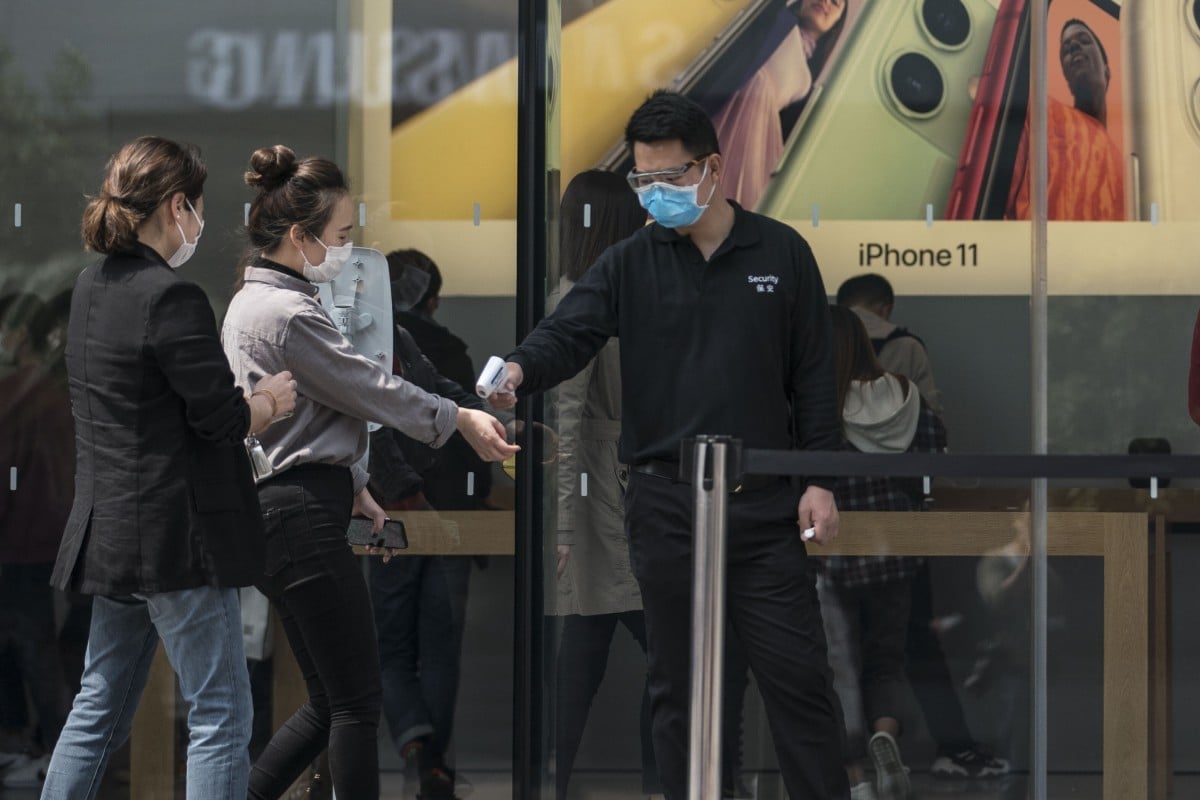
The landmark Apple Store in the popular Taikoo shopping centre is open, but with limited customers allowed inside, there are long queues outside. Customers are required to scan a QR code to check their movements over the last few days before entering.
Coronavirus: More schools reopen in China for students preparing for university entrance exams
“Why do I have to spend 20 minutes just to get into the Apple Store? The sun has almost melted me down,” one visitor complained to the security guards at the front of the shop.
China’s continued pandemic prevention measures, coupled with still hesitant consumer demand, will inevitably lead to persistent limitations on the nation’s economic recovery, analysts said.
Ernai Cui, an economist at research firm Gavekal Dragonomics, said on Monday that China’s cautious approach to lifting restrictions “points to a weak second quarter for consumer services”, adding additional pressure to the economic recovery.Mao Zhenhua, a researcher at the China Institute of Economics at Renmin University, said China’s preventive measures will inevitably be a drag on production, employment and exports.
BEIJING, April 7 (Xinhua) — A Chinese Foreign Ministry spokesperson said Tuesday that China opposes all forms of discrimination and prejudice.
Spokesperson Zhao Lijian made the remarks in a press briefing when responding to media reports that since China tightened immigration control measures to contain imported cases of COVID-19, some foreigners have complained about discrimination and rising xenophobia in China.
“China always attaches great importance to the safety and health of foreign nationals in China and protects their legitimate rights and interests in accordance with the law,” Zhao stressed.
Since the COVID-19 outbreak, relevant departments and local governments in China have made every effort to meet the living, epidemic control and medical needs of the foreign citizens, Zhao said, adding that foreign nationals infected with COVID-19 in China are provided timely treatment.
“China opposes all forms of discrimination and prejudice,” Zhao noted, adding that in light of the development of the epidemic, China has promptly and dynamically adjusted the inspection, quarantine, prevention and control measures for foreign nationals entering into China.
“These are temporary measures that China has to take in response to the current situation by referring to the practices of many countries. China has to do so because we must be responsible for our own people and foreign citizens as well,” Zhao said.
“We always treat foreign nationals and Chinese citizens alike, implement measures without discrimination, give full consideration to the legitimate concerns of the persons concerned and respect their religions and customs. We do not increase or reduce certain regulations on someone just because they are foreign citizens,” Zhao said.
Zhao stressed that all foreigners in China should strictly abide by the Law of the People’s Republic of China on the Prevention and Treatment of Infectious Diseases, as well as other laws and local regulations on epidemic prevention and control.
“We hope foreign citizens in China will continue to fully understand and actively cooperate with China’s epidemic control measures to prevent risks and protect the health and safety of their own and others. That is the way to contribute to the final victory over the epidemic,” he added.
BEIJING/WUHAN, China (Reuters) – China on Saturday mourned the thousands of “martyrs” who have died in the new coronavirus outbreak, flying the national flag at half mast throughout the country and suspending all forms of entertainment.
The Chinese national flag flies at half-mast at Tiananmen Square in Beijing, as China holds a national mourning for those who died of the coronavirus disease (COVID-19), on the Qingming tomb sweeping festival, April 4, 2020. REUTERS/Carlos Garcia Rawlins
The day of mourning coincided with the start of the annual Qingming tomb-sweeping festival, when millions of Chinese families pay respects to their ancestors.
At 10 a.m. (0200 GMT) Beijing time, the country observed three minutes of silence to mourn those who died, including frontline medical workers and doctors. Cars, trains and ships sounded their horns and air raid sirens wailed.
In Zhongnanhai, the seat of political power in Beijing, President Xi Jinping and other Chinese leaders paid silent tribute in front of the national flag, with white flowers pinned to their chest as a mark of mourning, state media reported.
More than 3,300 people in mainland China have died in the epidemic, which first surfaced in the central province of Hubei late last year, according to statistics published by the National Health Commission.
In Wuhan, the capital of Hubei province and the epicentre of the outbreak, all traffic lights in urban areas turned red at 10 a.m. and all road traffic ceased for three minutes.
Some 2,567 people have died in Wuhan, a megacity of 11 million people located in the middle reaches of the Yangtze river. The Wuhan deaths account for more than 75% of the country’s fatalities.
Among those who died was Li Wenliang, a young doctor who tried to raise the alarm about the disease. Li was honoured by the Hubei government earlier this week, after initially being reprimanded by police in Wuhan for “spreading rumours”.
Gui Yihong, 27, who was among thousands of Wuhan locals who volunteered to deliver food supplies to hospitals during the city’s months-long lockdown, recalled the fear, frustration and pain at Wuhan Central Hospital, where Li worked.
“If you weren’t at the frontlines you wouldn’t be able to experience this,” said Gui, as he laid some flowers next to Wuhan’s 1954 flood memorial by the Yangtze.
“I had to (come) and bear witness. For the last 80 days we had fought between life and death, and finally gained victory. It was not easy at all to come by.”
While the worst was behind Wuhan, the virus has spread to all corners of the globe since January, sickening more than a million people, killing more than 55,000 and paralysing the world economy.
Wuhan banned all tomb-sweeping activities in its cemeteries until at least April 30, curtailing one of the most important dates in the traditional Chinese lunar new year calendar which usually sees millions of families travel to tend to their ancestral graves, offer flowers and burn incense.
They have also told residents, most stuck at home due to lockdown restrictions, to use online streaming services to watch cemetery staff carry out those tasks live.
ASYMPTOMATIC CASES
Online, celebrities including “X-Men: Days of Future Past” star Fan Bingbing swapped their glamorous social media profile pictures for sombre photos in grey or black, garnering millions of “likes” from fans.
Chinese gaming and social media giant Tencent (0700.HK) suspended all online games on Saturday.
As of Friday, the total number of confirmed cases across the country stood at 81,639, including 19 new infections, the National Health Commission said.
Eighteen of the new cases involved travellers arriving from abroad. The remaining one new infection was a local case in Wuhan, a patient who was previously asymptomatic.
Asymptomatic people exhibit few signs of infection such as fevers or coughs, and are not included in the tally of confirmed cases by Chinese authorities until they do.
However, they are still infectious, and the government has warned of possible local transmissions if such asymptomatic cases are not properly monitored.
China reported 64 new asymptomatic cases as of Friday, including 26 travellers arriving in the country from overseas. That takes the total number of asymptomatic people currently under medical observation to 1,030, including 729 in Hubei.
The Battle of Triangle Hill is known in China as a victory against foreign aggressors
Film’s timing linked to deteriorating relations between Beijing and Washington on multiple fronts
A scene from the 1956 Chinese film Shang Gan Ling, about the Korean war Battle for Triangle Hill, subject of a new film which is about to go into production in China. Photo: Handout
One of the bloodiest battles of the Korean war is the subject of a film that will soon start production in China, in a move which is being linked to surging Chinese nationalism amid poor relations between Beijing and Washington.
The film, based on the Battle of Triangle Hill – also known as the Shang Gan Ling campaign in China – was given the green light by state regulator the China Film Administration in July, but was not reported by Chinese official media until last week.
Hou Jianwei, one of China’s best known war novelists, has been signed on as screenwriter for the film, to be produced by Ao Bo Film Zhejiang which confirmed on microblogging platform Weibo that production was already in “active preparation”.
“More than 100,000 people from the People’s Voluntary Army and forces from the US and South Korea took part in the 43-day fighting, and over 2.4 million shells of ammunition were fired. The battle was unprecedentedly fierce and 40,000 lives were lost,” the film company said in its most recent Weibo post.
“With a multitude of heroes, our army built up an impenetrable barrier in the East.”
China invokes Korean war talks as reason not to bow to US in trade dispute
News of the film has coincided with mounting confrontations between Beijing and Washington on multiple fronts ranging from trade and technology, to Hong Kong and Xinjiang.
Korean war-themed productions have long been a taboo subject for China’s heavily censored film industry, partly because of Beijing’s complicated relations with the US and North Korea.
But the 1950-53 war, in which China and North Korea battled Western forces led by the US, has increasingly become a tool to rally public opinion behind Beijing’s ongoing trade war with the US. Study Times, a Central Party School publication, for example, has directly likened the trade war to the end of the Korean conflict, saying China was determined to oppose US bullying as trade negotiations entered their 17th month.
While Beijing has never given an official account of its decision to join the Korean war, it is often portrayed as a necessary intervention to shield China from US aggression.
The Battle of Triangle Hill has often been presented in China’s official media as a victory by the “volunteers” of the People’s Liberation Army over foreign aggressors.
News of the production has raised avid discussion on Chinese social media, with many seeing the new film as part of China’s efforts to reinforce surging Chinese nationalism in the face of growing pressure from the West.
“Isn’t the approval [to make the film] a strong signal to the West that we are now a strong power?” one Weibo microblogger wrote.
You Quan, a member of the Secretariat of the Communist Party of China (CPC) Central Committee and head of the United Front Work Department of the CPC Central Committee, attends a symposium to commemorate the 74th anniversary of the victory in the Chinese People’s War of Resistance Against Japanese Aggression and the World Anti-Fascist War in Beijing, capital of China, Sept. 3, 2019. (Xinhua/Shen Hong)
BEIJING, Sept. 3 (Xinhua) — China on Tuesday held a symposium to commemorate the 74th anniversary of the victory in the Chinese People’s War of Resistance Against Japanese Aggression and the World Anti-Fascist War.
You Quan, a member of the Secretariat of the Communist Party of China (CPC) Central Committee and head of the United Front Work Department of the CPC Central Committee, joined about 200 representatives from various sectors at the event in Beijing.
Participants including Party officials, military officers, war veterans and student representatives spoke highly of the great achievements made by the Chinese people in safeguarding national independence and liberty and protecting the sovereignty and sanctity of the country at the symposium.
Families of war heroes, representatives of non-Communist parties and foreigners who contributed to China’s war against Japanese aggression also attended the symposium.
BEIJING, Feb. 27 (Xinhua) — Chinese lawmakers have met at a bimonthly legislative session to discuss a research report on poverty relief, and brainstormed methods to seal the country’s victory against poverty.
The report was based on the investigation led by three National People’s Congress (NPC) Standing Committee vice chairpersons into poverty alleviation efforts in 16 provinces and regions last year.
It was reviewed at the two-day committee session, which ended Wednesday.
Delivered at the session by Wu Weihua, vice chairperson of the NPC Standing Committee, the report said that “decisive progress” had been made in the anti-poverty fight but circumstances remained challenging.
Support for extremely impoverished regions should be continuously strengthened, according to Li Yuefeng, a member of the standing committee, who said that areas in abject poverty still posed the most difficult tasks in the battle against poverty, and called for consistent efforts to make sure they did not lag behind.
Fellow lawmaker Liu Yuankun believes the problems for extremely poor areas are rooted in their economy and society, and suggested poverty relief in such areas be integrated with local economic and social development.
“As soon as transportation works, everything will work,” he said, stressing the construction of infrastructure, which allows funds, talent and industries to flow into impoverished areas.
Another member Zheng Gongcheng said that only by building inner faith and hope could the endogenous power to defeat poverty be long-lasting, and suggested prioritizing efforts in education and employment to enhance the capacity of people in poverty.
In 2018, China lifted 13.86 million people in rural areas out of poverty, with the number of impoverished rural residents dropping from 98.99 million in late 2012 to 16.6 million by the end of last year.
The number is still high, however, and many of the impoverished are long suffering from illnesses, disabled, or elderly people with no family, according to the report.
“A long-term and effective mechanism to prevent people from falling back into poverty due to illness is significant,” said Li Xueyong, a member of the NPC Standing Committee, who asked for more measures to cut major illnesses at the root.
BEIJING, Jan. 1 (Xinhua) — Chinese President Xi Jinping on Tuesday warmly congratulated Raul Castro, first secretary of the Central Committee of the Communist Party of Cuba, and Miguel Diaz-Canel, president of the Council of State and the Council of Ministers of Cuba, on the 60th anniversary of Cuba’s revolution victory on behalf of the Communist Party of China (CPC) and the Chinese government and people.
In his congratulatory message to Raul Castro, Xi, who is also general secretary of the CPC Central Committee, said under the strong leadership of the Communist Party of Cuba over the past 60 years, the Cuban government and people have made great achievements with hard work in the cause of socialist construction, which are highly appreciated and congratulated by the CPC and the Chinese government and people.
The relations between the two parties and two countries have stood the test of international vicissitudes and achieved fruitful results, making the two sides good friends, good comrades and good brothers, Xi noted.
Xi said he attaches great importance to the development of the China-Cuba friendship and is willing to work together with Raul Castro to lead bilateral relations to keep marching forward.
In his congratulatory message to Diaz-Canel, Xi said that the Communist Party of Cuba and its people are endeavoring to update and improve the nation’s socialist system, which will guarantee new developments in Cuba’s socialist cause.
Xi mentioned Diaz-Canel’s historic visit to China around a month ago, during which the two leaders proposed a blueprint for bilateral ties in the new era, adding that he is willing to join hands with Diaz-Canel for continuous development of China-Cuba relations.
Chinese Premier Li Keqiang also sent a congratulatory message to Diaz-Canel on Tuesday, saying Cuba has enjoyed flourishing national developments and will usher in a brighter future.
The two countries have always understood and supported each other, pushing bilateral relations for an all-round and in-depth development, said the premier.
Li also voiced hope that with the joint efforts from both sides, their traditional friendship will continue to bear fruits.


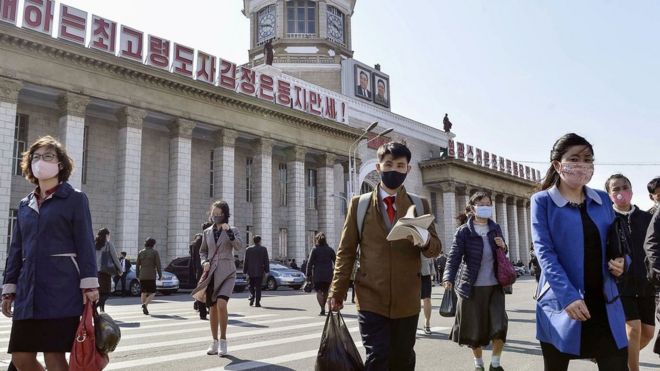 Image copyright REUTERS
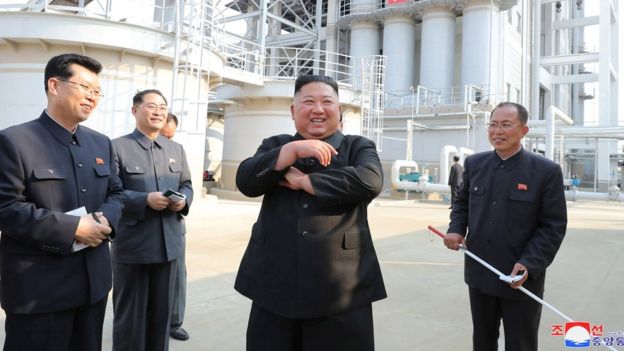 Image copyright REUTERS


 CHINDIA ALERT: You'll be living in their world, very soon