Archive for ‘Vietnam’

27/08/2019

Viewpoint: How serious is India’s economic slowdown?

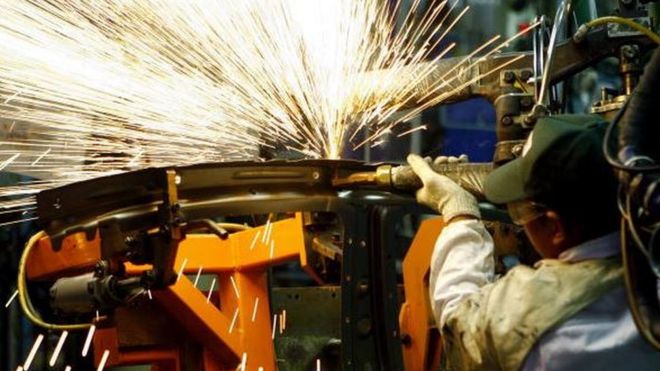
Indian factory worker
Image caption Private sector investment is at a 15-year low

Top Indian government officials are engaged in a vociferous public debate over the state of the country’s economy.

Rajiv Kumar, the head of the government’s think tank Niti Aayog, recently claimed that the current slowdown was unprecedented in 70 years of independent India and called for immediate policy interventions in specific industries.

The Chief Economic Adviser, K Subramanian, disagreed with the idea of industry-specific incentives and argued for structural reforms in land and labour markets. Members of Prime Minister Narendra Modi’s economic advisory council sound inchoate, resorting to social media and opinion editorials to counter one another.

In essence, the quibble among the members of the economic team of Mr Modi and his government is not about whether India is facing an economic slowdown or not, but about how grave the current economic crisis is.

This is a remarkable reversal in stance of the same group of economists who, until a few months ago, waxed eloquent about how India was the fastest growing economy in the world, generating seven million jobs a year.

To put all this in context, it was less than just two years ago, in November 2017, that the global ratings agency Moody’s upgraded India’s sovereign ratings – an independent assessment of the creditworthiness of a country – for the first time in 14 years.
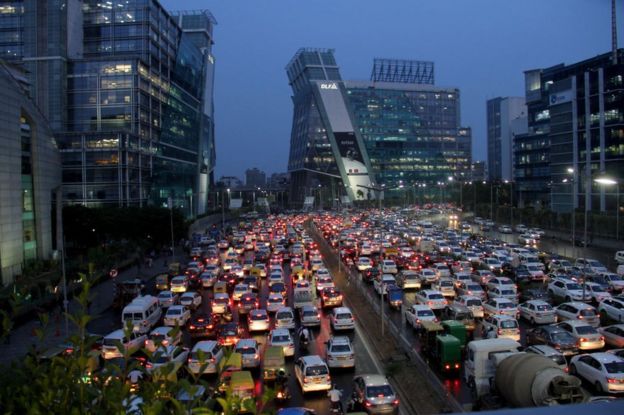
GurgaonImage copyrightGETTY IMAGES
Image captionSales of cars and SUVs have slumped to a seven-year low

Justifying the upgrade, Moody’s had then argued that the economy was undergoing dramatic “structural” reforms under Mr Modi.

In the two years since, Moody’s has downgraded its 2019 GDP growth forecast for India thrice – from 7.5% to 7.4% to 6.8% to 6.2%.

The immediate questions that arise now are: is India’s economic condition really that grim and, if yes, how did it deteriorate so rapidly?

Presentational grey line

Read more about the Indian economy

Presentational grey line

One of India’s most celebrated entrepreneurs, the founder of the largest coffee store chain, Café Coffee Day, recently killed himself, ostensibly due to unmanageable debt, slowing growth and alleged harassment by tax authorities.

The auto industry is expected to shed close to a million direct and indirect jobs due to a decline in vehicle sales. Sales growth of men’s inner wear clothing, a key barometer of consumption popularised by former Federal Reserve Chair Alan Greenspan, is negative. Consumption demand that accounts for two-thirds of India’s GDP is fast losing steam.

To make matters worse, Finance Minister Nirmala Sitharaman presented her first budget recently with some ominous tax proposals that threatened foreign capital flows and dented investor confidence. It sparked criticism and Ms Sitharaman was forced to roll back many of her proposals.
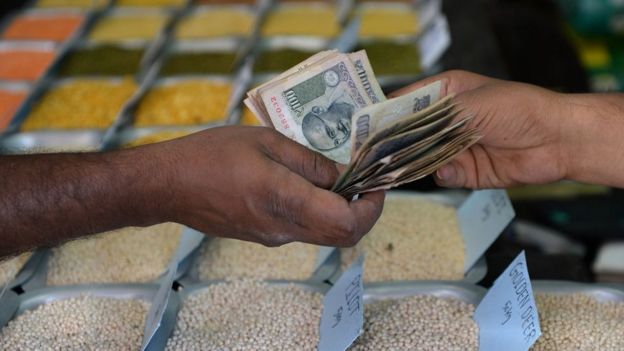
An Indian customer hands over cash to a food grain merchant at a wholesale trading shop in BangaloreImage copyright GETTY IMAGES
Image caption In 2016, India withdrew 85% of all currency notes from the economy

So, it is indeed true that India is facing a sharp economic downturn and severe loss of business confidence.

The alarm over the economic condition is not merely a reflection of a slowdown in GDP growth but also the poor quality of growth.

Private sector investment, the mainstay of sustainable growth in any economy, is at a 15-year low.

In other words, there is almost no investment in new projects by the private sector. The situation is so bad that many Indian industrialists have complained loudly about the state of the economy, the distrust of the government towards businesses and harassment by tax authorities.

But India’s economic slowdown is neither sudden nor a surprise.

Behind the fawning headlines in the press over the past five years about the robustness of India’s growth was a vulnerable economy, straddled with massive bad loans in the financial sector, disguised further by a macroeconomic bonanza from low global oil prices.

India’s largest import is oil and the fortuitous decline in oil prices between 2014 and 2016 added a full percentage point to headline GDP growth, masking the real problems. Confusing luck with skill, the government was callous about fixing the choked financial system.

To make matters worse, Mr Modi embarked on a quixotic move in 2016 to withdraw all high-value banknotes from circulation overnight. This effectively removed 85% of all currency notes from the economy.
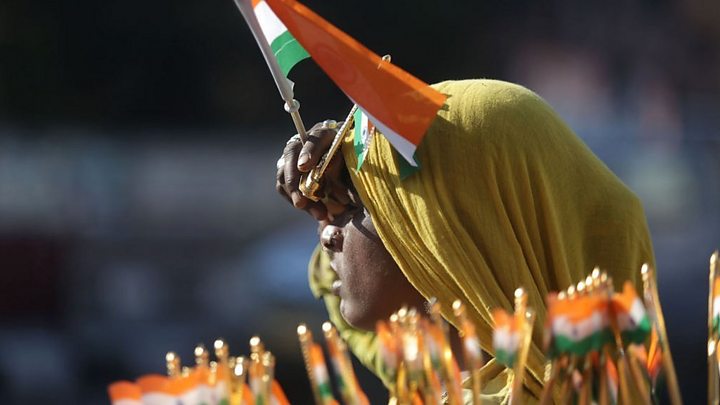
Media caption What is really happening with India’s economy?

This move destroyed supply chains and impacted agriculture, construction and manufacturing that together account for three-quarters of all employment in the country.

Before the economy could recover from the currency ban shock, the government enacted a transition to a new indirect taxation system of the Goods and Services Tax (GST) in 2017. The GST rollout wasn’t smooth and many small businesses initially struggled to understand it.

Such massive external shocks to the economy, coupled with a reversal in low oil prices, dealt the final blow to the economy. Millions of Indians started to lose their jobs and rural wages remained stagnant. This, in turn, impacted consumption, slowing down the economy sharply.

Not easy

The wobbly state of the economy has also thrown government finances in disarray: tax revenues are much below expectations.

On Monday, the government got a much-needed breather when India’s central bank announced a $24bn (£19bn) one-time payout for the cash-starved government. (This amount is more than the dividend paid by the central bank to the government in all five years of the Congress rule between 2009 and 2014.)

The solutions to the economic crisis are not easy.

Indian industry, fed and fattened with government protection through decades, is once again clamouring for tax cuts and financial incentives.

But it is not clear that such benefits will revive private sector investment and domestic consumption immediately.

For all the hype about the Make in India programme, hailed as the harbinger of the country’s emergence as a manufacturing power, India’s dependence on China for goods has only doubled in the past five years.

India today imports from China the equivalent of 6,000 rupees ($83; £68) worth of goods for every Indian, which has doubled from 3,000 rupees in 2014.

India’s exports have remained stuck at 2011 levels and not grown.

So, India is neither making goods for itself nor for the world.
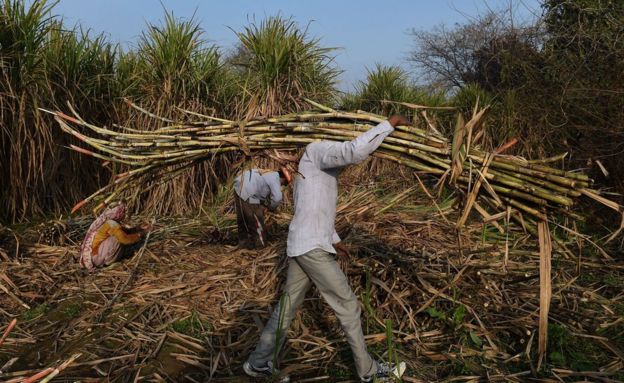
An Indian farmer carries sugarcane to load on a tractor to sell it at a nearby sugar mill in Modinagar in Ghaziabad, some 45km east of New Delhi, on January 31, 2018Image copyright AFP
Image caption India’s agrarian crisis is a major stumbling block

Ornamental tax and other fiscal incentives to specific industries are not suddenly going to make Indian manufacturers competitive and stop India’s addiction for affordable Chinese goods. If any, the trade spat between China and the United States only saw countries such as Vietnam and Bangladesh benefit and not India.

More currency or trade tariffs are not the solutions either. The central bank has lowered interest rates and there is some push to lowering the cost of capital for industry. But again, Indian industry will invest more only when demand for goods and services increases. And demand will increase only when wages increase, or there is money in the hands of people.

So, the only immediate solution for India seems to be to boost consumption through a stimulus given directly to people, in the classical Keynesian mould.

Of course, such a stimulus should be combined with reforms to boost business morale and confidence.

In sum, India’s economic picture is not pretty.

It is important for India’s political leadership to see this not-so-pretty picture and not hide behind rose tinted glasses. Prime Minister Modi has a unique electoral mandate to embark on bold moves to truly transform the economy and pull India out of the woods.

Source: The BBC
24/08/2019

Chinese ship inches closer to Vietnam coastline amid South China Sea tensions

HANOI (Reuters) – A Chinese survey vessel on Saturday extended its activities to an area closer to Vietnam’s coastline, ship tracking data showed, after the United States and Australia expressed concern about China’s actions in the disputed waterways.

The Haiyang Dizhi 8 vessel first entered Vietnam’s exclusive economic zone (EEZ) early last month where it began a weeks-long seismic survey, triggering a tense standoff between military and coastguard vessels from Vietnam and China.

The Chinese vessel continued to survey Vietnam’s EEZ on Saturday under escort from at least four ships and was around 102 kilometres (63 miles) southeast of Vietnam’s Phu Quy island and 185 kilometres (115 miles) from the beaches of the southern city of Phan Thiet, according to data from Marine Traffic, a website that tracks vessel movements.

The Chinese vessel group was followed by at least two Vietnamese naval vessels, according to the data.

Vietnam’s foreign ministry did not immediately respond to a request from Reuters for comment.

A country’s EEZ typically extends up to 200 nautical miles (370 kilometres or 230 miles) from its coastline, according to an international UN treaty. That country has sovereign rights to exploit any natural resources within that area, according to the agreement.

Vietnam and China have for years been embroiled in a dispute over the potentially energy-rich stretch of waters and a busy shipping lane in the South China Sea.

China’s unilaterally declared “nine-dash line” marks a vast, U-shaped, expanse of the South China Sea that it claims, including large swathes of Vietnam’s continental shelf where it has awarded oil concessions.

On Friday, Vietnamese Prime Minister Nguyen Xuan Phuc and his Australian counterpart expressed their concern about China’s activities in the South China Sea, known in Vietnam as the East Sea.

Earlier in the week, the United States said it was deeply concerned about China’s interference in oil and gas activities in waters claimed by Vietnam, and that the deployment of the vessels was “an escalation by Beijing in its efforts to intimidate other claimants out of developing resources in the South China Sea”

Chinese Foreign Ministry spokesman Geng Shuang, in response to the U.S. statement, said Washington was “sowing division and had ulterior motives”.

“The aim is to bring chaos to the situation in the South China Sea and damage regional peace and stability. China is resolutely opposed to this,” Geng told a daily news briefing on Friday.

Source: Reuters

03/08/2019

A boy, a girl and two mothers: how a trailblazing Chinese lesbian couple are creating a family

  • Cai Rui and Wu Chen are the proud parents of twins but they had to go abroad for the IVF treatment they needed to bring the children into the world
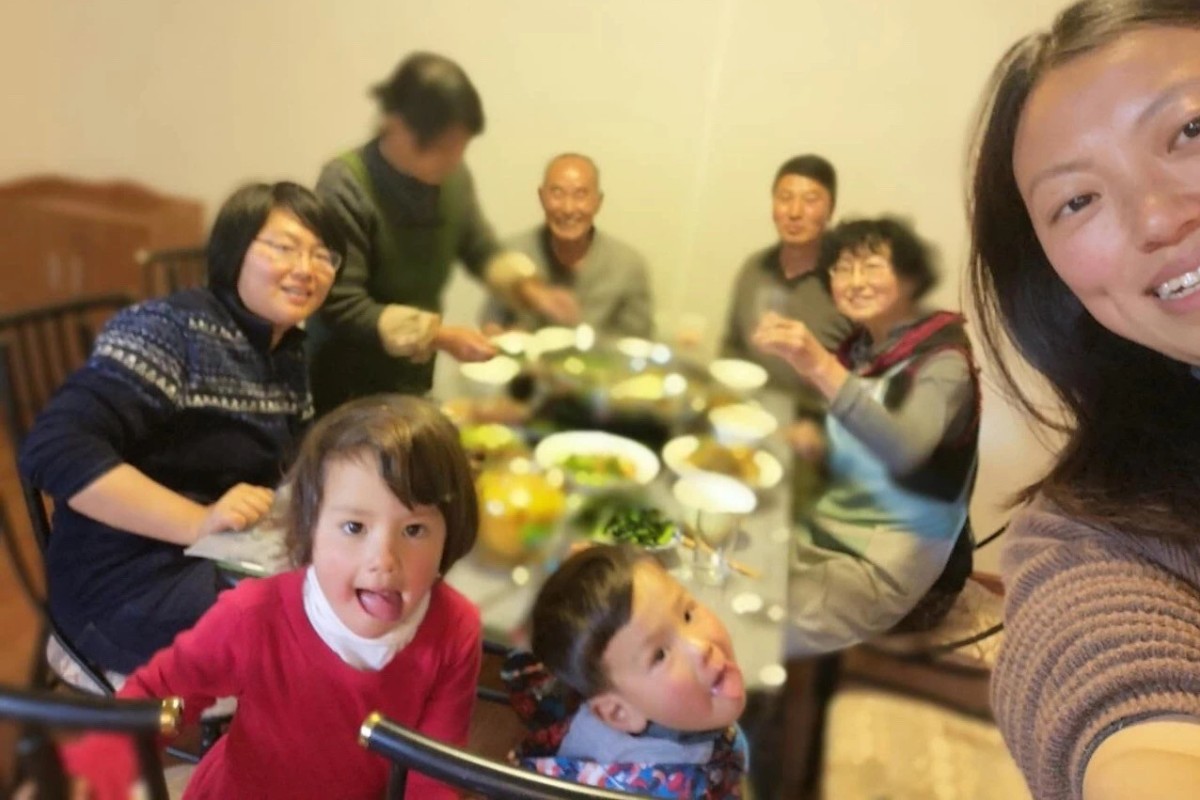
Wu Chen (far left) and Cai Rui (right) are raising their young family together in China. Photo: Cai Rui
When three-year-old twins Harry and Helen are asked about their dad, they have a set answer.
The children tell the curious that they do have a father but he lives in the United States.

Harry and Helen live on the outskirts of Kunming in the southwestern Chinese province of Yunnan with their two mothers, Cai Rui and Wu Chen.

Cai gave birth to the twins after being implanted at a US IVF clinic with ova from Wu and sperm from an American donor.

The couple were forced to seek treatment abroad because Chinese clinics will only perform IVF procedures on couples who can produce a marriage certificate – something limited to heterosexuals.

For Cai and Wu, it was a leap into the unknown – there was little information in China and few others had gone public about their experience.

But their biological clocks were ticking and the couple were used to taking difficult paths.

Gay Chinese find a place to be themselves on ‘Rainbow Cruise’ to Vietnam

Cai and Wu met while studying in Britain and registered their marriage there in 2014. Both women were in their thirties and soon began thinking about having children.

They looked forward to being mothers and felt the experience would strengthen their relationship even more, Cai said.

“I think it’s natural for a woman to aspire to be a mother once she turns 30,” she said. “We were both aware that the older a woman is, the harder it is for her to get pregnant. So it’s an immediate thing for us.”

Their parents were also worried about the couple’s welfare as they grew older.

“Our parents have accepted our relationship, thinking it’s our own choice. However, they worried that when we are old, there will be no children to look after us,” Cai said.

Wu Chen (left) and Cai Rui (right) brought their twin children Helen and Harry into the world with help from IVF treatment in the United States. Photo: Cai Rui

The couple embarked on two rounds of IVF in London, with Cai impregnated with Wu’s fertilised ova, but both rounds failed.

They then returned to China and searched for other options but at the time there were few posts by Chinese lesbians sharing their experience of having babies abroad, Cai said.

So they contacted three clinics in the US and finally decided to go through one in Portland, Oregon, in large part because of the city’s gay-friendly reputation.

Cai said that when it came time to choose a sperm donor, they were less concerned about his outward appearance and more focused on his physical and mental health, his academic record and his experience growing up.

“We wanted to make sure our baby’s father was a healthy and interesting guy,” she said.

The couple chose the sperm of a white man and implanted two fertilised eggs into Cai’s body to raise the chances of success. Twelve weeks later, the couple flew back to Beijing where Harry and Helen were born on April 1, 2016.

Thanks to a more relaxed population policy since 2016, Cai was able to register the children as a single mother while the children were given her partner’s surname.

“So my lover is their biological mother and I am their birth mother,” Cai said.

Small victory for China’s online lesbian community as censored forum is restored, but another remains blocked
The family lived in Beijing for about a year before moving to Yunnan for work commitments. Cai said there had not been any big problems raising the children there apart from some annoying questions from neighbours about why the children are biracial and why the father is not in the home.
“These questions are like flies around us. But they’re not a big deal and won’t affect our life,” she said.
She said she told various villagers in their community about the children’s conception and they responded by saying, “What an advanced lifestyle you have!”
Twins Harry and Helen celebrate Lunar New Year. Photo: Cai Rui

The couple have also tried to explain the situation to the twins.

“We instilled diverse family values in them from a very young age, through everything including cartoon books they read and stories we made up by ourselves,” Cai said.

“So we told [them] that you have a father. But the reason for forming a family is love. We don’t have love with your father, so he doesn’t live with us.”

About four years ago the couple opened a public account on social media app WeChat called Rainbow Babies, to share their experience with other lesbians on the mainland. Cai said the account had more than 17,000 followers, many responding by relating their own stories about IVF.

One woman wrote on the platform that she and her partner had been together for 10 years and after having a daughter they were pregnant with a boy.

“I am not confident of us lesbians raising a boy. Do you have any tips to share with us?” the woman wrote.

Why China’s gays and lesbians are still stuck in the closet

Another woman wrote that since she and her partner decided to have a baby, they had confronted obstacles at every step in the process, but the biggest benefit was that “after so many hardships, our love has been consolidated and we have cherished each other more than before”.

Cai said the most popular destinations for mainland lesbians seeking IVF treatment were the US, Thailand and Cambodia, with at least 1,000 either pregnant or having given birth.

“Some people are hesitant to have babies because of social pressure. [But] as times goes by and women get older, the possibility of them getting pregnant becomes lower,” Cai said.

Cai said she and Wu were often praised for their courage but they were in the habit of choosing a tougher road.

“On many occasions, this habit is the most reliable way to push us to keep our innocent heart and to do things to be ourselves,” she said.

Source: SCMP

31/07/2019

China claims progress towards world’s biggest trade deal, but India remains biggest roadblock to RCEP

  • China suggests good progress made in Regional Comprehensive Economic Partnership talks after marathon 10-day negotiations in Zhengzhou
  • Indian Commerce Minister Piyush Goyal has opted to skip the upcoming high-level meetings, adding fuel to rumours that the country could be removed
The Association of Southeast Asian Nations (Asean) has overtaken the US to become China’s second-largest trading partner in the first half of 2019. Photo: AP
China has claimed “positive progress” towards finalising the world’s largest free-trade agreement by the end of 2019 after hosting 10 days of talks, but insiders have suggested there was “never a chance” of concluding the deal in Zhengzhou.
The 27th round of the Regional Comprehensive Economic Partnership (RCEP) negotiations closed on Wednesday in the central Chinese city. 
The 10-day

working level conference brought over 700 negotiators from all 16 member countries to Henan province, with China keen to push through a deal which has proven extremely difficult to close.

If finalised, the agreement, which involves the 10 Asean nations, as well as China, Japan, South Korea, Australia, New Zealand, and India, would cover around one-third of the global gross domestic product, about 40 per cent of world trade and almost half the world’s population.
“This round of talks has made positive progress in various fields,” said assistant minister of commerce Li Chenggang, adding that all parties had reaffirmed the goal of concluding the deal this year. “China will work together with the RCEP countries to proactively push forward the negotiation, strive to resolve the remaining issues as soon as possible, and to end the negotiations as soon as possible.”
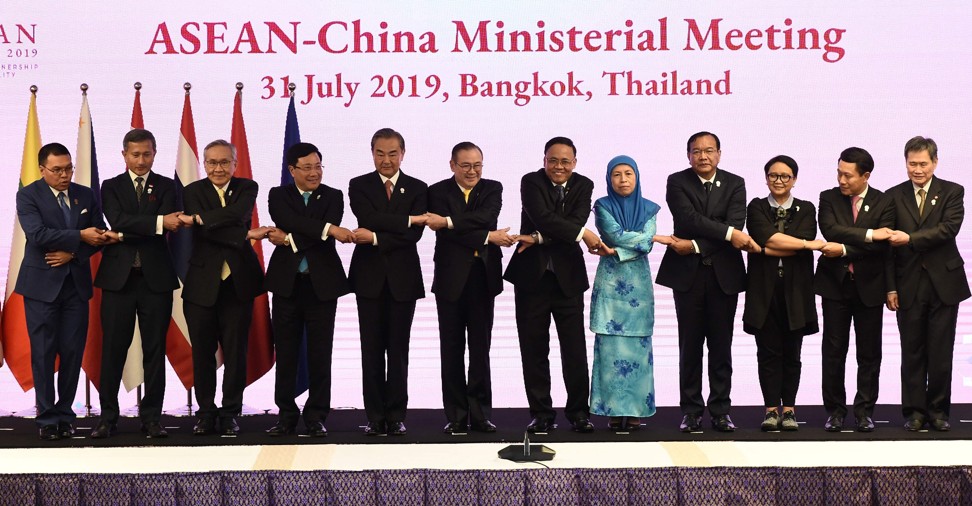
China's Foreign Minister Wang Yi (fifth left) poses with foreign ministers from the Association of Southeast Asian Nations (Asean) countries during the ASEAN-China Ministerial Meeting in Bangkok. Photo: AFP
China’s Foreign Minister Wang Yi (fifth left) poses with foreign ministers from the Association of Southeast Asian Nations (Asean) countries during the ASEAN-China Ministerial Meeting in Bangkok. Photo: AFP

China is keen to complete a deal which would offer it a buffer against the United States in Asia, and which would allow it to champion its free trade position, while the US pursues protectionist trade policy.

The RCEP talks took place as Chinese and American trade negotiators resumed face-to-face discussions in Shanghai, which also ended on Wednesday, although there was little sign of similar progress.

As the rivalry between Beijing and Washington has intensified and bilateral trade waned, the Association of Southeast Asian Nations (Asean) overtook the US to become China’s second-largest trading partner in the first half of 2019. From January to June, the trade volume between China and the 10-member bloc reached US$291.85 billion, up by 4.2 per cent from a year ago, according to government data.

The Asean bloc is made up of Indonesia, Thailand, Malaysia, Singapore, Philippines, Vietnam, Myanmar, Cambodia, Brunei and Laos.

China will work together with the RCEP countries to proactively push forward the negotiation, strive to resolve the remaining issues as soon as possible, and to end the negotiations as soon as possible. Li Chenggang

RCEP talks will now move to a higher level ministerial meeting in Beijing on Friday and Saturday, but trade experts have warned that if material progress is not made, it is likely that the RCEP talks will continue into 2020, prolonging a saga which has already dragged on longer than many expected. It is the first time China has hosted the ministerial level talks.
But complicating matters is the fact that India’s Commerce Minister, Piyush Goyal, will not attend the ministerial level talks, with an Indian government official saying that he has to participate in an extended parliamentary session.
India is widely viewed as the biggest roadblock to concluding RCEP, the first negotiations for which were held in May 2013 in Brunei. Delhi has allegedly opposed opening its domestic markets to tariff-free goods and services, particularly from China, and has also had issues with the rules of origin chapter of RCEP.
China is understood to be “egging on” other members to move forward without India, but this could be politically explosive, particularly for smaller Asean nations, a source familiar with talks said.
Deborah Elms, executive director of the Asian Trade Centre, a Singapore-based lobby group, said that after the last round of negotiations in Melbourne between June 22 to July 3 – which she attended – there was “frustration” at India’s reluctance to move forward.
She suggested that in India’s absence, ministers in China could decide to move forward through a “pathfinder” agreement, which would remove India, but also potentially Australia and New Zealand.
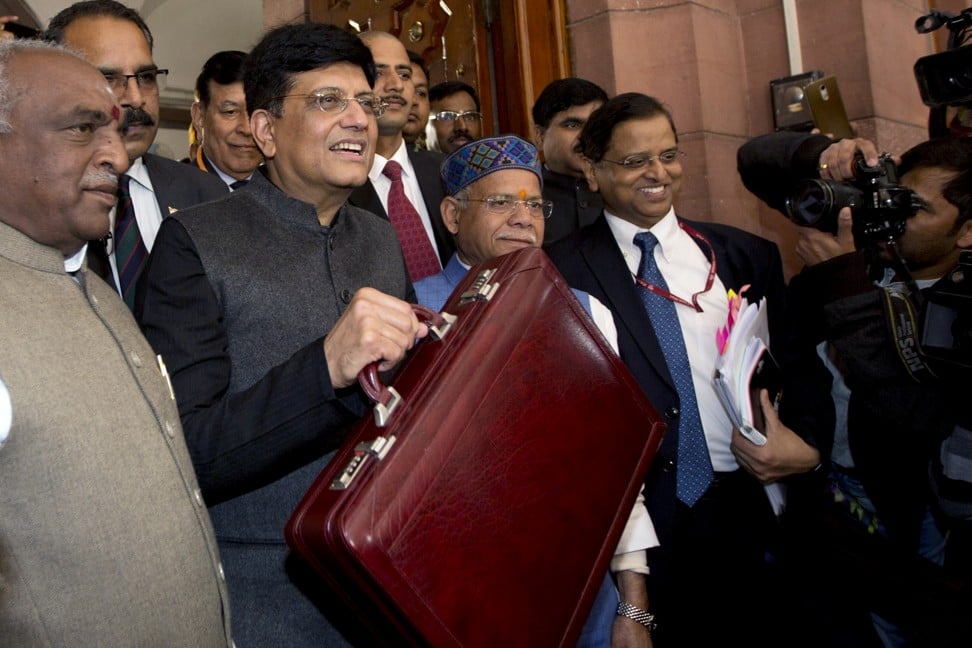
India’s Commerce Minister, Piyush Goyal, will not attend the ministerial level talks this week in Beijing. Photo: Bloomberg

This “Asean-plus three” deal would be designed to encourage India to come on board, Elms said, but would surely not go down well in Australia and New Zealand, which have been two of the agreement’s biggest supporters.

New Zealand has had objections to the investor protections sections of RCEP, and both countries have historically been pushing for a more comprehensive deal than many members are comfortable with, since both already have free trade agreements with many of the other member nations.

However, their exclusion would be due to “an unfortunate geographical problem, which is if you’re going to kick out India, there has always been an Asean-plus three concept to start with”. Therefore it is easier to exclude Australia and New Zealand, rather than India alone, which would politically difficult.

A source close to the negotiating teams described the prospect of being cut out of the deal at this late stage as a “frustrating rumour”, adding that “as far as I know [it] has no real basis other than a scare tactic against India”.

There was “never a chance of concluding [the deal during] this round, but good progress is being made is what I understand. The key issues remain India and China”, said the source, who wished to remain anonymous.

Replacing bilateral cooperation with regional collaborations is a means of resolving the disputesTong Jiadong

However, Tong Jiadong, a professor of international trade at the Nankai University of Tianjin, said Washington’s refusal to recognise India as a developing country at the World Trade Organisation could nudge the world’s second most populous nation closer to signing RCEP.

“That might push India to the RCEP, accelerating the pace of RCEP,” Tong said, adding that ongoing trade tensions between Japan and South Korea could also be soothed by RCEP’s passage.

“Replacing bilateral cooperation with regional collaborations is a means of resolving the disputes between the two countries,” Tong said.

Although the plan was first proposed by the Southeast Asian countries, China has been playing an increasingly active role, first as a response to the now defunct US-backed Trans-Pacific Partnership (TPP), and more recently as a means of containing the impact of the trade war.

China’s vice-commerce Minister, Wang Shouwen, told delegates last week that RCEP was “the most important free trade deal in East Asia”. He called on all participants to “take full advantage of the good momentum and accelerating progress at the moment” to conclude a deal by the end of the year.

Source: SCMP

28/07/2019

Vietnam renews demand for ‘immediate withdrawal’ of Chinese ship in disputed South China Sea

  • Hanoi says it has sent several messages to Beijing that a Chinese survey ship vacate the waters located in its exclusive economic zone
  • ‘Vietnam resolutely and persistently protects our sovereign rights … by peaceful means on the basis of international laws,’ a foreign ministry spokesperson said
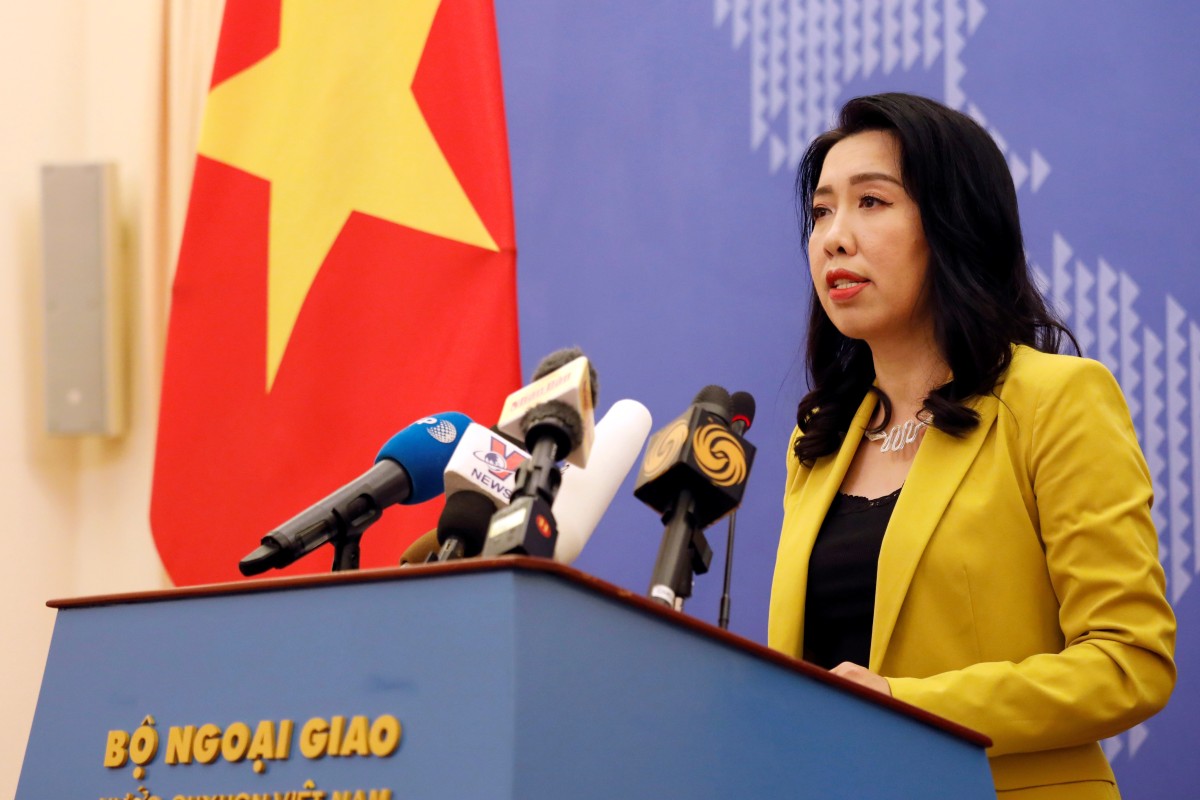
Vietnamese foreign ministry spokeswoman Le Thi Thu Hang. Photo: Reuters
Vietnam on Thursday called for the “immediate withdrawal” of a Chinese ship in the 
South China Sea

, as the stand-off over the disputed waters intensified.

Beijing last week issued a new call for Hanoi to respect its claims to the resource-rich region – which has historically been contested by Vietnam, as well as Taiwan, the Philippines, Malaysia and Brunei.
Hanoi responded by saying it had sent several messages to Beijing insisting that a Chinese survey ship vacate its waters, and doubled down on Thursday with new demands for the vessel’s removal.
“Vietnam has had several appropriate diplomatic exchanges … requesting immediate withdrawal from Vietnam’s exclusive economic zone,” a foreign ministry spokesperson told reporters, while refusing to disclose the ship’s precise location.
“Vietnam resolutely and persistently protects our sovereign rights … by peaceful means on the basis of international laws,” Le Thi Thu Hang added.
The ship, owned by the government-run China Geological Survey, begun research around the contested Spratly Islands on July 3, according to the US-based Center for Strategic and International Studies (CSIS).

Before it was spotted, a Chinese coastguard vessel also patrolled near Vietnamese supply ships in a “threatening manner”, CSIS said.

China has not confirmed the presence of its ships in the area.

China’s neighbours boost coastguards as tensions rise in South China Sea

Beijing invokes its so-called nine-dash line to justify its claim to historic rights to the waterway, and has previously built up artificial islands as well as installed airstrips and military equipment in the region.

The line runs as far as 2,000km (1,240 miles) from the Chinese mainland to within a few hundred kilometres of the Philippines, Malaysia and Vietnam.

In 2014 Beijing moved an oil rig into waters claimed by Hanoi, sparking deadly anti-China protests across Vietnam.

The latest stand-off in the sea prompted a swift rebuke from the United States over the weekend, calling for an end to China’s “bullying behaviour”.

US accuses China of acting like a bully in the South China Sea

“China’s repeated provocative actions aimed at the offshore oil and gas development of other claimant states threaten regional energy security,” the US State Department said Saturday.

The US has long called for freedom of navigation in the South China Sea, and on Thursday said it sailed a warship through the Taiwan Strait

.
Source: SCMP
17/07/2019

Vietnam, China embroiled in South China Sea standoff

HANOI (Reuters) – Vietnamese and Chinese ships have been embroiled in a weeks-long standoff near an offshore oil block in disputed waters of the South China Sea, which fall within Vietnam’s exclusive economic zone, two Washington-based think-tanks said on Wednesday.

China’s U-shaped “nine-dash line” marks a vast expanse of the South China Sea that it claims, including large swathes of Vietnam’s continental shelf where it has awarded oil concessions.

The Haiyang Dizhi 8, a ship operated by the China Geological Survey, on Monday completed a 12-day survey of waters near the disputed Spratly Islands, according to separate reports by the Center for Strategic and International Studies (CSIS) and the Center for Advanced Defense Studies (C4ADS)

One of the oil blocks it surveyed is licensed by Vietnam to Spanish energy firm Repsol, which was forced last year and in 2017 to cease operations in Vietnamese waters because of pressure from China.

As the Haiyang Dizhi 8 conducted its survey, nine Vietnamese vessels closely followed it. The Chinese ship was escorted by three China Coast Guard vessels, according to data from Winward Maritime, compiled by C4ADS.

In a separate incident days earlier, the China Coast Guard ship Haijing 35111 manoeuvred in what CSIS described as a “threatening manner” towards Vietnamese vessels servicing a Japanese-owned oil rig, the Hakuryu-5, leased by Russian state oil firm Rosneft in Vietnam’s Block 06.1, 370 km (230 miles) southeast of Vietnam.

That block is within the area outlined by China’s “nine-dash line”. A series of dashes on Chinese maps, the line is not continuous, making China’s claims often ambiguous.

Last year, Reuters exclusively reported that Rosneft Vietnam BV, a unit of Rosneft, was concerned that its drilling in Block 06.1 would upset China.
“On July 2 the vessels were leaving the Hakuryu-5 when the 35111 manoeuvred between them at high speed, passing within 100 metres of each ship and less than half a nautical mile from the rig,” CSIS said in its report.
It was not clear on Wednesday if any Chinese ships were still challenging the Rosneft rig.
In 2014, tension between Vietnam and China rose to its highest levels in decades when a Chinese oil rig started drilling in Vietnamese waters. The incident triggered boat rammings by both sides and anti-China riots in Vietnam.

‘READY TO FIGHT’

In response to reports of this month’s standoff, which first emerged on social media, Chinese foreign ministry spokesman Geng Shuang said on July 12 that China’s position on the South China Sea was “clear and consistent”.

“China resolutely safeguards its sovereignty in the South China Sea and maritime rights, and at the same time upholds controlling disputes with relevant countries via negotiations and consultations,” Geng said, without elaborating.

On Tuesday, Vietnam’s foreign ministry released a statement in response to unspecified “recent developments” in the South China Sea.

“Without Vietnam’s permission, all actions undertaken by foreign parties in Vietnamese waters have no legal effect, and constitute encroachments in Vietnamese waters, and violations of international law,” foreign ministry spokeswoman Le Thi Thu Hang said.

Neither statements confirmed or elaborated on the standoff.

Neither Rosneft nor Repsol immediately responded to an emailed request from Reuters for comment.

In a new statement on Wednesday, China’s foreign ministry spokesman Geng acknowledged that there had been an incident with Vietnam.

“We hope the Vietnam side can earnestly respect China’s sovereignty, rights, and jurisdiction over the relevant waters, and not take any actions that could complicate the situation,” Geng told a regular news conference.

On July 11, as China was conducting its survey of the blocks, Vietnam’s prime minister, Nguyen Xuan Phuc, visited the headquarters of the Vietnam Coast Guard in Hanoi.

State media did not mention the incident, but showed Phuc speaking to sailors on board vessels via a video link.

Phuc told the sailors to “stay vigilant and ready to fight” and to be aware of “unpredictable developments”, the Vietnam Coast Guard said in a statement on its website.

On the same day, Vietnam’s national assembly chairwoman, Nguyen Thi Kim Ngan, met her Chinese counterpart, Li Zhanshu, in Beijing, China’s Xinhua news agency reported.

The two officials agreed to “jointly safeguard peace and stability at sea”, Xinhua said.

Source: Reuters

12/07/2019

Top Chinese, Vietnamese legislators hold talks on cooperation

CHINA-BEIJING-LI ZHANSHU-VIETNAM-TALKS (CN)

Li Zhanshu (R), chairman of the Standing Committee of the National People’s Congress of China, holds talks with visiting Chairwoman of the National Assembly of Vietnam Nguyen Thi Kim Ngan, in Beijing, capital of China, July 11, 2019. (Xinhua/Zhang Ling)

BEIJING, July 12 (Xinhua) — Top Chinese legislator Li Zhanshu held talks with visiting Chairwoman of the National Assembly of Vietnam Nguyen Thi Kim Ngan on Thursday, agreeing to enhance exchanges and cooperation between the two countries’ legislative bodies.

Li, chairman of the Standing Committee of the National People’s Congress of China, told Ngan that China stands ready to work with Vietnam to comprehensively implement the important consensus reached by the leaders of the two parties and the two states.

Li called on the two sides to accelerate cooperation on jointly building the “Belt and Road” and the “Two Corridors, One Economic Circle,” jointly safeguard peace and stability at sea, as well as constantly improve the friendship between their people.

On the ties between the two legislative bodies, the National People’s Congress of China and the National Assembly of Vietnam, Li said they could provide legal support for bilateral cooperation. He called on both sides to learn from each other through increased communication, promote people-to-people, local and youth exchanges, and strengthen coordination within multilateral mechanisms.

Ngan said Vietnam is willing to work with China to fully implement the important consensus reached by the leaders of the two parties and the two states, to enhance mutually beneficial cooperation in various fields and promote friendship between the two peoples.

The National Assembly of Vietnam is looking forward to stronger ties with the National People’s Congress of China so as to make greater contributions to the growth of relations between the two countries, she said.

At the invitation of Li, Ngan visited China from Monday to Friday.

Source: Xinhua

04/07/2019

Samsung and other South Korean companies’ exodus from China sets an example to Western firms fleeing trade war tariffs

  • Lotte, Kia and Hyundai are also gradually winding down their China business due to political risks, tariffs and losing market share
  • Western companies fleeing Donald Trump’s tariffs may not have luxury of a managed exit, but should look at the South Korean case studies closely, experts say
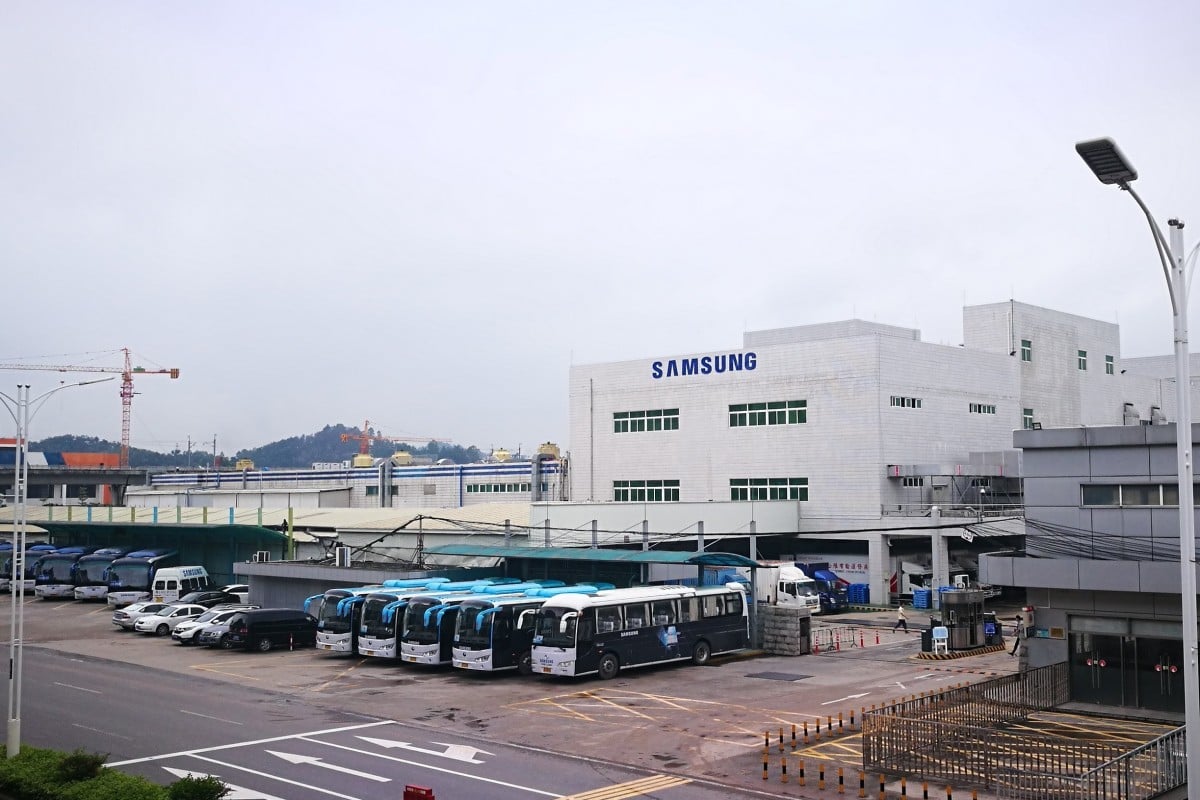
Samsung’s last mobile phone production line remaining in China in Huizhou is winding down, implementing a voluntary retirement programme. Photo: He Huifeng
Upon landing in Australia in 2017 to attend a seminar, a senior politician with South Korea’s parliamentary defence committee was greeted by Julie Bishop, then Australia’s foreign minister, who had a burning question: “How are you dealing with the China threat?”
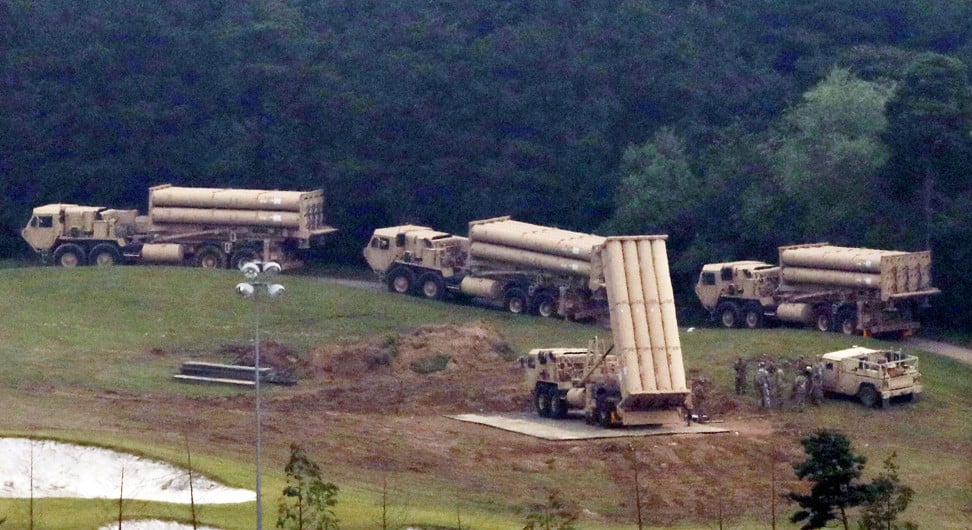
Bishop was referring to the treatment of South Korean firms in China, which escalated after Seoul agreed in 2016 to a long-standing request from the United States to allow the deployment of the Terminal High Altitude Area Defence system (THAAD) on South Korean soil.
Lotte Corporation, one of Korea’s chaebol conglomerates that dominate its economy, had sold a plot of land in Seongju county to the South Korean government, on which the system’s radar and interceptor missiles were set up. While both Washington and Seoul said it was meant to counter threats from North Korea, Beijing viewed THAAD as a security risk, since its radar had the range to monitor China’s nearby military facilities.
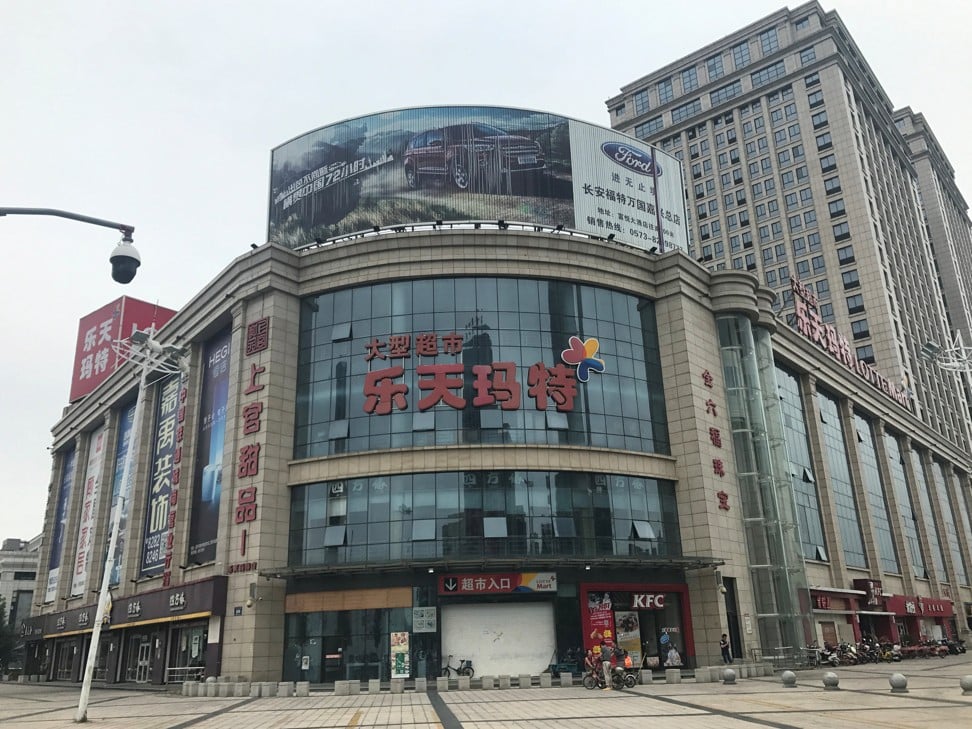
After it was deployed in 2017, THAAD triggered widespread boycotts of Lotte’s retail operations in China, with the state-owned media acting as aggressive cheerleaders. The company was sanctioned by Beijing, with its expansion plans in China grinding to a halt on the orders of the Chinese government.
The Terminal High Altitude Area Defence (THAAD) arrived in Seongju in September 2017. Photo: Reuters

Australia – like South Korea – is heavily dependent on trade with China, but is also closely bound to the US in defence and political terms, and Bishop feared that should Australia fall out of favour with Beijing, Australian companies could face similar risks, and so she sought the counsel of the politician, who asked not to be named.

The case of Canadian canola and meat exports being banned from China, reportedly in retaliation for the arrest of Huawei chief financial officer Meng Wanzhou, also known as Sabrina Meng and Cathy Meng, is an example of how third nations can be drawn into the modern day superpower rivalry.

Many analysts say the efforts of South Korean firms in China should be essential study material for Western governments and businesses about the political risks of doing business in the mainland, which are growing as the US-China trade war threatens to draw in other nations and expand into a broader geopolitical struggle.

But large South Korean firms have been gradually withdrawing from China for a number of years – even before the THAAD crisis – and have been able to leave on a managed basis. They are leaving to avoid a repeat of the political crisis that ruined Lotte’s China business, and to avoid tariffs on exports of their China-made products to the US.

Lotte have been forced to close retail operations in China. Photo: Reuters

But they are also leaving because Chinese firms have become much more competitive in the domestic market that South Korean companies had found so fruitful for more than a decade – a fate that could easily befall Western companies that are eyeing China’s burgeoning middle-class consumer market. Now, while American firms are considering exiting China and setting up in nations that have lower tariff access to the US, South

Korean competitors have had a few years’ head start.

“In a way, all the problems that some South Korean companies had since 2017 might be a blessing in disguise. It meant that they started all of this [supply chain shift] two years before all the other companies,” said Andrew Gilholm, Seoul-based director of analysis for China and Korea at political risk advisory, Control Risks.

Another chaebol, Samsung Electronics, opened its first plant in Vietnam in 2008 and this long-term presence has enabled it to build a supply chain of South Korean companies, which in turn makes it easier for other South Korean firms to establish a base in the Southeast Asian nation.

We have experienced some of the worst situations in China over the past few years and learnt that the political risk there wouldn’t just simply go away overnight Ex-Lotte Shopping manager

As a result, South Korean investment into Vietnam climbed to US$1.97 billion in the first half of 2018, exceeding the country’s investment in China of US$1.6 billion over the same period for the first time, according to the Export-Import Bank of Korea.

Overall in 2018, South Korea’s total investment to the Southeast Asian country totalled US$3.2 billion. Its exports to Vietnam also increased to US$48.6 billion, 121 times that of 1992, when the two countries established diplomatic relations, and the trend is expected to continue.

“We have experienced some of the worst situations in China over the past few years and learnt that the political risk there wouldn’t just simply go away overnight,” said a former manager of Lotte Shopping, the chaebol’s retail arm, who spoke on condition of anonymity.

“China may pass all the legislation ensuring the safety of foreign investments and the rights of multinational companies, but the chance of it swinging away again when there is another political confrontation is just too high … we cannot afford to take any more risk.”

China eventually lifted its economic sanctions on Lotte in April, and the municipal government of Shenyang, the capital of Liaoning province in Northeastern China, gave the company permission in May to resume work on the US$2.6 billion Lotte Town shopping and leisure development.

But according to a person close to the project, Lotte is considering selling the complex after its completion, as it does not wish to continue its retail business in China. A Lotte spokesman declined to comment, saying the situation is “complicated”.

On one hand, its eagerness to leave China reflects the volatility in the market, but on the other, its decision to complete the construction of project before leaving suggests an unwillingness to burn bridges in the process, analysts said.

Samsung is another South Korean giant downsizing its Chinese manufacturing presence after it closed its Shenzhen production line in May 2018, followed by its Tianjin factory in December.

Samsung has been very aware of the potential issues around those closuresJason Wright

Its last remaining mobile phone production line in

China, in Huizhou, is also winding down,

implementing a voluntary retirement programme. Samsung is also considering moving some television manufacturing from China to Vietnam, according to a company insider.

However, it too, is carefully managing its exit strategy, said Jason Wright, founder of Hong Kong-based intelligence firm Argo Associates, who is advising a growing number of South Korean companies seeking to leave China. Samsung is still a large supplier of microchips to Chinese companies like Huawei, and to exit on negative terms could disrupt its ongoing business.
“Samsung has been quite generous in the packages that have been offered [to workers in the factories that it has closed],” Wright said. “Samsung has been very aware of the potential issues around those closures.”
As well as the political risks and tariffs, Samsung has seen its mainland market share in several product queues shrink dramatically due to competition from Chinese rivals. Its share of China’s smartphone market, for example, fell from 20 per cent in 2013 to just 0.8 per cent last year, according to Strategy Analytics, a market research firm.
Over the same period, it has been moving its supply chain out of China in a “subtle and imperceptible” way, according to Julien Chaisse, a professor of trade law at City University of Hong Kong who has advised, among others, Lotte on its plans to relocate to Vietnam.
Samsung Electronics opened its first plant in Vietnam in 2008. Photo: Cissy Zhou
As stories emerged in June that Apple was considering a partial exit of China, it was impossible not to see parallels. iPhone sales in China fell 30 per cent in the first quarter of 2019, according to research firm Canalys, while smartphones will be among those facing a potential tariff of up to 25 per cent, although this has been at least delayed after the trade war truce agreed by

US President Donald Trump

and Chinese President Xi Jinping at the

G20 summit in Osaka.

Meanwhile, South Korean car companies Kia and Hyundai’s combined market share in China fell to 2.7 per cent last year, from about 10 per cent at the beginning of the decade. Both companies, which have shared ownership, are downsizing their Chinese operations.

“In the past, China was just a great market, but for Korea, now China has become a competitor. So that is really a change in the dynamic over the last five years. China was not really able to compete with Korea in most areas,” said Wright from Argo Associates.

City University of Hong Kong professor Chaisse traces the exodus of South Korean firms back to 2014, before THAAD and before the trade war, and highlighted an arcane arbitration case at the United Nations’ dispute settlement courts as a turning point. After that case, South Korean companies in China faced an increasingly hostile environment.

Filed in 2014 and settled in 2017, the case emerged after South Korean company Ansung Housing had been forced to sell a golf resort it was developing in Eastern China after a change in the country’s real estate legislation.

Ansung took the case to an arbitration panel, claiming it breached a Sino-Korean investment treaty. The company won – only the second defeat for China in two decades of participation in the court, but this ushered in a “change in atmosphere” for South Korean firms.

“My take is that while the Korean case is unique for a number of reasons, it highlights what is going to happen to many other foreign companies operating in China,” Chaisse said.

“I think very soon even European companies will be reconsidering their businesses in China. Every time it will be a different story: different countries, different companies, in different economic sectors will have different reaction times and the magnitude of their withdrawal may vary.”

But for those now fleeing trade war tariffs, they may not have the luxury of long-term planning that companies like Samsung and Lotte have had, said Gilholm from Control Risks.

“Long term, I think the Korean firms that are moving out of China have had it easier because they haven’t had to do it under quite such pressured and scrutinised circumstances as a company which starts to move things now,” he said.

Source: SCMP

23/06/2019

Southeast Asian leaders emphasise economic strength in face of U.S.-China tensions

BANGKOK (Reuters) – Southeast Asian leaders agreed on Sunday to work together on regional economy and security to strengthen their positions amid growing U.S.-China tensions, as they wrapped up this year’s first summit in Bangkok.

The 10-member Association of Southeast Asian Nations (ASEAN) will need its collective economic strength for bargaining power globally, especially amid the trade tensions between the world’s top two economies, Thai Prime Minister Prayuth Chan-ocha told a news conference, as chairman of the 34th ASEAN Summit.
Prayuth urged ASEAN nations to complete negotiations this year for the China-initiated Regional Comprehensive Economic Partnership (RCEP) pact that includes 16 countries.
“This will help ASEAN handle the changes and uncertainty that will happen in the region going forward, particularly the impacts of trade tension between ASEAN’s important trade partners.”
Negotiations began in 2012 on RCEP, which envisions the creation of a free trade zone encompassing 45% of the world’s population and more than a third of its GDP, but does not involve the United States.
First proposed by China, RCEP’s 16 signatories include the 10 ASEAN member states and six Asia-Pacific countries, including major economies China, India, Japan and South Korea. ASEAN has existing free-trade agreements with all six countries.
“If we can do this, we will have the bargaining power and base for negotiation. Because when combined, we are 650 million people, the largest regional bloc in the world,” the Thai prime minister said.
Four ASEAN countries – Thailand, Indonesia, Singapore and Vietnam – will discuss the trade war in next week’s G20 summit, which assembles 20 major economies, in Tokyo, Prayuth said.
ASEAN countries also agreed on a common approach on a U.S.-led Indo-Pacific initiative, at a time when U.S.-China tensions were rising and forcing ASEAN countries to take sides.
Prayuth hailed the bloc’s agreement on the ASEAN Outlook on the Indo-Pacific as a “significant step” for the region.
The endorsed outlook document, seen by Reuters, acknowledges “maritime issues such as unresolved maritime disputes that have the potential for open conflict” as existing and emerging geopolitical challenges.
It outlines maritime cooperation “for peaceful settlement of disputes”. It also aims for connectivity in the Indo-Pacific region.
Source: Reuters
03/06/2019

Inside China’s state-owned industrial park in Vietnam, Beijing’s image trumps trade war profits

  • China-Vietnam (Shenzhen-Haiphong) Economic and Trade Cooperation Zone is only Chinese state-owned industrial park in Vietnam
  • Venture has attracted increasing interest since start of US-China trade war, but operators say first duty is to support Xi Jinping’s trade initiative
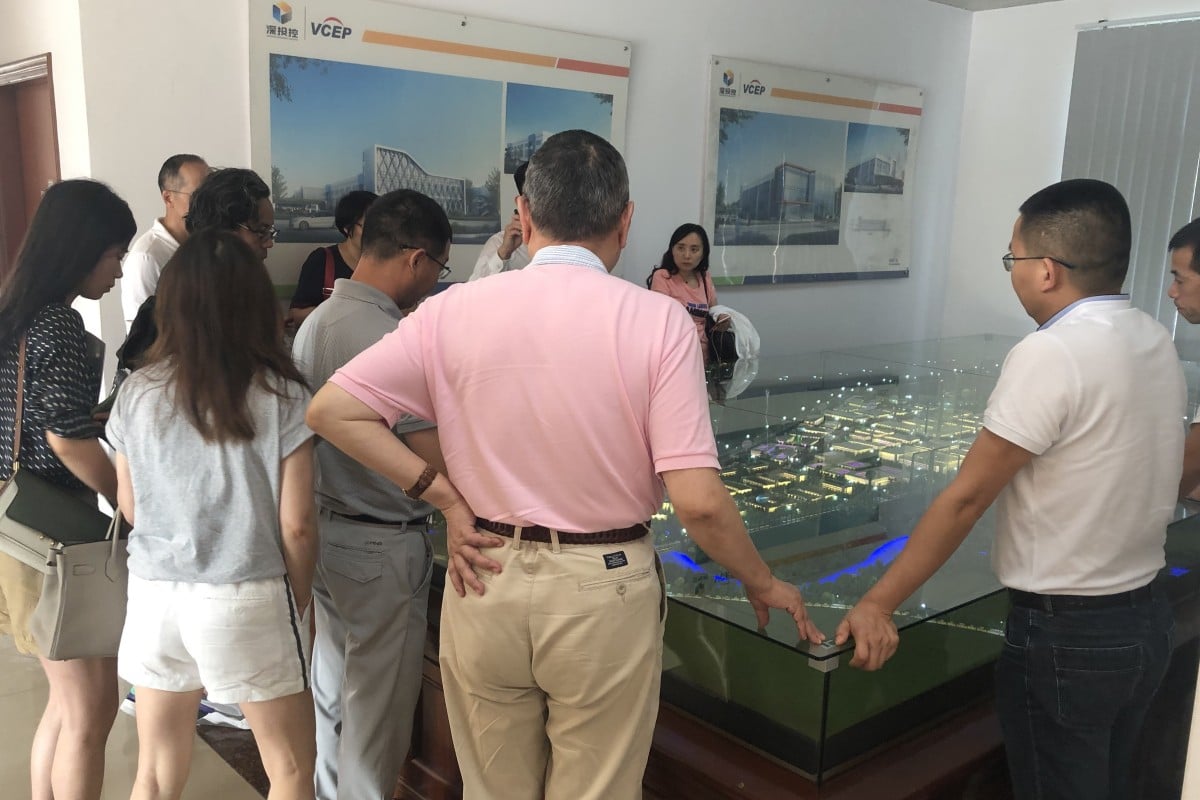
A total of 16 of the 21 Chinese companies that have relocated to the China-Vietnam (Shenzhen-Haiphong) Economic and Trade Cooperation Zone did so after the start of the US-China trade war. Photo: Cissy Zhou
Until the middle of 2018, business was slow for the only Chinese state-owned industrial park in Vietnam, located in the northeastern manufacturing hub of Haiphong and wholly-owned by the Shenzhen city government.
US President Donald Trump’s tariffs on Chinese goods enacted last year changed that, with 16 of the 21 Chinese companies that have relocated to the China-Vietnam
(Shenzhen-Haiphong) Economic and Trade Cooperation Zone – many of them electronic device manufacturers – having done so since the start of the trade war.
However, profit-making was never the top priority for the park’s operators, which took over the reins from private investors after a series anti-Chinese riots raged through southern and central Vietnam in May 2014 forced the owners to abandon the project.
Protesters set fire to other industrial parks and factories and attacked Chinese workers, killing more than 20 people and injuring more than 100.

While any commercial organisation would be thrilled at the rush of manufacturing firms into Vietnam, for the park’s operators, the first duty is to showcase the Chinese government’s top international economic cooperation project, the Belt and Road Initiative.

[They] requested that we make this industrial park a showcase for the Belt and Road Initiative, so that when our top leaders pay state visits to Vietnam, they can come to our park Chen Xu

The Shenzhen arm of the State-owned Assets Control and Supervision Commission (SASAC), which oversees all city owned companies “has requested that we make this industrial park a showcase for the Belt and Road Initiative, so that when our top leaders pay state visits to Vietnam, they can come to our park”, Chen Xu, vice general manager at the Vietnam-China Economic and Trade Cooperation Park (VCEP), told the South China Morning Post.
The Chinese industrial enclave in Vietnam is part of a largely untold story of the trade war. The common narrative is that Chinese and international firms are fleeing China to avoid paying tariffs, setting up in low-cost hubs in Vietnam and elsewhere in Southeast Asia, but the picture is more nuanced than that.

In Haiphong, a part of the Chinese government is actively encouraging firms to come to Vietnam, armed with US$200 million in investment capital and with a vision of creating 30,000 jobs by the time the entire three-phase project is completed in 2022.

The then-private VCEP project was suspended after the 2014 riots, and after the local government in Vietnam said it would reclaim the land unless it resumed, the Shenzhen government “decided to fully take over the project”, according to VCEP general manager Zhang Xiaotao.

Newcomers must now buy land from the park and build their facilities themselves as the original buildings have already been rented out. Photo: Cissy Zhou

“Our evaluation then was that we could not make a profit out of this project. Then why did we still take it over? We have to serve the Belt and Road Initiative, as it is a national strategy,” Zhang added. “In fact, we surrender part of our profit [because] we sell the land [in the park] at a lower price and with better facilities than in neighbouring industrial parks. We are still in the red based upon the current land price. Our bosses understand the situation and ask us at least not to lose money.

“To make a profit is of course the priority of any company. But we are different, we are not a pure commercial project.”

Furthermore, it is a commonly held assumption that China is only open to losing low-end, labour intensive and high-polluting industry, as it looks to upgrade its manufacturing profile domestically. And while there is certainly truth to that as examples of low-value Chinese manufacturing plants litter Vietnam, VCEP is keen to avoid that persona.

Because of the need to maintain a relatively high-profile, the park does not welcome labour-intensive manufacturers such as shoes factories, because “it is bad for our image”, Chen said. Instead, it is focused on hi-tech engineering – exactly the kind of industry China is desperate to nurture on its own soil. In this sense, the Shenzhen-Haiphong facility represents something of a paradox.

With 1,500 people currently employed, it is some way from reaching its 30,000 goal, but the number of Chinese manufacturers wanting to set up factories in the park is now about eight times what it was before the trade war started last July, according to both Chen and Zhang. Newcomers must now buy land from the park and build their facilities themselves as the original buildings have already been rented out.

The relatively poor state of the surrounding infrastructure has also led VCEP to spend 30 million yuan (US$4.3 million) on a new road and bridge linking the park to the national highway in Haiphong.

“We could not wait for the Vietnamese government to build the infrastructure. They don’t have the money and their efficiency is low, so we built it ourselves,” said Li Meng, a member of VCEP’s Strategic Investment Department, who said it took less than nine months to finish the project.

The cost of the bridge was more than triple what it would have cost in China as “the efficiency is much lower here and we needed to import a lot of material from China due to lack of material in Vietnam”, Li added

“Every inch of the road and the bridge linking the national highway in Haiphong to VCEP is paved with renminbi.”

The Vietnam-China Economic and Trade Cooperation Park has a vision of creating 30,000 jobs by the time the entire three-phase project is completed in 2022. Photo: Cissy Zhou

TP-Link, the Shenzhen-based Chinese manufacturer of computer networking products, has rented a plant in the park and will start testing its equipment in July. The company, the world’s largest provider of consumer Wi-fi networking devices, has bought an additional 140,000 square metres of land in the park to expand production.

When TP-Link bought the land in late-2018, the price was between US$75 to US$80 per square metre, Chen said. Now, six months later, the price has risen to US$90 per square metre. This is indicative of the huge spike in interest in manufacturing in Vietnam caused by the trade war. Data from Vietnam’s Foreign Investment Agency shows that Vietnam attracted US$16.74 billion in foreign capital over the first five months of 2019, a year-on-year increase of 69.1 per cent. Of this, 72 per cent was invested in the processing and manufacturing sectors.

“Chinese local governments are, of course, unhappy with the increasing number of manufacturers who are relocating to Vietnam, but President Xi has clearly put forward the Belt and Road Initiative, which local governments cannot disturb. So local governments are not encouraging manufacturers to relocate, but they dare not try to stop them,” said vice-general manager Chen.

The Chinese inflow has also met with opposition in Vietnam, although far from the scale of the deadly riots of 2014.

“Some local [Vietnamese] media have been demonising China, with local prime time TV news talking about fake Chinese meat and poisoned food and hyping these cases. High-ranking Chinese officials have asked the Vietnamese government to guide public opinion in the right direction,” Chen added.

General manager Zhang added that the Vietnamese authorities have also become more sensitive to investment from China, a view reflected by Lam Thanh Ha, a senior lecturer at the Diplomatic Academy of Vietnam university which operates under the management of Vietnam’s Ministry of Foreign Affairs. “Overreliance on foreign cash in general and Chinese capital in particular may pose risks for Vietnam in terms of exchange rate fluctuations and external influences,” Ha warned.

“As production is generally dependent on transnational supply chains, foreign enterprises in Vietnam are often deeply engaged in both import and export processes, leaving the Vietnamese economy vulnerable to global economic conditions,” Ha added.

In a 

commentary published

by the Post earlier in May, Ha warned that Vietnam should avoid “becoming China’s dirty industrial backyard”, although Zhang had the opposite view.

“We are not shifting all our low-end industries to Vietnam, which would be irresponsible. China is trying to help Vietnam with sincerity, even if we don’t make a profit, we still want to proceed with the project,” he said.
Source: SCMP
Law of Unintended Consequences

continuously updated blog about China & India

ChiaHou's Book Reviews

continuously updated blog about China & India

What's wrong with the world; and its economy

continuously updated blog about China & India