Archive for ‘Villagers’

14/05/2020

China relocates villagers living in 800m-high cliffs in anti-poverty drive

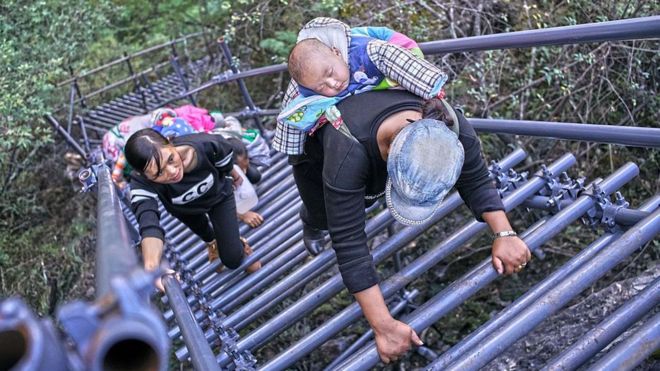
People climb on the newly-built metal ladder with hand railings to Ahtuler village on a cliff on November 11, 2016Image copyright GETTY IMAGES
Image caption The village made headlines after photos showed people scaling ladders to get home

They used to call an 800m-high cliff home, but dozens of villagers in China’s Sichuan province have now been relocated to an urban housing estate.

Atulie’er village became famous after photos emerged showing adults and children precariously scaling the cliff using just rattan ladders.

Around 84 households have now been moved into newly built flats as part of a local poverty alleviation campaign.

It’s part of a bigger national campaign to end poverty by the end of 2020.

‘So happy I got a house’

Atulie-er village made headlines in 2016 when it was revealed that its villagers had to scale precarious ladders to get home, carrying babies and anything the village needed.

Soon afterwards the government stepped in and replaced these with steel ladders.

The households have now been moved to the county town of Zhaojue, around 70km away.

They will be rehoused in furnished apartment blocks, which come in models of 50, 75 and 100 sq m – depending on the number of people in each household.

It’ll be a big change for many of these villagers, who are from the Yi minority and have lived in Atulie-er for generations.

Photos on Chinese state media showed villagers beaming, one of them telling state media outlet CGTN that he was “so happy that I got a good house today”.

‘Big financial burden’

According to Mark Wang, a human geography professor at the University of Melbourne, such housing schemes are often heavily subsidised by the government, typically up to 70%. However, in some instances families have been unable to afford the apartments despite the subsidies.

“For some really poor villages, the 30% may still be difficult for them to pay, so they end up having to borrow money – [ironically] causing them even more debt,” he told BBC News.

“For the poorest, it’s a big financial burden and so in some instances, they might have to stay.”

According to Chinese state media outlet China Daily, each person will have to pay 2,500 yuan ($352; £288) for this particular move – so for a family of four, the cost would come up to 10,000 yuan.

Villagers Living On Cliff Shop Online In LiangshanImage copyright GETTY IMAGES
Image caption This is the journey the villagers had to make to get home

This is quite a low price, says Mr Wang, as he had heard of people having to pay up to 40,000 yuan for other relocation projects.

Mr Wang says in most poverty resettlement campaigns, villagers are given a choice whether or not to move, and are not usually moved into cities from the countryside.

“In most instances it’s a move to a county town or a suburb. So it’s not like they’re moving to a big city. Not everyone wants an urban life and most of those who do would have already left these villages and moved to the big cities,” he says.

“Usually the government [puts a limit] on the resettlement distance. This is in most people’s favour because it means they can keep their farm land, so that’s very attractive.”

The Atulie’er villagers will share this new apartment complex with impoverished residents across Sichuan province.
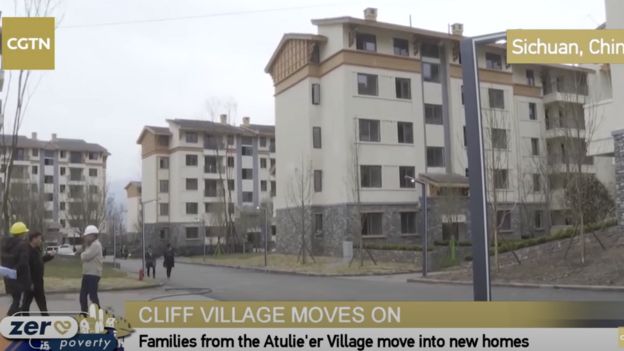
The new apartment blocksImage copyright CGTN/YOUTUBE
Image caption The villagers will be living in these apartment buildings

Around 30 households will remain in the Atulie’er village- which is set to turn into a tourism spot.

According to Chinese state media outlet China Daily, these households will effectively be in charge of local tourism, running inns and showing tourists around.

The county government has ambitious plans – planning to install a cable car to transport tourists to the village and to develop some surrounding areas. An earlier report said there were plans to turn the village into a vacation resort, with state media saying the state would pump 630 million yuan into investment.

Though these developments are likely to bring more jobs to the area, it’s not clear what safeguards are in place to make sure that the site’s ecological areas are protected and not at risk of being overdeveloped.

Media caption Do people in China’s rural communities think poverty reduction can work?

Chinese President Xi Jinping has declared that China will eradicate poverty in China by 2020.

There’s no one standard definition of poverty across all of China, as it differs from province to province.

One widely quoted national standard is 2,300 yuan ($331; £253) net income a year. Under that standard, there were around 30 million people living in poverty across the whole of China in 2017.

But the 2020 deadline is approaching fast – and Mr Wang says the plan could be derailed by the virus outbreak.

“Even without Covid-19 it would be hard to meet this deadline and now realistically, it has made it even more difficult.”

Source: The BBC

07/05/2020

Gas leak at S.Korea-owned factory in India kills 11, hundreds hospitalised

CHENNAI (Reuters) – At least 11 people were killed in India in a gas leak at a South Korean-owned factory making polystyrene products that made hundreds of people sick and led to the evacuation of villagers living nearby, officials said.

The accident occurred some 14 km (9 miles) inland from the east coast city of Visakhapatnam, in Andhra Pradesh state, at a plant operated by LG Polymers, a unit of South Korea’s biggest petrochemical maker, LG Chem Ltd.

Srijana Gummalla, commissioner of the Greater Visakhapatnam Municipal Corporation, said gas from styrene, a principal raw materials at the plant, leaked during the early hours of the morning, when families in the surrounding villages were asleep.

Yashwanth Saikumar Ambati, 23, who lives about 300 metres away from the plant, said he woke up around 4.30 a.m. because of a strong smell.

“I went back to sleep and I woke up around 6 because the smell got stronger. My eyes were itchy, and I was feeling drowsy, light-headed and slightly breathless,” he told Reuters, adding that neighbours also complained of eye irritation and stomach aches.

In a statement issued from Seoul, LG Chem said that the gas emitted in the leak can cause nausea and dizziness when inhaled, adding that it was seeking to ensure casualties received treatment quickly.

Video from Reuters partner ANI shot later on Thursday showed emergency workers in the area rushing to help victims, some of whom appeared to be listless and disoriented.

A number of victims lay unconscious on the streetside, as volunteers fanned them and others carried them to ambulances.

A spokesman for LG Chem in Seoul said the leak was discovered by a night shift maintenance worker and has been brought under control.

According to both the company spokesman and Gummalla, the plant was being reopened after India relaxed a nationwide lockdown that had been imposed on March 25 to contain the spread of the new coronavirus.

Thursday’s incident brought back bad memories of a gas leak at an factory of U.S. chemical firm Union Carbide that killed thousands in the central Indian city of Bhopal in 1984, but thankfully it was on a far smaller scale.

“I pray for everyone’s safety and well-being in Visakhapatnam,” Prime Minister Narendra Modi said in a tweet.

S.N. Pradhan, director general of the National Disaster Response Force, said that at least 11 had died after around 1,000 people living near the plant were exposed to the gas.

FALLING, RUNNING AWAY

B.V. Rani, a revenue official in the district, said she received a call at around 4 a.m. from a police officer near the facility, who sounded panicky. “He asked me to come to the spot immediately,” Rani told Reuters.

When Rani went there, she saw that people had collapsed unconscious in the village adjoining the 60-acre site of the plant.

“I personally helped more than 15 people get to an ambulance who had tried to run away from the village but dropped down within a few metres,” she said.

At least one child was among the dead, a policeman at the site told ANI, whose video showed at least two other children being lifted into an ambulance.

Between 300-400 people were hospitalised, Swarupa Rani, an Assistant Commissioner of Police in Visakhapatnam told Reuters. Another 1,500 people had been evacuated, mostly from a neighbouring village.

Areas within approximately 3-kilometre (nearly 2-mile) radius of the plant were evacuated, he said, with emergency services going from door-to-door to find anyone left behind.

TOP PETROCHEMICAL MAKER

Andhra Pradesh Chief Minister Jagan Mohan Reddy said in a televised address that the gas leak occurred because raw material was stored for a long period of time.

The state government will give 10 million rupees ($131,900) compensation to the families to those who died, and it will also form a panel to investigate the cause of the accident, said P.V. Ramesh, a senior aide to the chief minister.

“Obviously something has gone wrong,” Ramesh told Reuters. “Nobody will be spared.”

LG Chem’s share priced closed nearly 2% weaker on Thursday, in a Seoul market that was broadly flat.

South Korea’s top petrochemical maker by capacity, LG Chem acquired the plant in 1997 and established LG Polymers India Private Limited (LGPI), according to a company website.

The LG Polymers plant makes polystyrene products which are used in manufacturing electric fan blades, cups and cutlery and containers for cosmetic products such as make up.

“LG Polymers is a multi national, reputed company, and it is sad that the incident has happened in their plant,” Chief Minister Reddy said in a televised media address.

($1 = 75.8140 Indian rupees)

Source: Reuters

03/05/2020

Farmers work in terraced fields in Gongxian, Sichuan

CHINA-SICHUAN-GONGXIAN-TERRACED FIELD-FARMING (CN)Aerial photo taken on May 2, 2020 shows villagers planting rice seedlings in a terraced field in Gongxian County, southwest China’s Sichuan Province. (Xinhua/Jiang Hongjing)

Source: Xinhua

31/03/2020

Xi inspects east China county

CHINA-ZHEJIANG-ANJI-XI JINPING-INSPECTION (CN)

Chinese President Xi Jinping, also general secretary of the Communist Party of China Central Committee and chairman of the Central Military Commission, talks with villagers and learns about the huge changes brought about by advancing green development, in Yucun Village of Tianhuangping Township in Anji County, east China’s Zhejiang Province, March 30, 2020. (Xinhua/Shen Hong)

HANGZHOU, March 30 (Xinhua) — Xi Jinping, general secretary of the Communist Party of China Central Committee, Monday inspected the county of Anji in east China’s Zhejiang Province.

While visiting Yucun Village, Xi talked with villagers and learned about the huge changes brought about by advancing green development.

In 2005, it was in this mountainous village Xi, then Party chief of Zhejiang, put forward the concept that “lucid waters and lush mountains are invaluable assets.”

The village has adhered to that concept for the past 15 years. Today, the village has 280 households and its residents earned a per capita income of 49,598 yuan (7,040 U.S. dollars) in 2019.

Leaving the village, Xi went to Anji’s mediation center to learn about how primary-level social disputes are resolved.

Xi started his inspection tour in Zhejiang Sunday.

Source: Xinhua

03/10/2019

Discover China: Run-down house finds new life as deluxe hotel

FUZHOU, Oct. 3 (Xinhua) — Zheng Yangmei, 35, has mixed feelings about working as a receptionist in her childhood home, a 400-year-old country lodge that has been adapted into a luxury hotel in southeast China’s Fujian Province.

The new profession gives her a different angle to perceive the beauty of the ancestral house built sustaining Tang Dynasty (618-907) architecture style, as experts marveled.

The restoration is beyond her family clan’s imagination, which keeps the historic details of the dilapidated residence as much as possible, while replacing the interior with modern decor suitable for comfortable living.

The place of a stinky hog pen in the yard, which Zheng remembers, is turned into a tea pavilion decorated with a neutral color palette. But the lodge is still roughly what she remembers, wood carvings, stone mills and the grey-tile roofs.

Tucked away in the idyllic village of Banding, an hour’s drive north of Fuzhou, the provincial capital, the old house offers a breathtaking view in the backdrop of lush mountains and a vast expanse of paddy fields.

Named “Sanluocuo,” or three juxtaposed houses, the wood and stone complex covers an area of 3,000 square meters and consists of over 200 dark shabby rooms, where Zheng spent part of her childhood life bunking with her parents and two siblings in a 25-square-meter room.

Since the mid 16th century, it has been held by the extended Zheng family clan. Zheng remembers that there were over 200 members living in the houses when she was there.

“There was no toilet, no tap water in each house,” said Zheng, whose family moved out of the aged buildings when she was 8, as they could no longer fix the house. Instead, they built new two-story brick houses 1,000 meters away.

The old buildings were completely abandoned by all the villagers in the early 2000s, Zheng recalled.

She left the village for college study at the age of 19 and then worked as a vet in several pig farms in more prosperous towns, until 2013 when she got married and returned to the village to raise her kids.

“Villagers seldom went back to the buildings, considering the place pretty spooky, with filthy water, messy electric wires hung in the air like spider webs and cracks on walls,” said Zheng, a mother of two daughters.

Elders of the family clan called on the clan members to raise funds to fix leaky roof tiles, control termites, and straighten leaning walls to prevent the ancestral houses from completely collapsing, but nobody would imagine it can be fixed in a way that the hotel developer later did.

With the local government-initiated plan for preserving ancient folk houses, a property company came in investing 150 million yuan (20.98 million U.S. dollars) to rehab the obsolete buildings.

After two years of reconstruction, “Sanluocuo” was turned into a trendy boutique hotel with centuries-old wooden beams, garden-like atriums, earthen walls and contemporary luxury.

The transformative creation of “Sanluocuo” is among the artworks selected for the China Pavilion overseas show at the ongoing Biennale de Curitiba 2019 in Brazil, as a model for “building a future countryside.”

“We actually leased the complex from the villagers for the renovation. The old rooms were very small. So we converted the original 200 cramped rooms into 40 guest rooms to make them comfortable for living, but we pay the rents based on 200 rooms to the villagers,” said Zhang Yiwen, operations manager of the project.

Targeted at high-flown customers, the hotel rooms in “Sanluocuo” are priced on average at over 600 yuan per night even in the off season.

Visitors can touch the original wood pillars with deep cracks, and decayed rammed-earth walls with weeds, while enjoying hot bath and clean toilets with heated seats inside each room.

The hall that used to house the Zheng family shrine and warehouses have been converted to galleries, restaurants, bars and stores attached to the hotel, which help the village unleash its cultural potential, and once again become a place that villagers like hanging around in leisure time.

The project has triggered an online sensation, after visitors post their travel photos inside the hotel, showing off their cultural and stylish taste on social media.

Zhang said weeks ahead of the National Day holiday, all of the 40 rooms were booked out.

Zheng and 30 other villagers are employed in the hotel, which has also sparked an entrepreneurial enthusiasm in the village. Zhang said the hotel is willing to help villagers open small inns, eateries and stores selling souvenirs and local delicacies, to further improve the village’s tourist potential.

Zhang said the real estate developer of “Sanluocuo,” Land Shine, has leased two more clusters of such old residence from a neighboring village, as folks bear wishes that their obsolete ancestry complex could shine as well as “Sanluocuo.”

Source: Xinhua

Law of Unintended Consequences

continuously updated blog about China & India

ChiaHou's Book Reviews

continuously updated blog about China & India

What's wrong with the world; and its economy

continuously updated blog about China & India