19/08/2019
- President says sale of Lockheed Martin F-16Vs will go ahead if ratified by Senate
- Military experts have said the jets would bolster Taiwan’s ability to counter the threat of air strikes from mainland China
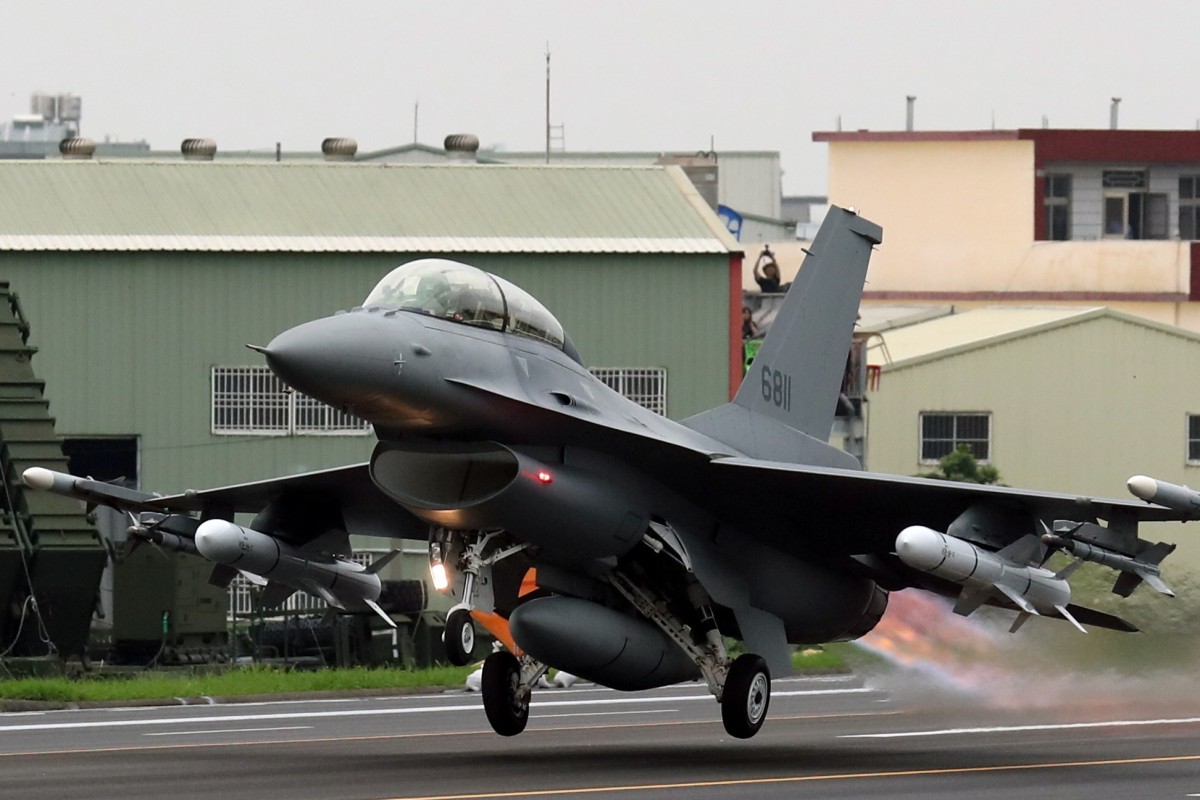
A Taiwan Air Force F-16V takes off during a drill in May. Photo: EPA-EFE
Beijing warned it would take countermeasures against Washington for selling 66 fighter jets to Taiwan after US President Donald Trump said he had approved the US$8 billion deal.
Chinese foreign ministry spokesman Geng Shuang on Monday said the sale of Lockheed Martin F-16V jets was a serious violation of the one-China principle.
“China has made numerous solemn representations to the US on the sale of F-16V jets to Taiwan,” Geng said in a press conference, adding that the United States should halt the sale.
“The US has to bear all the consequences triggered by the sale,” Geng said. “China will take necessary measures to defend its self-interest based on the development of the situation.”
Geng gave no details of the action China would take. In July, Beijing said it would impose sanctions on US firms involved in a deal to sell US$2.2 billion worth of tanks, missiles and related equipment to Taiwan, describing it as harmful to China’s sovereignty and national security.
Liang Yunxiang, an international relations expert from Peking University, said one countermeasure Beijing might use was to suspend military-to-military exchanges with the United States.
Speaking to reporters in New Jersey on Sunday, Trump said that the sale would need to be ratified by the US Senate but that he had approved it.
“It’s US$8 billion. It’s a lot of money. That’s a lot of jobs. And we know they’re going to use these F-16s responsibly,” he said.
If the deal is approved by Congress, it will be the first time since 1992 that the United States has sold F-16s to Taiwan. Previous requests were rejected by the Barack Obama administration, which instead offered to upgrade Taiwan’s existing fleet of about 140 F-16A/B Block 20 aircraft.
During months of slow progress since
the sale was outlined earlier this year, some lawmakers and defence experts had suggested that Trump was using the proposed deal as leverage to secure a better agreement for the US in talks to resolve its year-long
Taiwan’s presidential office and foreign ministry lauded Trump’s announcement, calling it a strong sign of the US’ commitment to its security and saying the deal would help to maintain regional stability.
“The new warplanes will greatly strengthen our anti-air defence capability and we will continue to be devoted to safeguarding peace and stability across the Taiwan Strait and in the region, thereby maintaining freedom and democracy in Taiwan,” presidential office spokesman Alex Huang said.
‘Fighter jets trump battle tanks’ in Taiwan’s US arms priorities
In a statement, Taiwan’s foreign ministry said persistent war games by the mainland around the island and in the East and South China Sea had not only sabotaged peace and stability in the region but also triggered grave concern from China’s neighbours.
It described Trump’s approval of the deal as a “strong indicator of the close and growing security partnership between the US and Taiwan”.
Opinion: Care needed over Taiwan arms deal
Military experts have said the new variant of the F-16, the Viper – which can carry a wide range of short and medium-range air-to-air missiles – is more able to counter the threat of an air strike from mainland China’s fourth-generation aircraft, such as the Su-35 and J-10.
Last week, Republican Senator Marco Rubio said the US administration had made progress in advancing the deal, which he called “an important step in support of Taiwan’s self-defence efforts”.
In July, the US also approved arms sales to Taiwan worth US$2.2 billion, including 108 M1A2T Abrams tanks and 250 Stinger portable surface-to-air missiles.
Beijing strongly opposes arms deals with Taiwan, which it considers a renegade province, but the US is obliged to help defend the self-governing island under the terms of its Taiwan Relations Act, effective since 1979.
Source: SCMP
Posted in Abrams tanks, air strikes, approves, Barack Obama administration, Beijing, China’s sovereignty, chinese foreign ministry spokesman, Congress, consequences, countermeasures, fighter jets, Foreign Ministry, foreign ministry spokesman, international relations expert, Lockheed Martin F-16Vs, Mainland China, Military experts, National security, one-China principle, Peking University, President Donald Trump, renegade province, sale, Senate, Stinger portable surface-to-air missiles, Taiwan, Taiwan Relations Act, Taiwan Strait, Uncategorized, US, war games, warns, warplanes, Washington |
Leave a Comment »
10/06/2019
- With a defence budget second only to the US, China is amassing a navy that can circle the globe and developing state-of-the-art autonomous drones
- The build-up is motivating surrounding countries to bolster their own armed forces, even if some big-ticket military equipment is of dubious necessity
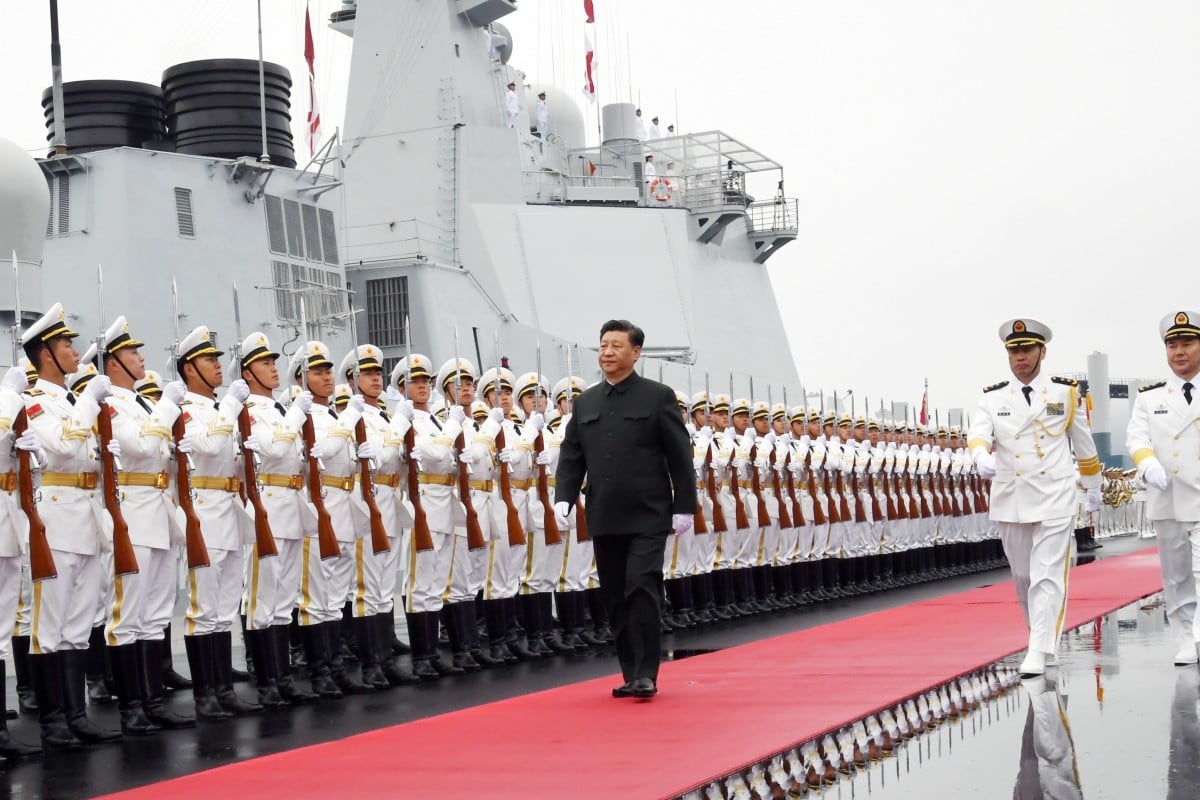
Chinese President Xi Jinping reviews an honour guards before a naval parade in Qingdao. Photo: Xinhua
The Asia-Pacific region is one of the fastest-growing markets for arms dealers, with economic growth, territorial disputes and long-sought military modernisation propelling a 52 per cent increase in defence spending over the last decade to US$392 billion in 2018, according to the Stockholm International Peace Research Institute.
The region accounts for more than one-fifth of the global defence budget and is expected to grow. That was underscored last week by news of
’s bid to strike a
to purchase US tanks and missiles.
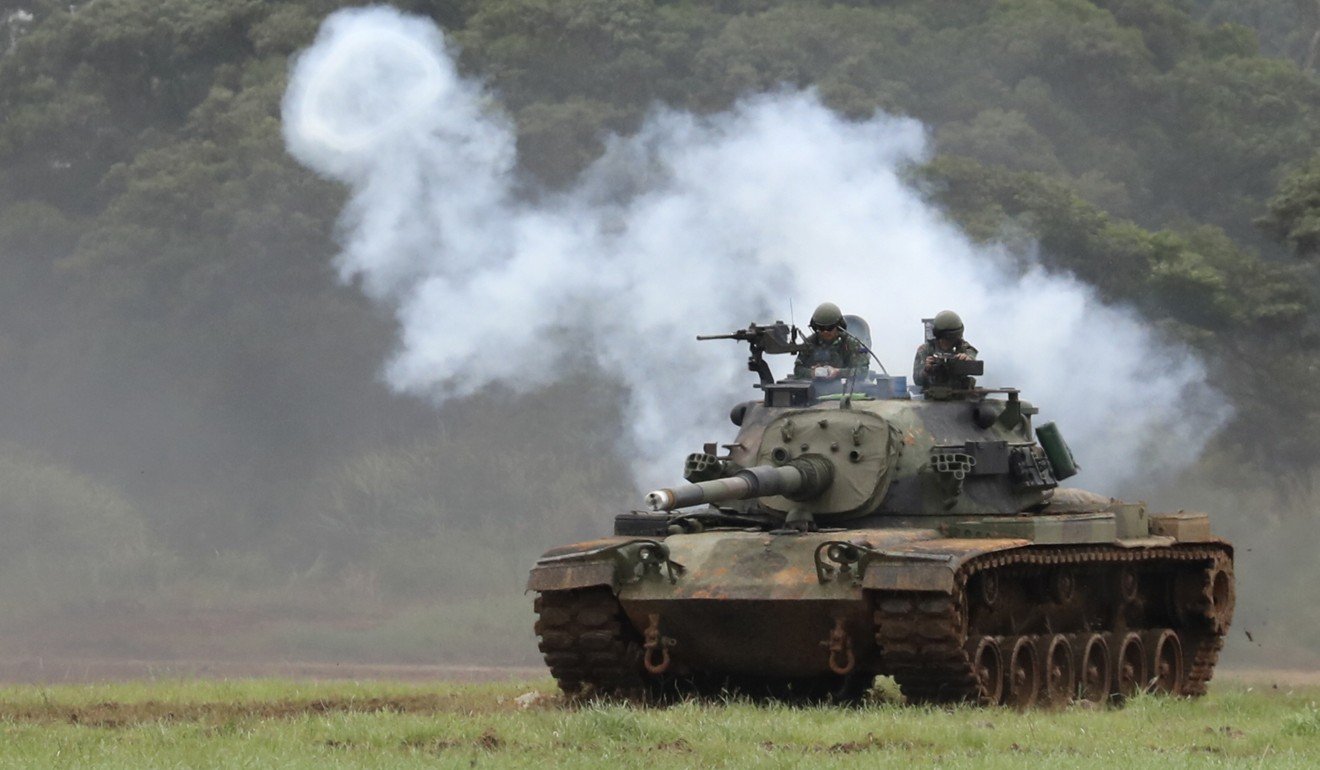
Taiwanese Soldiers on a CM11 battle tank, jointly developed with US arms manufacturer General Dynamics. Photo: EPA
The biggest driver in arms purchases, however, is
– responsible for 64 per cent of military
spending in the region. With a defence budget that is second only to the
, China is amassing a navy that can circle the globe and developing state-of-the-art autonomous drones. The build-up is motivating surrounding countries to bolster their armed forces too – good news for purveyors of submarines, unmanned vehicles and warplanes.
It is no coincidence that the recent
in
, a security conference attended by
chiefs, was sponsored by military contractors including Raytheon,
and
.
Opinion: How the Shangri-La Dialogue turned into a diplomatic coup for China
Kelvin Wong, a Singapore-based analyst for Jane’s, a trade publication that has been covering the defence industry for 121 years, has developed a niche in infiltrating China’s opaque defence industry by attending obscure trade shows that are rarely advertised outside the country.
He said the US is eager to train allies in Asia and sell them arms, while also stepping up its “freedom of navigation” naval operations in contested waters in the
and Taiwan Strait. It has lifted a ban on working with
’s special forces over atrocities committed in
. And it is considering restarting arms sales to the
.
In his speech at the Shangri-La Dialogue, acting US Defence Secretary Patrick Shanahan touted American advancements in technology “critical to deterring and defeating the threats of the future” and said any partner could choose to win access to that technology by joining the US defence network.
Wong said the message was clear: “Buy American.”
Analysts say Chinese soldiers have less training, motivation and lower morale than their Western counterparts. Photo: Reuters
The analyst said there is a growing admission among the Chinese leadership that the
has an Achilles’ heel: its own personnel.
He said one executive at a Chinese defence firm told him: “The individual Chinese soldier, in terms of morale, training, education and motivation, (cannot match) Western counterparts. So the only way to level up is through the use of unmanned platforms and
To that end, China has developed one of the world’s most sophisticated drone programmes, complete with custom-built weapon systems. By comparison, Wong said,
US drones rely on weapons originally developed for helicopters.
Wong got to see one of the Chinese drones in action two years ago after cultivating a relationship with its builder, the state-owned China Aerospace Science & Technology Corporation. He viewed a demonstration of a 28-foot-long CH-4 drone launching missiles at a target with uncanny ease and precision.
“Everyone knew they had this,” Wong said. “But how effective it was, nobody knew. I could personally vouch they got it down pat.”
China unveils its answer to US Reaper drone – how does it compare?
That is what Bernard Loo Fook Weng, a military expert at Singapore’s S. Rajaratnam School of International Studies, told the author Robert Kaplan for his 2014 book, Asia’s Cauldron, about simmering tensions in the South China Sea.
He was describing the competition for big-ticket military equipment of dubious necessity.
is littered with examples of such purchases.
owns an aircraft carrier without any aircraft. Indonesia dedicated about one-sixth of its military budget to the purchase of 11
Su-35 fighter jets. And
splurged on two
submarines it could not figure out how to submerge.
“It’s keeping up with the Joneses,” Wong said. “There’s an element of prestige to having these systems.”
Submarines remain one of the more debatable purchases, Wong said. The vessels aren’t ideal for the South China Sea, with its narrow shipping lanes hemmed in by shallow waters and coral reefs. Yet they provide smaller countries with a powerful deterrence by enabling sneak attacks on large ships.
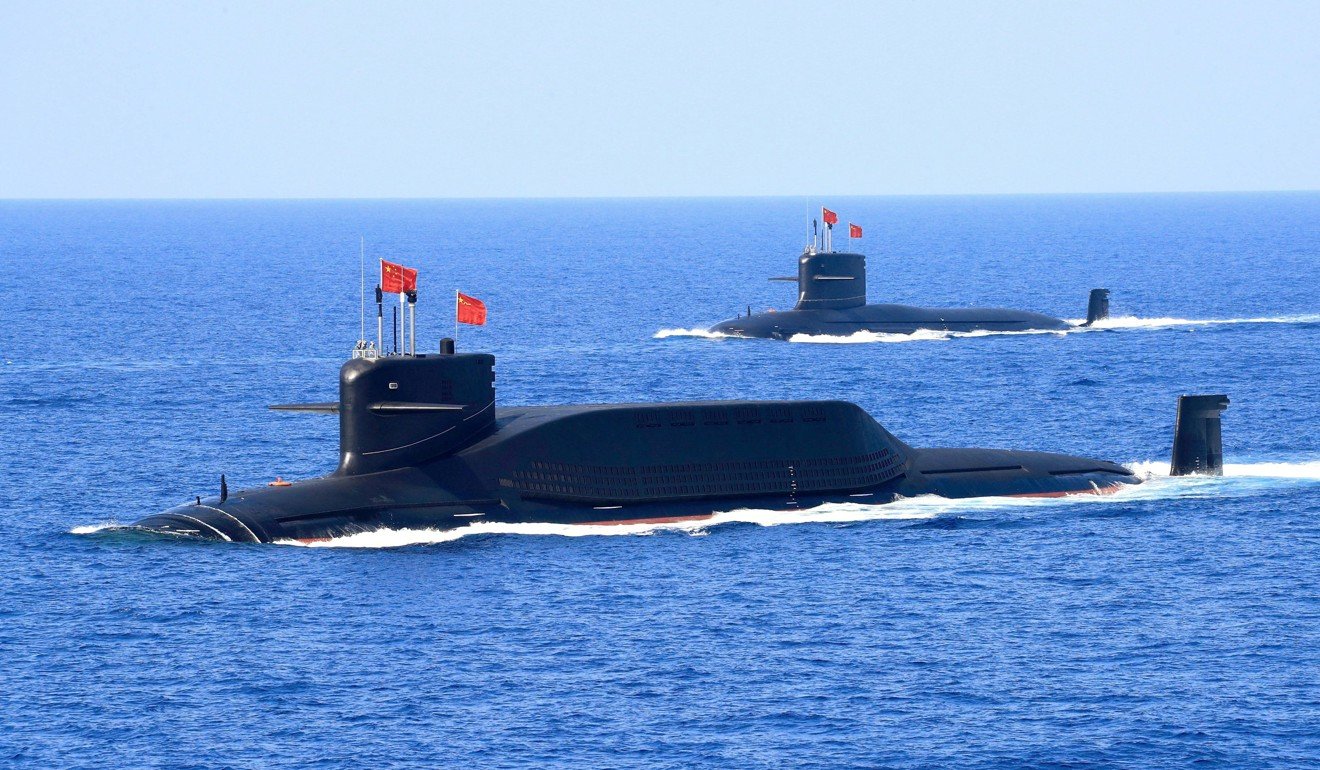
Nuclear-powered PLA Navy ballistic missile submarines in the South China Sea. Photo: Reuters
Asia and
are home to 245 submarines, or 45 per cent of the global fleet, according to the US-based naval market intelligence firm AMI International.
The Philippines remains one of the last coastal nations in the region without a sub – though it is in talks with Russian builders to acquire some.
Singapore recently received the first of four advanced
Type 218 submarines with propulsion systems that negate the need to surface more frequently. If the crew did not need to eat, the submarine could stay under water for prolonged periods. Wong said the craft were specially built for Asian crews.
“The older subs were designed for larger Europeans so the ergonomics were totally off,” he said.
Singapore, China deepen defence ties, plan larger military exercises
Tiny Singapore plays a crucial role securing the vital sea lanes linking the Strait of Malacca with the South China Sea. According to the
the country dedicates 3.3 per cent of its gross domestic product to defence, a rate higher than that of the United States.
State-of-the-art equipment defines the Singapore Armed Forces. Automation is now at the centre of the country’s military strategy, as available manpower is shrinking because of a rapidly ageing population.
Wong said Singapore is investing in autonomous systems and can operate frigates with 100 crew members – 50 fewer than they were originally designed for.
“We always have to punch above our weight,” he said.
Source: SCMP
Posted in artificial intelligence (AI), Asia, Asia-Pacific region, Australia, autonomous drones, BAE Systems, China Aerospace Science & Technology Corporation, East Timor, French, frigates, German, Indonesia, Lockheed Martin, Malaysia, military spending, naval parade, navy, People’s Liberation Army, President Xi Jinping, Qingdao, Raytheon Co, ripple effect, Russian, Shangri-La Dialogue, Singapore, Singapore Armed Forces, South China Sea, Southeast Asia, Stockholm International Peace Research Institute, Strait of Malacca, submarines, Taiwan Strait, Thailand, the Philippines, Uncategorized, unmanned vehicles, US Reaper drone, warplanes, World Bank |
Leave a Comment »
28/05/2019
- President Tsai Ing-wen says Taipei should ‘maintain a high degree of vigilance’
- Exercise simulates response to attack from mainland on military bases
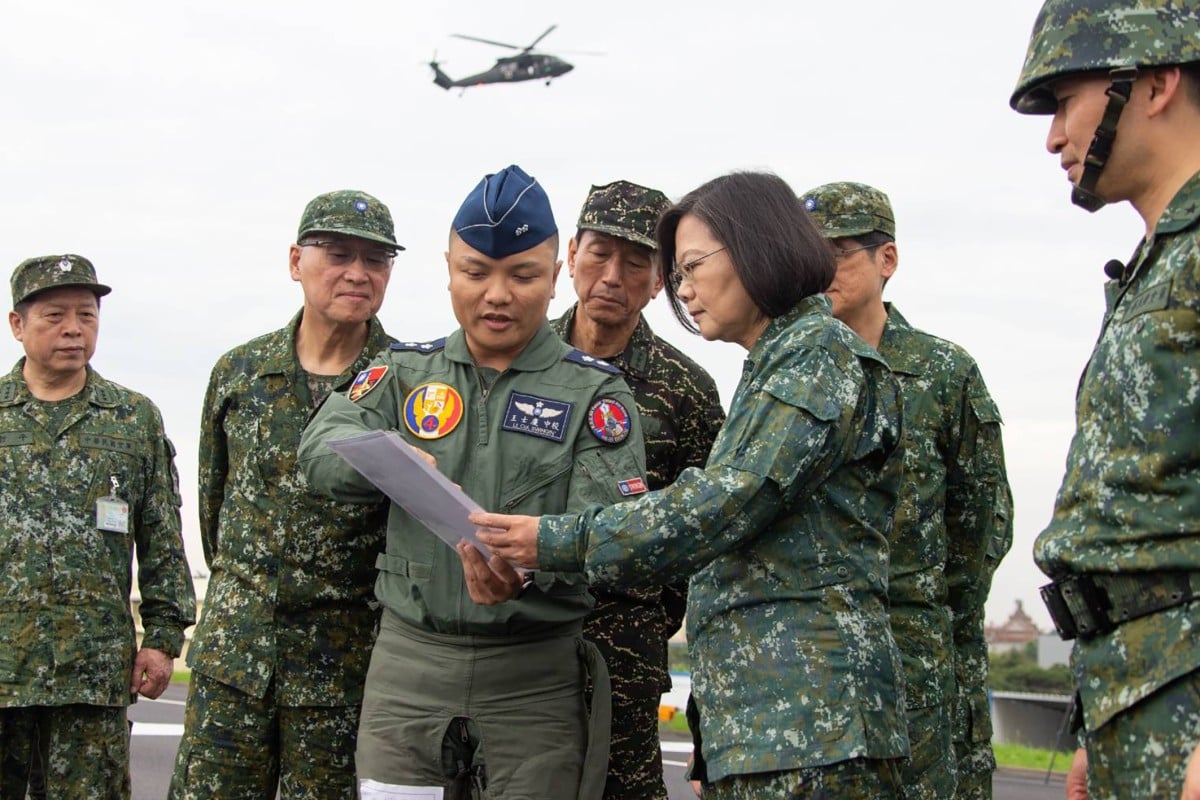
President Tsai Ing-wen and senior Taiwanese military staff during an exercise in southern county Changhua, not far from one of the island’s main airbases at Taichung. Photo: Facebook
Taiwanese warplanes landed on a highway on Tuesday as part of annual exercises designed to test the island’s military capabilities and resolve to repel an attack from the mainland across the Taiwan Strait.
President Tsai Ing-wen watched the exercise in the southern county of Changhua, not far from one of Taiwan’s main airbases at Taichung.
“Our national security has faced multiple challenges,” Tsai said. “Whether it is the Chinese Communist Party’s [People’s Liberation Army] long-distance training or its fighter jets circling Taiwan, it has posed a certain degree of threat to regional peace and stability.
“We should maintain a high degree of vigilance,” she said.
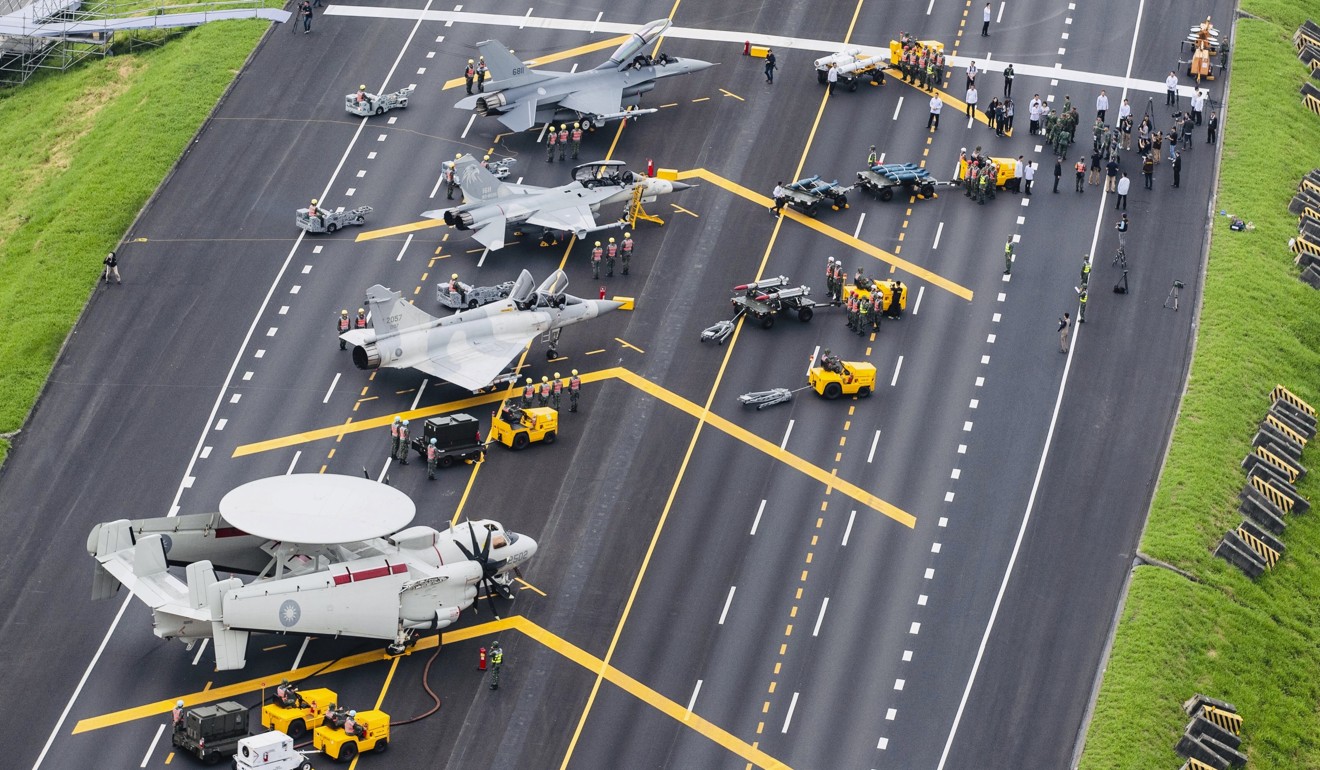
Taiwanese warplanes are parked on a highway during an exercise to simulate a response to a mainland attack on its airfields in Changhua. Photo: AP
Aircraft involved in the exercise included US-made F-16 Fighting Falcons, French Mirage 2000s, Taiwan-made IDF fighter jets and US-built Northrop Grumman E-2 Hawkeye surveillance aircraft.
Ground crews practised refuelling and ammunition replenishment before the aircraft returned to the air. About 1,600 service personnel were mobilised in Tuesday’s exercise.
The event marked the exercise debut of the first F-16 upgraded to the V variant, featuring advanced radar and combat capabilities. Taiwan is spending about US$4.21 billion to upgrade 144 F-16As and Bs to the F-16V version.
Rare meeting between Taiwanese, US security officials angers Beijing
Taiwan buys military hardware mainly from the US and has asked to purchase new F-16V fighters and M1 Abrams tanks.
American arms sales to Taiwan have long been a thorn in the side of US relations with China, routinely drawing protests from Beijing that Washington had reneged on commitments.
Beijing has also been angered by warming relations between Taipei and Washington since Tsai came to power in 2016.
On Monday, Beijing reacted frostily to photos showing a rare meeting between uniformed Taiwanese officers and their US counterparts this month.
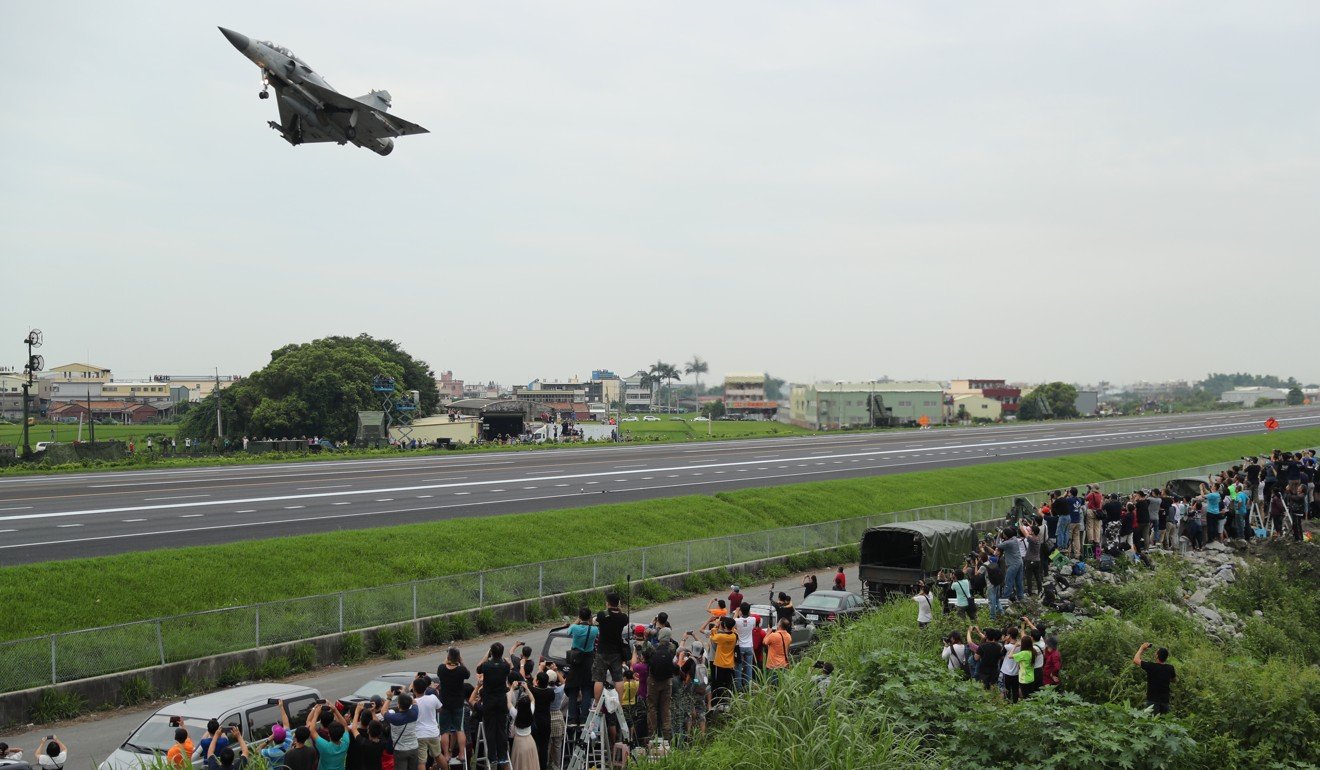
A Mirage 2000-5 fighter jet takes off from a highway during an emergency take-off and landing drill in Changhua, Taiwan. Photo: EPA
Last week, Beijing lodged a protest with Washington after two US warships sailed through the Taiwan Strait.
Taiwan expected to be outgunned in terms of troop numbers and firepower in any war with mainland China but it claimed to have had developed sophisticated asymmetric warfare tactics to make any invasion costly for Beijing.
“There are only a few military airbases which would become the prime targets in the event of an attack. The highway drill is necessary as highway strips would be our priority choice if the runways were damaged during a war,” air force Colonel Shu Kuo-mao.
Taiwan changes name of de facto embassy in United States to ‘reflect stronger ties’
Taiwan’s Central News Agency said highway take-off and landing drills last took place in 2014. A military source told CNA that Tuesday’s drill was not much different from those conducted by the military during the Han Kuang exercises, but it was still challenging.
Among the challenges were that the drill could not be rehearsed and it required clear communications between the military, police and the National Freeway Bureau, said the source.
Source: SCMP
Posted in air force, Beijing, Central News Agency, Changhua, chinese communist party, Colonel Shu Kuo-mao, Han Kuang exercises, Highway, lands, mainland, military airbases, military bases, Military exercise, National Freeway Bureau, People’s Liberation Army, President Tsai Ing-wen, Taichung, Taipei, Taiwan, Taiwan Strait, Uncategorized, US warships, vigilance, warplanes, Washington |
Leave a Comment »



 CHINDIA ALERT: You'll be living in their world, very soon