Chindia Alert: You’ll be Living in their World Very Soon
aims to alert you to the threats and opportunities that China and India present. China and India require serious attention; case of ‘hidden dragon and crouching tiger’.
Without this attention, governments, businesses and, indeed, individuals may find themselves at a great disadvantage sooner rather than later.
The POSTs (front webpages) are mainly 'cuttings' from reliable sources, updated continuously.
The PAGEs (see Tabs, above) attempt to make the information more meaningful by putting some structure to the information we have researched and assembled since 2006.
American destroyer’s mission comes a week before Taiwanese president officially starts second term in office
Increased military activity in the region could have unintended consequences but unlikely to lead to direct conflict, observer says
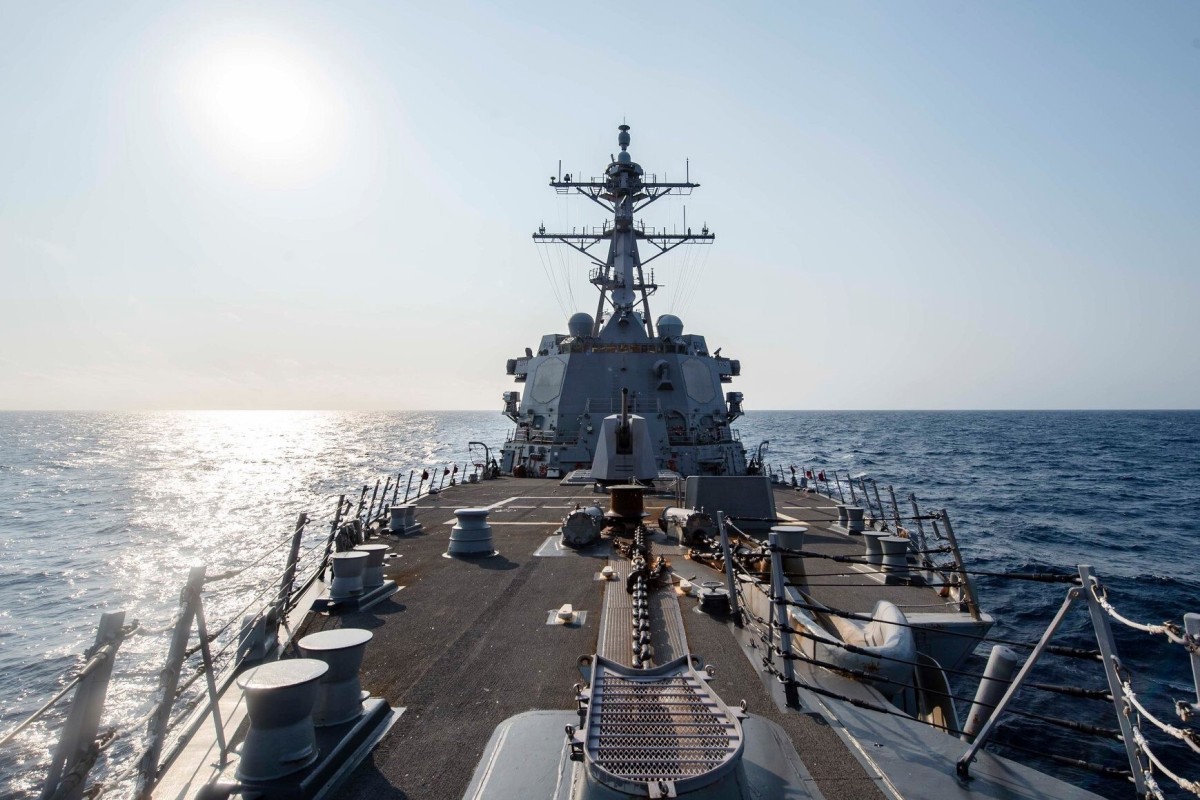
The guided-missile destroyer USS McCampbell made a transit through the Taiwan Strait on Thursday. Photo: US Navy
The United States sent a warship through the Taiwan Strait on Thursday as the Chinese military embarked on more than two months of live-fire naval drills off the mainland’s northern coast.
According to Taiwan’s defence ministry, the Arleigh Burke-class guided-missile destroyer transited the narrow body of water separating Taiwan from mainland China from north to south “in a routine mission”.
“It is continuing its southward voyage and the military is monitoring its movement through the intelligence it has gathered,” the ministry said.
In a statement on its Facebook page, the US Pacific Fleet said the McCampbell transited the Taiwan Strait as part of ongoing operations in the Indo-Pacific.
Analysts said the passage was a response to the People’s Liberation Army’s increasing military activity near Taiwan and in the wider region.
“This will become a new routine as a kind of US security commitment to maintain stability in the Indo-Pacific region,” said Soong Hseik-wen, professor of strategic studies and international relations at National Chung Cheng University in Taiwan.
Beijing urges France to cancel contract to sell arms to Taiwan
13 May 2020
The PLA has staged a series of war games, including fly-bys and warship transits through the strait, in recent months in response to what Beijing sees as growing pro-independence moves by the Tsai government and her party. China has also warned the US against supplying weapons to the island, which Beijing considers to be a wayward province that must return to the mainland fold, by force if necessary.
Mainland China has suspended official exchanges with Taiwan since Tsai was first elected president in 2016 and refused to accept the one-China policy, which Beijing says must be the foundation for any talks.
The PLA has embarked on 11 weeks of naval exercises off the coast of Tangshan in northern China, barring all other vessels from a 25km (15 mile) radius of the drill area, according to the China Maritime Safety Administration.
Taiwanese support closer ties with US over China, few identify as solely Chinese, Pew Research survey finds
13 May 2020
Both Beijing and Washington have ramped up military activities near Taiwan in recent months during the coronavirus pandemic, moves that some observers say run the risk of miscommunication.
Alexander Huang Chieh-cheng, professor of strategic studies and international relations at Tamkang University in Taipei, said no one could exclude the possibility of unintended incidents when both the US and the mainland were stepping up their presence in the region.
“Rational analysts would however argue that the two nuclear powers are not likely to engage in or escalate to direct military conflict,” he said.
Huang said he believed cross-strait relations would worsen during Tsai’s second term in office, which begins on May 20.
“The already damaged relationship between Taiwan and mainland China has worsened since the pandemic mainly due to travel bans and Taiwan’s increased international visibility,” he said.
On Tuesday, Japan’s Kyodo News reported that the PLA was planning a large-scale beach landing exercise near Hainan province in August, simulating a takeover of the Pratas Islands, which are controlled by Taiwan and also known as the Dongsha Islands.
In Taipei, Major General Lin Wen-huang said Taiwan was monitoring the PLA movements and “has contingency plans in place for the South China Sea to strengthen combat readiness and defence preparedness on both the Spratly and Pratas islands”.
Taiwan’s coastguard also announced on Wednesday that its Pratas Islands Garrison was scheduled to conduct an annual live-fire exercise in June to ensure the “effectiveness of various mortar and machine-gun positions”.
Taiwan shows off its military power after presidential election
Shanghai-based military commentator Ni Lexiong said that both the US Navy and PLA were increasing activities during the pandemic because neither side could afford to show weaknesses that the other might take advantage of.
The destroyer’s passage and the PLA’s drills were all part of such efforts, Li said.
But he agreed that both countries were unwilling, unable, and unlikely to have a real conflict.
“They are both bluffing. It’s a fake crisis,” he said. “A pandemic always ends or prevents a war if you look at history.
“I also don’t believe the PLA would want to take over the Dongsha or Taiping islands [in the South China Sea], because these islets alone are not worth a military campaign and all the consequences of that. The only target valuable enough for the PLA is Taiwan.”
Hardline politicians want president to fulfil promise to overhaul constitution to reflect the self-ruled island’s political reality
A petition calls for two referendums on the issue – proposing it either be replaced with a new one or revised
The push for constitutional change could lead to a cross-strait conflict. Photo: Handout
Taiwanese President Tsai Ing-wen is under growing pressure from the hardline camp to push for constitutional change to reflect the self-ruled island’s independent status – something observers say could provoke a cross-strait conflict.
With Tsai due to be sworn in for a second four-year term next month after a landslide victory in January’s election, hardline pro-independence politicians want her to fulfil a 2015 campaign promise: to overhaul the constitution so that it reflects Taiwan’s political reality. The process has been stalled since Tsai’s first term, which began in 2016.
Leading the charge is the Taiwan New Constitution Foundation, a group formed last year by a Tsai adviser and long-time independence advocate Koo Kwang-ming.
The foundation launched a petition at the end of March calling for two referendums on the constitution – proposing that it either be replaced with a new one or revised.
The existing constitution was adopted when Kuomintang leader Chiang Kai-shek and the KMT fled to Taiwan and set up an interim government in 1949 following their defeat by Mao Zedong’s communists in mainland China.
Drawn up in 1947, the constitution still puts the mainland and Mongolia under the Republic of China jurisdiction – Taiwan’s official name for itself. In reality, its jurisdiction extends only to Taiwan and its outlying islands of Penghu, Matsu and Quemoy, which is also known as Kinmen.
Taiwan’s constitution was adopted when KMT leader Chiang Kai-shek fled to the island in 1949. Photo: Handout
“We have garnered more than 3,000 signatures from the public for the first phase of initiating the proposals to hold two referendums asking the president to push for constitutional change,” Lin Yi-cheng, executive director of the Taiwan New Constitution Foundation, said on Wednesday.
He said they would propose that voters be asked two questions in the referendums: “Do you support the president in initiating a constitutional reform process for the country?”
And: “Do you support the president in pushing for the establishment of a new constitution reflecting the reality of Taiwan?”
“We’re ready to send the two referendum proposals to the Central Election Commission on Thursday,” he said.
Confusion prompts call for China Airlines name change in Taiwan, but at what cost?
14 Apr 2020
Under Taiwan’s Referendum Act, the process for holding a referendum involves three stages: a proposal, endorsement and voting.
Lin said there should be no problem for the commission to approve the proposal stage since they had gathered far more than the minimum 1,931 signatures needed under the act.
The endorsement stage requires a minimum of 290,000 signatures, and if the referendum is held, they will need at least 5 million votes.
Lin said if the process went smoothly, he expected a referendum could be held in August next year, allowing time for review and making the necessary arrangements.
He said if the referendum questions got enough public support, Tsai would need to deal with the issue.
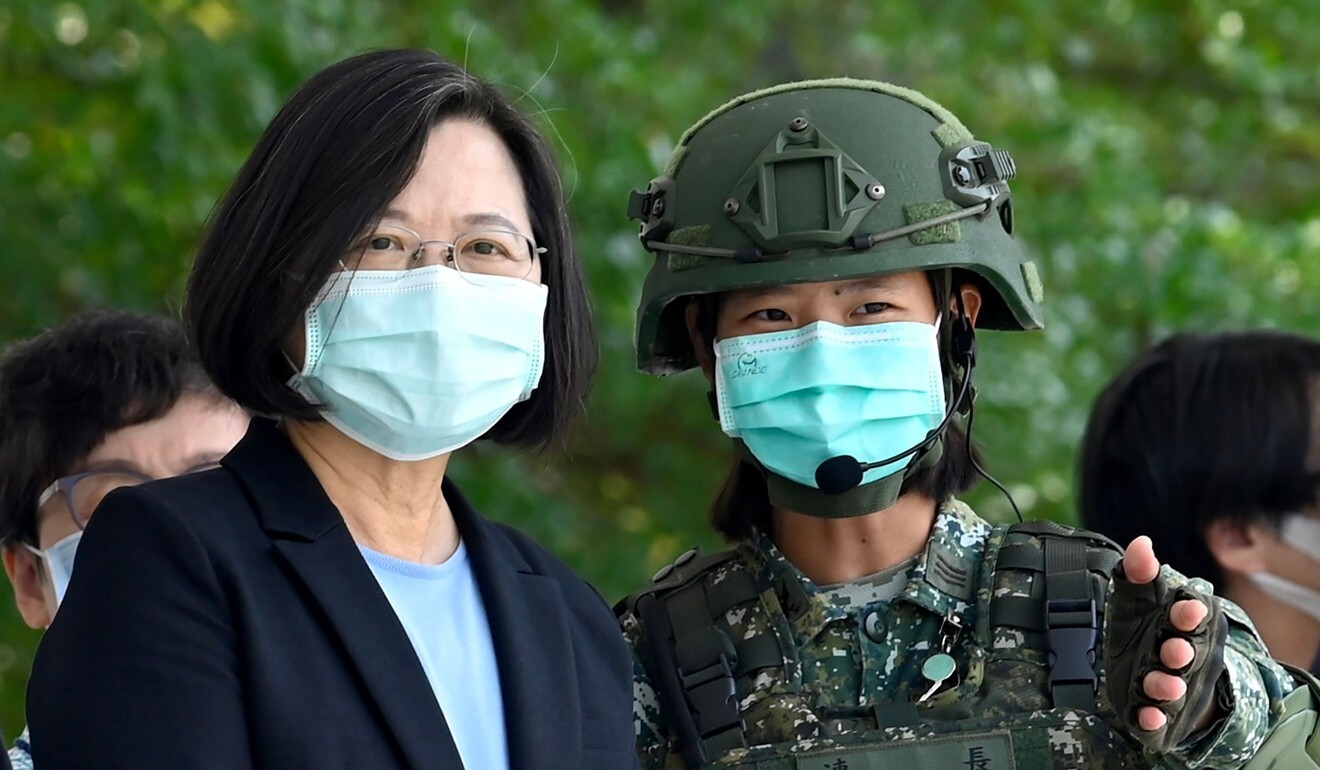
Tsai Ing-wen visits a military base in Tainan earlier this month. The pressure for constitutional change creates a dilemma for the president. Photo: AFP
Tsai’s Democratic Progressive Party government has been tight-lipped over the constitutional change issue, which Beijing sees as a move for the island to declare formal independence from the mainland.
Beijing considers Taiwan a wayward province that must be returned to the mainland fold, by force if necessary, and it has warned Tsai against declaring formal independence.
A DPP official said the foundation’s push would put Tsai in a difficult position.
“If she ignores the referendums, she will come under constant pressure from the hardline camp, and if she seriously considers taking action and instituting a new Taiwan constitution, she will risk a confrontation with Beijing, the consequence of which could be a cross-strait conflict,” said the official, who requested anonymity.
On Tuesday, Zhu Fenglian, a spokeswoman for the mainland’s Taiwan Affairs Office, warned the island against holding any referendum on constitutional revision, saying it would be doomed to end in an impasse and would ultimately fail.
“It will only push Taiwan towards an extremely dangerous abyss and bring disasters to Taiwanese compatriots,” she said.
Chinese air force’s drill ‘aimed at signalling deterrent around Taiwan’
2 Apr 2020
But according to Wang Kung-yi, a political science professor at Chinese Culture University in Taipei, Tsai should not be too worried about the hardline camp move.
“The hardline camp has been marginalised greatly in the past several years as reflected by the poor showing in the legislative elections in January,” Wang said, adding that he expected Tsai to continue her relatively moderate cross-strait policy of not sharply provoking the mainland.
TAIPEI/BEIJING (Reuters) – Taiwan and the United States this week discussed how to get “closer coordination” between the island and the World Health Organization (WHO) during the coronavirus outbreak, drawing a rebuke from China for “political manipulation” of the epidemic.
Taiwan’s is excluded from the WHO due to diplomatic pressure from China, which considers it merely a wayward province with no right to the trappings of state.
Its omission has become a major source of anger for the Taiwan, which says it has been unable to get first hand information from the WHO, putting lives on the island in danger for the sake of politics. Both the WHO and China say Taiwan has been given the help it needs.
The U.S. State Department said on Thursday senior officials from the United States and Taiwan on Tuesday held a “virtual forum on expanding Taiwan’s participation on the global stage”, with particular focus on the WHO and how to share Taiwan’s successful model of fighting the coronavirus.
“Participants also discussed ongoing efforts to reinstate Taiwan’s observer status at the World Health Assembly, as well as other avenues for closer coordination between Taiwan and the World Health Organization,” it said.
The World Health Assembly is the WHO’s decision-making body.
Taiwan attended it as an observer from 2009-2016 when Taipei-Beijing relations warmed, but China blocked further participation after the election of Taiwan President Tsai Ing-wen, who China views as a separatist, charges she denies.
Taiwan’s Foreign Ministry expressed thanks to the United States on Friday for its “continued taking of concrete actions to support Taiwan’s participation in the WHO and other international organisations”.
In Beijing, Chinese Foreign Ministry spokeswoman Hua Chunying said the United States and Taiwan were both well aware that members of the WHO must be sovereign states, and accused Taiwan of seeking political capital from the outbreak.
“We hope they will not attempt to use this epidemic to engage in political manipulation,” she told a daily news briefing.
U.S. President Donald Trump signed a new law last month requiring increased support for Taiwan’s international role. China threatened unspecified retaliation in response.
Like most countries the United States has only unofficial ties with the island, but is its strongest backer on the world stage.
Taiwan has been far more successful than many of its neighbours keeping the virus in check thanks to early and stringent steps to control its spread. It has reported 348 cases and five deaths to date.
In its latest measure, Health Minister Chen Shih-chung said on Friday people who don’t wear face masks on public transport would face fines of up to T$15,000 (nearly $500).
Large-scale drills conducted across island in what defence ministry describes as test of combat-readiness
Exercise follows US Navy live-fire exercise last month and a series of incursions by Chinese warplanes in recent weeks
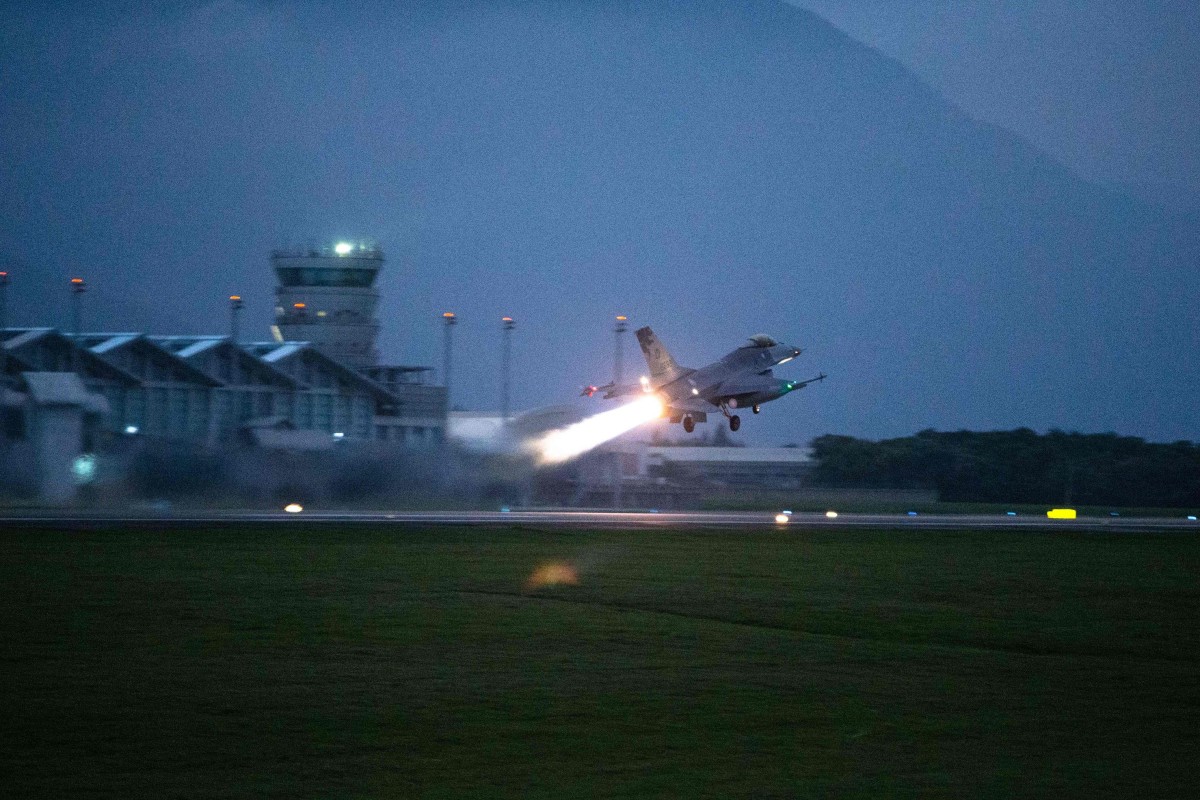
An F-16 fighter takes off from Hualien air base in eastern Taiwan. Photo: Military News Agency/ AFP
Taiwan has staged large-scale military drills throughout the island, including an exercise to repel an invading force, against a backdrop of rising tensions with Beijing.
The exercises, dubbed “Lien Hsiang,” involved the air force, army and the navy and were conducted on Tuesday from various military bases and strongholds in Taiwan, the island’s defence ministry said in a statement.
“The drills were designed to test the combat readiness of our forces and their responses to an all-out invasion by the enemy,” the ministry said, referring to the People’s Liberation Army, which has threatened to attack the self-ruled island.
The exercise follows a live-fire US drill in the region last week.
Taipei says Chinese military aircraft flew night exercise across Taiwan Strait
17 Mar 2020
Eight F-16 fighter jets took off from the air force base in the eastern county of Hualien at dawn on Tuesday, simulating an emergency mission to scramble and intercept enemy warplanes entering the island’s airspace, the defence ministry said.
Elsewhere on the island, F-16 and other fighter jets were spotted taking off from other air force bases in the southwestern county of Chiayi, the northern county of Hsinchu, Ching Chuan Kang in central Taiwan and the southern city of Tainan, according to Taiwanese media.
The exercises also involved operations testing cyberwarfare capabilities, while the air force ground crew simulated an emergency repair of the aircraft runway, the ministry said.
Anti-air units of both the army and the navy also joined the air force in the drills, while various types of naval warships, including Kidd-class destroyers, plus Perry and Kang Ding-class frigates, were deployed near Taiwan’s coast for separated training drills, it added.
The ministry said the training mission, carried out without live ammunition, was also designed to test the military response and make improvements based on the results.
Hundreds of Taiwanese to return from coronavirus centre after Beijing and Taipei reach deal
10 Mar 2020
Beijing considers Taiwan a wayward province that must be returned to the mainland fold, by force if necessary.
Beijing has staged a series of war games close to the island and poached seven of Taiwan’s diplomatic allies to heap pressure on President Tsai Ing-wen, from the independence-leaning Democratic Progressive Party, who was re-elected in January.
The exercises came after recent missions by PLA warplanes which briefly crossed the midpoint of the Taiwan Strait into the Taiwanese side in what analysts saw as testing the response from Taiwan and the US.
Three separate groups of warplanes approached Taiwan on their way to the western Pacific over the Bashi Channel for long-distance training exercises before returning home over the Miyako Strait to the northeast of Taiwan on February 9, 10 and 28.
Coronavirus threat shows ‘unacceptability’ of Beijing isolating Taiwan, US official says
28 Feb 2020
On March 17, another flight of PLA warplanes approached Taiwan in a rare exercise which analysts said was aimed at showing off their night navigation and all-weather capabilities.
Taiwan’s air force scrambled fighter jets to shadow, intercept and disperse the PLA warplanes through radio warnings during each approach by the mainland’s planes, according to the ministry.
Those actions also prompted the US to send two B-52 bombers on southbound flights off Taiwan’s east coast, while a transport plane flew over the Taiwan Strait, the defence ministry said.
DPP legislator Wang Ting-yu asked the Tsai government to take note of developments in the South China Sea, saying the US actions indicated that Washington must have learned “certain information suggesting that the Chinese government is planning certain military activities” or the 7th Fleet would not have made such a bold move.
Lawrence Chung covers major news in Taiwan, ranging from presidential and parliament elections to killer earthquakes and typhoons. Most of his reports focus on Taiwan’s relations with China, specifically on the impact and possible developments of cross-strait relations under the pro-independence Democratic Progressive Party and mainland-friendly Kuomintang governments. Before starting work at the South China Morning Post in 2006, he wrote for Reuters and AFP for more than 12 years.
President Tsai Ing-wen also vowed in a National Day speech to defend Taiwan’s sovereignty, saying her government would safeguard freedom and democracy as Beijing ramps up pressure on the self-ruled island it considers a wayward province.
Tsai, who is seeking re-election in January amid criticism of her policy towards China, referred to the arrangement for the return of the former British colony of Hong Kong to Chinese rule in 1997 as a failure.
Hong Kong has been hit by months of anti-government protests triggered by widespread resentment of what many city residents see as relentless efforts by Beijing to exert control of their city despite the promises of autonomy.
China has proposed that Taiwan be brought under Chinese rule under a similar arrangement, but Tsai said Beijing’s policies towards the island were a danger to regional stability.
“China is still threatening to impose its ‘one country, two systems’ model for Taiwan. Their diplomatic offensives and military coercion pose a serious challenge to regional stability and peace,” Tsai said.
“When freedom and democracy are challenged, and when the Republic of China’s existence and development are threatened, we must stand up and defend ourselves,” Tsai said, referring to Taiwan by its official name.
“The overwhelming consensus among Taiwan’s 23 million people is our rejection of ‘one country, two systems,’ regardless of party affiliation or political position.”
Taiwan’s National Day, marking the anniversary of the start of a 1911 uprising that led to the end of dynastic rule in China and the founding of a republic, was celebrated in Taipei with singing, dancing and parades.
Cold War hostility between the island and the mainland had eased over the past decade or so as both sides focused more on expanding business ties, but relations have cooled considerably since Tsai took office in 2016.
China suspects Tsai and her independence-leaning Democratic Progressive Party of pushing for the island’s formal independence, and this year threatened it with war if there was any such move.
Tsai denies seeking independence and reiterated that she would not unilaterally change the status quo with China.
FLASHPOINT
Despite her assurances, Beijing has stepped up pressure on the island to seek “reunification” and backed up its warnings by flying regular bomber patrols around it.
Beijing also says Taiwan does not have the right to state-to-state relations and is keen to isolate it diplomatically.
Seven countries have severed diplomatic ties with the Taiwan and switched allegiance to Beijing since Tsai coming to power. It now has formal diplomatic ties with just 15 nations.
But Tsai said Taiwan was undaunted.
“The determination of the Taiwanese people to embrace the world has never wavered,” she said, adding that Taiwan must work with “like-minded countries” to ensure peace and stability across the Taiwan Strait.
Tsai said under her watch Taiwan has boosted its combat capabilities with the purchase of advanced weapons and development of home-made aircraft.
Taiwan unveiled its largest defence spending increase in more than a decade in August, aiming to purchase more advanced weapons from overseas.
The island has long been a flashpoint in the U.S.-China relationship.
In July, the United States approved the sale of an $2.2 billion worth of weapons to Taiwan, angering Beijing.
The United States has no formal ties with Taiwan but is bound by law to help provide it with the means to defend itself.
BEIJING (Reuters) – China will formally resume ties soon with Kiribati, the foreign ministry said on Monday, following the Pacific island state’s decision to ditch relations with Taiwan.
But it did not say what will happen to a space tracking station that China used to operate in Kiribati and is now closed.
Kiribati announced last week that it was cutting relations with self-ruled Taiwan in favour of China, which claims Taiwan as a wayward province with no right to state-to-state ties.
China and Kiribati had ties until 2003, when Tarawa established relations with Taipei, causing China to break off diplomatic relations.
Until then, China had operated the space tracking station in Kiribati, which played a role in tracking China’s first manned space flight in 2003, just before the suspension of ties.
Speaking in Beijing, Chinese Foreign Ministry spokesman Geng Shuang did not answer a question about what would happen with the former space tracking station.
On the timing of when China and Kiribati will formally resume diplomatic relations, Geng said: “What should happen will come sooner or later. Everybody should remain patient.”
“We look forward to resuming diplomatic relations with Kiribati and opening a new page in the two countries’ relations,” Geng said.
He said China also believed this would serve both countries’ people and would be beneficial for peace, stability and prosperity for Pacific island countries.
China has welcome Kiribati’s decision though the two have not yet officially signed an agreement to resume ties.
Last week was a difficult one for Taiwan, as the Solomon Islands also ditched Taipei for Beijing. The Solomon Islands foreign minister signed a deal on diplomatic ties with Beijing in China on Saturday.
Both the Solomon Islands and Kiribati are small developing nations but lie in strategic waters that have been dominated by the United States and its allies since World War Two, and China’s moves to expand its influence in the Pacific have angered Washington.
A former Taiwanese ambassador to Kiribati, Abraham Chu, told Taiwan’s Central News Agency over the weekend that China had never fully removed the tracking station in Kiribati and said China’s then-ambassador in Kiribati was a space expert.
The equipment was locked away and guarded by four fishermen, Chu said.
“It seems it can come back at any time,” he added, referring to the tracking station.
The Kiribati government did not respond to a request for comment.
China’s space programme is overseen by the military. China’s Defence Ministry did not respond to a request for comment.
Taiwan now has formal relations with just 15 countries, mostly small and poor nations in Latin America and the Pacific, including Nauru, Tuvalu and Palau. China has signalled it is coming for the rest of its allies.
Coordination Council for North American Affairs becomes Taiwan Council for US Affairs, island’s foreign ministry says
Move signifies ‘firm and close relationship between Taiwan and the US’, President Tsai Ing-wen says
Taiwan has changed the name of its de facto embassy in the United States to better reflect ever-improving ties between the sides. Photo: EPA
Taiwan has changed the name of its de facto embassy in the United States to better reflect relations between the sides, which are at their strongest in decades, Taipei said on Saturday.
Once the necessary formalities have been completed, the agency formerly known as the Coordination Council for North American Affairs will be called the Taiwan Council for US Affairs, the island’s foreign ministry said.
“The new name better reflects the [agency’s] role in coordinating US-Taiwan affairs. It also symbolises the close and amicable relations between Taiwan and the United States,” it said.
Observers said the name change was significant as it appeared to drop the pretence that the council was non-diplomatic or political in nature.
The name change was possible because of the consensus between Taiwan and the US. Photo: CNA
Although Washington severed formal diplomatic ties with Taipei in 1979 in favour of Beijing, the two sides retained unofficial relations that have grown ever-closer in recent years, including an increase in military exchanges and cooperation.
“The new name [was made possible] as a result of the consensus between Taiwan and the US,” the island’s President Tsai Ing-wen said in a Facebook post. “This is the first time the designations ‘Taiwan and the US’ have been used to refer to each other’s affairs office on an equal basis, signifying the firm and close relationship.”
Taiwan begins mass production of missile corvettes, minelayers
Taiwan had been forced to use the old title because of the “special historical background” related to the change in diplomatic allegiance 40 years ago, Tsai said.
Beijing, which considers Taiwan a wayward province awaiting reunification, by force if necessary, has demanded that Washington observe the one-China policy by not officially recognising Taiwan or allowing it to use either “Republic of China” – the island’s official name – or “Taiwan” in the title of its representative offices in the US.
Washington also enacted the Taiwan Relations Act in 1979 to prescribes relations with the island and includes a commitment to supply it with arms to protect itself.
“After continuous efforts and coordination by the two sides, and in 2019, the 40th anniversary of the Taiwan Relations Act, our office handling relations with the US is finally able to change its name,” Tsai said.
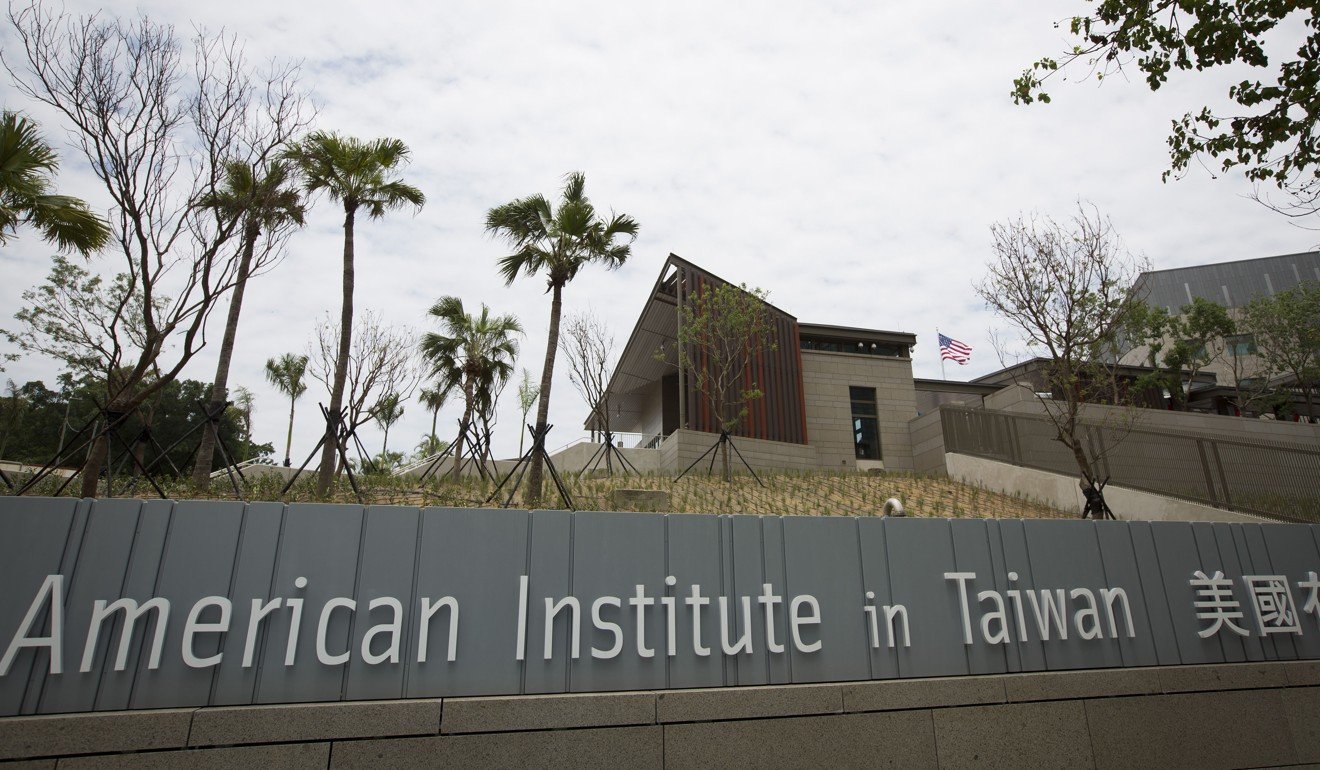
The American Institute in Taiwan relocated to a larger, purpose-built compound last month. Photo: Bloomberg
Presidential spokesman Alex Huang said the name change was due mainly to an improvement in relations between Taiwan and the US as a result of a greater cooperation on the promotion of regional peace and the Indo-Pacific security agenda.
“In the past few years, the US government has given Taiwan strong and firm support in terms of national security and participation in international events, as well as support from Congress and think tanks,” he said, referring to bills signed by US President Donald Trump that allow for exchanges between high-level officials and military personnel, and the approval of new sales of arms and logistical support to the island.
US official urges Pacific island nations to maintain diplomatic ties with Taiwan
Also, last week, Taiwan’s national security chief David Lee met US National Security Adviser John Bolton in Washington for the first talks of their kind since 1979, Taiwan’s Central News Agency reported on Saturday.
Last month, the American Institute in Taiwan – the United States’ unofficial embassy in Taipei – relocated to a significantly larger, purpose-built compound, in yet another sign of improving relations.
US support for Taiwan has increased under Trump’s leadership as he regards Beijing as a hostile competitor, not only on trade, but also in military and global influence terms.
Tensions between Taipei and Beijing have flared since Tsai became president in 2016 and refused to accept the one-China principle. The mainland subsequently halted all official exchanges with the island and embarked on a campaign to squeeze its diplomatic allies around the world.








 CHINDIA ALERT: You'll be living in their world, very soon