11/09/2019
- Police in Fujian ask people who picked up notes to ‘be rational and return the money’
- Impulse move caused traffic jams as pedestrians ran into road to grab what they could
The man from Shishi city in Fujian province who tossed US$14,000 into the air after a bad day at work has asked for help in getting it back. Photo: Weibo
The man from southeastern China who caused a cash frenzy on the street after he threw more than 100,000 yuan (US$14,052) into the air because he’d had a bad day at work is asking for his money back, authorities said.
Huang, 42, said he acted on impulse after he withdrew cash from a bank in Shishi city, Fujian province, on Monday.
His actions caused a traffic jam and passers-by fell over each other to grab what they could, the municipal police bureau said on Tuesday.
The man, who said he was having trouble at work, now regrets what he did and is hoping he will get the money back, the police statement issued on Weibo, China’s Twitter-like microblogging platform, said.
Police in Fujian said Huang’s impulsive move had caused him a lot of trouble and asked the public to return the money he threw away. Photo: AFP
Officers criticised Huang for his “inappropriate behaviour” and urged those who picked up the cash to take it to the police.
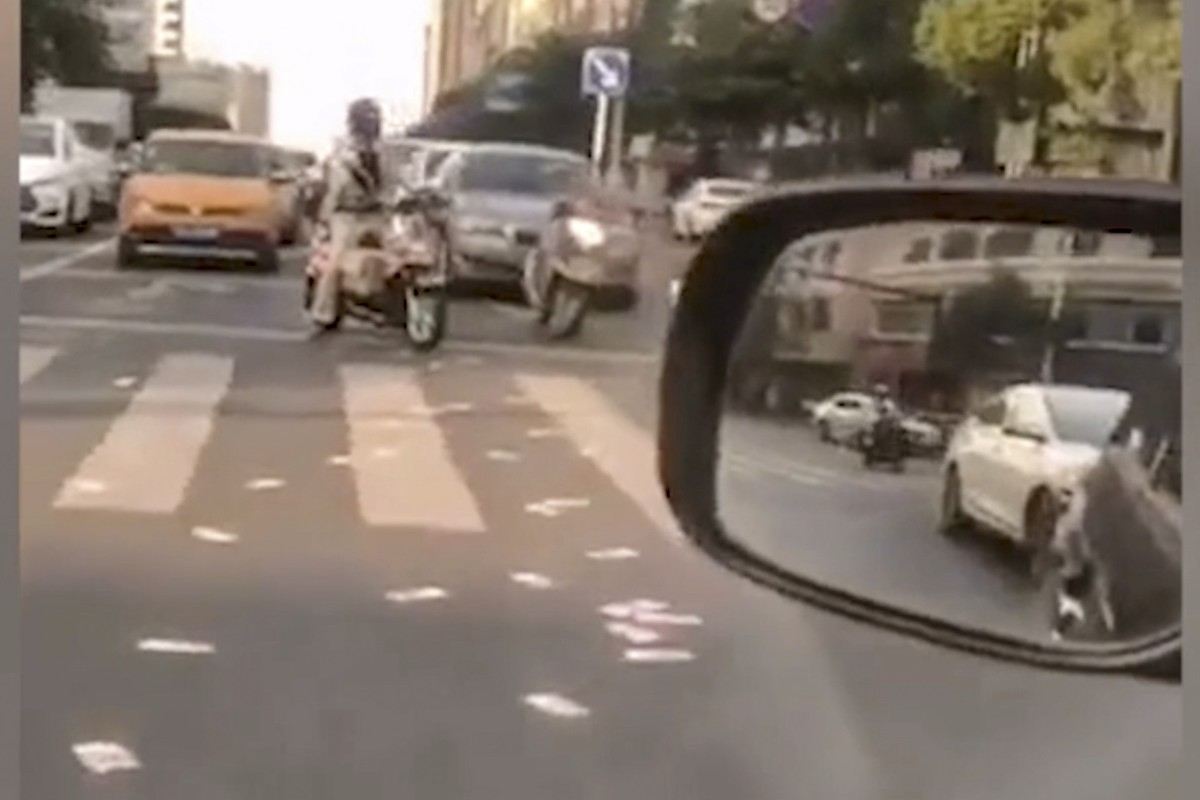
A video clip shared on Weibo on Tuesday showed motorists pulling up sharply in the street to pick 100 yuan banknotes off the road.
In another video, pedestrians were seen rushing into the middle of the road to join in the frenzy.
Banknotes falling from the sky send crowd into a frenzy in Hong Kong neighbourhood of Sham Shui Po
Some of the money had been returned by Tuesday evening, the Shishi police Weibo account said.
“Huang is from an ordinary family and not rich at all. A sudden impulse has caused big trouble for himself and his family. Please be rational and return the money,” it said.
On December 24, 2014, Hong Kong Police appealed to the public for help after a G4S Hong Kong van carrying HK$525 million (US$66.9 million) crashed on a main road near Wan Chai district, causing major traffic jams as motorists abandoned their cars to collect notes.
While armed police were quickly on the scene and closed off two lanes of the road, witnesses reported money being taken. One office worker said she saw a “regular Hong Kong lady” walking briskly away from the scene with 10 bricks of notes.
In March 2017, a woman threw away more than 16,000 yuan (US$2,250) in cash at a busy crossing in southwestern Chongqing municipality, but passers-by simply looked on instead of scrambling to pick up the money, the Chongqing Morning Post reported.
Police collected the bills quickly and found the owner. She said she threw the money because she was “in a bad mood”.
Source: SCMP
Posted in back, bad da, bad day, Chinese man, Chongqing Morning Post, Chongqing Municipality, Fujian Province, Hong Kong, inappropriate behaviour, money, motorists, neighbourhood, pedestrians, pleads, Police, scattered, Sham Shui Po, Shishi city, street, traffic jams, Uncategorized, Wan Chai district, Weibo, work |
Leave a Comment »
11/09/2019
- Chengdu school teaches boys to build model rockets while girls learn about knitting
- Handicrafts show at school prompts question, ‘Why can’t boys knit and girls build rockets?’
Pupils and staff at Chengdu Caotang Elementary School in Sichuan show off knitting from their Boys and Girls are Vastly Different class. Photo: Weibo
A school in southwest China that teaches boys to grow “heroically” and wants “tranquil feminine examples” for its girls has generated a heated debate about sexism.
Chengdu Caotang Elementary School in Sichuan province developed a course that teaches boys to build model rockets and girls to knit alongside mainstream subjects such as maths, languages and art, in the hope of “increasing their gender knowledge”.
The course, called Boys and Girls are Vastly Different, started last semester because school managers believed that “boys and girls have been shaped in the same way recently”, principal Fu Jin told the Chengdu Economic Daily on Monday.
That “led to boys lacking enough space to grow heroically and girls lacking gentle and tranquil feminine examples to follow, so there’s some gender dislocation”, she said.
Chengdu Caotang Elementary School wants its boys to be “heroic” and its girls to be “tranquil”. Photo: Weibo
Last semester, pupils learned the differences between female and male bodies. This semester, boys are learning how to build model planes, rockets and cars, while the girls are being taught knitting by teachers and mothers who volunteer to help out in classes.
On Monday, a show of handicrafts and jumpers hosted by the school to promote the class led to a backlash on social media, with members of the public criticising the school for sexism and enforcing gender stereotypes.
“They are tying the hands of girls when young, and when these girls grow up, people would say there are only a few female scientists because girls are born unfit for that role,” a Weibo user said.
What Chinese summer camps taught teens about gender values
“It’s typical gender discrimination,” another said. “Why can’t boys knit and girls build rockets?”
Authorities cracked down on controversial classes for Chinese children after some extreme examples of gender education. In December, a Weibo account highlighted a lurid “virtue” class where a sobbing woman was seen on video confessing to teenagers at a summer camp in Wenzhou, eastern Zhejiang province that “promiscuous women got gangrene”.
“I dressed myself up in a fashionable and revealing way, and that’s an invitation for others to insult me and rape me,” she told her audience.
“Three drops of sperm are equal to poison, and they will hurt unclean women,” she said. “I’m afraid my body will rot, will stink and ache, and they’ll have to amputate my legs.”
The camp was condemned and shut down by the local government.
Source: SCMP
Posted in authorities, boys, Boys and Girls are Vastly Different, build, Chengdu, Chengdu Caotang Elementary School, Chengdu Economic Daily, Chinese school, controversial, cracked down, gangrene\, girls, grow ‘heroically’, knitting, learn about, model rockets, promiscuous women, school, semester, sexism row, sichuan province, sparks, to be ‘tranquil’, Uncategorized, Weibo, Wenzhou, zhejiang province |
Leave a Comment »
10/09/2019
- Deity has all the necessary travel documents for seven-day journey bringing blessings to coastal communities
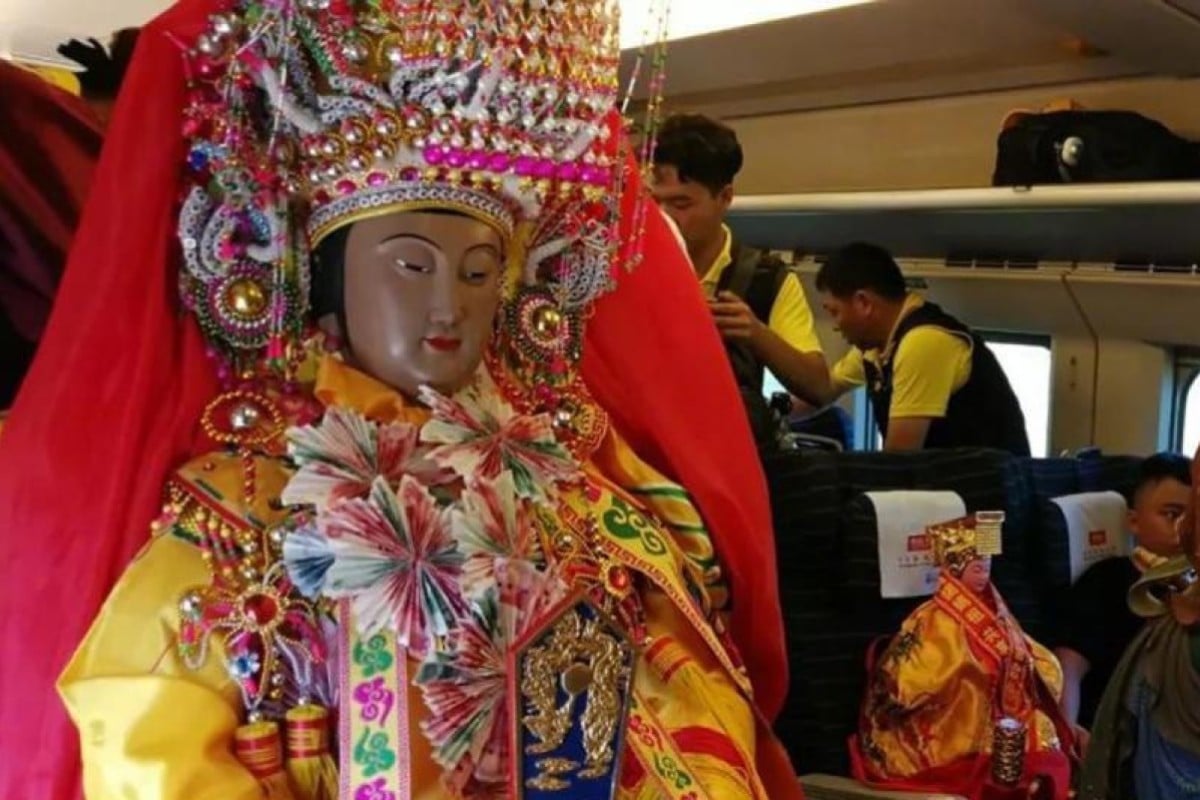
The statue of Chinese sea goddess Mazu on board the train for her seven-day tour of eastern China. Photo: Weibo
High-speed rail travellers in eastern China may find themselves in exalted company this week as one of China’s most beloved deities is on a seven-day tour.
Mazu, protector of seafarers, boarded the train at Putian in Fujian province on Friday with an entourage of 230 worshippers for one of her regular “inspection tours”. And, like any modern traveller, the sea goddess had the necessary identity card and ticket for the journey.
Mazu, known as Tin Hau in Hong Kong, began life more than 1,000 years ago as a mortal named Lin Mo, according to Chinese folk belief. As a girl she is said to have saved some of her family members when they were caught in a typhoon while out fishing. In another version of the myth, Lin Mo died while trying to rescue shipwreck victims.
She fell out of favour in mainland China during the Cultural Revolution, when her ancestral temple on Meizhou Island in the southeastern province of Fujian was destroyed to make way for a People’s Liberation Army garrison. In the late 1970s the temple was rebuilt and in 2009 the beliefs and customs surrounding Mazu were recognised as an Intangible Cultural Heritage of Humanity by Unesco.
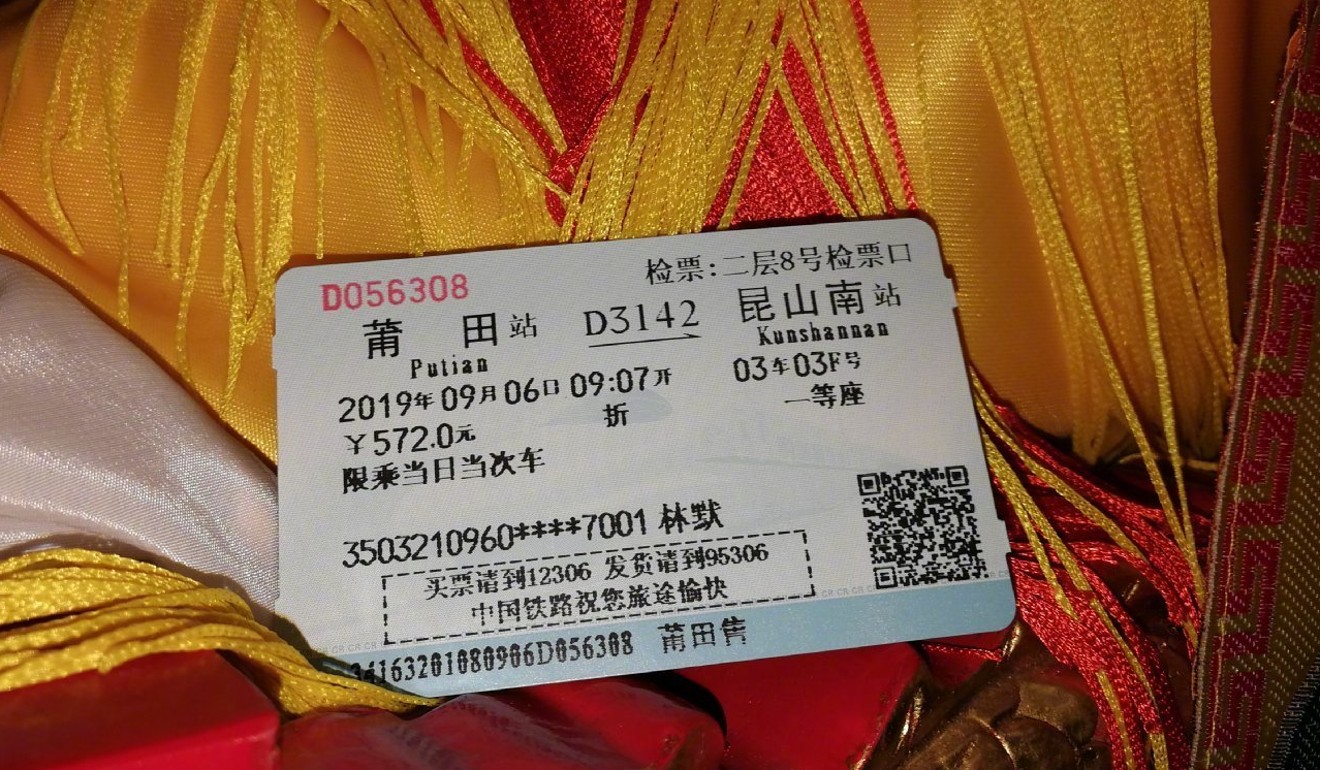
Inspectors on China’s high speed rail will find everything in order if they ask to see the goddess Mazu’s ticket during her seven-day tour. Photo: Weibo
Staff at the Meizhou Mazu Temple applied for an ID card for the goddess, in her earthly name of Lin Mo. Tickets were also organised for two other fairy figures who traditionally protect her, according to Chinese folklore.
“Not only Mazu but Thousand-Mile Eye and Wind-Accompanying Ear were all bought tickets,” a temple representative told the Southern Metropolis News.
This is not the first time the trio have been bought travel tickets. Two years ago their airfares were paid for when they visited Malaysia and Singapore and, a year later, they took a cruise ship to the Philippines.
This year’s tour includes a visit to Kunshan in Jiangsu and Shanghai, before Mazu returns to her home temple on the island of Meizhou. At each stop, devotees believe Mazu blesses the location with her presence and protects its residents from harm.
Taiwanese tycoon Gou thanks sea goddess for presidential inspiration
The tour has been organised jointly by the Meizhou Temple as well as the Huiju Mazu Temple in Kunshan and the Lugang Mazu Temple in Taiwan.
News of the celestial train journey quickly went viral on Chinese social media, with posts on Mazu receiving 460 million views on Weibo, the Twitter-like microblogging platform, since Monday. “First, respect. Second, she takes up a seat so it’s not crazy to buy her a ticket,” one comment read.
Source: SCMP
Posted in airfares, ancestral temple, blessings, celestial train journey, Chinese folk belief, Chinese social media, coastal communities, Cruise Ship, Cultural Revolution, Deity, Eastern China, exalted company, fishing, Fujian Province, garrison, High-speed rail travellers, Hong Kong, Huiju Mazu Temple, identity card, inspection tours, Intangible Cultural Heritage of Humanity, jiangsu province, journey, Kunshan, lets train, Lin Mo, Lugang Mazu Temple, Mainland China, Malaysia, Mazu, Meizhou Island, modern traveller, most beloved deities, myth, necessary, on board the train, People’s Liberation Army, Philippines, protector of seafarers, Putian, sea goddess, seven-day journey, Shanghai, shipwreck victims, Singapore, Southern Metropolis News, statue, Taiwan, Taiwanese tycoon, take the strain, Thousand-Mile Eye, ticket, Tin Hau, tour, travel documents, Typhoon, Uncategorized, UNESCO, viral, Weibo, Wind-Accompanying Ear, worshippers |
Leave a Comment »
10/09/2019
- Suspects rounded up after people complain of being duped into making donations to support non-existent temples
- One woman says she handed over US$4,600 after being told that charitable gesture would help her live to be 400
One victim of the alleged scams said she was told she could live for 400 years if she handed over her money. Photo: Thepaper.cn
Police in southeast China have detained 100 people on suspicion of being part of a criminal network that cheated members of the public out of 50 million yuan (US$7 million) by preying on their superstitions and generosity.
Authorities in Ningguo, Anhui province launched an investigation in May after receiving a number of complaints about the activities of several groups posing as fortune-tellers on social media platforms like Weibo, financial news outlet Caijing reported on its website on Tuesday.
One of the groups, which operated on the Twitter-like service under the name “Kanxiang Zen Master”, was run by a local man surnamed Zhang and had 12 million followers, the report said.
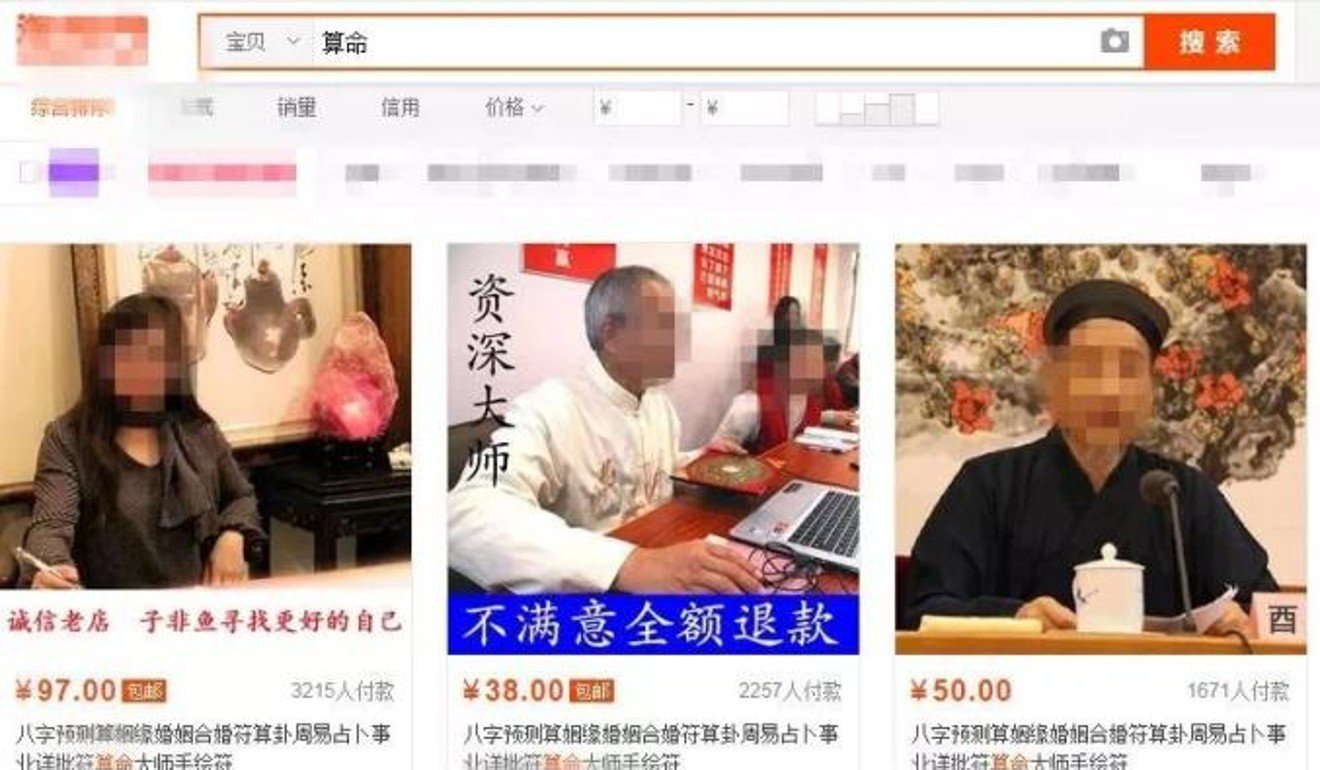
Adverts for online fortune-telling services are common in China. Photo: Thepaper.cn
In one alleged scam, members of the group were told they would receive good luck if they made a donation to support a “famous temple”. But when a man who gifted 10,000 yuan via WeChat Pay checked on the address of the recipient, he found it was a residential address in the city of Xuancheng and not a place of worship, the report said.
When police investigated, they found Zhang had links to seven criminal groups in Anhui and neighbouring Jiangsu province, which between them operated about 60 fortune-telling accounts on Weibo, several of which had more than 10 million followers. The Kanxiang Zen Master account has since been removed from the platform.
Six Chinese wanted for internet scam arrested in Vanuatu
A number of the gangs were registered as media companies and operated as semi-professional organisations with formal recruiting procedures and regular conferences to plan their fraudulent activities, the report said, adding that they had been operating for at least two years.
Police in July staged a series of raids to round up the suspects and confiscated associated equipment, including computers, vehicles and mobile phones, the report said.
Authorities in Ningguo have appealed for more victims to come forward.
A separate report by Shanghai-based news outlet Thepaper.cn said that some of the suspects also used e-commerce sites such as Taobao and the messaging service WeChat to promote their fortune-telling services.
Taobao is owned by Alibaba Group, which also owns the South China Morning Post.
In one case, a woman from the city of Changshu in Jiangsu said she made multiple payments – totalling about 33,000 yuan – to a fortune-teller she met on WeChat who said the money would be used to buy incense for use in offerings to the gods.
She said she reported the alleged fraud after starting to doubt the fortune-teller’s claims, including one that said if she made the donations she could live for up to 400 years.
Alibaba, Weibo and Tencent, which owns WeChat, have been contacted for comment.
Posted in Adverts, Alibaba Group, Anhui, authorities, Caijing, Changshu, chinese police, complain, detain, duped, e-commerce sites, famous temple, financial news outlet, fortune-tellers, fortune-telling, generosity, gods, incense, Jiangsu, jiangsu province, Kanxiang Zen Master, making donations, messaging service, Ningguo, non-existent temples, offerings, place of worship, promote, residential address, scam, Services, Shanghai-based news outlet, social media platforms, south china morning post, superstitions, Taobao, TENCENT, Thepaper.cn, Uncategorized, Vanuatu, website, WeChat, WeChat Pay, Weibo, Xuancheng, Zhang |
Leave a Comment »
10/09/2019
- Residents evacuated from building in Shenzhen as it leans to one side
- An investigation is launched and utilities in the area are cut off
The building leans to one side after apparently sinking into the ground. Photo: Weibo
Emergency workers sealed off a building in the southern Chinese city of Shenzhen after it collapsed on Wednesday morning, local authorities said.
At around 11.20am, a block of flats in Luohu district suddenly sank into the ground and leaned to one side, the Shenzhen government said on Weibo, China’s equivalent of Twitter.
“Before it happened, the local community office heard noises coming from underground, and evacuated residents. Right now there are no casualties,” the Weibo post said. “The case is being investigated.”
In a short video published by state broadcaster CCTV, a residential building appears to have sunk into the ground and leans on the neighbouring building, with bricks and concrete strewn on the ground.
The area was closed off as police, ambulance crews and firefighters attended the scene.
The authorities also evacuated residents from surrounding buildings, moving them into temporary housing. A panel of experts began to investigate the cause of the collapse, while water, gas and electricity supplies were cut off in the area and construction work was halted as a precaution.
Earlier this month, a stadium in Shenzhen collapsed while demolition work was being carried out, killing three workers and injuring three. The part of the venue that collapsed had previously been used as a basketball court but was being renovated, with most of the interior having been torn down apart from a few pillars supporting the roof.
Source: SCMP
Posted in ambulance crews, authorities, basketball court, Block of flats, Building, casualties, collapses, construction work, demolition, Electricity, Emergency workers, evacuated, evacuated residents, firefighters, gas, halted, injuring, interior, investigation, killing, Luohu district, pillars, Police, precaution, renovated, residential building, residents, Roof, sealed, Shenzhen, sinking into ground, stadium, state broadcaster CCTV, Twitter, Uncategorized, underground, utilities, venue, water, Weibo |
Leave a Comment »
10/09/2019
- Expensive presents are officially discouraged but have become the norm at many schools on day of appreciation for educators
Students at Yangzhou Technical Vocational College form the Chinese characters for “Hello Teacher” to mark China’s Teachers’ Day. Photo: Handout
Despite a decade of official discouragement, parents in China have been struggling with one of the biggest dilemmas of the school year – how to mark the country’s annual Teacher’s Day.
Ellen Yuan agonised for a day and a night before sending her son off to kindergarten on Tuesday with a 1,000 yuan (US$140) gift card in his bag for the teacher.
It was the boy’s second week of attendance and Yuan had given no thought to any Teacher’s Day obligations –until she learned that several of her friends had been busy over the weekend preparing gifts for their children’s teachers.
“It makes me feel that I am being a drag on my son if I don’t do so,” said Yuan, who works for a foreign company in Shanghai.
Respecting teachers has traditionally been a fundamental social norm in China but gift giving on the special day for educators has gone beyond an expression of appreciation by their students, as parents have taken over with ever more expensive gifts – and sometimes cash – which they hope will mean their kids are well taken care of while at school.
What gift, how expensive it should be, and how to deliver it have become the biggest questions for many parents in the run-up to September 10 each year, even though the education ministry and its subordinate bodies have repeatedly issued directives over the past decade to ban teachers accepting gifts.
Yuan said one of her friends had bought a body care set worth more than 600 yuan for each of her child’s three teachers, another had bought an 800 yuan gift card, while a third had given the head teacher a 1,000 yuan bottle of perfume.
Some parents had delivered the presents directly to the school, while others had asked their children to take the gifts to their teachers. Yuan’s plan was to message the teacher and tell her to take the gift card from her son’s bag.
“I know it’s bad. I don’t want my kid to know that,” Yuan said.
Hundreds of teachers protest in China over poor pay
The question of whether parents should give gifts on Teacher’s Day was one of the hottest topics on Weibo, China’s Twitter-like social media platform, attracting more than 15 million views as of Tuesday afternoon.
“Of course we should not, but I don’t dare to ignore it,” one user said, winning more than 10,000 likes.
Chu Zhaohui, a researcher at the National Institute of Education Sciences, said the gift-giving trend had been partly driven by a “keeping up with the Joneses” mentality.
“Everybody has given a gift. Would my child be specially treated if I don’t? This is a common concern,” Chu said. As a result, the purpose of gift giving on Teacher’s Day had become about protecting the children’s interests instead of a sincere expression of gratitude, he said.
But not every teacher gets presents – with gifts usually reserved for those teaching the “main subjects” of mathematics, Chinese and English, which count the most in high school and college entrance examinations.
Emily Shen, an English teacher from a middle school in Hangzhou, in the eastern province of Zhejiang, said she also prepared gifts for the teachers of her two kids. “Some chocolate for them to take to school. And I myself would give a gift card to each of those who teach the main subjects,” she said.
Zhuang Ke, a music teacher at a primary school in Jiaxing, also in Zhejiang province, admitted she was embarrassed by the parents’ different treatment of teachers of “less important” subjects like her’s. “It’s always nice to receive presents. But teachers who teach music, art and PE are often forgotten,” she said.
Chinese kindergarten teacher fired for hot sun punishment
State broadcaster CCTV said in a commentary on its website on Sunday that “all forms of behavior that attempt to ruin normal teaching order and interfere in equality by sending gifts should be resolutely abandoned”. A similar message was run by a series of official media outlets at local level.
“The most fundamental way to stop parents from sending gifts is to treat the students equally and fairly every day, so that parents conclude it makes no difference whether they give a gift,” Rednet.cn, the official news portal of Hunan province, said on Monday.
Although some teachers have made it explicit to students that they will refuse presents on Teacher’s Day, Yuan said her son’s teacher accepted the gift, as did the teachers of her three friends’ children.
Source: SCMP
Posted in Art, bag, body care set, bottle of perfume, Chinese, chinese parents, Chocolate, college entrance examination, commentary, day of appreciation, discouraged, educators, English, Expensive presents, fired, foreign company, forgotten, fundamental way, gift card, gift etiquette, Hangzhou, High school, hot sun punishment, Hunan Province, Jiaxing, keeping up with the Joneses, kindergarten, mathematics, mentality, middle school, music, music teacher, National Institute of Education Sciences, norm, official news portal, officially, PE, poor pay, primary school, Protest, Rednet.cn, schools, Shanghai, sincere expression of gratitude, state broadcaster CCTV, struggle, teacher, Teacher’s Day, Uncategorized, website, Weibo, Yangzhou Technical Vocational College, zhejiang province |
Leave a Comment »
08/09/2019
- Two people from the circus have been detained after the animal managed to get out of its cage and run towards nearby cornfields on Friday evening
- It was found the next morning and police used a tranquilliser to subdue the tiger but it died on the way to the zoo, which believes it had been hit by a car
Video footage shows circus handlers using sticks to try to coax the tiger back inside the cage after it escaped on Friday night. Photo: Thepaper.cn
A circus tiger that escaped from its cage during a show in central China was captured by police after an overnight search, but died while it was being transported to a nearby zoo, according to media reports.
Two people from the circus where the tiger was raised in the county of Yuanyang, Henan province, have been detained, Beijing Youth Daily reported, without elaborating. It said the tiger escaped during the circus’ first public show, which had not been registered with the local authorities.
The tiger was part of a performance for a local school on Friday evening when it managed to get out of its cage and run towards nearby cornfields.
A video posted by news site Thepaper.cn shows the moment it escaped from the cage, with its handlers using sticks to try to coax the animal back inside. The scene is chaotic, as people scream and run from the venue.
A tranquilliser dart was used to subdue the tiger on Saturday morning and it was transported to a zoo in Xinxiang. Photo: Thepaper.cn
The police were called in, and officers used drones, police dogs and thermal imaging equipment to hunt for the tiger, according to the local government.
The authorities also put out an emergency advisory telling residents to stay indoors and contact police if they had any information on the tiger’s whereabouts.
It was spotted the following morning, and a tranquilliser dart was used to subdue the animal at about 10.30am on Saturday. The tiger was then transported to a zoo in the city of Xinxiang.
According to one of its zookeepers, the animal had already died by the time it was delivered to the zoo, China Youth Daily reported on Sunday.
The \jsq, surnamed Feng, said the tiger was hit by a car after it escaped and may have sustained internal injuries. The zoo is conducting an autopsy.
Chinese circus tiger attacks two children after breaking out of cage in middle of performance
Thousands of social media users expressed their sympathy for the tiger’s plight, saying it must have suffered greatly, with many people calling for animal circuses to be banned in China.
“Tigers don’t belong in cages, they belong in the wilderness,” one person wrote on microblog site Weibo.
Chinese circus defends using rare animals in its acts despite poor crowds at shows and criticism of its methods.
Source: SCMP
Posted in Beijing Youth Daily, cage, captured, car, Central China, chaotic, China alert, circus, Circus tiger, cornfields, died, dies, drones, escapes, handlers, Henan province, local authorities, local school, performance, Police, police dogs, registered, scream and run, sent to zoo, show, Thepaper.cn, thermal imaging equipment, tiger, tranquilliser, tranquilliser dart, Uncategorized, venue, Weibo, Xinxiang, Yuanyang, Zoo |
Leave a Comment »
05/09/2019
- Doctor who helped 13-year-old girl recover says demands on her to do well at school induced condition
- Weibo poll reveals that 68 per cent of participants had hair loss in school
Studies and polls suggest stress leading to hair loss is a big health concern in China. Photo: Alamy
When the 13-year-old girl walked into the hospital in southern China around eight months ago, she was almost completely bald, and her eyebrows and eyelashes had gone.
“The patient came with a hat on and did not look very confident,” Shi Ge, a dermatologist at the Sixth Affiliated Hospital of Sun Yat-sen University in Guangzhou, told the Pear Video news portal.
The girl had done well in primary school but her grades dropped in middle school, Shi said.
Under parental pressure to do well, the girl pushed herself harder, but the stress resulted in severe hair loss.
With time and medical treatment, the teen’s hair grew back but her story left a lasting impression, raising awareness of the increasing number of young people in China seeking treatment for stress-induced hair loss, according to Chinese media reports.
Jia Lijun, a doctor at Shenzhen Traditional Chinese Medicine Hospital, told state-run Xinhua News Agency in May that aside from genetics, factors such as stress in work, study and life would result in endocrine imbalances which affected the cycle of hair growth.
And in January, a survey of 1,900 people by China Youth Daily found that 64.1 per cent of people aged between 18 and 35 said they had hair loss resulting from long and irregular working hours, insomnia, and mental stress.
Hits and myths: stress and hair loss
Shi said that an increasing number of young people had come to her for treatment of hair loss in recent years, and those working in information technology and white-collar jobs were the two biggest groups.
“They usually could not sleep well at night due to high pressure or had an irregular diet because of frequent business trips,” Shi said.
A Weibo poll on Wednesday revealed that 68 per cent out of 47,000 respondents said they had had serious hair loss when they were in school. About 22 per cent said they noticed after starting their careers, while only 5 per cent said it happened after they entered middle age.
More than half of the Chinese students who took part in a China Youth Daily survey said they had hair loss. Photo Shutterstock
Research published in 2017 by AliHealth, the health and medical unit of the Alibaba Group, found that 36.1 per cent of Chinese people born in the 1990s had hair loss, compared to the 38.5 per cent born in the 1980s. Alibaba is the parent company of the South China Morning Post.
The teenager’s experience sparked a heated discussion on Weibo, with users recounting similar cases and some voicing their panic.
“My niece’s hair was gone while she was in high school and has not recovered, even after she graduated from university. This makes her feel more and more inferior,” one user said.
Hong Kong’s schoolchildren are stressed out – and their parents are making matters worse
Another said: “I lost a small portion of my hair during the high school entrance exam, but that is already scary enough for a girl in her adolescence.”
“I had to quit my job and seek treatment,” said a third, who adding that he also suffered from very serious hair loss a few months ago because of high pressure.
Source: SCMP
Posted in adolescence, Alibaba Group, Alibaba Group Holding, AliHealth, at school, business trips, careers, chasing grades, China Youth Daily, Chinese people, Chinese teenager, condition, debate, demands, dermatologist, do well, doctor, entrance exam, frequent, Guangzhou, hair loss, health and medical unit, her hair, high pressure, High school, induced, inferior, Information technology, irregular diet, job, lost, middle age, middle school, myths, pressure, primary school, quit, recover, school, Shenzhen Traditional Chinese Medicine Hospital, Sixth Affiliated Hospital, south china morning post, sparks, stress, Sun Yat-Sen University, treatment, Uncategorized, university, Weibo, white-collar jobs, Xinhua News Agency, young people |
Leave a Comment »
04/09/2019
- Two classrooms on Nanjing campus were chosen for pilot project
- Camera automatically captures students’ faces without their cooperation
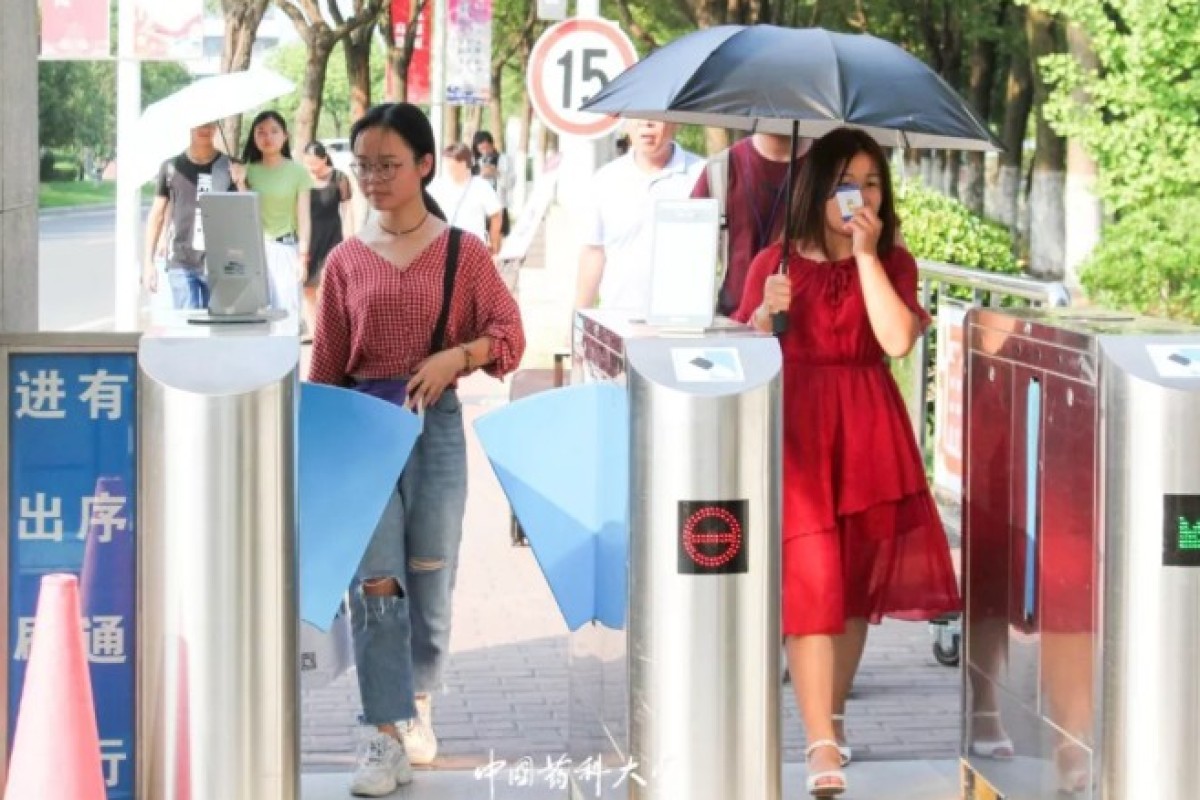
Students pass through a facial recognition turnstile at China Pharmaceutical University in Nanjing. Photo: Weibo
A university in eastern China has installed a facial recognition system at its entrance and in two classrooms to monitor the attendance and behaviour of students.
China Pharmaceutical University in Nanjing, Jiangsu province, announced on its website on Thursday that it was one of the first higher education institutions in the country to put such a system in place.
“It can effectively solve the management difficulties and low efficiencies in a traditional attendance system, and make it easier for managers to track their students,” Xu Jianzhen, director of the university’s library and information centre, told news website Thepaper.cn
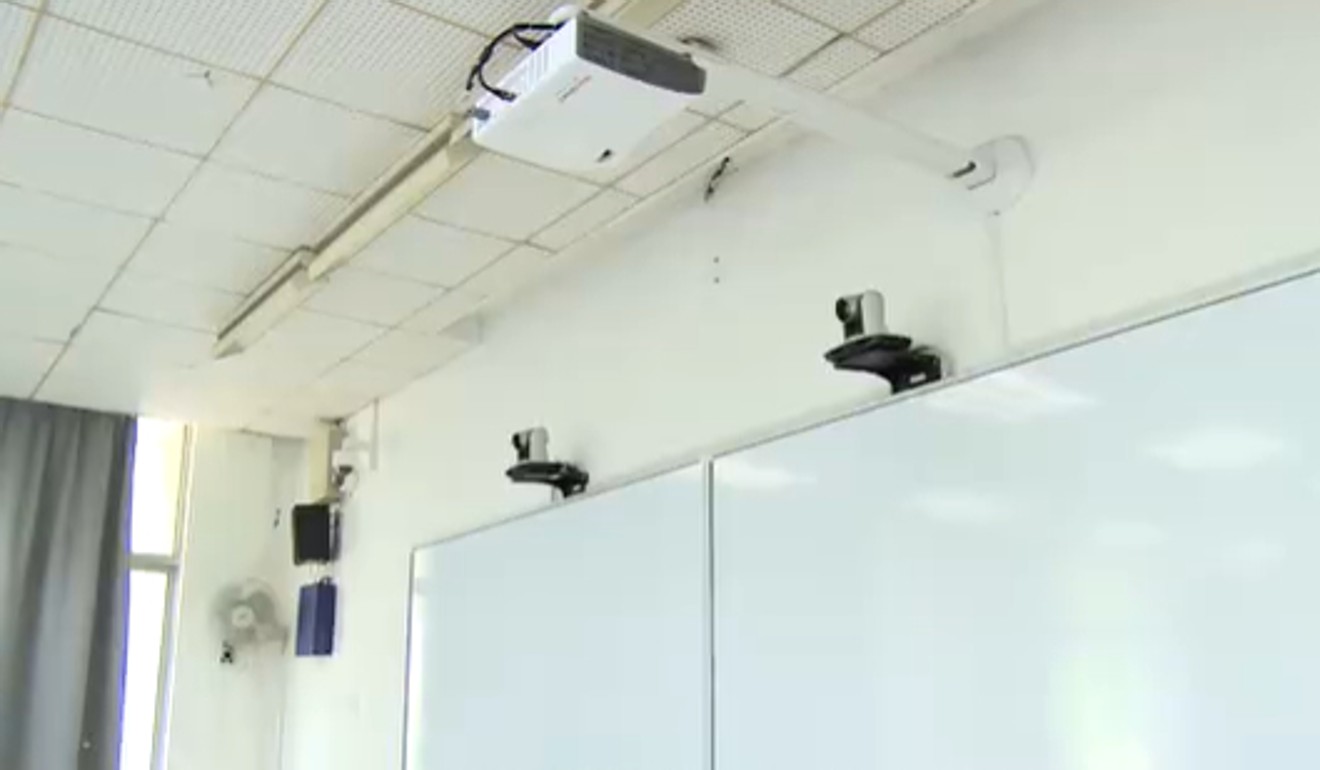
In a pilot project, two classrooms were equipped with an attendance system using facial recognition software, with a camera that automatically captured the faces of students in class without their cooperation, the university said.
“Besides attendance, the system installed in the classroom can provide surveillance of the students’ learning, such as whether they are listening to the lectures, how many times they raise their heads, and whether they are playing on their phones or falling asleep,” Xu told the news website.
“The school is taking action to cut down on students skipping class, leaving classes early, paying for a substitute to attend classes for them and not listening in class,” he said.
The plan was not well received online, with some critics raising privacy concerns for staff and students.
Why are Hong Kong protesters targeting lamp posts?
“What kind of talent are they trying to cultivate?” a user of the Twitter-style Weibo network asked. “I’ve never seen such a method.”
Another wrote: “If this system was being installed in Europe or America, they’d be sued and the school would have to close down.”
But Xu said the university had consulted the police and sought legal advice, and was told the system would not be considered an invasion of privacy as classrooms were public spaces.
“You are complaining about [a system] that’s meant to urge you to learn? Are you a student?” he told the news website.
A spokesman said China Pharmaceutical University was using a facial recognition system to improve class attendance. Photo: Weibo
The university would seek feedback from teaching staff before deciding whether to install facial recognition systems in all of its classrooms, according to the report.
In May last year, a school in Hangzhou, Zhejiang province, installed cameras to monitor pupils’ facial expressions and attentiveness in class as part of a “smart classroom behaviour management system” to give teachers real-time information on their students.
Elsewhere, facial recognition has been used to catch unlicensed drivers in the southern technology hub of Shenzhen, jaywalkers in Shanghai, and criminal suspects at public events across China.
Source: SCMP
Posted in America, attendance, attentiveness, automatically captures, Camera, China alert, China Pharmaceutical University, Chinese university, consulted, cooperation, criminal suspects, Europe, facial expressions, Facial recognition system, Hangzhou, invasion of privacy, jaywalkers, jiangsu province, legal advice, library and information centre, Nanjing, pilot project, Police, public events, Shanghai, Shenzhen, students’ faces, sued, Thepaper.cn, Uncategorized, university, unlicensed drivers, website, Weibo, without, zhejiang province |
Leave a Comment »
22/08/2019
- State media says presence is part of preparations for major drill, but analyst calls it a ‘psychological warfare tactic’
- Fears that the armed presence was a show of power to Hong Kong
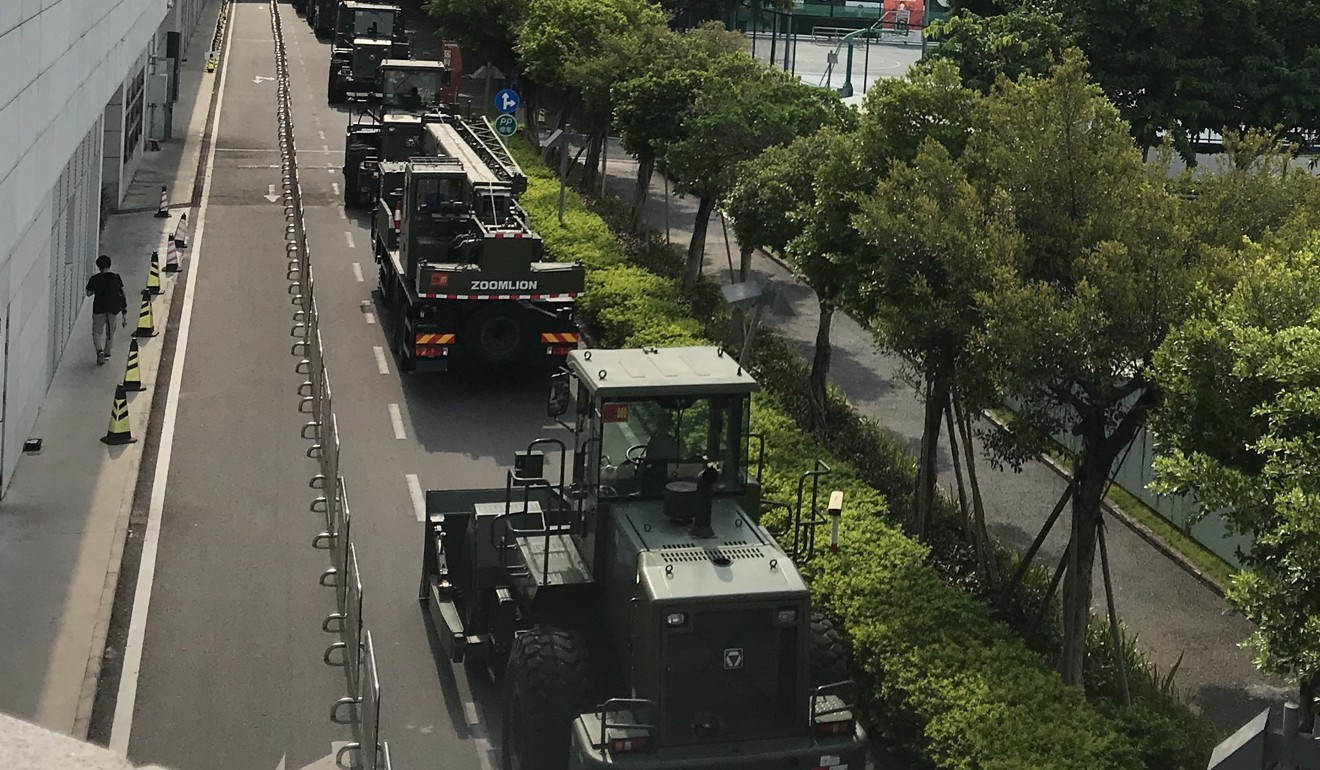
Dozens of trucks line a street next to the entrance of the Shenzhen Bay Sports Centre in Shenzhen on Monday. Photo: SCMP
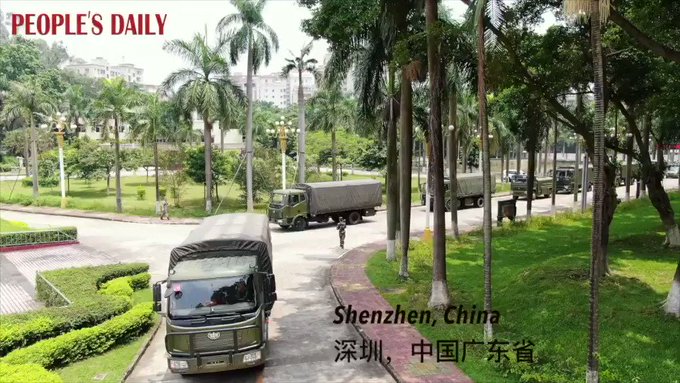
A convoy of armed police trucks has been stationed at a sports centre in a mainland Chinese city bordering Hong Kong, adding to speculation online that Beijing could be preparing to intervene directly in the protests roiling the special administrative region.
But a Beijing-based military expert said the movements were part of regular exercises and not cause for concern.
Footage of the trucks rolling into Shenzhen in the southern province of Guangdong began circulating online on Saturday.
On Monday, Communist Party mouthpiece People’s Daily and Global Times posted videos of the convoy in the city, saying the police were there to prepare for large-scale drills.
Dozens of the trucks as well as excavators lined a pavement next to the entrance of the Shenzhen Bay Sports Centre in Nanshan district on Monday, across the harbour from Hong Kong.
Personnel in camouflage uniforms stood at the entrances of the sports centre, but did not block access to civilians.
Asked whether they were in Shenzhen for a drill and what time they had arrived, the personnel shook their heads and said nothing.
Also on Monday, the Hong Kong and Macau Affairs Office released a stern statement, calling attacks on police “signs of terrorism”.
Online, internet users speculated that the armed presence was a show of power to Hong Kong.
Excavators are among the heavy equipment stationed near the entrance of the Shenzhen Bay Sports Centre on Monday. Photo: SCMP
“They are just waiting for an order before they’ll drive to Hong Kong to calm the riots. We hope the armed forces can enter Hong Kong and beat the hell out of these idiotic youth,” one commenter said on Weibo, China’s Twitter-like social media platform.
Beijing-based military specialist Zhou Chenming said that the armed police were taking part in regular drills and that people should not feel nervous.
“The central government has repeatedly stated it will only interfere if there are large-scale riots and the Hong Kong government has applied voluntarily for support,” Zhou said.
Hong Kong policeman filmed aiming gun at protesters hailed as a hero by Chinese state media
“If the situation does not reach that point, then this is only a deterrence measure, to deter these [small group of people] from stepping over the line.”
Dixon Sing Ming, a political-science professor at the Hong Kong University of Science and Technology, said the move was a “psychological warfare tactic”.
“The drill is part and parcel of a well-coordinated attempt by Beijing to pressure the protesters and the general public to give up their five demands, including the one for universal suffrage immediately,” Sing said.
Hong Kong has been engulfed in protests since early June, at first to oppose the now-shelved extradition bill that would have allowed Hong Kong to send suspects to other jurisdictions, including mainland China.
Chinese police mass 12,000 anti-riot officers in Shenzhen for drill
But protesters now have five demands, including a complete withdrawal of the extradition bill and an independent investigation into the police’s use of force in handling the protests.
As the confrontations have escalated, public opinion in the mainland has grown steadily tougher, with many calling for more stern measures to restore order.
On August 6, 12,000 police officers gathered in Shenzhen for a drill, which included anti-riot measures similar to those seen on the streets of Hong Kong.
Although the police said the drill was part of security preparations for the 70th anniversary of the People’s Republic on October 1, internet users saw it as a show of power and warning to Hong Kong.
Source: SCMP
Posted in 70th anniversary, anti-riot officers, armed police, Beijing, camouflage uniforms, Central government, Chinese armed police, excavators, Global Times, guangdong province, harbour, Hong Kong, Hong Kong and Macau Affairs Office, Hong Kong University of Science and Technology, large-scale drills, mainland Chinese city, Nanshan district, October 1 1949, People’s Daily, People’s Republic, Police, protests, psychological warfare tactic, regular drills, Shenzhen, Shenzhen Bay Sports Centre, signs of terrorism, Special administrative region, truck convoy, Uncategorized, videos, Weibo |
Leave a Comment »














 CHINDIA ALERT: You'll be living in their world, very soon
Chinese parents struggle with Teacher’s Day gift etiquette
Despite a decade of official discouragement, parents in China have been struggling with one of the biggest dilemmas of the school year – how to mark the country’s annual Teacher’s Day.
Ellen Yuan agonised for a day and a night before sending her son off to kindergarten on Tuesday with a 1,000 yuan (US$140) gift card in his bag for the teacher.
It was the boy’s second week of attendance and Yuan had given no thought to any Teacher’s Day obligations –until she learned that several of her friends had been busy over the weekend preparing gifts for their children’s teachers.
“It makes me feel that I am being a drag on my son if I don’t do so,” said Yuan, who works for a foreign company in Shanghai.
Respecting teachers has traditionally been a fundamental social norm in China but gift giving on the special day for educators has gone beyond an expression of appreciation by their students, as parents have taken over with ever more expensive gifts – and sometimes cash – which they hope will mean their kids are well taken care of while at school.
What gift, how expensive it should be, and how to deliver it have become the biggest questions for many parents in the run-up to September 10 each year, even though the education ministry and its subordinate bodies have repeatedly issued directives over the past decade to ban teachers accepting gifts.
Yuan said one of her friends had bought a body care set worth more than 600 yuan for each of her child’s three teachers, another had bought an 800 yuan gift card, while a third had given the head teacher a 1,000 yuan bottle of perfume.
Some parents had delivered the presents directly to the school, while others had asked their children to take the gifts to their teachers. Yuan’s plan was to message the teacher and tell her to take the gift card from her son’s bag.
“I know it’s bad. I don’t want my kid to know that,” Yuan said.
But not every teacher gets presents – with gifts usually reserved for those teaching the “main subjects” of mathematics, Chinese and English, which count the most in high school and college entrance examinations.
Emily Shen, an English teacher from a middle school in Hangzhou, in the eastern province of Zhejiang, said she also prepared gifts for the teachers of her two kids. “Some chocolate for them to take to school. And I myself would give a gift card to each of those who teach the main subjects,” she said.
Zhuang Ke, a music teacher at a primary school in Jiaxing, also in Zhejiang province, admitted she was embarrassed by the parents’ different treatment of teachers of “less important” subjects like her’s. “It’s always nice to receive presents. But teachers who teach music, art and PE are often forgotten,” she said.
Chinese kindergarten teacher fired for hot sun punishment
State broadcaster CCTV said in a commentary on its website on Sunday that “all forms of behavior that attempt to ruin normal teaching order and interfere in equality by sending gifts should be resolutely abandoned”. A similar message was run by a series of official media outlets at local level.
“The most fundamental way to stop parents from sending gifts is to treat the students equally and fairly every day, so that parents conclude it makes no difference whether they give a gift,” Rednet.cn, the official news portal of Hunan province, said on Monday.
Although some teachers have made it explicit to students that they will refuse presents on Teacher’s Day, Yuan said her son’s teacher accepted the gift, as did the teachers of her three friends’ children.
Source: SCMP
Posted in Art, bag, body care set, bottle of perfume, Chinese, chinese parents, Chocolate, college entrance examination, commentary, day of appreciation, discouraged, educators, English, Expensive presents, fired, foreign company, forgotten, fundamental way, gift card, gift etiquette, Hangzhou, High school, hot sun punishment, Hunan Province, Jiaxing, keeping up with the Joneses, kindergarten, mathematics, mentality, middle school, music, music teacher, National Institute of Education Sciences, norm, official news portal, officially, PE, poor pay, primary school, Protest, Rednet.cn, schools, Shanghai, sincere expression of gratitude, state broadcaster CCTV, struggle, teacher, Teacher’s Day, Uncategorized, website, Weibo, Yangzhou Technical Vocational College, zhejiang province | Leave a Comment »