Archive for ‘White House’

02/04/2020

Coronavirus latest: more than 21,000 dead as UN warns of threat to ‘whole of humanity’

  • US$2 trillion rescue package passes US Senate, heads to House
  • Malaysia’s king and queen in ‘self-quarantine’ after staff test positive
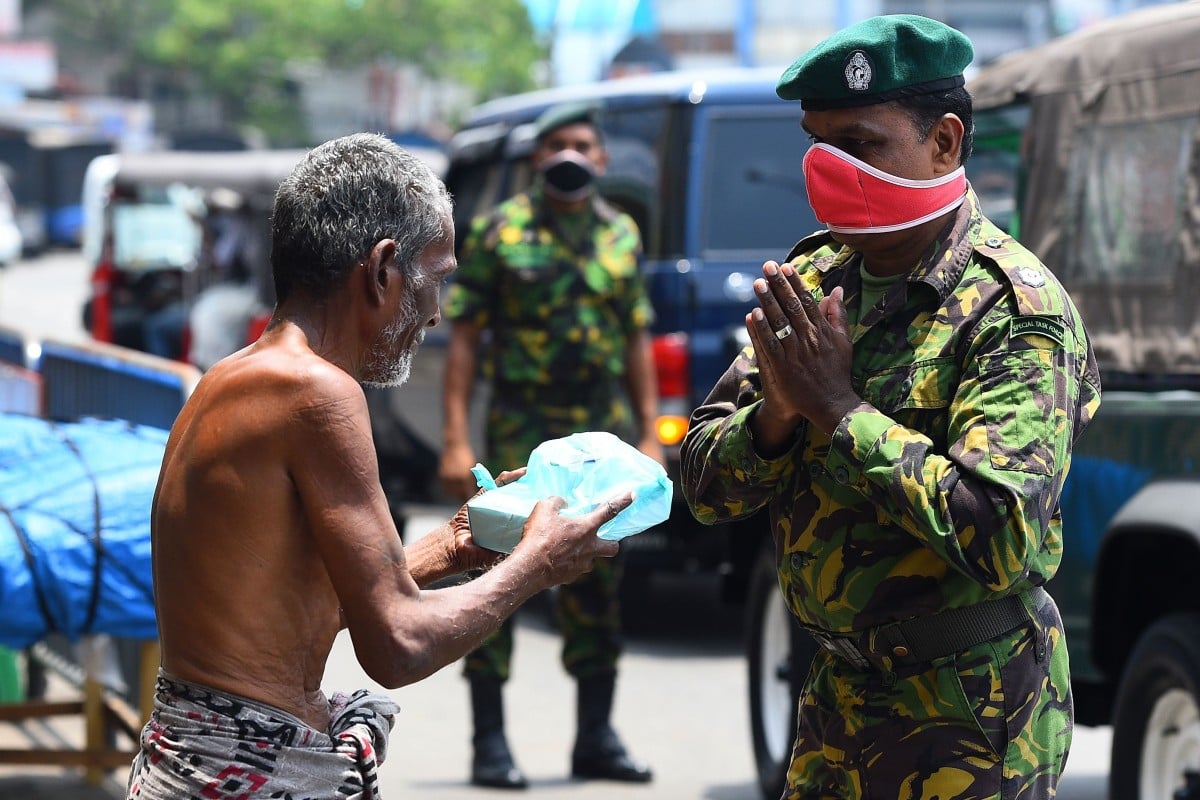
Police commandos in Sri Lanka hand out food to homeless people during a nationwide curfew against the spread of coronavirus. Photo: AFP

More than three billion people are living under lockdown measures as soaring death tolls in Europe and the US underlined a United Nations warning that the coronavirus, which has now infected nearly half a million people globally, threatens all of humanity.

The global death toll from the virus now stands at more than 21,000, with Spain joining Italy in seeing its number of fatalities overtake China, where the virus first emerged just three months ago.

“Covid-19 is threatening the whole of humanity – and the whole of humanity must fight back,” UN Secretary General Antonio Guterres said, launching an appeal for US$2 billion to help the world’s poor.

“Global action and solidarity are crucial. Individual country responses are not going to be enough.”

The G20 major economies will hold an emergency videoconference on Thursday to discuss a global response to the crisis, as will the 27 leaders of the European Union, the outbreak’s new epicentre.

The economic damage of the virus – and the lockdowns – could also be devastating, with fears of a worldwide recession worse than the financial meltdown more than a decade ago.

Here are the developments:

US$2 trillion rescue package passes US Senate

The US Senate passed the nation’s largest-ever rescue package late Wednesday, a US$2 trillion lifeline to suffering Americans, depleted hospitals and an economy all ravaged by a rapidly spreading coronavirus crisis.

The monster deal thrashed out between Republicans, Democrats and the White House includes cash payments to American taxpayers and several hundred billion dollars in grants and loans to small businesses and core industries. It also buttresses hospitals desperately in need of medical equipment and expands unemployment benefits.

The measure cleared the Senate by an overwhelming majority and was headed next to the House of Representatives, which must also pass it before it goes to President Donald Trump for his signature.

US President Donald Trump has voiced hope the US will be “raring to go” by mid-April, but his optimism appeared to stand almost alone among world leaders.

Unemployment benefit filings by Americans workers to surge to 3.3 million last week – the highest number ever recorded, the Labour Department reported on Thursday.

The normally routine report is at the front lines of the economic crisis caused by the outbreak, which has forced widespread closures of restaurants, shops and hotels, and brought airline travel to a virtual halt, prompting the stunning increase in people filing for benefits nationwide in the week ending March 21.

Nearly every state cited Covid-19 for the jump in initial jobless claims, with heavy impacts in food services, accommodation, entertainment and recreation, health care and transport, the report said.

Malaysia’s king and queen in quarantine after staff test positive

The official residence of Malaysia’s monarchy on Thursday confirmed seven of its staff have tested positive for Covid-19 and are currently receiving treatment at the Kuala Lumpur Hospital.

Malaysia’s king, Sultan Abdullah Sultan Ahmad Shah and queen, Tunku Azizah, have also been tested, but their results showed a clean bill of health, a spokesman for the Istana Negara said in a statement.

“Nevertheless, Their Majesties are now observing a 14-day self-quarantine, starting yesterday, ” he said.

Meanwhile, Prime Minister Muhyiddin Yassin, along with all federal ministers and their deputies, announced they will take a two-month pay cut, with the savings to be donated to Putrajaya’s Covid-19 fund.

The Prime Minister’s Office said the decision was made during a cabinet meeting and showed the government’s sincerity in helping those affected by the pandemic.

“The Covid-19 fund was launched on March 11 as part of the government’s efforts to help those who were affected by the disease outbreak,” the office said, adding that 8.5 million ringgit (US$1.97 million) has been collected, including government grants.

Malaysia on Wednesday announced a two-week extension of a national lockdown as part of stepped-up measures to contain the coronavirus outbreak.

The “movement control order,” which requires people to stay home and was originally set to expire on March 31, will now continue until April 14.

Moscow monitors people in coronavirus quarantine with 100,000 ‘under the skin’ surveillance cameras

Russia to ground international flights

Russia will halt all international flights from midnight on Friday under a government decree listing new measures against the coronavirus outbreak.
The decree published on Thursday orders aviation authorities to halt all regular and charter flights, with the exception of special flights evacuating Russian citizens from abroad.
The announcement came after Russia on Wednesday recorded its biggest daily spike in confirmed coronavirus infections so far, with 163 new cases for a total of 658 across the country.
Denis Protsenko, head doctor of Moscow’s new hospital treating coronavirus patients, told President Vladimir Putin that Russia needed to be ready for an “Italian scenario”, referring to what is now the hardest-hit country in the world in terms of deaths.

Singapore boosts stimulus package to 11 per cent of GDP

Singapore reported 52 new coronavirus cases on Thursday, taking its tally to 683 infections.

The health ministry said that out of the 52, 28 were imported while 24 were locally transmitted.

The city state earlier on Thursday unveiled more than $30 billion in new measures to help businesses and households fight the coronavirus pandemic that threatens to push the bellwether economy into a deep recession.

Drawing on national reserves for the first time since the global financial crisis to support an economy heading for recession, the additional spending will push up the government’s virus-related relief to almost S$55 billion, or 11 per cent of gross domestic product, Finance Minister Heng Swee Keat said in a speech in parliament Thursday. It also will widen the budget deficit for the financial year starting April 1 to 7.9 per cent of GDP, from a previous target of 2.1 per cent.

“This extraordinary situation calls for extraordinary measures,” Heng said. “We have saved up for a rainy day. The Covid-19 pandemic is already a mighty storm, and is still growing.”

Coronavirus: Italy’s slowing infection rate boosts case for lockdowns

26 Mar 2020
‘If you catch it, don’t spread it to others’, 1949 flu advice still applies to coronavirus pandemic

Imported cases rise in China

Mainland China reported a second consecutive day of no new local coronavirus infections as the epicentre of the epidemic Hubei province opened its borders, but imported cases rose as Beijing ramped up controls to prevent a resurgence of infections.

A total of 67 new cases were reported as of end-Wednesday, up from 47 a day earlier, all of which were imported, China’s National Health Commission said in a statement on Thursday.

The total number of cases now stands at 81,285.

The commission reported a total of 3,287 deaths at the end of Wednesday, up six from the previous day.

All of the new patients were travellers who came to China from overseas, with the mainland reporting no locally transmitted infections on Wednesday.

Fearing a new wave of infections from imported cases, authorities have ramped up quarantine and screening measures in other major cities including Beijing, where any travellers arriving from overseas must submit to centralised quarantine.

Coronavirus could become seasonal

There is a strong chance the new coronavirus could return in seasonal cycles, a senior US scientist said Wednesday, underscoring the urgent need to find a vaccine and effective treatments.

Anthony Fauci, who leads research into infectious diseases at the National Institutes of Health, told a briefing the virus was beginning to take root in the southern hemisphere, where winter is on its way.

“What we’re starting to see now … in southern Africa and in the southern hemisphere countries, is that we’re having cases that are appearing as they go into their winter season,” he said.

“And if, in fact, they have a substantial outbreak, it will be inevitable that we need to be prepared that we’ll get a cycle around the second time.

“It totally emphasises the need to do what we’re doing in developing a vaccine, testing it quickly and trying to get it ready so that we’ll have a vaccine available for that next cycle.”

There are currently two vaccines that have entered human trials -one in the US and one in China – and they could be a year to a year-and-a-half away from deployment.
British Columbia is testing for Covid-19 faster per head than South Korea
27 Mar 2020

Spain extends emergency by two weeks

Spain’s parliament has voted in favour of the government’s request to extend the state of emergency by two weeks that has allowed it to apply a national lockdown in hopes of stemming its coronavirus outbreak.

The parliamentary endorsement will allow the government to extend the strict stay-at-home rules and business closings for a full month. The government declared a state of emergency on March 14. It will now last until April 11.

Spain’s government solicited the two-week extension after deaths and infections from the Covid-19 virus have skyrocketed in recent days. Spain 47,600 total cases. Its 3,434 deaths only trail Italy’s death toll as the hardest-hit countries in the world.

The parliament met with fewer than 50 of its 350 members in the chamber, with the rest voting from home to reduce the risk of contagion.

Greece locks down Muslim towns

Greek authorities have quarantined a cluster of Muslim-majority towns and villages in the country’s northeast after several cases and a death from the new coronavirus in the area.

The area in Xanthi prefecture was placed in lockdown as of Wednesday evening as nine people in the region overall have tested positive for the virus over the past six days, civil protection deputy minister Nikos Hardalias told reporters.

“All residents have been temporarily confined at home. No exceptions are allowed,” Hardalias said.

The centre of the outbreak appears to be the small Pomak town of Ehinos, a community of about 2,500.

“Ehinos residents will be provided with food and medicine,” Hardalias said.

Police were deployed on Thursday on a bridge leading into town to enforce the lockdown, television footage showed.

One 72-year-old Ehinos man has died from the virus, local mayor Ridvan Deli Huseyin told Antenna television.

“It’s better to take some measures now than to cry about this later,” said Huseyin, the mayor of the local administrative centre of Miki.

The Pomaks are a Muslim group of Slavic origin who live mainly in neighbouring Bulgaria.

They make up part of Greece’s roughly 110,000-strong Muslim minority in the country’s northeast bordering Turkey.

Many of them work as migrant industrial workers in other European countries.

Economy seats go for business-class fares as travellers flee
27 Mar 2020

Colombia goes into lockdown, Chile extends schools closures

Countries across Latin America tightened measures on Wednesday to halt the spread of the deadly novel coronavirus, with more lockdowns, border closings and school closures as well as increased aid to the region’s poorest.

As cases of Covid-19 cases continue to rise – more than 7,400 and 123 deaths up to now – Bolivia and Colombia became the latest countries to impose a total lockdown, while Chile extended its schools closures until the end of April.

Brazil’s President Jair Bolsonaro has warned of possible “chaos” and the “looting” of supermarkets if state shutdowns ordered by the governors of Sao Paulo and Rio de Janeiro aren’t ended.

Bolsonaro, who has repeatedly scoffed at the severity of the deadly pandemic, had previously criticised the closing of schools and businesses in Sao Paulo and Rio states, two of the country’s most populous states.

Germany ramps up testing, approves huge bailout

Germany has boosted its coronavirus test rate to 500,000 a week, Christian Drosten, who heads the Institute of Virology at Berlin’s Charite University Hospital, said on Thursday, adding that early detection has been key in keeping the country’s death rate relatively low.

Drosten also highlighted Germany’s dense network of laboratories spread across its territory as a factor contributing to early detection.

The news came after Chancellor Angela Merkel’s government secured emergency spending, unlocking a historic rescue package designed to cushion the blow of the coronavirus pandemic.

A majority of lawmakers in the Bundestag voted on Wednesday to allow additional borrowing to combat the crisis, according to the legislature’s president. The Bundesrat, or upper house of parliament, will vote on Friday.

The extraordinary authorisation is part of a packet of legislation aimed at protecting German jobs and businesses. The new borrowing of €156 billion (US$169 billion) is equivalent to half of the country’s normal annual spending.

The country, which tightened lockdown measures this week, has about 32,700 cases and more than 150 deaths.

Trump and Widodo back chloroquine treatment, but fake news is deadly
25 Mar 2020

Ukraine declares ‘emergency situation’

Ukraine on Wednesday declared a month-long “emergency situation” to slow the coronavirus outbreak, as the number of confirmed cases jumped to 113.

Ukraine has already closed schools, universities and public spaces to stem the spread of the disease, but the measures were due to expire at the beginning of April.

The emergency situation announced on Wednesday effectively extends existing measures for 30 days until April 24, a government spokesperson said.

“We are extending quarantine and imposing an emergency situation in Ukraine,” Prime Minister Denys Shmygal said.

Unlike an official state of emergency, the initiative announced by the prime minister does not have to be rubber stamped by both the parliament and president. Ukraine has confirmed 113 cases of Covid-19 and four deaths, according to official statistics.

Prince Charles tests positive for coronavirus

Mexican governor says poor are ‘immune’

The governor of a state in central Mexico is arguing that the poor are “immune” to the new coronavirus, even as the federal government suspends all non-essential government activities beginning Thursday in a bid to prevent the spread of the virus.

Puebla Governor Miguel Barbosa’s comment on Wednesday was apparently partly a response to indications that the wealthy have made up a significant percentage of Mexicans infected to date, including some prominent business executives.

Officials say three-quarters of Mexico’s 475 confirmed cases are related to international travel, and the poor do not make many international trips. Some people apparently caught the virus on ski trips to Italy or the United States. The country has seen six deaths so far.

“The majority are wealthy people. If you are rich, you are at risk. If you are poor, no,” Barbosa said of the coronavirus. “We poor people, we are immune.”

Barbosa also appeared to be playing on an old stereotype held by some Mexicans that poor sanitation standards may have strengthened their immune systems by exposing them to bacteria or other bugs.

There is no scientific evidence to suggest the poor are in any way immune to the virus that is causing Covid-19 disease around the world.

No agreement on ‘Wuhan virus’ name as G7 spars over infection source

26 Mar 2020

Japan belatedly bans entry from Europe, Iran

Japanese Prime Minister Shinzo Abe has established a task force under the country’s revised emergency law to deal with the global rise in coronavirus infections and deaths.

In Tokyo on Thursday, Abe said it was necessary for people to act as one to overcome what can be described as a national crisis.

Japan will ban entry from 21 European countries as well as Iran, to take effect from Friday, he added.

The country has already begun asking visitors and its nationals arriving from some countries in Southeast Asia, the Middle East and Africa to self-quarantine for 14 days.

Arrivals from a total of seven Southeast Asian countries and four in the Middle East and Africa are also asked to refrain from using public transport.

Similar steps are in place for visitors from China, South Korea, most of Europe and the United States.

Malaysia to lock down two communities to curb spread

Malaysia on Thursday announced that 3,570 residents in two communities in the country’s south will be placed under complete lockdown due to their high coronavirus infection rates.

Defence Minister Ismail Sabri Yaakob said in a statement that the residents in Kluang district of Johor state are banned from leaving home for two weeks beginning Friday, to enable the health authorities to conduct door-to-door screening.

The tough measure was taken after 73 per cent of the 83 infection cases found in the district were traced to the two small communities of Kampung Dato Ibrahim Majid and Bandar Baru Dato Ibrahim Majid.

Ismail said the residents cannot leave home, not even to buy food, as the welfare department will supply them with two weeks’ worth of food. All businesses must close and all access into the two areas will be sealed. The police and army have been deployed to ensure compliance.

Australia scraps haircut time limit

The Australian government scrapped a time limit on haircuts following a backlash.

The government had imposed a rule on hairdressers and barbers on Tuesday that haircuts should take less than 30 minutes, as part of social distancing restrictions to deal with the coronavirus outbreak.

The restriction put around 40,000 hairdressers at risk, the Australian Hairdressing Council said in response.

“This decision is outrageous,” the council’s chief executive Sandy Chong said in a statement.

“Whilst many barbers can do a male haircut within that time frame, it really isn’t feasible for a majority of hairdressing salons.”

Australian Prime Minister Scott Morrison issued a statement Thursday saying the policy would be reversed with immediate effect.

But salons and barbers must still strictly observe new rules that there may only be one person per four square metres within the premises, Morrison said.

India unveils US$22.6 billion stimulus package

India’s government announced a 1.7 trillion rupee (US$22.6 billion) stimulus package, as it stepped up its response to the coronavirus pandemic.

The measures will include cash transfers as well as steps on food security, Finance Minister Nirmala Sitharaman said in New Delhi on Thursday, adding that the package will benefit migrant workers.

Asia’s third-largest economy joins countries from the US to Germany that have pledged spending to contain the economic fallout of the pandemic. India is on a total lockdown for three weeks from Wednesday in the world’s biggest isolation effort, as Prime Minister Narendra Modi seeks to prevent the virus from spreading locally.

The government will also provide an insurance cover of 5 million rupees to medical workers, Sitharaman said.

Source: SCMP
15/03/2020

Lockdowns, self-isolation and entry bans imposed to fight global coronavirus spread

(Reuters) – France and Spain joined Italy in imposing lockdowns on tens of millions of people, Australia ordered self-isolation of arriving foreigners, and Argentina and El Salvadore extended entry bans as the world sought to contain the spreading coronavirus.

Panic buying in Australia, the United States and Britain saw leaders appeal for calm over the virus that has infected over 138,000 people globally and killed more than 5,000.

Several countries imposed bans on mass gathering, shuttered sporting, cultural and religious events, while medical experts urged people to practice “social distancing” to curb the spread.

All of Pope Francis’ Easter services next month will be held without the faithful attending, the Vatican said on Sunday, in a step believed to be unprecedented in modern times.

The services, four days of major events from Holy Thursday to Easter Sunday, usually draw tens of thousands of people to sites in Rome and in the Vatican.

Australian Prime Minister Scott Morrison said from midnight Sunday international travellers arriving in the country would need to isolate themselves for 14 days, and foreign cruise ships would be banned for 30 days, given a rise in imported cases.

“What we’ve seen in recent weeks, is more countries having issues with the virus and that means the source of some of those transmissions are coming from more and more countries,” Morrison told a news conference.

Australia’s latest restrictions mirror those announced by neighbouring New Zealand on Saturday. Australia has recorded more than 250 coronavirus cases and three deaths.

TRAVEL BANS, AIRLINE CUTBACKS

U.S. President Donald Trump declared a national emergency on Friday. The United States has recorded more than 2,000 cases and 50 deaths, but has been criticised for slow testing.

Travel bans and a plunge in global air travel saw further airline cut backs, with American Airlines Inc (AAL.O) planning to cut 75% of international flights through May 6 and ground nearly all its widebody fleet.

The dramatic announcement by the largest U.S. airline came hours after the White House said the United States would widen new travel restrictions on Europeans to include travellers in the United Kingdom and Ireland, starting Monday night.

Washington has already imposed flight restrictions on China.

China tightened checks on international travellers arriving at Beijing airport on Sunday, after the number of imported new coronavirus infections surpassed locally transmitted cases for a second day in a row.

Anyone arriving to Beijing from abroad will be transferred directly to a central quarantine facility for 14 days for observation starting March 16, a city government official said.

China, where the epidemic began in December, appears to now face a greater threat of new infections from outside its borders as it continues to slow the spread of the virus domestically.

China has reported 80,984 cases and 3,203 deaths, according to a Reuters tally, of which 66,911 have recovered in mainland China, which has imposed draconian containment policies, locking down several major cities.

LOCKDOWNS, STAY HOME

Spain put its 47 million inhabitants under partial lockdown on Saturday as part of a 15-day state of emergency to combat the epidemic in Europe’s second worst-affected country after Italy.

Spain had 193 coronavirus deaths and 6,250 cases, public broadcaster TVE said on Saturday, up from 120 deaths reported on Friday.

France will shut shops, restaurants and entertainment facilities from Sunday with its 67 million people were told to stay home after confirmed infections doubled in 72 hours.

French Prime Minister Edouard Philippe said the government had no other option after the public health authority said 91 people had died in France and almost 4,500 were now infected.

“We must absolutely limit our movements,” he said.

Britain is preparing to ban mass gatherings, while isolating people aged over 70 for up to four months is part of its action plan to tackle coronavirus which will be implemented in the coming weeks, Health Secretary Matt Hancock said on Sunday.

Argentina banned entry to non-residents who have travelled to a country highly affected by coronavirus in the last 14 days, the government officially announced late on Saturday.

The ban will last 30 days. Argentina has 45 cases of coronavirus, the health ministry said, up from 21 on March 12.

Panama said flights arriving from Europe and Asia would be temporarily suspended, with the exception of flights that transport doctors, medical equipment or other humanitarian aid.

Colombia will expel four Europeans for violating compulsory quarantine protocols, just hours after it closed its border with Venezuela, the government said on Saturday.

ANTI-TERRORISM TRACKING TO FIGHT VIRUS

Israel will use anti-terrorism tracking technology and partially shutdown its economy to minimise transmission risks, Prime Minister Benjamin Netanyahu said on Saturday.

Cyber tech monitoring would be deployed to locate people who have been in contact with those carrying the virus, subject to cabinet approval, Netanyahu told a news conference in Jerusalem.

Starting Sunday, South Korea began to subject visitors from France, Germany, Britain, Spain and the Netherlands to stricter border checks, after imposing similar rules for China, Italy and Iran which have major outbreaks.

Visitors from those countries now need to download an app which will report whether they have symptoms. South Korea has been testing hundreds of thousands of people and tracking potential carriers using cell phone and satellite technology.

Source: Reuters

12/03/2020

Coronavirus: Donald Trump’s speech was meant to reassure, but it did just the opposite

  • ‘He is a reality-show expert. This is a real crisis. The happy ending is not guaranteed,’ communications strategist says
  • Televised Oval Office address offered an ineffective remedy in the European travel ban and fell short on other policy recommendations, according to analysts
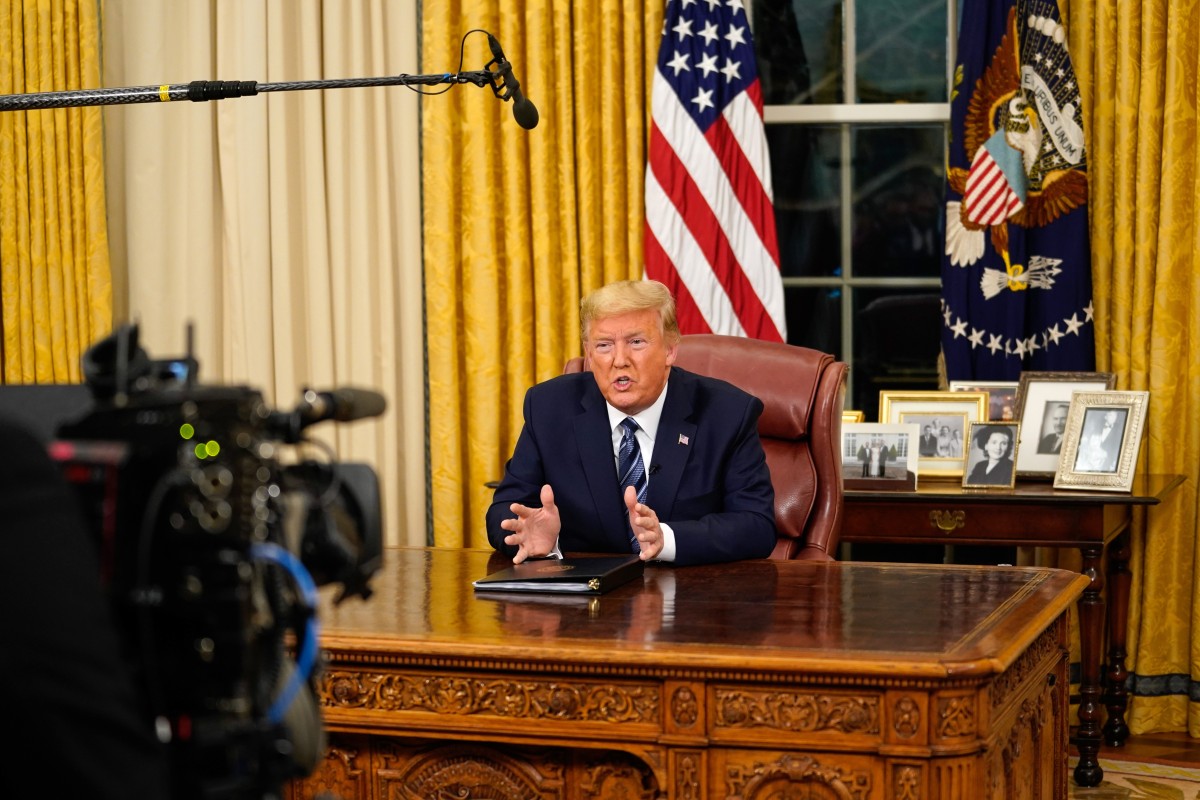
US President Donald Trump addresses the nation from the Oval Office of the White House on Wednesday night. Photo: Bloomberg

US President Donald Trump’s coronavirus address from the Oval Office on Wednesday night was meant to project confidence, show leadership in a time of crisis and otherwise reassure an anxious nation and world.

It didn’t work out that way, say health, government policy and crisis management experts, pointing in part to the 1,000-point drop in stock futures even before his 10-minute nationally televised speech was finished.

“You had an uncomfortable president who looked like he didn’t want to be there. He doesn’t want to be the leader that the country, if not free world, wants him to be in a crisis,” said Richard Levick, chief executive of Levick Strategic Communications.

“He is a reality-show expert,” Levick added. “This is a real crisis. The happy ending is not guaranteed. The applause line is not guaranteed. You have to actually lead. He doesn’t like that.”

Trump bans travel from Europe to the US as coronavirus pandemic hits actor Tom Hanks and the NBA
Public health experts say Trump’s announcement that the US was blocking all incoming visitors from Europe for 30 days will prove largely ineffective given that the virus is already firmly rooted in the US and spreading rapidly. And his efforts to reassure the public that testing is widely available, medical experts are fully deployed and face masks widely available was not convincing and a case of too little, too late, they added.

His speech, only his second Oval Office address, followed weeks of denying the gravity of the coronavirus, spreading misinformation, deflecting blame onto Democrats and the media and contradicting highly regarded experts, including Dr. Anthony Fauci, head of infectious diseases at the National Institutes of Health, observers said.

“He has such a bad track record, no one will believe him,” said JB Silvers, professor of health finance at Case Western University in Ohio. “He can’t help but make this a political thing. A Chinese virus? Viruses don’t have nationalities.”

“He could’ve ramped up testing much earlier,” Silvers added. “Instead he told people, ‘Don’t worry, go back to work.’ All the wrong things.”

New York bans gatherings of more than 500 on coronavirus fears

13 Mar 2020

Governments around the world have struggled to cope with the spread of the virus, prepare adequately and take lessons from China and South Korea, which were hit early.

But Trump’s speech also fell short from a policy standpoint, some said. Washington and the markets have been looking for direction, given the logjam and partisanship in Congress. That includes whether the president would support, albeit grudgingly, a Democratic package of economic stimulus measures, oppose specific parts or reject it outright in favour of a still unformed Republican plan.

“No one has a clear sign what he wants, what he will sign,” said Jeffrey Wright, North America analyst with EurAsia Group. “It was a massive failure, one of the least effective presidential prime-time addresses in my memory.”

Companies and markets hate uncertainty and want reassurance, which they’re not getting said Zhaohui Chen, associate professor of commerce at the University of Virginia. “Investors are worried about the policy, that it may cause more harm to the economy,” he said.

Communication and policy experts said there tend to be few obvious answers initially during a crisis, which puts a premium on relatively transparent leaders who can acknowledges what is known and unknown, build trust and work through complexities toward a solution.

“It’s not so much what he did last night, it’s what he did before. Never before has Trump’s habit of making events about himself hurt him until now,” said Eric Dezenhall, chief executive of public relations firm Dezenhall Resources.

“Standing with science officials and talk about how no one has seen such a scientific genius before him, that he should’ve become a doctor, we’re not selling time-shares in the Caymans,” he added.

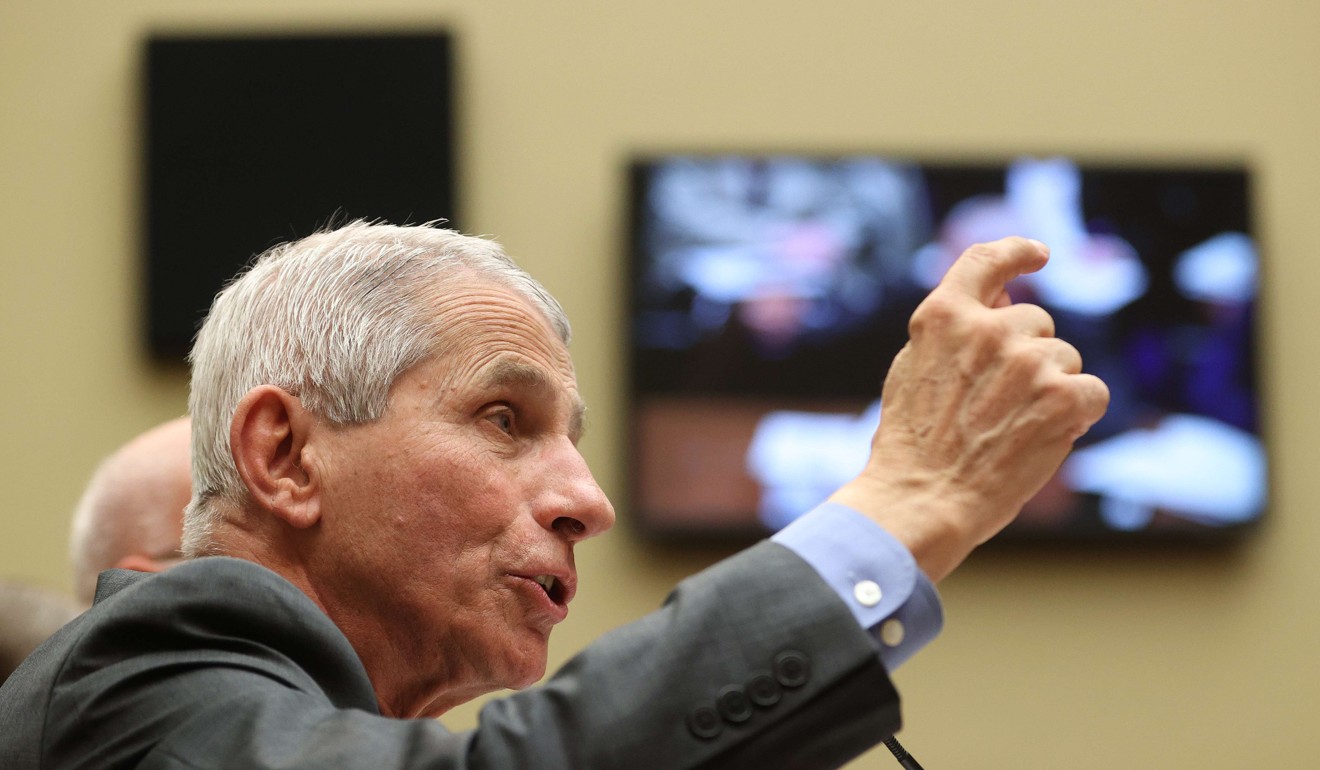
Anthony Fauci, director of the National Institute of Allergy and Infectious Diseases, testifies to lawmakers about coronavirus preparedness on Thursday. Photo: Getty Images/AFP
Leslie Rosenthal, a writer from New Jersey, said the speech failed to reassure her as an ordinary citizen, and seemed to focus on the wrong issues.
“What I wanted to hear from the president was a solution to what’s happening in this country right now,” she said. “While stopping people from coming into the country might do something, it’s about what’s going on here. Where are the test kits? Where are the viral hotspots? I’m placing my trust in Dr. Fauci.”
Trump is a skilled off-the-cuff orator at rallies, where he can energise and be energised by the crowd, communication experts said, and less adept at delivering prepared speeches, as seen on Wednesday night.
“He used a teleprompter, but still made misstatements in ways that rocked the market,” said Levick. Most notable was his statement that his administration was blocking not just people but all cargo from Europe, a statement his office quickly walked back shortly after the speech, he said.
White House orders secrecy for coronavirus meetings
12 Mar 2020

Also questionable was the decision to block travellers from the European continent but not from Britain, even though the UK is a global travel and financial hub.

“You can’t ban people from some countries and not others,” said Ron Waldman, a doctor, professor of global health and infectious disease specialist at George Washington University. “It makes no sense.”

Trump hoped the speech would build confidence in the US economy, its health care system and his leadership. “The virus will not have a chance against us,” he said. “No nation is more prepared.”

But many experts had a different view.

“We’re clearly unprepared,” said Ali Khan, epidemiology professor at the University of Nebraska Medical Center and a former director at the Centres for Disease Control and Prevention.

“We don’t even need to talk about a pandemic,” he said, adding that even a bad flu outbreak would swamp American hospitals.

Trump vows to ‘take care’ of citizens and economy as coronavirus cases rise in the US

After playing down the economic and health risks from the coronavirus for weeks, the Trump administration kicked into gear on Monday, floating a blizzard of proposals to stimulate the economy. These include expanding loans to small businesses, increasing paid sick leave and extending tax relief for the hospitality industry. The White House and congressional leaders are now trying to hammer out an economic relief bill.

Trump’s turnaround reflects, in part, a growing realisation that the disease is real, can’t be tweeted away, can’t be blamed on political opponents and seriously threatens his re-election prospects.

“He’s definitely worried,” said Silvers. “All those ‘Democratic viruses’ are going to cause him trouble.”

Source: SCMP

12/03/2020

Coronavirus: China’s mask-making juggernaut cranks into gear, sparking fears of over reliance on world’s workshop

  • China is now making more than 100 million masks a day, up from 20 million before the coronavirus outbreak, and may start to export more to other countries
  • Mask shortages elsewhere once more raise the debate about an over-reliance on China, with critics pointing to a lack of US industrial policy
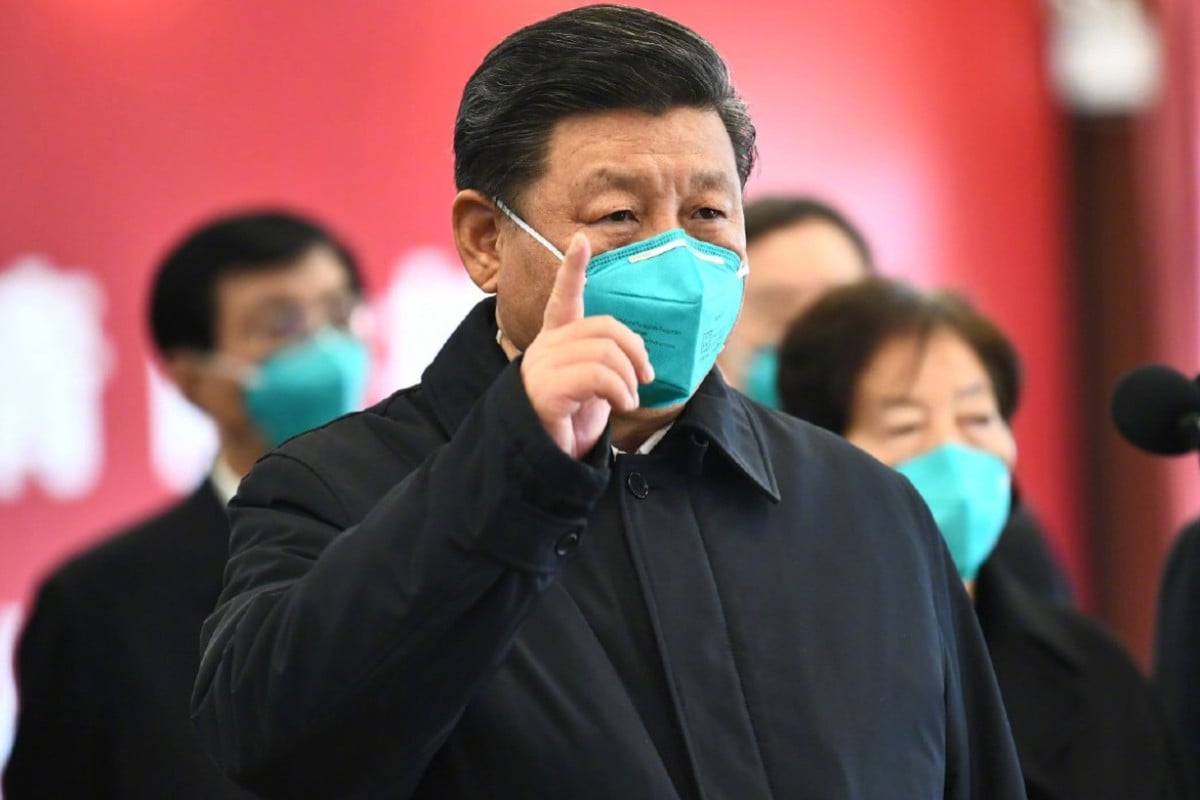
China was producing 116 million masks per day of February 29, including a mix of disposable and high-end masks like the American-designed N95 model worn by President Xi Jinping on his trip on Tuesday to Wuhan. Photo: Xinhua

The Liu family factory has been making diapers and baby products in the Chinese city of Quanzhou for over 10 years, but in February, for the first time, it started making face masks, as demand soared spectacularly due to the coronavirus outbreak.

The business – which employs 100 people in the Southeastern Fujian province – has added two production lines to make up to 200,000 masks a day.
And while the decision was primarily commercial, “encouragement” from the Chinese government – in the form of subsidies, lower taxes, interest-free loans, fast-track approvals for expansion and help alleviating labour shortages – made the decision an obvious one, said Mr Liu who preferred only to give his family name.
“The government is advocating an expansion in production,” Liu said. “With faster approvals, producers need to prioritise the government’s needs over exports.”
WHO declares coronavirus crisis a pandemic
The factory is one of thousands of refitted pop-ups around China making masks and other protective equipment for the first time, part of a massive industrial drive to respond to the spread of the coronavirus.
Before the outbreak, China already made about half the world’s supply of masks, at a rate of 20 million units a day. That rose to 116 million as of February 29, according to China’s state planning agency, a mix of disposable and high-end masks like the American-designed N95 model worn by President Xi Jinping on his trip on Tuesday to Wuhan, the epicentre of the outbreak.

This exponential jump is the result of a wartime-like shift in industrial policy, with Beijing directing its powerful state-owned enterprises to lead the nationwide mask-making effort, and the country’s sprawling manufacturing engine following their lead.

For me, this is the big advantage of China, the speed Thomas Schmitz

“For me, this is the big advantage of China, the speed,” said Thomas Schmitz, president of the China branch of Austrian engineering giant Andritz, which has seen a big uptick in demand for its wet wipe-making machines in recent weeks, also due to the virus. “When you need to run, people know how to run, and this is something which has been lost in other countries since their industrial heydays.”

Chinese oil and gas major Sinopec upped production of mask raw materials such as polypropylene and polyvinyl chloride in January. This week, it set up two production lines in Beijing to produce melt-blown non-woven fabric, intended to make four tonnes of the fabric each day, which can then be used to produce 1.2 million N95 respirators or six million surgical masks a day.

The maker of China’s new J-20 stealth fighter jet, Chengdu Aircraft Industry Group, repurposed part of its factory to design a mask production line, according to local media reports. The Sichuan Daily said 258 of the company’s engineers spent three days fast-tracking development of an assembly line with more than 1,200 components.

Coronavirus: From mysterious origins to a global threat
More than 2,500 companies in China have reportedly started making masks, among them 700 technology companies including iPhone assembler Foxconn and smartphone makers Xiaomi and Oppo, in an extraordinary mobilisation of resources.

The result resembles “the war effort” in the middle of the last century in the United States and western Europe, but arguably no other nation could undergo such a transformation so quickly today.

It is a reminder of what can happen in a centrally-planned economy with a strong manufacturing base, but also brings into sharp focus some of the geopolitical issues which have characterised China’s at-times difficult relationship with the rest of the world, particularly the European Union and US, over the past couple of years.

China’s dominance in manufacturing has become all the more evident as the rest of the world scrambles to shore up their own dwindling medical supplies, leading many to wonder why the world is so dependent on it for vital supplies.

The lesson for Washington is not that we need to emulate the Chinese economic model, but rather that we need to better steward the industrial base in key sectors Rush Doshi

The Italian government, which is dealing with the highest number of coronavirus cases and deaths after China, is to take shipment of 1,000 ventilators, 2 million masks, 100,000 respirators, 200,000 protective suits and 50,000 testing kits from China.
Italian foreign minister Luigi Di Maio said after a phone call with Chinese counterpart Wang Yi, they had agreed the export deal in the same week that European neighbours France and Germany banned masks from being exported because of low domestic supplies.
The Italy export deal showed that “China is emerging as a global public goods provider as the US proves unable and unwilling to lead,” said Rush Doshi, the director of the China Strategy Initiative at the Washington-based Brookings Institute think tank.
“China’s ability to produce what is needed to fight coronavirus is not simply a product of its economic model – it’s also a product of its industrial capacity,” Doshi said. “The US once had this capacity too, but it has lost important parts of it. The lesson for Washington is not that we need to emulate the Chinese economic model, but rather that we need to better steward the industrial base in key sectors.”

The frustration is felt acutely by Michael Einhorn, president of medical equipment distributor Dealmed-Park Surgical in New York, who has been trying to source stock from China for weeks, “but cannot get straight answers” from vendors.

Unaware that Wuhan was still under heavy economic lockdown,
 Einhorn said he placed an order with a private seller in China’s virus-stricken city last week, but that the goods had not been shipped.
“Everyone is running out here, people are panicking in hospitals and we want to be able to help our most important customers,” Einhorn said. “We are dealing with hospitals that do not have products, how in the United States of America in 2020 did this happen?”
With the number of confirmed coronavirus cases in China falling daily, it is not inconceivable that the sort of export deal struck with Italian leaders becomes commonplace, although for now, it deal can be chalked up as a significant public relations coup for Beijing.

The World Medical Association is unable to specify how many masks are required to supply frontline medical staff in virus-hit areas, but said that “this crisis should be a wake up call for politicians and societies to make the necessary investment in emergency preparedness and to look into the vulnerability of our supply chains”.

Australian-listed manufacturer Eagle Health announced on Friday that it had installed production lines at its Xiamen factory in southern China to make 300 million masks a year and said it had already received orders from China and would be securing further larger orders internationally.

The group, which normally makes products including amino acids, protein supplements and lozenges in China, said it would prioritise meeting the large domestic demand, but was aware of an impending global shortage.

Eagle Health has already commenced production of its first order of 3.2 million medical masks for the Yiling Hospital Management Group in China, a process which will take 10 days. It has other smaller orders from Chinese government agencies and expects to receive more orders outside China.

The decision to make more masks came from increased demand. These are opportunities. The global demand for high quality masks will be significant Xu Gang

“The decision to make more masks came from increased demand. These are opportunities,” said chief executive Xu Gang. “The global demand for high quality masks will be significant. Imagine when the schools open. The situation will take some time to peak.”
Last week, the Australian Dental Association said supplies of masks at many practices were expected to run out within four weeks. The Australian government has since arranged a supply of 54 million masks for both the dental and medical industries.
At the same time, the US only has 1 per cent of the 3.5 billion masks it would need to counter a serious outbreak, Bloomberg reported.
While China has no quota on the volume of masks that had to be hived off for local consumption, the government has said domestic demand needs to be prioritised.

Businesses are free to export but overseas demand has yet to explode like it has in China, said Fujian factory owner Liu.

Wendy Min, sales director of Pluscare, a manufacturer based near the virus’ epicentre in Hubei province, said her company is making 200,000 masks per day, much of which are sold to the government, with exports still restricted by partial lockdown of workers and cargo transport.

“We previously exported to Europe, South America and other parts of Asia,” Min said. “But at the moment we can’t export. We are trying to discuss this with the government, but we cannot wait any more – we have to export soon.”

Min said that while she was receiving countless cold calls up until last week from people in China looking for masks, these have stopped, perhaps unsurprising given the abundance in supplies becoming available.

An influx of Chinese-made masks, though, is likely to be welcomed in other virus-stricken parts of the world.

Self-quarantine of all international travellers to Beijing as China fights import of coronavirus
Miguel Luiz Gricheno, CEO of Brazilian mask manufacturer Destra, said that his company is making 30,000 masks a day, but cannot meet local demand due to a lack of supplies, including the non-woven fabric from which masks are made.
“In disposable masks, most Brazilian companies are paralysed due to the lack of raw materials,” Gricheno said. “With the arrival of the coronavirus in Brazil, the demand has increased a lot but the main raw material comes from abroad.”
However, a short-term supply fix will not answer underlying questions about how so many countries found themselves in such dire straits, meaning the geopolitical fallout of the coronavirus will be extensive.
Decades of weak industrial policy helped elect US President Donald Trump, who said he would bring manufacturing jobs back to America at China’s expense. While he has waged a bruising two-year trade war with China in response, the current situation shows just how difficult it will be to change the global manufacturing processes, which are so heavily controlled by China.

One of the great flaws of globalisation is that everyone wanted things cheaper, but did you compromise your health care infrastructure in the process? Stephen Roach

“In the guise of trying to improve efficiency and create value for price-sensitive consumers, we’ve created a global production network that is very difficult to unwind,” said Stephen Roach, a professor of economics at Yale University and a veteran China watcher. “One of the great flaws of globalisation is that everyone wanted things cheaper, but did you compromise your health care infrastructure in the process.
Reuters reported that Trump is considering invoking the emergency provisions of the Defence Production Act, which would allow the government to instruct companies to alter production to help address the domestic shortage of medical supplies like masks. If a company is producing 20 per cent N95 masks and 80 per cent standard masks, the White House could order them to rejig the ratio, an unnamed official said.
The New York Times reported on Wednesday that the White House is preparing an executive order that would allow the government to buy medical supplies from overseas in the hope that it will incentivise companies to make them within the US.

But these changes still do not give Trump the sort of sweeping powers enjoyed by Chinese counterpart Xi.

“When you have a pluralistic, democratic situation that Trump is overseeing, it becomes more unwieldy” to take the steps necessary to address a crisis situation, said Harry Broadman, chair of the emerging markets practise at the Berkeley Research Group and a senior US government official in the 1980s and 1990s.

“That is why I think Trump looks at Xi with envy, because he doesn’t have to deal with a disparity of views or democratic interests,” Broadman said. “I think Trump is at heart a bilateral guy, as you saw with the phase one [US-China] trade deal and the state-to-state purchases. That is why he likes dealing with [Russian President Vladimir] Putin and Xi, because each of them can move mountains. I think Trump is very envious of that ability.”

Source: SCMP

29/02/2020

Could the coronavirus help to improve China’s ties with South Korea, Japan?

  • Cooperation on ‘soft’ issues like public health can provide an ‘opportunity for improvement’ in the nations’ broader relationship, international affairs expert says
  • Foreign ministers agree to do all they can to ensure Chinese President Xi Jinping’s planned visits to east Asian neighbours go ahead later this year
South Korea on Thursday reported 505 new coronavirus cases, its largest increase yet. Photo: AP
The rapid spread of the coronavirus outside China, especially in South Korea and

Japan, 

has created a fresh challenge to Beijing’s delicate relationship with its northeast Asian neighbours, but experts say the unprecedented public health crisis could draw them closer, at least for now.

China’s Foreign Minister Wang Yi held separate conversations with his South Korean and Japanese counterparts on Wednesday as Beijing scrambles to deal with the growing risk of imported infections from the two countries.
In a sign of the “strong momentum at the leadership level on both sides”, Wang and Japanese Minister for Foreign Affairs Toshimitsu Motegi agreed to ensure Chinese President Xi Jinping’s state visit to Japan later this year goes ahead as planned, despite mounting fears the virus outbreak will become a pandemic.
China’s foreign ministry said on Thursday that Yang Jiechi, Wang’s predecessor and Xi’s top aide on foreign affairs, would visit Japan on Friday. His trip is expected to pave the way for Xi’s high stakes visit in the spring, observers said.

But Benoit Hardy-Chartrand, an international affairs expert at Temple University in Tokyo, said that if the outbreak did not subside in the next few weeks, Japanese Prime Minister Shinzo Abe’s government would come under intense pressure to delay the visit.

“Despite reassuring official pronouncements, no one would be surprised if the visit was postponed to a later date,” he said. “With an already declining approval rate, the Abe administration would be hard-pressed to go ahead with the summit.”

During her phone call with Wang, South Korean Foreign Minister Kang Kyung-wha urged China to refrain from carrying out what she described as “excessive” restrictions and forcible quarantine measures against visitors from her country, the Yonhap news agency reported.

White House announces coronavirus ‘coordinator’ to lead response under Pence

28 Feb 2020
South Korea

on Thursday reported 505 new coronavirus cases – its largest increase yet and the first time any country has confirmed more daily cases than China. The outbreak has now spread to more than 30 countries and killed more than 2,800 people.

US-CHINA TRADE WAR
In the cities of Qingdao and Weihai in east China’s Shandong province – both of which are home to large South Korean and Japanese communities – local authorities have begun to quarantine arrivals from the two countries, while similar measures targeting South Koreans in particular have been introduced in Shenyang and Nanjing.

This is the first time China, where the coronavirus originated and which earlier criticised other nations for overreacting to the outbreak, has introduced country-specific measures in the name of disease control.

The move sparked fierce criticism in South Korea, with more than 750,000 people signing an online petition calling for a ban on Chinese visitors.

The foreign ministry in Seoul said that about 40 nations and regions had imposed some sort of restrictions on South Korean visitors.

Both South Korea and Japan – which were among the first to offer support and aid to China when the epidemic took hold – have imposed only partial restrictions on Chinese travellers, mostly those from Hubei, the province at the centre of the contagion.

Wang again thanked South Korea for its support and defended China’s control measures, saying they were necessary to reduce the cross-border movement of people and restrict the spread of the disease, China’s foreign ministry said.

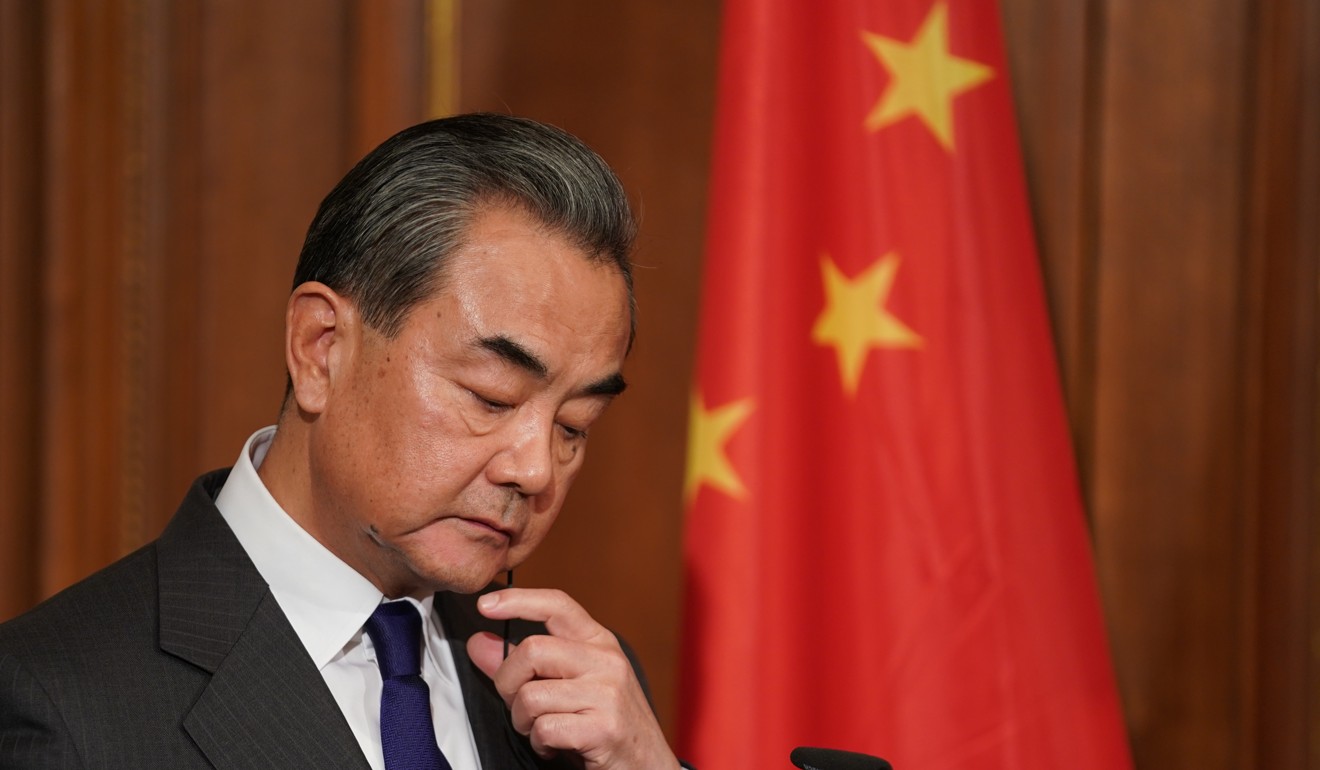
China’s Foreign Minister Wang Yi. Photo: EPA-EFE
Yonhap said both Wang and Kang also agreed that Xi’s proposed trip to South Korea in the first half of the year would proceed as planned.
Chinese experts said the coronavirus had deepened distrust and antagonism towards China in both countries, with many South Koreans and Japanese blaming China for the spread of the disease.
Li Wen, an expert from the China Institute of International Studies, said the coronavirus crisis had seen the rise of the “China threat” in South Korea, with its government under enormous pressure to get tough on its giant neighbour.

According to Yonhap, Kang urged South Korean diplomats in China earlier this month to help minimise any negative impact the epidemic might have had on relations between the two countries.

Hardy-Chartrand said relations between China and South Korea remained tense because of Seoul’s deployment of the American-made THAAD missile defence system, which in turn led to Beijing introducing unofficial sanctions that caused resentment among South Koreans.

Hongkongers stuck in Japan with airlines reluctant to fly them home

28 Feb 2020

But the latest spat over the control measures was unlikely to be a major obstacle to regional relations, he said.

“Overall, cooperation on so-called soft issues like public health, as we are witnessing at the moment, can provide an opportunity for further improvement in the broader relationship, at least in the short term,” he said.

China-Japan relations might also benefit from closer cooperation on disease control given uncertainty in the region over the US-China trade war, the North Korean denuclearisation impasse, the United States’ commitment to its allies, and the coronavirus outbreak, he said.

“I am less sanguine about the mid- to long-term prospects for Sino-Japanese relations, given that the sources of the tensions that we saw from 2010 to 2017, namely the East China Sea territorial dispute and other historical issues, remain wholly unresolved,” he said.

According to a Pew study in December, 85 per cent of Japanese have an unfavourable view of China, the highest among 34 countries surveyed, while 63 per cent of South Koreans see China negatively.

Source: SCMP
28/02/2020

After fumbled messaging, Donald Trump gets a coronavirus tsar by another name

  • Health official Debbie Birx appointed as ‘coronavirus response coordinator’ under Vice-President Mike Pence
  • Facing outbreak threat a month ago, US president said ‘we have it totally under control’. This week, under fire, he changed course
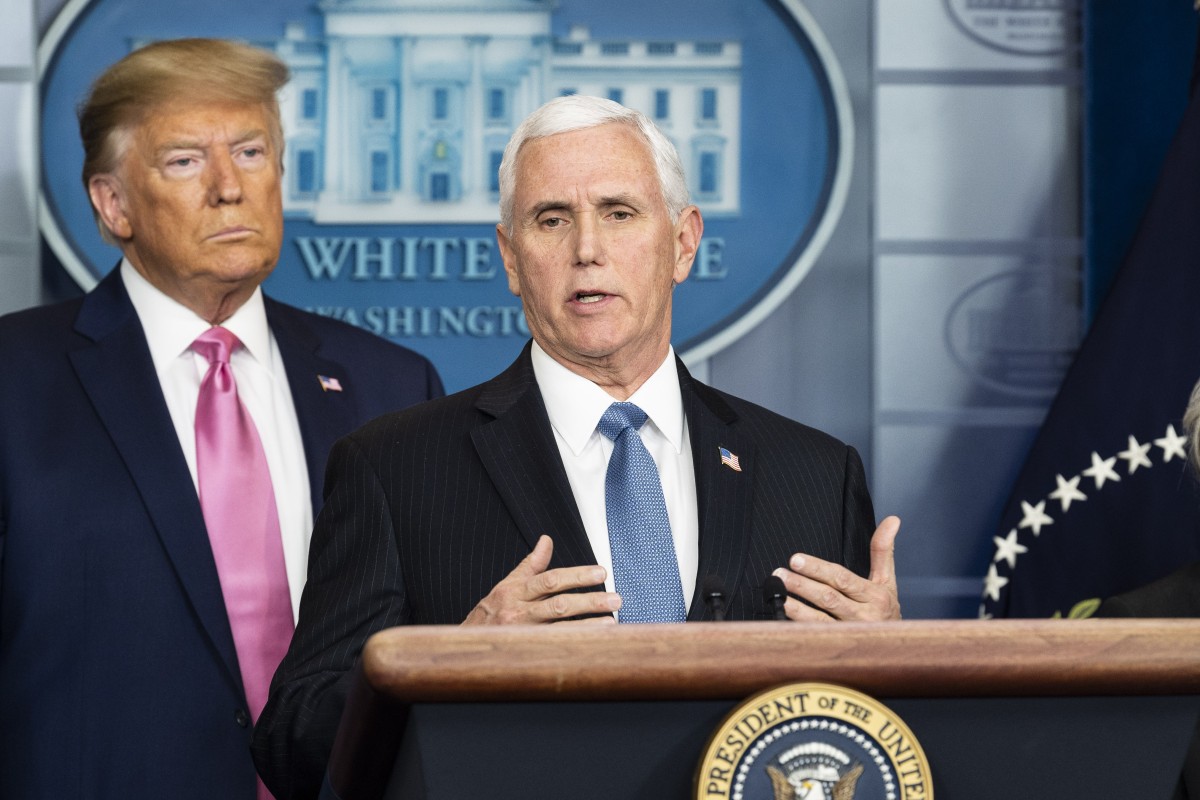
US Vice-President Mike Pence (right) speaks alongside US President Donald Trump during a press conference about the coronavirus at the White House on Wednesday. Photo: dpa
This story is published in a content partnership with POLITICO. It was originally reported by Adam Cancryn, Quint Forgey and Dan Diamond on politico.com on February 27, 2020.
In the end, US President Donald Trump got a coronavirus tsar – without having to call it a tsar.
Vice-President Mike Pence, whom Trump appointed on Wednesday to lead his coronavirus response, announced a global health official as the “White House coronavirus response coordinator” – installing a tsar-like figure under him to guide the administration’s response to the outbreak after a protracted public dance around how to display the power of the federal bureaucracy to the American people.
The move marked the administration’s latest attempt to show it is in control of the spreading global threat after weeks of fumbled messaging, rising market jitters and mounting backlash from lawmakers on both sides of the aisle.
Coronavirus: New cases outside China outnumber those inside for first time since start of epidemic
The two-day journey of upgrading the federal government’s public response highlighted a sharp contrast between Trump’s political instincts to play down the virus risk in an election year and calls from health officials and lawmakers to show the government in command of a deadly and frightening threat.

The new role will put Ambassador Debbie Birx, who has served since 2014 as the US government’s leader for combating HIV/Aids globally, at the centre of what now appears to be three leaders of the government response.

Trump revealed in a news conference on Wednesday evening that Pence would head up the administration’s management of the coronavirus, overseeing a task force nominally led by Health and Human Services Secretary Alex Azar. Birx will report to Pence but serve on the task force that Azar chairs.

Over three decades of public health experience, Birx “has been utilising the best science to change the course of the HIV pandemic and bring the pandemic under control”, the White House said in a statement, adding that she “will bring her infectious disease, immunologic, vaccine research and inter-agency coordinating capacity to this position”.

Speaking at the Conservative Political Action Conference on Thursday, Pence said “we are ready for anything” to fight coronavirus.

Trump faces ‘black swan’ threat to economy and re-election

25 Feb 2020

“I promise you, this president, this administration, is going to work with leaders in both parties. We’ll work with leaders across this nation, at the state and local level. And this president will always put the health and safety of America first.”

Birx’s appointment marked the latest swerve by the White House in assigning responsibility to tackle the burgeoning public health crisis.

At the World Economic Forum in Davos last month, Trump said “we have it totally under control” and maintained “it’s going to be just fine”. The virus has since exploded globally from China to nearly 50 countries, with more worries emerging inside the US.

A week after Trump’s Davos comments, the White House announced a task force to handle the widening outbreak. A month later, Trump was forced to vastly upgrade the response when his bold predictions proved to be wrong.

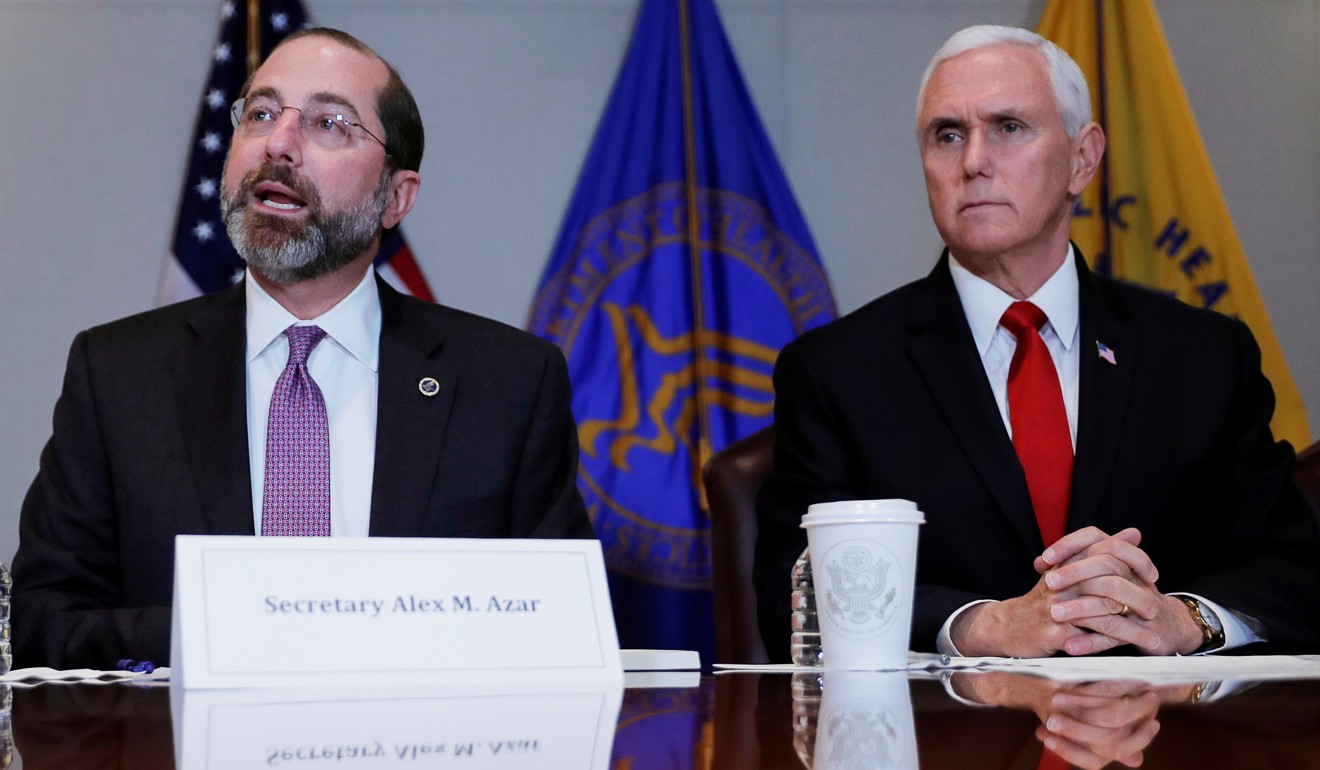
US Health and Human Services Secretary Alex Azar (left) speaks as US Vice-President Mike Pence listens during a coronavirus task force meeting in Washington on Thursday. Photo: Reuters
Appointing a “coordinator” allowed Trump to fulfil an increasingly urgent call from lawmakers to put a trusted public health official at the centre of the White House response as a tsar.
Some administration officials had opposed appointing a tsar – a move President Barack Obama used in 2014 during the Ebola threat – because it could be perceived as an admission of failure up to this point, while others have been criticising Azar for months for his work on the president’s health initiatives far beyond coronavirus.
On Wednesday, Azar told lawmakers “I serve as the lead” on coronavirus efforts, and he denied a POLITICO report stating that the White House was weighing whether to appoint a tsar to coordinate its response to the spreading epidemic.
The leadership change – putting Pence in charge – was a shock to Azar and his team, four people familiar with the matter said, coming soon after the health secretary returned from his full day of congressional testimony.
Facebook cancels its big annual developers event due to coronavirus
28 Feb 2020

Azar had reason to be confident: Trump had reassured him earlier in the day that he was doing a good job atop the task force and would not be replaced. And technically, he was not, even though he has lost ultimate authority over the federal response.

Azar insisted at Trump’s Wednesday news conference, however, that he would remain the chair of the White House task force, indicating Pence would play a supervisory role. That was before Thursday morning’s coronavirus “coordinator” announcement, which Trump hinted at the prior night.

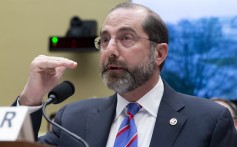
At a congressional hearing on Thursday, Azar downplayed the significance of Pence’s appointment, calling it a “a lot of continuity” of the administration’s response to date.

“What the vice-president will do is actually a function very similar to what acting chief of staff Mick Mulvaney has been doing very ably for me,” he told the House Ways and Means Committee, describing the role largely as ensuring alignment across the government and coordinating decision-making outside the health care arena.

“The vice-president’s involvement and leadership across the whole of government brings just the weight of the office of the vice-president to that task.”

Why the WHO isn’t labelling Covid-19 a pandemic and how the world coped with past global diseases
Azar later insisted that he was consulted and involved in the decision to put Pence in charge, telling lawmakers that he was supportive as soon as the suggestion was made. “I said, quote, that’s genius,” he said.
Azar also told reporters after the hearing that he was “involved” in the decision Wednesday to name Birx.
“She’s a terrific leader. And she will do wonderful work helping us with just the internal processes,” he said. As for Pence’s new role, Azar said “the vice-president helps me, in terms of heft within the executive agency” but maintained that he’s still leading the inter-agency task force work among a slew of other responsibilities as the nation’s health chief.
The compromise position allows the White House to respond to frustration inside and outside the administration while allowing Azar to save face. Trump remains pleased with his health secretary and had reassured him as recently as Wednesday that he was happy with his work on the coronavirus, people close to the White House said.
The White House is battling bipartisan criticism from members of Congress sceptical of the administration’s response and emergency funding request, which some lawmakers have slammed as insufficient to counter the growing threat.
US lawmakers push White House for more aggressive coronavirus preparations
27 Feb 2020

The administration’s disjointed messaging about the severity of the threat earlier this week frustrated even Republicans on Capitol Hill, especially after White House National Economic Director Larry Kudlow declared the containment effort as nearly “airtight” at nearly the same time CDC officials were warning of its “inevitable” spread.

An exasperated Senator John Kennedy aired his concerns directly to Trump on Tuesday, after the Louisiana Republican struggled to extract basic answers about the disease from acting Homeland Security Secretary Chad Wolf.

“We had one story from the classified briefing, we had another story from one Cabinet secretary, then we had another story from another Cabinet secretary,” said Kennedy, who on Thursday praised the decision to elevate Pence. “[Trump] said, I hear what you’re saying, I’m gonna get this straight.”

The announcement of Birx’s latest role within the administration came hours after news broke in California of the first potential case of coronavirus spreading within the US.

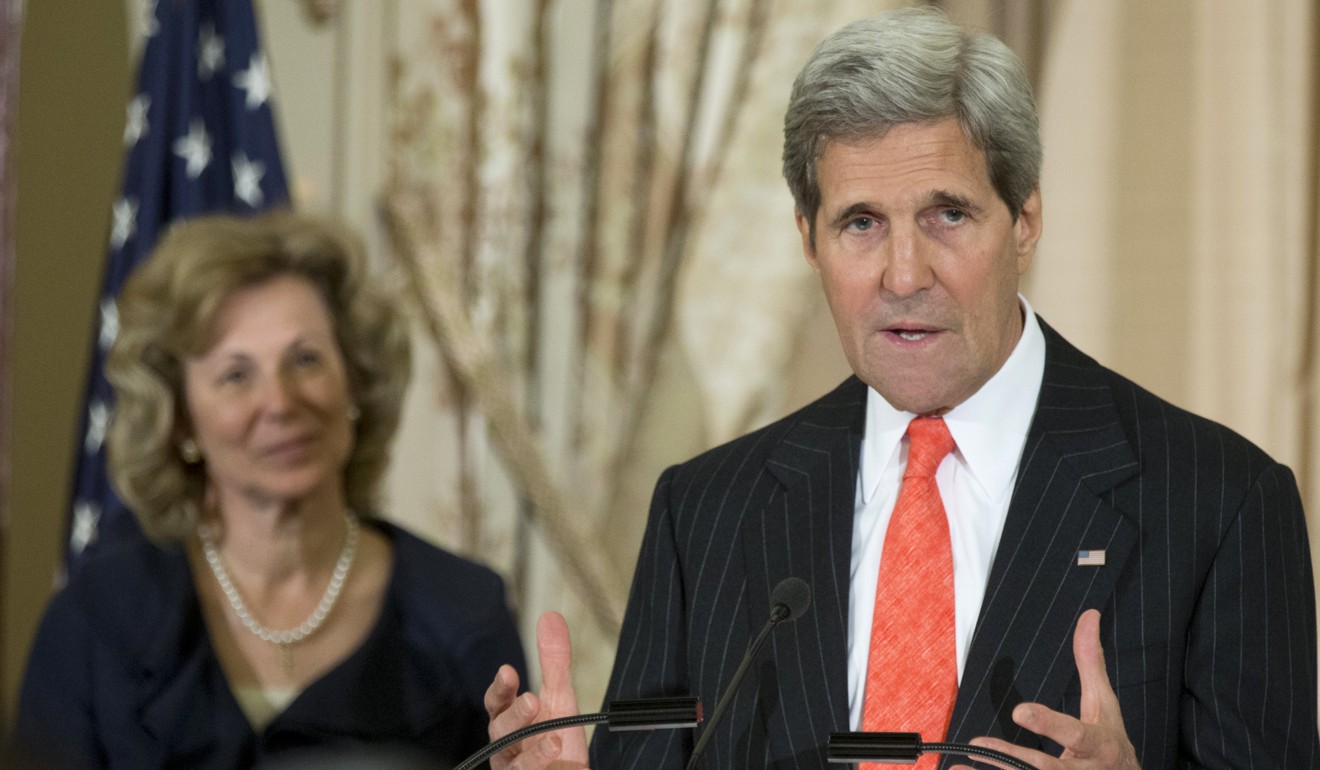
Secretary of State John Kerry speaks during an April 2014 swearing-in ceremony for Debbie Birx (left) as ambassador-at-large and coordinator of US government activities to combat HIV/Aids. Photo: AP
Secretary of State John Kerry speaks during an April 2014 swearing-in ceremony for Debbie Birx (left) as ambassador-at-large and coordinator of US government activities to combat HIV/Aids. Photo: AFP
It also follows intense scrutiny of Pence’s record as governor of Indiana overseeing a massive HIV outbreak in the state that public health experts deemed preventable – an episode that House Speaker Nancy Pelosi raised directly with the vice-president on Thursday morning.
“I expressed to him the concern that I had of his being in this position,” she said during her weekly press conference.
Birx brings bipartisan credibility to the job, having won widespread praise from Democrats in the run-up to her 2014 confirmation as head of the Obama administration’s global HIV/Aids office.
Senate Foreign Relations Committee Democrat Ben Cardin in 2014 called her “one of the most well-qualified nominees that has ever come before the US Senate for confirmation,” ahead of a unanimous vote to install her in the job.
Trump asks Congress for US$2.5 billion to fight coronavirus
25 Feb 2020

Congressman Eliot Engel, now the top Democrat on the House’s Foreign Affairs Committee, similarly lauded her as a “dedicated force in efforts to eliminate the global scourge of HIV/Aids”.

Yet despite her Obama-era appointment, Birx is a Republican and could be characterised as a conservative, one person who knows her said.

This person added that she’d be “good on camera” and has already worked closely with several of the administration’s current top public health officials – including Centres for Disease Control and Prevention director Robert Redfield, with whom she served as an Army doctor.

Most notably, this person said, she aided Redfield’s candidacy to become CDC chief in 2018, serving as a reference and advocating for him within the administration.

Source: SCMP
22/02/2020

Trump in India: A brief history of US presidents’ trips

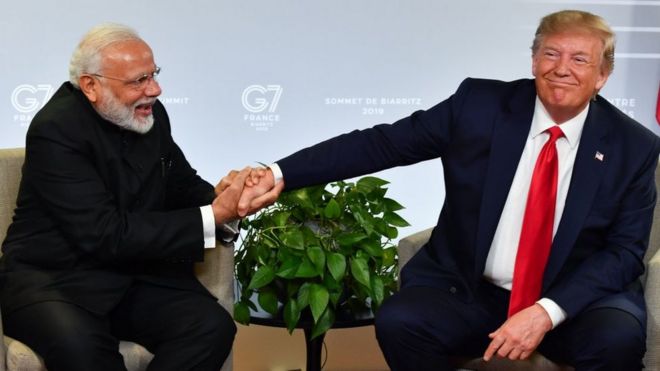
Indian Prime Minister Narendra Modi (L) and US President Donald Trump shakes hands as they speak during a bilateral meeting in Biarritz, south-west France on August 26, 2019.Image copyright GETTY IMAGES
Image caption Mr Trump is making his first official visit to India

US President Donald Trump is expecting a raucous welcome on his first official state visit to India on Monday and Tuesday.

He follows a long line of leaders who have made the journey. Some of his predecessors were greeted enthusiastically; others stumbled through diplomatic gaffes; one even had a village named after him.

Can history be a guide to how this diplomatic tryst might go? Here’s a brief look at past visits, ranked in order of how they went.

The good: President Eisenhower

Let’s begin at the beginning.

Dwight D Eisenhower, the first US president to visit India, was greeted with a 21-gun salute when he landed in the national capital, Delhi, in December 1959. Huge crowds lined the streets to catch a glimpse of the World War Two hero in his open-top car – Mr Trump is expecting a similar reception in Ahmedabad city, where he will be doing a road show.

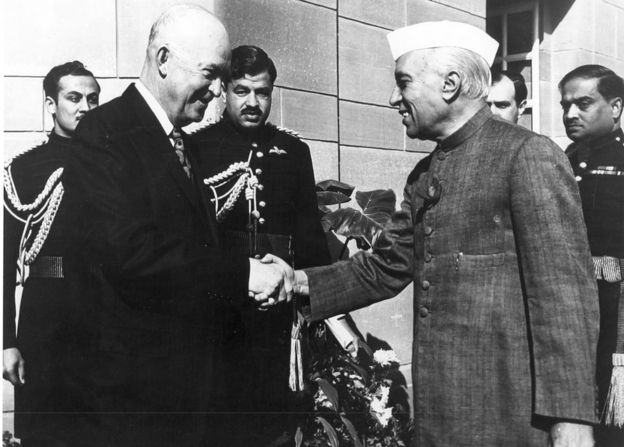
President Eisenhower (L) with Prime Minister Jawaharlal NehruImage copyright US EMBASSY ARCHIVES
Image caption Dwight D Eisenhower, pictured with Prime Minister Jawaharlal Nehru, was the first US president to make the trip

The warmth between President Eisenhower and Indian Prime Minister Jawaharlal Nehru helped during what was a rocky phase in US-India ties. This was early in the Cold war, when the US and Pakistan had become become close allies, and India insisted on staying neutral or “non-aligned”. Like today, relations with China were at the core of the India-US equation, with Washington pressuring Delhi to take an aggressive stance with Beijing on the issue of Tibet.

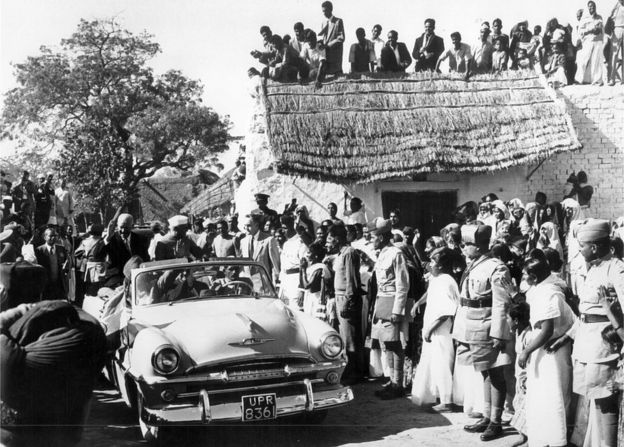
But, on the whole, Eisenhower’s four-day trip was billed a success. And nearly every US president on a state visit to India has emulated his itinerary: he laid flowers at Mahatma Gandhi’s memorial, took in the splendour of the Taj Mahal, addressed parliament and spoke at Delhi’s iconic Ramlila grounds, which, according to one news report, attracted one million people.

When he left, Nehru said he had taken with him “a piece of our heart”.

President Eisenhower drove in open car to small village to get a glimpse of rural India on December 13, 1959.Image copyright US EMBASSY ARCHIVES
Image caption President Eisenhower was greeted by large crowds
Presentational white spaceThe game-changer: Bill Clinton

If there was a game-changing visit, it would be Bill Clinton’s in March 2000 with Prime Minister Atal Bihari Vajpayee. Mr Clinton’s arrival came after a two-decade lull – neither Ronald Reagan nor George Bush Snr made the journey East. It came at a tricky time as Washington had imposed sanctions on Delhi following its 1999 test of a nuclear bomb.

But, according to Navtej Sarna, a former Indian Ambassador to the US, the five-day trip was “a joyous visit”. It included stops in Hyderabad, a southern city that was emerging as a tech hub, and Mumbai, India’s financial capital. “He came and saw the economic and cyber potential of India, and democracy in action,” says Mr Sarna.

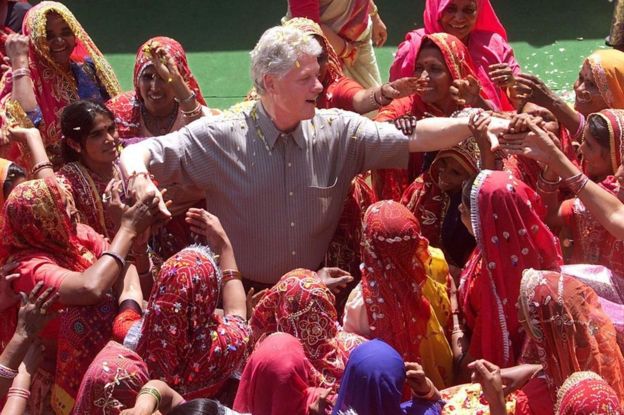
US President Bill Clinton shakes hands with local villagers after touring Nayla Village 23 March 2000.Image copyright GETTY IMAGES
Image caption Bill Clinton’s visit was described as “joyous”
Mr Clinton also danced with villagers, took a tiger safari and sampled Delhi’s famously creamy black dal (lentils) at a luxury hotel that has since been associated with the president.

The country’s reaction is perhaps best expressed in this New York Times headline: “Clinton fever – a delighted India has all the symptoms.”

The nuclear deal: George W Bush

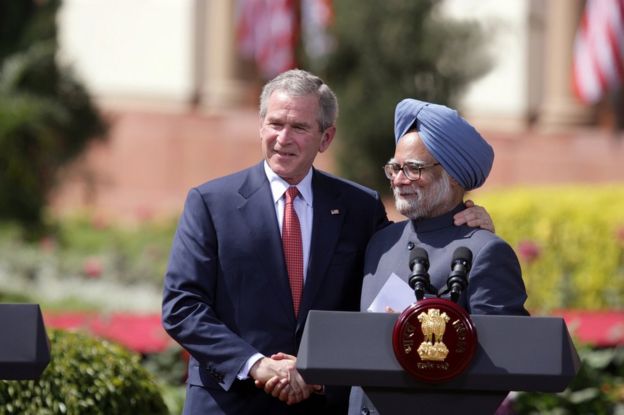
George W Bush, as Forbes magazine once put it, was the “best US president India’s ever had”. His three-day visit in March 2006 was a highlight in the two countries’ strategic relationship – especially in matters of trade and nuclear technology, subjects they have long wrangled over. His strong personal dynamic with Prime Minister Manmohan Singh was hard to miss – after he left office, Mr Bush, a keen artist, even painted a portrait of Mr Singh.

The two leaders are credited for a historic but controversial nuclear deal, which was signed during Mr Bush’s visit. It brought India, which had for decades refused to sign the Nuclear Non-Proliferation Treaty (NPT), out of isolation. Energy-hungry India got access to US civil nuclear technology in exchange for opening its nuclear facilities to inspection.

George W Bush (L) with Manmohan Singh (R)Image copyright US EMBASSY ARCHIVES
Image caption George W Bush and Manmohan Singh had a very good relationship
However, while the visit was substantive, it was not as spectacular as others – there was no trip to the Taj, nor an address to parliament. But the timing was important. Anti-US sentiment over the invasion of Iraq was running high – left-wing MPs had staged a protest against Mr Bush’s visit, and there were demonstrations in other parts of India.

Double visit: Barack Obama

Barack Obama was the only president to make two official visits. First, in 2010 with Prime Minister Manmohan Singh, and then in 2015 with Prime Minister Narendra Modi.

On his first visit – in a break from the past – he landed in Mumbai, instead of Delhi, with a large trade delegation. This was not just about economic ties but a show of solidarity following the Mumbai terror attacks of 2008, which killed 166 people. Mr and Mrs Obama even stayed at the Taj Mahal hotel, one of the main targets.

It was significant that the US president declared support for India to join a reformed and expanded UN Security Council, says Alyssa Ayres, a former US deputy assistant secretary of state for South Asia. “That all these years later nothing has changed in the UN system is another matter, but that was a major policy shift for the United States.”

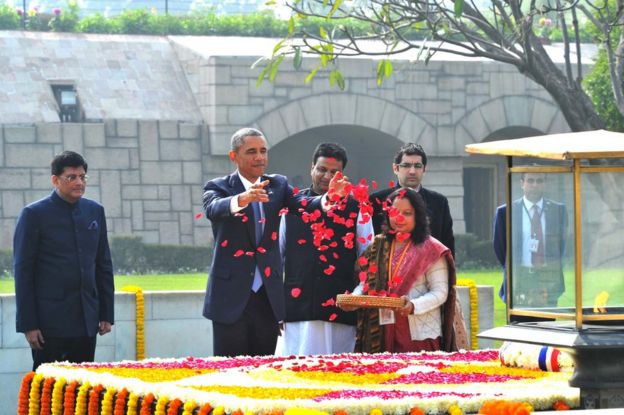
US President Barack Obama paying floral tributes at the samadhi of Mahatma Gandhi at Rajghat in Delhi.Image copyright US EMBASSY ARCHIVES
Image caption Barack Obama visited India twice
Mr Obama returned in 2015 as chief guest at India’s Republic Day celebrations, at PM Modi’s invitation. Trade, defence and climate change were at the heart of the talks. The trip also emphasised an Indo-Pacific strategy, where both leaders expressed unease over Beijing’s provocations in the South China Sea.

The not-so-good: Jimmy Carter

Although Jimmy Carter’s two-day visit in 1978 was a thaw in India-US relations, it was not free of hiccups.

With some 500 reporters in tow, Carter followed a packed itinerary: he met Prime Minister Morarji Desai, addressed a joint session of parliament, went to the Taj Mahal, and dropped by a village just outside Delhi.

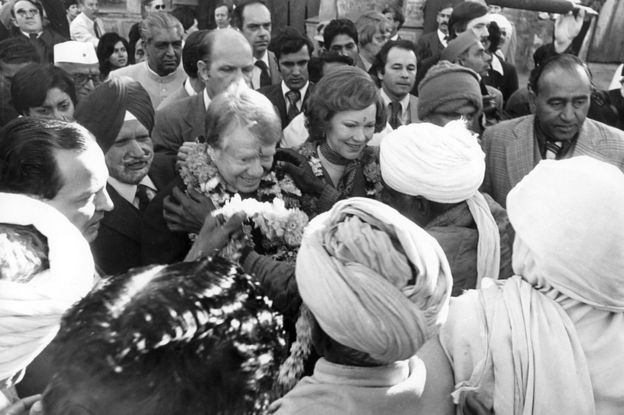
The village, Chuma Kheragaon, had a personal connection: Carter’s mother, Lillian, had visited here when she was in India as a member of the Peace Corps in the late 1960s. So when Carter and his wife, Rosalynn, made the trip, they gave the village money and its first television set. It was even renamed “Carterpuri”, a moniker it still holds.

Jimmy Carter being greeted by villagers of 'Carterpuri'Image copyright US EMBASSY ARCHIVES
Image caption Jimmy Carter being greeted by villagers of ‘Carterpuri’
But beyond the photo-ops, India and the US were sparring. India was building its nuclear programme, and had conducted its first test in 1974. The US wanted India to sign the NPF, which sought to stop the spread of nuclear weapons. But India refused, saying the agreement discriminated against developing countries.

In a leaked conversation that made headlines and threatened to derail the visit, Mr Carter promised his Secretary of State, Cyrus Vance, a “very cold and very blunt” letter to Desai. The two leaders signed a declaration, promising greater global co-operation, but Carter left India without the assurances he had hoped for.

The ugly: Richard Nixon

Richard Nixon was no stranger to India when he arrived in August 1969 for a day-long state visit. He had been here as vice-president in 1953, and before that on personal trips. But, by all accounts, he wasn’t a fan.

“Nixon disliked Indians in general and despised [Prime Minister] Indira Gandhi,” according to Gary Bass, author of Blood Telegram: Nixon, Kissinger and a Forgotten Genocide. And, he adds, the feeling was said to be mutual.

This was also at the height of the Cold War, and India’s non-alignment policy “appalled” American presidents. Mr Bass says that under Gandhi, India’s neutrality had turned into a “noticeably pro-Soviet foreign policy”.

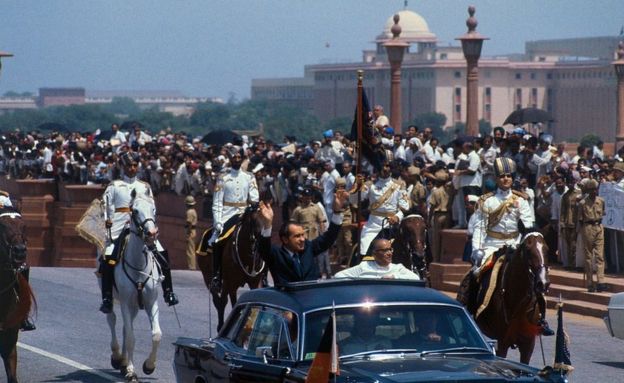
President Richard Nixon waves to crowds as he rides in open car with the acting president of India, Mohammad Hidyatullah, in motorcade from airport upon arrival here July 31.Image copyright GETTY IMAGES
Image caption Richard Nixon waves to the crowds alongside Mohammad Hidyatullah, India’s acting president
The relationship only turned frostier after the trip as India backed Bangladesh (then East Pakistan) in its fight for independence from Pakistan, a close American ally. The differences were laid bare when Gandhi visited the White House in 1971. Declassified state department cables later revealed that Nixon referred to her as an “old witch”.

And the future: Donald Trump

The US and India have certainly had their ups and downs, but during the last official visit in 2015, Mr Obama and Mr Modi signed a declaration of friendship: “Chalein saath saath (Let’s move forward together)…” it began.

President Trump’s visit will take the relationship forward, but it’s unclear how.

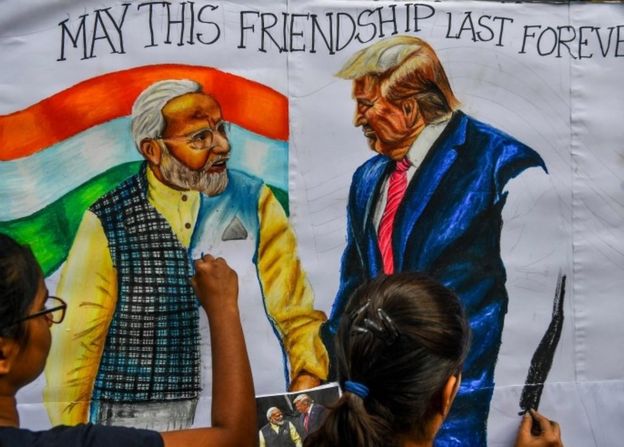
Students paint on canvas faces of US President Donald Trump (R) and India"s Prime Minister Narendra Modi, in the street in Mumbai on February 21, 2020, ahead of the visit of US President in IndiaImage copyright AFP

His arrival in Ahmedabad, the main city in PM Modi’s home state of Gujarat, followed by a big arena event, is expected to draw a massive crowd. It will echo President Eisenhower’s rally in Delhi years ago, perhaps cementing the personal ties between the two leaders.

But while Mr Trump’s trip will be packed with pageantry, it could be light on policy. Unlike other presidential visits, this one is not expected to yield concrete agreements, with the trade deal Mr Trump so badly wants looking unlikely.

Source: The BBC

19/02/2020

Mike Pompeo takes aim at corruption and Chinese investment in Angola

  • US secretary of state is eager to promote US investment as an alternative to China, which holds the lion’s share of Angola’s foreign debt
  • Isabel dos Santos, the former president’s daughter, became Africa’s richest woman but now stands accused of massive fraud
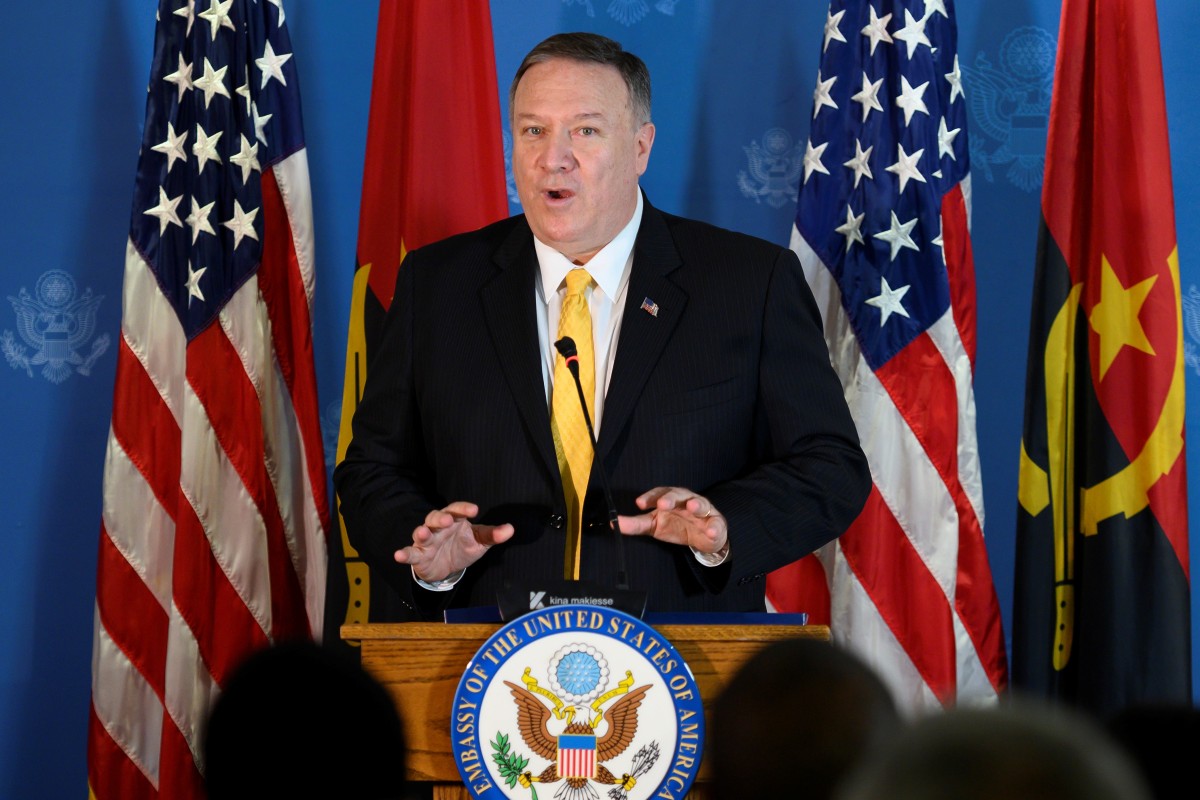
US Secretary of State Mike Pompeo in Luanda, Angola. Photo: Reuters

US Secretary of State Mike Pompeo denounced corruption and touted American business on Monday during the second leg of an African tour in Angola, where the government is seeking to claw back billions of dollars looted from state coffers.

Pompeo is aiming to promote US investment as an alternative to Chinese loans while assuaging concerns over a planned US military withdrawal and the expansion of visa restrictions targeting four African countries.

In Angola’s capital Luanda, Pompeo met with President Joao Lourenco, who took office in 2017 promising wide-ranging economic reforms and a crackdown on the endemic corruption that marked his predecessor Jose Eduardo dos Santos’ four-decade rule.

“Here in Angola, damage from corruption is pretty clear,” he told a group of businessmen following that meeting. “This reform agenda that the president put in place has to stick.”

Here in Angola, damage from corruption is pretty clear Mike Pompeo
Portugal’s public prosecutor has ordered the seizure of bank accounts belonging to

Isabel dos Santos

, the former president’s billionaire daughter, who is a suspect in an Angolan fraud investigation. Reputedly the richest woman in Africa, she has repeatedly denied any wrongdoing.

Angola, with Sub-Saharan Africa’s third-largest economy and its second-largest oil producer is ranked as one of the world’s most corrupt nations, in 165th place on a list of 180 countries, according to anti-corruption group Transparency International.

US oil majors ExxonMobil and Chevron have significant stakes in Angolan oilfields.

Last year, Chevron signed onto a consortium to develop Angola’s natural gas assets alongside Italy’s Eni, France’s Total, BP and Angolan state oil company Sonangol.

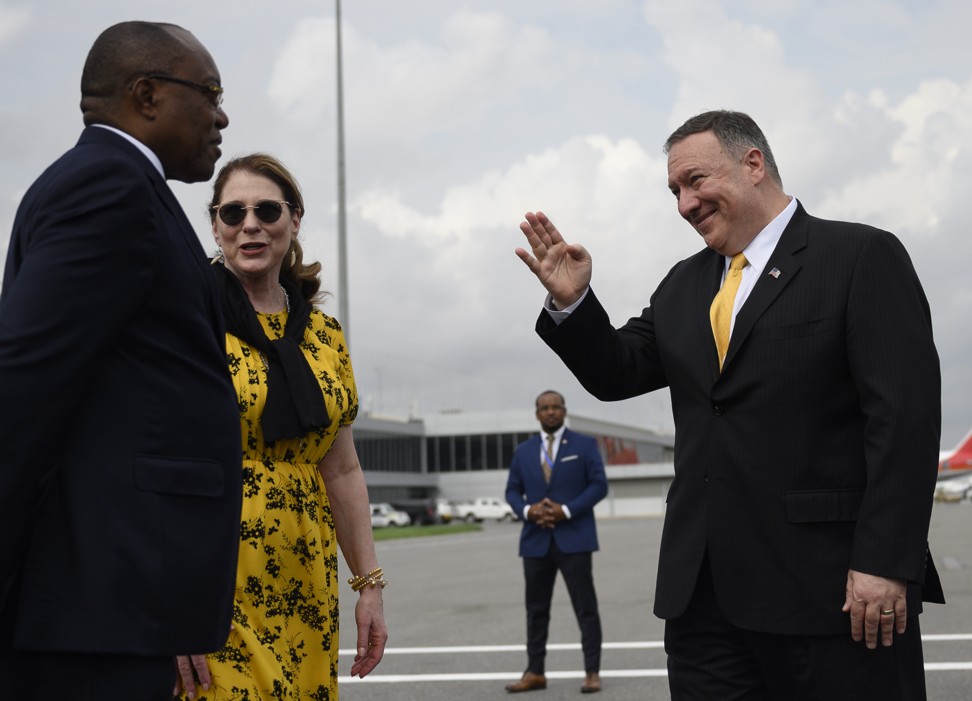
Mike Pompeo and his wife Susan greet Angola Foreign Minister Manuel Domingos Augusto in Luanda on Monday. Pool photo: AFP
“We’ve got a group of energy companies that have put more than US$2 billion in a natural gas project. That will rebound to the benefit of the American businesses for sure, but to the Angolan people for sure as well,” Pompeo said.

Despite US investments, the bulk of Angola’s oil production is destined for China, which holds the lion’s share of Angolan foreign debt.

The Trump administration has accused China of predatory lending in Africa, where Beijing has loaned governments billions of dollars for infrastructure projects in exchange for access to natural resources as part of its Belt and Road project. China rejects the criticism.

With a revamped International Development Finance Corporation and its new Prosper Africa trade and investment strategy, the administration is seeking to combat Chinese influence on the continent.

But the push comes as some governments are questioning US President Donald Trump’s commitment to Africa.

Do Africa’s emerging nations know the secret of China’s economic miracle?

13 Oct 2019

The White House last month tightened visa restrictions on nationals from Sudan, Tanzania, Eritrea and Nigeria.

West African governments are also worried about a proposed US troop withdrawal from the region just as Islamist groups with links to Islamic State and al-Qaeda are gaining ground.

During the first leg of his African trip in Senegal on Sunday, Pompeo sought to put some of those fears to rest.

“We have an obligation to get security right here, in the region. It’s what will permit economic growth, and we’re determined to do that,” he told reporters.

Source: SCMP
13/02/2020

Another wall goes up for Trump, this time in India

AHMEDABAD, India (Reuters) – U.S. President Donald Trump will be shielded from the sight of slums by a newly built wall when he visits the city of Ahmedabad during a visit to India this month.

A senior government said the wall was being built for security reasons, not to conceal the slum district.

But the contractor building it told Reuters the government “did not want the slum to be seen” when Trump passes by on the ride in from Ahmedabad’s airport.

“I’ve been ordered to build a wall as soon as possible, over 150 masons are working round-the-clock to finish the project,” the contractor said, speaking on condition of anonymity.

The government official conceded that the wall was part of a “beautification and cleanliness” drive.

Whatever the reason, the 400-meter-long and seven-feet-high wall will prevent the U.S. leader from getting a glimpse of a slum district that houses an estimated 800 families.

Trump, who has made his pledge to build a wall along the United States’ border with Mexico a feature of his presidency, will visit India on Feb. 24-25 to reaffirm strategic ties that have been buffeted by trade disputes.

He is expected to attend an event dubbed “Kem Chho Trump” (“How are you, Trump”) at a stadium in Ahmedabad along the lines of the “Howdy Modi” extravaganza he hosted for Indian Prime Minister Narendra Modi in Houston last September.

Speaking at the White House on Tuesday, Trump quoted Modi as saying “millions and millions of people” would attend the rally.

The event provides Trump, who was impeached in December, with the opportunity to woo the support of hundreds of thousands of Indian-American voters ahead of the U.S. presidential election in November.

But some slum dwellers whose homes will be cordoned off by the wall in Ahmedabad – the largest city in Modi’s home state of Gujarat – said the government was wasting tax-payer money to hide the poor.

“Poverty and slums are the reality of our life, but Modi’s government wants to hide the poor,” said Parvatbhai Mafabhai, a day worker who has lived there with his family for more than three decades.

Source: Reuters

28/01/2020

UK grants Huawei a limited role in 5G, defying President Trump

LONDON (Reuters) – Prime Minister Boris Johnson on Tuesday granted China’s Huawei a limited role in Britain’s 5G mobile network, resisting U.S. pressure to exclude the company from next generation communications on fears China could use it to steal secrets.

In the biggest test of his post-Brexit foreign policy to date, Johnson ruled that “high-risk vendors” would be allowed into the “non-sensitive” parts of 5G networks, but their involvement would be capped at 35%.

They would be excluded from the sensitive core of networks, where data is processed, and banned from all critical networks and sensitive locations such as nuclear sites and military bases, the government said.

The decision will dismay President Donald Trump’s administration which fears China could use Huawei to steal secrets and which has warned that if London gives Huawei a role then it could scale back intelligence cooperation.

“This is a UK-specific solution for UK-specific reasons and the decision deals with the challenges we face right now,” Communications Secretary Nicky Morgan said following a meeting of the National Security Council chaired by Johnson.

Huawei was not mentioned by name in the British government’s statement, but British cyber security officials said they had always treated the company as a “high risk” vendor.

The White House and U.S. state department did not immediately respond for a request to comment.

Huawei, though, was happy.

“Huawei is reassured by the UK government’s confirmation that we can continue working with our customers to keep the 5G roll-out on track,” said Victor Zhang, Vice-President, Huawei.

“This evidence-based decision will result in a more advanced, more secure and more cost-effective telecoms infrastructure that is fit for the future. It gives the UK access to world-leading technology and ensures a competitive market.”

Sources told Reuters last week senior British officials had proposed granting Huawei a limited role in the 5G network – a “calculated compromise” which could be presented to Washington as a tough restriction but also accepted by British operators already using the company’s equipment.

Huawei, the world’s biggest producer of telecoms equipment, says the United States wants it blocked from Britain’s 5G network because no U.S. company can offer the same range of technology at a competitive price.

The United States has argued that as 5G technology evolves, the distinction between the “edge” and “core” will blur as data is processed throughout the network, making it difficult to contain any security risks.

Huawei’s equipment is already used by Britain’s biggest telecoms companies such as BT (BT.L) and Vodafone (VOD.L), but it has been largely deployed at the “edge” of the network and excluded in the “core” where data is processed.

Source: Reuters

Law of Unintended Consequences

continuously updated blog about China & India

ChiaHou's Book Reviews

continuously updated blog about China & India

What's wrong with the world; and its economy

continuously updated blog about China & India