23/04/2020

Chinese President Xi Jinping, also general secretary of the Communist Party of China Central Committee and chairman of the Central Military Commission, visits Xi’an Jiaotong University in Xi’an, capital of northwest China’s Shaanxi Province, April 22, 2020. Xi on Wednesday inspected the city of Xi’an during his trip to northwest China’s Shaanxi Province. (Xinhua/Ju Peng)
XI’AN, April 23 (Xinhua) — Xi Jinping, general secretary of the Communist Party of China Central Committee, on Wednesday visited an exhibition on the relocation of Jiaotong University from Shanghai to Xi’an and its development and achievements at the Xi’an Jiaotong University museum.
He met with 14 professors, who had been relocated along with the university decades ago
Source: Xinhua
Posted in achievements, decades, development, exhibition, general secretary of the Communist Party of China Central Committee, Jiaotong University, meets, Museum, professors, relocation, Shanghai, Uncategorized, visited, visits, Wednesday, Xi JinPing, Xi'an |
Leave a Comment »
22/04/2020
SEOUL/BEIJING (Reuters) – China has allowed 200 employees from South Korea’s Samsung Electronics Co Ltd (005930.KS) to enter the country to work on an expansion of the firm’s NAND memory chip factory, the company said on Wednesday.
The move came after China said on Tuesday that it was in talks with some countries to establish fast-track procedures to allow travel by business and technical personnel to ensure the smooth operation of global supply chains.
China said it has reached a consensus on such an arrangement with South Korea, without elaborating on the terms, including whether individuals entering China will be subject to quarantine.
China, where the virus first emerged late last year, blocked entry last month for nearly all foreigners in an effort to curb risks of coronavirus infections posed by travellers from overseas. After bringing the local spread under control with tough containment measures, it is trying to restart its economic engines after weeks of near paralysis.
A chartered China Air Ltd (601111.SS) plane flew in the Samsung Electronics employees on Wednesday, a company spokeswoman said.
Samsung said its employees will follow the local government’s policy upon arrival, without elaborating.
Shaanxi province, where Samsung’s NAND memory chip plant is located, requires people travelling from overseas to undergo a 14-day quarantine, according to South Korea’s foreign ministry.
“Samsung employees will not be exempted from the 14-day quarantine rule imposed by the Shaanxi province. They will get coronavirus tests at the airport upon arrival and will be transported to a local hotel designated by Chinese authorities,” an official at the Consulate General of South Korea in Xi’an told Reuters.
Samsung Electronics in December increased investment at its chip factory in China by $8 billion to boost production of NAND flash memory chips.
Source: Reuters
Posted in $8 billion, 14-day quarantine, 200, according, after, Airport, allow, allowed, allows, Arrangement, arrival, Beijing, billion, blocked, boost, bringing, Business, came, chartered, China, China Air Ltd, chinese authorities, chip factory, Company, consensus, Consulate General, containment, control, coronavirus infections, coronavirus tests, countries, Country, curb, December, designated, economic engines, effort, elaborating, emerged, employees, ensure, enter, entering, entry, establish, exempted, expansion, Factory, fast-track, firms, flash memory chips, flew, Foreign Ministry, Foreigners, from, from overseas, global supply chains, including, increased, individuals, Investment, last month, late last year, local governments, local hotel, local spread, located, measures, memory chip, move, NAND, near, nearly, Official, operation, overseas, paralysis, People, personnel, plane, Plant, policy, posed, procedures, production, quarantine, reached, requires, restart, Reuters, Risks, rule, Samsung Elec, Seoul, shaanxi province, smooth, South Korea, South Korea’s, spokeswoman, staff, subject, talks, technical, terms, tough, transported, travel, travellers, travelling, trying, Tuesday, Uncategorized, undergo, upon, Virus, Wednesday, weeks, whether, without, work, Xi'an |
Leave a Comment »
02/04/2020
 Min Yuting (C), a member of the national emergency medical rescue team from Shaanxi Province, weeps at the Shaanxi Provincial People’s Hospital in Xi’an, northwest China’s Shaanxi Province, April 1, 2020. As one of the 43 members of the national emergency medical rescue team from Shaanxi Province, Min and her colleagues finished a 14-day quarantine on Wednesday after their return from virus-hit Hubei. The team, dispatched by Shaanxi Provincial People’s Hospital, has worked in two temporary hospitals together with colleagues from Wuhan City and Henan Province, managed 988 beds and treated 1,235 patients since their arrival in Wuhan on Feb. 4. (Xinhua/Li Yibo)
Source: Xinhua
Posted in 14-day quarantine, finish, Henan opera, hubei province, medics, national emergency medical rescue team, return, shaanxi province, Shaanxi Provincial People's Hospital, two temporary hospitals, Uncategorized, Wuhan, Wuhan city, Xi'an |
Leave a Comment »
24/03/2020
- ‘Aggressive and targeted’ tactics needed to curb spread of Covid-19 as more than 100,000 new infections recorded in just four days
- Global political commitment and coordination needed to halt trajectory, agency chief says
A customs officer speaks to passengers on board an inbound flight at Beijing Capital International Airport. Photo: Xinhua
The
World Health Organisation has warned that the
Covid-19 pandemic is accelerating, calling for “aggressive and targeted tactics” to curb its spread after more than 100,000 new infections were recorded in just four days.
The warning, by the UN agency chief Tedros Adhanom Ghebreyesus, came as the number of deaths from the disease, caused by the new coronavirus, continued to rise, and as mainland China reported a doubling in new cases.
The outbreak, which was first reported in December in China, is rapidly spreading across the globe. Tedros said it had taken 67 days from the first reported case to the first 100,000 infections, and just 11 days for the number to soar to the second 100,000.
“[It was] just four days for the third 100,000 cases. You can see how the virus is accelerating,” he said on Tuesday.
“But we’re not prisoners to statistics. We’re not helpless bystanders. We can change the trajectory of this pandemic.”
China’s National Health Commission reported 74 imported coronavirus infections on Monday – the highest since March 4, when it began including data on such cases and noted two infections that had originated abroad.
They bring the total number of imported cases on the mainland to 427, as of Monday. The total number of infections there now stands at 81,171, and the death toll has risen to 3,277, with seven new fatalities.
Tedros said political commitment and coordination at the global level were needed to stop the spread, but warned against using untested medicines, saying they could raise false hope.
“To win, we need to attack the virus with aggressive and targeted tactics – testing every suspected case, isolating and caring for every confirmed case, and tracing and quarantining every close contact,” he said.
Italy’s number of new Covid-19 cases dropped to a five-day low on Monday, easing the strain on overstretched hospitals, but the situation in Spain continued to worsen.
Italian health authorities announced 4,789 new cases on Monday, a drop from 5,560 on Sunday and 6,557 on Saturday. Spanish authorities announced 462 deaths on Monday, the country’s worst day since the start of the epidemic.
Italy has a glimpse of hope as new coronavirus cases drop to a 5-day low
The British government said on Monday that another 54 people had died in the previous 24 hours after testing positive for the coronavirus, raising the country’s deaths from the pandemic to 335. The number of confirmed cases in Britain rose to 6,650 on Monday, from 5,683 on Sunday.
Mainland China officials have said the risk facing the nation was to contain imported infections. Among the new imported infections, 31 were recorded in Beijing, 14 in Guangdong and nine in Shanghai.
Beijing has stepped up measures to contain imported infections, diverting all arriving international flights from Monday to other cities, including Shanghai and as far west as Xian, where passengers will undergo virus screening.
Guangzhou also requires all travellers to the city, except for those from Hong Kong, Macau and Taiwan, to undergo the coronavirus test. Beijing has required the test for incoming travellers with symptoms and epidemic history.
The coastal province of Zhejiang, near Shanghai, will also put all arrivals from overseas in centralised quarantine facilities for 14 days, according to media reports.
Source: SCMP
Posted in across, aggressive tactics, Beijing, Beijing Capital International Airport, Britain, British government, calls, chief, China’s National Health Commission, coronavirus cases, coronavirus test, COVID-19, Covid-19 pandemic, customs officer, death toll, doubling, facilities, fatalities, Guangdong, Hong Kong, inbound flight, Italian health authorities, Italy’s, Macau, mainland, Mainland China, outbreak, passengers, quarantine, Shanghai, soar, Spain, Taiwan, the world, Uncategorized, WHO, World Health Organisation, Xi'an, Zhejiang |
Leave a Comment »
01/03/2020
- Materials can bought cheaply online and combined to filter out germs, while people exchange tips in online chat groups
- Urgent demand has forced individuals and hospitals alike to get to work to meet the shortfall
A worker in northern China makes a face mask as companies strive to match demand – but some people are buying similar materials to assemble at home. Photo: Xinhua
Living in the scenic Puer city in southwestern China’s Yunnan province, 30-year-old Zhang Jianing had thought the
coronavirus outbreak in Hubei was far away and irrelevant, until cases were confirmed in her province and then her city at the end of January.
Heeding the warnings to protect herself, Zhang rushed out to buy masks, only to find them all snapped up. When she plucked up the courage to go out to buy groceries, she realised she needed to have a mask on to be allowed to enter shops.
After doing some research online, Zhang made a mask herself: two layers of cotton on the outside, with a sheet of plastic food wrap inside.
“The mask fit my face well and protected me from droplets,” Zhang said. “There was just one thing: it was too difficult to breathe through.”
Experts devise do-it-yourself face masks to help people battle coronavirus
When a nation of 1.4 billion people was suddenly alerted and in many cases ordered to wear masks not only in public indoor places but also in the open air, the huge demand quickly exhausted supply.
Mask production capacity in China was 22 million a day – insufficient for the country’s population. There were hopes that the supply of masks would pick up after a Lunar New Year holiday that was extended to help prevent further spread of infection, but things did not look promising after factories reopened. By Monday, despite mask manufacturers making 10 per cent more than in early February, masks remained a rare commodity.
Making DIY masks became the top trending topic on Chinese online shopping site Taobao for several days. Materials became much sought-after, from nose bars to the non-woven fabric used in disposable surgical masks to filter out viral droplets. An online shop based in Fujian, southeast China, said it had sold more than 5,500 packages of DIY mask materials that can make 50 to 200 surgical masks apiece.
Surgical masks ‘protect more from germs on fingers than viruses in the air’
Zhang spent 200 yuan (US$29) on materials online, from which she made 60 surgical masks when they arrived last week. She is a qipao designer and has a sewing machine at home. The outer layer was a blue waterproof non-woven fabric, over a layer of melt-blown fabric that can filter out most germs and droplets. The inner layer was made with a face flannel.
Hongkongers make reusable fabric masks as Covid-19 epidemic leads to shortages and sky-high prices
“I sent some to my parents and relatives,” Zhang said. “I am not sure how protective they are, but the good thing is our city hasn’t had any new cases for a long time.”
DIY mask production is being taken very seriously, spawning online chat groups to discuss reliability of materials and disinfection methods as people try to make theirs as safe and professional as possible.
Alex Zhang, an office worker in Shanghai, donated her N95 masks to Wuhan, the epicentre of the coronavirus outbreak, when hospitals in the city appealed to the public for protective gear amid an acute shortage – but soon found herself short of masks herself.
Shanghai companies begin production of first reusable face masks
The Shanghai government allowed households to buy a certain number of surgical masks, but it was not enough for her family. Taking apart an N95 mask to see what it was made of, she felt assembling the layers of fabric required no special technique, and decided to do it herself.
Zhang spent 45 yuan on two square metres of melt-blown fabric to stop viruses, and sandwiched it with two layers of nonwoven fabric and an air pad. She sewed the layers together and put them in an electric oven at 70 degrees Celsius (158 Fahrenheit) for a minute, for disinfection. The finished mask is attached using a plastic band.
“Each mask cost about 3 yuan [43 US cents] and was almost like an N95 filter,” Zhang said. “I didn’t find it difficult. I am quite satisfied with my masks and feel very safe to wear them in crowded places.”
How to properly remove and discard face masks to reduce the risk of infection
She later bought nursing pads, which are already disinfected, to replace the layer closest to the face.
DIY masks have also been used where large amounts of protective gear are needed. Garment manufacturer Shenzhou International, in the coastal Zhejiang province, assigned 100 staff to make masks with melt-blown non-woven fabric to meet the needs of its factory workforce of nearly 15,000, who needed two masks each per day, according to a report by Ningbo Daily.
Hospitals short of masks have mobilised nurses to make their own using a non-woven fabric used to wrap disinfected medical products. At least three hospitals, in Xian in central China and in Jinhua, Zhejiang, have tried making masks for medical staff not serving on the front line, according to media reports.
DIY handmade face masks in Hong Kong
The World Health Organisation has said that wearing masks alone is not sufficient protection against the coronavirus, and should be combined with precautions including hand-washing with soap or an alcohol-based hand rub.
However, facing a shortage that will not end any time soon, health authorities have changed from saying people should discard masks every four hours to advising recycling them when possible.
A guideline issued by the National Health Commission said healthy people could wear masks repeatedly and for a longer time.
Chinese driver wears 12 face masks amid coronavirus outbreak
“Masks for repeat use can be hung in clean, dry and airy places or put in a clean paper bag,” its guidelines said. “The masks must be placed separately to avoid contact with other masks.”
Making masks with layers of cotton bandage is acceptable, because they can stay dry when breathed on, but plastic wrap is not recommended, because it blocks the ability to breathe entirely, according to Cai Haodong, an infectious diseases specialist at Beijing’s Ditan Hospital.
Coronavirus: Thais urged to make their own masks, sanitisers due to shortage
Cai said her hospital did not have surgical masks, nor N95s, during the severe acute respiratory syndrome (Sars) outbreak in 2003, and hospital staff made masks for use by front-line medics, disinfecting them with boiling water and drying them in the sun.
“The key is to keep the mask dry,” Cai said. “Self-made masks offer some degree of protection and it is better to wear them than nothing.”
Source: SCMP
Posted in alcohol-based hand rub, Beijing’s Ditan Hospital, China’s, coronavirus, coronavirus outbreak, COVID-19 epidemic, epicentre, face mask, Fujian, hand-washing, hubei province, inspired, Jinhua, Lunar New Year holiday, materials, National Health Commission, Ningbo Daily, People, qipao designer, sewing machine, Shanghai, shortage, soap, Thais, to learn, to make, Uncategorized, World Health Organisation, Wuhan, Xi'an, Yunnan Province, Zhejiang, zhejiang province |
Leave a Comment »
09/12/2019
XI’AN, Dec. 8 (Xinhua) — In the winter drizzle, a white control line model plane climbs, dives and turns. The flyer, Huang Jinquan, 11, has just won his first national title in August with a dazzling aerobatic performance.
Not keen to talk, the introverted champion prefers to show his passion with the two lines in his hands.
Jinquan is a student of Redian Primary School in the eastern suburbs of Xi’an, northwest China. More than 70 percent of the students at this school come from rural areas and have been taken to cities by their parents, who are migrant workers striving for a better life. Many, like Huang, lack a companion as their parents are usually busy with work, and model planes are too expensive for them.
Headmaster Han Baoan had a chance to receive flying training in 1983 when he first came to work in Redian. Since then he has been trying his best to help his students fly.
“We may not have enough money, but nothing can deprive us of passion for the sport,” he says.
The school managed to establish a model airplane club in 2012. The sport became more popular among Redian students when it was included in the program of the 2017 Chinese National Games. Now the club has 20 members and has won the national championships in two years in a row.
“Model planes are expensive. Many beginners in the more developed coastal provinces can afford serious competition models. They can buy new ones when they crash the models,” says Han. “We don’t have enough funding. Neither can we charge our students in the club. All we can do is to train harder than other teams.”
“But still, I’d like to help these children fly further and higher in their life,” Han says.
Han and other teachers bought components and made model planes themselves. They teach students take-off and landing and later flying stunts.
“A good flyer needs to practice for thousands of hours. For example, Huang has to finish more than 10 training sessions every week in order to better master the skills,” says Han.
The club renewed an air-raid shelter under the classroom building to store and fix models.
“We can fix up some small problems of the model airplanes such as a broken propeller or a broken landing gear,” says Jin Yuwei, who partnered Huang to snatch the first place of the Chinese Teenagers’ Model Airplane Competition.
The title was hard-earned. In the 2017 national competition, her plane accidentally crashed into Huang’s. The then eight-year-old girl burst into tears. After the failure, she trained even harder and now she can operate the plane better.
“I love the sport and my parents are all supportive. Since I began playing model planes I seldom play computer games or get up late at the weekend. The sport helps me to develop good habits,” Jin says.
Flying model airplanes also means more opportunities for these students. To promote the sport, the city government has launched a project in which schools like Redian can share local top schools’ funding and other resources on extra-curricular activities.
Jinquan’s sister Jinxia, who snatched the club’s first national title in 2018, was also recommended to study in one of the top middle schools in Xi’an.
Jinquan says he just wants to keep playing model airplanes, without elaborating on his future plan.
Source: Xinhua
Posted in children, dream, fly high, migrant, migrant workers, model plane, Uncategorized, Xi'an |
Leave a Comment »
16/10/2019
Chinese Premier Li Keqiang, also a member of the Standing Committee of the Political Bureau of the Communist Party of China (CPC) Central Committee, visits a startup community in Xi’an, capital of northwest China’s Shaanxi Province, Oct. 15, 2019. Li made an inspection tour in the cities of Xi’an and Xianyang in northwest China’s Shaanxi Province from Monday to Tuesday. (Xinhua/Pang Xinglei)
XI’AN, Oct. 15 (Xinhua) — Chinese Premier Li Keqiang has stressed deepening reform and opening-up to facilitate steady economic growth and continuously improve people’s livelihood.
Li, also a member of the Standing Committee of the Political Bureau of the Communist Party of China (CPC) Central Committee, made the remarks during his inspection tour in the cities of Xi’an and Xianyang in northwest China’s Shaanxi Province from Monday to Tuesday.
In his visit to a community in Xi’an, Li stressed that the renovation of old residential communities can improve the livelihood of people, especially those with financial difficulties, and is conducive to boosting effective investment and consumption.
In this regard, Li called for efforts to upgrade community facilities and enhance public services such as elderly care and childcare.
When visiting a restaurant, Li said measures should be taken to guarantee the supply of pork and stabilize vegetable prices to ensure the basic livelihood of those facing difficulties. He also urged the implementation of policies of cutting taxes and fees for private businesses.
The country will make unswerving efforts to open up wider, give equal treatment to both domestic and overseas businesses registered in China, continuously improve the business environment, and intensify the protection of intellectual property rights, said the premier during his visit to Samsung China Semiconductor Co., Ltd.
Commenting on the great development potential of China’s western regions, Li urged greater efforts to create a good business environment, pledging more targeted policy support.
At the construction site of the Yinchuan-Xi’an high-speed railway, the premier underscored the acceleration of key infrastructure projects in west China and encouraged effective investment in spurring development and improving people’s livelihood.
Li, while visiting a startup community, urged efforts to improve the business environment for entrepreneurship and innovation.
Source: Xinhua
Posted in childcare, Chinese premier Li Keqiang, construction site, cutting taxes and fees, deepening reform, Economic growth, Elderly care, facilitate, key infrastructure projects, opening up, people's livelihood, private businesses, Public services, Restaurant, Samsung China Semiconductor Co., Ltd, shaanxi province, stabilize vegetable prices, Standing Committee of the Political Bureau of the Communist Party of China (CPC) Central Committee, supply of pork, Uncategorized, west China, Xi'an, Xianyang, Yinchuan-Xi'an high-speed railway |
Leave a Comment »
14/08/2019
- New facility is designed to help scientists study particles that help deflect cosmic rays in the high atmosphere
- Despite scepticism among some scientists, those familiar with the project insist radar will have a range about 10 times greater than existing ones
When completed the new laser radar will be used to study the high atmosphere. Photo: Handout
China has started building the world’s most powerful laser radar designed to study the physics of the Earth’s high atmosphere, according to state media reports and scientists informed of the project.
It is described as having a detection range of 1,000km (600 miles) – 10 times that of existing lasers – and will be used to study atmospheric particles that form the planet’s first line of defence against hostile elements from outer space such as cosmic rays and solar winds.
The facility, to be built on a site that remains classified, is expected to be up and running within four years and will form part of an ambitious project to reduce the risk from abnormal solar activities.
The radar will use a high-energy laser beam that can pierce through clouds, bypass the International Space Station and reach the outskirts of the atmosphere, beyond the orbiting height of most Earth observation satellites.
Lasers help tell ghostly story of doomed Nazi submarine U-576 and its entombed crew
There, the air becomes so thin that scientists will be able to count the number of gas atoms found within a radius of several metres.
These high-altitude observations could greatly expand our knowledge of a part of the atmosphere that has been little studied because the distances involved mean no one has been able to make direct observations from the ground.
“The large-calibre laser radar array will achieve the first detection of atmospheric density of up to 1,000km in human history,” said a statement posted on the website of the Chinese Academy of Sciences on Tuesday, a day after the launch of the project.
But the claim has been greeted with some scepticism in the scientific world.
“I think the 1,000km is a misprint!” professor Geraint Vaughan, director of observations at the National Centre for Atmospheric Science in the UK, replied when asked about the project.
Vaughan, who is also a Fellow of the Royal Meteorological Society, said that while he thought the Chinese announcement was “very interesting”, it did not seem possible with existing technology.
At present, the effective range of atmospheric lasers is about 100 kilometres.
Some other senior scientists in China and overseas also expressed doubt about the project, although they requested anonymity due to the sensitivity of the issue.
US warns airmen to beware of laser attacks near China’s military base in Djibouti
“There are other approaches, such as launching a satellite. Building such a huge, expensive machine on the ground does not make sense,” said a Beijing-based laser scientist.
But several researchers told the South China Morning Post that the project did exist, and insisted that 1,000km range was not a mistake.
Hua Dengxin, a professor at Xian University of Technology and a lead scientist in China’s laser radar development programmes, said: “I have heard of the project, yes. But I cannot speak about it.”
Powerful telescopes will pick up the signals reflected back to earth. Photo: Handout
According to publicly available information, the facility will use several large optical telescopes to pick up the faint signals reflected by the high-altitude atoms when the laser is fired at them.
The project is part of the Meridian Space Weather Monitoring Project, an ambitious programme that started in 2008 to build one of the largest, most advanced observation networks on Earth to monitor and forecast solar activities.
By 2025 Meridian stations containing some of the world’s most powerful radar systems will be established across the world – with facilities in Arctic and Antarctic, South China Sea, the Gobi desert, the Middle East, Central Asia and South America.
China in race for counter-drone tech and laser weapons as it tries to catch up with US
The purpose of the Meridian project, according to the Chinese government, is to reduce the risk abnormal solar activities pose to a wide range of Chinese assets including super-high voltage power grids, wireless communication, satellite constellations, space stations or even a future base on the Moon.
Chinese laser scientists have developed some of the world’s most sophisticated systems in recent years, including ranging stations that can track the movement of satellites and space debris, which the Pentagon has claimed have temporarily blinded some American scientists.
Last year researchers based in Xian, the capital of Shaanxi province, announced that they had developed a “ laser AK-47” that could set fire to target from a distance of 800 metres.
The Chinese government is also funding the development of a laser satellite that can penetrate seawater to a depth of 500 metres from space to detect the waves generated by submarines.
The use of such a powerful laser raises concerns that passing objects such as planes, satellites or spacecraft – to say nothing of birds – may be at risk from its beams.
But Professor Qiao Yanli, engineer in chief at the Anhui Institute of Optics and Fine Mechanics, part of the Chinese Academy of Sciences, said there was an “extremely low” risk of this happening.
“The sky is enormous. Getting hit by a tiny beam is almost impossible,” he said.
Some much smaller laser radars, such as those installed in auto-driving test vehicles, have reportedly damaged digital cameras by burning a few pixels on sensor.
But spacecraft such as earth observation satellites, according to Qiao, usually have some protection mechanisms, such as a warning system, to avoid permanent damage caused by an accidental laser hit.
‘Laser AK-47’? Chinese developer answers sceptics with videos of gun being tested
Professor Li Yuqiang, a researcher at the Yunnan Observatories in Kunming, whose team has measured the distance between the Earth and the Moon by shooting lasers at a reflector placed on the lunar surface during the US Apollo 15 mission, said detecting atom-sized targets on the fringes of the atmosphere posed many technical challenges.
“The number of photons [particles of light] reflected by the sparse gas particles will be very small. Even if they can be picked up by large telescopes on the ground, the analysis will require some very good algorithms to separate the useful signals from the noise,” Li said.
“How that can be achieved is beyond the scope of my knowledge.”
Source: SCMP
Posted in algorithms, Anhui Institute of Optics and Fine Mechanics, Antarctica, Arctic, Building, Central Asia, China alert, Chinese Academy of Sciences, Djibouti, Earth's solar shield, Gobi Desert, high atmosphere, International Space Station, Kunming, Meridian Space Weather Monitoring Project, Middle East, Moon, National Centre for Atmospheric Science, Nazi submarine, Pentagon, physics, powerful laser radar, Royal Meteorological Society, shaanxi province, south china morning post, South China Sea, study, Uncategorized, Xi'an, Xian University of Technology, Yunnan Observatories |
Leave a Comment »
05/07/2019
- Civil affairs ministry reaffirms plan to eradicate names that ‘violate the core values of socialism, damage national confidence’
- One man says it reminds him of the dark days of the Cultural Revolution
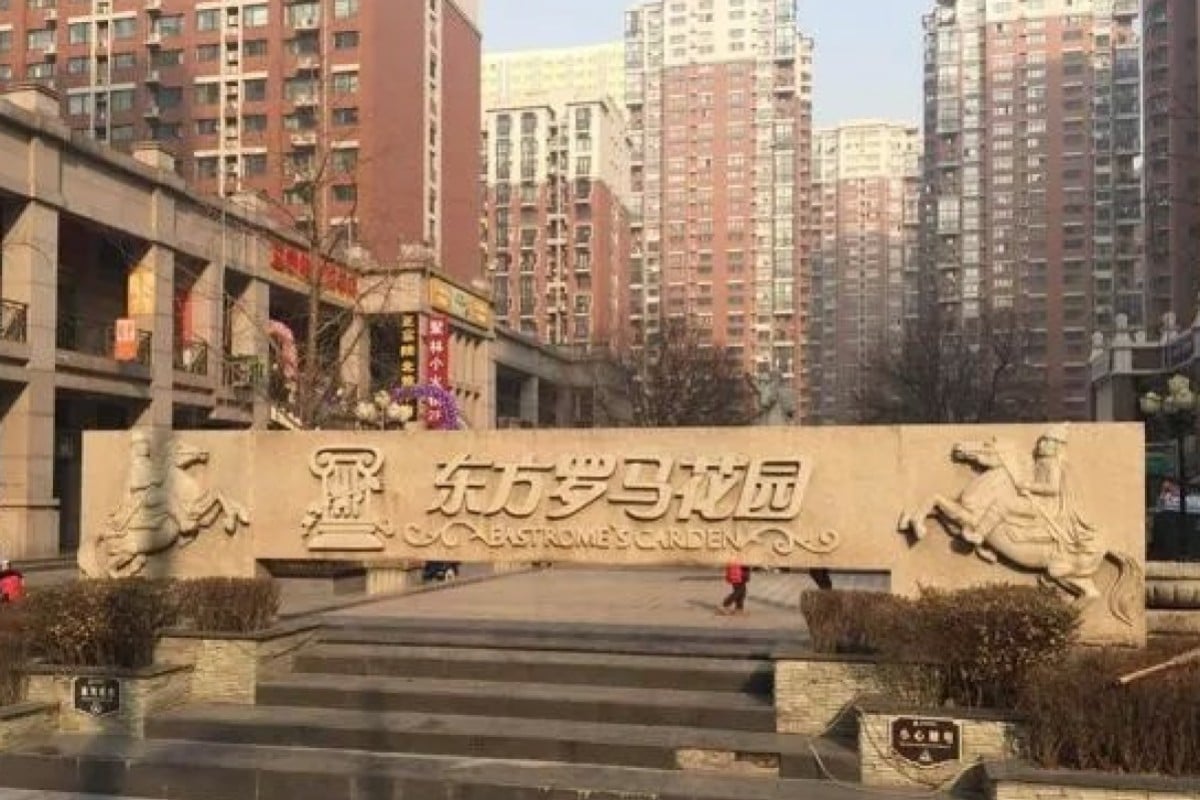
Beijing wants to eradicate place and property names, like “East Rome’s Garden”, that are influenced by foreign or “weird” words. Photo: Weibo
Beijing has reiterated its commitment to rid Chinese cities of “big, foreign and weird” property and place names, sparking a backlash from the public.
The campaign began last year when six government departments introduced a joint policy requiring provincial and county authorities to identify all such properties within their jurisdictions and rename them by the end of March.
On Friday, the Ministry of Civil Affairs reaffirmed its support for the plan, but reminded local governments to implement it “prudently and appropriately”.
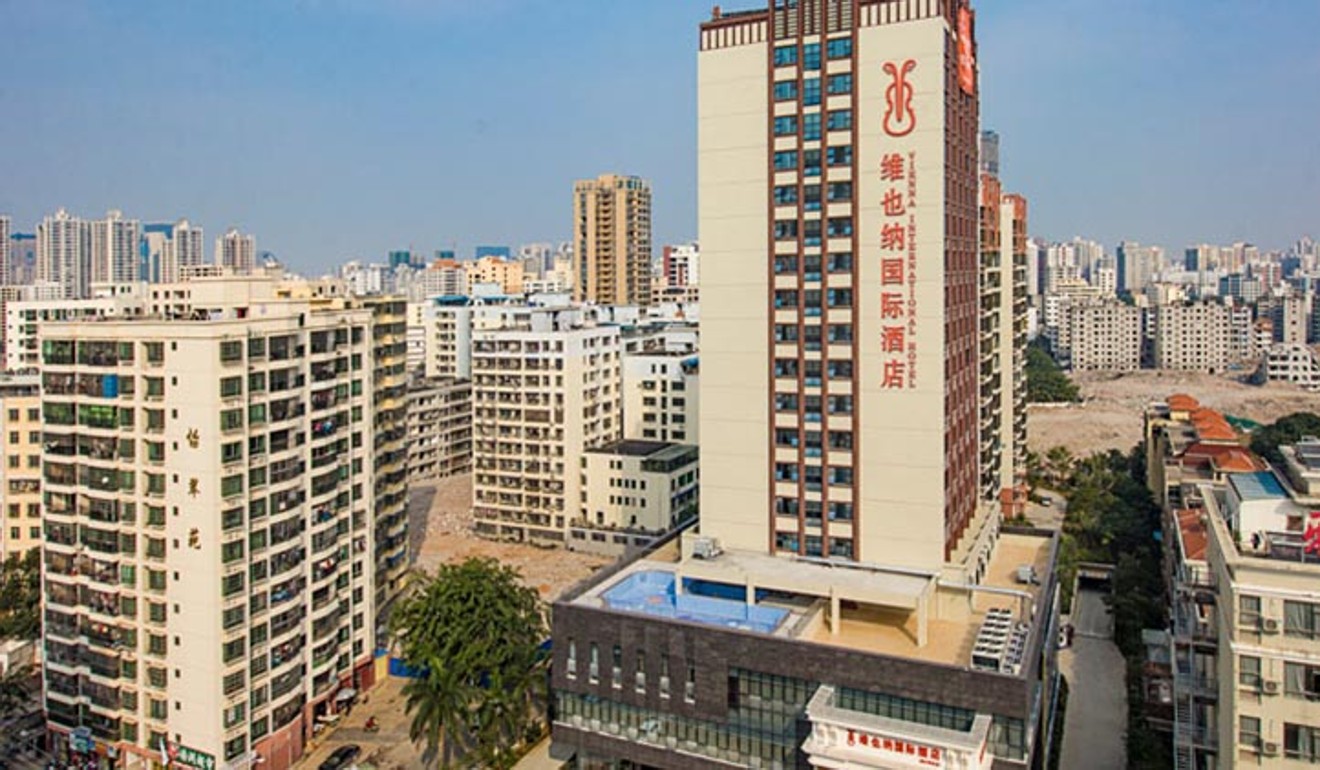
Many Chinese properties, especially hotels and apartment buildings, incorporate famous foreign places, like Manhattan, California or Paris, into their names, but under the new rule they all have to go. According to a report by local newspaper Sanqin Metropolis Daily, in one city in Xian, the capital of Shaanxi province, at least 98 apartment projects, hotels, townships, communities and office towers need to be rebranded.
Many Chinese properties, like the Vienna International Hotel, incorporate famous foreign places into their names. Photo: Weibo
But for some people, the plan is nothing more than a waste of time and money.
“If projects are forced to change their names, what about the name on the property certificate, the enterprise licence and tax registration? Do they have to be changed too?” asked Zhu Yun, a woman who lives in Guangzhou, the capital of south China’s Guangdong province.
Hospital’s plan for ‘lucky’ Harvard babies gets poor marks
“And what’s the standard for the new names, and who’s going to do the renaming? It’s just a waste of people’s energy and money, and will do nothing for the national culture or confidence.”
Zhu Min, an octogenarian who also lives in Guangdong, said the scheme had echoes of a darker time in China’s history.
“It reminds me of the bad times of the Cultural Revolution,” he said. “At that time, a great number of streets, roads and stores were forced to rename, because they contained elements of old customs and old culture.”
The debate has also been raging online, with tens of thousands of people airing their views on social media.
“Cultural and national confidence is about respect for multiculturalism,” one person wrote on Weibo, China’s Twitter-like platform.
Tsinghua University sues kindergartens for using its name
Despite the outcry, the civil affairs ministry said the implementation of the scheme was “an important measure … to carry forward the national and local culture”, Xinhua reported.
“The relevant regulations and guidelines of the campaign should be strictly observed to prevent the campaign from being expanded in an arbitrary manner,” it said.
The plan announced last year stated that “big, foreign, weird” place names and those based on homonyms “violate the core values of socialism, damage national confidence, and affect the production and lives of the people, and must be rectified and cleaned up”.
Source: SCMP
Posted in Beijing, big, foreign and weird, California, China still committed, Cultural Revolution, East Rome’s Garden, getting rid of, guangdong province, Guangzhou, Manhattan, Ministry of Civil Affairs, Paris, place names, Sanqin Metropolis Daily, shaanxi province, Tsinghua University, Uncategorized, Vienna International Hotel, Weibo, Xi'an |
Leave a Comment »
04/07/2019
- China’s talent is turning away from multinationals and towards domestic tech champions in the search for a more fulfilling career
- Change in sentiment comes amid raging US-China tech war and perceptions of ‘bamboo ceiling’ in the West
An increasing number of Chinese jobseekers are looking towards domestic tech firms. Image: SCMP
Molly Liu left her hometown Beijing to pursue a master’s degree in the United States in the 1990s.
After graduation, she fought hard to win an entry-level position at a US-based consultancy and after a period was later sent back to China to help the company’s expansion.
In the land of opportunity, the ambitious US firm showered her with avenues to pursue her career and she ended up working in Hong Kong as well as being one of the first people on the ground for the consultancy in Shanghai, Beijing, Taipei and Singapore.
Times have changed, though. Recently, her only son, Ben Zhang, turned down a hard-to-get job offer from a Boeing subsidiary in the US after gaining a master’s degree in computer science from Carnegie Mellon University in Pittsburgh, Pennsylvania.
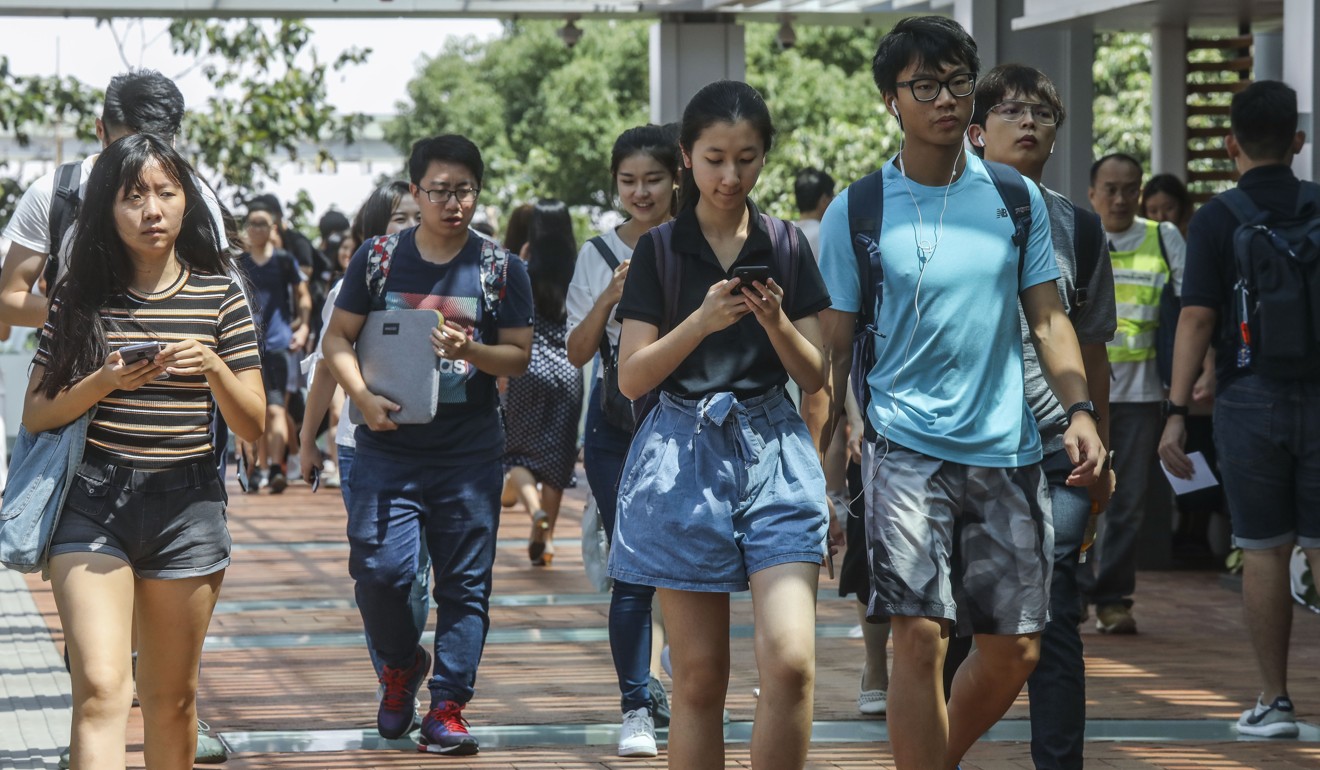
Chinese students educated in the US are now looking more at jobs in China. Photo: SCMP
He decided to return to Beijing in 2018 and now works as a product manager at Chinese smartphone maker Xiaomi. He is convinced that the start-up turned tech major can offer him the same sort of opportunities today that the US tech consultancy offered his mother in the 1990s.
This family story about the career choices of two different generations of US-educated Chinese students reflects a wider trend. Once upon a time, US corporations could cherry-pick top Chinese talent from American universities with the promise of large salaries, generous benefits and the chance to work at market-leading organisations.
Today, China’s cutting-edge technology companies – often referred to as China Tech Corporation (CTC) – are the most sought-after employers among many Chinese students, who want more than just a cushy life.
This marks another blow for multinational corporations (MNCs) already struggling to do business in China amid a myriad of restrictions and growing hostility towards them as the US-China trade and tech war gathers pace.
“What I look for in a job is not money. My parents are not counting on me to support them,” says 28-year-old Zhang, whose team in Xiaomi is working on a wide array of connected devices, from televisions to lamps to smart locks. “What I care about most is personal improvement and access to the best resources a company can offer.”
“In Boeing, I could probably work on a new product once every two to three years. But at Xiaomi, every three months, we can roll out a new product,” he added. “You can bring so many things into people’s everyday lives in China, like using your voice to control a TV or an air conditioner – things you can only imagine in the US.”
Zhang is not alone and many Chinese today perceive a “bamboo ceiling” in the US, where they are more often seen as engineers rather than executives.
One Chinese executive who now oversees the technology unit of a listed finance and insurance firm in China said that he used to lead a team of 20 engineers at one of the world’s most valuable tech companies in Silicon Valley.
“My job was to keep optimising the performance of a product [in Silicon Valley],” he said.
“But within three years in China, I was promoted to the chief scientist of our entire company, leading a team of 1,000,” said the man, who asked to remain anonymous as some of his family still reside in the US.
How Trump’s assault on Huawei is forcing the world to contemplate a digital iron curtain
According to an April survey by professional networking site LinkedIn, an increasing number of Chinese jobseekers share Zhang’s outlook. LinkedIn compiled a list of the top 25 most desired employers in China, and about 60 per cent were local Chinese companies, with 13 of them internet firms.
CTC bagged four of the top five spots, with e-commerce giant Alibaba, search giant operator Baidu and Bytedance – which operates short video hit TikTok – taking the lead.
Tesla ranked sixth behind its Chinese challenger Nio. Amazon, the only other foreign company in the top ten, ranked eighth.
Alibaba is the owner of the South China Morning Post.
Li Qiang, executive vice-president of Zhaopin, one of China’s largest online recruiters, described the rising status of CTC among jobseekers as “the dawning of a new era”.
“Nowadays, there is nothing a multinational can offer that a domestic firm cannot, be it a compensation package or the chance to be part of international expansion,” said Beijing-based Li.
“Jobseekers are not particularly looking for domestic firms or multinational firms. They are after good firms and most of the good firms in China these days happen to be domestic tech firms,” said Li.
Li’s comments reflect the wider opportunities within the domestic economy for Chinese jobseekers today, after the rise of many successful private-sector companies and a thriving start-up scene over the past 10 years, meaning it’s not just a one-way street to a state-owned enterprise (SOE) any longer.
A survey by Zhaopin in late 2018 found that 28 per cent of Chinese university students said MNCs were their employer of choice, down from 33.6 per cent in 2017.
Even on pay and benefits, CTC is catching up with multinationals. Zhang said Xiaomi matched the offer from the Boeing unit in the US and many leading tech firms offer benefits such as gym memberships and childcare facilities.
And the rags-to-riches stories of many leading China tech entrepreneurs, some of whom have become billionaires, continue to grab media attention and inspire the younger generation.
To be sure, Chinese students would still rather work for an MNC than an SOE – but the rise of CTC can be seen in company rankings and in the total number of CTC companies in the top employer list, according to Zhaopin.
For a growing number of Chinese students, the doors to America are closing
William Wu, China country manager of global employer brand consultancy Universum, said that the one element Chinese jobseekers pay most attention to these days is whether or not a job can be “a good reference point for a future career”. And a growing number of private Chinese companies now have global brand recognition.
A recent survey by Universum shows that Apple and Siemens were the only two Western names in the top 10 ideal employers for Chinese students in the engineering sector this year, while there were four foreign firms in the top 10 list in 2017.
Huawei Technologies, the Chinese telecoms giant that has been put on a US trade blacklist after the Trump administration said it was a national security risk, ranked top in the Universum list. Xiaomi, the smartphone maker Ben Zhang works for, ranked second while Apple, one of the most valuable tech firms in the US, ranked seventh.
It seems that China’s rising clout in the world is now an attractive factor for jobseekers.
“Every engineer would like to see the technology they’ve worked on have the potential to change the world one day,” said Li Yan, head of multimedia understanding at Chinese short video major Kuaishou. “In the old times Chinese companies were at the bottom of the global value chain, now they are climbing up, providing more opportunities for talent to create world-changing products.”
At Beijing-based Kuaishou, Li’s 100-strong artificial intelligence algorithm team – many of whom joined from Microsoft Asia Research – is working to make machines understand content better than humans by studying the millions of user-generated videos on the company’s platform every day.
CTC companies do have a strong home advantage, with big Western firms having to navigate a myriad of restrictions.
For example, the “Great Firewall” lets Chinese authorities control the content and information reaching the country’s 800 million-plus internet population. Western firms also face other forms of red tape, such as having to form joint ventures with local partners.
Amazon earlier this year announced the close of its China marketplace, giving up the brutal fight with Chinese online shopping giants such as Alibaba to capture domestic e-commerce market share. Oracle China reportedly laid off 900 people in March as it winds down its research and development center in the country.
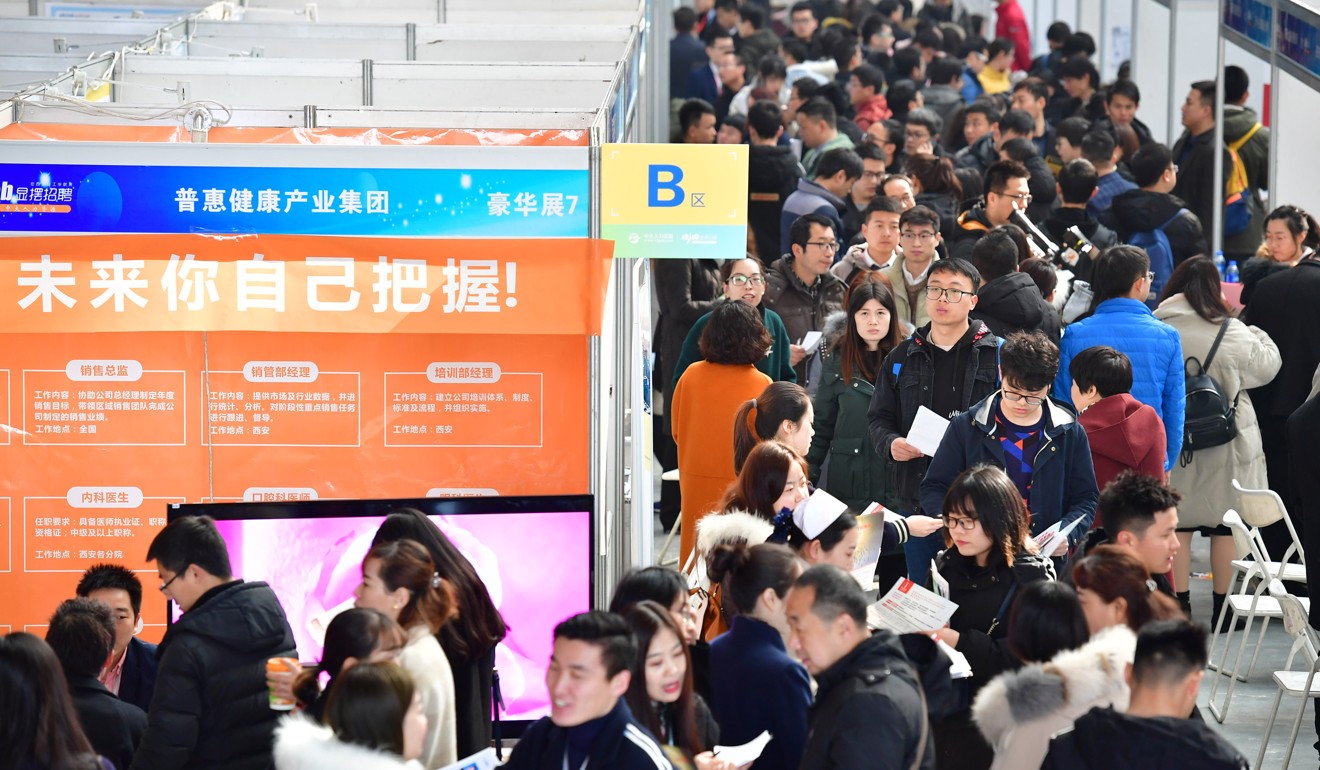
Job applicants visit a provincial job fair at Qujiang International Conference and Exhibition Center in Xian, northwest China’s Shaanxi Province in February. Photo: Xinhua
Oracle has never confirmed the number of lay-offs but said the job cuts formed part of an overall global strategy transformation.
However, there has been little sympathy for those losing their jobs in China, judging by social media posts.
Some people posted that those working for big US tech firms are not “wolf” enough compared with counterparts who work for local tech firms, referring to the long work-hours culture of the domestic tech scene.
A viral story titled “Why there should be no pity for the sacked Oracle China employees” said the company was Beijing’s biggest nursery because of the flexible “work from home” culture and generous compensation package offered to employees.
Oracle said to begin mass lay-offs in China as part of global move to cloud services
“They had every chance to join rising domestic internet firms. But they settled for high salary and low work pressure, which eventually made them frogs in boiling water. Why pity them?” said the article, adding that the earlier people give up on the “glory” of working for MNCs, the quicker they will benefit.
Not all Chinese workers would agree, and there has been a recent backlash against the “996” culture within China’s tech sector, where people routinely work from 9am to 9pm, six days a week.
With geopolitical uncertainty growing day by day, though, many Chinese are asking why leave the family behind for an uncertain fate overseas?
A survey done by consultancy BCG and The Network in 2018 showed that only one in three China residents was willing to move abroad for work, down from 61 per cent in 2014. The country is also the 20th most popular destination worldwide to relocate for a job, compared with 29th in the 2014.
“One of my graduate classmates in the US just gave up a six-digit package at Oracle and joined drone maker DJI in Shenzhen,” said Ben Zhang. “I asked what prompted his return to China. He sent me the viral article and asked, ‘who wants a life that one can see the end of from the very beginning?’”
Source: SCMP
Posted in Alibaba, Apple, ‘bamboo ceiling’, “Great Firewall”, Baidu, Beijing, big brand multinationals, Boeing, Bytedance, Carnegie Mellon University, China Tech Corporation (CTC), China’s top talent, Hong Kong, huawei technologies, Kuaishou, LinkedIn, multinational corporations (MNCs), Nio. Amazon, Oracle China\, Pennsylvania, Pittsburgh, Qujiang International Conference and Exhibition Center, rising domestic tech stars, shaanxi province, Shanghai, Siemens, Silicon Valley, Singapore, south china morning post, state-owned enterprise (SOE), Taipei, Tesla, TikTok, Uncategorized, Universum, wants to work, Xi'an, Xiaomi |
Leave a Comment »









 CHINDIA ALERT: You'll be living in their world, very soon