07/10/2019

Across China: Bumper harvest on a young farmer’s canvas

NANCHANG, Oct. 6 (Xinhua) — Unlike most of his peers with an unquenchable thirst for urban life, Zhou Jing, a 23-year-old farmer painter, has a special affinity for the golden paddy fields of his hometown.

Zhou, who lives in a small town of Lichuan County, east China’s Jiangxi Province, would drive a tractor on the bumpy country road to the fields every morning, and pack up the paddies in gunny bags with his father.

With a paintbrush in hand and a paintbox on his desk, he was busy coloring a nearly finished oil painting of a bumper autumn harvest in the glow of several groggy light bulbs.

Painting in his small studio fills a pleasant hour after a day’s farm work for the young farmer who has studied painting for seven years. The scratch of paintbrushes is euphonic to his ear.

Although he chose farm work over further study or migrant work after graduating from middle school in 2012, Zhou later signed up to learn to paint at a local industrial park specialized in oil painting.

“I was hesitant, but I knew I should make a living by myself as soon as possible,” he said.

Yet his early paintings were no more than simple compositions of colored blocks, since the young man was not professionally trained. Zhou worked hard and continued to draw long after his classes had ended.

Years of practice did indeed make perfect. Zhou gradually developed his own painting style, as well as the unity of colors. He was finally recognized and started his new career as a registered painter at the industrial park in April.

Life in the countryside is improving as unremitting efforts have been made by the Chinese government to increase support for agriculture, rural areas and farmers. In Lichuan, with a population of less than 300,000, oil wall paintings by the farmers can be found everywhere.

Lichuan was selected as the “Hometown of Chinese Folk Culture and Art” for its oil painting industry in January, with the industrial park’s annual output reaching 300 million yuan (about 41.9 million U.S. dollars). More than 1,000 farmer artists have been trained, increasing their annual income by over 10,000 yuan.

“When I was little I used to envy those who ate chicken drumsticks, food that for me existed only on my drawing paper,” Zhou said. “I had long dreamed of being able to live such a life, and now those dreams have become a reality.”

Source: Xinhua

07/10/2019

Xi extends Seniors’ Day greetings

BEIJING, Oct. 7 (Xinhua) — President Xi Jinping wished senior citizens nationwide a happy Double Ninth Festival, also known as Chongyang Festival, which falls on Monday.

Xi extended the greetings Sunday in reply to a letter written earlier by 30 senior residents in Macao.

The senior residents are serving in a professional elderly service center established in 2007, where Xi used to pay a visit in January 2009 as the vice president of China.

“You have experienced the successful practice of ‘one country, two systems’ in Macao,” Xi said. “I am glad that you devote yourselves to public welfare undertakings after retirement.”

Xi expressed his hope that the senior residents could tell young people in Macao more stories happening before and after Macao’s return to the motherland and encourage them to pass on the fine tradition of loving the motherland and loving Macao to make contributions to the development of Guangdong-Hong Kong-Macao Greater Bay Area and to work together in making Macao more beautiful.

In their letter to Xi, the senior residents spoke of the changes since Macao’s return to the motherland, and expressed their pride to be Chinese and determination to pass on the tradition of loving the motherland and Macao.

Source: Xinhua

07/10/2019

China to brace for heavy rains

BEIJING, Oct. 7 (Xinhua) — Parts of southern and western China will be swept by heavy rains, according to the National Meteorological Center (NMC).

Southern part of of south China will experience heavy rains or rainstorms Monday, with heavy downpours in some areas, said the NMC.

Parts of Chongqing Municipality and Sichuan Basin, as well as southern Shaanxi province will have heavy rains or rainstorms from Monday to Tuesday.

China’s western areas will be gripped by continuous rainfalls until Saturday, with the cumulative precipitation in parts of Shaanxi, Sichuan, Hubei provinces and Chongqing Municipality topping 180 mm.

The NMC warned against potential geological hazards that may be caused by lingering rains.

Source: Xinhua

07/10/2019

Chinese celebrate National Day with birthday noodles, films

BEIJING, Oct. 6 (Xinhua) — While fireworks and festivities drew the largest crowds during this year’s National Day holiday, many Chinese chose to celebrate the occasion with a bowl of patriotic noodles and homegrown films.

This year marks the 70th anniversary of the People’s Republic of China which was founded on Oct. 1, 1949. The weeklong National Day holiday, introduced in 1999 by the State Council, or China’s cabinet, saw “National Day noodles” become a popular choice among some Chinese this year.

Birthday noodles are to Chinese people what birthday cakes are to Westerners. In accordance with the Chinese custom, people enjoy a bowl of noodles on their birthday as a symbol of longevity. Many restaurants will prepare a bowl of birthday noodles for free if there is a diner celebrating their birthday.

Beijing Huatian Catering Group, a leading catering company in Beijing that has more than 20 time-honored brands, sold more than 25,000 bowls of National Day noodles and gave away more than 120 bowls of birthday noodles, according to a Saturday report by Beijing Daily.

Beijing Honghua Dahaiwan Catering Group said that it has sold 3,800 bowls of noodles during the first three days of the National Day holiday, up 25 percent compared to the same period of last year.

Moviegoers meanwhile got their fill of National Day celebrations in an entirely different manner.

“My People, My Country,” “The Climbers” and “The Captain” were all set for theatrical release on the Chinese mainland on Sept. 30, a day ahead of the weeklong National Day holiday, according to the China Film Distribution and Exhibition Association.

Featuring seven short stories from seven directors, “My People, My Country” draws on important historical moments since the founding of the PRC, aiming to awaken the shared memories of Chinese around the world.

“The Climbers” dramatizes the real-life expedition of Chinese mountaineers to ascend Mount Qomolangma in 1960 and 1975.

“The Captain” is a cinematic portrayal of a real-life event that occurred on May 14, 2018, when a captain of Sichuan Airlines managed a successful emergency landing after the windshield of his plane broke in the air, safely bringing home the 119 passengers and nine crew members on board.

According to the real-time statistics of MaoYan Movie, the leading online movie ticketing platform in China, the three movies ranked as the top three films at the box office over the holiday. “My People, My Country” has raked in more than 2 billion yuan (around 279.8 million U.S. dollars) as of Sunday, “The Captain,” 1.7 billion yuan, and “The Climbers,” 743 million yuan.

Source: Xinhua

07/10/2019

Xinhua Headlines: China achieves best world championships results in 20 years over National Day holiday

The Chinese legion at the World Athletics Championships celebrated the 70th anniversary of the founding of the People’s Republic of China in style — staging their best performance at the world championships in 20 years in Doha.

By Sportswriters Ma Xiangfei, Wu Junkuan and Liu Ning

DOHA, Oct. 6 (Xinhua) — For the first time in history, the World Athletics Championships spanned almost the entirety of China’s National Day holiday.

More coincidentally, the year 2019 is the 70th anniversary of the founding of the People’s Republic of China, which gave added meaning to the Chinese delegation’s quest in Doha.

And the Chinese legion celebrated the holiday in style — staging the country’s best performance at the 10-day world championships in 20 years with three gold, three silver and three bronze medals.

“The race had a special meaning for me because it was held just before China’s National Day,” said former world record holder Liang Rui, who led a one-two finish for China in the women’s 50-kilometer race walk.

“This victory is a birthday gift from me for my homeland,” she said after finishing the race at dawn on September 29.

Liang Rui of China celebrates after the women’s 50km race walk at the 2019 IAAF World Championships in Doha, Qatar, Sept. 29, 2019. (Xinhua/Jia Yuchen)

At the same time, many Chinese back home were busy preparing for a huge nationwide celebration on October 1 in a festival atmosphere similar to that of the traditional Chinese Lunar New Year.

One day later, when China was counting down to a grand military parade and mass pageantry at Beijing’s iconic Tian’anmen square, Olympic gold medalist Liu Hong and her teammates Qieyang Shijie and Yang Liujing swept the 20km race walk podium in Doha.

“Even before we came here, the team was confident of retaining the 20km title before the National Day, and the only question was who would win it. Every one of us wanted to win the gold medal, to pay tribute to our country,” said 32-year old Liu, who returned to action in early 2019 after more than two years of maternity leave.

“This is the third time I have won at the World Championships. I am very pleased that I won this time because tomorrow will be the 70th anniversary of the founding of the People’s Republic of China. Winning all three medals, this achievement is our gift to our motherland,” she said.

China’s Liu Hong (2nd L), Qieyang Shenjie (2nd R) and Yang Liujing (1st R) compete during the women’s 20km race walk final at the 2019 IAAF World Championships in Doha, Qatar, Sept. 29, 2019. (Xinhua/Wang Jingqiang)

Hours before first light was shed on a sleepless Beijing on October 1, Xie Zhenye had written a piece of athletics history when he became the first Chinese man ever to qualify for the 200m final at the world championships.

“Yes, I created some history. I did my best today and I am proud of myself, especially on this day,” said the 26-year-old, who qualified as the third fastest runner in the 200m semifinals.

Xie eventually finished seventh in the final on Tuesday night, when 6,000km away China was deep in sleep after the National Day culminated in spectacular firework displays in the heart of the capital city.

The Asian record holder said he took valuable experience from Doha, and already has his sights set on next year’s Tokyo Olympic Games.

“I believe I have gone through the most difficult process, running in the strongest heat group and in the inside lane in the final. I took this as a test and a learning opportunity for next year’s Olympics,” he said.

“Everyone in the team was trying to keep it steady this year because our bigger goal is Tokyo.”

China’s Xie Zhenye (R) competes during the men’s 200m final at the 2019 IAAF World Athletics Championships in Doha, Qatar, on Oct. 1, 2019. (Xinhua/Xu Suhui)

As the National Day celebrations drew to a close, many Chinese people began to enjoy their holiday by traveling around the country. In the first four days of the seven-day holiday, the country received a total of 542 million domestic tourists and recorded 452.63 billion yuan (63.6 billion U.S. dollars) in domestic tourism revenue.

Many people also elected to stay at home and relax, allowing them to watch the world championships and hear more good news from Doha.

Defending champion Gong Lijiao, competing in her seventh world championships, retained her shot put title on October 3. The 30-year-old held off a strong challenge from Jamaica’s Danniel Thomas-Dodd and produced four throws over 19m, grabbing the gold with a throw of 19.55m in the fourth round.

Despite her win, Gong was unsatisfied with her performance and promised to do better in Tokyo.

“I’m so happy to win but the result was well below my expectations,” said Gong, whose personal best is 20.43m.

“I worked out too much in the warm-up before the final and was dripping with sweat. So when the competition started, I felt like I was losing all my momentum, and the air conditioning in the stadium worked against me too,” she explained.

“This is a lesson for me and I will pay more attention to these details in Tokyo. My dream is obviously to win the title then,” said Gong, who already has a silver and a bronze from the Olympic Games.

China’s Gong Lijiao celebrates after winning the title of the women’s shot put final at the 2019 IAAF World Athletics Championships in Doha, Qatar, Oct. 3, 2019. (Xinhua/Wang Lili)

Liu Shiying and Lyu Huihui also brought home a silver and a bronze medal respectively in women’s javelin, although the color of the medal was not the right one for Lyu, a clear favorite before the world championships with a four-month winning streak across 12 competitions.

“I have already competed at two world championships before, winning a silver and a bronze, and I really wanted a gold this time,” she said.

Little did she know that the Chinese team’s achievements in Doha had already made their compatriots proud.

When the women’s 20km walk race medal ceremony was held on China’s National Day on October 1, 2014 Winter Olympic gold medalist Zhang Hong watched three Chinese flags fluttering on the big screen at the Khalifa International Stadium.

The scene could well have reminded her of her days as an athlete, when she raced to the 1,000m speed skating title in Sochi in 2014, becoming the first Chinese Olympic champion in this event.

“I was so proud when I heard the national anthem on October 1. Those athletes who saw the national flags raised in the competition are the best,” said the current International Olympic Committee (IOC) member.

Gold medalist Liu Hong (C) of China, silver medalist Qieyang Shenjie (L) of China and bronze medalist Yang Liujing of China pose for photos at the awarding ceremony of women’s 20km race walk during the 2019 IAAF World Athletics Championships in Doha, Qatar, Sept. 30, 2019. (Xinhua/Wang Jingqiang)

Zhang retired after the 2018 Winter Olympics and was elected to the Athlete’s Commission of the IOC. During her visit to Doha as a representative of the IOC, Zhang was informed that she was appointed to the Future Host Commission, which will explore, monitor and encourage interest in future Olympic Games, Olympic Winter Games and Youth Olympic Games.

After joining the IOC, Zhang said she could see her country from another perspective.

“After I became an IOC member, I came to know more about athletes from other countries and regions. I didn’t know how well we Chinese athletes are taken care of until I spoke to others,” she said.

Zhang’s career path could set an example for other Chinese athletes, as China’s top sprinter Su Bingtian was nominated as one of the 15 candidates for the six available seats in the IAAF Athletes’ Commission.

“I met him in Doha the other day and gave him my encouragement. I hope he can be elected,” Zhang said.

Source: Xinhua

07/10/2019

Aarey protests: Supreme Court steps in to save Mumbai trees after protests

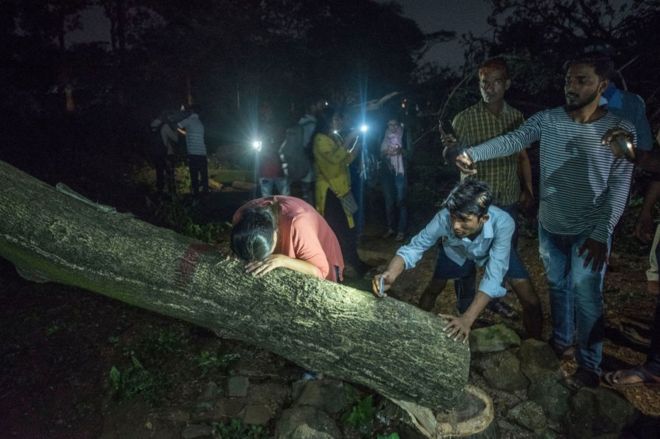
Protesters cry over felled trees in Aarey colony on October 5, 2019 in Mumbai, India.Image copyright GETTY IMAGES
Image caption Protesters cry over felled trees in Aarey colony

India’s top court has asked officials to stop cutting trees in a forested area in Mumbai city after protesters clashed with police over the weekend.

The trees, part of a green strip known as Aarey colony, were being cut to make way for a new metro rail project.

Locals have long opposed the move, and filed petitions seeking Aarey to be declared a protected area.

But a high court dismissed the petitions on Friday, sparking protests as officials began felling the trees.

They planned to cut 2,185 trees, and admitted in the Supreme Court that more than 1,500 had already been cut. But petitioners claim that officials have cut around 2,500 trees.

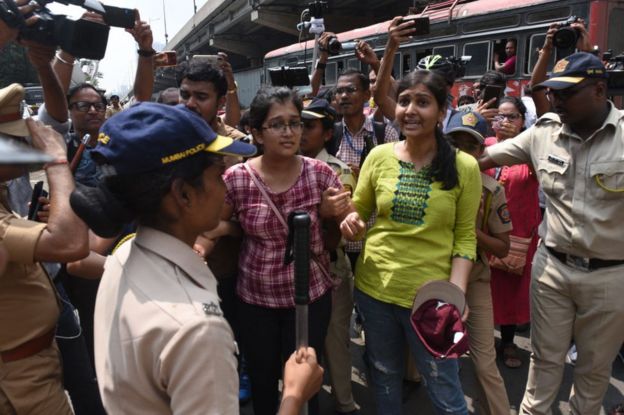
Local residents, students and environmental activists clashed with police on Friday as they took to the streets to stop authorities, and even broke through barricades to enter Aarey colony. More than 50 people were arrested and police imposed restrictions on public gatherings.

The protests grabbed the national spotlight over the weekend, and the Supreme Court took suo moto (without a formal complaint from any party) notice.

What did the Supreme Court say?

A special two-judge bench heard the matter on Monday after students wrote to the chief justice, asking the court to intervene and save the trees.

The court asked the state government of Maharashtra, where Mumbai is located, to not cut any more trees.

Activists were forcefully evacuated from Aarey Checknaka and taken to local Police Station at Goregaon, on October 5, 2019 in Mumbai, India.Image copyright GETTY IMAGES
Image caption Police arrested more than 50 protesters

The court also asked the government to maintain “status quo” – which means that no construction can take place – until 21 October when it will hear the matter again.

The court also ordered the release of all activists who were arrested or detained on bail.

What is Aarey colony?

Spread over 1,300 hectares (3,212 acres), Aarey is a densely forested area dotted with lakes and has the Mithi river flowing through it. It lies at the heart of Mumbai and is often referred to as its last green lung.

It’s locally known as the Aarey “milk colony” because most of the land was given to the department of dairy development in 1951. But they are allowed to grow cattle fodder only on a fraction of the land.

Activists break barricades to stop authorities from cutting at the main gate of Metro car shed , Picnic point, Aarey colony , Goregaon east, on October 5, 2019 in Mumbai.Image copyright GETTY IMAGES
Image caption Protesters broke through barricades and clashed with police on Friday

Earlier this year, officials cleared some 40 hectares of the forested area to build a zoo, complete with a night safari. And now, locals complain, another slice of it is in danger from the metro construction.

They also fear that the government will eventually clear the way for private builders to encroach on the Sanjay Gandhi National Park, which lies to the north of Aarey colony.

Officials, however, dismiss these fears as unfounded and point out that the construction for the metro only requires 30 hectares.

How crucial is the metro rail for Mumbai?

The city badly needs a “mass rapid transport system,” Ashwini Bhide, managing director of the Mumbai metro rail corporation, had told the BBC earlier.

The land in Aarey colony, she said, was “the most suitable land due to its size, shape and location”.

She has also been defending the decision to cut the trees on Twitter.

Presentational white space

India’s financial hub is congested and infamous for its crawling traffic jams.

Its colonial-era local train system ferries some 7.5 million people between the city’s suburbs and its centre on a daily basis.

Officials say that the metro will eventually carry around 1.7 million passengers every day and bring down the number of vehicles on the road by up to 650,000.

Source: The BBC

06/10/2019

HKSAR chief executive vows greatest resolve to end violence

HONG KONG, Oct. 5 (Xinhua) — Chief Executive of China’s Hong Kong Special Administrative Region (HKSAR) Carrie Lam said Saturday that the government will take the greatest resolve to end violence, after rampant rioters Friday wreaked havoc in various areas of Hong Kong.

Lam said in a video address that Hong Kong witnessed “a very dark night” on Friday and the society was half-paralyzed, describing the extreme acts as “unprecedented and appalling.”

Violent and disruptive acts were staged again in Hong Kong on Friday as masked rioters blocked roads, set fires, damaged public facilities, and assaulted police officers and passersby, leaving the transport network paralyzed and forcing numerous shops to close.

“The extreme violence is a clear indication of the widespread danger to public security in Hong Kong,” Lam said.

Given the escalating violence recently, the HKSAR government has invoked the power under the Emergency Regulations Ordinance and put in place the Prohibition on Face Covering Regulation. The anti-mask law, designed to end violence and restore order, came into effect on Saturday, Lam said.

The move has received support from 40 Legislative Council members and many chambers of commerce, media outlets and social organizations, she said.

Lam reiterated the legality of the action and said the HKSAR government adopted appropriate measures using the power conferred by the existing law.

Lam urged foreign officials and lawmakers to understand the nature of the violent incidents. “Hong Kong is facing unprecedented violence and the government needs to adopt resolute legal measures to stop violence, restore peace and order, and protect the rights and freedoms of Hong Kong residents from the threats of rioters.” She said anti-mask legislations were also adopted in a number of western countries.

Lam also called on Hong Kong residents to support the HKSAR government in stopping the violence, make a clean break with rioters, and work together to bring back peaceful lives as soon as possible.

Source: Xinhua

06/10/2019

Chinese, Guinean presidents exchange congratulations on 60th anniversary of diplomatic ties

BEIJING, Oct. 4 (Xinhua) — Chinese President Xi Jinping and his Guinean counterpart Alpha Conde on Friday exchanged congratulatory messages on the 60th anniversary of the establishment of the two countries’ diplomatic ties.

Noting that Guinea was the first sub-Saharan African country to establish diplomatic relations with the People’s Republic of China, Xi said in his message that over the past 60 years, the two countries have always maintained sincerity, friendship and mutual support no matter how the international situation changed, setting an example of unity and cooperation for China-Africa relations.

Xi said he attaches great importance to the development of China-Guinea relations, and values the traditional friendship between the two countries.

He said he is willing to work together with Conde, taking the 60th anniversary of bilateral diplomatic relations as a new starting point, to grasp the historical opportunity of jointly building the Belt and Road and the flourishing development of China-Africa cooperation, cement friendship and mutual trust, and deepen practical cooperation.

The two sides should continue to promote the development of China-Guinea comprehensive strategic cooperative partnership, so as to benefit both countries and peoples, and further contribute to building an even stronger China-Africa community with a shared future, said the Chinese leader.

Conde, for his part, said that the establishment of Guinea-China diplomatic relations has great significance to the development of Africa-China ties. For a long time, the two countries have maintained special, friendly relations, representing an epitome of Africa-China friendly cooperation.

Guinea highly appreciates the Belt and Road Initiative, and is willing to work together with the Chinese side to cement their traditional friendship, carry out the outcomes of the Beijing Summit of the Forum on China-Africa Cooperation, and promote continuous and in-depth development of China-Guinea comprehensive strategic cooperative partnership, Conde added.

Source: Xinhua

06/10/2019

Xinhua Headlines: China’s Greater Bay Area busy laying foundation for innovation

As China aims to develop its Greater Bay Area into an international innovation and technology hub, innovation and entrepreneurship resources are shared in the area to provide more opportunities for young Hong Kong and Macao entrepreneurs.

The provincial government of Guangdong has stepped up efforts to improve basic research capability, considered the backbone of an international innovation and technology hub, by building large scientific installations and launching provincial labs.

by Xinhua writers Liu Yiwei, Quan Xiaoshu, Wang Pan, Jing Huaiqiao

GUANGZHOU, Oct. 5 (Xinhua) — Hong Kong man Andy Ng was surprised his shared workspace Timetable was rented out completely only six months after it had started operation in Guangzhou, capital of south China’s Guangdong Province.

While studying economics at City University of Hong Kong, Ng set up his first business, developing an online education platform, but soon realized the Hong Kong market was too small. After earning a master’s degree in the UK in 2017, Ng returned to China and chose Guangzhou as his new base.

Timetable is now accumulating popularity and even fans in Dianping.com, China’s major online consumer guide. Ng feels lucky that his business caught the implementation of the Guangdong-Hong Kong-Macao Greater Bay Area (GBA) development plan.

The bay area, covering 56,000 square km, comprises Hong Kong and Macao, as well as nine cities in Guangdong. It had a combined population of about 70 million at the end of 2017, and is one of the most open and dynamic regions in China.

Aerial photo taken on July 11, 2018 shows the Hong Kong-Zhuhai-Macao Bridge in south China. (Xinhua/Liang Xu)

In July 2017, a framework agreement on the development of the bay area was signed. On February 18 this year, China issued the more specific Outline Development Plan for the Guangdong-Hong Kong-Macao Greater Bay Area. One of its major aims is to develop the area into an international innovation and technology hub.

OPPORTUNITIES FOR YOUTH

The plan proposes that innovation and entrepreneurship resources be shared in the bay area to provide more opportunities for young Hong Kong and Macao entrepreneurs.

An incubator for entrepreneurship, Timetable is home to 52 companies, including 15 from Hong Kong and Macao, such as Redspots, a virtual reality company that won the Hong Kong Information and Communications Technology (ICT) Awards 2019.

“I persuaded them one by one to come here,” Ng said. “I told them of my own experience that the GBA is a great stage for starting a business with ever-upgrading technologies, ever-changing consumer tastes and a population 10 times that of Hong Kong.”

Timetable is a startup base of the Guangzhou Tianhe Hong Kong and Macao Youth Association, which has assisted 65 enterprises founded by Hong Kong and Macao young people since its establishment in October 2017.

The association and its four bases provide a package of services from training and registering to policy and legal consultation, said Chen Jingzhan, one of the association founders.

Tong Yat, a young Macao man who teaches children programming, is grateful the association encouraged him to come to Guangdong, where young people enjoy more preferential policies to start their own businesses.

“The GBA development not only benefits us, but paves the way for the next generation,” Tong said. “If one of my students were to become a tech tycoon in the future and tell others that his first science and technology teacher was me, I would think it all worthwhile.”

In the first quarter of this year, there were more than 980 science and technology business incubators in Guangdong, including more than 50 for young people from Hong Kong and Macao, said Wu Hanrong, an official with the Department of Science and Technology of Guangdong Province.

INNOVATION HIGHLAND

As the young entrepreneurs create a bustling innovative atmosphere, the Guangdong government has stepped up efforts to improve basic research capability, considered the backbone of an international innovation and technology hub, by building large scientific installations and launching provincial labs.

Several large scientific facilities have settled in Guangdong. China Spallation Neutron Source (CSNS) operates in Dongguan City; a neutrino observatory is under construction in Jiangmen City; a high intensity heavy-ion accelerator is being built in Huizhou City.

Aerial photo taken on June 23, 2019 shows the construction site of the Jiangmen Underground Neutrino Observatory (JUNO) in Jiangmen, south China’s Guangdong Province. (Xinhua/Liu Dawei)

Guangdong also plans to build about 10 provincial labs, covering regenerative medicine, materials, advanced manufacturing, next-generation network communications, chemical and fine chemicals, marine research and other areas, said Zhang Yan, of the provincial department of science and technology.

Unlike traditional universities or research institutions, the provincial labs enjoy a high degree of autonomy in policy and spending. A market-oriented salary system allows them to recruit talent from all over the world, and researchers from other domestic organizations can work for the laboratories without giving up their original jobs, Zhang said.

The labs are also open to professionals from Hong Kong and Macao. Research teams from the universities of the two special administrative regions have been involved in many of the key programs, Zhang said.

For example, the provincial lab of regenerative medicine and health has jointly established a regenerative medicine research institute with the Chinese University of Hong Kong, a heart research center with the University of Hong Kong, and a neuroscience research center with the Hong Kong University of Science and Technology (HKUST).

Photo taken on July 24, 2019 shows a rapid cycling synchrotron at the China Spallation Neutron Source (CSNS) in Dongguan, south China’s Guangdong Province. (Xinhua/Liu Dawei)

Guangdong has been trying to break down institutional barriers to help cooperation, encouraging Hong Kong and Macao research institutions to participate in provincial research programs, exploring the cross-border use of provincial government-sponsored research funds, and shielding Hong Kong researchers in Guangdong from higher mainland taxes.

NANSHA FOCUS

Located at the center of the bay area, Guangzhou’s Nansha District is designed as the national economic and technological development zone and national free trade zone, and is an important pivot in building the area into an international innovation and technology hub.

The construction of a science park covering about 200 hectares started on Sept. 26. Gong Shangyun, an official with the Nansha government, said the park will be completed in 2022.

Jointly built by the Guangzhou government and the Chinese Academy of Sciences (CAS), the science park will accommodate CAS research institutes from around Guangzhou, including the South China Sea Institute of Oceanology, the South China Botanical Garden (SCBG) and the Guangzhou Institute of Energy Conversion.

Ren Hai, director of the SCBG, is looking forward to expanding the research platforms in Nansha. “We will build a new economic plant platform serving the green development of the Pearl River Delta, a new botanical garden open to the public, and promote the establishment of the GBA botanical garden union.”

Wang Ying, a researcher with the SCBG, said the union will help deepen the long cooperation among its members and improve scientific research, science popularization and ecological protection. “Predecessors of our botanical garden have helped the Hong Kong and Macao counterparts gradually establish their regional flora since the 1950s and 1960s.”

HKUST also started to build a new campus in Nansha the same day as the science park broke ground. “Located next to the high-speed rail station, the Guangzhou campus is only a 30-minute journey from the Hong Kong campus. A delegation from the HKUST once paid a visit to the site and found it very convenient to work here,” Gong said.

Chief Executive of the Hong Kong Special Administrative Region (HKSAR) Carrie Lam hoped the new campus would help create a new chapter for the exchanges and cooperation on higher education between Guangzhou and Hong Kong, and cultivate more talents with innovative capabilities.

Nansha’s layout is a miniature of the provincial blueprint for an emerging international innovation and technology hub.

“We are seeking partnership with other leading domestic research institutions and encouraging universities from Hong Kong and Macao to set up R&D institutions in Guangdong,” said Zhang Kaisheng, an official with the provincial department of science and technology.

“We are much busier now, because research institutes at home and abroad come to talk about collaboration every week. The GBA is a rising attraction to global scientific researchers,” Zhang said.

Source: Xinhua

06/10/2019

China, North Korea vow to strengthen ties hours after US nuclear talks collapse

  • Leaders exchange congratulatory messages on 70th anniversary of diplomatic relations amid speculation that Kim Jong-un will visit China soon
  • It comes after Pyongyang’s denuclearisation negotiations with Washington broke off in Stockholm without any breakthroughs
North Korean leader Kim Jong-un (left) may soon visit China again. He last met Xi Jinping during the Chinese leader’s trip to Pyongyang in June. Photo: AFP
China and North Korea on Sunday vowed to continue strengthening their ties that have “stood the test of time”, hours after another squabble broke out between Pyongyang and Washington over the breakdown of their first nuclear talks in eight months.
Chinese President Xi Jinping exchanged congratulatory messages with North Korean leader Kim Jong-un on the 70th anniversary of diplomatic ties, according to state media in both countries, amid speculation that Kim will soon pay another visit to China.
Observers said the communist neighbours’ warm exchanges and Kim’s possible visit showed Beijing and Pyongyang shared mutual interests and needed each other in their respective geopolitical plans to counter Washington – especially as they both come under pressure from US President Donald Trump.
The two countries are said to be preparing for Kim to visit China as early as Sunday, which would be his fifth China trip since March last year and the first since Xi’s state visit to Pyongyang in June.
But given Pyongyang’s denuclearisation negotiations with Washington on Saturday – which broke off in Stockholm without any breakthroughs – China and North Korea may need to reconsider or delay Kim’s visit to avoid criticism of Beijing’s role in the nuclear talks, one expert suggested.
“The triangular ties between China, the United States and North Korea are of immense importance in finding a solution to the nuclear issue on the Korean peninsula and Beijing’s role in the talks has always been sensitive, especially in the eyes of the US and its allies,” said Wang Sheng, a North Korea specialist at Jilin University.

“While China will almost certainly reiterate its stance to support continued dialogue and talks between Pyongyang and Washington, it may not be a good time for Kim’s high-profile visit just a day after their talks broke down, which would inevitably make it more difficult for China to play a mediating role,” he said.

On Sunday, Xi said the traditional friendship between the two countries had “stood the test of time and changes in the international landscape, growing stronger with the passage of time” and “made important and positive contributions to regional peace and stability”, according to Chinese state news agency Xinhua.

Citing his five recent meetings with Kim, Xi said bilateral ties had entered a new era and China would promote “long-term, healthy and stable” relations with North Korea.

Kim also hailed the special relationship between the two countries, which he said had been forged “at the cost of blood” and “weathered all tempests while sharing weal and woe with each other”, the Korean Central News Agency reported.

North Korean mouthpiece Rodong Sinmun meanwhile said in a commentary that bilateral ties with Beijing were “fully in accordance” with the interests of the two sides and would develop “regardless of the international situation”, according to South Korea’s Yonhap news agency.

The lavish praise for Sino-North Korean relations comes as a group of working-level officials from North Korea are working with the Chinese side for a possible visit by Kim in the next few days, according to South Korea’s Dong-A Ilbo.

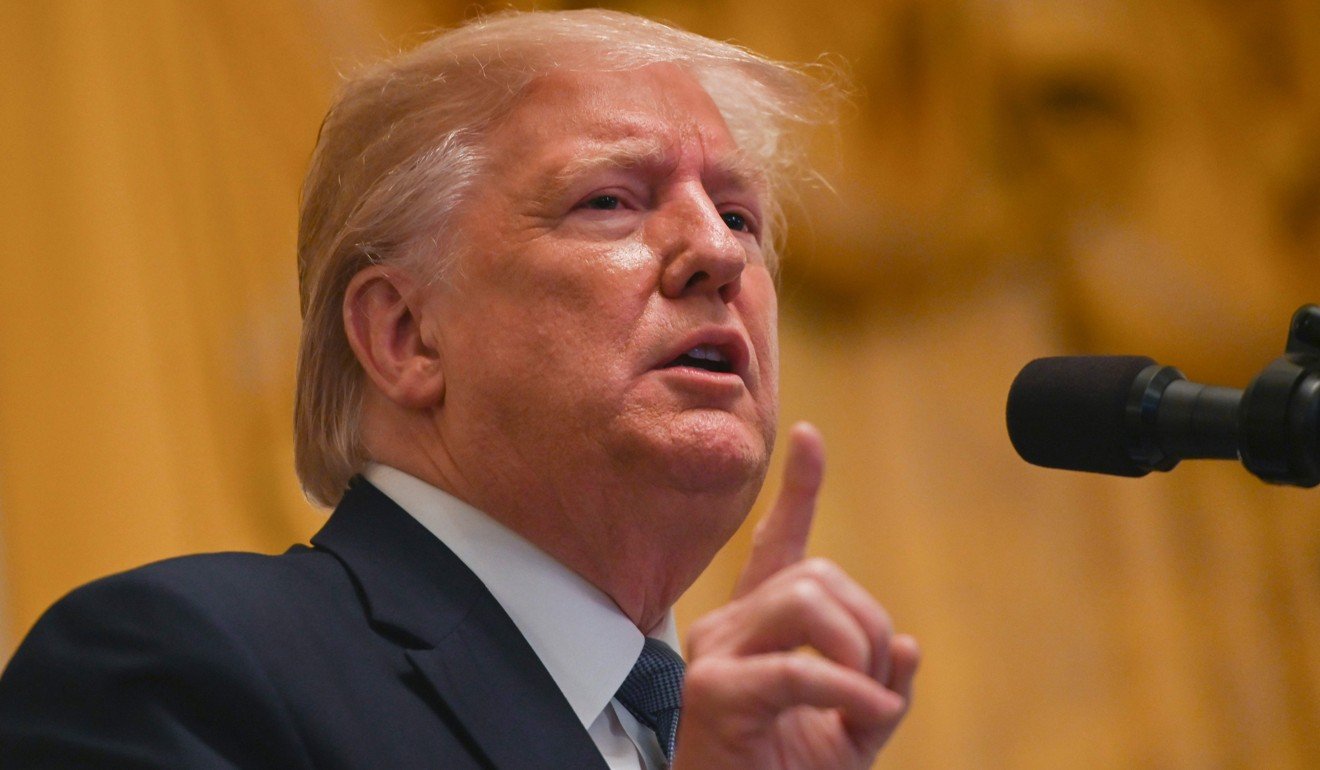
China and North Korea have set aside their differences as both countries come under pressure from US President Donald Trump. Photo: AFP
North Korea was among the first countries to recognise the People’s Republic of China
70 years ago and Xi has exchanged three messages with Kim in the past month, repeatedly pledging to move closer despite lingering grievances over Pyongyang’s nuclear brinkmanship.
In the face of Trump’s increasingly antagonistic approach, the former communist allies – whose relationship deteriorated over Beijing’s support for the UN sanctions against the North, led by Washington – have set aside their differences to patch up ties in recent months.
Meanwhile, Pyongyang’s first nuclear talks with Washington in eight months ended on Saturday with the two sides offering conflicting assessments of their first formal discussion since the failed Trump-Kim summit in Vietnam in February.
North Korea’s top negotiator Kim Myong-gil expressed his “great displeasure” with the discussions, blaming Washington and urging the Trump administration to correct its course and keep the talks alive or “forever close the door to dialogue”, according to Yonhap.
North Korean negotiator Kim Myong-gil expressed his “great displeasure” with the discussions on Saturday. Photo: AP

But the US State Department issued a rebuke hours later, claiming the negotiators had a “good discussion”. State Department spokeswoman Morgan Ortagus said in a statement that the US had put forward “creative ideas” and “a number of new initiatives that would allow us to make progress in each of the four pillars of the Singapore joint statement”.

The two countries were not expected to “overcome a legacy of 70 years of war and hostility on the Korean peninsula through the course of a single Saturday”, she said, adding that Washington would return for more discussions with Pyongyang in two weeks at Sweden’s invitation.

As Trump administration enters survival mode, foreign policy moves are anyone’s guess

Wang from Jilin University said the breakdown of another round of talks had again laid bare the huge gap between the two sides over a long list of issues, from the definition of denuclearisation to their vastly different, often conflicting, demands and interests.

“It’s very likely that Washington has again rejected some of Pyongyang’s key demands in the recent talks, such as providing a security guarantee for Kim’s regime and a range of economic sanctions relief,” he said.

And with North Korea a polarising issue in the looming US presidential poll for Trump as he seeks to score diplomatic points for his re-election bid, it might become even more challenging for the two sides to narrow their differences.

“The breakdown of the talks should not be seen as a failure,” Wang said. “It simply underscores the difficulty of reaching any consensus in the nuclear talks, which still have a long way to go.”

Source: SCMP

Law of Unintended Consequences

continuously updated blog about China & India

ChiaHou's Book Reviews

continuously updated blog about China & India

What's wrong with the world; and its economy

continuously updated blog about China & India