Chindia Alert: You’ll be Living in their World Very Soon
aims to alert you to the threats and opportunities that China and India present. China and India require serious attention; case of ‘hidden dragon and crouching tiger’.
Without this attention, governments, businesses and, indeed, individuals may find themselves at a great disadvantage sooner rather than later.
The POSTs (front webpages) are mainly 'cuttings' from reliable sources, updated continuously.
The PAGEs (see Tabs, above) attempt to make the information more meaningful by putting some structure to the information we have researched and assembled since 2006.
BEIJING, Oct. 4 (Xinhua) — Chinese President Xi Jinping’s speech during Tuesday’s National Day celebrations was warmly embraced across the globe, with politicians and experts in different parts of the world expressing support for China’s social and economic development.
“China’s yesterday has been inscribed in human history while China’s today is being created in the hands of hundreds of millions of Chinese people,” Xi said. “China will surely have an even brighter future.”
Marcelo Abi-Ramia Caetano, secretary general of the International Social Security Association, said Xi’s speech briefly summarized the “remarkable socio-economic progress” achieved by the People’s Republic of China (PRC) over the past 70 years.
“In terms of social protection, China serves as an excellent example in extending social security coverage and improving social security administration, and has much to share with the rest of the world,” he added.
The “overarching theme” of China’s National Day celebrations is “a comprehensive and integrated vision of why China’s system works so well for China, and how, at the same time, it benefits the world,” said Robert Kuhn, a leading U.S. expert on China.
China’s goal is “to improve the standards of living of all its citizens, and then to share the fruits of such development with the world in various forms,” added Kuhn, also chairman of the Kuhn Foundation.
“China’s role in the world has increased and (the) PRC has been making an important contribution to global governance and its needed reforms,” said Fabio Massimo Parenti, an Italian scholar of international studies at the International Institute Lorenzo de’ Medici.
The China-proposed Belt and Road Initiative is “for the entire world” and has received support from countries across the globe, he added.
Mahmoud Raya, director of the Lebanese website “China in Arab Eyes,” said Xi’s speech reflected strength and hope.
The strength comes from the glorious history of the Chinese nation and the confidence of the younger generation in their future, he added.
Xi’s speech showed “solid confidence that China has,” and revealed “future directions that China will follow,” said Do Tien Sam, former director of the Institute of Chinese Studies under the Vietnam Academy of Social Sciences.
BEIJING, Oct. 4 (Xinhua) — Despite the slowing momentum of global trade growth, China remains attractive to the world’s multinationals with its huge consumer market, optimized business environment and innovation capability.
EXPANDING PRESENCE
Swiss tech giant ABB began construction of its new 67,000-square meter robotics manufacturing and research facility in Shanghai in September with an investment of 150 million U.S. dollars.
It is designed to be the most advanced, automated and flexible factory in the global robotics industry, utilizing the latest manufacturing processes –– a cutting-edge center where robots make robots.
Since 1992, ABB has invested more than 2.4 billion U.S. dollars in China, with nearly 20,000 employees in total. China has become the company’s second-largest market.
“In the future, we will continue to expand investment in the country, further optimize the business layout and enhance innovation capability,” said Gu Chunyuan, president of ABB Asia, Middle East and Africa Region.
German company Henkel, a leading player in industrial and consumer businesses, also has a long-term commitment to and strong confidence in China. Early this year, Henkel announced it is stepping up investment by around 300 million euros annually to build on its strengths and capture opportunities.
“China will be one of the focal markets. We will strengthen our position by accelerating the launch of new brands and innovations, increasing our marketing investments and driving digitalization even further,” said Jeremy Hunter, president of Henkel Greater China.
Having established its first office in Beijing in 1988, the company now has around 5,000 employees at 25 sites across China. The production output of its manufacturing plant in Yantai of Shandong Province has increased more than 50 times over the years.
EMBRACING OPPORTUNITIES
“China’s huge market, steady growth momentum, complete industrial infrastructure as well as rich talent resources are all very attractive, ” said Gu Chunyuan.
As ABB’s second-biggest market, China’s increasingly optimized business climate, more energetic and effective market system and deepened opening-up policies have lured the company to beef up its confidence in the China market, he said.
As the center of the world’s manufacturing industry, China has witnessed unprecedented upgrading and transformation of industries toward digitalization and intelligence, which will unleash huge market potential, said Gu, adding that China’s development has brought many opportunities to the company, and convinced ABB to expand investment.
Hunter attributed Henkel’s success in China to the country’s continuous efforts of pursuing innovation-driven economic development, which has fostered a favorable environment for the company.
“Moreover, China has become a global force in digital technologies. Accelerated digitalization has also been a key driver for Henkel,” said Hunter, noting that the rapid transformation of China’s manufacturing and consumption upgrading are also driving demand for the company.
EXPECTING GROWTH
Foreign investors agree that the Chinese economy offers them indispensable certainty and confidence with its positive outlook.
Commenting on China’s efforts on pushing for all-around opening-up and building a stable, transparent and predictable investment environment, Gu said these measures will bring huge development opportunities for foreign-funded companies.
“We believe that China’s further opening-up will promote the globalization as well as the liberalization and facilitation of trade,” Gu said.
Hunter noted China will maintain its unparalleled momentum in industrial and consumption upgrading and its integration into global flows of trade, talent and innovation.
“I believe that the Chinese market will go beyond just participating in these areas to actively shaping their future development,” he said.
BEIJING, Oct. 4 (Xinhua) — The 12th Belt and Road Eco-Agriculture and Food Safety Forum will be held on Nov. 6 in Shanghai, authorities said.
The forum, co-sponsored by the State Administration for Market Regulation, the Chinese People’s Association for Friendship with Foreign Countries and the China Council for the Promotion of International Trade, is scheduled during the second China International Import Expo from Nov. 5 to 10.
Under the theme “Expand food import, enrich people’s lives,” the event aims at enhancing international cooperation in food and farm produce, facilitating the high-quality development of the industry, and providing development opportunities for people from home and abroad.
The forum will invite government officials from China and the world, as well as representatives from international organizations, associations, chambers of commerce and enterprises worldwide.
The first Belt and Road Eco-Agriculture and Food Safety Forum was held in September 2013 as a part of the Euro Asia Economic Forum.
Maha Prasad Adhikari, Chief Executive Officer (CEO) of Nepal Investment Board (IBN) speaks during a signing ceremony of the construction of China-Nepal Friendship Industrial Park, in Kathmandu, Nepal, Oct. 3, 2019. Damak Clean Industrial Park, a China-invested company, has signed a Memorandum of Understanding with Nepal Investment Board (IBN) for the China-Nepal Friendship Industrial Park in Nepal’s eastern Jhapa district. (Photo by Sunil Sharma/Xinhua)
KATHMANDU, Oct. 4 (Xinhua) — Damak Clean Industrial Park, a China-invested company, has signed a Memorandum of Understanding with Nepal Investment Board (IBN) for the China-Nepal Friendship Industrial Park in Nepal’s eastern Jhapa district.
Damak Clean Industrial Park President Govinda Thapa and IBN Chief Executive Officer Maha Prasad Adhikari signed the MoU at a function on Thursday evening in Kathmandu.
Lhasa Economic and Technological Development Zone Investment Development Company Limited is investing in the project which aims to develop a complete industrial infrastructure for industries to come in and operate there.
“Industries related to food products, home appliances, transport equipment electrical and communication equipment will be brought inside the park,” Zhou Chengjie, chairman of Lhasa Economic and Technological Development Zone Investment Development Company Limited, said during the signing ceremony.
The location is the hometown of Nepali Prime Minister KP Sharma Oli.
The IBN, a government body focused on promoting large scale investment, approved Foreign Direct Investment (FDI) of 586 million U.S. dollar from the Chinese company in August.
“This investment is for the first phase of the works under which industrial park will be developed in 484.81 hectares of land out of planned development in 1,600 hectares,” Zhou said.
According to him, the project will be developed in four phases and his company has aimed to invest 1 billion U.S. dollar for the entire development. It will be one of the largest FDI to Nepal from China in recent years.
IBN CEO Adhikari said the China-Nepal Friendship Park would be milestone for industrial infrastructure development in Nepal as industrial infrastructure in the Himalayan country has remained poor.
“This will also help Nepal to utilize the economic opportunity offered by the Belt and Road Initiative,” he said.
Visitors tour the desert on camels at Shapotou Scenic Area in Zhongwei, northwest China’s Ningxia Hui Autonomous Region, Oct. 3, 2019. Since the start of the National Day holiday, Shapotou Scenic Area has entered its peak season for tourism. (Photo by Yang Zhisen/Xinhua)
BEIJING, Oct. 4 (Xinhua) — Chinese President Xi Jinping and his Guinean counterpart Alpha Conde on Friday exchanged congratulatory messages on the 60th anniversary of the establishment of the two countries’ diplomatic ties.
Noting that Guinea was the first sub-Saharan African country to establish diplomatic relations with the People’s Republic of China, Xi said in his message that over the past 60 years, the two countries have always maintained sincerity, friendship and mutual support no matter how the international situation changed, setting an example of unity and cooperation for China-Africa relations.
Xi said he attaches great importance to the development of China-Guinea relations, and values the traditional friendship between the two countries.
He said he is willing to work together with Conde, taking the 60th anniversary of bilateral diplomatic relations as a new starting point, to grasp the historical opportunity of jointly building the Belt and Road and the flourishing development of China-Africa cooperation, cement friendship and mutual trust, and deepen practical cooperation.
The two sides should continue to promote the development of China-Guinea comprehensive strategic cooperative partnership, so as to benefit both countries and peoples, and further contribute to building an even stronger China-Africa community with a shared future, said the Chinese leader.
Conde, for his part, said that the establishment of Guinea-China diplomatic relations has great significance to the development of Africa-China ties. For a long time, the two countries have maintained special, friendly relations, representing an epitome of Africa-China friendly cooperation.
Guinea highly appreciates the Belt and Road Initiative, and is willing to work together with the Chinese side to cement their traditional friendship, carry out the outcomes of the Beijing Summit of the Forum on China-Africa Cooperation, and promote continuous and in-depth development of China-Guinea comprehensive strategic cooperative partnership, Conde added.
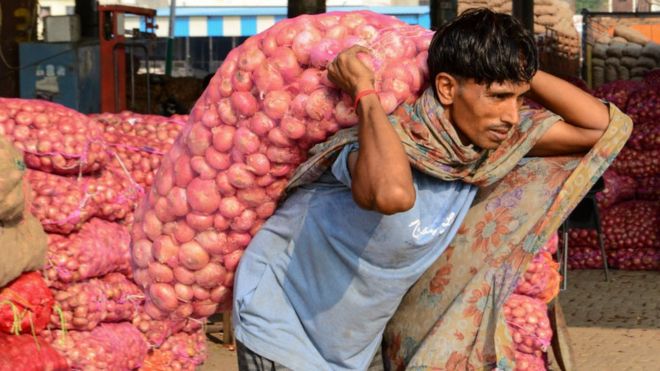
Image copyright GETTY IMAGESImage caption The onion is India’s most “political” vegetable
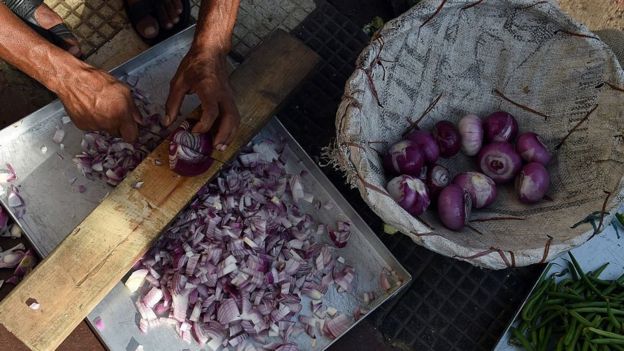
Onion prices have yet again dominated the headlines in India over the past week. BBC Marathi’s Janhavee Moole explains what makes this sweet and pungent vegetable so political.
The onion – ubiquitous in Indian cooking – is widely seen as the poor man’s vegetable.
But it also has the power to tempt thieves, destroy livelihoods and – with its fluctuating price a measure of inflation – end the careers of some of India’s most powerful politicians.
With that in mind, it’s perhaps unsurprising those politicians might be feeling a little concerned this week.
So, what exactly is happening with India’s onions?
In short: its price has skyrocketed.
Onion prices had been on the rise in India since August, when 25 rupees ($0.35; £0.29) would have got you a kilo. At the start of October, that price was 80 rupees ($1.13; £0.91).
Fearing a backlash, the Bharatiya Janata Party (BJP)-led government banned onion exports, hoping it would bring down the domestic price. And it did.
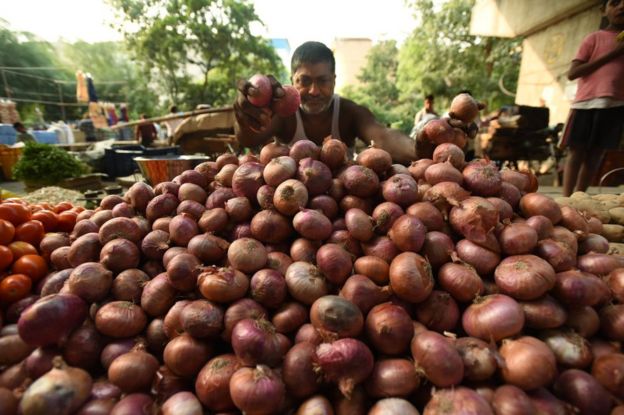
Image copyright GETTY IMAGESImage caption Onion prices peaked by the end of September
A kilo was selling for less than 30 rupees on Thursday at Lasalgaon, Asia’s largest onion wholesale market, located in the western state of Maharashtra.
However, not everyone is happy.
While high prices had angered consumers in a sluggish Indian economy, the fall in prices sparked protests by exporters and farmers in Maharashtra, where state elections are due in weeks.
And it is not just at home where hackles have been raised: the export ban has also strained trade relations between India and its neighbour, Bangladesh, which is among the top importers of the vegetable.
But why does the onion matter so much?
The onion is a staple vegetable for the poor, indispensable to many Indian cuisines and recipes, from spicy curries to tangy relishes.
“In Maharashtra, if there are no vegetables or you can’t afford to buy vegetables, people eat ‘kanda bhakari’ [onion with bread],” explains food historian Dr Mohseena Mukadam.
True, onions are not widely used in certain parts of the country, such as the south and the east – and some religious communities don’t eat them at all.
But they are especially popular in the more populous northern states which – notably – send a higher number of MPs to India’s parliament.
“Consumers in northern India wield more power over the federal government. So although consumers in other parts of India don’t complain as much about higher prices, if those in northern India do, the government feels the pressure,” says Milind Murugkar, a policy researcher.
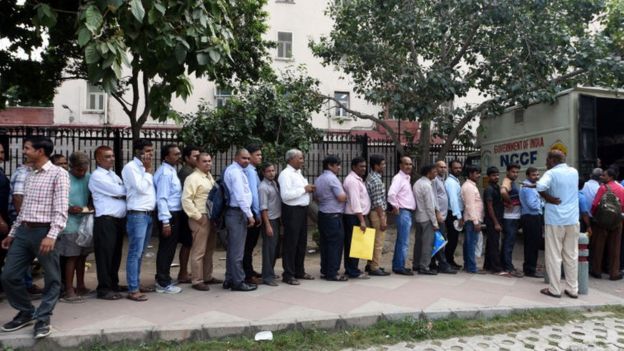
Image copyright GETTY IMAGESImage caption Onions are so ubiquitous that the government has been selling them at subsided rates
A drop in prices also affects the income of onion farmers, mainly in Maharashtra, Karnataka in the south and Gujarat in the west.
“Farmers see the onion as a cash crop that grows in the short term, and grows well in dry areas with less water,” says Dipti Raut, a journalist, who has been on the “onion beat” for years.
“It’s like an ATM machine that guarantees income to farmers and sometimes, their household budget depends on the onion produce,” she said.
Onions have even attracted robbers: when prices skyrocketed in 2013, thieves tried to steal a truck loaded with onions, but were caught by the police.
Why do politicians care about the onion?
Put simply, because the price moving too far one way or another is likely to anger a large block of voters, be they everyday households, or the country’s farmers.
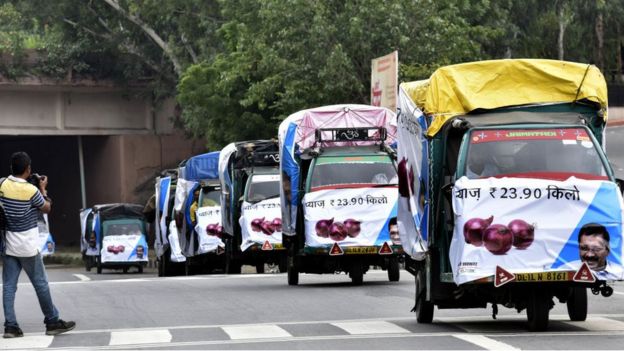
Image copyright GETTY IMAGESImage caption The Delhi government transported 70 vans full of subsidised onions
Onions are so crucial they have even featured in election campaigns. The Delhi state government bought and sold them at subsidised rates in September when prices were at their peak: chief minister Arvind Kejriwal, it should be noted, is up for re-election next year.
Meanwhile, Indira Gandhi swept to power in 1980 on slogans that used soaring onion prices as a metaphor for the economic failures of the previous government.
But why did onion prices rise this year?
A drop in supply, due to heavy rains and flooding destroying the crop in large parts of India, and damaging some 35% of the onions stocks in storage, according to Nanasaheb Patil, director of the National Agricultural Co-operative Marketing Federation.
He said the flooding had also delayed the next round of produce, which was due in September.
Image copyright GETTY IMAGES
“This has become a fairly regular phenomenon in recent decades,” Mr Murugkar said. “Onion prices swing heavily with a small drop or increase in production.”
In fact, the shortage – and subsequent rise in prices – happens almost every year around this time, according to Ms Raut.
“It’s a vicious cycle and the trader lobby and middlemen benefit from even the slightest price fluctuations,” she added.
What’s the solution?
Ms Raut says more grass-root planning and better storage facilities and food processing services will ease the problem – and making a variety of cash crops and vegetables available across the country would also ease the pressure on onions.
“The government is quick to act when onion prices rise. Why don’t they act as swiftly when prices fall?” asked Vikas Darekar, an onion farmer in Maharashtra. He said the government should buy onions from farmers at a “fair price”.
Mr Murugkar, however, feels that the government should never interfere in “onion matters”.
“If you are interested in raising purchasing power of the people, they should not curtail exports. Do we have such a ban on software exports? It’s really absurd. A government which has won such a huge majority should be able to withstand the pressures from a few consumers.”
URUMQI, Oct. 3 (Xinhua) — The Tarim oilfield branch of PetroChina, China’s largest oil and gas producer, said Thursday that they discovered a huge gas field with an estimated reserve of 115.3 billion cubic meters in Xinjiang’s Tarim Basin.
Tian Jun, the company’s vice general manager, said they completed a successful test of a well in the gas field, with a daily output of 418,200 cubic meters of natural gas and 115.15 cubic meters of gas condensate.
The gas field has been estimated to contain 115.3 billion cubic meters of natural gas and 21.66 million tonnes of gas condensate, Tian said, adding that the field is expected to start production in November.
The Tarim oilfield provides natural gas to a total of 15 provincial-level regions in northern and eastern China via the country’s West-to-East gas pipelines.
Photo taken on Oct. 3, 2019 shows a large maintenance machine at the Lobito station of the Benguela Railway in Lobito, Angola. The Benguela Railway, which was built by the China Railway 20 Bureau Group Corporation (CR20), was officially handed over to Angola in the port city of Lobito on Thursday. The 1,344-km railway runs through Angola, from west of the Atlantic port city of Lobito, eastward through important cities such as Benguela, Huambo, Kuito and Luena, and reaches the border city of Luao, bordering the Democratic Republic of the Congo. (Photo by Liu Zhi/Xinhua)
LOBITO, Angola, Oct. 3 (Xinhua) — The Benguela Railway, which was built by the China Railway 20 Bureau Group Corporation (CR20), was officially handed over to Angola in the port city of Lobito on Thursday.
The 1,344-km railway runs through Angola, from west of the Atlantic port city of Lobito, eastward through important cities such as Benguela, Huambo, Kuito and Luena, and reaches the border city of Luao, bordering the Democratic Republic of the Congo.
According to Han Shuchen, General Manager of CR20 Angola International Company, the Benguela Railway, which started construction in January 2006, was one of the most important projects in Angola after the civil war.
The total investment of the railway was about 1.83 billion U.S. dollars. It was contracted by CR20 for design, procurement and construction with Chinese standards.
During the construction, CR20 created more than 25,000 jobs for locals, and trained more than 5,000 technicians, including drivers, line workers, communication and signal technicians, said Han.
“Because of natural disasters, diseases and landmines, more than 20 Chinese employees and two local employees sacrificed their lives in the construction of the project. Their lives were honored for the unbreakable friendship between China and Angola.” he said.
On August 21, 2014, the Benguela Railway was announced to be completed and was delivered to the Angola authorities on July 27, 2017.
Luis Lopes Teixeira, chairman of the Benguela Railway company(CFB-EP), spoke at the handover ceremony that the official handover of the railway marked the beginning of a new era, with more cooperation projects and new investment for Angola.
Teixeira expressed confidence with CR20 in the future cooperation, and hoped that CR20 would have more cooperation and support in railway technology, practical operation, line maintenance and other aspects.
Ottoniel Mauro de Almeida Manuel, Director of the National Railways of Angola, stated that the official handover ceremony meant the transfer of responsibility.
Manuel said all the projects of the Benguela Railway are of good quality, and the test results of the equipment also prove that they meet the international standards of railway operation and traffic.




 CHINDIA ALERT: You'll be living in their world, very soon