30/07/2019

Special treatment for developing members in WTO should be safeguarded: Foreign Ministry

BEIJING, July 29 (Xinhua) — The principle of special and differential treatment for developing members in the World Trade Organization (WTO) should be safeguarded, a Foreign Ministry spokesperson said Monday.

The United States issued a memorandum on Friday that required the WTO to change how it designates developing countries, singling out China multiple times.

In response, spokesperson Hua Chunying said the WTO must respect the general will of all members, and the principle of special and differential treatment for developing members reflects the core value and basic principle of the WTO.

Most WTO members believe these core values and basic principles should be upheld regardless of how the WTO is reformed, Hua said, adding that the United States should realize its claims would not gain support from other WTO members.

No single country or a few countries can designate developing members in the WTO. It should be determined through consultations among WTO members, especially by respecting the opinions of developing countries.

The U.S. side exaggerates the development level of some developing countries, which has been repeatedly opposed by most developing members, Hua said, noting that a recent report by the United Nations Conference on Trade and Development said the current classification of developing countries was reasonable.

As the largest developing country in the world, China insists on its status of developing country not because it shrinks from due responsibilities, but because it advocates the basic rights of developing countries and safeguards global justice and fairness, Hua said.

China would contribute to help other developing members achieve common development, safeguard the multilateral trade system and promote the WTO reform in the right direction, she said.

She said the U.S. move on developing country status within the WTO further exposed its arrogance and selfishness, and was not in line with its status as the world’s largest country.

Source: Xinhua

30/07/2019

Fight against terrorism, extremism in Xinjiang should be supported, respected: Chinese FM

BEIJING, July 29 (Xinhua) — The attempt of some Western countries to tarnish the image of the Xinjiang Uygur Autonomous Region is doomed to fail, and the fight against terrorism and extremism in Xinjiang should be supported and respected, a Chinese foreign ministry spokesperson said Monday.

Recently, ambassadors from 50 countries to the United Nations Office at Geneva (UNOG) have sent a joint letter to the President of the UN Human Rights Council (UNHRC) and the High Commissioner for Human Rights to voice their support for China’s position on issues related to Xinjiang.

The 50 ambassadors, who are from countries including Russia, Pakistan, Saudi Arabia, Algeria and Cuba, have collectively stated for the first time that the counter-terrorism and de-radicalization measures, including the establishment of vocational education and training centers, have effectively safeguarded basic human rights in Xinjiang, spokesperson Hua Chunying told a press briefing.

According to media reports, 24 members of the UNHRC have previously signed a letter criticizing China’s position on relevant issues.

“The 24 members, with a total population of no more than 600 million, are all developed Western countries, none of them being an Islamic or developing country. While of the 50 countries that support China are from Asia, Africa, Latin America and Europe, with a total population of nearly 2 billion, 28 are members of the Organization of the Islamic Cooperation, and their population is more than twice that of the 24 members that criticized China,” Hua said. “So it’s obvious who is right and who is wrong on the matter of Xinjiang,” she added.

Hua said many of the ambassadors who supported China’s Xinjiang policy have visited Xinjiang and witnessed the truth.

As the ambassadors pointed out, those who had visited Xinjiang found what they saw and heard was completely different from what was described in Western media reports, according to Hua.

“The ambassadors also appreciated China’s achievements in human rights, believed that Xinjiang’s establishment of vocational education and training centers, as well as other counter-terrorism and de-radicalization measures, effectively guaranteed basic human rights and urged relevant countries to stop their unfounded accusations against China,” said the spokesperson.

“This fully shows that the international community has its fair judgment on the development of Xinjiang,” said Hua, adding that attempt to smear Xinjiang and put pressure on China in the name of “human rights” will never succeed.

Pointing out that the current problem in Xinjiang is the issue of counter-terrorism and extremism rather than religious and human rights issues, Hua said the counter-terrorism and de-radicalization struggle in Xinjiang deserve support, respect and understanding.

“Faced with severe threats of terrorism and extremism, the Xinjiang Uygur Autonomous Region has taken a series of counter-terrorism and de-radicalization measures according to law, including the establishment of vocational education and training centers,” said Hua, adding that those measures have turned the situation around.

“In almost three years, not a single violent or terrorist incident took place in Xinjiang. The region now enjoys social stability and unity among all ethnic groups. People there are living a happy life with a stronger sense of fulfillment and security. They endorse the government’s policies and measures wholeheartedly,” said the spokesperson.

Noting that many of the 24 countries that denounce China’s Xinjiang policy have been victims of terrorism, Hua said relevant people and officials from these 24 countries are welcome to visit Xinjiang to learn about Xinjiang’s counter-terrorism and de-radicalization experience.

Hua said China is working with all parties to ensure that multilateral human rights mechanisms stick to the purposes and principles of the UN Charter. Human rights issues should be dealt with in an objective, fair and non-selective way. “We need to advance international human rights cause in a sound manner through constructive dialogue and cooperation.”

“We resolutely oppose any country’s act of using the Human Rights Council and other mechanisms to interfere in other countries’ internal affairs and wantonly criticize, smear and pressure others. We urge the relevant countries to correct their mistakes at once, not to politicize the relevant issue or practice double standards, and stop meddling in other countries’ domestic affairs,” she added.

Source: Xinhua

30/07/2019

Military-to-military relationship important part of China-Philippines ties: Chinese ambassador

MANILA, July 29 (Xinhua) — The military-to-military relationship between China and the Philippines has become an important part of the bilateral relations, Chinese Ambassador to the Philippines Zhao Jianhua said on Monday.

“China-Philippines relations have achieved positive turnaround, consolidation and elevation over the past three years, and have entered a new stage of development,” Zhao said in a speech at a reception marking the 92nd anniversary of the founding of the People’s Liberation Army (PLA) of China.

“We have increased contacts and exchanges,” he said, referring to the series of recent military exchanges made by both countries.

In January 2019, the Chinese naval escort fleet, composed of three vessels, paid a five-day friendly visit to the Philippines, he said.

In April 2019, the Philippine Navy sent its amphibious warfare ship BRP Tarlac to participate in the international fleet review during the 70th anniversary celebration of PLA Navy in Qingdao, China, he added.

He further said that members of the Command and General Staff College students of the Armed Forces of the Philippines (AFP) just concluded their educational and cultural tour in China recently.

“PLA stands ready to deepen the mutual understanding, mutual trust and mutual confidence with our Filipino counterparts, and to jointly safeguard regional peace and stability,” Zhao said.

As a result of the concerted efforts of China, the Philippines and other countries in the region, the situation in the South China Sea “has been stabilized in general, with growing momentum for cooperation and increasing positive factors,” Zhao said, adding that China stays committed to peace and stability in the South China Sea.

“China respects and upholds the freedom of navigation and overflight enjoyed by all states under international law in the South China Sea, and stays ready to work with other coastal states and the international community to ensure the safety of and the unimpeded access to the international shipping lanes in the South China Sea,” Zhao said.

For his part, Philippine Defense Secretary Delfin Lorenzana said at the reception that the Philippines is also “committed to the resolution of disputes through peaceful means.”

Lorenzana added that he is looking forward to “more shared endeavors, mutually productive and beneficial cooperation and partnership agreements” with China “to create understanding and friendship between our two nations.”

Source: Xinhua

30/07/2019

Taiwan responds to Beijing’s military exercises with drill of its own

  • Armed F-16 fighter jets simulate attack followed by medium and long-range missile launches into eastern waters
  • People’s Liberation Army launched two large-scale drills close to Taiwan Strait on Sunday
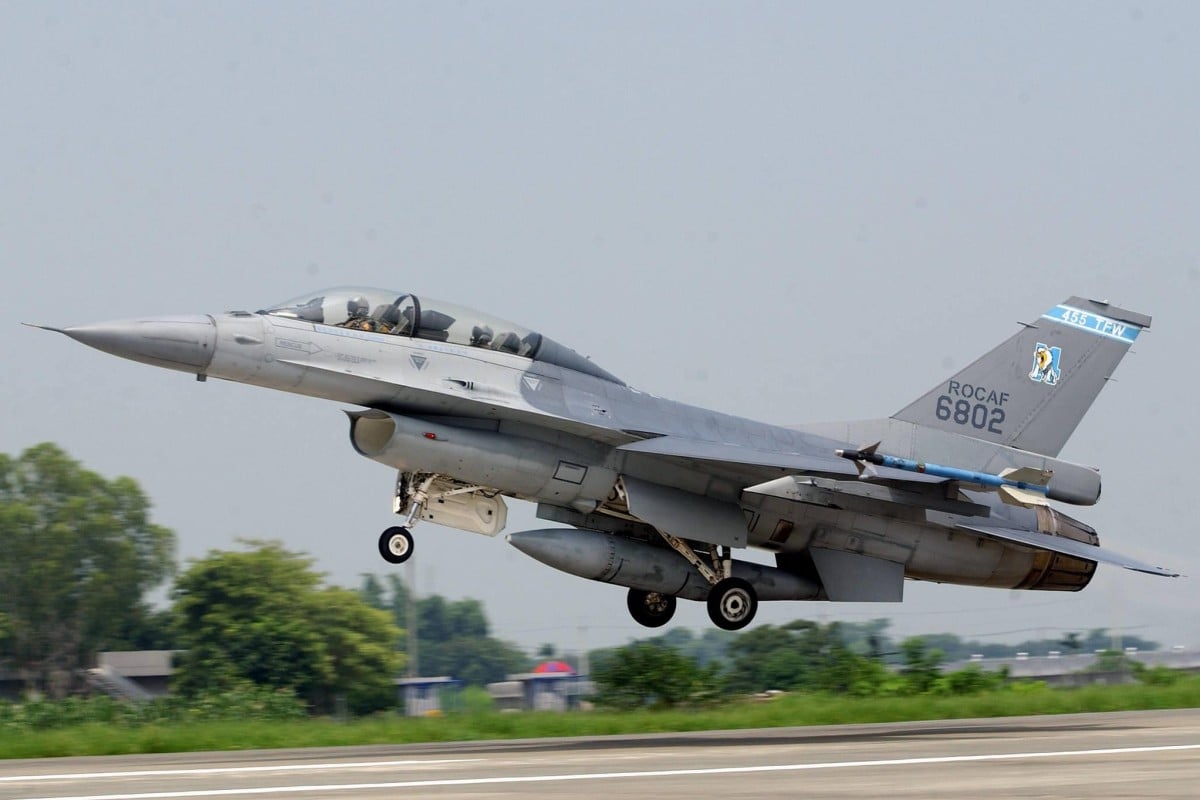
9Taiwan has launched a military exercise including F-16 fighter jets in response to Beijing’s war games, which began on Sunday. Photo: AFP
Taiwan has launched a military exercise including F-16 fighter jets in response to Beijing’s war games, which began on Sunday. Photo: AFP
Taiwan responded to Beijing’s military drill targeting the self-ruled island by deploying its most advanced fighter jets and firing 117 medium and long-range missiles on Monday and Tuesday.
Defence ministry spokesman Lee Chao-ming said the missiles were fired from the Jiupeng military base to waters off eastern Taiwan, with a range of 250km (155 miles), in an exercise covering five types of training for the island’s forces.
On Monday, Taiwan’s air force also dispatched two F-16 fighter jets armed with AGM-84 Harpoon missiles in a simulation of an attack off the island’s southeast coast.

Song Zhongping, a military commentator based in Hong Kong, said the Taiwan drill was aimed at the mainland Chinese exercise which began on Sunday. The location of the Taiwan drill meant its missiles’ electronic data could avoid detection by the People’s Liberation Army’s radar, he said.

Chinese military starts Taiwan Strait drills amid rising tension

“Taiwan is focusing on boosting self-defence, and building up a comprehensive air and sea defence network to counter military threats from the mainland,” Song said.

“The test firing of missiles is to boost the island’s self-defence capability. The military drill of the PLA has triggered a lot of concerns in Taiwan, and Taiwan is responding to it also through a strong military means.”

The PLA launched two large-scale military drills close to the Taiwan Strait on Sunday, after a notice issued by the Zhejiang Maritime Safety Administration prohibited ships from entering the waters off the coast of the eastern province between 6pm on Saturday and 6pm on Thursday.

The Guangdong Maritime Safety Administration said another set of military exercises would be held in the waters off Fujian province between Monday morning and Friday evening.

Observers said they expected PLA forces from the Southern and Eastern commands – whose area of responsibility includes Zhejiang and Fujian, which lie across the strait from Taiwan – to take part in the exercises.

Japan’s Ministry of Defence said on Monday that six Chinese warships had passed through the Miyako Strait – a waterway lying between Okinawa Island and Miyako Island – presumably in preparation for the drills.

Japanese military vessels said a Chinese class-three missile destroyer – a type 054A missile frigate – was sailing 240km north of Miyako Island on Saturday.

On Thursday, Japanese ships reported China’s type 052D destroyer Xining, type 054A missile frigate Daging, the guided missile frigate Rizhao, and the ocean comprehensive supply ship Hulun Lake, all entered the Pacific Ocean through the Miyako Strait.

This is China’s first war game to involve simultaneous exercises at two locations in waters near Taiwan since the 1995–96 Taiwan Strait Crisis, during which the PLA conducted a series of large-scale live-fire exercises in response to then-Taiwanese leader Lee Teng-hui’s visit to the United States, and ahead of the Taiwanese presidential election.

Source: SCMP

30/07/2019

China jails award-winning cyber-dissident Huang Qi

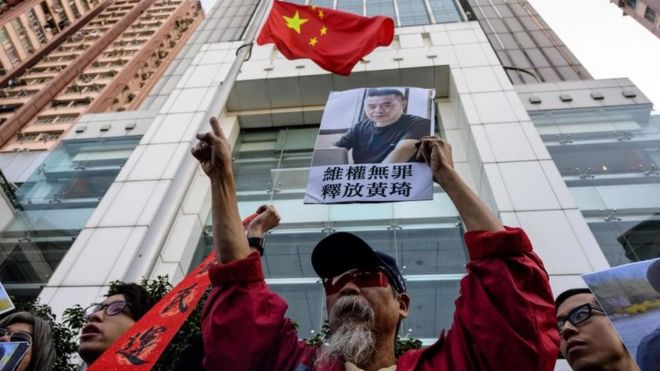
Huang Qi placardImage copyright GETTY IMAGES
Image caption Pro-democracy campaigners in Hong Kong have previously demanded Huang Qi’s release

A Chinese court has sentenced a civil rights activist widely referred to as the country’s “first cyber-dissident” to 12 years in jail.

Huang Qi is the founder of 64 Tianwang, a news website blocked in mainland China that covers alleged human rights abuses and protests.

An official statement said he had been found guilty of intentionally leaking state secrets to foreigners.

Huang has been detained since being arrested nearly three years ago.

He has already served previous prison sentences related to his journalism.

The statement, from Mianyang Intermediate People’s Court, added Mr Huang would be deprived of his political rights for four years and had also been fined 20,000 yuan ($2,900; £2,360).

Huang has kidney and heart disease and high blood pressure. And supporters have voiced concern about the consequences of the 56-year-old remaining imprisoned.

“This decision is equivalent to a death sentence, considering Huang Qi’s health has already deteriorated from a decade spent in harsh confinement,” said Christophe Deloire, the secretary-general of Reporters Without Borders.

The press-freedom campaign group has previously awarded Huang its Cyberfreedom Prize. It has now called on President Xi Jinping to “show mercy” and issue a pardon.

Amnesty International has called the sentence “harsh and unjust”.

“The authorities are using his case to scare other human rights defenders who do similar work exposing abuses, especially those using online platforms,” said the group’s China researcher Patrick Poon.

Repeated arrests

Huang created his website in 1998 to help people search for friends and family who had disappeared. But over time it began covering allegations of corruption, police brutality and other abuses.

In 2003, he became the first person to be put on trial for internet crimes in China, after he allowed articles, written by others, about the brutal crackdown of 1989’s Tiananmen Square pro-democracy protests to be published on the site.

That led to a five-year jail sentence.

He was subsequently sentenced to a further three years in prison, in 2009, after giving advice to the families of children who had died in an earthquake in Sichuan the previous year.

The relatives had wanted to sue the local authorities over claims that school buildings had been shoddily built – a claim the central government denied.

Huang was detained again, in 2014, after 64 Tianwang covered the case of a woman who had tried to set herself on fire in Tiananmen Square to coincide with the start of that year’s National People’s Congress.

Then he was arrested in November 2016 and accused of “inciting subversion of state power”, since when he has been incarcerated.

Since then, several human rights organisations, including Freedom House and the China Human Rights Lawyers Concern Group, have called for his release and raised concerns about reported threats to his 85-year-old mother, who had been campaigning on his behalf.

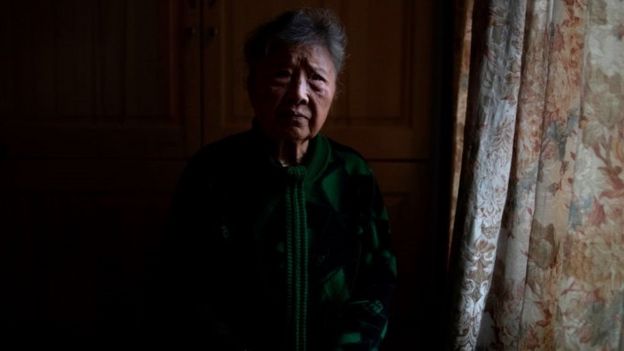
Pu WenqingImage copyright GETTY IMAGES
Image caption Huang’s mother, Pu Wenqing, had travelled to Beijing to plead her son’s case

And in December 2018, a group of the United Nations’ leading human rights experts also pressed for Huang to be set free and be paid compensation.

According to Reporters Without Borders, China currently holds more than 114 journalists in prison.

Source: The BBC

30/07/2019

Reckitt cuts sales target as China infant formula demand slows

LONDON (Reuters) – Reckitt Benckiser (RB.L) cut its full-year revenue target after reporting lower than expected second-quarter sales in its last quarter under long-time chief executive Rakesh Kapoor, hurt by a surprise slowdown in demand for infant formula in China.

Shares of the British household goods maker, which had risen the previous day to near their highest level for the year, fell as much as 5.7% in early trade.

The Durex condom and Lysol disinfectant maker said it now expects full-year like-for-like sales growth of between 2% and 3%, down from its previous target of 3% to 4%.

Reckitt, which maintained its “broadly flat” operating margin target, said slowing birth rates over the past two years and increased competition had led to market share losses for its Enfamil infant nutrition products in China, its biggest market for baby food.

The company is also recovering from supply chain disruptions in China, after technical issues at a baby formula factory in the Netherlands, which supplies the Asian market, prevented it from supplying retailers with formula in the third quarter of 2018.

The disruption forced mothers to turn to rival products and in part helped rival Danone (DANO.PA), which last week reported strong infant nutrition sales in China as its strategy to focus on more premium products paid off.

For Reckitt, the slowdown resulted in a surprise 1% drop in like-for like sales in its health business, even as sales of its over-the-counter products, such as Mucinex cough medicine, rebounded after several quarters of decline.

Analysts were expecting Reckitt’s Health business, which also sells Scholl foot products and Nurofen tablets, to rise 1.3%.

“Within Health, Infant and child nutrition was a big negative surprise,” Bernstein analyst Andrew Wood said, adding he expects the business to grow in the third quarter as it faces an easier comparison with last year.

DISAPPOINTING PERFORMANCE

Overall like-for-like sales were flat in the second quarter, missing the 1.9% growth analysts on average had expected, according to a company supplied consensus.

Net revenue rose 2% to 3.08 billion pounds against analysts’ average estimate of 3.13 billion.

The second-quarter report is the last under Chief Executive Rakesh Kapoor, who in September hands over to PepsiCo executive Laxman Narsimhan.

Kapoor said on a media call he was disappointed by the company’s performance in the first half but was “confident growth would be second-half weighted.”

Kapoor, CEO for the past eight years, said he was bullish that increased investments behind its brands and in medical channels, as well as new products such as Mucinex Night Shift and Enfagrow Pro Mental, and its expansion into new cities in China would help drive that growth.

He also said a plan to split the group into two business units – one for health and one for hygiene and home products – was on track for completion in mid to late 2020.

Still, analysts said the new CEO has a tough task.

“The patchy half-year figures mean the incoming CEO Laxman Narasimhan has a difficult job on his hands to try and put the business back on track, as well as decide the strategic future direction of the group,” investment firm AJ Bell said.

Reckitt shares were down 3% at 6,469 pence by 0830 GMT and were among the biggest losers in the FTSE .FTSE index.

Source: Reuters

30/07/2019

Punjab: India state launches ‘gun for plants’ scheme


A man poses with plant saplings before applying for a gun licenseImage copyright COURTESY: CHANDER GAIND
Image caption Applicants for gun licenses must plant at least 10 saplings and submit ‘selfies’ as proof

Guns and plant saplings are an odd combination – but in India’s northern Punjab state, the two are now linked.

For a month now, applicants in the state’s Ferozepur district have had to plant at least 10 saplings before applying for gun licences.

“Punjabis are mad about cars, weapons and mobiles. Let them be mad about plantations too,” District Commissioner Chander Gaind told the BBC.

Mr Gaind said applicants would have to submit selfies with the saplings.

“With roads being widened at a [fast] rate, trees are being cut in very large numbers, so this was the need of the hour,” he added.

With 360,000 licensed gun holders, Punjab has the third largest number of licenses in India, government data shows.

But a selfie with a sapling does not guarantee one of the much sought after licences. It merely means the application will be “considered” for processing.

The order was issued on 5 June to coincide with world environment day, but has only now picked up traction in local media as more people have started complying.

Mr Gaind says they have received at least 100 applications – along with selfies – since the order was passed.

But simply planting saplings and taking selfies with them is not enough – applicants also have to submit follow-up selfies a month later, proving that they are nurturing the plants.


Source: The BBC
29/07/2019

Experts accuse U.S. of using Xinjiang to interfere in China’s domestic affairs

URUMQI, July 28 (Xinhua) — A group of Chinese experts have criticized the United States for adopting double standards on counterterrorism and deradicalization and using Xinjiang-related issues as a tool to interfere in China’s domestic affairs.

The experts, who specialize in studies in the fields of human rights, international relations and anti-terrorism, made the remarks at a seminar held recently in Urumqi, capital of Xinjiang Uygur Autonomous Region.

Wang Yu, an associate researcher with the Institute of Chinese Borderland Studies, said China’s anti-terror measures implemented in Xinjiang in recent years have provided a new solution to the global fight against terrorism.

For some time China’s Xinjiang has seen frequent incidents of terrorist attacks, but over the past nearly three years, there have been no such incidents in the region, Wang noted.

Gu Liyan, a researcher with the Xinjiang Academy of Social Sciences, accused the United States of using human rights issues to erode public trust in governments of some other countries and create social conflict and unrest there, so as to attain its global hegemony.

“Whatever measures or policies China implements on counterterrorism and deradicalization will never accord with the so-called human rights standards of the U.S.,” she said.

Li Wei, a researcher with the China Institute of Contemporary International Relations, said education and training centers were established in Xinjiang in order to prevent trainees from falling victim to terrorism and extremism.

China’s measures on deradicalization offer a successful case study to the international community and have won widespread recognition and acclaim, said Li.

Shu Hongshui, an anti-terror expert at Northwest University of Political Science and Law, said the U.S. adoption of double standards on counterterrorism and deradicalization is intended to curb China’s development.

The propaganda warfare waged by the United States and some other Western countries against China on Xinjiang-related issues is unable to conceal their strategic anxiety and predicament, Shu said

Source: Xinhua

29/07/2019

Chinese missile destroyer partakes in Russian naval parade

RUSSIA-ST. PETERSBURG-NAVY DAY-CHINESE WARSHIP

Sailors in full dress line up on the deck of Chinese missile destroyer Xi’an during the military parade marking Russia’s Navy Day on the sea near Kronshtadt islet off the shore of St. Petersburg, Russia on July 28, 2019. Chinese missile destroyer “Xi’an” of the 32nd Chinese naval escort fleet participated in a military parade here marking Russia’s Navy Day on Sunday. (Photo by Li Hao/Xinhua)

ST. PETERSBURG, Russia, July 28 (Xinhua) — Chinese missile destroyer “Xi’an” of the 32nd Chinese naval escort fleet participated in a military parade here marking Russia’s Navy Day on Sunday.

Russian President Vladimir Putin reviewed the Chinese warship along with Russian vessels and an Indian frigate on the sea near Kronshtadt islet off the shore of St. Petersburg.

The audience stood up cheering and applauding when the Chinese missile destroyer with its sailors in full dress lining up on the deck passed them.

A total of 12 Russian warships and submarines as well as dozens of aircraft took part in the parade.

Source: Xinhua

29/07/2019

Senior CPC official meets French Communist Party delegation

CHINA-BEIJING-HUANG KUNMING-FRENCH DELEGATION-MEETING (CN)

Huang Kunming, a member of the Political Bureau of the Communist Party of China (CPC) Central Committee and head of the Publicity Department of the CPC Central Committee, meets with a delegation of the French Communist Party (PCF) led by PCF’s National Secretary Fabien Roussel in Beijing, capital of China, July 28, 2019. (Xinhua/Rao Aimin)

BEIJING, July 28 (Xinhua) — Huang Kunming, a member of the Political Bureau of the Communist Party of China (CPC) Central Committee, met with a delegation of the French Communist Party (PCF) on Sunday.

Huang, also head of the Publicity Department of the CPC Central Committee, said the CPC cherishes its traditional friendship with the PCF. He called on the two parties to enhance dialogues and exchanges and forge closer relations.

The Chinese side will make joint efforts with the French side to safeguard multilateralism, cope with global challenges and build a community with a shared future for mankind, Huang added.

PCF’s National Secretary Fabien Roussel, also head of the PCF delegation, said the PCF will beef up cooperation with the CPC for better development of the two countries’ relations and benefits for the two peoples.

Source: Xinhua

Law of Unintended Consequences

continuously updated blog about China & India

ChiaHou's Book Reviews

continuously updated blog about China & India

What's wrong with the world; and its economy

continuously updated blog about China & India