02/07/2019

China Focus: Garbage sorting games in Shanghai win hearts of young people

SHANGHAI, July 1 (Xinhua) — As Shanghai starts mandatory garbage sorting on Monday, games and toys that explore fun ways to spread garbage sorting knowhow are gaining popularity among young people.

A 15-second video of a VR game went viral on Chinese social media in the past few days. In the video, players wearing VR equipment could see four different types of trash cans in front of them, and they threw different types of garbage appearing in front of them into the corresponding buckets to score.

This garbage sorting VR game debuted at the Mobile World Congress Shanghai last week. Although this is not the only VR game in the venue, visitors lined up around the booth to explore the game because of its garbage sorting theme.

“As a Shanghai resident, I am in great need of this game. Maybe I won’t need to check how to categorize each garbage on my phone while going through all my garbage every day if I play this game more often,” said Zhou Zhou, a young Shanghai resident. Although the game has not launched officially, Zhou said she was very much looking forward to it.

Some social media users have recently complained about the difficulties in sorting different types of garbage in Shanghai.

Wu Xia, founder and CEO of VitrellaCore, the company that created the game, said the purpose of this VR game is to provide an interesting method for learning garbage sorting.

“It’s simple and easy to understand. Residents can practice garbage sorting knowledge without actually going through the rubbish, and it is also a more effective method than paper materials when training garbage sorting volunteers,” Wu Said.

GARBAGE SORTING NO CHILD’S PLAY

Shanghai is widely promoting a mandatory garbage sorting system, which requires residents to throw away garbage at a fixed time and place. There is a designated garbage disposal site for every 300-500 households, where volunteers carefully check whether household waste is accurately classified.

The city enacted a set of regulations on household garbage sorting and recycling from Monday, which requires residents to sort household garbage into four kinds: dry refuse, wet trash, recyclable waste and hazardous waste. Individuals who fail to sort garbage may be fined up to 200 yuan (about 29 U.S. dollars).

Wu said many streets and neighborhoods in Shanghai have expressed their willingness to cooperate, and the company hopes to launch VR games in more places for residents to experience for free.

“GARBAGE SORTING IS FUN”

On Taobao, an e-commerce platform under Alibaba, the sales volume of a garbage sorting toy increased by nearly 300 pieces on Sunday. This set of toys consists of four miniature sorting bins, with cards representing various types of garbage.

Most of the buyers of this toy are from Shanghai, and the toy is almost out of stock due to strong sales, according to the shop’s customer service representative.

One residential community called Jiayou in Shanghai’s Jiading District ordered several toys for its residents. “We hope to raise children’s interest in garbage sorting,” said Xing Minxia, secretary of the Jiayou Community branch of the Communist Party of China.

“Most garbage sorting volunteers are retired people, while young people are less involved. These innovative ways can win young people’s hearts and make them feel that garbage sorting is fun instead of a burden,” said Mao Qing, director of a community cultural activity center in Changning District.

Residents of this community have recently been keen on a mobile game called “Race Against Time.” In 45 seconds, players are required to move a trash bin of a specific category to accurately catch the garbage belonging to this category. Players who pass the game can participate in a lucky draw.

Fan Weicheng, deputy director of Shanghai Oriental Publicity and Education Service Center that developed the game, said about 21,000 people have played it since they launched the game in early June.

“We often see the elderly gathering around the garbage sorting knowledge boards in residential communities, but young people are hardly ever there,” Fan said. “We hope to involve more young people through mobile games.”

The garbage sorting VR game will be launched on the Steam platform and China’s Tencent WeGame platform in August this year, according to Wu.

“There will be more types of garbage and more gameplay at that time, but the core of the game will always be to teach people about garbage sorting in a fun way,” Wu said.

Source: Xinhua

02/07/2019

China Focus: China marks 98th anniversary of CPC’s founding

BEIJING, July 1 (Xinhua) — Monday marks the 98th anniversary of the founding of the Communist Party of China (CPC). Across the country, various types of events — book readings, concerts, visits to memorials, and renewing vows — have been held to mark the occasion.

Founded in 1921, the CPC has grown from a small party of about 50 members into the world’s largest ruling party, with more than 90 million members.

A brick-and-wood building on Xingye Road in Shanghai, where the CPC held its first national congress, has been packed with visitors in days leading to the anniversary.

In 1921, delegates representing about 50 CPC members nationwide convened the first national congress in the building, though they later had to move to a boat on Nanhu Lake in Jiaxing of east China’s Zhejiang Province due to harassment by local police.

The historic building has been open to the public as a museum since 1952.

Near Nanhu Lake, hundreds of members of the public gathered on a city square to present a chorus to wish the CPC a happy birthday. A relay run was held on Monday to commemorate the occasion.

Zhang Xianyi, the curator of the Nanhu Lake Revolution Museum, said the museum has become increasingly popular. On average, 11,000 people visit the museum and the boat every day. Last year, over 1.25 million people paid visits to the sites, he said.

Also on Monday, Li Jian, deputy manager-in-general of a private electronics maker in Zhengzhou, capital city of central Henan Province, had a new title. He was elected as head of a seven-member CPC branch in the company.

Li works in the Henan branch of the China Communication Technology Co., Ltd., a private company headquartered in Shenzhen.

Over the past decades, a growing number of private companies have set up CPC branches.

“By establishing a CPC branch, I hope the organizational life of CPC members can facilitate progress in achieving company goals,” Li said.

“As a CPC member myself, I hope I can play a leading role in guiding our staff forward,” he added.

Zhao Lei, an employee of the company and also a CPC member, said the spirit of Party building is in line with the entrepreneurial spirit in that it strengthens the sense of responsibility, innovation, attention to details and persistent learning.

“A strong CPC organization attracts people to the company and lends a competitive edge to it,” he said.

“Establish a CPC branch — only a good company actively seeks to do such a thing, if you ask me. This company has been an honest one. We have complaints, and it responds to them,” said company driver Su Nanju, who is not a CPC member.

Across the country, an education campaign on the theme of “staying true to our founding mission” has been launched throughout the Party in which members are called on to keep firmly in mind the fundamental purpose of whole-heartedly serving the people and its historic mission of realizing national rejuvenation.

In southwest China’s Guizhou Province, a conference was held on Monday to commend outstanding CPC members in the battle against poverty. China vows to eradicate absolute poverty by 2020. In areas still perplexed by impoverishment, dedicated CPC members are leading the people to exert transformational changes.

“People say if you have a daughter, never marry her to someone from Qinggangba, because she would have nothing to eat but pickled vegetables,” said Leng Chaogang, Party chief of the Qinggangba village at the conference.

“But now, people here have become rich thanks to good policies of the Party, dedicated work of the cadres, and the relentless strength of the people. We will continue to work harder to make our lives better,” he said.

Source: Xinhua

02/07/2019

China welcomes DPRK, U.S., South Korea leaders’ meeting at DMZ

BEIJING, July 1 (Xinhua) — China on Monday said it welcomed the recent trilateral meeting among leaders of the Democratic People’s Republic of Korea, the United States and the Republic of Korea in Panmunjom truce village.

While describing the friendly meeting held at the demilitarized zone Sunday afternoon “constructive,” Foreign Ministry spokesperson Geng Shuang said the meeting achieved positive outcomes.

“In particular, the DPRK and the U.S. agreed to resume working-level dialogue in the immediate future, which is of great significance,” Geng said at a press briefing, adding that China supports the decision.

China remains committed to realizing the denuclearization of the Korean Peninsula, safeguarding its peace and stability, and settling problems via dialogue, said Geng, noting that President Xi Jinping’s recent visit to the DPRK has injected new vitality into the political settlement of the Korean Peninsula issue.

The interaction among the three parties is in line with their common interests and conforms to the general expectation of the international community, the spokesperson said.

“Under the current circumstances, China hopes the relevant sides can seize the opportunity to meet each other halfway, and actively explore effective ways of addressing each other’s concerns, so as to promote denuclearization on the Peninsula and strive for new progress in the political settlement of the Peninsula issue,” Geng added.

Source: Xinhua

02/07/2019

Chinese premier stresses reform, opening-up in revitalizing NE China

CHINA-LIAONING-DALIAN-LI KEQIANG-INSPECTION (CN)

Chinese Premier Li Keqiang, also a member of the Standing Committee of the Political Bureau of the Communist Party of China Central Committee, hears a briefing on development driven by the opening-up of Liaoning’s coastal areas while inspecting the Liaoning Port Group in Dalian, northeast China’s Liaoning Province, July 1, 2019. Li on Monday went on an inspection tour to Dalian. (Xinhua/Liu Weibing)

DALIAN, July 1 (Xinhua) — Implementing the policy of reform and opening-up is a crucial step toward the revitalization of northeast China, Chinese Premier Li Keqiang said Monday.

Li, a member of the Standing Committee of the Political Bureau of the Communist Party of China (CPC) Central Committee, made the remarks during his tour in Dalian, a coastal city in northeast China’s Liaoning Province.

The province should maximize the market’s decisive role in allocating resources while strengthening governmental regulation, Li said, calling for more efforts to improve the business environment by reducing administrative burdens and enhancing services.

Hailing Liaoning’s excellent geographic conditions for opening-up, Li said it should be dedicated to deepening domestic and international cooperation and pioneering the revitalization of the northeastern region.

In his visit to an innovation center for major equipment manufacturing, Li emphasized the significance of innovation in revitalizing northeast China, encouraging scientific researchers to produce more market-oriented products and push forward the upgrading of the industry.

At Dalian University of Technology, Li stressed the employment of university graduates and urged Chinese universities to place more emphasis on vocational training and education.

Source: Xinhua

02/07/2019

China Focus: China starts implementing tougher vehicle emission standards

BEIJING, July 1 (Xinhua) — Several provincial-level regions on Monday started implementing the “China VI” vehicle emission standards ahead of schedule to ramp up efforts against a major source of air pollution.

Sales and registrations of new vehicles in regions including Beijing, Shanghai, Tianjin, Hebei Province and Guangdong Province now have to comply with what is believed to be one of the world’s strictest rules on automobile pollutants.

In Beijing, all new buses and other heavy-duty diesel vehicles shall follow the new emission rules, while all new vehicles are expected to follow suit starting Jan. 1, 2020.

All existing vehicles on the roads are obliged to meet the previous “China V” emission standards.

According to official data, emissions from some 6.2 million vehicles were responsible for 45 percent of Beijing’s concentration of small, breathable particles known as PM2.5, a key indicator of air pollution.

Compared with the “National V” standards, the new rules demand substantially fewer pollutants such as nitrogen oxides and particulate matters and introduce limits on particulate number and ammonia.

The new emission standards were initially set to take effect nationwide from July 1, 2020. A three-year action plan on air pollution control released last July urged early implementation in major heavily-polluted areas, the Pearl River Delta region, Sichuan Province and Chongqing Municipality.

Automakers and the market have been preparing for the tougher rules.

Manufacturers have completed the development of most “China VI” models and have entered the stage of mass production and sales, said Liu Youbin, a spokesperson with the Ministry of Ecology and Environment.

By June 20, 99 light vehicle makers had unveiled environmental protection information of 2,144 new models and 60 heavy-duty vehicle manufacturers unveiled information on 896 green models, Liu said.

“The market has basically accomplished a smooth transition,” Liu said.

Li Hong, an official with the China Association of Automobile Manufacturers (CAAM), said roll-outs of “China VI” vehicles as well as preferential tax and fee policies would boost China’s auto market.

“The production and sales of new energy vehicles (NEVs) will continue its relatively fast growth,” Li said.

Car sales in China continued to drop in May, with about 1.913 million vehicles sold, down by 16.4 percent year on year, CAAM showed. Bucking the trend, sales of NEVs kept growing that month, edging up 1.8 percent year on year.

China saw robust sales growth of NEVs in the first four months this year with 360,000 NEVs sold, surging by 59.8 percent from the same period a year earlier.

Chinese authorities have announced that the tax exemptions on NEV purchases will continue through 2020 to boost the country’s green development and retain a strong domestic market.

Source: Xinhua

02/07/2019

Rules of the house prove too much for Chinese housemaid

  • A Shanghai woman who set 20 ‘strict’ rules for her employee has sparked a fairness debate on social media
  • By 2025 it is estimated 5 million people will work in China’s home service industry
A list of rules for a new housemaid in Shanghai has sparked a debate on Chinese social media about the demands placed on workers in the home service industry. Photo: Shutterstock

The demands made on Chinese housemaids by their employers have triggered a heated debate after a Shanghai woman gave her new employee a list of 20 rules to memorise before she started work.

The new housemaid was required to sleep on the living room floor, change in to special clothes when caring for her employer’s baby, clean floors by hand with just a towel, and refrain from eating garlic.

Jail for Singapore woman who abused helper for doing chores slowly

According to Shanghai news channel STV, the woman, surnamed Zhou, offered 12,000 yuan (US$1,750) a month – far above the city’s average housemaid’s wage of 5,929 yuan – for someone to care for her baby and do the housework after her maternity leave.
The attractive compensation drew many applicants and a woman, surnamed Tang, was eventually offered the position. But when she was told of the rules she would have to follow, Tang rejected the offer.
“I have worked as a housemaid for 16 years, yet these are the strictest rules I have ever seen,” she said.
The 20 rules were divided into three parts: basic requirements and privacy protection, instructions for taking care of the newborn, and a set of personal hygiene requirements for the housemaid.

The list was leaked and circulated on a number of housemaid groups on WeChat, China’s most popular messaging app, before being posted on Weibo, China’s Twitter-like service, on June 29 where it quickly went viral. The hot trend attracted 140 million people to discuss and comment on the issue.

Saudi Arabia executes Filipino domestic worker for murder

Yet, others agreed with the employer, leaving comments like, “Actually, these rules are very basic, not immoral or unlawful”, and “I think is reasonable to raise the 20 rules with this high salary, if you cannot accept it then back to apply for the job with 4,000 to 5,000”.

The position was finally taken by a woman, surnamed Wang, who said, “Nowadays it is getting harder to earn money, no pain no gain. Housemaids are here for giving a high quality and friendly service, aren’t we?”

On Monday, Beijing Youth Daily reported the Shanghai Home Service Industry Association as saying the 20 rules were “strict and a rare requirement in the current home service industry, but didn’t contain any discrimination to the housemaid so it is a normal employer’s requirement”.

A 2018 report on China’s home service industry said there were more than 2.5 million people employed in home service work in 2016, and estimated that by 2025 the demand for household service would increase to 5 million.

On June 26, China’s State Council issued guidelines to improve standards in the home service industry. Among the recommendations were the establishment of courses to improve the quality of housemaids in China, the provision of health check services to the workers and the establishment of related laws to improve their working conditions

Source: SCMP
01/07/2019

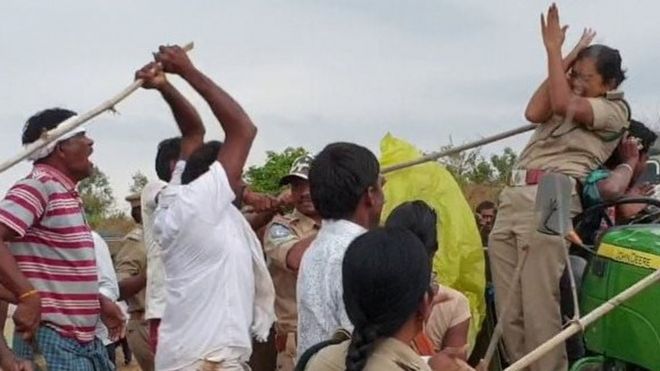
India arrests after mob attacks female forest officer

A still from the viral video in which a mob of men are seen attacking a woman forest officerImage copyright BBC TELUGU

Sixteen men have been arrested after a female forest official was brutally beaten with sticks by a mob as police officers watched in the southern Indian state of Telangana.

The mob, led by a member of the state’s ruling party, was protesting against a tree plantation drive on Sunday.

A video of the incident has gone viral, and the party’s president has condemned the attack on Twitter.

The forest officer is being treated in hospital for severe injuries.

A video of the incident shows the mob attacking the officer with bamboo sticks, as she stands on a tractor and tries to placate them.

She is repeatedly hit with the sticks until forest officials and local police step in to disperse the mob and contain the attack.

The footage has gone viral in India and led to outrage across the country.

This prompted a high-ranking official of the Telangana Rashtra Samithi (TRS) party, Kalvakuntla Taraka Rama Rao, to condemn the incident on Twitter.

Media caption ‘This ambitious water project killed my husband’

Two police officers, who were at the scene at the time of the attack, have been suspended for failing to protect the officer, BBC Telugu confirmed.

The incident occurred in the town of Kagaznagar, where the state’s forest department has been authorised to carry out a plantation drive as part of the Kaleshwaram project – a large irrigation scheme, which was inaugurated last week.

Opposition parties in the state, the Bharatiya Janata Party (BJP) and the Congress party, have strongly condemned the attack.

Source: The BBC

01/07/2019

Heavy rains batter India’s Mumbai, disrupting air, rail traffic

MUMBAI (Reuters) – Heavy rains battered India’s financial capital Mumbai on Monday causing disruption to the commuter train network, snarling traffic on water-logged streets and delaying flights from the country’s second-busiest airport.

The city, home to India’s two biggest stock exchanges and the headquarters of several major companies, has been hit by heavy rain since Sunday night and could get more over the next 24 hours, the weather department said.

Suburban trains were delayed by as much as two hours because the tracks were submerged under water while some long distance trains were cancelled.

Several flights were delayed by around half an hour, said a spokeswoman for Mumbai International Airport.
Thousands of commuters were stranded in trains and vehicles during peak morning hours as they tried to reach offices.
“Fifty minutes train journey took two and half hours today as railway tracks were flooded,” said Ketan Bondre, who works for a private sector company.
Although Mumbai is trying to build itself into a global financial hub, large parts of the city struggle to cope with annual monsoon rains.
Unabated construction on floodplains and coastal areas, as well as storm-water drains and waterways clogged by plastic garbage, have made the city increasingly vulnerable to chaos.
Floods in 2005 killed more than 500 people in Mumbai. The majority of deaths occurred in shanty town slums, which are home to more than half of Mumbai’s population.
Source: Reuters
01/07/2019

First China-Africa Economic, Trade Expo closes in central China

CHANGSHA, June 30 (Xinhua) — The first China-Africa Economic and Trade Expo closed Saturday in Changsha, the capital city of central China’s Hunan Province.

A total of 84 deals worth 20.8 billion U.S. dollars were reached in trade, agriculture, tourism and other fields during the three-day event, which saw 14 activities, including the opening ceremony, seminars, conferences and forums, as well as an exhibition.

Experts, businessmen and officials from China and African countries discussed the new methods of the cooperation between the two sides during the event.

International organizations including the United Nations Industrial Development Organization, the World Food Programme and the World Trade Organization have sent representatives to the expo.

The expo, with an exhibition area of more than 40,000 square meters, attracted over 100,000 guests and traders, including those from 53 African countries, according to the organizing committee.

Source: Xinhua

01/07/2019

Spotlight: Xi’s trip to Osaka drives multilateralism, G20 cooperation, global economy

JAPAN-OSAKA-XI JINPING-G20 SUMMIT

Chinese President Xi Jinping attends the 14th G20 summit held in Osaka, Japan, June 28, 2019. Xi called on G20 to join hands in forging high-quality global economy while addressing the 14th G20 summit held in the Japanese city of Osaka. (Xinhua/Xie Huanchi)

BEIJING, June 29 (xinhua) — Attending the summit of the Group of 20 (G20) major economies and holding meetings with his counterparts, Chinese President Xi Jinping paid a three-day visit to Osaka, Japan, which has proved a success with expanding consensus on the promotion of multilateralism and providing direction for both the G20 cooperation and global growth.

Chinese State Councilor and Foreign Minister Wang Yi made the remarks while noting that the 14th summit happened at a historic moment when chaos and uncertainties have brought the world to a critical crossroads, and that Xi’s tight diplomatic agenda marked China’s continuous efforts as a reliable and responsible major country to help with broad visions and workable solutions.

Envisioning a new type of international relations and a community with a shared future for mankind, Xi’s efforts were focused on promoting multilateralism, partnerships, mutually beneficial cooperation and joint development, which helped expand consensus, push forward cooperation, and increase confidence in global peace and development.

According to Wang, Xi’s speech at the G20 summit struck an extensive chord and China’s ideas received widespread support. In addition, the world is happy to see that Xi’s meetings with other leaders will help shape healthier major-country relations, that new opportunities will come with the new measures Xi announced for China’s further opening-up, and that Xi and U.S. President Donald Trump agreed that the two countries will restart trade talks.

WIDE CONSENSUS

During his trip to Osaka, by upholding multilateralism, the Chinese president guided the dialogue and discussions towards the direction of cooperation and inclusiveness in order to achieve win-win results.

Xi made four overseas trips since the beginning of June, setting a record for the history of the diplomacy of The People’s Republic of China, Wang said.

Xi put forward a four-point proposal in his speech at the summit, including exploring driving force for growth, improving global governance, removing development bottlenecks, and properly addressing differences.

Those proposals have outlined the direction to tackle the challenges facing the world economy, which is conducive to creating greater space for the global development and a better environment for international cooperation, Wang said.

With joint efforts, the G20 summit in Osaka has voiced support for multilateralism. It has been proven that upholding and practicing multilateralism is not just China’s choice, but a consensus and wish of the majority of countries in the world, Wang said.

Besides, on the sidelines of the G20 summit, Xi also attended a meeting of BRICS nations, China-Africa leaders’ meeting, China-Russia-India leaders’ meeting, and held a series of bilateral meetings.

During the meetings, Xi urged more efforts to promote global governance based on the principle of extensive consultation, joint contribution and shared benefits, safeguard the international system with the UN at the core and the international law as the foundation, preserve the multilateral trade regime with the World Trade Organization at the core and the rules as the foundation, promote multilateralism and free trade, push forward the democratization of international relations, and build an open world economy, Wang said.

Meanwhile, Xi met with Japanese Prime Minister Shinzo Abe with the two sides reaching a 10-point consensus to promote the development of bilateral relations.

When meeting with UN Secretary-General Antonio Guterres, Xi said the more complex and severe the situation is, the more necessary it is to highlight the UN’s authority and role.

Xi also exchanged views and reached new consensus with South Korean President Moon Jae-in on bilateral relations and the Korean Peninsula situation. Xi’s meetings with his French counterpart, Emmanuel Macron, and German Chancellor Angela Merkel will promote the in-depth development of China-Europe relations, Wang said.

Xi also met with Trump, South African President Cyril Ramaphosa, Indonesian President Joko Widodo during his visit.

COOPERATION, NOT CONFRONTATION

As China’s legitimate and lawful rights have been undermined by a series of unilateral and protectionist measures by the United States, China has to adopt necessary counter-measures, Wang said.

During the summit, Xi, at the invitation of his U.S. counterpart, met with President Trump, stating China’s stance on fundamental issues concerning the development of bilateral relations, and conducting candid communication over major challenges facing the two sides, Wang added.

Summing up the experience and illumination in the past the four decades since China and the United States established diplomatic ties, Xi said the two sides both benefit from cooperation and lose in confrontation, and that cooperation and dialogue are better than friction and confrontation.

China and the United States have highly integrated interests and extensive cooperation areas, and they should not fall into so-called traps of conflict and confrontation, Xi said.

On issues involving China’s sovereignty and dignity, China must safeguard its core interests, Xi stressed.

For his part, Trump said he values the good relationship with Xi and that it is of great significance for the two heads of state to maintain close contacts.

The U.S. side attaches importance to its relations with China, and harbors no hostility towards China, Trump said, adding that his country is willing to cooperate with China and that he hopes for better relations between the two countries.

During the meeting, Xi also reiterated the position of the Chinese government on the Taiwan issue, urging the United States to stick to the one-China principle and the three China-U.S. joint communiques.

The U.S. stance has not changed and it continues to pursue the one-China policy, Trump said.

When talking about the China-U.S. trade frictions, Xi emphasized that the essence of the China-U.S. economic and trade cooperation is mutual benefit and win-win, and that the two sides will eventually have to find a mutually acceptable solution to their differences through equal dialogue and consultation. Trump agreed with Xi in this regard.

Trump said the differences in such fields as economy and trade between the two sides should be properly settled, and that the United States will not add new tariffs on imports from China.

The most important consensus reached between the two heads of state is that China and the United States agree to continue to advance a China-U.S. relationship featuring coordination, cooperation and stability, Wang said.

They announced the restart of economic and trade consultations between their countries on the basis of equality and mutual respect. These significant consensuses send positive signals to the international community and global markets, Wang said.

As long as the two sides follow the principles and consensus established by the two heads of state, firmly grasp the correct direction of bilateral ties, expand cooperation based on mutual benefit, manage differences on the basis of mutual respect, and properly settle all problems that exist or will likely happen in bilateral relations, there is hope of a long-term and steady growth of the China-U.S. ties, and of more benefit to the two peoples and the people from other parts of the world, Wang said.

BRIGHT FUTURE OF CHINA

During the G20 summit and meetings with other world leaders, Xi explained China’s development philosophy and cooperation proposals.

According to Wang, Xi stressed that China is confident in pursuing its path, handling its own affairs well, achieving peaceful co-existence and win-win cooperation with all other countries, which has enhanced their understanding and support for China.

Stressing that the Chinese economy is registering a stable performance with good momentum for growth, Xi introduced a clear attitude and the latest measures on opening up the Chinese market, expanding imports, improving business environment as well as advancing free trade arrangements and regional economic integration, Wang said.

The Chinese president said China is breaking new ground in opening-up and pressing ahead with high-quality development.

Meanwhile, during the summit, Xi invited all interested parties to join the Belt and Road Initiative, amplifying the positive effects of the second Belt and Road Forum for International Cooperation.

Xi also advocated international cooperation in innovation so as to benefit more countries and people, Wang said.

According to Wang, all sides are optimistic about China’s development prospects, and believe that the new round of reform and opening-up measures announced by Xi are sincere and substantial, and the high-quality cooperation on building the Belt and Road corresponds with the trend of the times and the aspirations of people in the world.

It has been once again proven that China is a driving force for world economic growth, promoting openness in the world and providing a major market for other countries to explore business opportunities, Wang said.

Source: Xinhua

Law of Unintended Consequences

continuously updated blog about China & India

ChiaHou's Book Reviews

continuously updated blog about China & India

What's wrong with the world; and its economy

continuously updated blog about China & India