03/06/2019

China broadens participation in Mexico’s int’l culture fair

MEXICO-MEXICO CITY-CHINA-INT'L CULTURE FAIR

Chinese Ambassador to Mexico Zhu Qingqiao (C) poses for group photos with Facebook followers of China’s Cultural Center in Mexico during the annual International Friendly Cultures Fair at Mexico City’s Chapultepec Park, Mexico, June 1, 2019. China has been broadening its participation in the annual International Friendly Cultures Fair in Mexico, reflecting the growing bilateral ties between the two countries, Chinese Ambassador to Mexico Zhu Qingqiao said here Saturday. (Xinhua/Xin Yuewei)

MEXICO CITY, June 1 (Xinhua) — China has been broadening its participation in the annual International Friendly Cultures Fair in Mexico, reflecting the growing bilateral ties between the two countries, Chinese Ambassador to Mexico Zhu Qingqiao said here Saturday.

From May 31 to June 16, the fair at Mexico City’s Chapultepec Park is packed with exhibitors from more than 70 countries, with stands showcasing national cuisines, costumes and handicrafts, as well as books and other items.

China’s stand showed the country’s more than 5,000 years of history with photographs of key monuments and sites of interest, where visitors can take part in a traditional tea ceremony and savor dishes.

The cultural event offered Mexican people opportunities to learn about the Chinese culture, Zhu said. “China is a very active participant in this event and China has maintained very close ties with the Mexican government in recent years.”

The two countries have established a comprehensive strategic partnership and their cooperation is expected to further create win-win results in the progress of globalization, he added.

China’s Cultural Center in Mexico has issued special invitations to its Facebook followers for the fair.

Eduardo Aguera, 29, one of those who received a special invitation, said he has been a big fan of China since he first watched Chinese movies as a child.

“The Chinese have a lot of culture, many traditions and a long history, and in terms of their personality as negotiators or entrepreneurs, I think they are very persistent. They don’t give up, and they move forward,” he said. “I also think they are very friendly toward the Mexican people.”

Since it was first held in Mexico City in 2009, the event has attracted a total of more than 22 million visits, according to the organizers.

Source: Xinhua

03/06/2019

Where there are threats, there are defenses: Chinese defense minister on South China Sea

SINGAPORE, June 2 (Xinhua) — Chinese State Councilor and Defense Minister Wei Fenghe said here on Sunday that China’s construction on its South China Sea islands and reefs is its legitimate right and is purely defensive in nature.

“The current situation in the South China Sea is improving towards greater stability. It is attributed to the common efforts of the countries in the region,” Wei said. “However, there are always people trying to rake in profits by stirring up troubles in the region.”

He said over 100,000 ships sail through the South China Sea each year, and “none has been threatened.”

However, in recent years, some countries outside the region come to the South China Sea to flex muscles, in the name of freedom of navigation. “The large-scale force projection and offensive operations in the region are the most serious destabilizing and uncertain factors in the South China Sea,” he said.

If there is chaos in the South China Sea, the regional countries are the ones who will bear the brunt, and China and the Association of Southeast Asian Nations (ASEAN) countries have made progress in negotiating the Code of Conduct in the South China Sea, he added.

Wei noted that China’s construction on its South China Sea islands and reefs is legitimate and defensive in nature. “It is the legitimate right of a sovereign state to carry out construction on its own territory. China built limited defense facilities on the islands and reefs for self-defense,” he said.

“Where there are threats, there are defenses. In the face of heavily armed warships and military aircraft, how can we stay impervious and not build some defense facilities?” he asked.

He also refuted the saying of “militarization” of China’s defensive construction on its South China Sea islands and reefs at the Q&A session. “Anyone who has some military sense would know it’s not militarization,” he said.

Wei is here to attend the 18th Shangri-La Dialogue from Friday to Sunday, and he gave a keynote speech on Sunday morning at a plenary session entitled “China and International Security Cooperation.”

Source: Xinhua

03/06/2019

Chinese vice president visits Germany, vows closer cooperation

GERMANY-CHINA-WANG QISHAN-VISIT

Chinese Vice President Wang Qishan meets with German President Frank-Walter Steinmeier in Berlin, Germany, May, 31, 2019. Wang Qishan paid a visit to Germany from Thursday to Sunday at the invitation of the German Federal Government. (Xinhua/Rao Aimin)

BERLIN, June 2 (Xinhua) — Chinese Vice President Wang Qishan paid a visit to Germany from Thursday to Sunday at the invitation of the German Federal Government.

During his visit in Berlin, Wang met with German President Frank-Walter Steinmeier, Chancellor Angela Merkel and Foreign Minister Heiko Maas separately.

When meeting with Steinmeier, Wang said that China and Germany were both major world economies and major countries with great influence. The relations between the two countries have gone beyond bilateral scope and bear global significance.

Wang said in recent years the high-level contacts were frequent, and the cooperation in all fields has been constantly deepened, adding he is willing to push for new development of the all-around strategic partnership through his visit.

Noting the ties between China and Germany is currently facing a new situation, Wang called on the two countries to set a model of win-win cooperation for the world through deepening collaboration, to bring stability to the world through guiding the China-EU cooperation, and to strength the power to safeguard multilateralism through boosting global governance.

For his part, German President Steinmeier said that the current international landscape is complicated and turbulent, and multilateralism is under threat.

He noted that Germany highly values the ties with China, adding Germany is willing to strengthen communication and coordination with China at all levels, and to continue the pragmatic cooperations in Industry 4.0 and in other fields.

Germany and China, and Europe and China, should join hands to maintain the world peace and stability, free trade, and existing international orders, Steinmeier added.

When meeting with Merkel, Wang said China sticks to peaceful development, and will through steadily deepening reform and opening up, solve the existing problem of imbalance and insufficient development to meet people’s desire for a better life and to fulfill the promises of the party and the government to the people.

Wang said China cannot develop itself in isolation from the world, nor can the world develop without the 1.4 billion Chinese people, and China advocates countries to together build a community of shared future for humankind.

Facing the profound and complex changes in the international situation, China always insists on doing its own share firstly, staying calm and clear-headed, showing composure, shouldering responsibility and reacting rationally, he noted.

Wang called on China and Germany, as all-around strategic partners, to strengthen cooperation in building a more fair and reasonable global governance system, and to jointly face the uncertainties.

The Chinese vice president also said that China has always viewed Europe from a strategic height and with a long-term vision, and firmly supported the European integration. Wang added that China is a trustworthy partner for Europe to have dialogue on an equal footing.

Chancellor Merkel said Germany appreciates China’s great achievements in economic development and believes that China can definitely achieve the ambitious goals of eradicating poverty and finishing building a moderately prosperous society on schedule.

Facing the current complex and volatile international environment in which various new problems emerge, Merkel said, Germany is always committed to safeguarding the principle of multilateralism and the existing international order.

She noted that Germany advocates to strengthen international coordination and collaboration through dialogue, disagrees with the action of exerting threat and pressure to solve problems.

She believed that Germany and China, as well as Europe and China, share broad consensus on a wide range of issues, expressing Germany’s willingness to strengthen communication, exchanges and cooperation with China, and to improve global governance system jointly with China.

When meeting with Heiko Maas, Wang said China and Germany share common interests in many fields such as deepening pragmatic cooperation, safeguarding multilateralism and free trade, improving global governance and promoting world peace.

Looking to the next stage of the bilateral relations, Wang advocates that both sides should set the right direction for the Sino-German, Sino-European win-win cooperation, encourage the enhanced exchanges in ideology, talents as well as science and technology, cement the friendship between the two peoples, and to inject more positive energy into the world.

Echoing Wang’s comments, Maas said Germany is willing to strengthen strategic communication and cooperation on multilateral issues with China, as well as to jointly tackle global challenges, safeguard multilateralism and international order, promote the liberalization of international trade.

During his visit to Germany, Wang also met with mayor of Hamburg Peter Tschentscher and Bavarian governor Markus Soeder and visited the port of Hamburg.

Before his tour to Germany, the Chinese Vice president also visited Pakistan and the Netherlands.

Source: Xinhua

03/06/2019

Inside China’s state-owned industrial park in Vietnam, Beijing’s image trumps trade war profits

  • China-Vietnam (Shenzhen-Haiphong) Economic and Trade Cooperation Zone is only Chinese state-owned industrial park in Vietnam
  • Venture has attracted increasing interest since start of US-China trade war, but operators say first duty is to support Xi Jinping’s trade initiative
A total of 16 of the 21 Chinese companies that have relocated to the China-Vietnam (Shenzhen-Haiphong) Economic and Trade Cooperation Zone did so after the start of the US-China trade war. Photo: Cissy Zhou
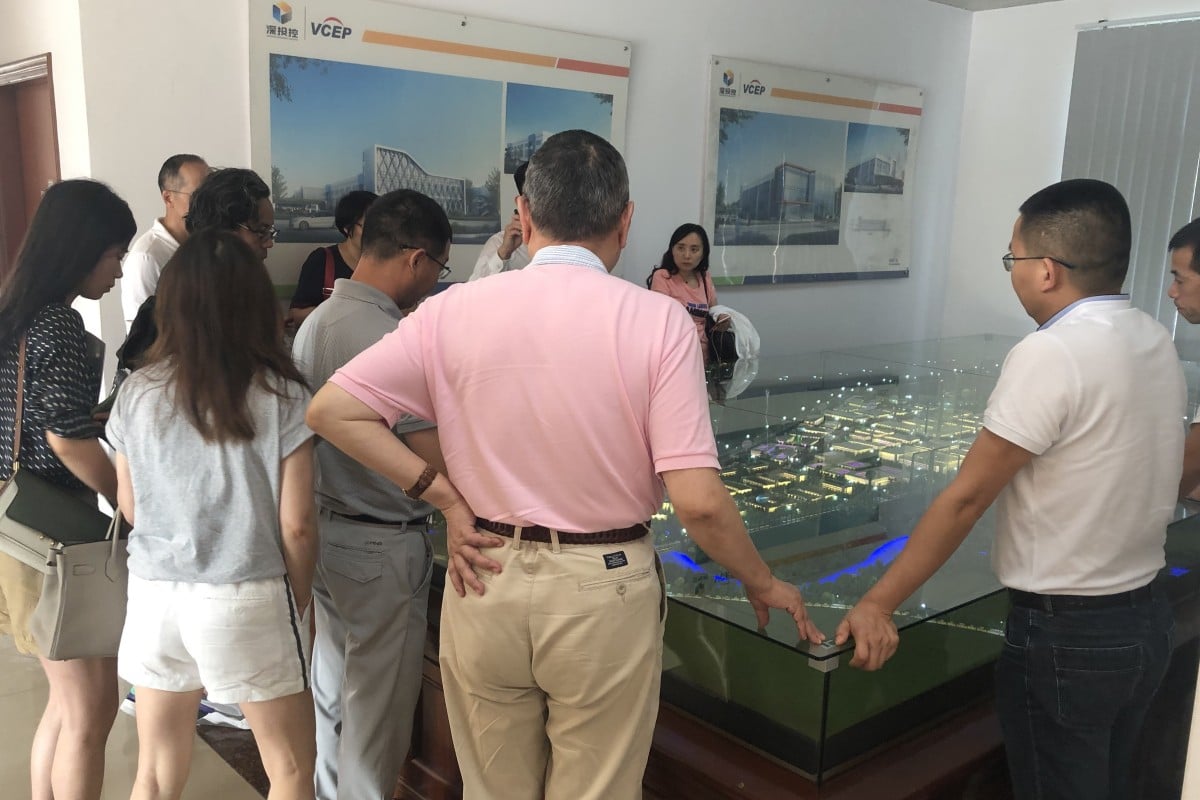
Until the middle of 2018, business was slow for the only Chinese state-owned industrial park in Vietnam, located in the northeastern manufacturing hub of Haiphong and wholly-owned by the Shenzhen city government.
US President Donald Trump’s tariffs on Chinese goods enacted last year changed that, with 16 of the 21 Chinese companies that have relocated to the China-Vietnam
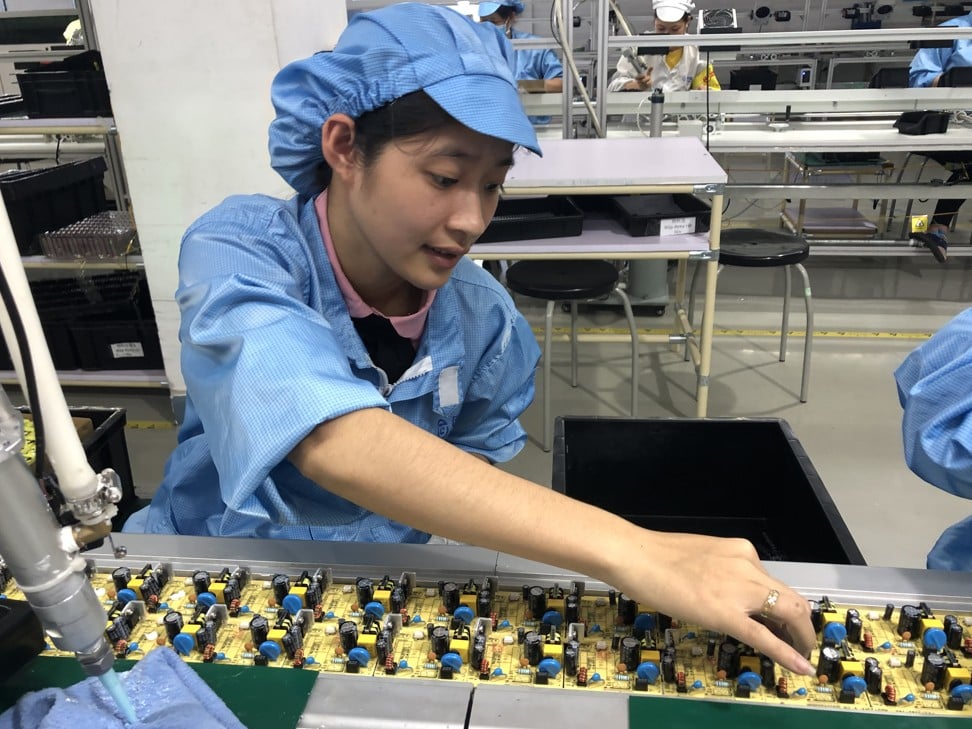
(Shenzhen-Haiphong) Economic and Trade Cooperation Zone – many of them electronic device manufacturers – having done so since the start of the trade war.
However, profit-making was never the top priority for the park’s operators, which took over the reins from private investors after a series anti-Chinese riots raged through southern and central Vietnam in May 2014 forced the owners to abandon the project.
Protesters set fire to other industrial parks and factories and attacked Chinese workers, killing more than 20 people and injuring more than 100.

While any commercial organisation would be thrilled at the rush of manufacturing firms into Vietnam, for the park’s operators, the first duty is to showcase the Chinese government’s top international economic cooperation project, the Belt and Road Initiative.

[They] requested that we make this industrial park a showcase for the Belt and Road Initiative, so that when our top leaders pay state visits to Vietnam, they can come to our park Chen Xu

The Shenzhen arm of the State-owned Assets Control and Supervision Commission (SASAC), which oversees all city owned companies “has requested that we make this industrial park a showcase for the Belt and Road Initiative, so that when our top leaders pay state visits to Vietnam, they can come to our park”, Chen Xu, vice general manager at the Vietnam-China Economic and Trade Cooperation Park (VCEP), told the South China Morning Post.
The Chinese industrial enclave in Vietnam is part of a largely untold story of the trade war. The common narrative is that Chinese and international firms are fleeing China to avoid paying tariffs, setting up in low-cost hubs in Vietnam and elsewhere in Southeast Asia, but the picture is more nuanced than that.

In Haiphong, a part of the Chinese government is actively encouraging firms to come to Vietnam, armed with US$200 million in investment capital and with a vision of creating 30,000 jobs by the time the entire three-phase project is completed in 2022.

The then-private VCEP project was suspended after the 2014 riots, and after the local government in Vietnam said it would reclaim the land unless it resumed, the Shenzhen government “decided to fully take over the project”, according to VCEP general manager Zhang Xiaotao.

Newcomers must now buy land from the park and build their facilities themselves as the original buildings have already been rented out. Photo: Cissy Zhou

“Our evaluation then was that we could not make a profit out of this project. Then why did we still take it over? We have to serve the Belt and Road Initiative, as it is a national strategy,” Zhang added. “In fact, we surrender part of our profit [because] we sell the land [in the park] at a lower price and with better facilities than in neighbouring industrial parks. We are still in the red based upon the current land price. Our bosses understand the situation and ask us at least not to lose money.

“To make a profit is of course the priority of any company. But we are different, we are not a pure commercial project.”

Furthermore, it is a commonly held assumption that China is only open to losing low-end, labour intensive and high-polluting industry, as it looks to upgrade its manufacturing profile domestically. And while there is certainly truth to that as examples of low-value Chinese manufacturing plants litter Vietnam, VCEP is keen to avoid that persona.

Because of the need to maintain a relatively high-profile, the park does not welcome labour-intensive manufacturers such as shoes factories, because “it is bad for our image”, Chen said. Instead, it is focused on hi-tech engineering – exactly the kind of industry China is desperate to nurture on its own soil. In this sense, the Shenzhen-Haiphong facility represents something of a paradox.

With 1,500 people currently employed, it is some way from reaching its 30,000 goal, but the number of Chinese manufacturers wanting to set up factories in the park is now about eight times what it was before the trade war started last July, according to both Chen and Zhang. Newcomers must now buy land from the park and build their facilities themselves as the original buildings have already been rented out.

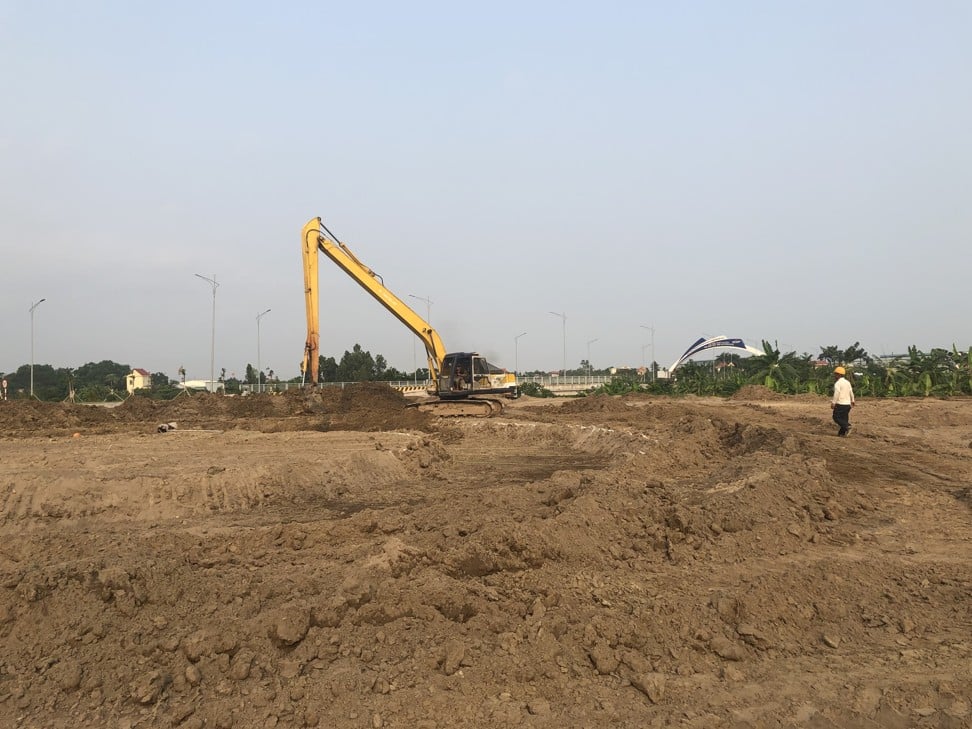
The relatively poor state of the surrounding infrastructure has also led VCEP to spend 30 million yuan (US$4.3 million) on a new road and bridge linking the park to the national highway in Haiphong.

“We could not wait for the Vietnamese government to build the infrastructure. They don’t have the money and their efficiency is low, so we built it ourselves,” said Li Meng, a member of VCEP’s Strategic Investment Department, who said it took less than nine months to finish the project.

The cost of the bridge was more than triple what it would have cost in China as “the efficiency is much lower here and we needed to import a lot of material from China due to lack of material in Vietnam”, Li added

“Every inch of the road and the bridge linking the national highway in Haiphong to VCEP is paved with renminbi.”

The Vietnam-China Economic and Trade Cooperation Park has a vision of creating 30,000 jobs by the time the entire three-phase project is completed in 2022. Photo: Cissy Zhou

TP-Link, the Shenzhen-based Chinese manufacturer of computer networking products, has rented a plant in the park and will start testing its equipment in July. The company, the world’s largest provider of consumer Wi-fi networking devices, has bought an additional 140,000 square metres of land in the park to expand production.

When TP-Link bought the land in late-2018, the price was between US$75 to US$80 per square metre, Chen said. Now, six months later, the price has risen to US$90 per square metre. This is indicative of the huge spike in interest in manufacturing in Vietnam caused by the trade war. Data from Vietnam’s Foreign Investment Agency shows that Vietnam attracted US$16.74 billion in foreign capital over the first five months of 2019, a year-on-year increase of 69.1 per cent. Of this, 72 per cent was invested in the processing and manufacturing sectors.

“Chinese local governments are, of course, unhappy with the increasing number of manufacturers who are relocating to Vietnam, but President Xi has clearly put forward the Belt and Road Initiative, which local governments cannot disturb. So local governments are not encouraging manufacturers to relocate, but they dare not try to stop them,” said vice-general manager Chen.

The Chinese inflow has also met with opposition in Vietnam, although far from the scale of the deadly riots of 2014.

“Some local [Vietnamese] media have been demonising China, with local prime time TV news talking about fake Chinese meat and poisoned food and hyping these cases. High-ranking Chinese officials have asked the Vietnamese government to guide public opinion in the right direction,” Chen added.

General manager Zhang added that the Vietnamese authorities have also become more sensitive to investment from China, a view reflected by Lam Thanh Ha, a senior lecturer at the Diplomatic Academy of Vietnam university which operates under the management of Vietnam’s Ministry of Foreign Affairs. “Overreliance on foreign cash in general and Chinese capital in particular may pose risks for Vietnam in terms of exchange rate fluctuations and external influences,” Ha warned.

“As production is generally dependent on transnational supply chains, foreign enterprises in Vietnam are often deeply engaged in both import and export processes, leaving the Vietnamese economy vulnerable to global economic conditions,” Ha added.

In a 

commentary published

by the Post earlier in May, Ha warned that Vietnam should avoid “becoming China’s dirty industrial backyard”, although Zhang had the opposite view.

“We are not shifting all our low-end industries to Vietnam, which would be irresponsible. China is trying to help Vietnam with sincerity, even if we don’t make a profit, we still want to proceed with the project,” he said.
Source: SCMP
03/06/2019

No compulsory Hindi in India schools after Tamil Nadu anger

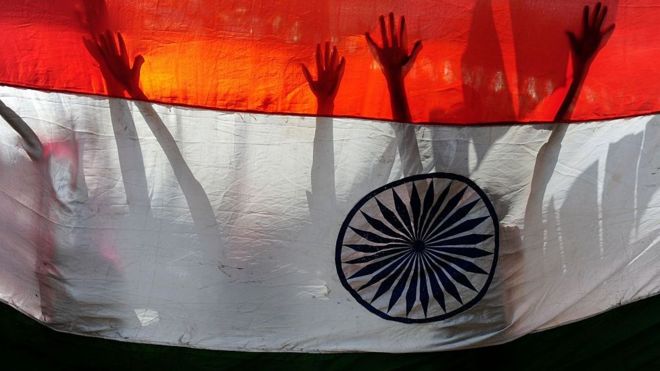
Indian schoolchildren are silhouetted against a national flag as they participate in Independence Day celebrations in Chennai on August 15, 2016.Image copyright GETTY IMAGES
Image caption Tamils argue that imposing Hindi will jeopardise their language

The Indian government has revised a controversial draft bill to make Hindi a mandatory third language to be taught in schools across the country.

The draft bill had met particularly strong opposition in the southern state of Tamil Nadu, which has always resisted the “imposition” of Hindi.

In 1965, it saw violent protests against a proposal that Hindi would be India’s only official language.

Tamil is one of the oldest languages and evokes a lot of pride in the state.

However the government decision has not calmed tensions in Tamil Nadu.

The two main political parties in the state, the DMK and AIADMK, have both said that simply revising the draft to say Hindi would not be mandatory is not enough.

The state teaches only two languages – Tamil and English – in the government school curriculum, and the parties do not want a third language introduced at all.

A DMK spokesman told the NDTV news channel that the third language clause would be used as a “back door” to introduce Hindi anyway.

Their rivals, the AIADMK, which allied with the Bharatiya Janata Party (BJP) in the general elections but lost badly in the state, had a similar view.

“Our party has always been clear in our stand. We have always followed a two-language policy. Though mandatory Hindi has been revised in the draft now, we still cannot support this three-language system. Our government will talk to the union government for our rights,” former state education minister and AIADMK spokesman Vaigaichelvan told BBC Tamil.

On Monday, #HindiIsNotTheNationalLanguage began trending on Twitter in India, which saw many from Tamil Nadu facing off against people from other parts of the country and asserting their right not to have the language “imposed” on them.

Skip Twitter post by @Akahrsh
Skip Twitter post by @AkbarHussaine
Presentational white space“There is no opposition to actually learning Hindi. In fact with the recent IT boom in the south, so many people from the north have migrated here that its use has become more widespread here. It is true that if you know Hindi you will find it easier to get work in other parts of India, so there are also many people here who willingly learn it. But that should be their choice. What people are opposing is the imposition of it,” senior journalist and political analyst KN Arun told the BBC.

Mr Arun also warned that there was a chance that the issue could lead to further protests in the state, saying that a few hardline Tamil groups had been using the issue to whip up anger among the people.

It is also a particularly emotive issue. Politics in the state is still centred around the ideas and principles of the Dravidian movement, which among other things reveres the Tamil language and links it closely to regional identity.

“Tamil is very rich in literature and different to other languages like Hindi which branched out of Sanskrit. There is fear that the Indian government is trying to slowly introduce Hindi, which will threaten the status of Tamil,” author and journalist Vaasanthi told the BBC.

Source: The BBC

03/06/2019

World’s 15 hottest places are in India, Pakistan as pre-monsoon heat builds

NEW DELHI (Reuters) – India warned of severe heat in northern and central areas on Monday, following similar extreme weather on Sunday.

Of the 15 hottest places in the world in the past 24 hours, eight were in India with the others in neighbouring Pakistan, according to weather monitoring website El Dorado.

Churu, a city in the west of the northern state of Rajasthan, recorded the country’s highest temperature of 48.9 Celsius (120 Fahrenheit) on Monday, according to the Meteorological Department.

Churu has issued a heat wave advisory and government hospitals have prepared emergency wards with extra air conditioners, coolers and medicines, said Ramratan Sonkariya, additional district magistrate for Churu.

Water is also being poured on the roads of Churu, known as the gateway to the Thar desert, to keep the temperature down and prevent them from melting, Sonkariya added.

A farmer from Sikar district in Rajasthan died on Sunday due to heatstroke, state government officials said.

Media reported on Friday that 17 had died over the past three weeks due to a heatwave in the southern state of Telangana. A state official said it would confirm the number of deaths only after the causes had been ascertained.

The temperature in New Delhi touched 44.6C (112.3F) on Sunday. One food delivery app, Zomato, asked its customers to greet delivery staff with a glass of cold water.

Heat wave warnings were issued on Monday for some places in western Rajasthan and Madhya Pradesh state.

The monsoon, which brings down the heat, is likely to begin on the southern coast on June 6, the weather office said last month.

The three-month, pre-monsoon season, which ended on May 31, was the second driest in the last 65 years, India’s only private forecaster, Skymet, said, with a national average of 99 mm of rain against the normal average of 131.5 mm for the season.

Source: Reuters

03/06/2019

Indian Air Force’s AN-32 aircraft with 13 onboard goes missing

airforce,India,breaking

An AN-32 aircraft of the Indian Air Force with 13 people onboard has gone missing after taking off from Jorhat in Assam.

The aircraft was headed to Mechuka Advance Landing Ground, the landing strip in the eastern Himalayas of Arunachal Pradesh’s West Siang district. The landing strip is about 30-odd km from the nearest point on the India-China border.

The transport aircraft took off from Jorhat at 12.25 pm.

It was in contact with ground agencies for the next 35 minutes. An Indian Air Force official said there had been no contact after 1 pm.

A total of eight crew and five passengers are onboard the aircraft.

News agency ANI said Sukhoi-30 combat aircraft and C-130 Special Ops aircraft had also been deployed on a search mission to locate the IAF aircraft.

Monday’s missing aircraft revived memories of the AN-32 that went missing while flying from Chennai to Port Blair in July 2016.
A massive search mission had been launched to find the 29 people on the transport plane. The IAF had then carried out 200 search sorties to cover over 2 lakh square nautical miles multiple times by these aircraft. The IAF court of inquiry later concluded that it was unlikely that the missing personnel on board the aircraft survived the accident.
Source: Hindustan Times
31/05/2019

China’s manufacturing index drops into negative territory in May as economic pressures mount

  • The manufacturing purchasing managers’ index (PMI), a gauge of sentiment among factory operators, fell to 49.4 in May
  • This was a decrease on April’s performance of 50.1, and below the median expectations of a poll of Bloomberg analysts, which had predicted a drop to just 49.9
An index reading above 50 indicates growth, while anything below 50 indicates a contraction. Photo: AFP
China’s manufacturing purchasing managers’ index fell further in May, suggesting the economy is continuing to slow amid the escalating trade war with the United States.
The manufacturing purchasing managers’ index (PMI), a gauge of sentiment among factory operators, fell to 49.4 in May, a decrease on 
April’s performance

of 50.1, and well below the median expectations of a poll of Bloomberg analysts, which had predicted a drop to 49.9. A reading of below 50 means that the activity in the sector is contracting.

The 49.4 reading was the lowest since February’s 49.2.
Non-manufacturing PMI, which covers the services and construction sectors, remained the same as last month at 54.3, in line with the expectations of the Bloomberg poll.
“The fall in the headline index was mostly driven by weaker new orders. Export orders dropped back particularly sharply, which suggests that [US President Donald] Trump’s latest tariff hike may already be undermining foreign demand,” said Julian Evans-Pritchard, senior China economist at Capital Economics.
“Stocks of raw materials continued to decline, reversing the build-up of inventories ahead of the 1 April VAT cut that helped to temporarily boost output in March.”

The composite PMI, which combines both manufacturing and services activity, was 53.3 in May, a slight decrease on 53.4 a month earlier.

An index reading above 50 indicates growth, while anything below 50 indicates a contraction.

The fall in the headline index was mostly driven by weaker new orders. Export orders dropped back particularly sharply, which suggests that [US President Donald] Trump’s latest tariff hike may already be undermining foreign demand.Julian Evans-Pritchard

The dip into contractionary territory for China’s manufacturing sentiment will be a concern to policymakers in Beijing, as they struggle to contain the effect the trade war is having on both economic mood and investment sentiment. While both composite and non-manufacturing PMIs remained above contraction levels, their stagnation points to continued challenges facing China’s economy.
The new data, released by the National Bureau of Statistics (NBS), combined with weaker economic data readings for April, suggest that Chinese growth slowed in the second quarter after stabilising at 6.4 per cent in the first quarter.
Details of the data show that within the manufacturing PMI, new orders were 49.8, down from 51.4 in April. Output also fell to 51.7, from 52.1 last month, while employment fell to 47.0 from 47.2 and new export orders plunged to 46.5 from 49.2.
Within the non-manufacturing PMI, the service sector was up to 53.5 from 53.2 in April, which the NBS said showed that “the service industry continued to maintain rapid growth”.
Details of the data show that within the manufacturing purchasing managers’ index, new orders were 49.8, down from 51.4 in April Photo: AFP

“China’s non-manufacturing business activity index was 54.3 per cent, which was the same as last month, indicating that the non-manufacturing industry continued to develop steadily and rapidly,” said the NBS statement.

Zhao Qinghe, senior statistician at the Service Industry Research Centre at the NBS, said that “there was some fluctuation in the manufacturing boom” and pointed to slowing demand as the cause of the slump.

“In May, the manufacturing PMI fell back. Among the 21 industries surveyed, 13 of the industry’s production indices are located in the expansion range, indicating that most industries in the manufacturing industry are relatively stable in production and operation,” said Zhao.

Among the 21 industries surveyed, 13 of the industry’s production indices are located in the expansion range, indicating that most industries in the manufacturing industry are relatively stable in production and operation.Zhao Qinghe

Zhao added that “the overall production and operation activities of Chinese enterprises have maintained a stable development trend”.
The deterioration in the PMI sentiment data was expected after the US escalated the trade war on May 10. From Saturday, a higher tariff of 25 per cent – increased from the earlier 10 per cent rate – will apply to US$200 billion of Chinese imports to the US. The US is also processing a tariff of up to 25 per cent on a further US$300 billion of Chinese goods, which would put significant further pressure on the Chinese economy. China has already retaliated by placing variable tariffs on US$60 billion of US imports.
Even before the escalation of the trade war, Chinese economic data in April was disappointing.
Retail sales growth slowed to 7.2 per cent in April – the lowest rate in 16 years – from 8.7 per cent in March, while industrial production growth slowed markedly to 5.4 per cent from 8.4 per cent. Exports fell 2.7 per cent in April compared with the same period in 2018, a sharp reversal from the 14.2 per cent rise in March.
While many private analysts expected the Chinese government to enact further 
fiscal and monetary stimulus

to offset the slowdown in growth, Beijing has so far refused to commit to doing so.

In part, the government is counting on already implemented personal and business tax cuts – including the trimming of the value-added tax rate for manufacturing firms – to gradually provide support for the economy.
Industrial profits stood at 515.39 billion yuan (US$74.7 billion) last month, down 3.7 per cent compared to a year earlier. Photo: AFP

The PMI rounds off a poor week for China’s economy after Monday’s industrial profits released by the NBS showed the fastest slump in almost three and a half years in April.

Industrial profits

stood at 515.39 billion yuan (US$74.7 billion) last month, down 3.7 per cent compared to a year earlier, the largest percentage decline since December 2015. With further tariffs about to kick in on

Chinese exports

, there is significant capacity for the downward trend to continue.

Fitch Ratings, in a

report earlier

this month, said that the escalation could lead to half a per cent being detracted from the Chinese economy this year, which would bring it to the lower limits of Beijing’s target growth range of between 6.0 and 6.5 per cent.

It is expected that a surge in orders will lead to a bumper month of exports in May and June as US importers and Chinese exporters attempt to front-load their stocks to beat the tariffs. 
Some exporters

are already shipping their stocks earlier, reporting has shown, as they look to manage the risk of the trade tariffs.

Source: SCMP
31/05/2019

China’s middle class growing desperate and anxious about US trade war impact

  • Fears of trade war impact also appear to be affecting willingness to spend and prompting moves to safeguard wealth in foreign currencies and gold
  • Rising food prices and unemployment levels adding to concerns despite state and social media urging nation to stand strong in face of adversity
Food prices jumped 6.1 per cent in April due to higher pork and fruit prices, with pork price increases accelerating to 14.4 per cent from 5.1 per cent in March. Photo: Reuters
China’s middle class, particularly better-educated white collar workers, are growing increasingly confused and anxious over how the trade war with the United States will affect the lives of ordinary citizens, in contrast to official press and social media which have been dominated by messages urging the country to stand strong in face of the adversity.
Concerns about the impact of the trade war, combined with rising food prices, are already affecting consumers’ willingness to spend, which could cause a further deceleration in Chinese economic growth.
These concerns may also increase efforts by the upper and upper middle classes to safeguard their wealth by buying gold or foreign currency and moving their wealth abroad.

For China’s urban middle class, who have benefited from the country’s economic boom in the last few decades and may have taken it for granted that life would be better, the intensified rivalry between China and the US is bringing a strong sense of uncertainty about their future, pushing citizens to scramble for any information about the trade war away from the official propaganda rhetoric.

“Please tell me the proper understanding of what the impact of the trade war will be on the lives of ordinary people like us. Thanks!” wrote Su Gengsheng, a popular online writer and blogger with more than 300,000 followers on China’s largest social media platform Weibo, four days after the 

US raised tariffs

on US$200 million of Chinese imports.

The post was unusual for Su’s extremely non-political account after she rose to popularity with cosmetics recommendations and make-up tips. However, the trade war question seemed to speak to the heart of the concerns shared by many of Su’s followers, and rapidly attracted thousands of replies and likes as well as more than 10,000 shares. Comments on the post were soon blocked because they “violated relevant laws and regulations”, although the original post was still visible.

Despite a lack of access to uncensored news, the adverse effects of the trade war have started to be felt and are rapidly becoming known throughout Chinese society. This is especially true for those who now have things to lose, including the value of their stocks and real estate, the chances of sending their children to study in the US, or even just being able to watch the final season of Game of Thrones on television.

The government’s nationalistic rallying cry, asking people to tighten their belts and to prepare for prolonged hardships, has further amplified concerns among those citizens who have worked hard to earn a comfortable lifestyle.

We used to think [a trade war] used to be absolutely impossible. Now I start to fear there will be a devaluation of the [yuan] in the near future, and even a more horrible situation aheadUnnamed Guangzhou-based exporter

“Recently, I often chat with my classmates and clients who live and work abroad. We talk very carefully as we are afraid of our WeChat account being blocked because of any sensitive content related to trade war news. But I really need to know more about what is really happening in the trade war and what will come next,” said a Guangzhou-based exporter in his 40s, who asked not to be named.
“In just two weeks, the mentality of my friends around me has changed. We used to think [a trade war] to be absolutely impossible. Now I start to fear there will be a devaluation of the [yuan] in the near future, and even a more horrible situation ahead if the two sides engage in a full-scale war, not only in trade and technology, but also in finance and the currency market.
“I would love it if all my fears were unnecessary, but I can’t help but have them. I think I might need to make a contingency plan, like keeping a certain amount of either yen, US dollars or Australian dollars in cash at home, only for emergencies in extreme situations. A problem may not arise, but now I really need to be aware of the possibility because of my family.”
The latest news on the economy and on the government’s response to the trade war has been unsettling for some, and came as a fresh blow to Chinese middle-class confidence on top of growing risks of inflation and unemployment.
Food prices jumped 6.1 per cent in April due to higher pork and fruit prices, with 
pork price

increases accelerating to 14.4 per cent from 5.1 per cent in March. Last week, Beijing set up a

special task force,

the State Council Employment Work Leading Group, to monitor the country’s employment situation, underscoring the government’s increasing concern over unemployment due to the continuing escalation of the trade war with the US and in the wake of recent high-profile lay-offs by the likes of Sony Mobile, Cisco Systems and Oracle.

“The yuan is sliding towards 7 to the US dollar, a 500-gram package of grapes has soared to 30 yuan (US$4.3) at the wet market, and Vice-Premier Hu Chunhua will head the group watching job market stress. There is more and more news on the effects of the trade war and how it is starting to impact our daily life,” said Yan Chao, a 30-year-old operations manager at a Shanghai-based advertising company.
“My job is very important for me as my wife is a housewife and we have a daughter who is just two years old. My parents are retired doctors and pay most of the mortgage for me. My wife and I are going to buy a new car through a car loan, but maybe it’s better to delay that plan until maybe next year when the economic situation becomes certain.”

The exchange rate with the US dollar hovered around 6.9 last week, but Li Yue, a veteran Shenzhen-based electronics engineer, has been converting some of his yuan savings at exchange rates of around 6.3, 6.5, and 6.7.

“It was very difficult to search for foreign technical information via the internet in the 1990s, and now I look longingly to that time. As a technologist, I have a full understanding that if Sino-US relations continue to deteriorate, or if China loses more orders from Western countries, many of the industrial supply chains developed in the past will soon be scrapped,” said Li Yue.

Other Chinese citizens are taking steps to safeguard their wealth due to fears of the effects of the trade war.

There is more and more news on the effects of the trade war and how it is starting to impact our daily lifeYan Chao
“I even heard some wealthy people are going to banks in Hong Kong to buy gold bars and keeping them in the bank for safety,” said Li Zhenbiao, a Guangzhou-based agent helping wealthy Chinese citizens emigrate and buy property overseas. “It’s a good choice if you are not optimistic about the [outlook for the] economy and the value of the yuan … but it’s a very new [practice] and just emerging. Not many people have acted yet to buy gold bars. After all, the investment threshold is high. Buying and stockpiling some dollars is the easiest thing to do for ordinary people.”
The high levels of debt held by many individuals is also of particular concern if the economy slows down further.
Eli Mai, a sales manager in Guangzhou, owns two flats with a total market value of 7 million yuan (US$1 million), with around 2 million yuan outstanding on the mortgages.

Mai, 35, spends most of his monthly salary, about 15,000 yuan (US$2,200), on his mortgage, while the family uses his wife’s income for daily expenses. At the beginning of last year, Mai felt that his career was stagnant and that his expenses were greater than his income. Therefore, he borrowed 300,000 yuan (US$43,400) from a local bank, with an average interest rate of over 5 per cent, and used the money to invest in a friend’s travel agency.

“The business is not profitable yet. I just pray that the trade war will end as soon as possible,” Mai said. “But on the other hand, I think it will be far from a happy ending.”

Source: SCMP

31/05/2019

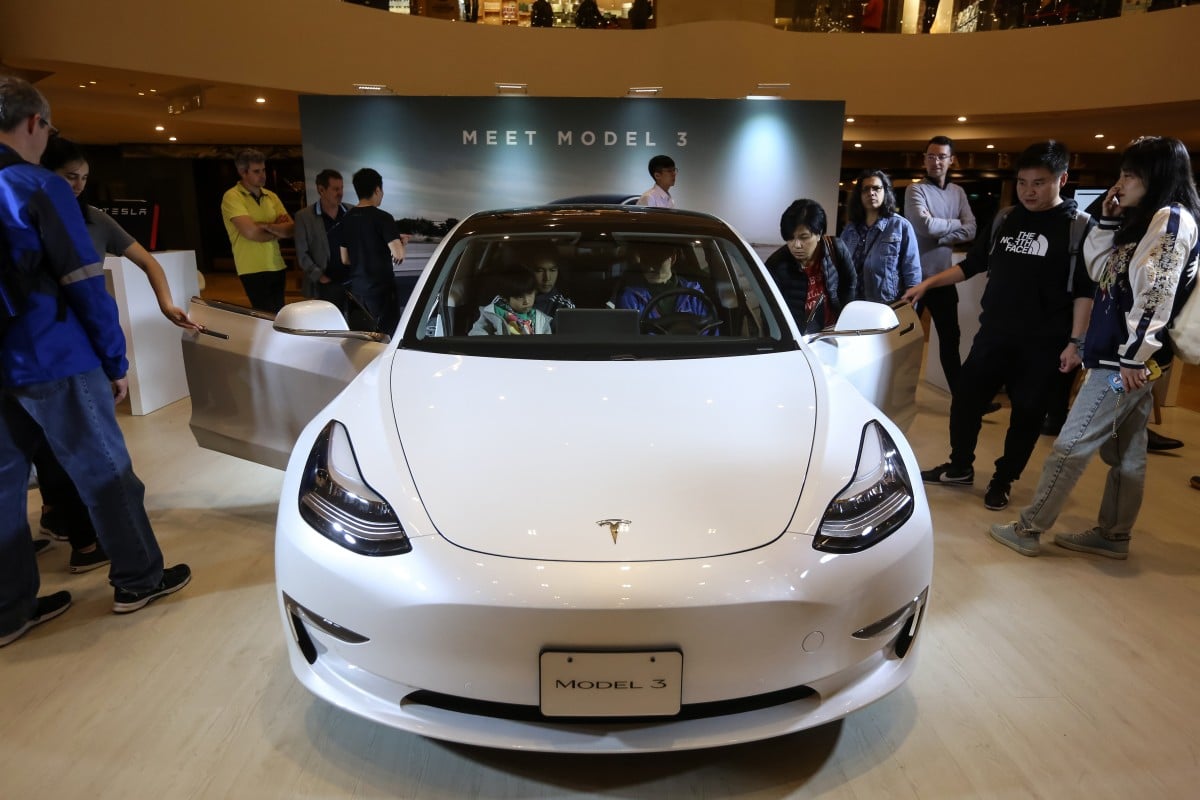
Tesla announces prices of made-in-China Model 3. At 328,000 yuan it’s 13 per cent cheaper than US imports

  • Deliveries will start in the next six to 10 months, carmaker says
  • Tesla will take on Chinese carmakers such as Geely and SAIC, and electric car start-ups including Nio and Xpeng Motors
Tesla said on Friday that its Model 3 electric car, which will be assembled in China, will be ready for deliveries in six to 10 months. Photo: AFP
Customers can pre-order the Model 3 assembled in China after Tesla announced on Friday that it would be priced 13 per cent lower than the US imports, taking the electric carmaker a step closer in tapping the world’s largest EV market.
The standard range plus Model 3 car that Tesla plans to assemble at the Gigafactory 3 in Lingang, Shanghai, will be priced at 328,000 yuan (US$47,529), 49,000 yuan cheaper than the same model currently imported from the US.
Tesla’s US-built cars are now subject to a 25 per cent import duty in China. The bestselling US electric carmaker plans to start deliveries in the next six to 10 months.

“Today we announced that Model 3 Standard Range Plus vehicles built at Gigafactory Shanghai will begin at 328,000 yuan for our customers in China,” Tesla said in a statement.

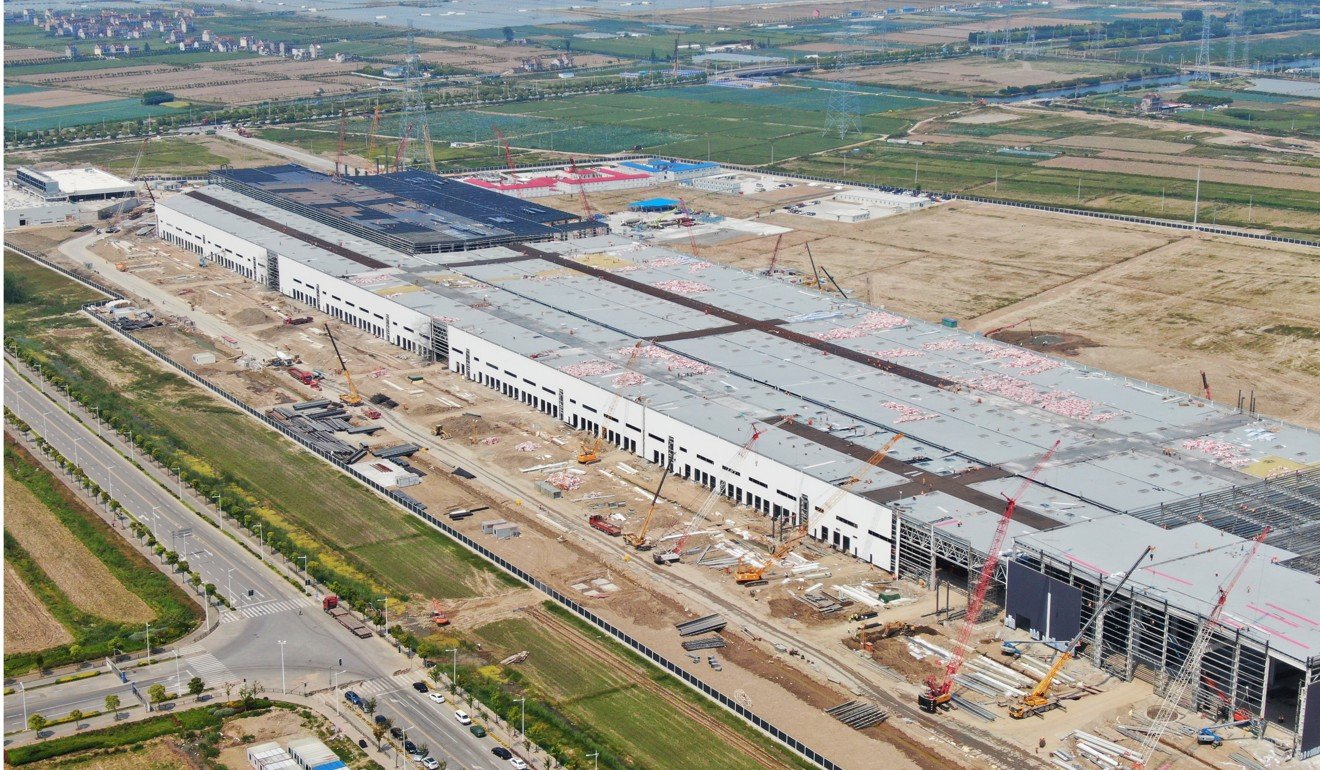
Aerial view of the Tesla Shanghai Gigafactory under construction in Lingang, Shanghai, on May 10, 2019. Photo: Imaginechina

The model has a range of 460km and a top speed of 225km/h.

Industry observers said that the price of the locally made car aimed at the mass market is on the higher side, adding that a 300,000 yuan price tag could attract thousands of Chinese buyers.

“If a Chinese customer can buy a Tesla car for less than 300,000 yuan, many of them will make a decision on the spur of the moment since it is viewed as the best EV in the world,” said Tian Maowei, a sales manager at Shanghai-based Yiyou Auto Service.

Tesla rushes Model 3s to China before trade war truce expires

US President Donald Trump has signed an executive order barring US companies from using telecoms equipment made by companies that pose a threat to national security, a move aimed at shutting out Huawei Technologies.

US technology companies including Google and Microsoft have severed business ties with Huawei to comply with the US trade ban.

Tesla’s Gigafactory 3 is expected to make around 3,000 Model 3 vehicles a week in the initial phase. Photo: AP

In January, Tesla started construction on a US$5 billion wholly-owned plant in Shanghai, the city’s single largest foreign direct investment just three months after it secured a land parcel to make electric cars locally.

The factory will produce Model 3 and Model Y electric vehicles that are seen as affordable to drivers in China.

Podcast: Here’s how the US-China tech war is affecting small electronics companies

Gigafactory 3 is expected to make around 3,000 Model 3 vehicles a week in the initial phase, ramping up to 500,000 per year when it becomes fully operational, Tesla said.

Tesla will take on Chinese carmakers such as Geely and SAIC and electric car start-ups including Nio and Xpeng Motors in China where sales of new-energy vehicles including battery-powered and plug-ins are expected to jump 27 per cent this year to 1.6 million units, according to the China Association of Automobile Manufacturers.

In March Beijing announced a cut in cash subsidies offered to NEV buyers by up to 60 per cent, believing it was time to remove the crutches and cull an industry that had spawned hundreds of small manufacturers.

It is unclear whether Tesla vehicles will receive subsidies from the Chinese government.

Source: SCMP

Law of Unintended Consequences

continuously updated blog about China & India

ChiaHou's Book Reviews

continuously updated blog about China & India

What's wrong with the world; and its economy

continuously updated blog about China & India