13/04/2019

Hundreds participate in march to commemorate Jallianwala Bagh massacre centenary

NEW DELHI (Reuters) – Hundreds of people holding candles and the national flag marched through the northern Indian city of Amritsar on Friday, on the eve of the centenary of the colonial-era Jallianwala Bagh massacre that British Prime Minister Theresa May has called a “shameful scar.”

On April 13, 1919, some 50 British Indian army soldiers began shooting at unarmed civilians who were taking part in a peaceful protest against oppressive laws enforced in the Punjab region.

At least 379 Sikhs were killed, according to the official record, although local residents said in the past the toll was far higher. The massacre took place in the walled enclosure of Jallianwala Bagh, which is still pocked with bullet marks.

The massacre became a symbol of colonial cruelty and for decades Indians have demanded an apology from Britain, including during Queen Elizabeth’s visit to Amritsar in 1997.

On Wednesday, May told the British parliament that “the tragedy of Jallianwala Bagh in 1919 is a shameful scar on British Indian history”, but she did not issue a formal apology.

In 2013, then British Prime Minister David Cameron described the killings as a “deeply shameful event” in a visitor book at the site, now marked by a 46-foot (14-metre) high flame-shaped memorial.

“There are events in the histories of nations which are difficult to forget and they hold a very emotionally charged space in a nation’s memory,” Navtej Sarna, a Sikh who has served as India’s High Commissioner to the United Kingdom, told Reuters.

“We have an excellent relationship with the United Kingdom today but it’s a question of assuaging sentiments and healing a wound which has been festering as part of our shared history.” India gained independence from Britain in 1947.

Security in the city – also home to Sikhism’s holiest shrine the Golden Temple – has been stepped up as hundreds of visitors and groups are likely to arrive at the site, Amritsar Police Commissioner S.S. Srivastava said.

Residents of the city, tourists, visitors, top government officials and students took part in the candle lit evening march from a building called Townhall to the massacre site.

The march of about one kilometre was accompanied by loudspeakers playing patriotic songs and onlookers thronged the roadsides. At the end of the march, people observed a two-minute silence.
Punjab state’s Chief Minister Amarinder Singh and Governor V P Badnore took part in the march while Rahul Gandhi, president of the opposition Congress party, was expected to visit the city later in the evening.
Source: Reuters
11/04/2019

China urges relevant countries to offer fair business environment for enterprises

BEIJING, April 10 (Xinhua) — China on Wednesday urged relevant countries to offer a fair, just and non-discriminatory business environment for enterprises of various countries, including Chinese ones.

Foreign Ministry spokesperson Lu Kang made the remarks at a routine press briefing when asked whether Australia applies double standards on the cybersecurity issue.

Recently, a number of Australian media reported that relevant Australian law mandated communication enterprises install “backdoors” for the Australian government. Google, Apple, Amazon and other technology companies have expressed serious concern about the act, saying it threatens cybersecurity in Australia and the world.

While the Australian side previously claimed that the country does not want any company in its communications networks that have an obligation to any other government. For this reason, Australia banned Huawei from the 5G telecommunications network.

Noting China has been closely following the relevant developments, Lu said the communication market and international cooperation will be seriously affected when it forces enterprises to install “backdoors” by legislation, which builds its own security and interests on the basis of violating other countries’ security and the privacy of their citizens.

“As you can see, the business communities have expressed serious concern about this,” Lu said.

A puzzling thing is that on the one hand, relevant countries use cybersecurity and sensationalize the so-called “security threat” of other countries or enterprises with trumped-up charges. On the other hand, they are doing things that endanger cybersecurity, Lu said.

“I am just as interested as you are in what the Australian government would say,” said the spokesperson.

Emphasizing that China has always attached great importance to and firmly maintained cybersecurity, Lu said that the Chinese side is willing to continue to actively participate in international cooperation in cybersecurity and work with all parties to build a peaceful, secure, open, cooperative and orderly cyberspace.

Source: Xinhua

11/04/2019

Chinese State Councilor calls for enhanced production safety, fire control

CHINA-BEIJING-WANG YONG-PRODUCTION SAFETY-FIRE CONTROL (CN)

Chinese State Councilor Wang Yong (C, back) speaks at a meeting ahead of the central government’s tour of inspection on provincial governments in production safety and fire control in Beijing, capital of China, April 10, 2019. (Xinhua/Ding Haitao)

BEIJING, April 10 (Xinhua) — Chinese State Councilor Wang Yong stressed Wednesday that major accidents must be prevented and contained.

Efforts should be made to stabilize and improve production safety and fire control, Wang said at a meeting ahead of the central government’s tour of inspection on provincial governments in these fields.

The tour of inspection is an important institutional arrangement that focuses on the implementation of the central authorities’ decisions and plans in production safety and fire control, Wang said.

Local governments which failed to rectify their problems and saw recurring accidents will be strictly held accountable, Wang said.

A specific inspection will be held for work related to dangerous chemical products, while checks will be made in coal and non-coal mines, transport, construction and fire control.

Local governments should live up to their supervision duties and take effective prevention measures to fundamentally keep safety accidents from happening, Wang said.

Source: Xinhua

11/04/2019

Guizhou strives to develop clean, efficient electricity industry

GUIYANG, April 10 (Xinhua) — Southwest China’s Guizhou Province will strive to develop a clean and efficient electricity industry, the provincial energy administration said Wednesday.

The province said that it aims to achieve 200 billion yuan (30 billion U.S. dollars) of output value in this field.

To promote the development of clean and efficient power industry, Guizhou will improve the efficiency of existing coal power facilities, speed up energy conservation and emission reduction, and accelerate the development of both coal and power industries.

In 2019, Guizhou will attempt to upgrade 1.8 million kW of coal-fired facilities to realize ultra-low emissions, while 3 million kW of coal-fired facilities are expected to accept energy-saving reconstruction.

The administration said the province would speed up the development of hydropower projects and increase the province’s hydropower capacity.

In addition to hydropower, Guizhou will further develop renewable energy, including wind and solar power. The province aims to add more than 500,000 kW of power in 2019 produced by non-hydro renewable energy.

Source: Xinhua

11/04/2019

Chinese envoy calls for political solution in Venezuela, asks to lift sanctions

UNITED NATIONS, April 10 (Xinhua) — A Chinese envoy on Wednesday called for a political solution to the Venezuela crisis and asked for the lifting of unilateral sanctions against the country.

“China calls on the Venezuelan government and opposition to seek a political solution through dialogue and consultations within the constitutional and legal framework,” Ma Zhaoxu, China’s permanent representative to the United Nations, told the Security Council.

China supports the Venezuelan government’s efforts to safeguard the sovereignty, independence and stability of the country and holds that Venezuelan affairs should be handled independently by the Venezuelan people themselves, said Ma.

China’s position on the Security Council’s involvement in the Venezuela issue has been consistent and clear, he said. “Our point of departure has always been to uphold the spirit of the UN Charter and the basic norms governing international relations, promote a peaceful settlement of the Venezuela issue and maintain long-term peace and development in Latin America.”

“China opposes the interference in Venezuela’s internal affairs by external forces, opposes military intervention in Venezuela and opposes the use of the so-called humanitarian issue to achieve political aims,” said Ma.

He called on relevant countries to lift unilateral sanctions against Venezuela.

History has proven repeatedly that unilateral sanctions will only further complicate situations and affect people’s everyday life. It will not help resolve problems, nor will it bring peace to a country, he said.

“On the one hand, we hear a lot of talk about care for the well-being of Venezuelans. On the other hand, we are seeing increasingly tighter sanctions on the country. They are contradictory and the motive is dubious,” said Ma.

“(We) hope that relevant countries will promptly lift unilateral sanctions against Venezuela, create normal conditions for its economic and social development, and lend help and support to the country in accordance with the basic principles of UN humanitarian assistance.”

He asked the international community to contribute positively to Venezuela’s peace, stability and development.

The peace and stability of Venezuela are in the fundamental interests of the country and its people, and serve the common interests of all parties, Ma said. “We hope the international community will do things that are truly conducive to the stability, economic development, and improved livelihood in Venezuela.”

Under the condition of respect for the sovereignty of Venezuela, the international community should provide constructive assistance to the country and promote a smooth settlement of relevant issues as soon as possible, he said.

The Chinese ambassador said China will continue its cooperation with Venezuela on the basis of mutual respect, equality, mutual benefit, and common development.

To help Venezuelan people overcome temporary difficulties, China has decided to provide emergency supplies for livelihood to Venezuela, said Ma.

Relevant supplies are on their way to Venezuela in batches. On March 29, the first batch of medicines and medical supplies were delivered to the Venezuelan government, he said.

China’s assistance to Venezuela is in keeping with its long-held principles for foreign aid. It is intended to help Venezuelan people overcome negative impacts caused by external interferences and sanctions with no political conditions attached, said the Chinese ambassador.

Source: Xinhua

11/04/2019

China to enhance BRI cooperation with Croatia: premier

CROATIA-ZAGREB-CHINA-LI KEQIANG-PM-TALKS

Chinese Premier Li Keqiang (L, front) attends a grand welcome ceremony held by Croatian Prime Minister Andrej Plenkovic (R, front) at the St. Mark’s Square in Zagreb, Croatia, April 10, 2019. Li held talks with Plenkovic in the Croatian capital of Zagreb on Wednesday. (Xinhua/Shen Hong)

ZAGREB, April 10 (Xinhua) — China is ready to enhance the synergy of the Belt and Road Initiative (BRI) with Croatia’s development strategies, Chinese Premier Li Keqiang said on Wednesday.

Li made the remarks when holding talks with Croatian Prime Minister Andrej Plenkovic in the Croatian capital of Zagreb.

Hailing the long-term friendship between the two countries, Li said China and Croatia have enjoyed a healthy and sound development of bilateral relations since the establishment of diplomatic ties.

He said China stands ready to work with Croatia to strengthen mutually beneficial and win-win cooperation and carry on friendship on the basis of mutual respect, equity and mutual trust, so as to explore new dimensions for bilateral relations and push forward bilateral cooperation to a new level.

On practical cooperation, Li said China is ready to expand the scale of two-way trade, boost the level of two-way investment, and increase the import of Croatian specialty products that suit the demands of the Chinese market, and deepen people-to-people exchanges including culture and tourism.

“China will support its companies to participate in the construction of Croatian ports and railways in line with market principles,” Li said.

The Chinese premier is scheduled to inspect the Peljesac Bridge project with his Croatian counterpart on Thursday. The bridge, which used European Union (EU) standards and funds, is contracted by a Chinese company through bidding.

“The Peljesac Bridge project is a model of tripartite cooperation among China, Croatia and the EU, and realizes mutual benefits and win-win results,” Li said.

Li stressed that the 16+1 cooperation mechanism has played an important role in enhancing cooperation between China and 16 Central and Eastern European Countries (CEEC) and cementing the European integration process.

China appreciates Croatia’s work on facilitating 16+1 cooperation and is ready to make joint efforts with Croatia toward a successful China-CEEC leaders’ meeting, Li said.

This is the first time ever by a Chinese premier to visit Croatia since the establishment of diplomatic ties.

Plenkovic welcomed Li on the visit and said Croatia stands ready to strengthen the understanding of China’s history and culture, share China’s development opportunities, support the building of the Belt and Road so as to benefit the two countries and peoples.

Noting the high-level development of bilateral relations, Plenkovic said Croatia and China will ink a series of cooperation documents during Premier Li’s visit, which demonstrates the latest achievements of practical cooperation between the two sides.

“The Peljesac Bridge is highly rated by the Croatian people and China is Croatia’s important partner on infrastructure construction,” said the Croatian prime minister, adding that Croatia is willing to further enhance cooperation with China in politics, economy, culture, tourism and port infrastructure.

Saying he is looking forward to co-chairing the eighth leaders’ meeting of China-CEEC, Plenkovic also commended positively the outcomes of the 21st China-EU leaders’ meeting and said as an EU member, Croatia stands ready to play an active and constructive role in cementing the development of EU-China ties.

After the meeting, Li and Plenkovic witnessed the signing of multiple bilateral cooperation documents in areas including trade and investment, tourism, quality inspection and sports. The two sides also released a joint communique between the two governments.

Prior to the meeting, Plenkovic held a grand welcome ceremony at the St. Mark’s Square for Li.

Source: Xinhua

11/04/2019

Xi meets with Myanmar’s commander-in-chief of defense services

CHINA-BEIJING-XI JINPING-MYANMAR-MEETING (CN)

Chinese President Xi Jinping (R) meets with Myanmar’s Commander-in-Chief of Defense Services Min Aung Hlaing at the Great Hall of the People in Beijing, capital of China, April 10, 2019. (Xinhua/Li Gang)

BEIJING, April 10 (Xinhua) — Chinese President Xi Jinping met with Myanmar’s Commander-in-Chief of Defense Services Min Aung Hlaing at the Great Hall of the People in Beijing Wednesday.

Noting the long-standing “Paukphaw” (fraternal) friendship between China and Myanmar, Xi spoke of the sound development of bilateral relations at present, the expanding exchanges and cooperation in various fields and at various levels, and new progress in the Belt and Road cooperation.

China attaches great importance to China-Myanmar relations, Xi said, noting that no matter how the international situation changes, China is willing as always to strengthen strategic communication with Myanmar, deepen mutually beneficial cooperation, and constantly enrich the China-Myanmar comprehensive strategic cooperative partnership, so as to bring more tangible benefits to the two peoples and contribute joint efforts to regional stability and prosperity.

Xi said China-Myanmar military cooperation is an important part of the comprehensive strategic cooperative partnership between the two countries.

The armed forces of the two countries should deepen practical exchanges and cooperation, and work together to build a military-to-military relationship based on mutual trust and benefit and devoted to safeguarding the common security and development interests of the two countries, Xi said.

Xi said China supports Myanmar’s peace process and pays attention to the development of situation in northern Myanmar. He expressed the hope that Myanmar will work with China to further strengthen border management and jointly safeguard border security and stability.

Noting the long-standing traditional friendship between Myanmar and China and the sound development of bilateral and military-to-military ties, Min Aung Hlaing said Myanmar appreciates China’s long-term and valuable assistance to the national and military development of Myanmar and the support to its peace process.

He said Myanmar welcomes, supports and stands ready to actively participate in the Belt and Road cooperation, strengthen practical cooperation with China in various fields, and take practical measures to safeguard stability in the Myanmar-China border areas.

Li Zuocheng, member of China’s Central Military Commission (CMC) and chief of staff of the Joint Staff of the CMC, and other officials were present at the meeting.

Source: Xinhua

11/04/2019

Chinese ‘spies’ stole Dutch chip machinery giant’s secrets, newspaper says

  • Links between company accused of receiving confidential information and Beijing, according to report
  • Investigation follows US court ruling against six Chinese employees of semiconductor maker ASML
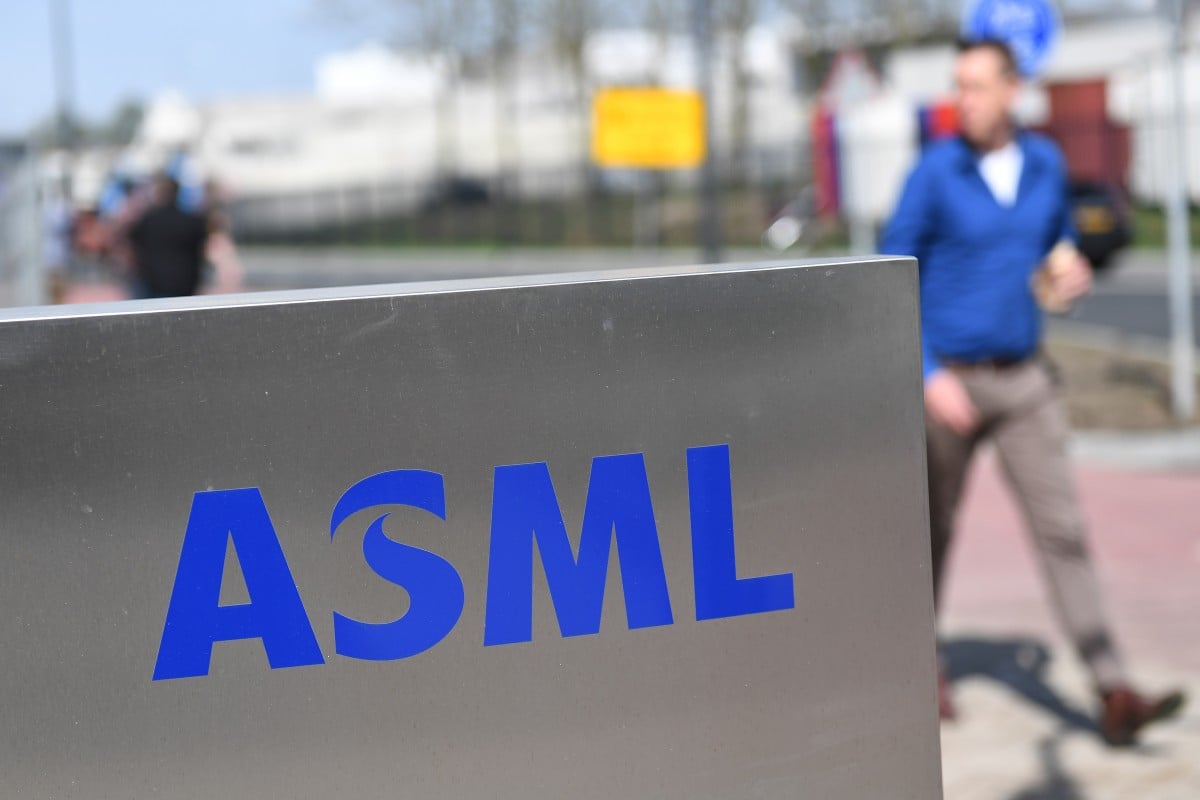
A newspaper in the Netherlands claims to have found evidence that six employees of Dutch semiconductor giant ASML passed corporate secrets to a company linked to the Chinese government. Photo: AFP
An investigation by a financial newspaper in the Netherlands has concluded that Chinese employees stole corporate secrets from Dutch semiconductor equipment giant ASML, resulting in hundreds of millions of dollars in losses.
The daily newspaper, Het Financieele Dagblad, reported on Thursday that ASML itself had “found no hard proof of involvement of the Chinese government” but that its own probe had determined that stolen technology had been ultimately leaked to a state-linked company.
According to the newspaper report, high-level Chinese employees in the research and development department of ASML’s US subsidiary were behind the breach.

An ASML spokeswoman said the company was aware of the report and was preparing a response.

The chip maker caught in US assault on China’s tech ambitions
ASML is the dominant maker of lithography systems, used to trace out the circuitry of semiconductor chips.
The newspaper based its report partly on company sources and partly on a November 2018 ruling by a California court in a suit between ASML’s US subsidiary and a subsidiary of a Chinese company, XTAL Inc.

The documents from the California Superior Court in Santa Clara show six former ASML employees, all with Chinese names, breached their employment contracts by sharing information on ASML software processes with XTAL, according to the report.

“The FDs investigation found XTAL’s Chinese parent company Dongfang Jingyuan has ties with the Chinese Ministry of Science and Technology,” the newspaper said.

The court awarded ASML US$223 million in damages and XTAL filed for bankruptcy a month later.

The Dutch intelligence agency has included warnings in its annual threat assessments for the past several years, saying that China is targeting tech companies in the Netherlands, as it does in other countries, for intellectual property theft.

In 2015, ASML disclosed a breach of its computer systems, but said at the time damage from the hack was limited and released few further details.

ASML’s sales to China doubled to 1.8 billion euros (US$2 billion) in 2018 from 919 million euros in 2017 as Beijing makes growth of its semiconductor industry a priority.

ASML CEO Peter Wennink said in January he saw no let-up in demand from China, despite an economic slowdown.

Source: SCMP

11/04/2019

U.S., China agree to establish trade deal enforcement offices – Mnuchin

WASHINGTON (Reuters) – The United States and China have largely agreed on a mechanism to police any trade agreement they reach, including establishing new “enforcement offices,” U.S. Treasury Secretary Steven Mnuchin said on Wednesday.

Mnuchin, speaking on CNBC television, said that progress continues to be made in the talks, including a “productive” call with China’s Vice Premier Liu He on Tuesday night. The discussions would be resumed early on Thursday, Washington time, he added.

“We’ve pretty much agreed on an enforcement mechanism, we’ve agreed that both sides will establish enforcement offices that will deal with the ongoing matters,” Mnuchin said, adding that there were still important issues for the countries to address.

Mnuchin declined to comment on when or if U.S. tariffs on $250 billion worth of Chinese goods would be removed. Although President Donald Trump said recently that a deal could be ready around the end of April, Mnuchin declined to put a timeframe on the negotiations, adding that Trump was focused on getting the “right deal.”

“As soon as we’re ready and we have this done, he’s ready and willing to meet with President Xi (Jinping) and it’s important for the two leaders to meet and we’re hopeful we can do this quickly, but we’re not going to set an arbitrary deadline,” Mnuchin added.

The United States is demanding that China implement significant reforms to curb the theft of U.S. intellectual property and end forced transfers of technology from American companies to Chinese firms.

Washington also wants Beijing to curb industrial subsidies, open its markets more widely to U.S. firms and vastly increase purchases of American agricultural, energy and manufactured goods.

The Chinese commerce ministry on Thursday confirmed that senior trade negotiators from both countries discussed the remaining issues in a phone call following the last round of talks in Washington.

“In the next step, both trade teams will keep in close communication, and work at full speed via all sorts of effective channels to proceed with negotiations,” Gao Feng, the ministry’s spokesman told reporters in a regular briefing in Beijing.

Mnuchin did not address whether the enforcement structure would allow the United States a unilateral right to reimpose tariffs without retaliation if China fails to follow through on its commitments.

People familiar with the discussions have said that U.S. negotiators are seeking that right, but that China is reluctant to agree to such a concession. Alternatively, the United States may seek to keep tariffs in place, only removing them when China meets certain benchmarks in implementing its reforms.

Mnuchin said he and U.S. Trade Representative Robert Lighthizer, who is leading the negotiations, are focused on “execution” of drafting the documents in the trade agreement.
The two sides are working on broad agreements covering six areas: forced technology transfer and cyber theft, intellectual property rights, services, currency, agriculture and non-tariff barriers to trade, according to two sources familiar with the progress of the talks.
“Some of the chapters are close to finished, some of the chapters still have technical issues,” Mnuchin said.
Source: Reuters
11/04/2019

India election 2019: Voting begins in world’s largest election

Indians have begun voting in the first phase of a general election that is being seen as a referendum on Prime Minister Narendra Modi.

Tens of millions of Indians across 20 states and union territories are voting in 91 constituencies.

The seven-phase vote to elect a new lower house of parliament will continue until 19 May. Counting day is 23 May.

With 900 million eligible voters across the country, this is the largest election ever seen.

Some observers have billed this as the most important election in decades and the tone of the campaign has been acrimonious.

Mr Modi’s Hindu nationalist Bharatiya Janata Party (BJP) won a historic landslide in the last elections in 2014. He stakes his claim to lead India on a tough image and remains the governing BJP’s main vote-getter.

But critics say his promises of economic growth and job creation haven’t met expectations and India has become more religiously polarised under his leadership.

The BJP faces challenges from strong regional parties and a resurgent Congress party, led by Rahul Gandhi. Mr Gandhi’s father, grandmother and great-grandfather are all former Indian prime ministers. His sister, Priyanka Gandhi, formally joined politics in January.

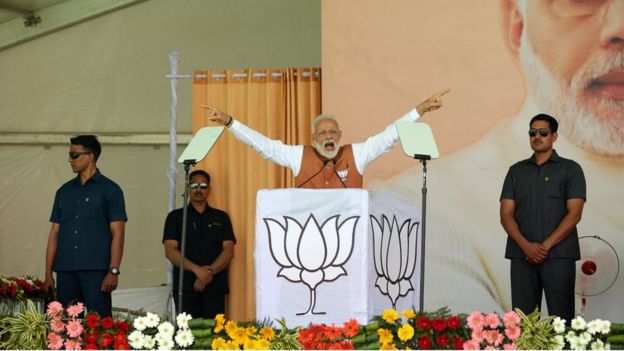
Modi at a rally in Meerut
Image captionMr Modi has made national security a key election issue

How has voting gone so far?

The Lok Sabha, or lower house of parliament has 543 elected seats and any party or coalition needs a minimum of 272 MPs to form a government.

Hundreds of voters began to queue up outside polling centres early Thursday morning. In the north-eastern state of Assam, lines of voters began forming almost an hour before voting officially began.

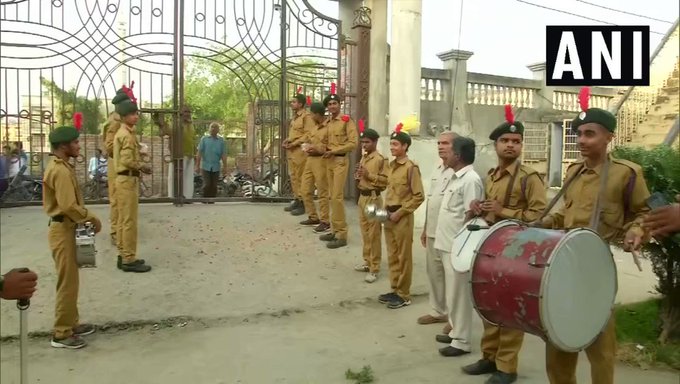
Voters at one polling booth in Baraut – in the northern state of Uttar Pradesh – got a royal welcome with people greeted by drums and a shower of flower petals.

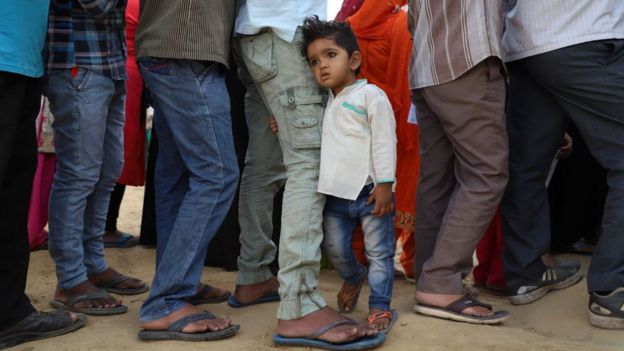
A little boy clutches his father outside a polling booth in Ghaziabad in Uttar Pradesh stateImage copyrightGETTY IMAGES
Image caption A little boy clutches his father outside a polling booth in Ghaziabad in Uttar Pradesh state

In central Chhattisgarh state, suspected Maoists detonated an IED device near a polling booth at around 04:00 local time (23:30 BST) – no injuries were reported.

The mineral-rich state has witnessed an armed conflict for more than three decades and attacks by Maoist rebels on security forces are common. On Tuesday a state lawmaker was killed in a suspected rebel attack.

How big is this election?

It is mind-bogglingly vast – about 900 million people above the age of 18 will be eligible to cast their ballots at one million polling stations. At the last election, vote turn-out was around 66%.

More than 100 million people are eligible to vote in the first phase of the election on Thursday.

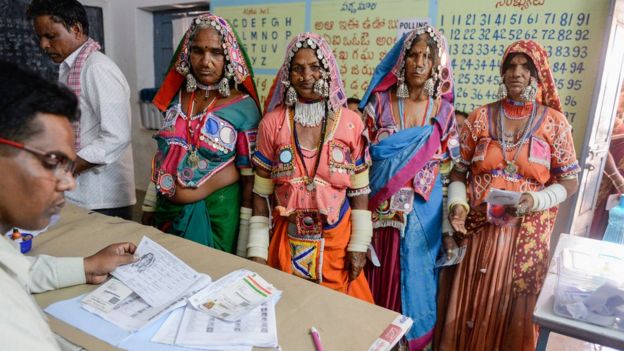
An official checks the names of Indian lambadi tribeswomen at a polling station during India's general election at Pedda Shapur village on the outskirts of Hyderabad on April 11, 2019.Image copyrightGETTY IMAGES
Image caption Indian lambadi tribeswomen at a polling station in southern India

No voter is meant to have to travel more than 2km to reach a polling station. Because of the enormous number of election officials and security personnel involved, voting will take place in seven stages between 11 April and 19 May.

India’s historic first election in 1951-52 took three months to complete. Between 1962 and 1989, elections were completed in four to 10 days. The four-day elections in 1980 were the country’s shortest ever.

Source: The BBC

Law of Unintended Consequences

continuously updated blog about China & India

ChiaHou's Book Reviews

continuously updated blog about China & India

What's wrong with the world; and its economy

continuously updated blog about China & India