Chindia Alert: You’ll be Living in their World Very Soon
aims to alert you to the threats and opportunities that China and India present. China and India require serious attention; case of ‘hidden dragon and crouching tiger’.
Without this attention, governments, businesses and, indeed, individuals may find themselves at a great disadvantage sooner rather than later.
The POSTs (front webpages) are mainly 'cuttings' from reliable sources, updated continuously.
The PAGEs (see Tabs, above) attempt to make the information more meaningful by putting some structure to the information we have researched and assembled since 2006.
Statue of Unity, the world’s tallest statue, is quickly emerging as a top tourist spot in India.
VADODARA: The 182-metre tall Statue of Unity, dedicated to Sardar Patel in Gujarat’s Narmada district, is quickly becoming one of the top tourist spots in the country and is now attracting about 30,000 people every day, senior state officials said on Monday.
Both Gujarat Chief Secretary JN Singh and the state’s Principal Secretary (Tourism) SJ Haider put the number of visitors over the past few days at 30,000.
The world’s tallest statue, located on an islet on the Sardar Sarovar Dam in Kevadiya, was inaugurated by Prime Minister Narendra Modi on October 31.
United States Consul-General Edgard Kagan visited the statue on Monday. He also spent time at the viewing gallery, located at a height of 153 metres. “The statue is very impressive and I’m happy to learn the purpose behind its construction,” Mr Kagan said after the visit.
COMMENT
Mr Kagan later visited Abhinay Gram Vikas, an NGO based in Rajpipla, which works for tribal welfare and rural development.
Rahul Gandhi has been attacking the Modi government over Rafale jet deal.
NEW DELHI: Congress chief Rahul Gandhi on Monday attacked Prime Minister Narendra Modi over the farmers’ issue, saying he was making “two Hindustans” – one for Anil Ambani and the other for farmers.
He cited a media report which claimed that for 750 kg of onion, a farmer was given Rs. 1040 in Maharashtra.
“Modi-ji is making two Hindustans. One is the Hindustan for Anil Ambani — who without doing anything, without making an airplane, will get the Rafale contract worth Rs. 30,000 crore from Modiji.
“The second is the Hindustan for farmers — whose 750 kg of onion grown after four months of toil will get only Rs. 1040 from Modiji,” the Congress president wrote on Twitter.
The Congress has been attacking the Modi government over issues concerning the farmers, alleging that the government’s policies have left them in distress.
The government has rejected the claims and pointed out the number of steps it has taken for the welfare of farmers.
The Congress and its chief have also launched an offensive on PM Modi and his government, alleging corruption and favouritism in the fighter jet deal for purchase of 36 Rafale aircraft from France’s Dassault Aviation, a charge the government has strongly denied.
A climb like this has never been done and I was thrilled to do this, Tuhin Satarkar said.
NEW DELHI: Bouldering sensation Tuhin Satarkar pushed his limits as he scaled three routes in the treacherous Sahayadri mountain range in 12 days, from November 16 to 28, to become the first Indian to ever achieve the feat, it was announced today.
In this project the Pune-based climber set out to climb three peaks in the Sahayadri mountains on a 12-day camping trip.
It was a true test of endurance, speed and invention as he studied the rock faces, set the route, successfully executed the climbs, and moved on to the next destination all within the 12 days he set out to complete the project.
The climb took him to Dhodap, Jivdhan and Naneghat, three famous peaks which are known to have been ascended by Chatrapati Shivaji Maharaj and his Marathi Malvas.
“The Sahayadri range has one of the most daunting mountains in Maharashtra. Being a Maharashtrian, I was excited to get an opportunity to pay tribute to Chatrapati Shivaji Maharaj and his band of Marathi Malvas,” the Red Bull athlete said.
“I would like to thank Red Bull for their continued support. It has been an exciting test for me- three climbs, across three forts and one ancient route in 12 days is definitely a challenge. A climb like this has never been done and I was thrilled to do this,” he added.
COMMENT
The Red Bull athlete Tuhin is the finest of India’s current generation of climbers. Inspired by his parents, who were both climbers, Tuhin took to the vertical sport at the age of eight and has been pushing boundaries ever since.
The Maharashtra farmer had planted brinjal on two acres of land. (Representational)
MUMBAI: After being offered a meagre 20 paise per kilogram for his brinjal production, a farmer in Maharashtra destroyed the entire plantation on his land to save himself from incurring further losses.
Rajendra Bawake, from Sakuri village of Ahmednagar, claimed he earned only Rs. 65,000 after investing Rs. 2 lakh and putting in all his energy to cultivate the brinjal crop.
Frustrated with low income, the farmer uprooted all brinjal plants from his field and threw them away on Sunday.
“I had planted brinjal on two acres of land and laid pipes for drip irrigation. I used fertilisers, pesticides and modern mulching techniques to enhance the production. The total investment came to around Rs. 2 lakh. In return, I earned only Rs. 65,000,” Mr Bawake said today.
The cultivator said he now owes dues worth over Rs. 35,000 to fertilisers and pesticide suppliers. “I don’t know how I am going to raise that money,” he said.
Mr Bawake claimed that when he tried to sell his produce at the wholesale markets in Nashik and Surat, he fetched only 20 paise per kg.
“I never got better returns in the last three-four months and so, I decided to do away with the plantation,” he added.
Mr Bawake said he rears three cows at home and needs money to buy fodder for the cattle. “I had hopes from brinjal farming, but now I don’t know how to take care of my cattle.”
Recently, an onion-grower from Nashik who had to sell his produce for little over Re 1 per kg and fetched only Rs. 1,064 for 750 kg of the vegetable, sent his earnings to prime minister Narendra Modi last month as a mark of protest.
COMMENT
Farmers from across the country gathered in New Delhi last Thursday in protest to press for various demands, including debt relief and remunerative prices for their produce.
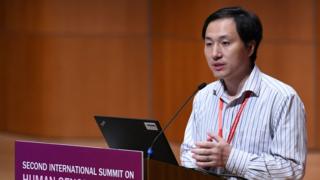
Image copyrightAFPImage captionProf He says there is a potential second pregnancy
China has halted the work of the scientist who claims to have created the world’s first genetically edited babies, and says it will investigate.
He Jiankui caused outrage earlier this week when he told a genome summit he had altered the genes of twin baby girls so they could not contract HIV.
His statement has not been confirmed, but if true breaks tight rules around the use of gene editing in humans.
Prof He’s university said it was unaware of his experiment.
The Southern University of Science and Technology in Shenzhen said earlier in the week he had been on unpaid leave since February, and it would be investigating the claims.
On Thursday, China’s science ministry said it had “demanded that the relevant organisation suspend the scientific activities of relevant personnel”.
The National Health Commission has already said Prof He’s work “seriously violates China’s laws, regulations and ethical standards” and would investigate the claims.
Speaking to the Human Genome Editing Summit at the University of Hong Kong, he said the girls were “born normal and healthy” and they would be monitored over the next 18 years.
He said he had funded the experiment himself and confirmed his university had not been aware of it.
Prof He also explained that eight couples – comprised of HIV-positive fathers and HIV-negative mothers – had signed up voluntarily for the experiment. One couple dropped out, but there was “another potential pregnancy” of a gene-edited embryo in its early stages.
He said his study had been submitted to a scientific journal for review, though he did not name the journal. He was also evasive about other details, including the names of “some experts” he said had reviewed his work and offered feedback.
Why is his work controversial?
The Crispr gene editing tool he claims to have used is not new to the scientific world, and was first discovered in 2012.
Media captionFergus Walsh: “CRISPR gene editing …. uses molecular scissors to cut both strands of DNA”
It works by using “molecular scissors” to alter a very specific strand of DNA – either cutting it out, replacing it or tweaking it.
Gene editing could potentially help avoid heritable diseases by deleting or changing troublesome coding in embryos.
But experts worry meddling with the genome of an embryo could cause harm not only to the individual but also future generations that inherit these same changes.
Hundreds of scientists, both in China and around the world, swiftly condemned his claims.
Professor Julian Savulescu, an ethics expert at the University of Oxford, said if true “this experiment is monstrous”.
“Gene editing itself is experimental and is still associated with off-target mutations, capable of causing genetic problems early and later in life, including the development of cancer,” he told the BBC. “This experiment exposes healthy normal children to risks of gene editing for no real necessary benefit.”
Many countries, including the UK, have laws that prevent the use of genome editing in embryos for assisted reproduction in humans. Scientists can do gene editing research on discarded IVF embryos, as long as they are destroyed immediately afterwards and not used to make a baby.
China allows in-vitro human embryonic stem cell research for a maximum period of 14 days, China’s Deputy Minister of Science and Technology Xu Nanping clarified.
Image copyrightGETTY IMAGESImage captionStaff members were penalised more the further away from the target they were
A company in China has come under fire for fining employees if they don’t walk at least 180,000 steps a month, it’s reported.
According to Information Times, employees at an unnamed real estate firm in the southern city of Guangzhou have been fined 0.01 yuan (0.1 cents; 0.1 pence) for every step that they fail to make when trying to reach their target.
One employee, ‘Little C’, told the paper that frequent overtime made it difficult for staff to walk at least 6,000 steps a day outside of work hours.
“I understand that the company wants to encourage us to get more exercise,” she said, “but I don’t even have enough time to sleep because I need to take walks to meet the target.”
Liu Fengmao, a representative from a local law firm, says that the company has no legal grounds for tracking staff members’ steps as a measure of performance, and that such a workplace rule could create further complications for the employer.
Mr Liu says that staff could potentially claim that walking outside of the office constitutes as overtime, or that a walking injury was a workplace incident.
Information Times says that this is not the first known case of a firm introducing a workplace walking rule. In January 2017, a technology firm in Chongqing in the south-west of the country was criticised for urging staff to walk 10,000 steps a day. The Chongqing Evening Post says that the company used this as a criterion for assessing their performance.
Many on the popular Sina Weibo microblog have expressed bemusement at the workplace rule, but have also been critical of it. “This company is just looking for a reason to deduct money,” one user says of the Guangzhou firm.
But others argue that such a regulation comes with some benefit. “The reward is that you’re healthy!” one user says.
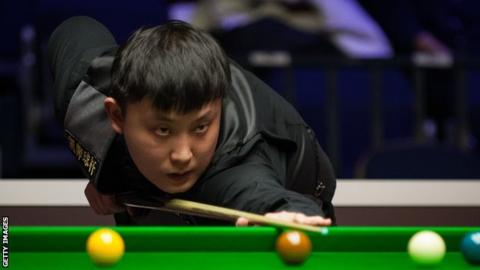
Yu Delu’s highest finish at a ranking event was the semi-finals of the 2016 Scottish Open
China’s Yu Delu has been banned from snooker for 10 years and nine months after a major match-fixing inquiry.
His compatriot Cao Yupeng also pleaded guilty to fixing and was banned for six years, although three and a half years of his sentence are suspended.
Suspicious betting patterns in numerous matches were investigated over two years in one of the sport’s biggest corruption scandals.
Yu has been described as a “scourge to the game of snooker”.
As reported first by the BBC, the pair are the first Chinese players to be banned for cheating.
Yu, who manipulated the outcome of five matches over a two-and-a-half-year period, will serve the longest suspension since English player Stephen Lee was given a 12-year ban in 2013.
In one match, the stakes placed on the result totalled £65,000, which would have generated a profit of £86,000.
The 31-year-old reached the semi-finals of the 2016 Scottish Open and was ranked 43 in the world when he was charged.
Twenty-eight-year-old Cao, who fixed three matches, was runner-up in the Scottish event last year and world number 38 when initially suspended in May.
Both players were investigated by the World Professional Billiards and Snooker Association (WPBSA) before an independent tribunal ruled on their cases.
The tribunal, chaired by David Casement QC, found that Yu “engaged in deliberate and premeditated corruption to secure substantial financial gain for his friends/associates and himself.”
Yu also admitted lying to the investigator, failing to cooperate with the inquiry and betting on snooker when prohibited from doing so.
“It is very sad when talented players are attracted to the opportunity to make money from fixing matches,” said WPBSA chairman Jason Ferguson.
Cao Yupeng “expressed his sorrow” over match-fixing and said he had financial difficulties
The fixed matches
Yu Delu admitted fixing in five matches:
Indian Open qualifiers: WON 4-3 v Martin McCrudden – 12 February 2015
Paul Hunter Classic: LOST 4-1 v Dominic Dale in Germany – 29 August 2015
Welsh Open: WON 4-3 v Ian Glover – 15 February 2016
European Masters qualifiers: LOST 4-1 v Michael Georgiou – 4 August 2017
Shanghai Masters: LOST 5-3 v Kurt Maflin – 15 November 2017
He also failed to report approaches to fix matches, did not cooperate with the investigation and breached rules by betting on snooker.
The scandals involved betting on markets in the Far East.
Yu won two of the five fixed matches, but had arranged for the correct score to be 4-3 to either player.
There is no suggestion any of the opponents were aware of the match-fixing plan.
Cao Yupeng admitted fixing in three matches:
Welsh Open: LOST 4-1 v Ali Carter – 15 February 2016
Indian Open qualifiers: LOST 4-0 v Stuart Bingham – 30 June 2016
UK Championship: LOST 6-1 v Stephen Maguire – 24 November 2016
Cao also failed to provide material that was requested during the investigation.
He told investigators that he received £5,000 for each of the matches he fixed and he was initially given an eight-year ban, but this was reduced to six – three and a half of which were suspended – because of his co-operation with the inquiry.
“Cao Yupeng has shown true remorse and he will assist the WPBSA in player education and in its fight against corruption, which is reflected in his reduced sanction,” said Ferguson.
Yu was given a 12-year ban, to match the sanction imposed on Lee five years ago, but this was reduced to 10 years and nine months because of his late guilty plea.
These two players are well known in China, and this story will be headline news there.
Lengthy bans show that the sport’s world governing body, the WPBSA, has the capability and desire to investigate such cases all over the world, and not just in Europe.
Sanctions like this send out a clear message to any player tempted to get involved in match fixing that it’s not worth the risk of getting caught.
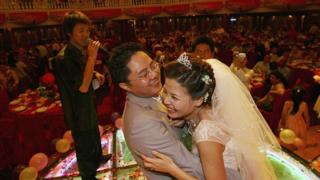
Image copyrightCHINA PHOTOSImage captionChinese weddings can feature lavish feasts with hundreds of guests
China is trying to put the brakes on a trend towards increasingly lavish weddings and pre-wedding pranks which can often become violent or sexualised.
Authorities have said modern weddings are both too extravagant and against Chinese and socialist values.
The traditional “hazing” rituals couples are put through have also often been getting out of control.
Beijing’s suggested answer is to try to standardise ceremonies to a more traditional and simple format.
Stop pulling all stops
People in China, as in many countries, have increasingly found themselves competing with neighbours and friends over weddings, and caught up in spiralling spending as bigger weddings become the fashion.
That means expensive receptions, elaborate outfits and overseas wedding photo shoots, pulling out all the stops no matter the cost.
Guests are also expected to bring ever more lavish gifts.
Image captionBeijing says weddings should become frugal and traditional again
Meanwhile the tradition of playing pranks on the bride and groom – originally meant as a way of helping them relax on their big day – has often been getting out of hand.
There are regular news reports of wedding-goers carrying out humiliating or violent pranks which have crossed the line into assault.
One week before, several bridesmaids were injured by broken glass when the groom’s party tried to get into the bride’s house by breaking the door with an axe.
There have also been reports of brides being forced to mime sexual acts or bridesmaids being pursued to the point of sexual harassment.
The ministry of civil affairs condemned all this as “extravagance and wastefulness” and instead proposed a clear “guidance” towards more “simple and moderate” weddings, China’s Xinhua news agency said.
Ceremonies should “integrate socialist values and Chinese traditional culture” to combat “negative social trends and wrong values” and instead set an example for society.
Authorities would “set guidelines on the process of weddings and the amount of cash gifts,” ministry official Yang Zongtao said in an interview on state TV broadcast on Sunday.
It’s not the first time China has tried to steer how exactly it wants its citizens to tie the knot.
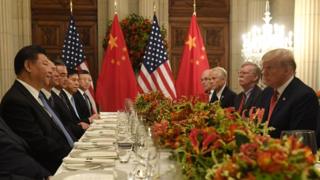
Failure to strike a deal would have seen tariffs on $200bn worth of Chinese goods rise from 10% to 25% at the start of next year, and would have opened the way for tariffs on additional Chinese goods.
On Monday, China’s foreign ministry said the presidents of China and the US had instructed their economic teams to work towards removing all tariffs following the G20 meeting,
But it didn’t say if that was a plan with specifics or something that was merely desirable.
Asian markets rallied after news of the trade war truce. In China, Hong Kong’s Hang Seng index climbed 2.5% and the Shanghai Composite index jumped 2.6%. Japan’s Nikkei 225 index rose 1%.
The gains spread to Europe, with the UK’s FTSE 100 index, the Cac 40 in France and Germany’s Dax index all up by about 2% in early trade.
The trade war has seen the US and China hit each other with escalating tariffs in an attempt to make their domestically made goods more competitive.
The US says its tariff policy is a response to China’s “unfair” trade practices and accuses it of intellectual property theft.
Since July, the US has hit China with tariffs on $250bn (£195.9bn) worth of goods. China has retaliated with duties on some $110bn of US goods over the same period.
As part of this, the US imposed a 25% tariff on Chinese cars, on top of the 2.5% already in place.
In July, China, which is the world’s largest market for cars, imposed a 40% tariff on US vehicle imports. The rate is much higher than the 15% it places on other trading partners and forced many carmakers to raise prices.
In his tweet, President Trump said Beijing had “agreed to reduce and remove tariffs on cars coming into China from the US”.
He did not provide a new level for the Chinese tariffs, and Beijing did not immediately confirm the statement.
What was agreed at the G20?
In a statement, the White House said US tariffs on Chinese goods would remain unchanged for 90 days, but added: “If at the end of this period of time, the parties are unable to reach an agreement, the 10 percent tariffs will be raised to 25 percent.”
Image captionThe US manufactures cars for export to China, the world’s largest car market
The US said China agreed to “purchase a not yet agreed upon, but very substantial, amount of agricultural, energy, industrial, and other products from the United States to reduce the trade imbalance between our two countries”.
Both sides also pledged to “immediately begin negotiations on structural changes with respect to forced technology transfer, intellectual property protection, non-tariff barriers, cyber intrusions and cyber theft”, according to the White House.
Chinese Foreign Minister Wang Yi told reporters after the talks that “the principal agreement has effectively prevented further expansion of economic friction between the two countries”.
Are tariffs still in place?
Yes. The truce prevents raising tariffs as planned on $200bn worth of Chinese goods.
But it does not remove tariffs that apply to a total of $250bn of Chinese goods targeted since July.
The truce also does not affect the existing duties China has imposed on $110bn of US goods in a tit for tat retaliation.
Will this resolve the dispute?
While the result of the G20 meeting was better than expected, it is unclear how the two countries will manage to resolve their underlying differences.
“There should be no wishful thinking that the truce would end the trade war between the world’s two largest economies,” DBS strategist Philip Wee wrote in a research note.
He said it “remains to be seen if real progress could be achieved during this narrow window to resolve the contentious issues, not just on trade, but also intellectual property”.
Louis Kuijs, head of Asia economics at Oxford Economics, said while the agreement itself was “positive” the next steps remained unclear.
“Whether we will see further de-escalation or whether it is temporary reprieve continues to be very much up to a political decision in Washington DC – that will continue to make this uncertain,” Louis Kuijs, head of Asia economics at Oxford Economics said.
The aim of the exercise is to provide operational exposure and undertake a mutual exchange of best practices towards enhancing operational capability.
ADVERTISEMENT
Manjeet Singh Negi
New Delhi
December 2, 2018
UPDATED: December 2, 2018 14:51 IST
Cope India is bilateral joint exercise held between the Indian Air Force and the US Air Force held in India. (Photo: IAF)
HIGHLIGHTS
Exercise to be held from December 3-14
Will be held at 2 air force bases in West Bengal
Approximately 200 US airmen will be arriving in India for exercise
The air forces of the United States and India are participating in a 12-day joint exercise called ‘Cope India 2018’ at two air force stations in West Bengal. Cope India 2018 is the fourth edition in the series of bilateral joint exercises held between the Indian Air Force and the US Air Force, which is conducted in India.
For the first time, the exercise is being planned at two air force bases, Kalaikunda and Panagarh from December 3-14. The Cope India exercise is being held after a gap of eight years, with the last one having taken place in 2010.
The USAF is participating with 12 XF15C/D fighter plane and 3 XC-130 planes. The IAF is participating with the Su-30 MKI, Jaguar, Mirage 2000, C-130J & AWACS aircraft.
The exercise showcases efforts and commitment of the two nations to a free and open Indo-Pacific region, a communique from the US Consulate said. “Exercise CI18 is a long-standing bilateral US Pacific Air Forces (PACAF)-sponsored Field Training Exercise (FTX), conducted with the Indian Air Force (IAF), focused on enhancing US-Indian mutual cooperation and building on existing capabilities, aircrew tactics and force employment,” the communique said.
Approximately 200 US airmen with 15 aircraft from the 18th Wing, Kadena Air Base, Japan and 182nd Airlift Wing, will be taking part in the exercise alongside their IAF counterparts.
The aim of the exercise is to provide operational exposure and undertake a mutual exchange of best practices towards enhancing operational capability. First held in 2004, the exercise has evolved to incorporate subject matter expert exchanges, air mobility training, airdrop training and large-force exercises, in addition to fighter-training exercises.