27/01/2016

With China weakening, Apple turns to India | Reuters

As China sales show signs of cooling, Apple Inc (AAPL.O) is touting India’s appetite for iPhones, betting that rising wages and an expanding middle class will pull consumers away from the cheap alternatives that currently dominate the market.

In an earnings call in which the company reported meager iPhone growth and forecast its first revenue drop in 13 years, the Indian market stood out as a rare bright spot for Apple.

Sales of the company’s flagship smartphone climbed 76 percent in India from the year-ago quarter, Apple Chief Financial Officer Luca Maestri said.

According to data compiled by Counterpoint Technology Research, Apple sold an estimated 800,000 iPhones in India in the fourth-quarter, its highest ever amount but one that is a fraction of the 28 million smartphones sold during that period.

Growth in India is a tantalizing prospect as Apple grapples with the economic downturn in China, its second largest market. While revenue in Greater China rose 14 percent in the last quarter, Apple is beginning to see a shift in the economy, particularly in Hong Kong, Maestri told Reuters in an interview.

But with nearly 70 percent of smartphones selling for less than $150 in India, Apple’s high-end phones remain out of reach of most consumers. The basic iPhone 6S sells at just under $700 in India, or nearly half the average annual wage.

“In many ways India is very similar to what China was a few years ago, but the middle class here is still very small and it can be two to three years before Apple gets a similar level of success in India,” said Counterpoint Technology Research analyst Tarun Pathak.

Apple CEO Tim Cook struck a more optimistic note, saying the company was “increasingly putting more energy” into India, citing a largely youthful population with rising disposable income as more people join the workforce.

With faster 4G coverage expanding, Apple has already asked Indian government for a license to set up its own retail stores just as the market seems to be turning in its favor.

As in China, Apple products are a coveted status symbol in India, a market that analysts say is likely to overtake the United States next year to become the world’s second largest smartphone market. “The love for the iPhone is there,” said Carolina Milanesi, chief of research and head of U.S. business at Kantar Worldpanel ComTech, a consumer research firm.

Source: With China weakening, Apple turns to India | Reuters
27/01/2016

India to build satellite tracking station in Vietnam that offers eye on China | Reuters

India will set up a satellite tracking and imaging centre in southern Vietnam that will give Hanoi access to pictures from Indian earth observation satellites that cover the region, including China and the South China Sea, Indian officials said.

The move, which could irritate Beijing, deepens ties between India and Vietnam, who both have long-running territorial disputes with China.

While billed as a civilian facility – earth observation satellites have agricultural, scientific and environmental applications – security experts said improved imaging technology meant the pictures could also be used for military purposes.

Hanoi especially has been looking for advanced intelligence, surveillance and reconnaissance technologies as tensions rise with China over the disputed South China Sea, they said.

“In military terms, this move could be quite significant,” said Collin Koh, a marine security expert at Singapore’s S. Rajaratnam School of International Studies. “It looks like a win-win for both sides, filling significant holes for the Vietnamese and expanding the range for the Indians.”

The state-run Indian Space Research Organisation (ISRO) will fund and set up the satellite tracking and data reception centre in Ho Chi Minh City to monitor Indian satellite launches, the Indian officials said. Indian media put the cost at around $23 million.

India, whose 54-year-old space programme is accelerating, with one satellite launch scheduled every month, has ground stations in the Andaman and Nicobar islands, Brunei, Biak in eastern Indonesia and Mauritius that track its satellites in the initial stages of flight.

The Vietnam facility will bolster those capabilities, said Deviprasad Karnik, an ISRO spokesman.

Source: India to build satellite tracking station in Vietnam that offers eye on China | Reuters

27/01/2016

The Drivers of Growth in China’s New Normal – China Real Time Report – WSJ

As China’s economic growth slows and the manufacturing and industrial sectors face declines, many companies are trying to determine whether or where they can tap into more growth.

The old drivers of the economy, including the middle class and the export sector, are out. What’s in for China’s so-called “new normal” is the upper-middle class and the service sector.

Affluent shoppers under the age of 35 and Internet surfers will push China’s consumer market up to $6.5 trillion in sales by 2020, an increase of 54% from 2015, according to consultancy the Boston Consulting Group. Upper-middle class households, defined as those making between $24,001 and $46,000 in annual income, will double to 100 million in population by 2020 and account for 30% of all urban households in the country.

Consumption is not isolated from the slowdown, but China hasn’t stopped shopping, consultancy The Boston Consulting Group said in a recent report. Consumption growth this year is poised to outpace GDP growth, which economists expect to range between 6% and 6.6%, BCG said.

Source: The Drivers of Growth in China’s New Normal – China Real Time Report – WSJ

24/01/2016

Well-wishing | The Economist

SINCE he took over as China’s leader in 2012, Xi Jinping has been a busy globetrotter. Last year he visited more countries than Barack Obama, America’s president (14 against 11).

Heedless of whether his hosts are powerful, puny or pariahs, he has flown everywhere from America to the Maldives and Zimbabwe. Mr Xi wants to project China’s rising power—and his role in promoting that—to foreign and domestic audiences. But until this week, he had not set a presidential foot in the Middle East.

The trip, under way as The Economist went to press, began in Saudi Arabia (whose king, Salman bin Abdul Aziz, is pictured with Mr Xi). He then visited Egypt and was due to finish his tour in Iran. No Chinese president had toured the region since 2009. China’s leaders had worried about getting embroiled in the region’s intractable disputes. But China has a big stake in the Middle East. It is the world’s largest oil importer and gets more than half of its crude from the region (see chart). Mr Xi’s much ballyhooed “new Silk Route”, aimed at linking China and Europe with the help of Chinese-funded infrastructure, runs across the Middle East. Chinese companies are already building expressways and harbours there. In this section Divorce: a love story Well-wishing Reprints Related topics Middle East Politics Government and politics World politics Asia-Pacific politics

The timing of Mr Xi’s tour is tricky. Tensions between Saudi Arabia and Iran are particularly high after Saudi Arabia executed a Shia cleric earlier this month and angry Iranians responded by storming the Saudi embassy in Tehran. But the lifting of Western sanctions on Iran on January 16th (see article) allowed Mr Xi to display even-handedness by visiting both countries, without upsetting Western powers. Mr Xi, like his predecessors, likes to present China as a non-interfering champion of peace. (Xinhua, China’s state-run news agency, said this week that the West’s “meddling hands” were “more of a mortal poison than of a magic potion” in the Middle East.) But Mr Xi is not keen to play a central role as peacemaker. China’s first “Arab Policy Paper”, released on January 13th, is a vague, waffly document. It talks of “building a new type of international relations”, but is devoid of new ideas.

Zhang Ming, a vice-foreign minister, said this week that economic development was the “ultimate way out” of conflict in the region. By expanding its trade and investment links with the Middle East, China hopes discontent and conflict there will gradually dissipate. In addition to crushing dissent, it is trying a similar approach in Xinjiang, a province in western China with a large Muslim population—so far without success.

In the long run, China may find it hard to avoid taking sides. To some extent it has already done so in Syria: it talks to representatives from both the Syrian government and the opposition, but by vetoing UN resolutions on intervention it tilts, in effect, in the government’s favour. The presence of a growing number of Chinese citizens in the Middle East may challenge China’s non-interventionist approach. After a Chinese national was executed by Islamic State in November, China promised to strengthen protection of its citizens abroad. Its new rules of Middle Eastern diplomacy could end up resembling familiar Western meddling

Source: Well-wishing | The Economist

22/01/2016

Prime Minister Narendra Modi flags off Mahanama Express in Varanasi – The Hindu

In his fifth visit to his constituency, Varanasi, after assuming power, Prime Minister Narendra Modi on Friday flagged off a new train, Mahanama Express, connecting the temple town to the national capital through Lucknow. Named after Pandit Madan Mohan Malviya, the founder of the Banaras Hindu University, the train is fully equipped with modern facilities and boasts of bio toilets in every coach and has renovated and refurbished AC-coaches fitted with led screen. The train will run thrice a week and cover the distance from Varanasi to New Delhi in 14 hours.

Prime Minister Narendra Modi interacts with a physically challenged child while distributing assistive devices at a function, in Varanasi on Friday.

Attending the Divyangjan Sashaktikaran Samaroh in Varanasi, Mr. Modi also gave away assisting electronic devices, artificial limbs, tricycles, Braille kits, hearing aids, teaching-learning material kit and other equipment to 9,296 ‘divyangs’ or specially-abled persons.

“When I say let us use the word ‘divyang’ it is about a change in mindset,” Mr. Modi said while reiterating his plea for doing away with the word “viklang” (handicapped) and instead calling the differently-abled as “divyang” (those born with a divine limb/organ).

“Let us not think about what is lacking in a person, let us see what is the extra ordinary quality a person is blessed with,” said Mr. Modi, who personally distributed electronic devices to around a dozen persons.

The PM last visited his constituency in December 2015 along with his Japanese counterpart Shinzo Abe. In his address, Mr. Modi recalled the visit and even praised Mr. Abe for appreciating and mentioning his trip to Varanasi in a speech in Japan. “In one year of this government, 1800 such camps have been held. While in the two decades not even a 100 camps were set up,” Mr. Modi said taking a jibe at previous Congress government’s indifference to the differently-abled. On the way to the function, a bus carrying ‘divyangs’ met an accident injuring around 20 persons. Taking cognizance of the matter, Mr. Modi ordered swift action and officials reached the spot. “Most of the received minor injuries, but some will need to be hospitalized for a few days. The government will make all arrangements for treatment,” Mr. Modi said.

The PM also interacted with ‘divyang’ children who have overcome disabilities relating to speech and hearing with the help of the ADIP (Assistance to Disabled Persons) scheme of the Centre.

“The result of such camps is that middlemen will get eliminated-nut bolts are being tightened and the shops of these middlemen are shutting down. And due to this some people are getting worried but not me. If I am in pained, it is by the plight of the poor in the country,” Mr. Modi said.

Source: Prime Minister Narendra Modi flags off Mahanama Express in Varanasi – The Hindu

22/01/2016

Chinese president offers remedies for Mideast predicaments, aid to Arab development – Xinhua | English.news.cn

Out-of-the box thinking.  Hope other major powers start to subscribe to this point of view. The current ones  of taking sides and partisan fighting isn’t working.

“Visiting Chinese President Xi Jinping on Thursday prescribed his remedies to restore peace in the Middle East and promote development in the Arab world.

EGYPT-CAIRO-CHINA-XI JINPING-VISIT

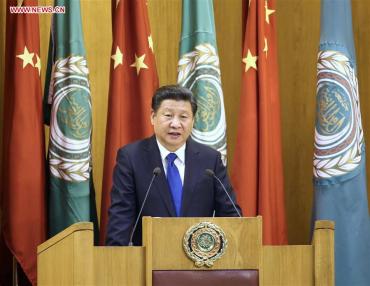
While delivering a speech at the headquarters of the Arab League, Xi described the Middle East region, which in many’s eyes is almost an equivalent to wars and tumult, as a “land of abundance.”

PATH TO PEACE

The Chinese leader concluded in the remarks that dialogues and development are the key factors that can help bring peace and stability back in this part of the world.

He said use of force offers no solution to problems, neither will zero-sum mentality bring enduring peace, adding that for the success of talks, there is need for utmost patience and flexibility.

Speaking of the Syrian crisis, he said there will be no winner out of a conflict, and to address the hot-spots, what is the most urgent, is to bring about cease-fire and start political talks.

Xi also believed that turmoil in the Middle East stems from the lack of development, while the ultimate solution will depend on development, saying that only when young people are able to live a fulfilled life with dignity can hope prevail in their heart. Only then will they voluntarily reject violence, extremist ideologies and terrorism.

Mahmoud Allam, former Egyptian ambassador to China, admitted that many of the deep-rooted problems the Arab world is grappling with have been the result of failures to achieve a successful development model, saying development is no doubt the most viable path of mobilizing people toward achieving their common interests and overcoming disagreements.

TANGIBLE HELP

Also in his speech, the Chinese president introduced a host of fresh moves including loans, financial aid and common investment fund to help improve livelihood, fight terrorism and promote development in the Arab world.

The Chinese government has decided to pledge 50 million RMB (7.53 million U.S. dollars) to help improve the lives of the Palestinians and 230 million RMB (about 35 million dollars) for Syria, Jordan, Lebanon, Libya and Yemen as humanitarian assistance, said Xi.

Beijing also wants to promote the industrialization in the Middle East. To achieve that end, China is going to hand out a number of loan programs, including a 15-billion exclusive loan, a 10-billion business lending, and 10 billion concessional loans so as to facilitate production capacity cooperation between China and the regional countries, according to the president.

Meanwhile, China also prepares to work with the United Arab Emirates and Qatar to set up a common investment fund worth 20 billion dollars that focuses on traditional sources of energy in the Middle East, infrastructure, and high-end manufacturing.

Xi also offered in his speech 300 million dollars for law enforcement cooperation, police training so as to help build up the abilities of the regional countries to maintain stability.China also planned to provide 1,000 training opportunities for young Arab leaders, and strengthen exchanges among their think tanks, experts and scholars.

CHINA’S DOS AND DON’TS IN MIDEAST

The Chinese leader also said his country will neither look for proxies nor try to fill any “vacuum” in the Middle East, adding that Beijing has no intention of building any sphere of influence in the region.

“Instead of looking for a proxy in the Middle East, we promote peace talks; instead of seeking any sphere of influence, we call on all parties to join the circle of friends for the Belt and Road Initiative; instead of attempting to fill the ‘vacuum’, we build a cooperative partnership network for win-win outcomes,” he said.

Meanwhile, Xi promised that China will not link terrorism with any specific ethnic group or religion, as doing so will only create ethnic and religious tensions, adding that there should be no double standards in battling terrorism.

Also, he said the Middle East is the meeting place of ancient human civilizations and home to diverse and splendid cultures. China will continue to unswervingly support Middle East and Arab states in preserving their ethnic and cultural traditions, and oppose all forms of discrimination and prejudice against specific ethnic group and religion.”

Source: Chinese president offers remedies for Mideast predicaments, aid to Arab development – Xinhua | English.news.cn

22/01/2016

Beijing shut down over 1,000 factories over past 5 years|Society|chinadaily.com.cn

Very good news, indeed.

Beijing has closed 1,006 manufacturing and polluting enterprises over the past five years, the municipal government revealed Friday.

In addition, 228 markets were also closed over the period, Beijing Mayor Wang Anshun said in a government work report presented during the city’s annual parliamentary session, which opened Friday.

More than 13,000 applications for new businesses have also been rejected because they were on the list of prohibited or restricted operations, Wang said.

Beijing had closed or relocated nearly 400 polluting factories in 2014 and another 300 in 2015, previous figures show.”

Source: Beijing shut down over 1,000 factories over past 5 years|Society|chinadaily.com.cn

22/01/2016

Chips on their shoulders | The Economist

THE Chinese government has been trying, on and off, since the 1970s to build an indigenous semiconductor industry. But its ambitions have never been as high, nor its budgets so big, as they are now.

In an earlier big push, in the second half of the 1990s, the government spent less than $1 billion, reckons Morgan Stanley, an American bank. This time, under a grand plan announced in 2014, the government will muster $100 billion-$150 billion in public and private funds.

The aim is to catch up technologically with the world’s leading firms by 2030, in the design, fabrication and packaging of chips of all types, so as to cease being dependent on foreign supplies. In 2015 the government added a further target: within ten years it wants to be producing 70% of the chips consumed by Chinese industry.

It has a long way to go. Last year China’s manufacturers, both domestic and foreign-owned, consumed $145 billion-worth of microchips of all kinds (see chart). But the output of China’s domestic chip industry was only one-tenth of that value. And in some types of high-value semiconductor—the processor chips that are the brains of computers, and the rugged and durable chips that are embedded in cars—virtually all of China’s consumption is imported.

To help them achieve their dream, the authorities realise that they must buy as much foreign expertise as they can lay their hands on. In recent months, state-owned firms and various arms of government have been rushing to buy, invest in or do deals with overseas microchip firms. On January 17th the south-western province of Guizhou announced a joint venture with Qualcomm, an American chip designer, to invest around $280m in setting up a new maker of specialist chips for servers. The province’s investment fund will own 55% of the business. Two days earlier, shareholders in Powertech Technology, a Taiwanese firm that packages and tests chips, agreed to let Tsinghua Unigroup, a state-controlled firm from the mainland, buy a 25% stake for $600m.

Officials argue that developing a home-grown semiconductor industry is a strategic imperative, given the country’s excessive reliance on foreign technology. They can point to the taxpayers’ money that politicians in America, Europe and other parts of Asia have lavished on their domestic semiconductor industries over the years.

China’s microchip trade gap is, by some estimates, only around half of what the raw figures suggest, since a sizeable proportion of the imported chips that Chinese factories consume go into gadgets, such as Apple’s iPhones and Lenovo’s laptops, that are then exported. Even so, a policy of promoting semiconductors fits with the government’s broader policy of moving from labour-intensive manufacturing to higher-added-value, cleaner industries.

Morgan Stanley notes that profit margins for successful semiconductor firms are typically 40% or more, whereas the computers, gadgets and other hardware that they go into often have margins of less than 20%. So if Chinese firms designed and made more of the world’s chips, and one day controlled some of the underlying technical standards, as Intel does with personal-computer and server chips, China would enjoy a bigger share of the global electronics industry’s profits.

In the government’s earlier efforts to boost domestic manufacturing of solar panels and LED lamps, it spread its largesse among a lot of local firms, resulting in excess capacity and slumping prices. This time it seems to be concentrating its firepower on a more limited group of national champions. For instance, SMIC of Shanghai is set to be China’s champion “foundry” (bulk manufacturer of chips designed by others). And HiSilicon of Shenzhen (part of Huawei, a maker of telecoms equipment) will be one of a select few champions in chip design.

Most intriguing of all, Tsinghua Unigroup, a company spun out of Tsinghua University in Beijing, has emerged in the past year or so as the chosen champion among champions, a Chinese challenger to the mighty Intel. Zhao Weiguo, the firm’s boss, started out herding goats and pigs in Xinjiang, a remote province in north-western China, to where his parents had been exiled in the 1950s, having been labelled as dissidents. After moving to Beijing to study at the university, Mr Zhao made a fortune in electronics, property and natural resources, before becoming chairman and second-largest shareholder (after the university itself) at Tsinghua Unigroup.

The company’s emergence from obscurity began in 2013 when it spent $2.6 billion buying two Chinese chip-design firms, Spreadtrum and RDA Microelectronics. In 2014 Intel bought a 20% stake in its putative future rival, for $1.5 billion, as part of a plan for the two to work together on chips for mobile devices, an area in which Intel has lagged behind. In May last year Tsinghua spent $2.3 billion to buy a 51% stake in H3C, a Hong Kong subsidiary of Hewlett-Packard that makes data-networking equipment. And in November it announced a $13 billion share placement to finance the building of a giant memory-chip plant.

Source: Chips on their shoulders | The Economist

20/01/2016

Apple seeks nod to open India stores amid concerns of slowing sales growth | Reuters

Apple Inc has applied to set up its own stores in India, one of the world’s fastest growing smartphone markets, as the iPhone-maker looks to tap new opportunities amid worries of slowing growth in its main markets.

An Apple logo is seen inside the Apple Store in Palo Alto, California November 13, 2015. REUTERS/Stephen Lam

Apple sells its iPhones, iPads and Macs in India through third party resellers, and industry analysts estimate that the Cupertino, California-based company has less than a 2 percent share in India’s smartphone market, dominated by cheaper brands.

The company has filed an application with India’s Department of Industrial Policy and Promotion to open its own stores, Amitabh Kant, secretary at the federal trade ministry unit told Reuters.

Apple also confirmed the application filing, but declined to give details.

Its expansion plans in India come at a time when concerns about slowing growth in the United States and China, the world’s most important market for smartphones, have weighed on the company’s stock in the last few months.

Shares in Apple, the world’s most valuable company by market value, are down 28 percent from their peak in April last year. The company operates more than 450 stores in 18 countries. Chief Financial Officer Luca Maestri told Reuters in October that Apple had 25 stores in China and was opening a new one roughly every month.

Its plans for India have been held back due to restrictions on foreign investment in the retail industry, which require single brand overseas retailers to buy close to a third of the goods sold at their stores from local producers.

Apple representatives held talks with Indian government officials about a relaxation of the 30 percent local-sourcing norms before filing the application, said a source familiar with the company’s plans.

Apple’s plans come against the backdrop of initiatives unveiled by Indian Prime Minister Narendra Modi, who met with Apple chief Tim Cook during his U.S. visit last year, to boost foreign investments in India.

In November, the government eased foreign investment norms in 15 major sectors, including relaxing the mandatory local-sourcing rule for foreign single-brand retailers in the case of “cutting-edge technology” products.

Kant said his department would examine Apple’s application in view of the changes made for local sourcing.

For years, India has been a low priority market for Apple as spending power is weaker than in China, where the company’s iPhones swiftly became must-have devices after their 2007 launch.

But Apple is now looking to boost its market share in India’s rapidly growing market, and the company’s recent growing spend on advertising in the country has indicated an aggressive campaign to sell more.

India is likely to overtake the United States to become the world’s No. 2 smartphone market in 2017, according to research firm Strategy Analytics. The local smartphone segment is dominated by Samsung Electronics and India’s Micromax.

Source: Apple seeks nod to open India stores amid concerns of slowing sales growth | Reuters

14/01/2016

Xi’s new model army – The Economist

Xi Jinping reforms China’s armed forces—to his own advantage

CHINA’S biggest military shake-up in a generation began with a deliberate echo of Mao Zedong.

Late in 2014 President Xi Jinping went to Gutian, a small town in the south where, 85 years before, Mao had first laid down the doctrine that the People’s Liberation Army (PLA) is the armed force not of the government or the country but of the Communist Party. Mr Xi stressed the same law to the assembled brass: the PLA is still the party’s army; it must uphold its “revolutionary traditions” and maintain absolute loyalty to its political masters. His words were a prelude to sweeping reforms in the PLA that have unfolded in the past month, touching almost every military institution.

The aim of these changes is twofold—to strengthen Mr Xi’s grip on the 2.3m-strong armed forces, which are embarrassingly corrupt at the highest level, and to make the PLA a more effective fighting force, with a leadership structure capable of breaking down the barriers between rival commands that have long hampered its modernisation efforts. It has taken a long time since the meeting in Gutian for these reforms to unfold; but that reflects both their importance and their difficulty.

The PLA itself has long admitted that it is lagging behind. It may have plenty of new weapons—it has just started to build a second aircraft-carrier, for instance—but it is failing to make effective use of them because of outdated systems of command and control. Before any substantial change in this area, however, Mr Xi felt it necessary to strengthen the party’s control over the PLA, lest it resist his reforms and sink back into a morass of money-grubbing.

The reforms therefore begin with the main instrument of party control, the Central Military Commission (CMC), which is chaired by Mr Xi. On January 11th the CMC announced that the PLA’s four headquarters—the organisations responsible for recruiting troops, procuring weapons, providing logistics and ensuring political supervision—had been split up, slimmed down and absorbed into the commission. Once these were among the most powerful organisations in the PLA, operating almost as separate fiefs. Now they have become CMC departments.

Power to the party

The political headquarters was the body through which the party kept an eye on the ranks and ensured they were up to speed on Maoist texts and the party’s latest demands. The loss of its autonomous status may suggest that the party’s role is being downgraded. Far from it. Now the party’s CMC (there is also a state one, which exists only in name) will be better able to keep watch. The body’s 15 new departments will include not only departments for politics but also for logistics, personnel management and fighting corruption. Mr Xi has already turned his guns on graft, imprisoning dozens of generals.

The second reform has been to put the various services on a more equal footing. The land forces have hitherto reigned supreme. That may have been fine when the PLA’s main job was to defend the country against an invasion across its land borders (until the 1980s the Soviet Union was considered the biggest threat). But now China has military ambitions in the South China Sea and beyond, and wants the ability to challenge American naval and air power in the western Pacific. A recent editorial in the Liberation Army Daily, a PLA mouthpiece, berated the armed forces for their “army-centric mindset”.

In addition to those for the navy and air force, a separate command has now been created for the army, which had previously run everything. On December 31st the CMC also announced the formation of a command responsible for space and cyberwarfare, as well as one for ballistic and cruise missiles (previously known as the Second Artillery Force, part of the army). There is also a new joint command with overall control of the various services, a little like America’s joint chiefs of staff.

Big changes are also afoot in regional command structures. China used to be divided into seven military regions. These were powerful and relatively self-contained; sharing or swapping troops and equipment was rare. Now, according to reports in the South China Morning Post, a newspaper in Hong Kong, the number will be reduced to five. Troops will be recruited and trained by the various services before regional deployment. This will ensure greater central control over the regions.

China has been talking about military reform for decades, but change has been glacial. Opposition within the armed forces has been intense. “If [reform] is not done properly,” wrote Sun Kejia and Han Xiao of the PLA National Defence University last month, “it could affect the stability of the armed forces or even all of society.” (The article was promptly removed from the Liberation Army Daily website.) Demobbed soldiers could make trouble—Mr Xi wants the number of troops to be cut by 300,000. State firms have been ordered to reserve 5% of jobs for laid-off veterans.

The recent reforms are more extensive than most Western observers had expected after the Gutian conference. But even so, they are incomplete. The army still holds sway over some appointments (all five chiefs of the new regional commands are army generals, for instance). The PLA has traditionally given higher status to combat units than to those providing communications, logistics, transport and the like, a misplaced emphasis in an age when information and communications are crucial in warfare. The reforms do little to correct that bias. Moreover, many details about them remain unclear. No one knows, for example, where the troop cuts will come from or what units will go into the new space and cyberwarfare command.

The first result of the reforms is likely to be confusion in the ranks, until the new system settles down. Dennis Blasko, an American observer of the PLA, says no one can be sure of the results until they are tested in battle. Amid the murk, only one man clearly seems to have got his way: Mr Xi.

From: http://www.economist.com/news/china/21688424-xi-jinping-reforms-chinas-armed-forcesto-his-own-advantage-xis-new-model-army

Law of Unintended Consequences

continuously updated blog about China & India

ChiaHou's Book Reviews

continuously updated blog about China & India

What's wrong with the world; and its economy

continuously updated blog about China & India