08/04/2020

China to set up new integrated pilot zones for cross-border e-commerce to stabilize foreign trade, investment

BEIJING, April 7 (Xinhua) — China will set up 46 new integrated pilot zones for cross-border e-commerce, as well as support processing trade with new steps and hold the Canton Fair online to keep foreign trade and investment stable amid the epidemic, according to the State Council’s executive meeting chaired by Premier Li Keqiang Tuesday.

Figures from the General Administration of Customs showed that the retail sales of China’s cross-border e-commerce businesses reached 186.21 billion yuan (about 26.25 billion U.S. dollars) in 2019.

The Tuesday meeting noted the massive impact of the fast-evolving outbreak worldwide on the global economy, trade and investment. The fast growth of cross-border e-commerce in recent years has become a new highlight in the country’s foreign trade. It is important to leverage the unique strength of cross-border e-commerce when the traditional sectors in foreign trade are hit hard in the COVID-19 outbreak, in order to drive foreign trade with new business forms in this trying time.

“Tackling the economic impact of the outbreak abroad is a pressing task. With the tight containment measures introduced across countries, foreign trade and investment are persistently going downward,” Li said.

The meeting decided to set up another 46 integrated pilot zones for cross-border e-commerce on top of the 59 existing ones. In addition to applying the practices proven effective in boosting the flow of commerce, firms in these zones will enjoy such support policies as exemption of value-added and consumption taxes on retail exports, and assessed levy of the corporate income tax.

Integrated pilot zones with proper conditions will be listed into the pilot program on retail imports of cross-border e-commerce. Companies will be supported to jointly build and share overseas warehouses.

“We must accelerate the development of cross-border e-commerce and other new models to boost foreign trade and investment. Competent departments must exercise sound quality supervision and ensure unimpeded logistic services,” Li said.

Measures to boost processing trade are also discussed at the meeting. With processing trade accounting for one fourth of the country’s foreign trade, the meeting stressed the need to coordinate domestic and foreign trade and help companies engaged in processing trade tackle their difficulties, as well as to stabilize foreign investment and employment.

“In a globalized world, countries all have a stake in each other’s future. The Chinese economy has been deeply integrated into the world economy. We must promptly analyze the outbreak’s impact on the industrial chains and work out our policy response accordingly. This is vitally important for stabilizing employment,” Li said.

It was decided at the meeting that interests of the deferred tax for the bonded materials or finished products in processing trade sold domestically will be temporarily waived till the end of this year. The pilot program where processing trade companies may pay duty for their domestic sales as either imported materials or finished goods will be extended to all the integrated bonded zones.

The category of industries where foreign investment is encouraged will be expanded, and the list of prohibited goods in processing trade will be shortened.

“We must take a holistic approach in developing domestic and foreign trade, and swiftly introduce support policies prioritizing the domestic sales by processing trade companies,” Li added.

It was also decided that given the serious outbreak situation globally, the 127th China Import and Export Fair, also known as Canton Fair, will be hosted online in mid- to late June.

Companies from home and abroad will be widely invited to exhibit their products online. Powered by advanced information technology, the Fair will provide around-the-clock services for online product promotion, matchmaking and business negotiations. It will be an Internet-enabled foreign trade platform of quality and specialty products where Chinese and foreign businesses may place orders and cut deals without the hassle of travel.

Source: Xinhua

08/04/2020

Xi and his unremitting call for global health cooperation

BEIJING, April 7 (Xinhua) — Over the past seven years, Chinese President Xi Jinping has on various occasions stressed the importance of global health cooperation, expressed China’s support for international health organizations, and voiced the country’s determination to help improve global health governance.

His remarks on global public health in recent years, especially in the last few months, have become particularly meaningful as countries worldwide mark the 2020 World Health Day on Tuesday amid a raging COVID-19 pandemic.

Back in 2013, during a meeting with then World Health Organization (WHO) Director-General Margaret Chan in Beijing, Xi said China will continue to improve public health and enhance cooperation with the WHO.

He also expressed his hope that China and the WHO could work closer to help promote Chinese medicine and medical products into overseas markets, and jointly assist African countries to improve their disease control and public health systems to meet the United Nations Millennium Development Goals.

In March 2015, Xi pointed out in a meeting in China’s Hainan province with Bill Gates, co-chair of the Bill & Melinda Gates Foundation, that preventing and controlling public epidemics is a common challenge to the international community and requires strengthening international cooperation on joint control.

Two years later, during his trip to Switzerland, Xi paid a special visit to the WHO headquarters, in which he co-witnessed with Chan the signing of a memorandum of understanding between China and the WHO pledging to step up health cooperation under the framework of the China-proposed Belt and Road Initiative.

During the meeting with Chan, Xi noted that China stands ready to enhance cooperation with the WHO in implementing the 2030 Agenda for Sustainable Development and assisting other developing countries.

Also in 2017, in his congratulatory letter to a meeting of BRICS countries’ health ministers, Xi called on relevant parties to study work in the field of traditional medicine and make joint efforts to tackle public health challenges.

“It is our common good vision that everyone enjoys good health,” he said in the letter.

In the past several months of 2020 which witnessed a hike in global caseload of COVID-19 infections, Xi has taken each opportunity to reiterate his call for global public health cooperation against the virus.

When meeting with visiting WHO Director-General Tedros Adhanom Ghebreyesus in Beijing in January, Xi said China attaches great importance to the cooperation with the WHO, and is ready to work with the organization as well as the international community to safeguard regional and global public health security.

In February, in a reply letter to Gates, Xi said “we are resolute in protecting the life and health of the people of China, and of all countries around the world. We are determined to do our part to uphold global public health security.”

In March, when the global anti-virus fight entered a critical stage, Xi highlighted the need for international health cooperation not only in several domestic meetings on epidemic prevention and control, but also in phone conversations with foreign leaders and heads of international organizations, as well as in such global events as the Extraordinary G20 Leaders’ Summit.

On March 12, Xi spoke with United Nations (UN) Secretary-General Antonio Guterres over phone, and urged the international community to take urgent action and carry out effective international cooperation in joint prevention and control, so as to form a strong concerted force to beat the disease.

China stands ready to share its experience with other countries, carry out joint research and development on drugs and vaccines, and offer as much assistance as it can to countries where the disease is spreading, Xi said.

Several days later, speaking at a meeting of the Standing Committee of the Political Bureau of the Communist Party of China Central Committee, he required closer cooperation with the WHO to strengthen the analysis and prediction of the changes in the global epidemic situation, and improvement in strategies and policies to cope with imported risks.

On March 21, in a phone conversation with his French counterpart, Emmanuel Macron, Xi pointed out that public health security is a common challenge faced by humanity.

China, he said, is willing to make concerted efforts with France to enhance international cooperation in epidemic prevention and control, support the UN and WHO playing a core role in improving global public health governance, and build a community of common health for mankind.

Three days later, talking with Kazakh President Kassym-Jomart Tokayev over phone, Xi said in the battle against the current global public health crisis, the urgency and significance of building a community with a shared future for mankind have become even greater.

On March 26, in his keynote speech at the Extraordinary G20 Leaders’ Summit via video, Xi said at such a moment, it is imperative for the international community to strengthen confidence, act with unity and work together in a collective response.

He called on G20 members to jointly help developing countries with weak public health systems enhance preparedness and response, and enhance anti-epidemic information sharing with the support of WHO and to promote control and treatment protocols that are comprehensive, systematic and effective.

Source: Xinhua

08/04/2020

Coronavirus: Carrie Lam takes pay cut, Hong Kong set for HK$138 billion in Covid-19 aid

  • Most of the relief fund earmarked to subsidise employees’ wages in affected industries
  • Lam and ministers slash their salaries following controversy over chief executive’s pay
Many businesses have been forced to close because of the coronavirus outbreak. Photo: Winson Wong

More than 1 million Hong Kong workers will have part of their wages paid for by the government under a HK$137.5 billion package of measures to help businesses and residents struggling during the Covid-19 crisis, while the city’s leader and her ministers have vowed to take a pay cut, the Post has learned.

Revealing the massive relief fund on Wednesday, Chief Executive Carrie Lam Cheng Yuet-ngor said HK$80 billion would go towards the wage scheme, targeting coronavirus-hit industries over six months with individual payments capped at 50 per cent of salaries, up to HK$9,000 a month. The employers receiving the lifeline must pledge not to lay off workers, she added.

Hong Kong records 25 new cases, including two-month-old baby; tally at 960

8 Apr 2020

Lam said the package, together with other recent pledges of financial relief, would cost a total of HK$287.5 billion, causing the budget deficit to surge from HK$139.1 billion this financial year to HK$276.6 billion, which is equivalent to 9.5 per cent of gross domestic product.

The relief deal is equivalent in size to 4.6 per cent of the city’s GDP.

Meanwhile, Lam’s monthly salary will fall to HK$390,000 after rising to HK$434,000 last July.

Lam and her 16 ministers had voluntarily agreed to a 10 per cent pay reduction for a year, the chief executive told the press conference.

The HK$137.5 billion deal – which was given the green light by her Executive Council earlier in the day – aims to safeguard employment and ease the woes of businesses, with the number of confirmed Covid-19 cases in the city reaching 960 on Wednesday.

A source said: “The scheme is aimed at coping with the economic hardship brought by the pandemic in the next six months. More than 1 million employees from various sectors, on top of those directly affected by the government’s social-distancing measures, will benefit.”

Staff affected by the latest social-distancing rules – including businesses forced to close – will benefit from the wage scheme, along with employees in sectors such as tourism and construction, two other sources said.

Some businesses set to benefit would be those related to education, such as tutorial centres, school bus operators and  PE coaches contracted from outside, according to one.

In February, the government unveiled a HK$30 billion fund that included 24 initiatives to help struggling sectors.
‘Lost faith’: EU’s top scientist quits over Covid-19 response
8 Apr 2020

“The government is drawing reference from the British government’s recent practice of paying 80 per cent of salaries of employees in affected industries, although the percentage and cap are lower in Hong Kong,” one source said.

In an unprecedented step announced last month, the UK government said the state would pay grants covering up to 80 per cent of salaries if companies kept workers on the payroll rather than laying them off.

In Singapore, the government has offered to pay 75 per cent of workers’ April wages, capped at S$4,600 (HK$25,000) per person.

The Japanese government on Tuesday approved its largest-ever economic relief package, which includes grants of up to 2 million yen (US$18,350), for small and medium-sized businesses whose revenues had more than halved.

Hongkonger recalls weeks of lockdown in Wuhan, China, the first epicentre of the Covid-19 pandemic
With the Hong Kong government sitting on reserves of more than HK$1.1 trillion, the Professional Commons think tank said the authorities should spend HK$200 billion on businesses and workers, including handing HK$7,500 a month over six months to sacked staff and covering 80 per cent of salaries up to a monthly maximum of HK$25,000 for workers at struggling firms and the self-employed.
Source: SCMP
08/04/2020

Internet giant Tencent pledges to invest in Wuhan as city emerges from coronavirus lockdown

  • Wuhan, where the first cases of the novel coronavirus were detected, is ending a 76-day lockdown
  • A day before the lockdown was fully lifted, Tencent announces a slew of initiatives focused on helping to revive the digital industry in the city
Passengers leaving Wuhan city are pictured at the Hankou Railway Station in Wuhan city, central China's Hubei province, on Wednesday morning, April 08, 2020. Photo: SCMP/Simon Song
Passengers leaving Wuhan city are pictured at the Hankou Railway Station in Wuhan city, central China’s Hubei province, on Wednesday morning, April 08, 2020. Photo: SCMP/Simon Song
A day before China lifted a months-long lockdown of Wuhan city, the initial epicentre of the coronavirus pandemic, Chinese internet giant Tencent Holdings pledged to invest in digital government, online education and artificial intelligence (AI) in the city, among other fields.
“During the epidemic, Tencent has been supporting Hubei and Wuhan’s fight against the virus through funds and technology,” the company best known for its gaming business said in a statement posted on Tuesday on WeChat. “In the future, we will also fully support Wuhan’s post-pandemic reconstruction and continue to support the development of Wuhan’s digital industry.”
China’s major tech companies have played a big role in the fight against the coronavirus, and are now playing their part in the economic recovery of Wuhan and other areas that have suffered under extended travel restrictions and business closures.
Last week, China’s biggest e-commerce services providers Alibaba Group Holding
JD.com

and Pinduoduo each announced their own initiatives to help revive sales of farm goods from Hubei as the province emerges from its months-long lockdown.

Popular mobile payments app Alipay also created a dedicated section for Wuhan merchants to allow users to buy from merchants in the city, and offered loans to small local merchants in need of financial support, according to an Alipay statement. Alipay is operated by Ant Financial, an affiliate of Alibaba, which owns the South China Morning Post.
How tech has helped China in its public health battle with coronavirus
23 Mar 2020

Wuhan, an industrial powerhouse for the steel, semiconductors and automotive sectors, is emerging from an unprecedented lockdown which began on January 23 and prevented people from moving in and out of the city.

Since restrictions began easing gradually in late March, business activity has shown signs of recovery: Tencent’s mobile payment platform WeChat Pay recorded a 162 per cent increase in offline transactions in a 10-day period from March 25, compared to the same period the previous month, according to a separate statement by Tencent on Wednesday.

Searches for “work resumption certificates” – which businesses need to submit to local authorities to prove their staff can safely restart work – also increased 320 per cent on Baidu, China’s biggest search engine, in the past month, Baidu said in a report on Wednesday.

Tencent declined to provide specific details regarding the size of its latest investment in Wuhan or a timeline for its implementation, but said in the statement that it will involve closer cooperation with city authorities in the areas of digital government, education, smart mobility, AI and cybersecurity to help the city with its digital industries.

Among these initiatives, it will push ahead with a plan to build a headquarters focusing on digital industries in Wuhan, specifically digitalisation for the government and smart city initiatives.

It will also establish a base in Wuhan for its online education initiatives, set up an AI lab and cybersecurity academy and build a school focusing on smart mobility in collaboration with Chinese carmaker Dongfeng Motor Corporation, the company said in the statement.

Source: SCMP

07/04/2020

China Focus: Qingming festival boosts recovery of domestic tourism

BEIJING, April 6 (Xinhua) — Bike riding, bird watching, or simply enjoying the natural scenery against the blue sky. A wild duck lake wetland in suburban Beijing has attracted urbanites during the traditional Qingming festival.

The park imposes a daily limit of 1,680 visitors and workers take body temperatures for visitors and ask them to show their health codes, which are common preventive measures in many scenic spots.

“Our tickets sold out one day in advance on the Internet, “said Liu Xuemei, a park management official. “Through the online booking of tickets, we strictly control the flow of tourists to protect wild birds as it is a season of bird migration.”

Besides paying tribute to the dead, outing is another tradition among Chinese during Tomb-sweeping Day, also known as Qingming Festival which fell on Saturday. Citizens enjoy a three-day holiday for the festival.

As China’s domestic COVID-19 situation continues its improving trend, more parks and scenic sites have reopened across the country, providing places for citizens to have spring outings amid tight prevention measures.

On Saturday, the Juyongguan section of the Great Wall and the Ming Tombs in Beijing reopened to the public after two months of closure in the prevention and control of COVID-19.

The famous Badaling section of the Great Wall in Beijing, which partly opened on March 24, hosted 12,000 tourists on Sunday alone.

Beijing’s major parks, which partly opened to the public, also adopted strict measures to control the number of tourists while cancelling some traditional spring activities such as enjoying flowers to avoid gathering.

Data from several domestic travel companies such as Qunar and Trip.com show that the domestic tourism industry is recovering and the booking volume of tickets for travel, hotels and scenic spots is on the rise.

Since March, some of the business activities of travel agencies have resumed in more than 10 provinces and municipalities. Tours around cities and 1-hour high-speed trips are popular, according to the travel platforms.

“I haven’t been out during the epidemic. It’s fine today. I brought my daughter to the mountain area to breathe fresh air and relax,” said a female tourist surnamed Liu, in the city of Wuhu, east China’s Anhui Province. Liu went to the suburban area of Wuhu with her daughter for an outing on Saturday and said she felt the epidemic prevention measures were reassuring.

At the Balihe scenic area in Yingshang County, Anhui, the number of tourists rose from 1,000 after it reopened on March 15 to about 8,000 per day during the Qingming holiday.

The scenic area implements online real-name booking. Its tourist service center has a body temperature detection area and provides wash-free disinfectant. Staff members wear masks and gloves, according to Wang Longtao, deputy general manager of a company in charge of the Balihe tourism development.

“I am optimistic about the recovery of domestic tourism. People have accumulated a strong desire to consume,” said Liang Jianzhang, co-founder and chairman of Trip.com Group.

Huangshan Mountain, a UNESCO world heritage site in Anhui Province, saw 20,000 tourists on Saturday and Sunday, as pictures of crowded tourists triggered concerns over epidemic prevention.

The scenic area authorities said Monday they increased 20 transfer buses and mobilized a total of 160 buses to prevent overcrowding.

Industry experts warn that as the COVID-19 epidemic has not ended domestically and the pressure of imported cases is growing, scenic spots should make people’s safety and health the top priority and take targeted measures as they reopen.

Source: Xinhua

07/04/2020

Vice premier stresses facilitating employment of college graduates in Hubei

CHINA-HUBEI-WUHAN-SUN CHUNLAN-WUHAN UNIVERSITY-VISIT (CN)

Chinese Vice Premier Sun Chunlan, also a member of the Political Bureau of the Communist Party of China Central Committee, learns about epidemic prevention and control efforts in a dormitory building of Wuhan University in Wuhan, central China’s Hubei Province, April 6, 2020. Sun, leading a central government group to oversee the COVID-19 epidemic control work in Hubei, made a visit to Wuhan University on Monday. (Xinhua/Li He)

BEIJING, April 6 (Xinhua) — Chinese Vice Premier Sun Chunlan Monday stressed the implementation of policies designed to facilitate the employment of college graduates in Hubei Province.

Leading a central government group to oversee the COVID-19 epidemic control work in Hubei, Sun, also a member of the Political Bureau of the Communist Party of China Central Committee, made the remarks in a visit to Wuhan University.

She said state-sponsored rural employment programs will expand recruitment and demanded incentive policies to encourage more college graduates to join the military or start their own businesses.

Online recruitment services should be optimized, more support should be given to graduates in need and discrimination against job hunters from hard-hit areas should be eliminated, she said.

Sun also urged epidemic prevention and control efforts on campuses before students’ return.

Source: Xinhua

07/04/2020

Coronavirus: nearly half a million Chinese companies close in first quarter as pandemic batters economy

  • Some 460,000 Chinese firms shut in the first quarter amid fallout from the coronavirus
  • Registration of new firms between January and March fell 29 per cent from a year earlier
Many Chinese businesses are struggling from the economic fallout of the coronavirus. Photo: Reuters

More than 460,000 Chinese firms closed permanently in the first quarter as the coronavirus pandemic pummeled the world’s second largest economy, with more than half of them having operated for under three years, corporate registration data shows.

The closures comprised of businesses whose operating licenses had been revoked, as well as those who had terminated operations themselves, and included 26,000 in the export sector, according to Tianyancha, a commercial database that compiles public records.

At the same time, the pace of new firms being established slowed significantly. From January to March, around 3.2 million businesses were set up, a 29 per cent drop from a year earlier.

Most of these new companies were in traditional centres of economic power, such as Guangdong province in southern China, and close to half of them were in distribution or retail.

Coronavirus: Is the gig economy dead, and should the self-employed worry?
The number of business closures underlines the challenges facing China as it tries to revive its economy, which is at risk of a contraction in the first quarter for the first time since 1976.
“China has managed to get the Covid-19 outbreak largely under control and domestic supply disruptions have now mostly dissipated,” Yao Wei and Michelle Lam, economists from French bank Societe Generale, said in a recent note.

“However, there are signs of lasting damage to domestic demand, and on top of that the external shock resulting from widespread lockdowns in other major economies is arriving fast and furious.”

In Dongguan, a once thriving industrial hub in the Pearl River Delta, rows of empty shops and closed factories are becoming a noticeable feature of the landscape as companies grapple with slumping international demand.
Coronavirus: Chinese companies cut salaries and staff in industries hit hardest by Covid-19
In March, a local export-oriented manufacturer of tote bags and toys in the city, Dongguan Fantastic Toy Company, collapsed after overseas orders dried up, leaving some workers with unpaid salaries, the local labour authority said last month. The government has ordered the factory’s landlord to pay the outstanding wages.

Chinese business owners who can no longer afford to maintain operations face a number of hurdles before they can walk away from a company.

If an insolvent firm wants to cancel its company registration, it needs to go through bankruptcy procedures or show a liquidation report confirming it had no unpaid debt or other obligations.

Once shareholders or creditors file for bankruptcy, it can take months for courts to accept the case, followed by a long process of verification, creditors’ meetings and asset sales, said Li Haifeng, a partner at Baker McKenzie FenXun.

A new phase of coronavirus blame game: what is the legacy of Covid-19 on global supply chains?
“I expect a surge shortly after the situation settles down. We know many enterprises are already on the verge of bankruptcy. It’s just that they don’t have to declare or file for bankruptcy immediately,” Li said, adding he had received many queries on the matter in recent months.
Given the costly nature of bankruptcy proceedings, particularly for small businesses
 struggling with cash flow or without sufficient assets, the number of bankruptcy filings this year would not be high, said Zhu Bao, a Beijing-based lawyer.
Fears over a growing number of companies going bust also appears to have played some part in Chinese courts rejecting and delaying bankruptcy filings, according to lawyers and official documents.
Creditors who filed on behalf of suppliers that helped contain the coronavirus or companies on the brink of bankruptcy as a direct result of the pandemic usually had their claims knocked back, dozens of court documents filed over the past two months showed.

We know many enterprises are already on the verge of bankruptcy. It’s just that they don’t have to declare or file for bankruptcy immediately – Li Haifeng

The courts in these cases encouraged the creditors to reconcile with the struggling firms and ride out the difficulties.
This – along with disruptions to court proceedings due to virus lockdowns – helped slow the review of bankruptcies in Chinese courts to 1,770 in February and March, from 2,160 filings in January, according to the national enterprise bankruptcy information disclosure platform.
“The delay and rejection of taking corporate bankruptcy cases is certainly intended to keep the economy going. Too many bankruptcies cases do not do much to help economic recovery,” Zhu said.
China’s central leadership has maintained it wants to hit economic targets for this year, even as the country braces for a possible second wave virus outbreak.

The delay and rejection of taking corporate bankruptcy cases is certainly intended to keep the economy going – Zhu Bao

The odds of a first quarter economic contraction for China are growing, however, and economists are debating whether it still makes sense for Beijing to set a specific gross domestic product (GDP) growth target for 2020.

Ma Jun, an academic member of the People’s Bank of China’s monetary policy committee, is one prominent voice that has suggested Beijing drop a set target amid the uncertainty caused by the virus outbreak.

However, others like Yu Yongding, an economist from Chinese Academy of Social Sciences, said it was necessary to anchor the country’s economic expansion, though the government should be realistic about the goal, reported the Beijing-based financial media group Caixin.

Source: SCMP

07/04/2020

Coronavirus: How China’s army of food delivery drivers helped keep country going during outbreak

  • Buying and paying for meals and supplies online was already second nature for many Chinese before the Covid-19 lockdown
  • The supply and delivery networks that were already in place were able to work with the authorities in cities like Wuhan
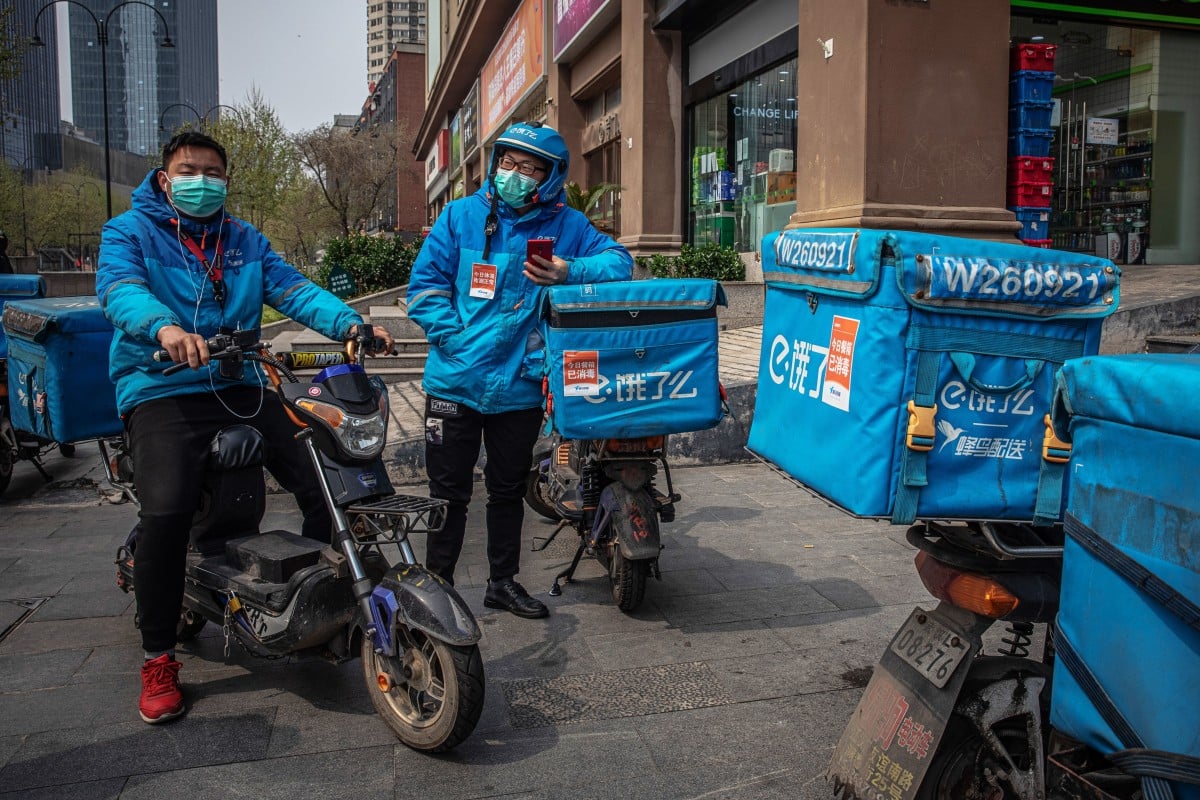
China’s established home delivery system played an important role in getting food and other necessities to residents during the Wuhan lockdown. Photo: EPA-EFE
When Liu Yilin, a retired middle schoolteacher in Wuhan, first heard rumours of a

highly contagious disease

spreading in the central Chinese city he started to stock up on supplies such as rice, oil, noodles and dried pork and fish.

These preparations spared the 66-year-old from some of the early panic when 
the city went into lockdown in late January

and shoppers flooded to the markets and malls to snap up supplies.

But as time went on and with residents banned from leaving their homes, he became increasingly concerned about getting hold of fresh supplies of vegetables, fruit and meat until the nation’s vast network of delivery drivers came to the rescue.
“It was such a relief that several necessity purchasing groups organised by community workers and volunteers suddenly emerged on WeChat [a leading social media app] days after the lockdown,” Liu said. “China’s powerful home delivery service makes life much easier at a time of crisis.”

Hu Xingdou, a Beijing-based independent political economist said: “Home delivery played a very important role amid the coronavirus outbreak. To some extent, it prevented people from starving especially in cases when local governments took extreme measures to isolate people.”

According to Liu, people in Wuhan during the lockdown had to stay within their residential communities, with community workers guarding the exits.

Human contact was limited to the internet. Residents placed orders online with farmers, small merchants or supermarkets to buy daily necessities, and community workers helped distribute the goods from deliverymen.

Every morning, Liu passed a piece of paper with his name, phone number and order number to a community worker who would collect the items from a courier at the gate of the residential area.

Thanks to a high population density in urban areas, affluent labour force and people’s openness to digital life, China has built a well-developed home delivery network.

Extensive funding from technology companies has been invested in hardware infrastructure, software to improve logistics and big data and cloud computing to help predict consumers’ behaviour.

Mark Greeven, professor of innovation and strategy at IMD Business School in Lausanne, Switzerland, said: “Whether it is delivery of products, air parcels or fresh food or even medicine or materials for medical use, China has a very well developed system. Much better developed than I think almost any other places in the world.

“Well before the crisis, China had started to embrace digital technology in daily life whether it is in consumption, business, government and smart cities and use of third party payments. All of these things have been in place for a long time and the crisis tested its agility and capability to deal with peak demand.”

China’s e-commerce giants help revive sales of farm goods from Hubei

3 Apr 2020
According to e-commerce giant JD.com, demands for e-commerce and delivery services spiked during the outbreak of Covid-19, the illness caused by the new coronavirus.
It sold around 220 million items between January 20 and February 28, mainly grains and dairy products with the value of beef orders trebling and chicken deliveries quadrupling compared with a year ago.
Tang Yishen, head of JD Fresh, its fresh foods subsidiary, said: “The surge of online demand for fresh merchandise shows the pandemic helped e-commerce providers further penetrate into the life of customers. It also helped upstream farm producers to know and trust us.”
Meituan Dianping, a leading e-commerce platform, said its grocery retail service Meituan Instashopping reported a 400 per cent growth in sales from a year ago in February from local supermarkets.
The most popular items ordered between January 26 and February 8 were face masks, disinfectant, tangerines, packed fresh-cut fruits and potatoes.
The food delivery service Ele.me said that, between January 21 and February 8, deliveries of frozen food surged more than 600 per cent year on year, followed by a nearly 500 per cent growth in delivery of pet-care products. Fresh food deliveries rose by 181 per cent while drink and snack deliveries climbed by 101 per cent and 82 per cent, respectively. Ele.me is owned by Alibaba, the parent company of the South China Morning Post.
Chinese hotpot restaurant chain adapts as coronavirus fears push communal meals off the menu
E-commerce providers used the opportunity to show goodwill and improve their relationship with customers and partners, analysts say.
Sofya Bakhta, marketing strategy analyst at the Shanghai-based Daxue Consulting, said the food delivery sector had made significant headway in reducing physical contact during the outbreak.
Delivery staff left orders in front of buildings, in lifts or temporary shelters as instructed by the clients as most properties no longer allowed them inside.
Some companies also adopted more hi-tech strategies.
In Beijing, Meituan used self-driving vehicles to deliver meals to contactless pickup stations. It also offered cardboard boxes to be used as shields aimed at preventing the spread of droplets among its clients while they ate in their workplaces. In Shanghai, Ele.me employed delivery drones to serve people under quarantine in the most affected regions.
Some companies even “shared” employees to meet the growing labour demand in the food delivery industry that could not be satisfied with their ordinary workforce, Bakhta said.
More employees from restaurants, general retail and other service businesses were “loaned” to food delivery companies, which faced manpower shortages during the outbreak, according to Sandy Shen, senior research director at global consultancy Gartner.
“These arrangements not only ensured the continuity of the delivery service but also helped businesses to retain employees during the shutdown,” she said.
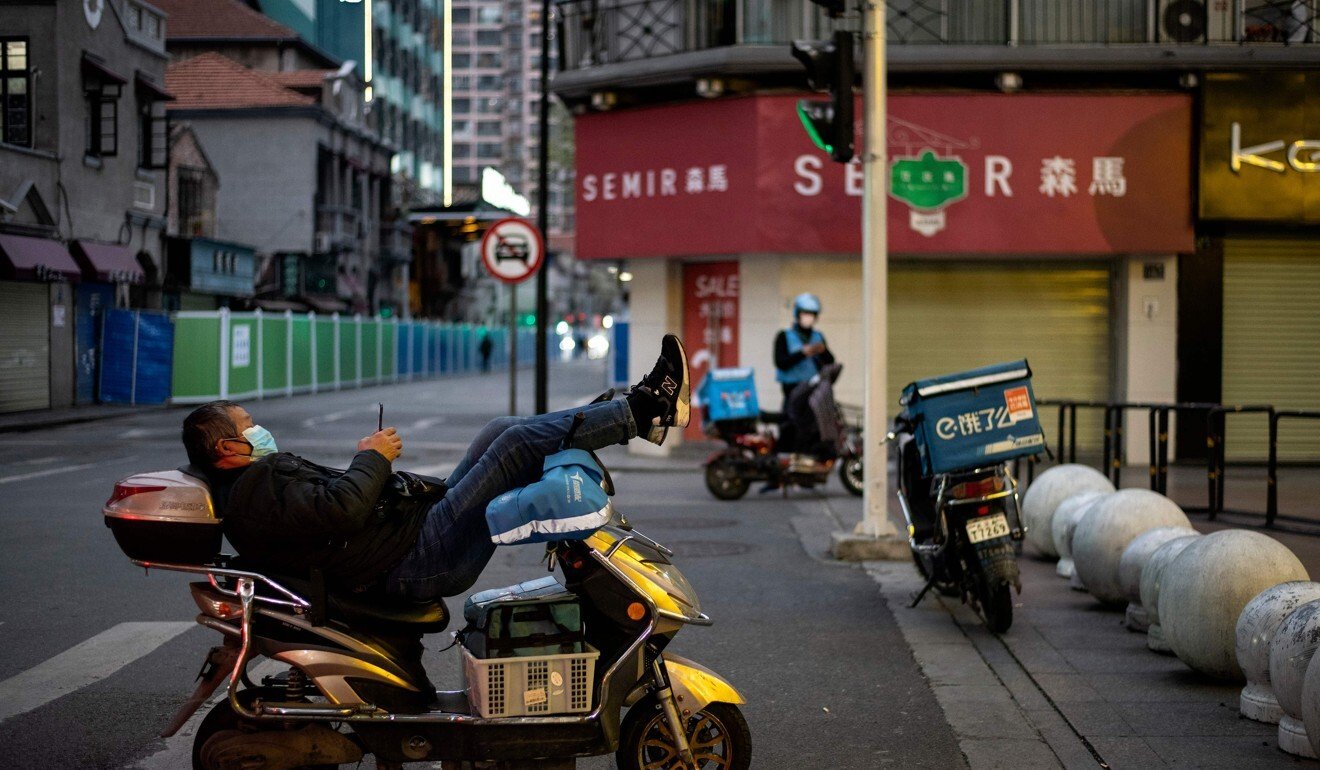
A delivery man takes a break between orders in Wuhan, central China, during the lockdown. Photo: AFP
Mo Xinsheng became one such “on-loan” worker after customers stopped coming to the Beijing restaurant where he worked as a kitchen assistant.
“I wanted to earn some money and meanwhile help people who are trapped at home,” said Mo, who was hired as a delivery man.
But before he could start work he had to go through lengthy health checks before he was allowed into residential compounds.
He also had to work long hours battling the wind and cold of a Beijing winter and carrying heavy loads.
“I work about 10 hours every day just to earn several thousand yuan [several hundred US dollars] a month,” he said.
“Sometimes I almost couldn’t breathe while my hands were fully loaded with packages of rice, oil and other things.
“But I know I’m doing an important job, especially at a time of crisis,” Mo said, “It was not until then that I realised people have become so reliant on the home delivery system.”
Woman uses remote control car to buy steamed buns amid coronavirus outbreak in China
The delivery system has been improved by an effective combination of private sector innovation and public sector coordination, said Li Chen, assistant professor at the Centre for China Studies at Chinese University of Hong Kong.
“[In China,] government units and the Communist Party grass roots organisations have maintained fairly strong mobilisation capabilities to cope with emergencies, which has worked well in the crisis,” he said.
However, Liu, the Wuhan resident, said prices had gone up and vegetables were three times more expensive than they had been over Lunar New Year in 2019.
“There were few varieties that we could choose from, apart from potatoes, cabbage and carrots,” he said.
“But I’m not complaining. It’s good we can still get fresh vegetables at a difficult time. Isn’t it? After all, we are just ordinary people,” he said.
Source: SCMP
07/04/2020

China reports no new coronavirus deaths as cases decline

BEIJING (Reuters) – Mainland China reported no coronavirus deaths for the first time since the pandemic began, and a drop in new cases, a day before the central city of Wuhan, where the virus emerged late in December, is set to lift its lockdown.

China had 32 new infections by Monday, down from 39 a day earlier, the National Health Commission said.

For the first time since the commission began publishing nationwide data in late January, Hubei’s provincial capital of Wuhan saw no new deaths, joining the rest of mainland China, which has recorded none since March 31.

Wuhan, a city of 11 million that reported only two new infections in the past fortnight is due to allow residents to leave the city on Wednesday, for the first time since it was locked down on Jan. 23 to curb the spread of the virus.

With mainland China well past February’s peak of infections, authorities have turned their attention to imported cases and asymptomatic patients, who show no symptoms but can still pass on the virus.

Total infections in mainland China stood at 81,740 on Monday with 3,331 deaths, the commission said. It reported 30 new asymptomatic cases, nine involving incoming travellers. Of the new asymptomatic cases, 18 were in Hubei.

By the end of Monday, 1,033 asymptomatic patients were under medical observation.

TIGHTER LAND BORDERS

Overseas arrivals made up all 32 of the new cases with symptoms, down from 38 a day earlier. Total imported infections stand at 983, the commission said.

China faces the “dual risks” of imported infections and domestic cluster outbreaks, a commission spokesman told a briefing on Tuesday.

The northeast province of Heilongjiang reported 20 new cases, all in Chinese citizens returning from neighbouring Russia. It had reported 20 new infections on Sunday, all also cases imported from Russia.

On Tuesday, the Chinese consulate in the Russian city of Vladivostok near the border with China said it strongly reminded Chinese nationals not to return home through the border port of Suifenhe, which is to be closed to all arrivals from Tuesday.

China has shut its borders to foreigners as the virus spread globally, though most imported cases have involved Chinese nationals returning from overseas.

The number of inbound travellers through airports is fewer than 3,000 a day, down from about 25,000 in late March, before China slashed the number of international flights.

It also started testing all international arrivals for the virus this month.

Source: Reuters

Law of Unintended Consequences

continuously updated blog about China & India

ChiaHou's Book Reviews

continuously updated blog about China & India

What's wrong with the world; and its economy

continuously updated blog about China & India