Archive for June, 2013

28/06/2013

Confrontation over the South China Sea ‘doomed’, China tells claimants

Reuters: “Countries with territorial claims in the South China Sea that look for help from third parties will find their efforts “futile”, China’s Foreign Minister Wang Yi warned on Thursday, adding that the path of confrontation would be “doomed”.

PRC foreign minister Wang Yi

Beijing’s assertion of sovereignty over a vast stretch of the South China Sea has set it directly against Vietnam and the Philippines, while Brunei, Taiwan and Malaysia also lay claim to other parts of the sea, making it Asia’s biggest potential military troublespot.

At stake are potentially massive offshore oil reserves. The seas also lie on shipping lanes and fishing grounds.

Wang didn’t name any third countries, but the United States is a close ally of Taiwan and the Philippines, and has good or improving relations with the other nations laying claim to all or part of the South China Sea.

“If certain claimant countries choose confrontation, that path will be doomed,” Wang said after a speech at the annual Tsinghua World Peace Forum.

“If such countries try to reinforce their poorly grounded claims through the help of external forces, that will be futile and will eventually prove to be a strategic miscalculation not worth the effort.”

The Philippine military said this week it had revived plans to build new air and naval bases at Subic Bay, a former U.S. naval base that American forces could use to counter China’s creeping presence in the South China Sea.

Wang’s comments came days before the minister is due to attend a meeting of foreign ministers of the Association of Southeast Asian Nations grouping in Brunei from Saturday to Tuesday.

The 10-member ASEAN hopes to reach a legally binding Code of Conduct to manage maritime conduct in disputed areas. For now a watered-down “Declaration of Conduct” is in place.

The path to a Code of Conduct will be slow and deliberate, Wang said, adding that the Declaration of Conduct was a commitment made by China and the 10 ASEAN countries and China would continue to abide by it.

“The right way is to fully implement the Declaration, and in this process, move forward with the Code in a gradual way,” Wang said.”

via Confrontation over the South China Sea ‘doomed’, China tells claimants | Reuters.

See also:

28/06/2013

Exposure via internet now China’s top weapon in war on graft

SCMP: “The internet has become the primary tool for exposing corruption on the mainland, “removing a corrupt official with the click of a mouse”, according to a leading think tank’s analysis.

internet_pek06_35887719.jpg

In its Blue Book of New Media, researchers from the Chinese Academy of Social Sciences (CASS) said that 156 corruption cases between 2010 and last year were first brought to light online – compared with 78 cases to resulting from reports in traditional media.

Forty-four cases involving disciplinary violations were first exposed in some form online, while 29 cases followed print and broadcast stories. Sixteen cases citing abuses of power were exposed online; 10 were revealed in traditional media.

Among the latest officials to fall from grace thanks to online revelations was Liu Tienan , a former deputy chief of the National Development and Reform Commission.

Liu was sacked in mid-May, more than five months after an editor of the influential Caijing magazine used his microblog account to expose allegations against him.

The report said revelations online, and the rise in interest in public affairs the internet had engendered, were the main reasons more people were participating in anti-corruption efforts.

However, the report cautioned that such efforts still had a long way to go. Only five officials of above departmental rank were brought down via online exposures last year – just a fraction of the 950 officials of that level who were probed for crimes.

The mainland had 564 million internet users at the end of last year, including 309 million microbloggers, according to the China Internet Network Information Centre. The Blue Book said the online community would likely exceed 600 million this year.

The new-media boom has posed an unprecedented challenge to Communist Party rulers, experts warned, due to the easy spread of information, including rumours. The report blamed the online rumour mill on governments’ declining credibility and growing concern on the part of the public.”

via Exposure via internet now China’s top weapon in war on graft | South China Morning Post.

See also: https://chindia-alert.org/2012/04/26/understanding-social-media-in-china/

27/06/2013

Shenzhen visitor at Hong Kong jewellery fair finds and returns HK$250m bag of diamonds

SCMP: “It’s not every day that someone in Hong Kong finds a bag of diamonds worth HK$250 million lying around. Even more rare is someone who would willingly return it.

tpbje20130620344_36503091_1.jpg

But mainland tourist Fu Zhuli did just that during a trip to a local jewellery fair at the weekend.

On Sunday, the woman from Shenzhen was strolling through the exhibition hall of the Hong Kong Jewellery & Gem Fair at the Convention and Exhibition Centre when she decided to take a short break.

“I went to the café to take a rest and have some chocolate ice-cream. I saw two foreigners chatting…after a while, they left – empty-handed. After a while, when the cleaners came to take the rubbish out, I realised there was a black bag at the foot of their table,” Fu told the Shenzhen Daily.

Fu said she could recognise their faces and tell from their accents that the foreigners were from Israel and possibily from the Israeli pavillion in the hall. She went over to pick up the bag and upon opening it, was shocked to find a trove of “good quality, soy-bean-sized roughs”.

Fu, a jewellery enthusiast, estimated the price of each diamond at about 400,000 yuan to 800,000 yuan (HK$500,000 to HK$1 million) and the total parcel of gems worth at least 200 million yuan. The bag weighed about 3kg.

None of the figures she stated could be confirmed.

After Fu sat at the table “guarding the bag” and thinking of what to do for two hours, one of the young foreigners came running back into the café.

“The shirt on his back was soaked with sweat, and his face was pale. He rushed in and saw the bag with me and leaned forward, uttered some incoherent words and kept bowing and saying ‘thank you’ in Putonghua,” she recounted. “I told him off for being so careless and leaving something so precious behind.”

Asked whether she had ever thought of taking the bag, Fu said: “No, I felt I was lucky enough to have seen those nice diamonds. You know, women love jewellery.” She said that she was a Christian and that her husband, who works in the Shenzhen police force, had told her to report the finding to police immediately. She admitted that some of her friends had told her to keep the bag.

“I never thought of doing that, I just felt like [the men] would come back to get it so I just sat there and waited,” Fu told the Shenzhen Daily. “I am a very honest, simple person and I believe in sincerity.””

via Shenzhen visitor at Hong Kong jewellery fair finds and returns HK$250m bag of diamonds | South China Morning Post.

26/06/2013

College Grads: The PLA Wants You!

BusinessWeek: “Over the past decade, China has invested significantly in higher education—and roughly quadrupled the number of students graduating college annually, to about 7 million. Unfortunately, demand for diploma-holders in China hasn’t kept pace, and the bleak job prospects of the class of 2013 are a frequent source of lament on Weibo, China’s Twitter. Even the state-run Global Times newspaper, usually known for patriotic boosterism, recently printed a depressing chart suggesting that the number of available new positions for graduates has actually been declining.

Delegates from Chinese People's Liberation Army pose for photos outside the Great Hall of the People

One institution is expanding its efforts to recruit college graduates: the People’s Liberation Army. The Beijing News has reported on a change in hiring policy that took effect on June 24. In addition to increased financial compensation, army recruits who have graduated from universities in Beijing will be eligible for permanent Beijing residence cards, called hukous, after they complete their tours of duty and find other jobs in the city. The sought-after hukou is required to purchase an apartment or send children to school in Beijing—in short, to set down permanent roots in the city. In recent years the government has been allocating fewer new hukous for private employers to grant employees in China’s over-crowded capital.

The PLA is aiming to upgrade the caliber of recruits. “Many of the skills and specialties that the PLA needs can only be obtained by attracting civilian college graduates,” says Andrew Scobell, an expert on China’s military at RAND. While joining the army has long been an appealing option for rural students with limited schooling or career choices, it’s been a hard sell among educated urbanites. “The PLA continues to have a tough time attracting well-educated recruits with skills the military needs,” says Scobell. “These new [hiring] policies underscore this ongoing challenge” and also “take advantage of the opportunities presented by the tougher job market for college graduates.”

Beijing is home to China’s leading universities, including Peking University and Tsinghua University—often dubbed the Harvard and MIT of China, respectively. Whether or not the PLA’s recruitment policy will be extended to students in other cities remains to be seen.

via College Grads: The PLA Wants You! – Businessweek.

See also: https://chindia-alert.org/2013/02/10/as-graduates-rise-in-china-office-jobs-fail-to-keep-up/

26/06/2013

Chinese Leader Xi Jinping’s Rare Scolding of Top Communist Party Leaders

WSJ: “After telling the lower ranks of the Communist Party to shape up and make a clean break from past practice, Chinese leader Xi Jinping has taken aim at a new target:  the Party leadership itself.

And he’s done so with authority and openness from the highest pulpit of politics in China–the Politburo, the very place where the senior leaders sit and make policy.

In a speech at the conclusion of a three-day special meeting that was covered across Party media and took up nearly half of the evening newscast on Tuesday evening, Xi proclaimed that senior members of the Party needed “to play an exemplary role,” and that they had to be “broad-minded enough to reject any selfishness…to adhere to self-respect, self-examination and self-admonition” in their work (in Chinese).

It’s extremely rare for Politburo proceedings to be spoken of in such detail and openness.  And it’s unprecedented in modern times for the Party boss to start taking swings at his colleagues at the top by so directly reminding them of their responsibilities—a move that suggests he might be planning something even stronger soon.

Having just admonished lower-level cadres in a salvo last week, some observers might think that Xi is simply putting on a show here. After all, it’s difficult to demand improvement in the work-styles of the rank and file without at least paying lip-service to the idea that those at the top could stand to do a little better themselves.

But the tone of Xi’s comments and the play they’ve received in the state media suggest this is far more than just rhetorical window dressing.  It wasn’t enough for high officials to “strictly abide by party discipline and act in strict accordance with policies and procedures,” Xi said. Those at the top must also “strictly manage their relatives and their staff and refrain from abuse of power.”

“The sole pursuit” of senior members of the Party, Xi insisted, should be tied to “the Party’s cause and interests” – in other words, “to seek benefits for the Chinese people as a whole.”

Whether it’s misuse of official license plates or the high-end looting of state assets (in Chinese), Xi knows that corruption is not always confined to lower-level cadres.

Xi was careful to concede that there have been some positive developments in the ways by which the Politburo and other Party bodies operate, such as “improvements in research and reporting.”  Meetings have been shortened and presentations streamlined, “enhancing the majority of party members’ and cadres’ sense of purpose, as well as the view of the masses” towards the Party leadership, he noted.

But it’s clearly morality at the top — not the way that decisions are made — that concerns Xi and his allies the most.   As Xi’s speech noted, “as long as Politburo comrades always and everywhere set an example, they can continue to call the shots, for that will have a strong demonstration effect, and the Party will be very powerful.”

via Chinese Leader Xi Jinping’s Rare Scolding of Top Communist Party Leaders – China Real Time Report – WSJ.

26/06/2013

Violence in China’s Xinjiang ‘kills 27’

BBC: “Riots have killed 27 people in China’s restive far western region of Xinjiang, Chinese state media report.

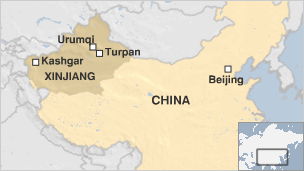
Map

The violence broke out in Turpan prefecture early on Wednesday.

Police opened fire after a mob armed with knives attacked police stations and a local government building, Xinhua news agency quoted officials as saying.

There are sporadic outbreaks of violence in Xinjiang, where there are ethnic tensions between Muslim Uighur and Han Chinese communities.

Confirming reports from the region is difficult because information is tightly controlled.

China’s state media have been quick to issue an official version of events regarding the latest round of violence in Xinjiang, but it will be tough to verify those reports.

Xinjiang lies on China’s remote north-west border and it is difficult for foreign media to travel there. Many people on both sides of the conflict are reluctant to speak to visiting journalists for fear of reprisals if they dispute the government’s stance.

Unfortunately Xinjiang usually hits international headlines when violence flares between the region’s minority ethnic Uighur Muslims and the majority Han Chinese. Many Uighurs contend that their language and religion are being smothered by an influx of Han Chinese migrants.

Xinjiang is a large geographic area rich in oil and gas deposits. Soon it will also become a major supplier of coal to China’s energy-hungry cities. The region’s fertile land also grows produce that is shipped to the rest of the country. The Han Chinese who move to Xinjiang hope to benefit from the region’s untapped resources.

The violence occurred in Turpan‘s remote township of Lukqun, about 200km (120 miles) south-east of the region’s capital, Urumqi.

The Xinhua news agency report, citing local officials, said rioters stabbed people and set police cars alight.

Seventeen people, including nine security personnel and eight civilians, were killed before police shot dead 10 of the rioters, it said.

At least three others were injured and were being treated in hospital, it added.

The Xinhua report did not provide any information on the ethnicity of those involved in the riot or on what sparked it.

But Dilxat Raxit, a spokesperson for the World Uighur Congress, an umbrella organisation of Uighur groups, told the Associated Press news agency the violence had been caused by the Chinese government’s “sustained repression and provocation” of the Uighur community.

In 2009 almost 200 people – mostly Han Chinese – were killed after deadly rioting erupted in Urumqi between the Han Chinese and Uighur communities.

In April an incident in the city of Kashgar left 21 people dead.

Uighurs and Xinjiang

Uighurs are ethnically Turkic Muslims. They make up about 45% of the region’s population; 40% are Han Chinese

China re-established control in 1949 after crushing short-lived state of East Turkestan. Since then, large-scale immigration of Han Chinese. Uighurs fear erosion of traditional culture.

The government said the violence began when “terrorists” were discovered in a building by officials searching for weapons.

But local people told the BBC that the violence involved a local family who had a longstanding dispute with officials who had been pressurising the men to shave off their beards and the women to take off their veils.

Uighurs make up about 45% of Xinjiang’s population, but say an influx of Han Chinese residents has marginalised their traditional culture.”

via BBC News – Violence in China’s Xinjiang ‘kills 27’.

See also: https://chindia-alert.org/political-factors/chinese-tensions/

22/06/2013

Russia, China sign ‘unprecedented’ $270 bn oil deal

Fox News: “Russian oil giant Rosneft and Chinese state firm CNPC signed Friday a $270 billion deal to supply China with oil over 25 years as Russian President Vladimir Putin pushes to diversify the country’s energy customer base away from Europe.

photo_1371814073854-2-HD.jpg

The agreement between Russia, the world’s largest energy producer and China, the world’s largest energy consumer — one of the biggest deals in the history of world oil industry — was signed by Rosneft chief executive Igor Sechin and CNPC head Zhou Jiping in the presence of Putin.

“An estimated value of the contract in current market parameters is absolutely unprecedented — 270 billion dollars,” Putin said in a speech to investors at the annual Saint Petersburg International Economic Forum after overseeing the signing of the deal together with visiting Chinese Vice Premier Zhang Gaoli.

Under the deal, the heavily-indebted Rosneft is slated to receive an upfront payment of around $70 billion, Putin said.

Under another deal, CNPC will acquire 20 percent in an Arctic liquified natural gas project in which France’s Total has 20 percent and Russian independent gas firm Novatek holds the rest.

Putin has made a priority of stabilising Russia’s sometimes prickly relations with its giant eastern neighbour at a time when its ties with the West are becoming ever more problematic.

Russia wants to diversify its base of energy customers away from crisis-hit Europe and is aware it has not fully exploited the colossal potential of Asian markets, China in particular.

“Consumption will be growing in China. And in Japan consumption will be growing, too,” Putin said. By contrast, he added: “Europe is going through some certain difficulties.””

via Russia, China sign ‘unprecedented’ $270 bn oil deal | Fox News.

21/06/2013

China’s Communist party takes page from Mao’s playbook

FT: “China’s Communist party has unleashed a rectification campaign of a scale and tone not seen in more than a decade as the leadership seeks to address frustration over corrupt officials while avoiding bold political reforms.

A China Communist party flag wavesd among soldiers and policemen at the opening ceremony of a revolutionary song singing concert

As investors wait for party chief Xi Jinping to initiate long-delayed economic reforms and liberals in China push for political change, Mr Xi is taking a page out of the playbook of Mao Zedong, the charismatic but dictatorial politician who led China through a sequence of mass campaigns.

Mr Xi, in a speech on Tuesday, exhorted the party that it must embrace the “mass line” to avoid its extinction. Every cadre, demanded Mr Xi, must “look in the mirror, tidy your attire, take a bath and seek remedies” to clean the party from formalism, bureaucratism, hedonism and extravagance.

All cadres from county level upwards have to attend study and criticism sessions during the year-long campaign. State media are blanketing the public with interpretations of the “mass line” – the concept that the party must remain close to the people to understand and address their needs.

“This is a very big thing for the party’s style. There has been nothing like it for at least the past decade,” says Wang Wen, the former commentary head of the party tabloid Global Times who now leads a think-tank at Renmin university.

via China’s Communist party takes page from Mao’s playbook – FT.com.

21/06/2013

Who wants to bet on a Chinese-invested ‘Nicaragua Canal’?

SCMP: “For centuries since the colonisation of the New World, entrepreneurs have dreamed of building a canal spanning Nicaragua to make it easier to tap Asia’s riches.

nicaraguacanal_afp.jpg

Sixteenth century Spanish conquistador Hernan Cortes yearned to cleave the isthmus, and ever since, French, American and Dutch financiers have all made abortive, Quixotic attempts to bisect the Central American country’s volcano-studded terrain.

Now it’s the turn of the Chinese. And scepticism is as strong as ever.

The Hong Kong-based company that won a concession to design, build and manage a US$40 billion canal to rival Panama’s says it has been lured by an energy renaissance in the United States and its belief that world trade could double by 2030.

The company, HKND Group, was registered last year in the Cayman Islands. This would be its first infrastructure project, and its 40-year-old boss, Wang Jing, is relatively unknown.

There is still no firm route for the proposed canal, which would cost about four years’ worth of Nicaragua’s annual gross domestic product, and would likely be three times longer than the 48-mile (77-km) Panama Canal, which took a decade to build. Engineers also note that the geography poses some major challenges – not least a 20 foot tide differential between the two coasts.

For all those reasons, investors and infrastructure experts are highly dubious that a canal will ever be built.

“Are international shipping companies going to trust a one-guy shop with minor telecommunications experience to be the system integrator on a US$40 billion project in a country whose transparency is already subject to question?”, said Evan Ellis, a professor of national security studies at the US Government’s National Defense University.

Greg Miller, a shipping consultant at IHS Fairplay, a global maritime intelligence company, was also highly sceptical.

“The Nicaragua canal will never be built and the only people who’ll financially profit from this proposal are the consultants paid to do the feasibility studies,” he said.

Rosario Murillo, the wife of President Daniel Ortega and his government spokeswoman, said at a ceremony with Wang after the concession was granted: “This is a day of miracles, of wonders.” Government officials declined to comment on scepticism that has emerged since then.

HKND Group is a unit of holding company the HK Nicaragua Canal Development Investment Co., which was incorporated last year, according to the Hong Kong Companies Registry.

It bases its projections for the future success of a Nicaragua canal on the US shale revolution, which has unlocked decades of oil and gas supply. If the United States wants to export more to Asia, the theory goes, it will need to send more and bigger ships from Gulf Coast refineries by canal to the Pacific, and Panama won’t be able to handle it all.”

via Who wants to bet on a Chinese-invested ‘Nicaragua Canal’? | South China Morning Post.

21/06/2013

4.7-trillion-yuan plan to double mainland road network by 2030

SCMP: “Central government earmarks 4.7 trillion yuan for upgrading and extending roads, giving the country 400,000km of highway by 2030

shenzhen_international_toll_roads_4634887.jpg Newspapers suggest 4.7-trillion-yuan plan to double mainland road network by 2030

The mainland will spend 4.7 trillion yuan (HK$5.9 trillion) in the next 17 years to more than double its network of major roads, top transport officials said yesterday.

Dai Dongchang , chief planner with the Ministry of Transport‘s general planning department, told a press conference that a recently approved blueprint for road expansion included 50,000 kilometres of toll highways and 160,000 kilometres of toll-free “national trunk ways”, which are narrower and have slower top speeds.

The mainland has 173,000 kilometres of the two kinds of road at present and the plan approved by the State Council last month says that should rise to 400,000 kilometres by 2030.

By then, toll-free trunk ways should connect all counties, Dai said, while highways should connect all cities with populations of more than 200,000, as well as important transport junctions and border ports.

Huang Min , head of the National Development and Reform Commission‘s basic industry department, said 18 cities of more than 200,000 lacked highway links at present, while more than 900 counties were not connected to national trunk ways.

The new highways would include two north-south routes in the nation’s west, Huang said, with many of the 900 counties expecting new trunk ways also located in the west.

The mainland now had about 110 million private vehicles, 60 times the number in 1981, when the plan for the existing road system was drafted, he said.

Dai said the volume of goods carried on mainland roads was 3.7 times the volume carried on United States’ roads and was expected to at least double by 2030, along with the number of passenger vehicles.

He said China had previously paid more attention to the construction of highways and small roads in the countryside, leading to sluggish development and poor maintenance of trunk ways.

The blueprint forecasts a total of 5.8 million kilometres of roads on the mainland by 2030 – 84 per cent countryside roads, 9 per cent provincial roads and 7 per cent highways and trunk ways.”

via 4.7-trillion-yuan plan to double mainland road network by 2030 | South China Morning Post.

See also: https://chindia-alert.org/economic-factors/chinas-infrastructure/

Law of Unintended Consequences

continuously updated blog about China & India

ChiaHou's Book Reviews

continuously updated blog about China & India

What's wrong with the world; and its economy

continuously updated blog about China & India