Chindia Alert: You’ll be Living in their World Very Soon
aims to alert you to the threats and opportunities that China and India present. China and India require serious attention; case of ‘hidden dragon and crouching tiger’.
Without this attention, governments, businesses and, indeed, individuals may find themselves at a great disadvantage sooner rather than later.
The POSTs (front webpages) are mainly 'cuttings' from reliable sources, updated continuously.
The PAGEs (see Tabs, above) attempt to make the information more meaningful by putting some structure to the information we have researched and assembled since 2006.
In the run-up to the Indian election, which gets under way on 11 April, BBC Reality Check is examining claims and pledges made by the main political parties.
One of the most dramatic actions taken by the ruling BJP was the withdrawal in 2016 of all high-value banknotes from circulation, almost overnight.
This effectively removed 85% of all cash notes from the economy.
It also said it would help move India towards an economy less dependent on cash.
However, Reality Check has found that there’s little evidence the ban has helped root out illegally held assets.
And compared with other emerging economies, the level of cash in circulation in India has remained high.
What actually happened?
In November 2016, the two highest notes in circulation – 500 and 1,000 Indian rupees (£11) – were scrapped.
The surprise move – referred to in India as “demonetisation” – caused widespread confusion and led to street protests.
Image copyrightGETTY IMAGES
For a limited period only, the withdrawn notes could be exchanged for legal currency at banks – but there was a limit of 4,000 rupees per person.
What impact did it have?
Critics said the policy severely disrupted the economy, badly affecting the poor and rural communities that relied on cash.
The government said it was targeting illegal wealth held outside the formal economy, which fuelled corruption and other illegal activity and had not been declared for tax purposes.
It was assumed that those with large amounts of such cash would now find it difficult to exchange for legal tender.
But by August 2018, a report published by India’s central bank said that more than 99% of the old banknotes in circulation prior to the ban had been accounted for.
It was suggested that there had not been much unaccounted for wealth held in cash in the first place – or if there had been, the owners had found ways to convert it to legal tender.
Image copyrightGETTY IMAGES
Did the policy achieve the objective of exposing counterfeit currency?
Not really, according to India’s central bank.
The number of fake 500 and 1,000 rupee notes found after the ban was only marginally higher than the amount from the previous year.
In the two years before the currency withdrawal, tax collection growth rates had been in single digits.
Then in 2016-17, the amount of direct taxes collected increased by 14.5% over the previous year.
The following year, collections rose by 18%.
But the rate of growth in collecting direct taxes had seen a similar increase between 2008-09 and 2010-11, when the Congress party was in power.
And it’s likely that other policies – such as an income tax amnesty in 2016 and a new goods and services tax the following year – may have contributed as much to the growing tax take as demonetisation.
What about a cashless society?
Against a long-term trend of a gradual rise in cashless payments, there is a significant jump at the end of 2016, when the notes were withdrawn.
But this reverted soon afterwards to the steady rising trend.
The overall increase over time may have less to do with government policy and more to do with changing technology and easier cashless payments.
As to whether the overall amount of cash in the economy has fallen, we can look at India’s currency to gross domestic product (GDP) ratio over time.
This is a measure of the amount of currency in circulation in proportion to the total value of goods and services produced.
This took a sharp dive immediately following the withdrawal of the 500 and 1,000 rupee notes – but by the following year, currency in circulation had reverted to pre-2016 levels.
NEW DELHI (Reuters) – India’s main opposition Congress party will reserve a third of federal government jobs for women if it comes into power, its chief Rahul Gandhi said on Wednesday, in a sign women’s rights are rising up the political agenda for next month’s election.
Over the last week, two powerful parties from eastern India said they would field women in a third of parliamentary races, putting pressure on Prime Minister Narendra Modi’s ruling Bharatiya Janata Party (BJP) and other big parties to follow suit.
India ranks at 149 out of 193 countries – worse than neighbouring Afghanistan, Bhutan, Bangladesh and Pakistan – for the percentage of women in national parliaments, according to the Inter-Parliamentary Union, an independent organisation promoting democracy.
“…Frankly, I don’t see enough women in leadership positions. I don’t see them leading enough companies, I don’t see them leading enough states, I don’t see enough of them in the Lok Sabha and the Vidhan Sabhas,” Gandhi said in the southern city of Chennai, referring to India’s lower house of parliament and state legislatures.
Federal government jobs in India are already subject to numerous quotas, including one passed in January that reserves 10 percent of openings for people outside high income brackets.
Gandhi also said that Congress would pass the Women’s Reservation Bill this year if it came to power. The bill, which reserves 33 percent of the seats in national and state assemblies for women, has been on hold for two decades despite being championed by Congress and the BJP at different points.
The BJP, which says it has empowered women through nationwide schemes including clean fuel and sanitation, questioned how the Congress jobs plan would be implemented.
“For how many generations have people talked about reservation in party positions, reservation for elections, reservation in jobs? But it doesn’t seem to happen,” BJP spokesperson Shaina N.C. said.
There are currently 66 women out of a total 543 elected members in India’s lower house of parliament. At 12 percent, this is the highest ever proportion of women in the Lok Sabha.
Women make up nearly half of all voters in the country of 1.3 billion people, according to the Election Commission of India. Based on recent state polls, women will likely head to voting stations in droves for the elections due by May, surpassing male turnout, analysts predict.
On Tuesday, Mamata Banerjee, chief minister of West Bengal state, said her All India Trinamool Congress party would field 17 women candidates across 42 seats.
Earlier, on Sunday, the Biju Janata Dal, which rules Odisha state in eastern India, said it would reserve seven of 21 seats it is contesting for women candidates.
“33% reservation in parliament will give them bigger role in highest policy making body,” Naveen Patnaik, leader of the BJD and Odisha’s chief minister, said in a tweet.
“Women of our nation rightfully deserve this from all of us.”
The Centre has also argued that the documents presented a “selective and incomplete picture of internal secret deliberations” on a matter relating to national security and defence.
INDIAUpdated: Mar 13, 2019 17:19 IST
Ashok Bagriya & Bhadra Sinha
Hindustan Times, New Delhi
The Centre reasoned that the Rafale review petition should be dismissed and the documents removed from the top court’s records.(PTI)
The widely-circulated review petition against the Supreme Court’s December verdict in the Rafale deal that includes leaked defence ministry jeopardizes national security and should be dismissed, the defence ministry has told the Supreme Court in an affidavit filed on Wednesday
The Centre has also argued that the documents presented a “selective and incomplete picture of internal secret deliberations” on a matter relating to national security and defence.
It reasoned that the petition should be dismissed and the documents removed from the top court’s records.
The government also claimed privilege over the documents presented under the evidence law for courts and insisted that the court could not take them into consideration without the government’s permission.
Defence Secretary Sanjay Mitra told the top court that the petitioners had attached documents relating to war capacity of India’s combat jets. “This information is now available to our adversaries…This puts the national security in jeopardy,” the top defence ministry official said.
The government also told a bench headed by Chief Justice of India Rajnan Gogoi that an internal inquiry into the leaks had started.
The petitioners are guilty of leakage of sensitive information, which offends the terms of the agreements for purchase of the fighter jets, the government said. Additionally, those who have conspired in this leakage are guilty of penal offences under the Indian Penal Code including theft by unauthorized photocopying and leakage of sensitive official documents affecting national security.
The move comes three days after 157 people were killed after an Ethiopian Airlines Boeing 737 MAX 8 crashed 6 minutes after take-off from Ethiopian capital Addis Ababa on Sunday.
SNS Web | New Delhi | March 13, 2019 9:37 am
The Directorate General of Civil Aviation (DGCA) on Wednesday informed that all Boeing 737 Max aircraft will be grounded before 4 pm today. This is to cater to situations where aircraft are to fly back to India or go to maintenance facility for parking.
Boeing 737 Max operations will stop from/to all Indian airports. Additionally no Boeing 737 Max aircraft will be allowed to enter or transit the Indian airspace effective 1600 hrs Indian time or 1030 UTC, the DGCA ordered.
The timeline is to cater to situations where aircraft can be positioned at maintenance facilities and international flights can reach their destinations.
Earlier on Tuesday, India grounded Boeing 737 Max 8 aircraft used by the country’s airline companies in light of the Ethiopian Airlines crash that killed 157 people.
SpiceJet has around 12 ‘737 Max 8’ planes in its fleet, while Jet Airways has five.
“DGCA has taken the decision to ground the Boeing 737-Max planes immediately. These planes will be grounded till appropriate modifications and safety measures are undertaken to ensure their safe operations,” the Ministry of Civil Aviation said in a tweet.
“As always, passenger safety remains our top priority. We continue to consult closely with regulators around the world, airlines, and aircraft manufacturers to ensure passenger safety,” it added.
Following the DGCA decision, SpiceJet suspended Boeing 737 Max operations. “Safety and security of our passengers, crew and operations are of utmost importance to us,” the airline informed.
The move comes three days after 157 people were killed after an Ethiopian Airlines Boeing 737 Max 8 crashed 6 minutes after take-off from Ethiopian capital Addis Ababa on Sunday.
Meanwhile, the Civil Aviation Secretary has called an emergency meeting of all airlines at 4 pm today in Delhi.
Earlier, the DGCA had issued additional safety instructions to the two Indian carriers that operate the Boeing 737 Max aircraft. Pilots of SpiceJet and Jet Airways should have at least 1,000 hours of flying experience to command these planes, the regulator ordered.
A total of 149 passengers and 8 crew members from 35 countries were on board the Ethiopian Airlines flight ET 302 when it ploughed into a field in Bishoftu (formerly Debre Zeit), a town located 48 kilometres south east of Addis Ababa.
Four Indians, including a UNDP consultant attached to India’s Environment Ministry, lost their lives in the crash.
This was second such crash involving the 737 Max 8 aircraft in less than five months.
In October last year, an aircraft operated by Lion Air crashed killing over 180 people in Indonesia.
Following Sunday’s accident, Ethiopian Airlines grounded its entire Boeing 737 Max 8 fleet until further notice.
European Union and many countries across the world have already banned the use of 737 Max 8 aircraft in their respective airspace.
On Monday, China, too, grounded all of its Boeing 737 Max 8 jets. Australia too followed the suit on Tuesday.
Ecology and Environment Minister Li Ganjie attends a press conference on “fighting resolutely to prevent and control pollution” for the second session of the 13th National People’s Congress (NPC) in Beijing, capital of China, March 11, 2019. (Xinhua/Shen Bohan)
BEIJING, March 11 (Xinhua) — China has made sound progress in addressing the prominent problems over environmental protection along the Yangtze River Economic Belt, the country’s Ecology and Environment Minister Li Ganjie said Monday.
After two years of work, 99.9 percent of the 1,474 drinking water sources in cities above the county-level along the Yangtze River Economic Belt, stringing up 11 provinces and municipalities from west to east, have had their problems resolved, Li told a news conference on the sidelines of the annual legislative session.
Meanwhile, over 90 percent of the 12 “black and malodorous water bodies” in the provincial capital cities have been cleaned up, while prefecture-level cities are catching up on this front, Li said.
A special campaign targeting illegal disposal of solid and hazardous waste along the Yangtze, China’s longest river, has also been successful, the minister said, adding that the country has made notable progress in enhancing protection of the nature reserves in the Yangtze River basin.
The country will continue to improve the supervision system for Yangtze protection, Li said.
China has made the “defense of lucid waters” a primary task in the battle against pollution for 2019. Research will be conducted for the drafting of laws on bio-security and Yangtze River conservation this year, according to the work report of the Standing Committee of the 13th National People’s Congress.
BEIJING, March 11 (Xinhua) — Chinese President Xi Jinping on Monday sent messages of condolence respectively to his Ethiopian and Kenyan counterparts, Sahle-Work Zewde and Uhuru Kenyatta, over the plane crash that killed 157 people on Sunday.
In his messages, Xi said he was shocked to hear about the crash of the Ethiopian Airlines plane and the massive casualties it caused, including Ethiopian, Kenyan and Chinese victims.
On behalf of the Chinese government, the Chinese people and in his own name, he expressed deep mourning for the victims and extended his condolences to the bereaved families.
Xi said that he believes the Ethiopian government is capable of properly handling the aftermath of the tragedy. He added that China would provide any necessary support and assistance.
Also on Monday, Chinese Premier Li Keqiang sent a message to his Ethiopian counterpart, Abiy Ahmed, offering his condolences over the plane crash.
No other injuries reported following accident on southern island of Hainan
Military is currently intensifying training for pilots as it looks to strengthen capabilities
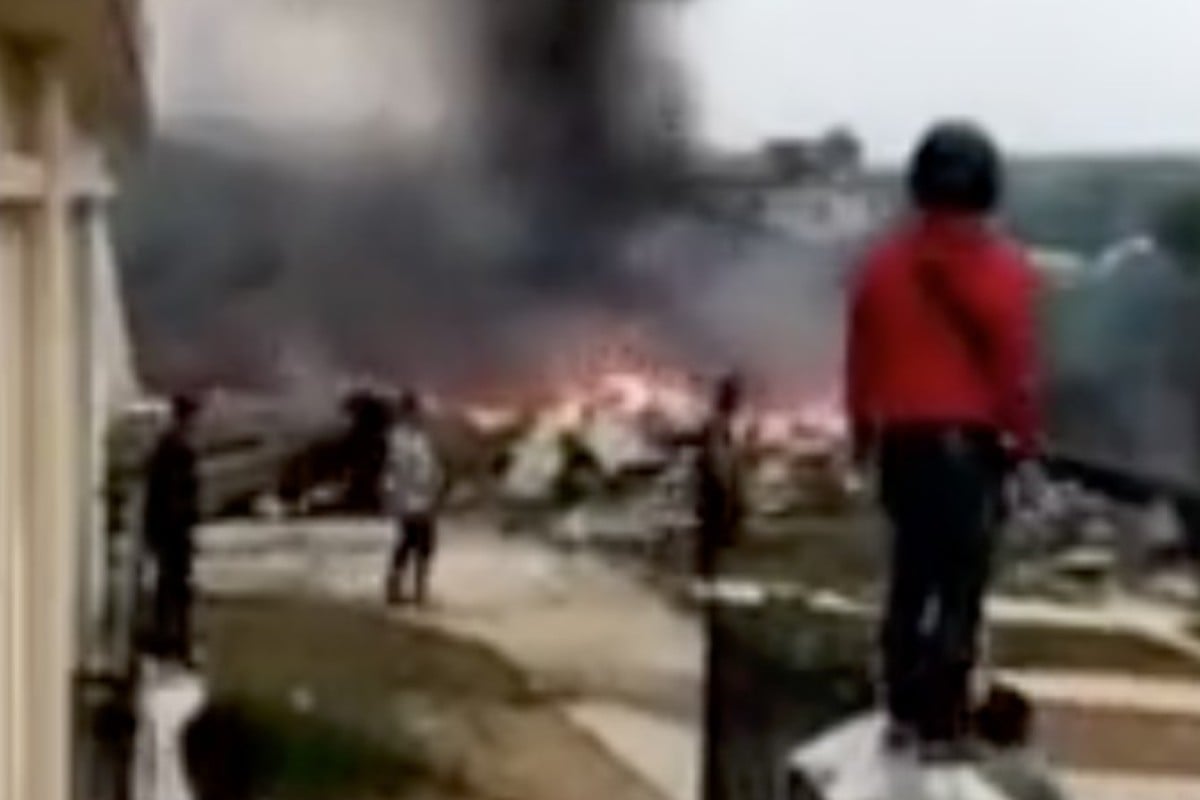
Mobile phone footage believed to be taken from the crash site. Photo: Handout
A Chinese navy plane crashed in Hainan province on Tuesday killing two crew members, the military said.
A short statement said the crash happened during a training exercise over rural Ledong county in the southern island province.
No one else was reported to have been injured after the plane hit the ground and the cause of the incident is being investigated.
Footage that purported to be taken from the crash site started circulating on social media after the accident.
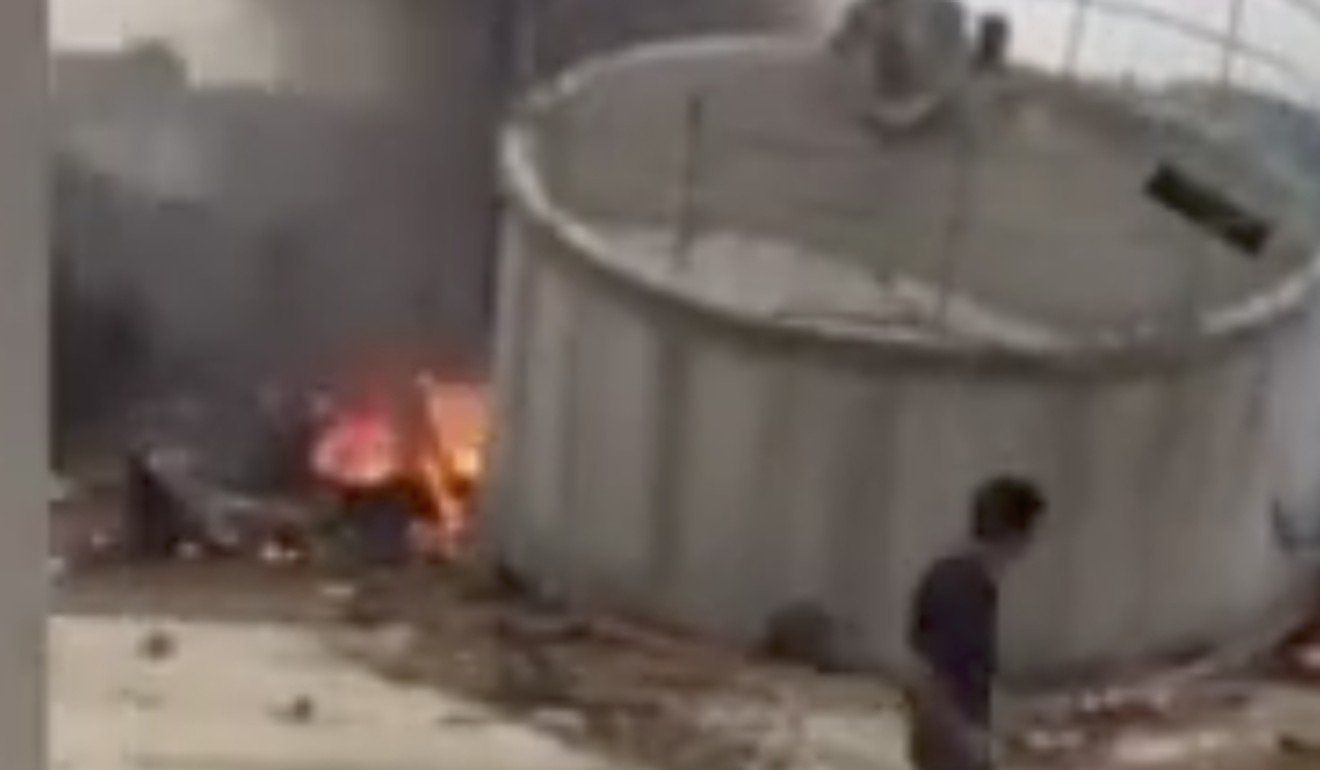
The mobile phone footage, which news portal 163.com said was taken in Hainan, showed smoke rising from piles of wreckage next to a damaged water tower as bystanders gathered at the site.
Footage apparently taken at the crash site. Photo: Handout
The person who uploaded the footage said the plane had hit the water tower before crashing into the ground.
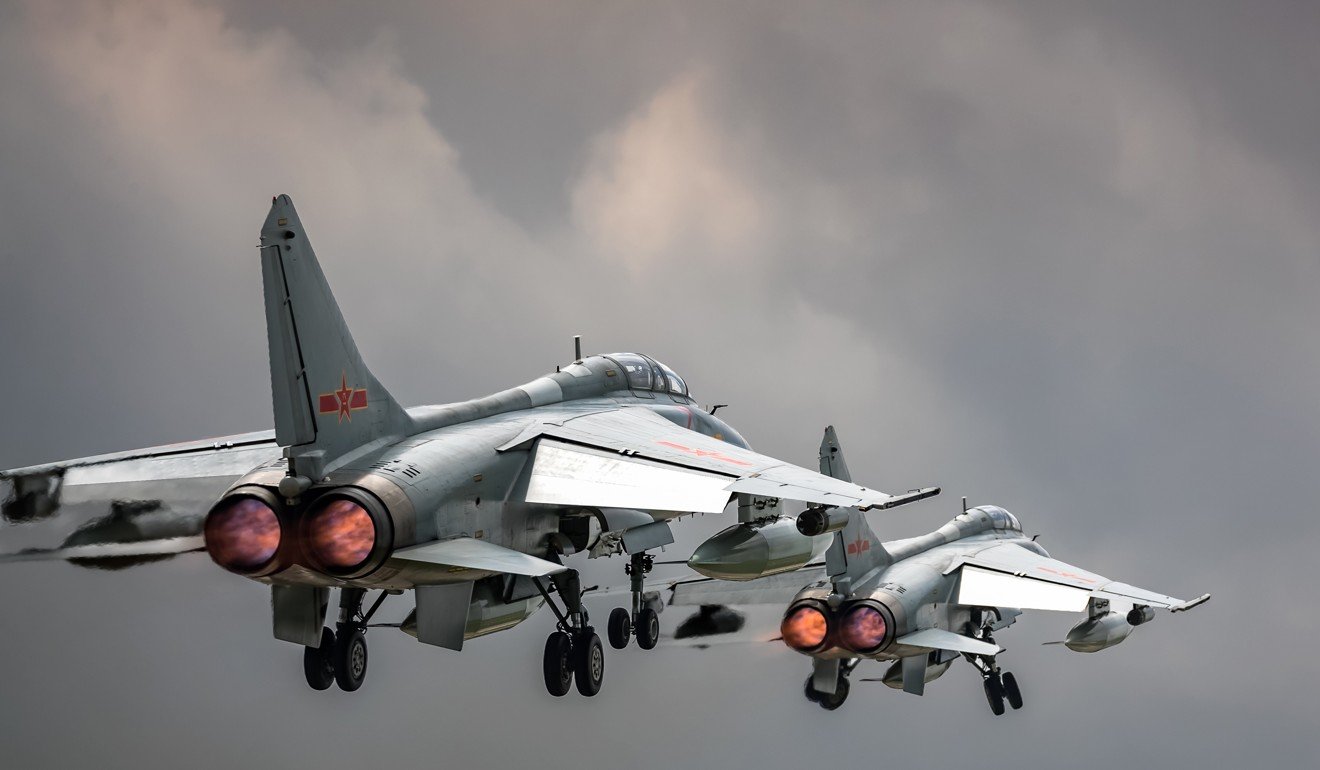
The PLA’s official statement did not specify the type plane that crashed, although unverified witness account online said it was a twin-seat Xian JH-7 “Flying Leopard”.
The JH-7, which entered service with the navy and air force in the 1990s, has been involved in a number of fatal accidents over the years.
The country’s worst military air accident in recent years happened in January 2018. At least 12 crew members died when a PLA Air Force plane, believed to be an electronic reconnaissance aircraft, crashed in Guizhou in the southwest of the country.
Between 2016 and 2017, there were at least four accidents involving the navy’s J-15 “Flying Sharks”, one of them resulting in the death of the pilot.
Military commentators have previously said that China’s drive to improve its combat readiness, which includes the building of new aircraft carriers and warplanes, has resulted in a serious shortage of qualified pilots.
To fill the vacancies the Chinese military has started a major recruitment drive and intensive training programme for pilot pilots.
One unverified report said the plane that crashed was a JH-7 “Flying Leopard”. Photo. Xinhua
Currently China has one aircraft carrier, the Liaoning, in service, which can carry a maximum of 24 J-15s as well as other aircraft.
Meanwhile, the new home-grown carrier Type 001A will soon be commissioned, which is designed to accommodate to carry eight more fighters.
In addition, construction is believed to have started on another carrier that will be able to carry heavier and more advanced warplanes.
According to figures from the end of 2016, there were only 25 pilots qualified to fly the J-15 while 12 others were in training.
Most of the Chinese navy’s pilots have been redeployed from the air force, which is itself in need of more trained pilots.
This year the navy for the first time began a nation-wide programme to scout out potential pilots.
Speaking on the sidelines of the ongoing legislative meeting in Beijing Feng Wei, a PLA pilot from the Western Theatre, said the military was currently intensifying its pilots’ training as increasing amounts of new equipment entered service.
“Personnel quality is the key to everything,” he added.
WASHINGTON (Reuters) – White House national security adviser John Bolton said on Monday Pakistan’s foreign minister has assured him Islamabad is committed to de-escalating tensions with India and dealing “firmly” with terrorists.
Bolton’s comments follow a Feb. 14 suicide bombing, claimed by Pakistan-based militants, which killed at least 40 Indian paramilitary police.
“Spoke with Pakistani FM (Shah Mehmood) Qureshi to encourage meaningful steps against JeM (Jaish-e-Mohammed) and other terrorist groups operating from Pakistan,” Bolton said on Twitter.
“The FM assured me that Pakistan would deal firmly with all terrorists and will continue steps to deescalate tensions with India,” Bolton added.
Pakistan, which denies Indian accusations of aiding militant groups, last week announced a crackdown against all proscribed outfits.
Pakistan’s foreign ministry late on Monday said Qureshi informed Bolton “about the de-escalatory measures taken by Pakistan” in the wake of the aerial bombing missions carried out by both countries in late February.
Qureshi told Bolton that Pakistan’s strike in Kashmir on Feb. 27 was in self-defence and retaliation to India’s raid on its territory a day earlier. New Delhi said it hit a JeM training camp in Pakistan, but Islamabad denies any such camp exists.
The two countries fought an aerial dogfight over Kashmir on Feb. 27, and a couple of days later Pakistan returned a downed Indian pilot in a gesture that appeared to de-escalate the crisis.
German Foreign Minister Heiko Maas, in a joint conference with Qureshi, commended Pakistan on Tuesday for returning the pilot and offering talks with India. But he also urged Islamabad to stamp out militant groups which attack neighbouring countries.
“We both agreed that cross-border terrorism has to be permanently stopped and there too there have been positive signs in the past few days that we welcome very much,” Maas said. “Ultimately it’s about fighting any kind of terrorism and extremism.”
CWC meeting LIVE: Congress is launching its Lok Sabha election campaign from Ahmedabad in Gujarat, the home state of PM Narendra Modi and BJP president Amit Shah with a meeting of its top leaders, including Rahul Gandhi, Sonia Gandhi, Manmohan Singh.
The Congress is launching its Lok Sabha election campaign from Ahmedabad in Gujarat, the home state of Prime Minister Narendra Modi and BJP president Amit Shah with a meeting of its Congress Working Committee (CWC) and a public rally by its top leaders.
Congress president Rahul Gandhi, UPA chairperson Sonia Gandhi, former Prime Minister Manmohan Singh and party general secretaries, including Priyanka Gandhi, will be among the senior leaders of the party attending the meeting.
The Congress Working Committee, the highest decision-making arm of the party, would seek answers to failures and unfulfilled promises of the Modi government on governance, agrarian distress, economic issues, unemployment, national security and women’s safety, according to party leaders.
Hardik Patel, a prominent young leader of Patidars, who is leading a movement for reservation in jobs and education for their community, is likely to join Congress and contest the Lok Sabha elections on a party ticket, according to sources.
t was agreed that Saudi Arabia and India should work together for irreversible, verifiable and credible steps against all terrorists without any discrimination.
Statesman News Service | New Delhi | March 12, 2019 2:10 pm
Prime Minister Narendra Modi on Monday held discussions with leaders of three key Islamic nations ~ Saudi Arabia, the United Arab Emirates (UAE) and Turkey ~ and, without directly naming Pakistan, impressed on them the importance of immediate, demonstrable and irreversible action against terrorism by all countries.
Visiting Saudi Minister of State for Foreign AffairsAdel bin Ahmed Al Jubeir had a meeting with Modi in New Delhi on Monday evening while the Indian leader had telephonic conversations with Sheikh Mohammed bin Zayed Al-Nahyan, Crown Prince of Abu Dhabi and Deputy Supreme Commander of the UAE Armed Forces, and Turkish President Recep Tayyip Erdogan.
Saudi Arabia, UAE and Turkey are key allies of Pakistan and are said to have played a significant role in reducing tension between India and Pakistan in the wake of the Pulwama attack.
During his meeting with the Saudi minister, PM Modi thanked the leadership of Saudi Arabia for expressing full solidarity with India in the fight against terrorism in all its forms and manifestations.
It was agreed that Saudi Arabia and India should work together for irreversible, verifiable and credible steps against all terrorists without any discrimination, the External Affairs Ministry said.
During his four-hour visit to the Indian capital, the Saudi minister also met External Affairs Minister Sushma Swaraj. The Indian minister reiterated that an immediate, irreversible and verifiable action to dismantle terror infrastructure was essential to fight the menace of terror.
The Turkish President conveyed to PM Modi his condolences for the victims of the recent terror attacks in India and wished a speedy recovery to those injured in these attacks.
PM Modi told him that terrorism remained one of the gravest threats to global peace and security. He underscored the importance of demonstrable and irreversible action against all terror groups.


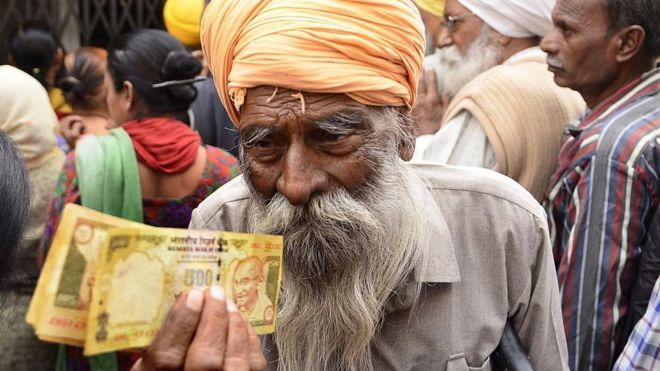 Image copyrightGETTY IMAGES
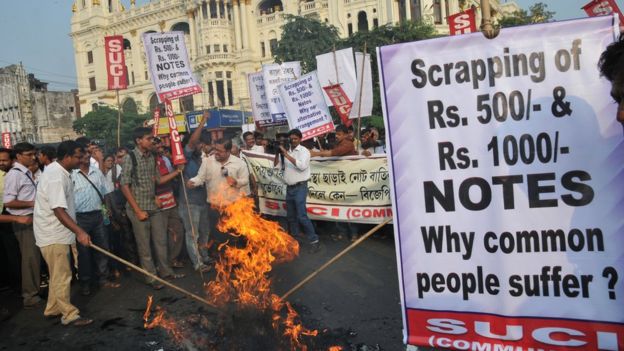 Image copyrightGETTY IMAGES
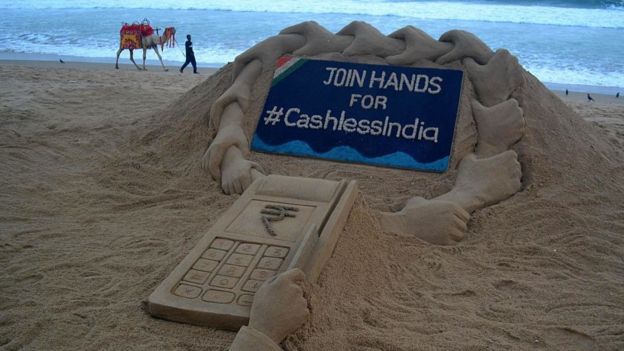 Image copyrightGETTY IMAGES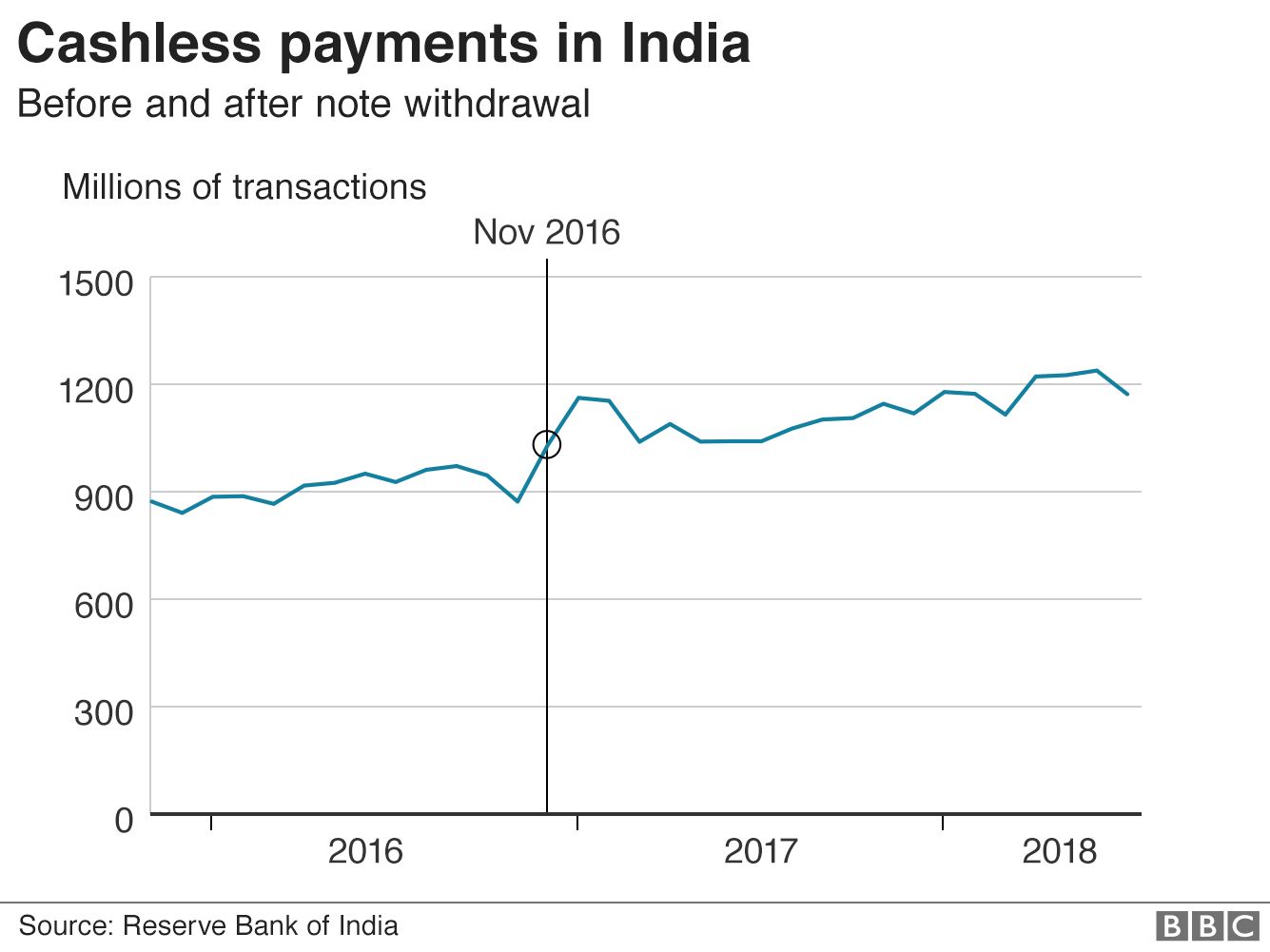




 CHINDIA ALERT: You'll be living in their world, very soon