Archive for March, 2019

03/03/2019

Across China: From imitation to creation, Chinese village paints new life

SHENZHEN, March 2 (Xinhua) — Zhao Xiaoyong was once called “China’s Van Gogh,” as the farmer turned oil painter made over 100,000 replicas of Van Gogh’s work over the past 20 years.

However, he never saw a single authentic piece of the Dutch post-impressionist painter until 2014 when he finally saved enough for a trip to the Netherlands.

The trip inspired him to think over his business and create his own works. “The masterpieces that I saw at the European museums made me realize that I have to develop my own style.”

Zhao is from Dafen, a village known for oil paintings in southern China’s Shenzhen City. Home to 1,200 studios and 8,000 painters, the village produces millions of replicas of Van Gogh, Monet and Picasso that are sold at home and abroad. According to statistics, 80 percent of oil paintings exported from China come from Dafen.

While the market demand for replicas is shrinking, Zhao and other painters in the village are creating their own art styles and attracting tourists.

Neighboring Hong Kong, Shenzhen is one of China’s first special economic zones for the country’s reform and opening drive. The painting industry started in Dafen Village in 1989 when Hong Kong purchasers sought to establish an oil painting base nearby.

Zhao, who quit his job at a craft factory, started learning how to paint from scratch in 1996. He imitated Van Gogh’s works via a painting album, including “sunflowers” and “almond blossoms.”

He sold his first works in 1999 when an American buyer ordered 20 paintings. More orders later came from abroad, prompting Zhao to recruit apprentices.

“My wife and my younger brothers are all my students,” he said with a smile. “I was even called ‘China’s Van Gogh’ in a documentary.”

Zhao and his team worked from 1 p.m. to 3 a.m. painting eight pieces per person every day at most. Prices for the replicas ranged from 200 yuan (30 U.S. dollars) to 3,000 yuan per piece, depending on the size.

In 2008, when the economic recession hit most parts of the world, a drastic reduction of foreign orders forced Zhao to explore the domestic market. Profits kept shrinking after 2012 due to consumers’ diversifying tastes and rising costs.

Since then, many painters in the village have given up making replicas and turned to innovation and creation.

Chen Qiuzhi, who used to paint copies of masterpieces like Zhao, has worked hard to develop his own style, combining Chinese calligraphy with painting. To support him, his wife sold two apartments and had an art center built.

The center, located at the far end of Dafen village, covers an exhibition area of over 3,000 square meters and has become a landmark of Dafen. Some 100 calligraphy works are exhibited at the center with other craftwork.

Ten years of hard work has won him fame, with his works popular in the auction market. Now, one piece of his calligraphy is worth tens of thousands of yuan, almost 100 times the value of replicas he painted in the past. The art center also draws visitors.

“Only by creation can one’s works be remembered,” said Chen.

Today, Dafen has gathered nearly 300 art creators. In 2017, the annual output value of Dafen reached 4.15 billion yuan, among which the original works have accounted for 20 to 30 percent.

From imitation to creation, Dafen Village has been making the transition from a low-end oil painting workshop cluster to an art center, said Liu Yajing, director of the village’s oil painting office.

She said an oil painting museum, a performance theater, a training center and a hotel are being built to develop the village into a tourist resort featuring oil painting production, trade, training and exhibition.

Compared with his Van Gogh replicas, painter Zhao finds his own works hard to sell. But he believes that he will finally be recognized someday in the future.

“Imitation leads me nowhere. I will continue to concentrate on creation for the market and also for my dream as a real artist,” Zhao said.

Source: Xinhua
03/03/2019

China stock market to see big capital inflow in 2019 upon MSCI weight decision, UBS says

NEW YORK, March 2 (Xinhua) — Capital inflow into Chinese on-shore stock market would accelerate in 2019 thanks to global index supplier MSCI’s decision to hike the inclusion factor of China’s A-Shares from 5 percent to 20 percent in three steps within 2019, according to a research note by Swiss multinational investment bank UBS AG.

The weighting for Chinese A-shares in MSCI Emerging Market index would rise to 3.3 percent by November, up from around 0.7 percent at present, said MSCI.

“This latest MSCI weight increase should help trigger at least 60 billion U.S. dollars in inflows to A-shares in 2019, pushing cumulative foreign ownership above 160 billion U.S. dollars,” said the research note issued on Friday.

Higher A-share allocation is a long-term structural trend for international investors, it added.

Incremental buying in the short term will probably remain biased toward select sectors and stocks currently prefered by overseas capital, such as white goods, insurance, healthcare and electronics, it said.

Meanwhile, the sharp run-up in onshore brokers, partially stoked by recent recovery in onshore stock markets, offers attractive levels to take profits in the sector, according to UBS.

MSCI’s announcement of higher A-share inclusion factor will bring a new pool of international investors to the A-share market, which overtime will help raise transparency and improve governance to these listed companies, said Jorge Mariscal, chief investment officer on emerging markets with UBS Wealth Management.

The weight of China’s A-shares in MSCI Emerging Market index could increase to 15 percent within the next 10 years and active emerging market investors would find it hard to brush aside exposure to Chinese onshore portfolios amid similar moves by other international index providers, according to UBS.

UBS said it remains tactically overweight on Chinese equities in its Asian portfolios and continues to prefer onshore to offshore Chinese stocks with the former set to benefit from capital inflow, more accommodative monetary policy and fiscal stimulus.

Widely-followed Shanghai Composite Index has entered territory of bull market thanks to solid growth so far this year and closed just shy of 3000 points on March 1.

Source: Xinhua

03/03/2019

Beijing chokes on dense smog as China’s political heavyweights meet

  • Capital issues orange alert as delegates arrive for one of the year’s biggest gatherings
  • All construction must stop, and elderly and children advised to stay indoors

News

Beijing chokes on dense smog as China’s political heavyweights meet

3 Mar 2019

An orange pollution alert will stay in place in Beijing throughout Sunday and Monday. Photo: AFP

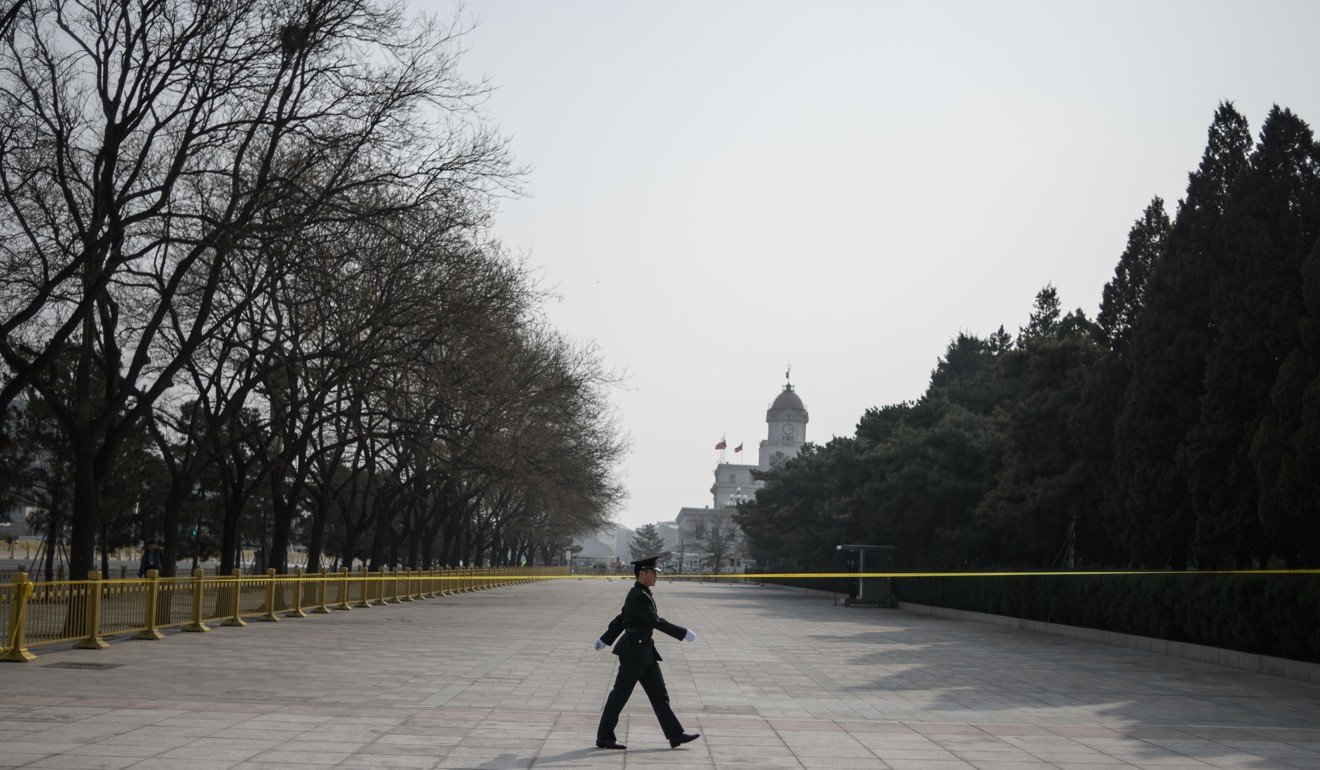
Heavy smog blanketed Beijing on Sunday as thousands of delegates started arriving in the Chinese capital for one of the annual highlights on the country’s political calendar.

The pollution descended on Friday night, prompting authorities on Saturday to issue an orange alert, the second-highest smog warning in the four-tier system.

The alert – which advises elderly people and children to stay indoors – will remain in place throughout Sunday, the first day of the Chinese People’s Political Consultative Conference (CPPCC), and Monday.

Conditions are expected to improve by Tuesday, when the National People’s Congress starts.

“Due to bad weather, there will be heavy regional pollution in the Beijing-Tianjin-Hebei region that will persist and affect a large area,” the Beijing Municipal Environmental Monitoring Centre said.

Under the orange alert, all construction work in the city must stop, some factories have to halt production, and all fireworks and outdoor barbecues are banned.

A Chinese paramilitary police officer patrols in front of the Great Hall of the People on Saturday on the eve of the opening session of the Chinese People’s Political Consultative Conference in Beijing. Photo: AFP
Source: SCMP
02/03/2019

Top political advisor wants annual session to reflect public thoughts

CHINA-BEIJING-WANG YANG-CPPCC-MEETING (CN)

Wang Yang (C, front), chairman of the Chinese People’s Political Consultative Conference (CPPCC) National Committee, presides over the closing meeting of the fifth session of the Standing Committee of the 13th CPPCC National Committee in Beijing, capital of China, March 1, 2019. (Xinhua/Huang Jingwen)

BEIJING, March 1 (Xinhua) — Chinese political advisors have been asked to convey real thoughts and appeals of the public during the upcoming second annual session of the 13th Chinese People’s Political Consultative Conference (CPPCC) National Committee.

Wang Yang, chairman of the CPPCC National Committee, said Friday that the national committee members should align their thoughts and actions with the scientific judgments on major circumstances and decisions on major issues made by the Communist Party of the China Central Committee.

The political advisors should also pool good experiences and practices of the people in order to better serve the work of the Party and the state, Wang said at a two-day meeting of the Standing Committee of the CPPCC National Committee that closed Friday.

The meeting approved the agenda and schedule of the annual session, a work report of the CPPCC National Committee’s Standing Committee and a report on how the Standing Committee has handled proposals put forward by political advisors.

Relevant drafts and reports will be submitted to the session for deliberation.

Source: Xinhua

02/03/2019

East China Fair opens in Shanghai

SHANGHAI, March 1 (Xinhua) — The 29th East China Fair, the largest regional trade fair in China, opened in Shanghai Friday.

More than 3,500 Chinese companies and over 450 overseas companies are taking part in the four-day event.

Over 5,800 booths, arranged under five categories from garments to modern lifestyle, cover an exhibition area of 126,500 square meters.

Customs data showed China’s foreign trade grew 9.7 percent year on year to a historic high of 30.51 trillion yuan (4.55 trillion U.S. dollars) in 2018.

The annual fair, established in 1991, is jointly held by nine provinces and cities in east China. It is regarded as an important barometer of China’s foreign trade.

Source: Xinhua

02/03/2019

China’s private business hub to increase trade with Africa

HANGZHOU, March 1 (Xinhua) — East China’s Zhejiang Province plans to increase its trade volume with Africa to 40 billion U.S. dollars by the end of 2022 to account for at least 20 percent of the total Sino-Africa trade.

Zhejiang’s department of commerce issued an action plan revealing the details on Friday as China’s first provincial-level plan on economic cooperation with African countries.

The 40-billion-dollar target will mark a significant rise from the 30.1-billion-dollar trade between Africa and Zhejiang, home to many of China’s most successful private businesses, in 2018.

The plan also promises to increase investments in Africa’s industries of textiles, garments, chemicals, equipment manufacturing and pharmaceuticals to meet the continent’s development needs.

The province, however, will bar investments that are polluting and highly energy-consuming from going to Africa, said the plan, which also calls for more agricultural investments and cooperation.

The document also said the province would expand goods imports from Africa, especially in the non-resources category.

According to China Customs, China’s foreign trade with Africa reached 204.19 billion dollars in 2018, up 19.7 percent year-on-year and 7.1 percentage points higher than the growth of China’s overall foreign trade during the same period.

Specifically, the country’s exports to Africa rose 10.8 percent to 104.91 billion dollars in 2018, while its imports from Africa surged 30.8 percent to reach 99.28 billion dollars.

Source: Xinhua

02/03/2019

Trump asks China to lift tariffs on U.S. farm products

WASHINGTON (Reuters) – U.S. President Donald Trump said he had asked China to immediately remove all tariffs on U.S. agricultural products because trade talks were progressing well.

He also delayed plans to impose 25 percent tariffs on Chinese goods on Friday, as previously scheduled.
“I have asked China to immediately remove all Tariffs on our agricultural products (including beef, pork, etc.) based on the fact that we are moving along nicely with Trade discussions,” Trump said on Twitter, pointing out that he had not raised tariffs on Chinese goods to 25 percent from 10 percent on March 1 as planned.
“This is very important for our great farmers – and me!” Trump said.
Farmers are a key constituency for Trump’s Republican Party, and the U.S. president’s trade war with China has had a heavy impact on them. Beijing imposed tariffs last year on imports of soybeans, grain sorghum, pork and other items, slashing shipments of American farm products to China.
U.S. Agriculture Secretary Sonny Perdue said this week that U.S. trade negotiators had asked China to reduce tariffs on U.S. ethanol, but it was not immediately clear whether Beijing was willing to oblige.
Trump’s post on Twitter came several hours after the U.S. Trade Representative’s office said that it would delay the scheduled hike in tariffs on $200 billion worth of Chinese goods.

The notice, due to be published in the Federal Register next Tuesday, says it is “no longer appropriate” to raise the rates because of progress in negotiations since December 2018. The tariff would remain “at 10 percent until further notice.”

In a statement on Saturday, China said it welcomed the delay.

Speaking at a separate briefing in Beijing, a Chinese government official said both countries were working on the next steps, though he gave no details.

“China and the United States reaching a mutually-beneficial, win-win agreement as soon as possible is not only good for the two countries, but is also good news for the world economy,” said Guo Weimin, spokesman for the high profile but largely ceremonial advisory body to China’s parliament.

A tariff increase to 25 percent from 10 percent was initially scheduled for Jan. 1, but after productive conversations with Chinese President Xi Jinping, the Trump administration issued a 90-day extension of that deadline.

Trump had said on Sunday he would again delay the increase because of progress in the talks.

Source: Reuters

02/03/2019

Pakistan and India step back from the brink, tensions simmer

MUZAFFARABAD, Pakistan/SRINAGAR, India (Reuters) – A flare up between arch-foes India and Pakistan appeared to be easing on Saturday after Islamabad handed back a captured Indian pilot, but tensions continued to simmer amid efforts by global powers to prevent a war between the nuclear-armed neighbours

Wing Commander Abhinandan Varthaman, who became the face and symbol of the biggest clash between India and Pakistan in many years, walked across the border just before 9 p.m. (1600 GMT) on Friday in a high-profile handover shown on live television.

Shelling across the Line of Control (LoC) that acts as a de facto border in the disputed Kashmir region, a frequent feature in recent weeks, continued on Saturday.

Pakistan’s military said on Saturday its air force and navy “continue to be alert and vigilant”, while two of its soldiers were killed after exchanging fire with Indian troops along the Line of Control. India’s military said on Saturday that Pakistan was firing mortar shells across the LoC.

Pakistan touted Abhinandan’s return as “as a goodwill gesture aimed at de-escalating rising tensions with India” after weeks of unease that threatened to spiral into war after both countries used jets for bombing missions this week.

Global powers, including China and the United States, have urged restraint to prevent another conflict between the neighbours who have fought three wars since independence from Britain in 1947.

Tensions escalated rapidly following a suicide car bombing on Feb. 14 that killed at least 40 Indian paramilitary police in Indian-controlled Kashmir.

India accused Pakistan of harbouring the Jaish-e Mohammad group behind the attack, which Islamabad denied, and Prime Minister Narendra Modi promised a strong response.

Indian warplanes carried out air strikes on Tuesday inside Pakistan on what New Delhi called militant camps. Islamabad denied any such camps existed, as did local villagers in the area, but Pakistan retaliated on Wednesday with its own aerial mission, that led to both sides claiming to have shot down jets.

The stand off came at a critical time for Modi, who faces a general election that must be held by May and who had been expected to benefit from nationalist pride unleashed by the standoff.

Pakistani leaders say the ball is now in India’s court to de-escalate the tensions, though the Pakistani army chief told top military leaders of the United States, Britain and Australia on Friday that his country would “surely respond to any aggression in self-defence”.

“COLLIDE HEAD-ON”

The Indian pilot’s ordeal since being shot down on Wednesday had made him the focal point of the crisis and he returned to his homeland to a hero’s welcome, with crowds thronging the Wagah border crossing and waving Indian flags.

Before his release, Pakistani television stations broadcast video of Abhinandan in which he thanked the Pakistani army for saving him from an angry crowd who chased him after seeing him parachute to safety.

Pakistan frees Indian pilot as crisis thaws
“The Pakistani army is a very professional service,” he said. “I have spent time with the Pakistan army. I am very impressed.”
On Friday, four Indian troops and one civilian were killed in a clash with militants in the Indian-administered Kashmir, where a further three people were killed and one wounded from Pakistani shelling.
Pakistan’s military said two civilians were killed and two wounded since Friday afternoon on Pakistan’s side of Kashmir from a barrage of Indian shelling.

In a sign of the unease, residents say they are afraid another conflagration is likely.

“The way situation is developing along the LoC makes me feel that both sides may collide head-on anytime now,” said Chaudhry Jahangir , a Pakistani resident of the Samahni sector in Kashmir.

Source: Reuters

02/03/2019

‘One chowkidar has defamed all others’: Rahul Gandhi’s renews attack on PM Modi

Rahul Gandhi renewed his attack on PM Modi over Rafale deal controversy during his public rally in Jharkhand

INDIA Updated: Mar 02, 2019 15:58 IST

HT Correspondent
HT Correspondent
Hindustan Times, Ranchi
Rahul Gandhi,ranchi,jharkhand
Congress president Rahul Gandhi addressing a public rally in Jharkhand on Saturday.(Photo: Twitter/INCIndia)

Congress president Rahul Gandhi on Saturday renewed his attack on Prime Minister Narendra Modi reiterating his charge that he misled the people on the issues of providing corruption-free government, job creation and addressing farm distress. Gandhi said PM Modi’s image has changed from a leader who promised to bring “achchhe din” (better time) to “chowkidar chor hai” (the watchman is a thief).

Speaking at the Congress’s Parivartan Ulgulan Maha Rally at the Morahbad in Jharkhand, Gandhi said, “One chowkidar has defamed all chowkidars of India…All the chowkidars of India are honest…Everyone knows that when someone says chowkidar chor hai, it refers to Narendra Modi.”

The Congress president alleged that PM Modi “snatched” Rs 30,000 crore from the Indian Air Force (IAF), which protects the country, and the Hindustan Aeronautics Limited (HAL) and gave it to industrialist Anil Ambani in Rafale deal.

Gandhi has been targeting PM Modi over Rs 58,000-crore Rafale deal with France that India signed in 2016 for the purchase of 36 fighter planes. A similar deal was being negotiated when the Congress-led United Progressive Alliance (UPA) was in power before 0214 for the purchase of 126 Rafale jets.

The Modi government renegotiated the deal with France terming the previous one unworkable. The Congress and other opposition parties have alleged that commercial favouritism was done in Rafale deal.

Gandhi on several occasions has alleged that PM Modi personally ensured that Ambani’s firm, Reliance Defence gets contract in Rafale deal. Both the government and the Reliance Defence have rejected the allegation as baseless. Reliance Defence is an off-set partner of the Dassault Aviation, the manufacturer of Rafale fighter jets.

Addressing his first rally in Jharkhand since 2014, the Congress president repeated his charge against PM Modi saying, “It is a matter of shame that Indian Air Force protects the country, air force pilots sacrifice their lives but the prime minister steals money from the air force and puts it in Anil Ambani’s pockets.”

He claimed that in the upcoming Lok Sabha elections, the “chowkidar” will be defeated. He promised that if voted to power the Congress government will implement a minimum income guarantee programme for the poor.

Source: hindustan Times

01/03/2019

China appreciates U.S. return of Chinese relics, artifacts

BEIJING, March 1 (Xinhua) — China appreciates the return of 361 Chinese relics and artifacts by the United States, said a Foreign Ministry spokesperson Friday.

The remarks came as Lu Kang, the spokesperson of the Foreign Ministry, responded to a query about the return of the Chinese relics and artifacts by the United States.

The United States announced the return of 361 Chinese relics and artifacts to China at a ceremony held Thursday in the Eiteljorg Museum in Indianapolis, the U.S. state of Indiana.

The repatriation will lead to the return of the largest batch of relics and artifacts to China from the United States since 2009, when the two nations signed a memorandum of understanding to enhance cooperation in this regard.

“Cooperation in preservation of relics is an important part of people-to-people, cultural exchanges between China and the United States,” Lu said. “We’re willing to make concerted efforts with the United States to enhance exchange and cooperation in preservation of relics, and to make greater contribution to advancing preservation efforts of cultural heritage in the world.”

Source: Xinhua

Law of Unintended Consequences

continuously updated blog about China & India

ChiaHou's Book Reviews

continuously updated blog about China & India

What's wrong with the world; and its economy

continuously updated blog about China & India