Archive for October, 2019

29/10/2019

175-meter experimental impoundment of Three Gorges comes to end

#CHINA-THREE GORGES PROJECT-WATER IMPOUNDMENT (CN)

Aerial photo taken on Oct. 28, 2019 shows the view of the Three Gorges project in Zigui County, central China’s Hubei Province. The 175-meter experimental impoundment of Three Gorges this year came to the end at present as the water level of the Three Gorges Reservoir rose to 174.43 meters as of 8pm Monday. (Photo by Wang Gang/Xinhua)

Source: Xinhua

29/10/2019

Donald Trump, Xi Jinping set for November 17 meeting in Chile to sign interim trade war deal: source

  • Chinese President Xi Jinping and US President Donald Trump set to meet on the sidelines of the Apec summit in Chile next month, a source says
  • The two state leaders are expected to sign an interim trade deal ‘if everything goes smoothly’
Chinese President Xi Jinping and US President Donald Trump have met twice already over the course of the 16-month trade war. Photo: AP

Chinese President Xi Jinping and US President Donald Trump are tentatively expected to meet on November 17 with the aim of signing an interim trade deal, a source briefed on the arrangements told the South China Morning Post.

The two leaders are expected to come face-to-face immediately after the Asia-Pacific Economic Cooperation (Apec) summit in Santiago, Chile, with a trade truce signed “if everything goes smoothly”, said the person, who declined to be identified.

Trade envoys from Beijing and Washington are still finalising the text for the two leaders to sign, but both sides have expressed optimism that Trump’s so-called phase one trade deal can be completed in time for the meeting.

Trump said on Monday that negotiations on the interim deal were running “ahead of schedule”.

“We are looking probably to be ahead of schedule to sign a very big portion of the China deal, and we’ll call it phase one but it’s a very big portion,” Trump said. “That would take care of the farmers. It would take care of some of the other things. It will also take care of a lot of the banking needs.

“So we’re about, I would say, a little bit ahead of schedule, maybe a lot ahead of schedule,” the president said, adding the deal would “probably” be signed.

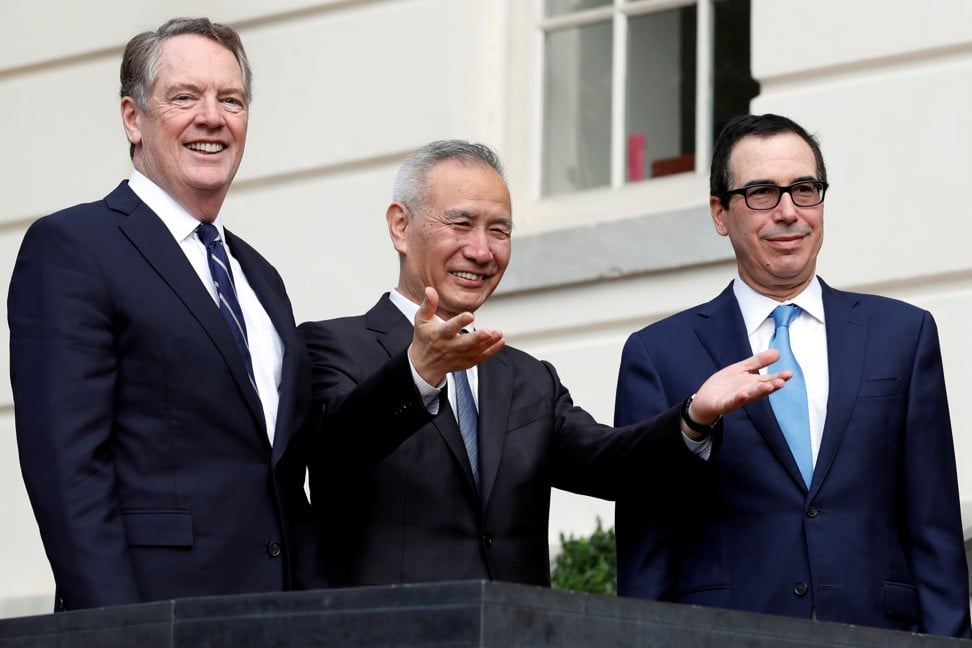
Top trade negotiators for the two countries – US Treasury Secretary Steven Mnuchin, US trade representative Robert Lighthizer and Chinese Vice-Premier Liu He – spoke by telephone last Friday. The Office of the US Trade Representative released a statement after the call saying that the two sides “made headway on specific issues” and “are close to finalising some sections of the agreement”.

China’s official Xinhua News Agency said on Saturday negotiators have “agreed to properly resolve core concerns of each other” and had “basically completed technical discussions about parts of the text”. In particular, China would lift the current ban on US poultry imports and recognise the American public health certification system for meat product imports, Xinhua said.

The top trade envoys are expected to hold another conference call in the near future.

China's Vice-Premier Liu He between US trade representative Robert Lighthizer (left) and US Treasury Secretary Steve Mnuchin during trade negotiations in Washington this month. Photo: Reuters
China’s Vice-Premier Liu He between US trade representative Robert Lighthizer (left) and US Treasury Secretary Steve Mnuchin during trade negotiations in Washington this month. Photo: Reuters

Taoran Notes, an account on Chinese social media platform WeChat run by the official Economic Daily newspaper, wrote over the weekend that Beijing and Washington had moved a step closer to agreement on a “temporary deal”.

“According to past experiences and practises, the negotiation will enter the stage of translation and legal review after the technical completion of the text,” the account said.

Geng Shuang, a Chinese foreign ministry spokesman, said that technical negotiations about part of the deal were finished but deputy-level talks were ongoing. “China hopes both sides can find a trade solution based upon mutual respect and benefits,” Geng said at a regular press conference on Tuesday.

If it goes ahead as planned, the summit between Trump and Xi in Chile next month would be the third time the two leaders have sat down to talk about ending the nearly 16-month-long trade war.

Last December, the two leaders met on the sidelines of the G20 Leaders’ Summit in the Argentinian capital Buenos Aires and agreed to a three-month tariff truce to allow time for the countries’ trade envoys to work out a comprehensive deal. But the talks collapsed in early May with the US blaming China for reneging on promises it made in negotiations, while China blamed the US for attempting to infringe on its economic sovereignty.

The pair met again in late June in the Japanese city of Osaka, where they agreed to restart trade negotiations.

A minor ceasefire was reached in October when Beijing promised to buy US$40 billion to US$50 billion worth of American agricultural products in exchange for Washington postponing indefinitely a tariff increase on US$250 billion of Chinese goods to 30 per cent from 25 per cent on October 15.

Analysts expect fresh 15 per cent duties on about US$160 billion of Chinese imports – including popular products like smartphones and consumer electronics – that are due to go into effect mid-December will also be postponed if a deal is signed, though this has not been officially confirmed.

The interim deal is also expected to contain a provision on intellectual property protection, a key US demand. China has taken steps to improve IP protection, including setting up a system to punish and compensate instances of infringement, and improve settlement disputes. But how well these measures will be implemented remains in question.

China and the US would also agree to avoid allowing currency devaluations to gain trade advantages, codifying a commitment both countries made as part of a G20 agreement several years ago. A currency agreement – similar to provisions in the yet-to-be-ratified US-Mexico-Canada Agreement – could pave the way for the US to remove its designation of China as a “currency manipulator”.

The deal may include a new dispute resolution mechanism to ensure both sides live up to commitments. The system, which will give both sides equal standing, would replace a contentious US-proposed enforcement mechanism that was a key reason for trade talks breaking down in May after China felt the demands too intrusive and one-sided. It is unclear how effective the proposal would be, but the US has insisted since talks began that a similar mechanism be implemented to ensure China did not backslide on promises as it had in the past.

In addition to large purchases of farm products, the interim agreement may contain commitments by China to buy US-built aircraft and energy products, particularly liquefied natural gas.

China will also agree to lift foreign ownership limits on Chinese financial firms under the deal, changes which are already underway.

However, the interim deal will not address broader US complaints about China’s economic model, particularly allegations that foreign firms are treated unfairly and heavy government subsidies favour some domestic industries. Nor will it contain any break for telecommunications equipment maker Huawei and other Chinese tech companies that were blacklisted by the US on national security concerns.

Source: SCMP

28/10/2019

Economic Watch: China’s international aviation market set to take off

BEIJING, Oct. 27 (Xinhua) — Beijing Daxing International Airport, a new aviation hub in the Chinese capital, started international flight operation Sunday, joining the country’s expanding airport network to serve outbound and inbound travelers.

During winter and spring, a total of 570,000 passenger trips are expected to be made via 15 overseas flight routes at the airport, which boasts fast customs clearance services thanks to smart technologies.

Airports across China are seeing flights to and from a growing number of overseas destinations, as domestic and international airlines race to tap the booming international aviation market.

China’s international aviation market is small compared with some countries, but enjoys fast growth and huge potential, said Zhao Wei, a professor with the Civil Aviation Management Institute of China, at the 2019 China Aviation and Tourism Forum.

The steady expansion of the outbound tourism market and the large number of individuals who are yet to enjoy air travel will drive the sector’s rise, Zhao said.

China is the world’s largest outbound tourism market. About 81.29 million overseas trips were made during the first half of this year, up 14 percent year on year. The total for the whole year might grow 12 percent year on year to reach about 168 million trips, the China Tourism Academy predicted.

The country’s airports saw 126 million cross-border passenger trips made in 2018, up 13 percent over 2017. The McKinsey Global Institute foresaw threefold growth in the number of people in China able to afford airline travel in the next 10 years, with the upper strata of China’s fast-growing middle class poised to become the principal engine of air-travel spending.

With the outbound travel market booming, the number of overseas airlines and destinations entering the Chinese market continues to increase, observed Brenda He, managing director with tourism marketing and sales services provider Travel Link Group, which saw growing market demand from overseas airlines and tourism authorities.

To improve international air travelers’ experience, aviation services should be developed in coordination with tourism development and destinations promotion, He said.

Li Xiaoping, senior vice president with China’s largest online travel agency Ctrip, said airports need to upgrade their infrastructure and services to improve travelers’ experience by meeting their diversifying consumption and entertainment demands.

Future airports will become social-networking and cultural venues, Li said. “An airport can become a sightseeing spot in its own right.”

Source: Xinhua

28/10/2019

Transport infrastructure key for China’s rural vitalization: experts

BEIJING, Oct. 27 (Xinhua) — Strengthening the construction of rural transport infrastructure is the key to boost various rural industries, said experts at a forum on rural vitalization and transport industry Sunday.

The construction of rural transport infrastructure should be integrated with the development of various undertakings in the rural areas, said Li Chunsheng, vice chairman of the Agriculture and Rural Affairs Committee of the National People’s Congress, at the forum held by China Well-off Society Association.

Rural transport construction has brought about major changes in the agricultural production chain, the ecological and environmental chains, as well as the value chain, and it will certainly speed up the rural vitalization, said Yin Chengjie, head of the Chinese Association of Agricultural Economics.

More efforts should be made to establish a mechanism for increasing financial input and integrating funds for agriculture and transport, so as to achieve various goals including high-quality rural road construction, said Chen Jiding, deputy head of the China Academy of Transportation Sciences.

The central government has issued an outline on transport construction, which clearly plans to form a rural transport infrastructure network and achieve poverty alleviation through transport facilitation.

Source: Xinhua

28/10/2019

Military World Games of “historic” and “peace” close in Wuhan

(SP)CHINA-WUHAN-7TH MILITARY WORLD GAMES-CLOSING CEREMONY

Xu Qiliang, president of the 2019 Military World Games organizing committee and also vice chairman of China’s Central Military Commission, declares the 7th CISM Military World Games close during the closing ceremony of the Games in Wuhan, capital of central China’s Hubei Province, Oct. 27, 2019. (Xinhua/Xiao Yijiu)

WUHAN, Oct. 27 (Xinhua) — Xu Qiliang, president of the 2019 Military World Games organizing committee, also vice chairman of China’s Central Military Commission, declared the Games close on Sunday in Wuhan, central China, to wrap up the biggest ever “Olympics for the military”.

Chinese Vice Premier Sun Chunlan, also president of the Wuhan Military World Games organizing committee, thinks highly of the organization of the Games and the performances of worldwide athletes.

“We have experienced a successful, wonderful and unforgettable military games in the lastest 10 days. This is a military gala of sharing friendship and safeguarding peace,” said Sun at the closing ceremony.

“This Games have showcased the spirits of the military personnel, which uphold perseverance, challenging limits and striving for better. This Games are full of wonders and achievements and are set to leave China’s marks in its history,” she added.

According to Sun, seven world records had been set and 85 International Military Sports Commission (CISM) affiliated records had been broken here in the tournament, as athletes rated it as a high-level international event, which featured 67 Olympic and world champions.

After 10-day competitions, host China collected 133 golds and 239 medals in total, the first time for a country to grab 100 plus golds. The traditional powerhouse Russia obtained 51 golds and 161 medals in all as an evident runner-up in medal tally, followed by Brazil, the host for 2011 Games, with 21 golds and 88 medals. France, Poland and Germany lined up from fourth to sixth places, all clinching 10 plus golds.

Herve Piccirillo, CISM president, hailed the Games as great success and tagged it with two key words “historic” and “peace” on Friday, lauding its material and spiritual legacy to the host city and the world.

“These are games that will mark the history of military competitions and develop new practices in the future,” said Piccirillo in an interview with Xinhua.

The president picked the word “historic” for its history-making participation of nearly 10,000 military personnel, investment for games organization, mobilization of volunteers and passion from Chinese people.

Explaining the word “peace”, he said, “because the message that is carried by a whole people, because beyond the games, it is all the Chinese people who are spreading this message of solidarity and peace, which corresponds to ‘friendship through sport’, the motto of the CISM.”

The 52-year-old Frenchman repeated his praise on the Games on Sunday at the closing ceremony, saying “the Military World Games leaves Wuhan unparalleled tangible and intangible heritage for the future generations.”

Piccirillo applauded the Athletes’ Village and sports facilities built for the Games. “Athletes’ Village represents the effectiveness of the city government’s effort to balance between urban development and environmental protection,” said he. “The multiple sports venues built in line with highest standards in the world can serve any future international sports event that Wuhan may step up to host.”

It’s the first time all competitions for the Games had been staged in a single city. The size of the host city, as well as its diversified terrain and abundant water resources, made it possible in Wuhan, where 35 sports venues were built or renovated to meet international standards.

A 30-building Village was built to accommodate the athletes and coaches, which is also the first attempt in the Games’ 24-year history.

Piccirillo expressed his sincere thanks to the organizers and volunteers for their contributions and services to the promotion of military sports, commenting “you have completed your jobs excellently.”

“I would like to thank the governments of China, Hubei province, and Wuhan city for enabling us all, valid and disabled, to share the common value of the military under the banner of inclusiveness, equality, universal love and sharing, and this is the greatest success of the event,” said Piccirillo.

“All these will not have been possible without the conscientious efforts of the organizing committee. The volunteers have made our stay in Wuhan better, easier and more convenient.”

Ma Guoqiang, Party secretary of Wuhan city, paid tributes to the participants across the world, saying they have been “writing down a brand-new page in the history of world military sports,” and honored their performances at the event.

“Military athletes from 109 countries have come here and given their full and best plays in the competitions. They have not only demonstrated excellent sports skills, but also showed high morale,” said Ma at the ceremony.

He also praised the athletes with disabilities, noting they have exemplified the military dignity and showcased the power of life with their firm determination and great perseverance.

Ma underlined the theme of “peace” delivered from the Games and the sign of goodwill from China. “Peace is an eternal theme and a shared aspiration of the human society, as well as an unremitting pursuit of the Chinese people,” said Ma.

“This Games, as a sign of goodwill from the Chinese government, the Chinese armed forces, and the Chinese people, convey our yearning and blessing for peace. We hope the Games, like bright sunshine, can dispel the darkness of war and build a bridge of friendship to promote exchanges between civilizations.”

The 2019 Games has attracted the largest number of athletes and presented the most sports in history. Nearly 10,000 soldiers from 109 nations have competed for 329 gold medals in events from athletics, football, swimming, and basketball to parachuting, lifesaving, aeronautical and naval pentathlons.

It’s the first time the Games are open to the public, instead of being confined to barracks. Over 600,000 tickets had been sold, according to the Games executive committee, with men’s basketball, women’s volleyball, swimming and diving in highest demand.

The Games will also leave Wuhan with huge benefits to infrastructure improvements, new subway lines, and environmental upgrades. Over the past three years, the city renovated 1,300 kilometers of its urban roads and saw its metro network reach 330 kilometers in total length. Meanwhile, a total of 360,000 trees were planted.

First held in 1995 in Rome, the Military World Games are a multi-sports event for military personnel organized by the CISM.

Source: Xinhua

28/10/2019

Chinese premier stresses vocational training for people with disabilities

BEIJING, Oct. 27 (Xinhua) — Premier Li Keqiang has urged enhancing the vocational skills of people with disabilities and supporting their employment and business creation.

Li, also a member of the Standing Committee of the Political Bureau of the Communist Party of China Central Committee, made the remarks in a written instruction as the sixth China national vocational skill competition for persons with disabilities and the third national Abilympics that kicked off Sunday in Jiaxing, east China’s Zhejiang Province.

Different regions and relevant government departments at all levels should fully implement the supportive employment policies and strengthen vocational education and training for persons with disabilities, according to the instruction.

In advancing targeted poverty alleviation, greater efforts should be made to assist more poverty-ridden people with disabilities living in rural areas, helping more disabled people realize their dreams of finding jobs and starting businesses, said Premier Li.

About 900 disabled persons from across the country will compete in 26 different contests under five categories, which include fine arts, handicrafts and engineering.

Launched in 1989, the sixth China national vocational skill competition for persons with disabilities has been held every four years since 2003.

The third national Abilympics will showcase participants’ products and skills as well as the nation’s progress in employment and business creation of persons with disabilities.

China now has around 35 million registered persons with disabilities, with 18 million of working age.

Source: Xinhua

28/10/2019

Putin accepts Duterte invite, just before Manila-Beijing South China Sea oil talks. Coincidence?

  • The president is set to become the first Russian leader to make a state visit to the Philippines for more than 40 years, according to a former envoy
  • Moscow is aware of China’s entry into the Philippines, and could have its eye on some projects there, while the US is also watching developments
Russian President Vladimir Putin and Philippine President Rodrigo Duterte shake hands during a 2016 meeting in Peru. Photo: EPA
The timing of Moscow’s announcement over the weekend that President Vladimir Putin
has accepted an invitation to visit Manila has raised eyebrows, as it comes on the eve of crucial bilateral talks between the Philippines and China on joint oil exploration in the

South China Sea

.

In a statement immediately welcomed by the Philippine presidential palace, Igor Khovaev, Russia’s ambassador to the Philippines, on Saturday told reporters Putin had accepted Duterte’s invitation “with gratitude”.

No date has been set for the visit, with Khovaev only saying Moscow would “do our best to arrange this meeting as soon as possible”.

A steering committee with representatives from both Manila and Beijing is set to meet this week to discuss the joint oil exploration deal. China has proposed a 60 per cent-40 per cent split in favour of the Philippines, according to Hermogenes Esperon, 

Courting Russia with South China Sea oil is a ‘dangerous gamble’ for Duterte

Neither side has clarified if the split refers to ownership or revenue, and no other details were disclosed.

After an August meeting with Duterte, Chinese President Xi Jinping said the countries could take a “bigger step” in jointly developing oil and gas resources if they could properly handle their sovereignty dispute in the South China Sea.

But defence and security analysts say the Philippine president took a “dangerous gamble” on a visit to Russia last month, when he invited the Russian state oil company Rosneft to explore for oil in Philippine waters – which include parts of the South China Sea claimed by China.

The timing of Moscow’s announcement has not gone unnoticed.

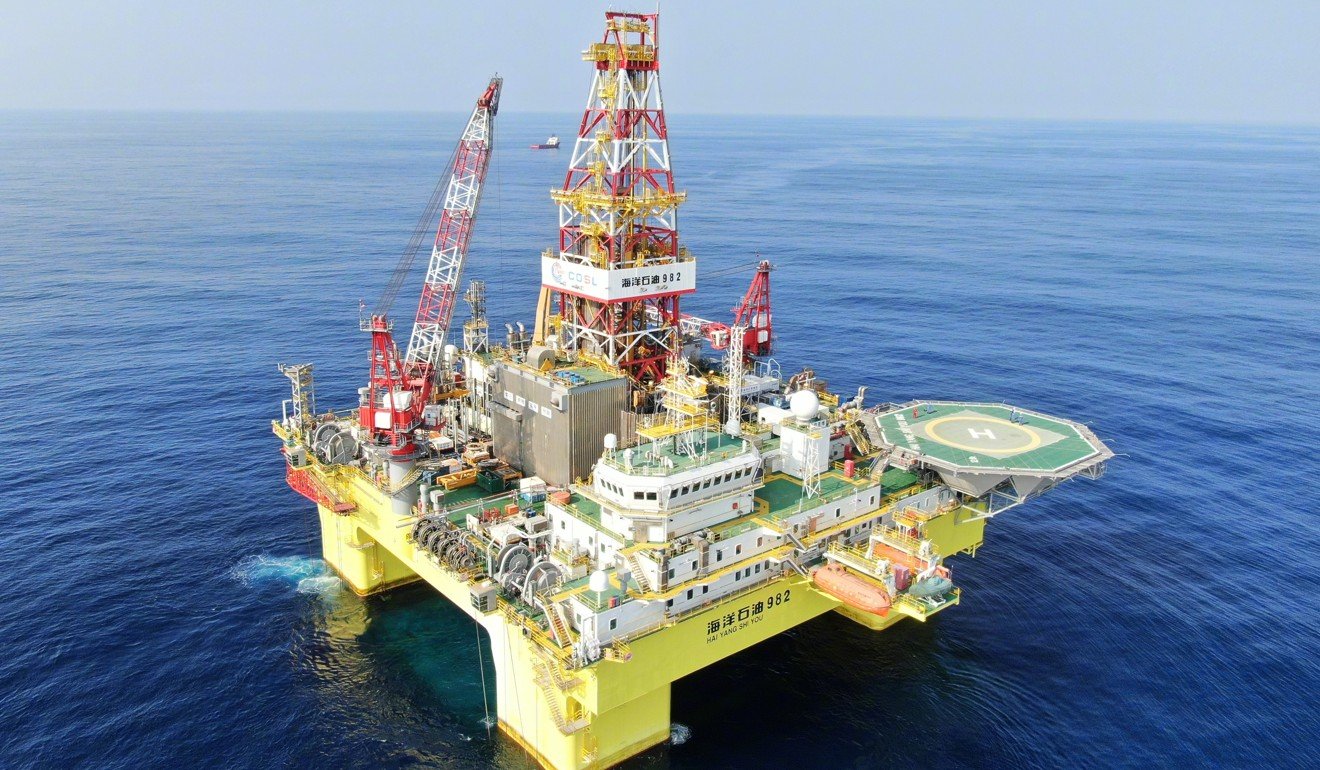
A Chinese deepwater oil rig in the South China Sea. Photo: Weibo

“It’s a welcome and historic development. Some wise guy in the Duterte government thought about timing [the invitation to Putin around the oil talks with Beijing],” said retired Philippine ambassador Lauro Baja, who once served as president of the United Nations Security Council.

Baja told the Post that no Russian president had visited the Philippines during his more than 40 years with the Department of Foreign Affairs.

“The Philippines then was almost a nonentity as far as Russia was concerned, [but] maybe now Russia recognises the strategic importance of the Philippines [in terms of] regional politics,” he said.

Baja said Moscow was aware of China’s entry into the Philippines, and could have its eye on some projects there.

“For all their so-called alliance, China and Russia are fierce competitors for influence and other benefits. And I think Russia has some objectives in mind like selling armaments and [forging] technological agreements,” he said, while cautioning that the situation remained “nebulous”.

New Philippines military chief sees no ‘shooting war’ in South China Sea despite disputes

“It’s a fascinating development but things are still early … For now, this is [just] an invitation extended by Duterte and accepted in principle by Putin.”

The United States will also be monitoring developments in the Philippines, according to Greg Poling, director of the Washington-based Centre for Strategic and International Studies’ Asia Maritime Transparency Initiative.

“Russia is eager to boost its influence in the region, and doubtless doing so with a long-standing US ally is seen as a bonus by Moscow,” he said. “There is nothing that prevents the Philippines from engaging in security cooperation with Russia, but the devil will be in the details.”

Poling added that the US would be concerned if Russia-Philippine cooperation involved acquiring military platforms that were incompatible with the shared platforms and doctrines used by Washington and Manila, as well as the latter’s other major security partners, namely Australia, Japan and South Korea.

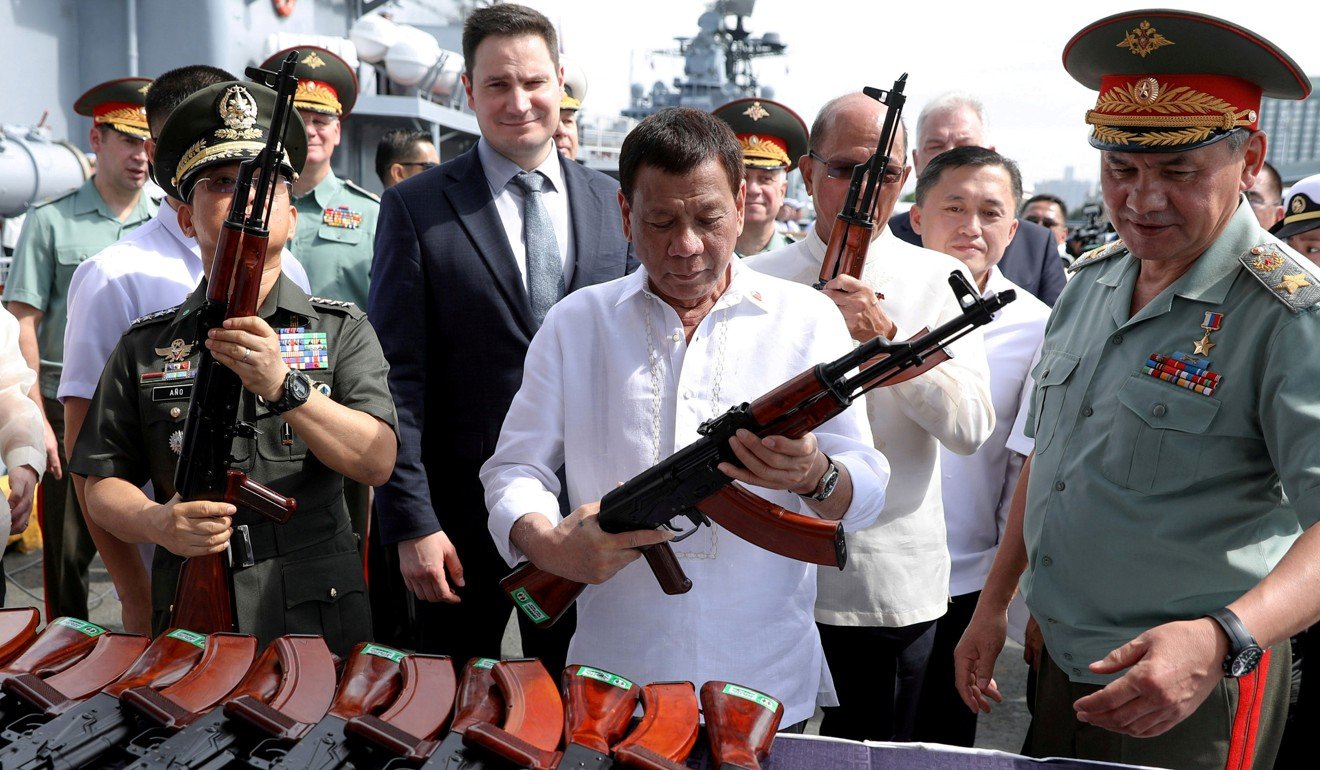
Philippine President Rodrigo Duterte inspects firearms donated by Russia in 2017. Photo: Reuters

“The US will also be concerned if any acquisitions or cooperation with Russia might threaten information security or intelligence cooperation between the US and the Philippines,” he said.

“And finally, any major platforms acquired from Russia would likely require the US to impose sanctions on the Philippines unless a waiver is granted, and the US government has been very stingy about awarding those waivers because they undermine the effectiveness of the sanctions regime.”

Moscow last week offered to help the Philippines produce its own arms for both domestic use and export with the help of Russian technology. Max Montero, an Australia-based Filipino security consultant, viewed that offer as “a swipe at the US”.

“Imagine a US stronghold and long-time ally and former colony becoming a manufacturing hub for Russian arms. And it makes it worse if [the Philippine armed forces] buys them too,” he said.

“Weakening the US alliances in Asia will benefit Russia [as it is] one of the US’ competitors in arms sales and geopolitics.”

Russia offers arms technology to the Philippines with ‘no conditions’ as US ties falter

The Philippines, Montero said, would benefit from such an arrangement since it is “a laggard in defence technology”. However, he pointed out that the country’s armed forces continue to buy weapons from the US and receive American arms as grants, potentially limiting the domestic market for Russian arms.

Navy cooperation has also been on the agenda, as Moscow and Manila discussed signing a new naval pact in March, while warships from each country have visited the other this year. Philippine naval vessels made their first-ever visit to Russia in October, while three Russian ships docked in the Philippines for a goodwill visit in January.

Russia is the top supplier of arms to Southeast Asia, and the No 2 global arms supplier, behind the US. Southeast Asia bought US$6.6 billion of Russian arms between 2010 and 2017, or more than 12 per cent of Russia’s sales, according to the Stockholm International Peace Research Institute, a Swedish think tank that publishes global arms tracking data.

Source: SCMP

27/10/2019

China establishes research center for Dunhuang studies

LANZHOU, Oct. 26 (Xinhua) — Dunhuang Academy China and Peking University have signed an agreement to establish a research center for Dunhuang studies, aiming to nurture more high-level research talent in the area.

Rong Xinjiang, a professor with Peking University, and Zhao Shengliang, the head of the Dunhuang Academy, will be the directors of the new center.

With a focus on the documents of Dunhuang and grottoes art, Dunhuang studies is an emerging interdisciplinary subject that covers areas such as history, geography, archeology and art.

The Dunhuang Academy, located in northwest China’s Gansu Province, administers the Mogao Grottoes, a renowned UNESCO World Heritage site that showcases the cultural integration and mutual learning among different civilizations along the ancient Silk Road.

The Mogao Grottoes are home to a priceless collection of Buddhist artwork — more than 2,000 colored sculptures and 45,000 square meters of murals — in 735 caves carved along a cliff by ancient worshippers.

Peking University is a pioneer of Dunhuang studies in China, with scholars of its predecessor beginning research in the area in the early 20th century.

Source: Xinhua

27/10/2019

Beijing’s new $63 billion mega-airport begins international flights

BEIJING (Reuters) – Beijing’s new $63 billion Daxing airport began its first scheduled international flights on Sunday as it ramped up operations to help relieve pressure on the city’s existing Capital airport.

Shaped like a phoenix – though to some observers it is more reminiscent of a starfish – the airport was designed by famed Iraqi-born architect Zaha Hadid, and formally opened in late September ahead of the Oct. 1 celebrations of the 70th anniversary of the People’s Republic of China.

It boasts four runways and is expected to handle up to 72 million passengers a year by 2025, eventually reaching 100 million.

China Southern Airlines (600029.SS) and China Eastern Airlines (600115.SS) will be the main domestic carriers at Daxing, though Air China (601111.SS) will provide a small number of flights too.

An Air China flight to Bangkok was the first international flight to leave on Sunday, while British Airways (ICAG.L) will operate the first transcontinental flight, to London.

About 50 foreign airlines, including Finnair (FIA1S.HE), plan to move all or part of their China operations to the airport in the coming quarters.

The relocation of all the airlines which will use Daxing is to due to be completed by the winter of 2021. Air China and its Star Alliance partners will remain mostly at Capital airport.

The airport, roughly the size of 100 football fields and expected to become one of the world’s busiest, has come in for some criticism due to its distance from central Beijing.

By public transport it takes over an hour to reach it from Beijing’s central business district, more than double the time needed to reach Capital airport, which strains at the seams and is often hit by delays.
Officials say Daxing airport is not only designed to serve Beijing, but also the surrounding province of Hebei and next-door city of Tianjin, to boost regional development.
Source: Reuters
27/10/2019

China’s secret ‘women only’ language

Young Chinese girls in Hunan province used Nushu, a language that no men could read, to communicate with one another. Now a new film aims to tell us more about it
2011, SNOW FLOWER AND THE SECRET FAN
 Gianna Jun and Binbing Li, in the film Snow Flower and the Secret Fan. Photograph: Fox Searchlight Pictures/Sportsphoto Ltd/Allstar

decade ago Chinese-American author Lisa See was researching an article on footbinding when she found a reference to Nushu, the world’s only “women’s writing”. Though the origins were murky, the script revealed a culture of women’s relationships and sparked the idea for her novel, Snow Flower and the Secret Fan, the film of which, co-produced by Rupert Murdoch’s wife Wendi Deng, is released tomorrow.

After having their feet bound at around the age of seven, girls in Jiangyong County in Hunan province would live indoors – first in the “women’s chamber” of their own homes, and later in the homes of their husband’s family. To ease their isolation and offer support in their pain, girls from the same village were brought together as “sworn sisters” until their weddings. But a more serious relationship, almost akin to marriage and expected to last for life, could be arranged between two girls by a matchmaker, with a formal contract, if the pair shared enough of the same “characters” (being born on the same day, for example). In See’s book she writes: “A laotong relationship is made by choice for the purpose of emotional companionship and eternal fidelity. A marriage is not made by choice and has only one purpose — to have sons.”

Women used Nushu – a script unique to the area – to write to their laotongs after they “married out” into different villages. Yet until the 1960s few outside the province knew about it, and no men could read it, says See. “In the mid-60s an old woman fainted in a station,” she says. “The police went through her things to see who she was and found a piece of paper with what looked like a code, so she was arrested on suspicion of being a spy.” In the midst of the cultural revolution, the experts who finally identified the script were sent to labour camps, not emerging to study the writing until the 80s. Following the success of See’s book, the film aims to allow people to learn more.

Source:The Guardian

Law of Unintended Consequences

continuously updated blog about China & India

ChiaHou's Book Reviews

continuously updated blog about China & India

What's wrong with the world; and its economy

continuously updated blog about China & India