Archive for ‘70 years’

29/04/2020

Coronavirus outbreak in France did not come directly from China, gene-tracing scientists say

  • Researchers conclude that the virus was circulating undetected in France in February
  • Findings highlight the difficulties governments face in tracing the source of coronavirus outbreaks

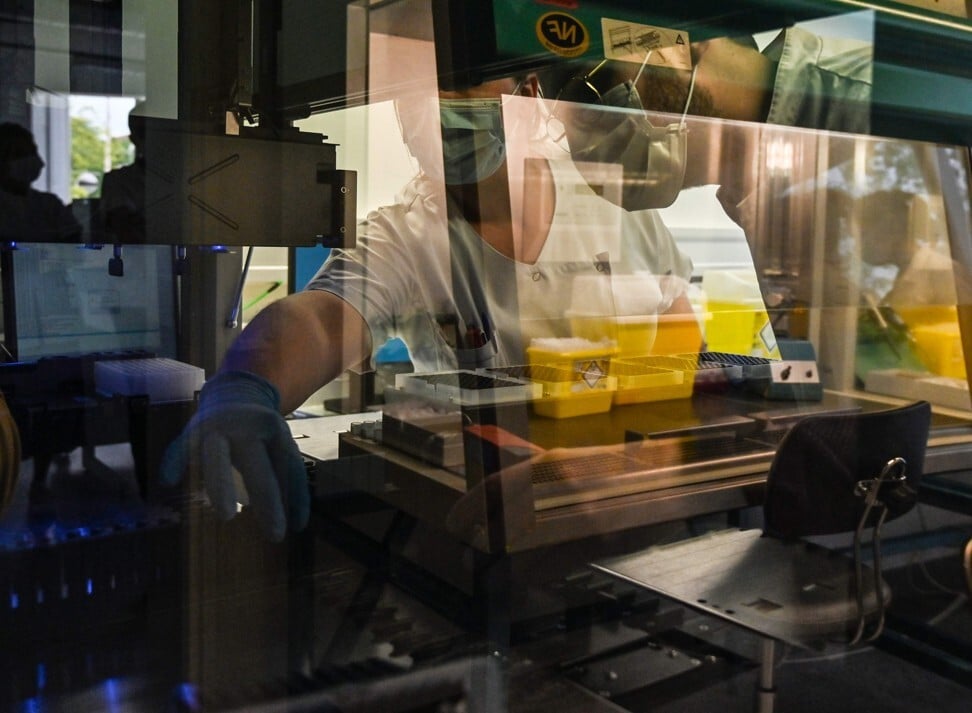
Researchers in France have carried out genetic analysis and found that the dominant types of the viral strains in the country did not come from China or Italy. Photo: AP
The coronavirus outbreak in France was not caused by cases imported from China, but from a locally circulating strain of unknown origin, according to a new study by French scientists at the Institut Pasteur in Paris.
Genetic analysis showed that the dominant types of the viral strains in France belonged to a clade – or group with a common ancestor – that did not come from China or Italy, the earliest hotspot in Europe.
“The French outbreak has been mainly seeded by one or several variants of this clade … we can infer that the virus was silently circulating in France in February,” said researchers led by Dr Sylvie van der Werf and Etienne Simon-Loriere in a non-peer reviewed paper released on bioRxiv.org last week.
The Covid-19 pandemic has infected more than 128,000 people in France and caused more than 23,000 deaths.
France detected the virus in late January, before any other country in Europe. A few patients with a travel history that included China’s Hubei province were sampled on January 24 and tested positive.
The Covid-19 pandemic has infected more than 128,000 people in France and caused more than 23,000 deaths. Photo: AFP
The French government took quick and decisive measures to trace contacts of the infected people and shut down the chance of further infection.

However, these strains were not found in patients tested after the initial imported cases, suggesting “the quarantine imposed on the initial Covid-19 cases in France appears to have prevented local transmission”, the researchers said.

The Pasteur institute collected samples from more than 90 other patients across France and found the strains all came from one genetic line. Strains following this unique path of evolution had so far only been detected in Europe and the Americas.

Singapore Covid-19 cases to rise as not all migrant workers being tested

28 Apr 2020

The earliest sample in the French clade was collected on February 19 from a patient who had no history of travel and no known contact with returned travellers.

Several patients had recently travelled to other European countries, the United Arab Emirates, Madagascar and Egypt but there was no direct evidence that they contracted the disease in these destinations.

To the researchers’ surprise, some of the later strains collected were genetically older – or closer to the ancestral root – than the first sample in this clade.

Spanish official cries reading names of health workers killed by coronavirus
A possible explanation, according to the authors, was that local transmission had been occurring in France for some time without being detected by health authorities.
The French government may have missed detecting the transmission. According to the researchers, a large proportion of those patients might have had mild symptoms or none at all.

The researchers also found that three sequences later sampled in Algeria were closely related to those in France, suggesting that travellers from France might have introduced the virus to the African country and caused an outbreak.

China says US politicians are lying as Trump calls for Covid-19 damages
29 Apr 2020

Benjamin Neuman, professor and chair of biological sciences with the Texas A&M University-Texarkana, said the French strains might have come from Belgium, where some sequences most closely related to the original strain from China were clustered.

“Since the earliest European strains of [the coronavirus] Sars-CoV-2 seem to be associated with Belgium, the idea that the virus spread from Belgium to both Italy and France at around the same time seems plausible, as this paper contends,” he said.

France is the latest in a growing number of countries and areas where no direct link between China and local outbreaks could be established.

The dominant strains in Russia and Australia, for instance, came from Europe and the United States, respectively, according to some studies.

These findings have drawn fire from some politicians who have tried to deflect domestic anger over their handling of the crisis by blaming China.

US President Donald Trump lashed out on social media after two separate teams in the US found the strains devastating New York came from Europe.

Is this the next big hotspot for the ‘little flu’?
28 Apr 2020

“So now the Fake News @nytimes is tracing the CoronaVirus origins back to Europe, NOT China. This is a first!” he tweeted on April 11, referring to a story about the studies in the The New York Times’ science section.

The findings also highlight the difficulties governments face in tracing the source of coronavirus outbreaks.

Less-developed countries may never know where their strains came from due to inadequate testing and sequencing capability.

India, for example, has released the genetic sequence of fewer than 40 samples to the public so far, a small number considering its huge population.

Most of the strains sampled in 35 early cases came from clades that could be traced to Italy and Iran, with only a few from China, according to a recent study. But researchers were not able to track further because of the lack of data.

A scientist on the study, Dr Mukesh Thakur, of the Zoological Survey of India, said it was too early to rule out China as the source of outbreaks in India because the number of samples at hand was limited.

A 20-year-old student studying medicine in Wuhan, for instance, might have come in contact with many people on the way home before she was tested positive on January 30.

Thakur said local media reported that the Indian government quarantined 3,500 people possibly linked to three positive cases imported from Wuhan.

“God knows how many of them tested positive in the subsequent stages,” Thakur said in an email response to the Post’s queries on Tuesday.

Some prominent scientists, including Francis Collins, director of the US National Institutes of Health, said the virus might have been spreading quietly in humans for years, or even decades, without causing a detectable outbreak.

The virus had thus adapted well to the human body. Some genes regulating its binding to host cells were similar, or even identical, to those found in some other highly infectious human viruses, such as HIV and Ebola.

According to some estimates, the ancestor of Sars-CoV-2, the virus causing Covid-19, might have left bats between 50 and 70 years ago. A recent study by a team of geneticists in Oxford University estimated the first outbreak of the current pandemic could have occurred as early as September last year.

They found that the dominant strains circulating in China and Asia were genetically younger than some popular strains in the United States.

Source: SCMP
01/10/2019

China anniversary: How the country became the world’s ‘economic miracle’

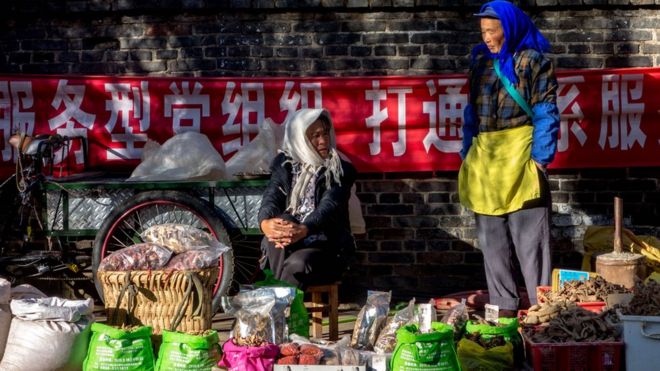
Local women sell produce in the market. Zhongyi market, located at the southern gate of Dayan ancient city, in Lijian, Yunnan Province in ChinaImage copyrightGETTY IMAGES

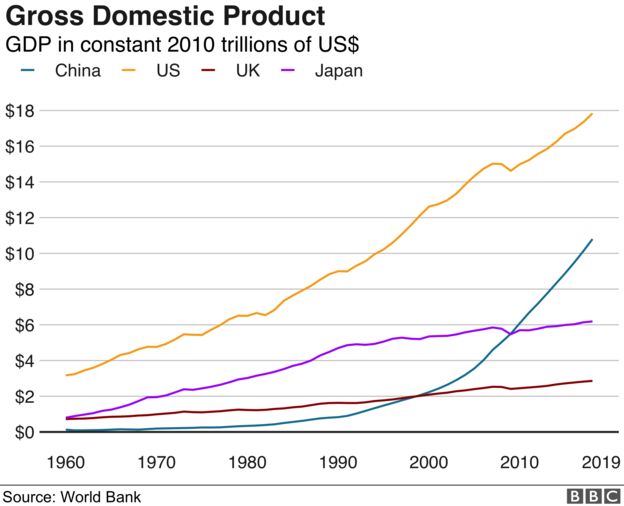
It took China less than 70 years to emerge from isolation and become one of the world’s greatest economic powers.

As the country celebrates the anniversary of the founding of the People’s Republic of China, we look back on how its transformation spread unprecedented wealth – and deepened inequality – across the Asian giant.

“When the Communist Party came into control of China it was very, very poor,” says DBS chief China economist Chris Leung.

“There were no trading partners, no diplomatic relationships, they were relying on self-sufficiency.”

Over the past 40 years, China has introduced a series of landmark market reforms to open up trade routes and investment flows, ultimately pulling hundreds of millions of people out of poverty.

Chart showing gross domestic product of US, China, Japan and the UK

The 1950s had seen one of the biggest human disasters of the 20th Century. The Great Leap Forward was Mao Zedong’s attempt to rapidly industrialise China’s peasant economy, but it failed and 10-40 million people died between 1959-1961 – the most costly famine in human history.

This was followed by the economic disruption of the Cultural Revolution in the 1960s, a campaign which Mao launched to rid the Communist party of his rivals, but which ended up destroying much of the country’s social fabric.

‘Workshop of the world’

Yet after Mao’s death in 1976, reforms spearheaded by Deng Xiaoping began to reshape the economy. Peasants were granted rights to farm their own plots, improving living standards and easing food shortages.

The door was opened to foreign investment as the US and China re-established diplomatic ties in 1979. Eager to take advantage of cheap labour and low rent costs, money poured in.

“From the end of the 1970s onwards we’ve seen what is easily the most impressive economic miracle of any economy in history,” says David Mann, global chief economist at Standard Chartered Bank.

Through the 1990s, China began to clock rapid growth rates and joining the World Trade Organization in 2001 gave it another jolt. Trade barriers and tariffs with other countries were lowered and soon Chinese goods were everywhere.

“It became the workshop of the world,” Mr Mann says.

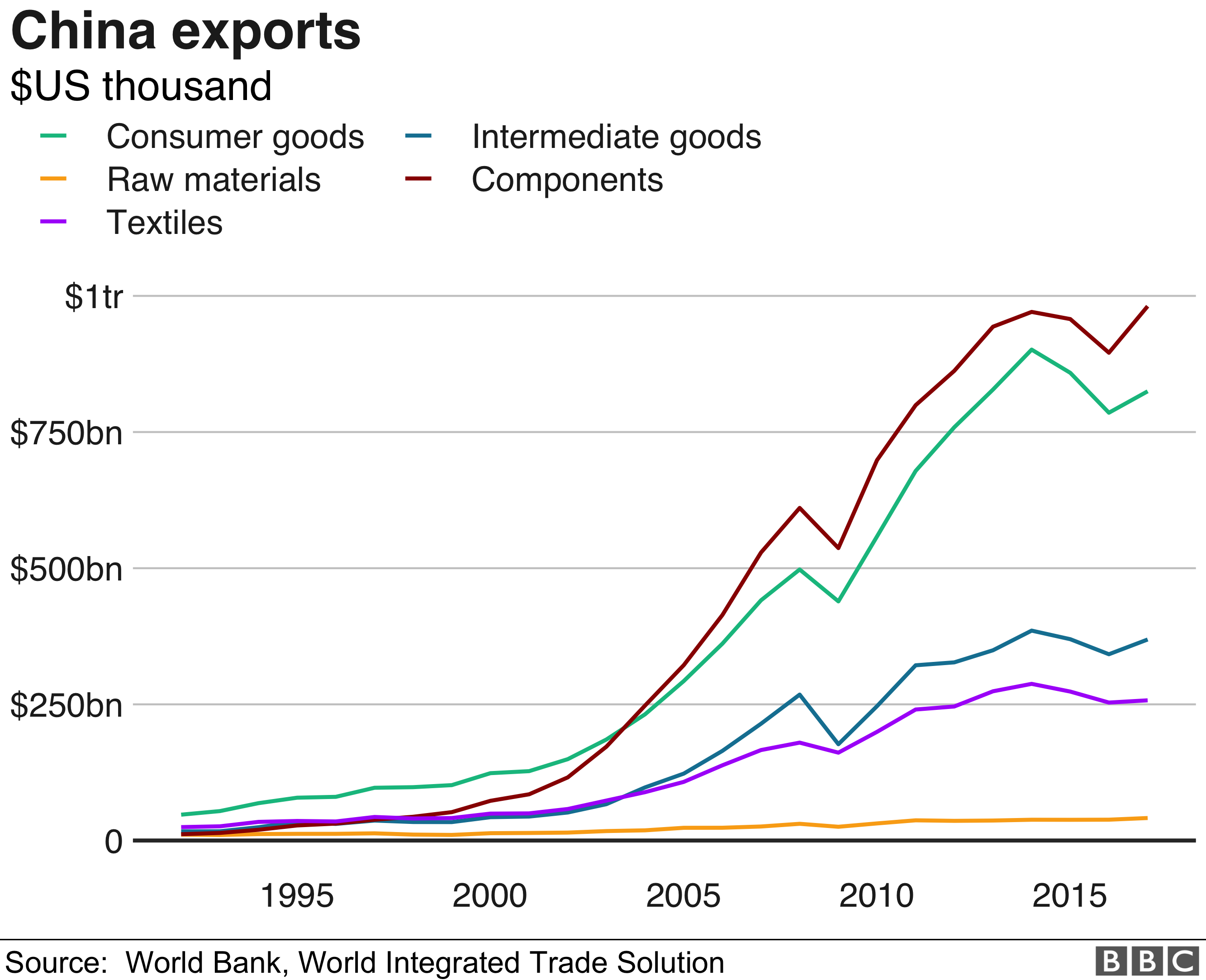
Chart showing China exports

Take these figures from the London School of Economics: in 1978, exports were $10bn (£8.1bn), less than 1% of world trade.

By 1985, they hit $25bn and a little under two decades later exports valued $4.3trn, making China the world’s largest trading nation in goods.

Poverty rates tumble

The economic reforms improved the fortunes of hundreds of millions of Chinese people.

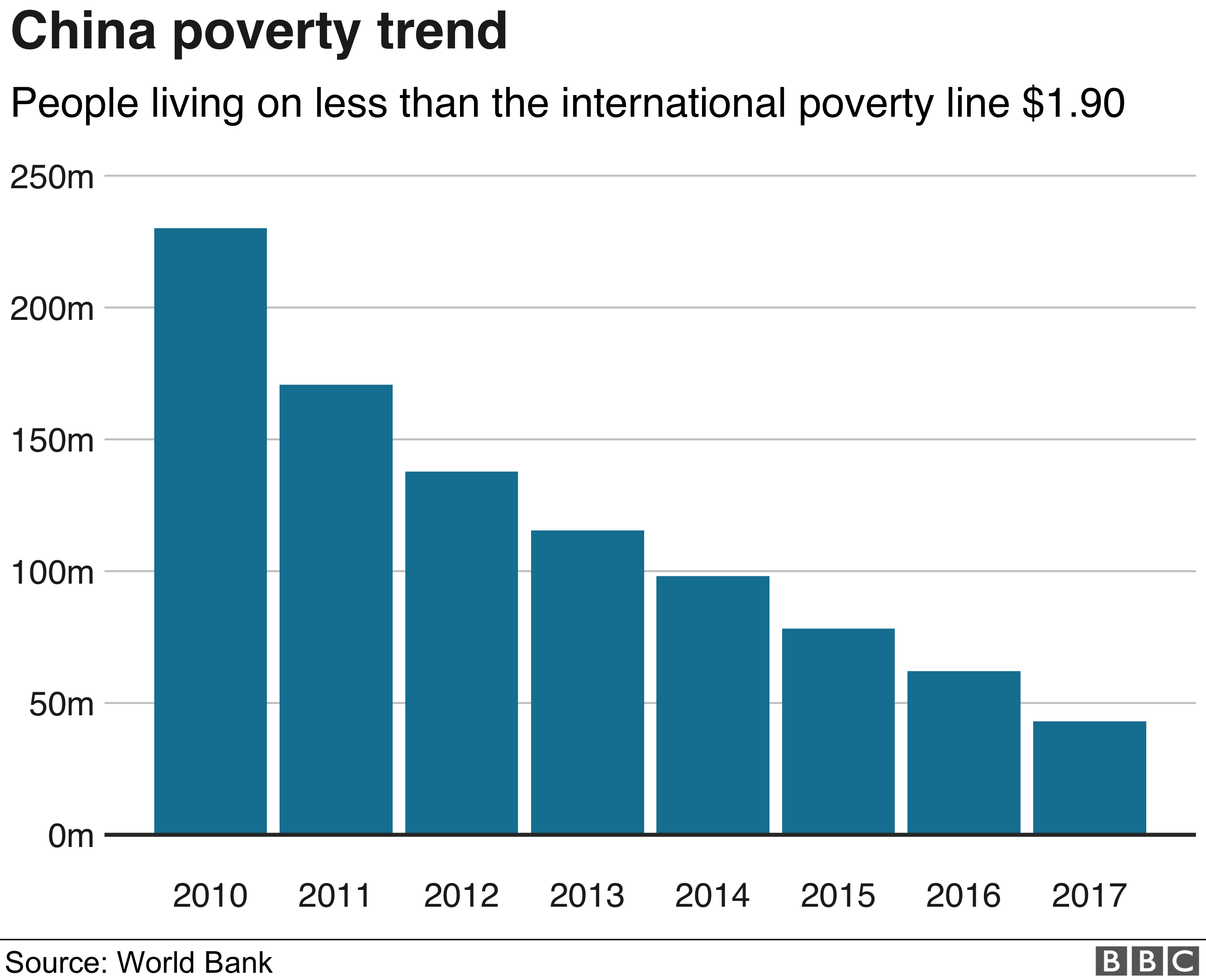
The World Bank says more than 850 million people been lifted out of poverty, and the country is on track to eliminate absolute poverty by 2020.

At the same time, education rates have surged. Standard Chartered projects that by 2030, around 27% of China’s workforce will have a university education – that’s about the same as Germany today.

China poverty rates

Rising inequality

Still, the fruits of economic success haven’t spread evenly across China’s population of 1.3 billion people.

Examples of extreme wealth and a rising middle class exist alongside poor rural communities, and a low skilled, ageing workforce. Inequality has deepened, largely along rural and urban divides.

“The entire economy is not advanced, there’s huge divergences between the different parts,” Mr Mann says.

The World Bank says China’s income per person is still that of a developing country, and less than one quarter of the average of advanced economies.

China’s average annual income is nearly $10,000, according to DBS, compared to around $62,000 in the US.

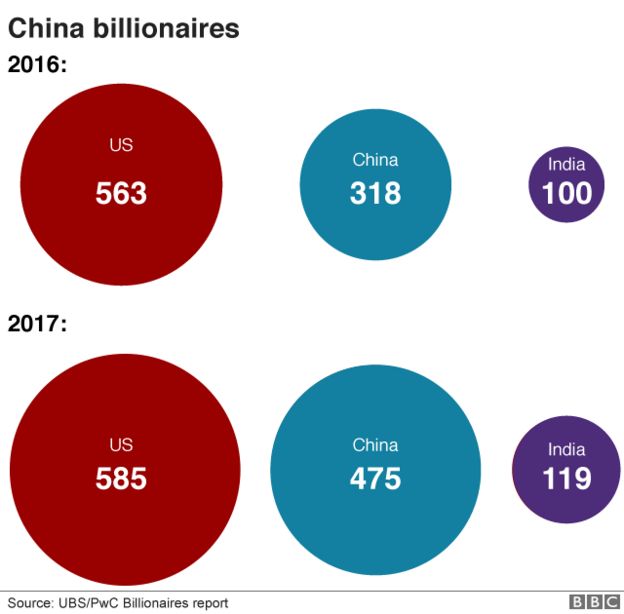
Billionaires in China, the US and India

Slower growth

Now, China is shifting to an era of slower growth.

For years it has pushed to wean its dependence off exports and toward consumption-led growth. New challenges have emerged including softer global demand for its goods and a long-running trade war with the US. The pressures of demographic shifts and an ageing population also cloud the country’s economic outlook.

Still, even if the rate of growth in China eases to between 5% and 6%, the country will still be the most powerful engine of world economic growth.

“At that pace China will still be 35% of global growth, which is the biggest single contributor of any country, three times more important to global growth than the US,” Mr Mann says.

The next economic frontier

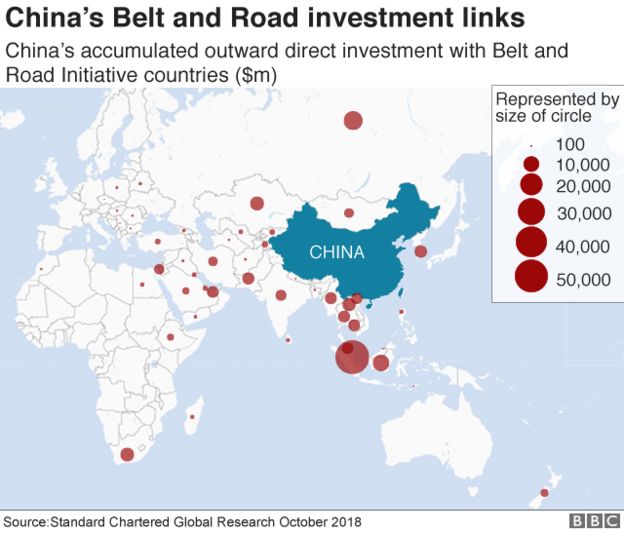
China is also carving out a new front in global economic development. The country’s next chapter in nation-building is unfolding through a wave of funding in the massive global infrastructure project, the Belt and Road Initiative.

Map showing Chinese investment as part of the Belt and Road initiative

The so-called new Silk Road aims to connect almost half the world’s populations and one-fifth of global GDP, setting up trade and investment links that stretch across the world.

Source: The BBC

29/09/2019

China anniversary: The deep cuts of 70 years of Communist rule

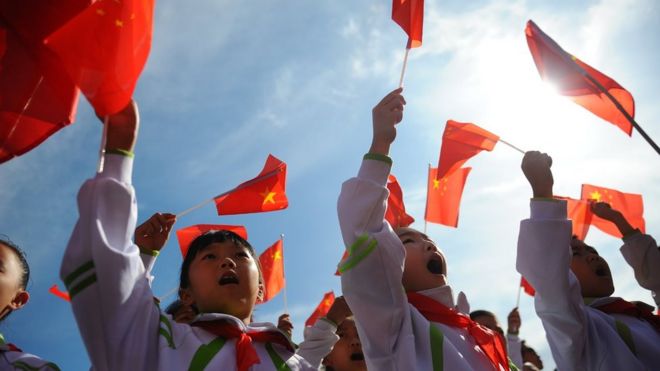
Children waving Chinese flagsImage copyright GETTY IMAGES
Image caption China’s version of its past is a story of prosperity, progress and sacrifice for the common good

China’s extraordinary rise was a defining story of the 20th Century, but as it prepares to mark its 70th anniversary, the BBC’s John Sudworth in Beijing asks who has really won under the Communist Party’s rule.

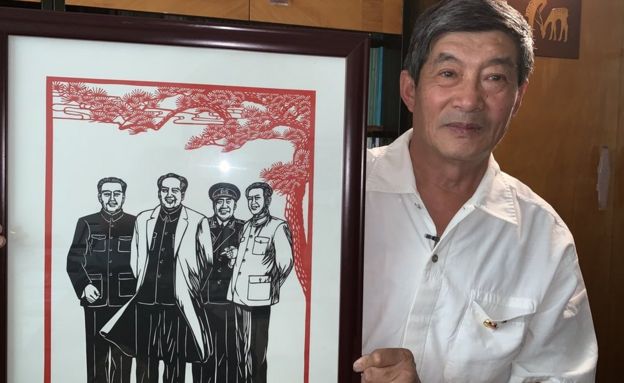
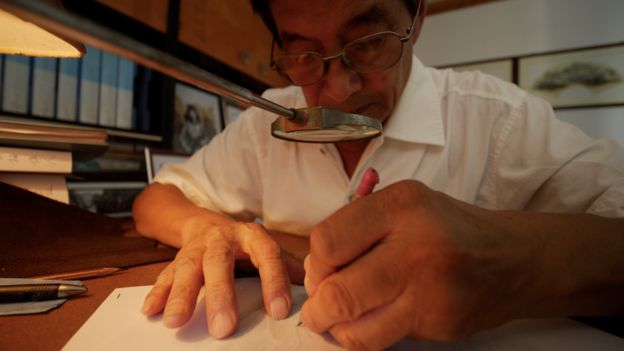
Sitting at his desk in the Chinese city of Tianjin, Zhao Jingjia’s knife is tracing the contours of a face.

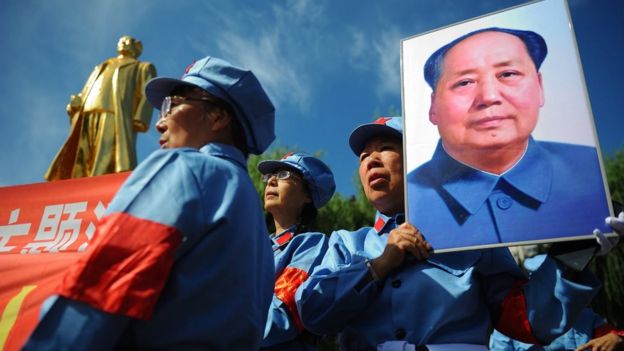
Cut by delicate cut, the form emerges – the unmistakable image of Mao Zedong, founder of modern China.

The retired oil engineer discovered his skill with a blade only in later life and now spends his days using the ancient art of paper cutting to glorify leaders and events from China’s communist history.

“I’m the same age as the People’s Republic of China (PRC),” he says. “I have deep feelings for my motherland, my people and my party.”

Zhao Jingjia with a paper cut of Mao Zedong
Image caption For people like Zhao Jingjia, China’s success outweighs the “mistakes” of its leaders

Born a few days before 1 October 1949 – the day the PRC was declared by Mao – Mr Zhao’s life has followed the dramatic contours of China’s development, through poverty, repression and the rise to prosperity.

Now, in his modest but comfortable apartment, his art is helping him make sense of one of the most tumultuous periods of human history.

“Wasn’t Mao a monster,” I ask, “responsible for the deaths of tens of millions of his countrymen?”

“I lived through it,” he replies. “I can tell you that Chairman Mao did make some mistakes but they weren’t his alone.”

“I respect him from my heart. He achieved our nation’s liberation. Ordinary people cannot do such things.”

On Tuesday, China will present a similar, glorious rendering of its record to the world.

The country is staging one of its biggest ever military parades, a celebration of 70 years of Communist Party rule as pure, political triumph.

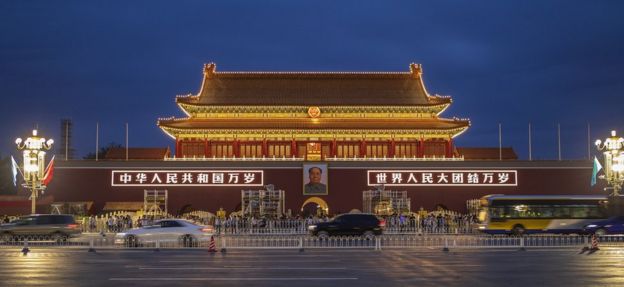
Beijing will tremble to the thunder of tanks, missile launchers and 15,000 marching soldiers, a projection of national power, wealth and status watched over by the current Communist Party leader, President Xi Jinping, in Tiananmen Square.

An incomplete narrative of progress

Like Mr Zhao’s paper-cut portraits, we’re not meant to focus on the many individual scars made in the course of China’s modern history.

It is the end result that matters.

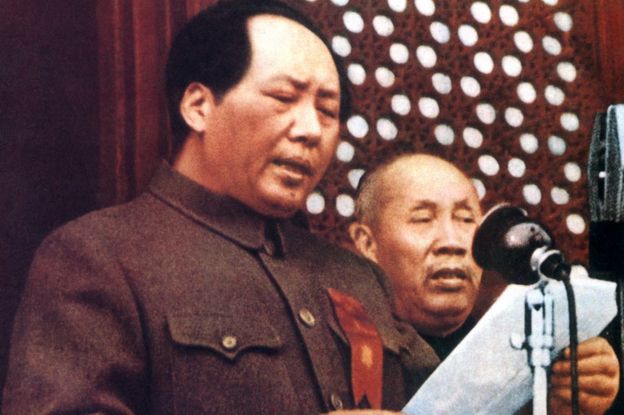
Mao Zedong declares the People's Republic of China in Beijing on 1 Oct 1949Image copyright XINHUA/AFP
Image caption Mao Zedong pronounces the dawn of the People’s Republic of China on 1 October 1949

And, on face value, the transformation has been extraordinary.

On 1 October 1949, Chairman Mao stood in Tiananmen Square urging a war-ravaged, semi-feudal state into a new era with a founding speech and a somewhat plodding parade that could muster only 17 planes for the flyby.

This week’s parade, in contrast, will reportedly feature the world’s longest range intercontinental nuclear missile and a supersonic spy-drone – the trophies of a prosperous, rising authoritarian superpower with a 400 million strong middle class.

It is a narrative of political and economic success that – while in large part true – is incomplete.

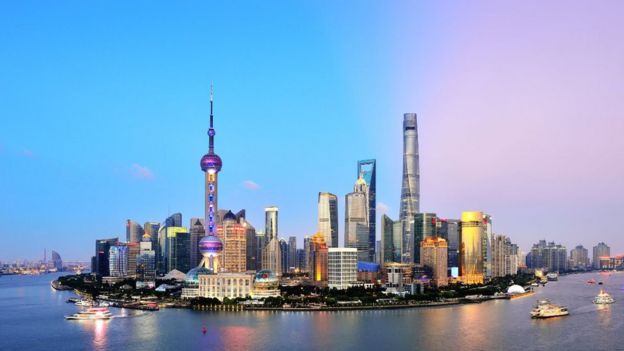
New visitors to China are often, rightly, awe-struck by the skyscraper-festooned, hi-tech megacities connected by brand new highways and the world’s largest high-speed rail network.

Shanghai skylineImage copyright GETTY IMAGES
Image caption Those in China’s glittering cities may accept the trade-off of political freedom for economic growth

They see a rampant consumer society with the inhabitants enjoying the freedom and free time to shop for designer goods, to dine out and to surf the internet.

“How bad can it really be?” the onlookers ask, reflecting on the negative headlines they’ve read about China back home.

The answer, as in all societies, is that it depends very much on who you are.

Many of those in China’s major cities, for example, who have benefited from this explosion of material wealth and opportunity, are genuinely grateful and loyal.

In exchange for stability and growth, they may well accept – or at least tolerate – the lack of political freedom and the censorship that feature so often in the foreign media.

For them the parade could be viewed as a fitting tribute to a national success story that mirrors their own.

But in the carving out of a new China, the knife has cut long and deep.

The dead, the jailed and the marginalised

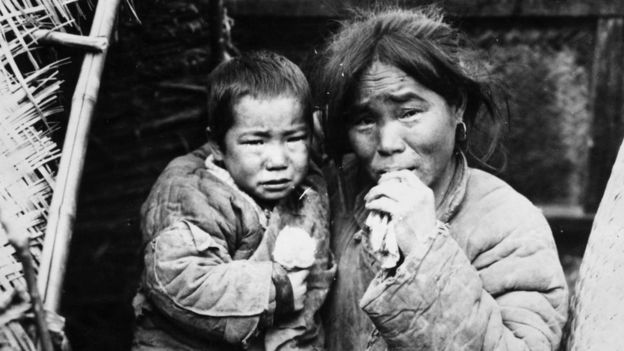
Mao’s man-made famine – a result of radical changes to agricultural systems – claimed tens of millions of lives and his Cultural Revolution killed hundreds of thousands more in a decade-long frenzy of violence and persecution, truths that are notably absent from Chinese textbooks.

Archive image of a starving woman and child during the famine in ChinaImage copyright GETTY/TOPICAL
Image caption Tens of millions starved to death under Mao, as China radically restructured agriculture and society

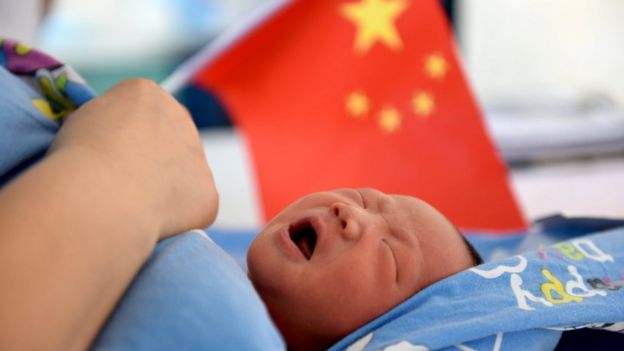
After his death, the demographically calamitous One Child Policy brutalised millions over a 40-year period.

Still today, with its new Two Child Policy, the Party insists on violating that most intimate of rights – an individual’s choice over her fertility.

The list is long, with each category adding many thousands, at least, to the toll of those damaged or destroyed by one-party rule.

Chinese baby in front of Chinese flagImage copyright GETTY IMAGES
Image caption Beijing still regulates how many children families can have

There are the victims of religious repression, of local government land-grabs and of corruption.

There are the tens of millions of migrant workers, the backbone of China’s industrial success, who have long been shut out of the benefits of citizenship.

A strict residential permit system continues to deny them and their families the right to education or healthcare where they work.

And in recent years, there are the estimated one and a half million Muslims in China’s western region of Xinjiang – Uighurs, Kazakhs and others – who have been placed in mass incarceration camps on the basis of their faith and ethnicity.

China continues to insist they are vocational schools, and that it is pioneering a new way of preventing domestic terrorism.

The stories of the dead, the jailed and the marginalised are always much more hidden than the stories of the assimilated and the successful.

Viewed from their perspective, the censorship of large parts of China’s recent history is not simply part of a grand bargain to be exchanged for stability and prosperity.

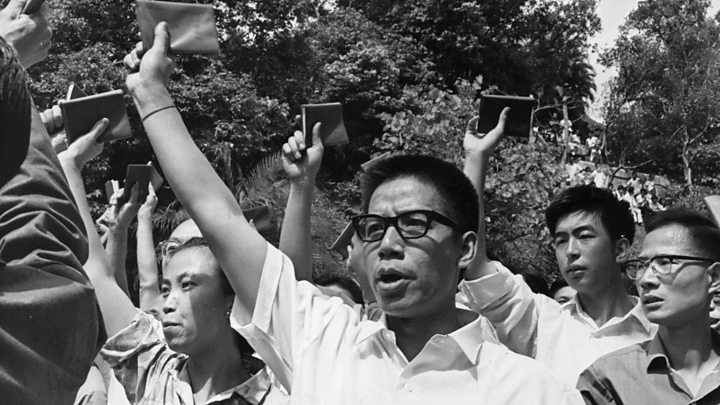
People holding pictures of Mao and the Little Red Book in Tiananmen Square, 1966

Getty
Timeline of modern China

  • 1949 Mao declares the founding of the People’s Republic of China
  • 1966-76 Cultural Revolution brings social and political upheaval
  • 1977 Deng Xiaoping initiates major reforms of China’s economy
  • 1989 Army crushes Tiananmen Square pro-democracy protests
  • 2010 China becomes the world’s second-largest economy
  • 2018 Xi Jinping is cleared to be president for life
It is something that makes the silence of their suffering all the more difficult to penetrate.

It is the job of foreign journalists, of course, to try.

‘Falsified, faked and glorified’

But while censorship can shut people up, it cannot stop them remembering.

Prof Guo Yuhua, a sociologist at Beijing’s Tsinghua University, is one of the few scholars left trying to record, via oral histories, some of the huge changes that have affected Chinese society over the past seven decades.

Her books are banned, her communications monitored and her social media accounts are regularly deleted.

“For several generations people have received a history that has been falsified, faked, glorified and whitewashed,” she tells me, despite having been warned not to talk to the foreign media ahead of the parade.

“I think it requires the entire nation to re-study and to reflect on history. Only if we do that can we ensure that these tragedies won’t be repeated.”

People with poster of Mao ZedongImage copyright GETTY IMAGES
Image caption Can progress really be attributed to the leadership?

A parade, she believes, that puts the Communist Party at the front and centre of the story, misses the real lesson, that China’s progress only began after Mao, when the party loosened its grip a bit.

“People are born to strive for a better, happier and more respectful life, aren’t they?” she asks me.

“If they are provided with a tiny little space, they’ll try to make a fortune and solve their survival problems. This shouldn’t be attributed to the leadership.”

‘Our happiness comes from hard work’

As if to prove the point about how the unsettled, censored pasts of authoritarian states continue to impact the present, the parade is for invited guests only.

Mao's portrait hanging in Tiananmen SquareImage copyright GETTY IMAGES
Image caption Mao’s portrait will, as it always is, be watching over the events in Tiananmen Square

Another anniversary, of which Tiananmen Square is the centrepiece, is also being measured in multiples of 10 – it is 30 years since the bloody suppression of the pro-democracy protests that shook the foundations of Communist Party rule.

The troops will be marching – as they always do on these occasions – down the same avenue on which the students were gunned down.

The risk of even a lone protester using the parade to mark a piece of history that has largely been wiped from the record is just too great.

With central Beijing sealed off, ordinary people in whose honour it is supposedly being held, can only watch it on TV.

Zhao

Back in his Tianjin apartment, Zhao Jingjia shows me the intricate detail of a series of scenes, each cut from a single piece of paper, depicting the “Long March”, a time of hardship and setback for the Communist Party long before it eventually swept to power.

“Our happiness nowadays comes from hard work,” he tells me.

It is a view that echoes that of the Chinese government which, like him, has at least acknowledged that Mao made mistakes while insisting they shouldn’t be dwelt on.

“As for the 70 years of China, it’s extraordinary,” he says. “It can be seen by all. Yesterday we sent two navigation satellites into space – all citizens can enjoy the convenience that these things bring us.”

Media caption What was China’s Cultural Revolution?

Source: The BBC

28/09/2019

China makes great strides in agriculture, poverty reduction over 70 years: officials

BEIJING, Sept. 27 (Xinhua) — China has reaped great accomplishments in agriculture and rural development in the past 70 years, successfully feeding a population of 1.4 billion and lifting over 800 million people in rural areas out of poverty.

China’s annual grain output has remained above 650 billion kg for four years in a row, up from 113.2 billion kg in 1949, Han Changfu, minister of agriculture and rural affairs, told a press conference on Friday.

Feeding 20 percent of the world population with 9 percent of the world’s arable land is a miracle in the history of agriculture, said Han.

The country has entered a new phase of development driven by technology and equipment innovation, with the area of high-standard farmland totaling 640 million mu (about 42.7 million hectares), Han added.

Poverty reduction in rural areas has also yielded dazzling results since the country’s opening-up, as more than 800 million people have been lifted out of absolute poverty, according to Liu Yongfu, director of the State Council Leading Group Office of Poverty Alleviation and Development.

By the end of 2018, per capita disposable income of rural residents living in poverty-stricken areas reached 10,371 yuan, equivalent to 71 percent of that for rural residents nationwide.

Liu said 95 percent of the population in poverty under current standards will be lifted out of poverty by the end of this year, while eradication of absolute poverty is expected by the end of 2020.

Source: Xinhua

20/09/2019

China Focus: China publishes white paper on progress of women’s cause in 70 years

CHINA-BEIJING-SCIO-WOMEN'S CAUSE-WHITE PAPER (CN)

A white paper titled “Equality, Development and Sharing: Progress of Women’s Cause in 70 Years Since New China’s Founding” is released by the State Council Information Office in Beijing, capital of China, Sept. 19, 2019. China on Thursday issued a white paper on the progress of women’s cause in the past 70 years since the founding of the People’s Republic of China. TO GO WITH “China publishes white paper on progress of women’s cause in 70 years” (Xinhua/Zhang Yuwei)

BEIJING, Sept. 19 (Xinhua) — China on Thursday issued a white paper on the progress of women’s cause in the past 70 years since the founding of the People’s Republic of China (PRC).

The white paper, titled “Equality, Development and Sharing: Progress of Women’s Cause in 70 Years Since New China’s Founding,” was released by the State Council Information Office.

The founding of the PRC in 1949 ushered in a new era for women in China, changing their social status from an oppressed and enslaved group in the past thousands of years to masters of their own fate, the white paper said.

As the Chinese nation is rising and growing richer and stronger, Chinese women’s social status has undergone enormous changes, it said.

“The great achievements China has made in the development of women’s cause is attributed to the leadership of the Communist Party of China (CPC),” said Huang Xiaowei, vice president of the All-China Women’s Federation, at a press conference.

The progress made by Chinese women led by the CPC is not only of considerable significance to China’s national rejuvenation but also a notable contribution to human civilization progress, Huang said.

As China’s development has entered a new era, promoting gender equality and women’s overall development at a higher level not only meets opportunities but also has a long way to go, the white paper said.

Under the guidance of Xi Jinping Thought on Socialism with Chinese Characteristics for a New Era, China will always adhere to safeguarding and improving women’s livelihoods, promote women’s all-round development, and lead hundreds of millions of women in working for national rejuvenation, it said.

MORE WORKING WOMEN

China has promulgated laws and regulations to fully protect women’s economic rights and interests, especially the right to equal employment, ensuring equal pay to men and women for equal work and eliminating gender discrimination in employment, the white paper said.

Women account for 40 percent of the labor force in China. In 2017, there were 340 million working women, doubling the figure in 1978.

Women’s job options have greatly expanded. In 2010, 46.8 percent of women worked in industry and service sectors, up 24.8 percentage points from 1982.

HIGHER POLITICAL STATUS

China has drawn up and implemented laws to guarantee that women share equal rights with men to vote, to be elected, and to participate in the administration of state affairs, the white paper said, adding that over the past four decades since the reform and opening-up, new opportunities and channels have been opened to women to participate in politics.

In 2017, women accounted for 52.4 percent of public servants newly-recruited by the central government organs and their affiliates, and the proportion was 44 percent among local governments.

The ratio of women deputies to the 13th National People’s Congress (NPC) was 24.9 percent, 12.9 percentage points higher than that of the first NPC in 1954.

MORE EDUCATED WOMEN

Chinese women’s education level has been dramatically lifted over the past seven decades, according to the white paper.

The illiteracy rate among females aged 15 and above dropped from 90 percent before the founding of the PRC to 7.3 percent in 2017, which was a historic change.

The gender gap in the nine-year compulsory education has been basically eliminated. In 2017, the net primary school enrollment rates of boys and girls were both 99.9 percent while the proportions of girls in primary schools and junior high schools were 46.5 percent and 46.4 percent respectively, 18.5 and 20.8 percentage points higher than those in 1951 respectively

In 2017, the gross high school enrollment rate was 88.3 percent, with girls accounting for 47.7 percent of all students in high schools.

Meanwhile, women accounted for 52.5 percent of students in regular institutions of higher education, 28.4 percentage points higher than in 1978, 32.7 percentage points higher than in 1949.

HEALTHIER WOMEN

Women’s health has further improved in China. Women’s average life expectancy grew to 79.4 years in 2015, an increase of 10.1 years over 1981 and 42.7 years over 1949, according to the white paper.

The maternal mortality rate has fallen 79.4 percent from 88.8 per 100,000 in 1990 to 18.3 per 100,000 in 2018, meaning that China has achieved the United Nations Millennium Development Goals ahead of time.

Source: Xinhua

11/08/2019

Chinese people’s disposable income surges 60 times in past 70 years

BEIJING, Aug. 11 (Xinhua) — Chinese residents saw their per capita disposable income surge by nearly 60 times during the past seven decades thanks to the country’s steady economic expansion.

The per capita disposable income stood at about 49.7 yuan in 1949, and topped 28,200 yuan (about 4,030 U.S. dollars) in 2018, registering a growth of over 59 times factoring in inflation, a report from the National Bureau of Statistics (NBS) showed.

The steady income growth also led to continuous increases in consumption spending. Chinese residents’ per capita consumption spending surged from 88.2 yuan in 1956 to 19,853 yuan in 2018, growing 28.5 times in real terms, NBS data showed.

Source: Xinhua

09/08/2019

China sees rapid income, consumption growth in rural areas over past 70 years

CHINA-RURAL RESIDENTS-INCOME GROWTH (CN)

A villager shops at a mart in Wangzhuanggou Village of Wuxiang County, north China’s Shanxi Province, Feb. 17, 2019.

China has seen rapid income and consumption growth in rural areas over the past 70 years, according to a report from the National Bureau of Statistics (NBS). In 2018, rural per capita disposable income had increased 40 times from 1949 to stand at 14,617 yuan (about 2,088 U.S. dollars) in real terms after deducting price factors, up 5.5 percent on average annually, the NBS said. The country’s urban-rural income gap narrowed remarkably, with the ratio of per capita disposable income for urban residents to that of rural residents hitting 2.69 in 2018, 0.64 lower than 1956. The rural consumption level continued to rise in the last 70 years, as indicated by its expanding size and improving quality. Per capita rural consumption grew by an average annual rate of 5.2 percent to reach 12,124 yuan in real terms in 2018 after deducting price factors, up 32.7 times from 1949, while the Engel coefficient for rural residents dropped 38.5 percentage points from 1954 to reach 30.1 percent. Per capita living space in rural areas reached 47.3 square meters, posing a sharp contrast to 8.1 square meters in 1978, according to the report.

Household consumption in rural areas also increased, with the average ownership of cars, computers and cell phones per 100 households reaching 22.3, 26.9 and 257, respectively in 2018. (Xinhua/Zhan Yan)

Source: Xinhua

Law of Unintended Consequences

continuously updated blog about China & India

ChiaHou's Book Reviews

continuously updated blog about China & India

What's wrong with the world; and its economy

continuously updated blog about China & India