Chindia Alert: You’ll be Living in their World Very Soon
aims to alert you to the threats and opportunities that China and India present. China and India require serious attention; case of ‘hidden dragon and crouching tiger’.
Without this attention, governments, businesses and, indeed, individuals may find themselves at a great disadvantage sooner rather than later.
The POSTs (front webpages) are mainly 'cuttings' from reliable sources, updated continuously.
The PAGEs (see Tabs, above) attempt to make the information more meaningful by putting some structure to the information we have researched and assembled since 2006.
Young people starting out in the jobs market face a hit to their prospects that could endure years after the Covid-19-induced downturn has run its course
A generation of angry youth raises the spectre of political instability
Freelance filmmaker Anita Reza Zein had grown used to jam-packed production schedules requiring her to put in long hours and run on little sleep. Until Covid-19 struck.
Today, the talented Indonesian is suddenly free. With five projects on hold and many more potentially cancelled, she now spends her time working on a personal project, doing research for her work and occasionally going for a ride on a bicycle.
“I feel calm and patient although I’m jobless. Maybe because it’s still the third week [of social distancing] and I still have enough savings from my previous work,” said the 26-year-old, who is from Yogyakarta. “But I imagine life will become tougher in the next few months if the situation gets worse.”
Like her, millions of youths are now part of a job market in Southeast Asia that has been ravaged by the coronavirus pandemic. They are the unlucky cohort of 2020 whose fortunes have changed so drastically, so quickly.
Freelance filmmaker Anita Reza Zein now spends most of her time at home as her projects have all been frozen due to the spread of Covid-19. Photo: Anita Reza Zein
Just three months ago, many eager graduates were about to partake in a strong economy and possibly land decent pay cheques.
Today, job offers are being withdrawn and hiring halted, leading to a spike in regional youth unemployment in the short term. In the long term, the effects on the Covid-19 cohort could lead to wider social and political problems.
JOB MARKETS SHUT
The virus’ impact on economies and the job market in the region has been swift and devastating. Borders have been slammed shut, workers ordered to stay at home, and thousands of companies closed every week.
The biggest problem is the lack of certainty about how long this will last – the longer the governments keep their countries on lockdown, the worse the economic impact.
In Indonesia, for example, the virus has caused almost 2.8 million people to lose their jobs, according to the Manpower Ministry and the Workers Social Security Agency. Likewise, in Malaysia, an estimated 2.4 million people are expected to lose their jobs, going by data from the Malaysian Institute of Economic Research (MIER).
is bracing itself for a 5.3 per cent contraction in GDP for the full year, the worst since the Asian financial crisis in 1997.
“We think about seven million jobs have been lost already, and the figure will hit 10 million if the outbreak drags on for two to three more months,” said Kalin Sarasin, council member and head of the Thai Chamber of Commerce.
Lockdown for 34 million people in capital Jakarta as Indonesia fights surge in coronavirus deaths
For young jobseekers, the outbreak of the Covid-19 pandemic could hurt even more, with companies unwilling to open up new jobs for them.
“My clients who were open to fresh graduates previously have realigned searches [for candidates] who have at least one year of experience, as it’s a lot faster for someone with experience to scale up quickly and contribute,” said Joanne Pek, a recruiter at Cornerstone Global Partners’ Singapore office.
For many small and medium-sized enterprises (SMEs) such as Singapore-based restaurant chain The Soup Spoon, saving jobs – rather than recruiting – is the priority.
“We don’t want to let anyone go during this period, so we’re focused on protecting jobs,” said co-founder and director Benedict Leow, who employs some 250 workers.
THE COVID-19 COHORT
The looming economic downturn could have distinct consequences for the Class of 2020 that will outlast the economic downturn itself.
For one thing, the paucity of jobs could result in the Covid-19 cohort becoming a “lost generation” of sorts, said Achim Schmillen, a senior economist at the World Bank Social Protection and Jobs Global Practice.
“Research from around the globe shows that graduating in a recession can have significant and long-lasting impacts that can affect the entire career. In particular, it can lead to large initial earnings losses which only slowly recede over time,” he said.
Coronavirus: why there’s no quick fix for a Covid-19 vaccine
12 Apr 2020
Economics professor Jeff Borland of the University of Melbourne said that international studies showed that what happened to people when they first entered the labour market would affect them for the rest of their working lives.
“Many international studies have shown that trying to move into employment during a major economic downturn cuts the probability of employment and future earnings for a decade or more.
“Why this occurs is less well-established. Reasons suggested include being forced to take lower-quality jobs, losing skills and losing psychological well-being,” he said in a piece published on The Conversation website.
Malaysia sets up Covid-19 test zones in the capital to hunt for ‘hidden’ coronavirus cases
This could create “lasting scarring” on the graduates this year, said labour economist Walter Theseira.
“If their careers start badly, it would affect their earnings for a number of years because they would lack the same experience as peers who started in a more secure position,” the associate professor of economics at Singapore University of Social Sciences said.
Shrinking salaries and the downsizing of companies mean that graduates might have to seek out professions outside their areas of study to survive, said Grace Lee Hooi Yean, head of the Economics Department at Monash University, Malaysia.
She said youth unemployment in the country, which stands at 11.67 per cent, could rise sharply.
“This looming crisis could trap a generation of educated and capable youth in a limbo of unmet expectations and lasting vulnerability if the graduates are not ready to face reality and adapt to the new challenges,” she said.
How long will a coronavirus vaccine take? A Q&A with Jerome Kim
12 Apr 2020
This is fast becoming the reality for final-year medical student Rebecca K. Somasundaram, who has been left without a job due to the pandemic.
After being offered a residency programme at a top specialist hospital in Kuala Lumpur, she was notified a month ago that her placement had been made void until further notice. This has thrown the 24-year-old’s plans into disarray as she was hoping to enter the workforce soon to pay off her student debts. Her plans to get married next year have also been put on hold temporarily.
“I am in constant talks with the hospital to see if there is any way I can join them soon but seeing how things are unfolding so quickly, I am slowly losing hope,” she said.
Over in Indonesia, the pandemic will trigger job losses on a national scale. To combat this, the government would need to introduce strong fiscal measures and beef up its social protection policies, said the country’s former minister of finance Muhamad Chatib Basri.
Many people on lower incomes tend to work in the extraction industry, such as mining and palm oil, and these are the first industries hit due to the global slowdown.
“The rich will be able to brave the storm, but the poor have no means to do so,” he said.
Singapore migrant workers under quarantine as coronavirus hits dormitories
SPECTRE OF 1997
With partial lockdowns imposed in the capital of Jakarta, more needs to be done to ensure that vulnerable citizens have access to food and financial support.
Without government intervention, economic woes could soon translate into political instability, a scenario last seen in the Asian financial crisis.
In 1997, waves of discontent sparked racial riots in Indonesia that toppled the country’s long-time strongman Suharto, while in Thailand a political crisis created the conditions for populist leader Thaksin Shinawatra to rise.
Rising discontent could have serious implications at the ballot boxes, warned Basri, who said young voters were a key voting bloc for President Joko “Jokowi” Widodo.
Coronavirus: food security, Asia’s next battle in a post-Covid world
6 Apr 2020
In last year’s general elections, Jokowi proved a hit among the lower-educated youth who had benefited from the creation of largely unskilled jobs during his tenure.
“With more young people expected to become unemployed in the coming months, things will only get worse from here,” said Basri, who added that the country’s youth unemployment stood at almost 20 per cent in 2018.
Indonesia, which has 268 million people and is Southeast Asia’s largest economy, had 133 million workers as of last August, according to official data.
Close to 10 per cent or about 12.27 million are university graduates but among this group, about 5.67 per cent or some 730,000 were unemployed. This was higher than the country’s overall unemployment rate at that time, which was 5.28 per cent.
‘Ghosts’ deployed to scare Indonesians into staying home to slow spread of the coronavirus
GETTING IT RIGHT
Economists say, however, that all is not lost. Much will depend on policy and how governments focus on battling the virus on the public health and economic fronts. They point to Singapore, which has launched a robust response to the crisis.
On April 6, the Singapore government announced its third budget in two months to help companies and households tide over the crisis. In all, Singapore’s total stimulus package, which aims to save jobs and keep funds flowing to companies, will cost the government a massive S$59.9 billion (US$42 billion).
The Singapore government was also preparing for a labour market that would be reluctant to hire fresh graduates on a full-time basis, said Theseira.
“There are plans to implement large-scale subsidised traineeships, which may be more palatable to companies which are worried about taking on permanent headcount this year,” he noted. “As the economic situation improves, they can be converted to permanent positions.”
The next coronavirus: how a biotech boom is boosting Asian defences
4 Mar 2020
While jobs were being created for fresh graduates, many would still have to temper their expectations, such as taking jobs with lower starting pay, said DBS Bank economist Irvin Seah.
“There are still some jobs to go around. There are still some companies that may need workers. But they will need to be realistic,” he said.
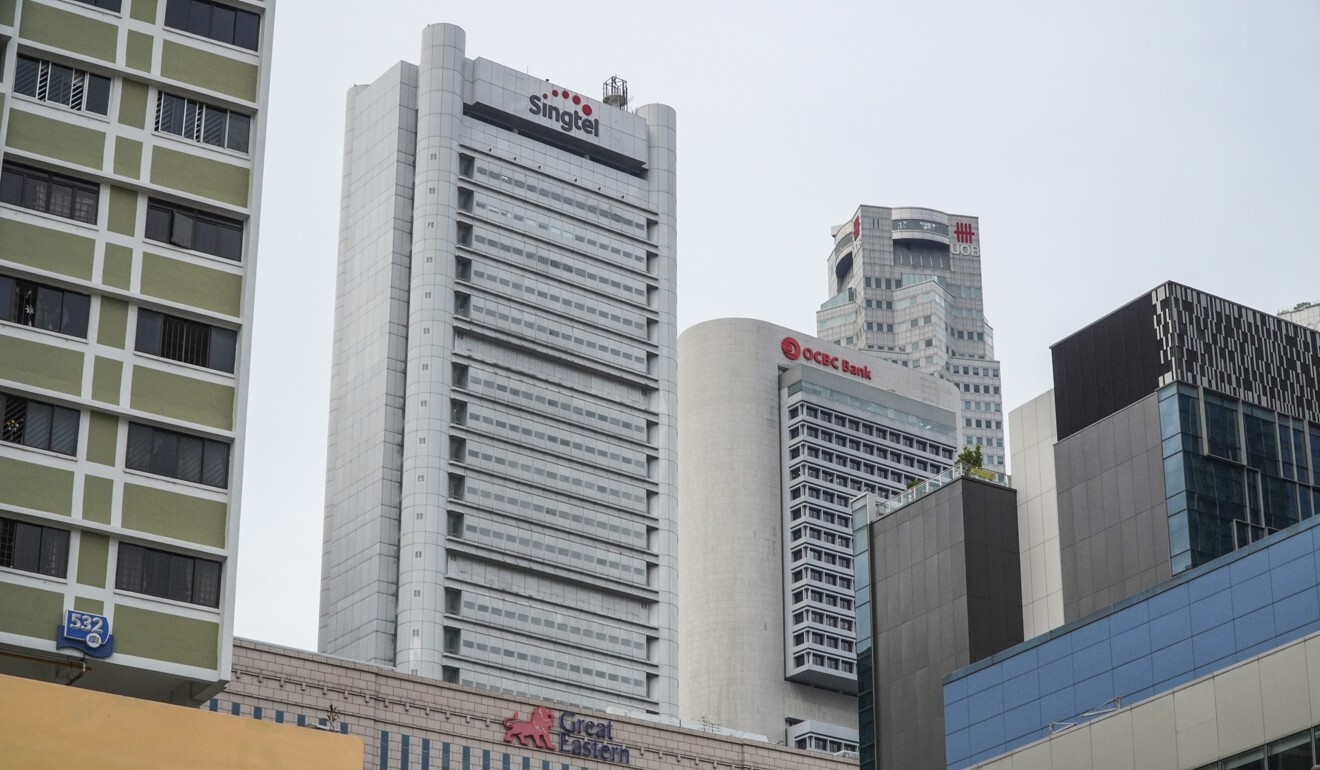
For instance, despite the downturn, Singapore telco Singtel expects to recruit over 300 fresh graduates for various permanent positions this year, according to Aileen Tan, the company’s Group Chief Human Resources Officer. Many of the new hires will be in new growth areas such as the Internet of Things, analytics and cloud.
The Singtel Comcentre building in Singapore. Photo: Roy Issa
Other companies that continue to hire include those in tech across the region, including e-commerce giant Shopee, food-delivery service Foodpanda and Amazon.
In Australia, Borland suggested helping young people to remain plugged into the labour market through government-funded paid internships, or even offering them loans to go for further studies and prevent a spell of unemployment.
For now, while some young jobseekers are taking a wait-and-see approach, the reality is hitting hard for others.
Final-year National University of Singapore student H.P. Tan had all but secured a job at a public relations firm last month, after three rounds of interviews.
The Faculty of Arts and Social Sciences undergraduate was rejected via an email from the agency, which said that they could no longer hire after Covid-19 started to drastically cut business.
“When I got that rejection, it was a turning point. I didn’t think I would be directly impacted,” said the 23-year-old.
“I also applied to a few other agencies but the response has been slow, so I am now freaking out at the possibility of not being able to find a job after graduation.”
SHANGHAI (Reuters) – China ordered on Saturday that anyone in Wuhan working in certain service-related jobs must take a coronavirus test if they want to leave the city.
The order comes after the central city, where the coronavirus emerged late last year, lifted a 70-day lockdown that all but ended the epidemic there.
People in Wuhan work in nursing, education, security and other sectors with high exposure to the public must take a nucleic acid test before leaving, the National Health Commission said in an order.
The government of Hubei province, of which Wuhan is capital, will pay for the tests, the commission said.
Since the city relaxed its lockdown restrictions people who arrived in there before Chinese New Year, when the virus was peaking in China, are allowed to go back to their homes.
People working in other sectors aiming to leave Wuhan are encouraged to take voluntary tests before going.
Within seven days of arrival at their destinations, people who can present test results showing they do not carry the virus, as well as a clean bill of health on a health app, can go back to work.
Everyone else will have to spend 14 days in quarantine before returning to work.
Authorities have worked with the China’s tech giants to devise a colour-based health code system, retrieved via mobile app, that uses geolocation data and self-reported information to indicate one’s health status.
Wuhan will speed up its efforts to investigate asymptomatic coronavirus cases and confirm the presence of antibodies in people, which might suggest immunity, the commission said.
Wuhan, which accounts for 60% of infections in China and 84% of the death toll as of Saturday, has been testing inhabitants aggressively throughout the virus’ breakout and many companies had already been asking workers from the city to undergo tests before resuming work.
Wuhan revised up its death toll from the coronavirus by 1,290 on Friday, taking the city’s toll to 3,869, because of incorrect reporting, delays and omissions, especially in the chaotic early stages of the outbreak, authorities said.
China national death toll is 4,632 from 82,719 cases.
GENEVA (Reuters) – World Health Organization officials on Wednesday denied that the body was “China-centric” and said that the acute phase of a pandemic was not the time to cut funding, after U.S. President Donald Trump said he may put contributions on hold.
The United States is the top donor to the Geneva-based body which Trump said had issued bad advice during the new coronavirus outbreak.
RELATED COVERAGE
WHO head dismisses suggestions he’s too close to China
U.S. contributions to WHO in 2019 exceeded $400 million, almost double the 2nd largest country donor, according to figures from the U.S. State Department. China contributed $44 million, it said.
“We are still in the acute phase of a pandemic so now is not the time to cut back on funding,” Dr Hans Kluge, WHO regional director for Europe, told a virtual briefing when asked about Trump’s remarks.
Trump told a news conference on Tuesday that the United States was “going to put a hold on money spent to the WHO,” however, he appeared to backtrack later when in response to questions he said: “We’re going to look at it.”
It was not immediately clear how Trump could “block” funding for the organization. Under U.S. law, Congress, not the president, decides how federal funds are spent.
Dr Bruce Aylward, senior advisor to the WHO Director-General, also defended the U.N. agency’s relationship with China, saying its work with Beijing authorities was important to understand the outbreak which began in Wuhan in December.
“It was absolutely critical in the early part of this outbreak to have full access to everything possible, to get on the ground and work with the Chinese to understand this,” he told reporters.
“This is what we did with every other hard-hit country like Spain and had nothing to do with China specifically.”
Aylward, who led a WHO expert mission to China in February, defended WHO recommendations to keep borders open, saying that China had worked “very hard” to identify and detect early cases and their contacts and ensure they did not travel.
“China worked very, hard very early on, once it understood what it was dealing with, to try and identify and detect all potential cases to make sure that they got tested to trace all the close contacts and make sure they were quarantined so they actually knew where the virus was, where the risk was,” he said.
“Then they made it very clear that these people would not and could not travel within the country, let alone internationally,” he added.
WHO Director-General Tedros Adhanom Ghebreyesus has been lavish in his praise of China from early in the outbreak, praising President Xi Jinping’s “rare leadership”.
David Heymann, a professor at the London School of Hygiene & Tropical Medicine who led WHO’s response to the 2003 SARS outbreak, said that any U.S. funding cut would be a huge blow.
“If the WHO loses its funding it cannot continue to do its work. It works on a shoe-string budget already,” Heymann said in London. “Of course it would be disastrous for the WHO to lose funding.”
NEW DELHI/MUMBAI (Reuters) – The Indian government ordered mobile carriers on Friday to immediately pay billions of dollars in dues after the Supreme Court threatened the companies and officials with contempt proceedings for failing to implement an earlier ruling.
The court, which had ordered companies including Vodafone Idea (VODA.NS) and Bharti Airtel (BRTI.NS) to pay 920 billion Indian rupees ($13 billion) in overdue levies and interest by Jan. 23, last month rejected petitions seeking a review of the order it issued back in October.
“This is pure contempt, 100% contempt,” Justice Arun Mishra told lawyers for the companies and the government on Friday.
Later in the day, the Department of Telecommunications called for “immediate payments” from the telcos. A second order instructed relevant offices to stay open on Saturday to “facilitate the Telecom Licensees to make payments or contact them with respect to any matter related to that.”
The companies had contested the government’s definition of revenues subject to tax and Vodafone Idea and Bharti Airtel both flagged risks to their ability to continue as ongoing concerns following the October order. They did not immediately respond to calls seeking comment on the new ruling.
The companies, along with Reliance Jio, which is backed by Asia’s richest man, Mukesh Ambani, control more than 90% of India’s mobile market.
Jio, a relatively new entrant which has disrupted the market with its cut-price offerings, has paid its dues.
Shares in Vodafone Idea, in which Britain’s Vodafone Group (VOD.L) owns a sizable stake, closed down 24.4% after the order. The company’s future is in doubt, with Vodafone Group having said it has no plans to commit any more equity into India.
Shares in Bharti Airtel rose 4.64%, as many investors expect it will be able to survive the payment, leaving it and Jio with a potential opportunity to win market share and enjoy an effective duopoly in the sector. In a letter to the government, Bharti Airtel said it would deposit 100 billion rupees by Thursday and pay the balance “well before” the next hearing on March 17.
Justice Mishra rebuked the government for having failed to implement the court order on collecting the dues. “A desk officer in the government stays a Supreme Court order … Is there any law left in the country?,” he said.
“We will draw up contempt against everyone,” he added, implying that both company and government officials could be fined or jailed if the dues are not paid by March 17.
Analysts said the court’s move could harm the government more broadly, as well as the companies.
“It can’t be in anybody’s interest if a company as high profile as Vodafone Idea shuts shop. Also, the government’s own dues from the sector are at risk,” said Mahesh Uppal, director at ComFirst, a telecom consultancy firm.
BANKS BURDENED
Indian banks are burdened with nearly $140 billion of bad loans and face another huge hit if Vodafone Idea is forced into bankruptcy.
Banks in India are owed roughly 300 billion rupees by Vodafone Idea, according to a Macquarie report from last year.
“Banks were yet to make additional provisioning for these loans as they were expecting some sort of a relief from the court,” said Siddharth Purohit, an analyst at SMC Institutional Equities.
Banks that have the highest exposure to Vodafone Idea include State Bank of India (SBI.NS), Punjab National Bank (PNBK.NS), Canara Bank (CNBK.NS) and Bank of India (BOI.NS), among others, the Macquarie report said.
Vodafone Idea, which owes the government about $4 billion in dues related to the ruling, has seen its shares slide more than 40% since the court ruling in October.
The broader Indian stock market also reversed early gains to trade lower after the ruling as investors worried about the fallout.
Still, some analysts remained hopeful the government could appeal to the court to review its decision.
“Let’s see how the government reacts and what they do. If the government appeals to the court they could still settle it out, and we may see some positives emerge for everyone,” said a senior industry analyst, who asked not to be named.
Families appeal to city authorities and toy company for help to recover fees already paid for classes
Four outlets shut their doors in aftermath of contract dispute
Families in Shanghai are appealing to authorities for help to recover money paid for lessons at closed Lego Education Learning Centres. Photo: Weibo
Hundreds of Shanghai parents are appealing to Danish toy company Lego for help after four of its authorised learning centres suddenly closed their doors, leaving families tens of thousands of yuan out of pocket.
Shanghai Jixiao Information Science and Technology, which ran three Lego Education Learning Centres in the city, said in an online statement on Monday that it was left with no choice but to close the centres after Lego Education in China ended its agreement with its Chinese partner, Beijing-based Semia.
The closure of the centres – the Ruihong, Jinqiao and Haiwaitan branches – came just weeks after the Lego centre in Nanxiang shut down.
Semia was authorised by Lego Education to operate learning branches across mainland China and authorisation third parties to do as well, according to Shanghai-based Jfdaily.com.
Rachel Wang, a mother of a six-year-old boy, said that in various online forums about 650 families had reported losing a combined 5.2 million yuan (US$742,000) in prepaid classes at the three stores. Another 130 families whose children were enrolled at the Nanxiang store were seeking 900,000 yuan in refunds, she said.
Wang said the parents had appealed to the Shanghai municipal government to pressure Lego to look at the case.
“We are planning to sue the learning centre, and in the meantime we hope Lego Group can pay attention to this case and help us. Many of the parents chose these centres as we saw on Lego’s website they were listed as among the company’s authorised stores,” she said.
“We are angry and very disappointed with Lego.
“It made a lot of money in China because we trusted it.”
Lego and Tencent will develop games and videos for kids in China
20 Sep 2019
Tao Lina said everything appeared fine when he took his five-year-old daughter to the Haiwaitan centre on Sunday.
“But the next day, we were told that the store had closed. I was so surprised,” Tao said.
“We had never heard of Semia and we were not aware of its existence. We all thought that the learning centres was franchised directly by Lego.”
He said he had paid for 144 classes at the centre and his daughter had attended about 60 of them, each costing 160 yuan. Tao said he hoped his daughter could continue attending the classes – which use Lego products to teach children about subjects such as robotics – but had not been able to contact the centre’s managers.
Shanghai Jixiao said the termination of the Semia-Lego Education agreement had scared off parents, cutting cash flow and forcing it to close the centres.
In its online statement, the company said its troubles started in September, when it received a lawyer’s letter from both Semia and Lego Education.
“It required us to promise not to use the [Lego Education] logo after December 31, 2019 and to stop teaching Lego courses after August of next year,” Shanghai Jixiao said.
On October 11, Lego Education said on WeChat that it had terminated its cooperation with Semia. Most of the 137 Lego learning centres in China would be allowed to use the Lego brand until December 31 and continue teaching Lego courses until July 31 next year.
But after the announcement, many parents sought refunds, causing a cash-flow crisis for the Shanghai company.
Shanghai Jixiao also said that the lawyer’s letter sent in September required all learning centres to sign an agreement absolving Semia of all responsibility.
If it signed the agreement, it would have three months to change the brand and products, which Shanghai Jixiao said was impossible. If it did not sign it, it would have to stop using the Lego brand at once.
Shutting the centres down was the only option after their various efforts, including joint appeals with other mainland learning stores to Lego, visiting Lego headquarters in Denmark and calling Lego’s executives, were unsuccessful, the Shanghai company said.
Chinese teens put to the information age test in global Pisa education study
5 Dec 2019
It offered two mobile phone numbers for parents to contact them but the phones were powered off on Wednesday and Thursday.
Lego did not respond to a request for comment from the South China Morning Post.
But on Wednesday, Lego said it ended the contract with Semia to improve the company’s learning centres, adding that it had no business relations with the closed stores, Thepaper.cn reported.
A manager at Semia’s franchising department identified only as Wei was quoted by Jfdaily.com as saying that the authorisation contract for the three stores owned by Shanghai Jixiao actually ended between October 2018 and February this year.
“They were waiting for us to renew the authorisation contract with Lego, but we failed to reach an agreement with Lego. So these learning centres lost their authorisation,” she was quoted as saying.
Wei said all the authorised stores operated independently.
“Legally speaking, their problems should be solved by themselves,” she said, adding that she could not contact Shanghai Jixiao’s owner either.
There are 19 Lego Education branches across Shanghai, according to Lego Education’s WeChat account.
Market regulation authorities in Pudong and Huangpu districts had started to look at the case, Jfdaily.com reported.
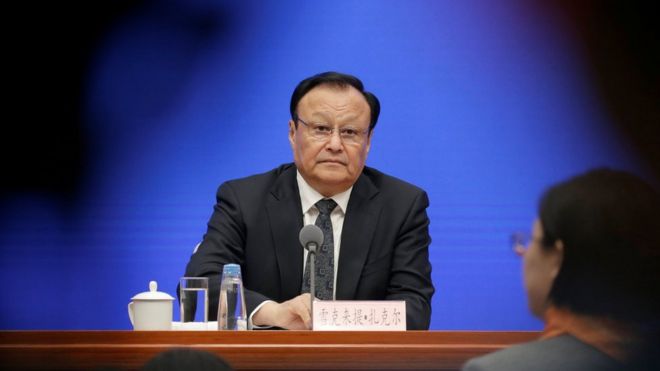
Mr Zakir told reporters in the Chinese capital on Monday that everyone in the centres had completed their courses and – with the “help of the government”- had “realised stable employment [and] improved their quality of life”.
He said that, in future, training would be based on “independent will” and people would have “the freedom to come and go”.
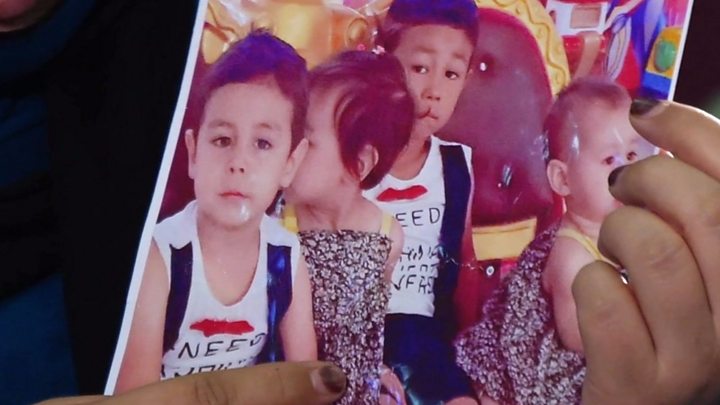
Media caption The BBC’s John Sudworth meets Uighur parents in Turkey who say their children are missing in China
BBC China correspondent John Sudworth points out it is not possible to verify the claims, as access for journalists is tightly controlled and it’s impossible to contact local residents without placing them at risk of detention.
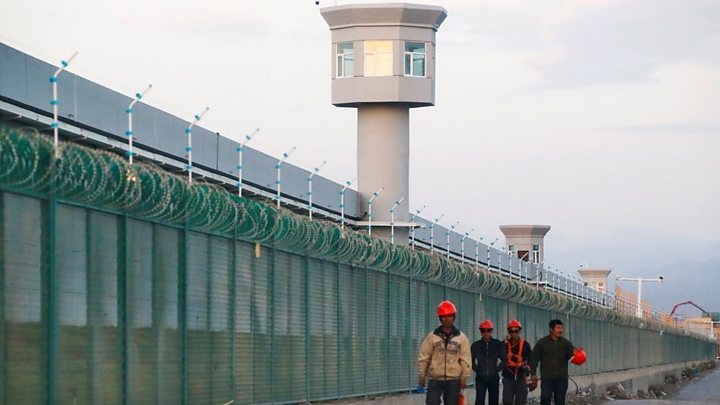
In recent months, independent reports have suggested that some camp inmates are being released, only to face house arrest, other restrictions on their movement or forced labour in factories.
What could be behind the move?
Pressure has been increasing on Beijing in recent months.
A number of high-profile media reports based on leaks to the New York Times and the International Consortium of Investigative Journalists (ICIJ) have shone a spotlight on what is happening at the network of centres, which are believed to hold more than a million people, mainly Uighur Muslims and other minorities.
The bill still needs approval from the Senate and from President Donald Trump.
However, Mr Zakir used the press conference to dismiss the numbers detained as “pure fabrication”, reiterating Beijing’s argument that the centres were needed to combat violent religious extremism.
Media caption“An electric baton to the back of the head” – a former inmate described conditions at a secret camp to the BBC
“When the lives of people of all ethnic groups in Xinjiang were seriously threatened by terrorism, the US turned a deaf ear,” Mr Zakir said at a press briefing.
“Now that Xinjiang society is steadily developing and people of all ethnicities are living and working in peace, the US feels uneasy, and attacks and smears Xinjiang.”
What’s going on in Xinjiang?
Reports of widespread detentions first began to emerge in 2018, when a UN human rights committee was told there were credible allegations that China had “turned the Uighur autonomous region into something that resembles a massive internment camp”.
Rights groups also say there’s growing evidence of oppressive surveillance against people living in the region.
The Chinese authorities said the “vocational training centres” were being used to combat violent religious extremism. However, evidence showed many people were being detained for simply expressing their faith, by praying or wearing a veil, or for having overseas connections to places like Turkey.
Records seen by the BBC show China has deliberately been separating Muslim children from their families.
This is an attempt to “raise a new generation cut off from original roots, religious beliefs and their own language”, Dr Adrian Zenz, a German researcher, told BBC News earlier this year.
“I believe the evidence points to what we must call cultural genocide.”
China’s ambassador to the UK said the allegations were “lies”.
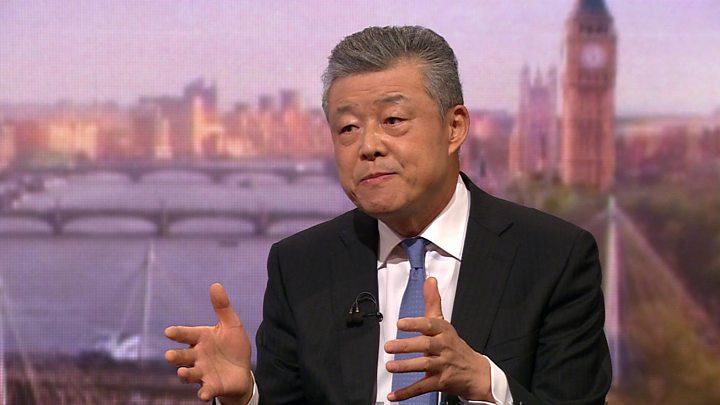
Media caption Chinese Ambassador Liu Xiaoming dismisses evidence of a separation campaign in Xinjiang
NEW DELHI/MUMBAI (Reuters) – India’s ruling Bharatiya Janata Party (BJP) is set to sweep two state polls next week, the first since Prime Minister Narendra Modi’s landslide win in a parliamentary election in May, a leading pollster said.
The BJP is set to comfortably win elections in the western state of Maharashtra and the northern state of Haryana, leaving the main opposition Congress party trailing, according to a survey by polling agency CVoter released on Friday.
CVoter estimates that a BJP-led alliance in Maharashtra will pick up 194 of the 288 seats on offer. In Haryana, the party is predicted to win 83 of the state’s 90 seats, leaving just three for Congress.
Voting in the elections will be held on Monday with the results expected to be announced on Thursday.
Several Congress party officials conceded they had all but given up hope of posing a serious challenge to Modi and the BJP.
In particular, the resignation of Congress chief Rahul Gandhi in July, after weeks of drama following the loss to the BJP in the general election, has sown internal confusion, triggering infighting and exits, two party officials in New Delhi said.
“It’s going to be a rout, and it will deflate morale even further,” one of the officials said, referring to the state elections. “It’s like a slow-moving disaster.”
They requested anonymity because they are not authorised to speak to the media.
Pranav Jha, the secretary in charge of Congress’s communication department, said the party was undergoing a period of “cleansing and churning” and remained committed to taking on the BJP.
“The people of India…can see through the diversionary drama of the ruling party, and realise that jobs, economy and issues of farmers can only be put on track by the Congress party,” Jha told Reuters.
Modi, analysts say, has moved decisively, including withdrawing special rights for Muslim-majority Jammu and Kashmir state, and consolidating the BJP’s hold over India’s Hindu-majority electorate.
INFIGHTING, INDIFFERENCE
In Maharashtra, one of India’s most industrialised states which includes Mumbai, two Congress officials said the top leadership’s relative indifference and infighting had hurt their already weak campaign.
Congress’s state wing had asked for Gandhi, his mother and current party chief Sonia Gandhi, and his charismatic sister Priyanka Gandhi Vadra to join the campaign, one of the two officials said.
But only Rahul Gandhi came and spoke at a handful of rallies.
“Senior leaders from BJP have covered every district. They have been visiting Maharashtra for the last two months to build momentum,” said one Congress official, who is contesting the upcoming poll.
“There wasn’t any concrete effort from Congress leaders in New Delhi to give energy to our cadre,” he said.
The list of recent resignations from the party include Ashok Tanwar, Congress’s former chief in Haryana who quit earlier this month and is now campaigning against his old party.
“The state of affairs in the Congress party is so dire that the decision makers can’t win an election themselves, while the soldiers on ground who stay in touch with the masses are neglected,” Tanwar wrote in his resignation letter.
The situation has even riled Congress allies. Two leaders from the Nationalist Congress Party, which is in alliance with the Congress in Maharashtra, said their partner was slack.
“It looks like Congress is not very serious about the state elections,” one of the leaders said. “Congress is not in the picture. Congress leaders are not attacking the ruling party the way we expected.”
In New Delhi, Congress officials said there was a sense of inertia at the party headquarters, without any understanding of who will become president after Sonia Gandhi, who is only holding charge temporarily.
“Without a clear leadership, nothing is going to change,” one of the officials said, “If it continues like this, the party will fade away.”
SHANGHAI, Aug. 11 (Xinhua) — Over 15 of Shanghai’s popular destinations, including the Shanghai Wildlife Park, Shanghai Center and the Shanghai Museum reopened Sunday after typhoon Lekima left the city.
The sky cleared up in the business hub on Sunday as Lekima headed north through Jiangsu and Shandong provinces.
Typhoon Lekima, the ninth typhoon of the year, made landfall in the city of Wenling, the coastal areas of eastern Zhejiang Province, at 1:45 a.m. Saturday morning, according to the National Meteorological Center.
Anticipating typhoon damage, Shanghai closed many of its popular tourist sites including parks and museums for safety reasons starting from Aug. 9. A total of 92 scenic sites, parks and resorts as well as museums were closed on Saturday.
On Sunday, 70 tourist sites remained closed for safety checks and are scheduled to reopen on Monday or Tuesday, said the municipal’s cultural and tourism bureau.
NEW DELHI/MUMBAI (Reuters) – India’s opposition Congress party selected past president Sonia Gandhi as its interim leader on Saturday, while it searches for a successor to her son Rahul Gandhi, who quit following a crushing election defeat by Prime Minister Narendra Modi.
The Congress Working Committee (CWC) unanimously decided to appoint Sonia Gandhi as “interim president pending the election of a regular president,” the party said in a statement late on Saturday night.
The committee wanted Rahul Gandhi to continue as its president but after he refused, they asked his mother to take over the reins instead, and she accepted, the statement said.
Sonia Gandhi is one of the most influential leaders of the Congress party and is credited with having brought the party back from the brink in 2004 with a surprise victory over the incumbent central government.
The widow of assassinated former Prime Minister Rajiv Gandhi, she was also the party’s longest serving president with 19 years at the helm, from 1998 to 2017, before handing over the baton to her son.
Congress, founded in 1885, is India’s oldest political party and dominated the country for decades after independence, led by generations of the Nehru-Gandhi family. The family produced three prime ministers: Jawaharlal Nehru, India’s first and longest-serving leader, his daughter Indira Gandhi and her son Rajiv.
However, Italian-born Sonia Gandhi faces a tall order to pull the party out of its worst crisis in decades and at the same time choose a worthy and dependable successor.
Party leaders and foot soldiers alike have been defecting to the ruling BJP. Remaining members have been dismayed at the party’s leadership vacuum following Modi’s re-election with a majority that surpassed his victory in 2014, and are questioning the party’s survival.
Rahul Gandhi, 49, announced his decision to quit as Congress leader in May, but the party leadership refused to accept it. They pressed him to reconsider, saying the party needed a unifying figure from the family to avoid splintering.
The party thanked Rahul Gandhi for his “exceptional leadership” during the state and general elections.
Last month in the southern state of Karnataka the defection of more than a dozen legislators from the ruling Congress-led coalition paved the way for Modi’s BJP to form a government.
Congress also appeared split in its response to Delhi’s decision to strip the state of Jammu and Kashmir of special constitutional status on Monday after putting the region on lockdown.
Some Congress members, including senior leader Jyotiraditya Scindia came out in support of the decision, and local media reported many in the party were supporting him.
Rahul Gandhi told reporters on Saturday night in New Delhi that considering there were reports of violence in Jammu and Kashmir, the government should provide transparent information about the actual situation on the ground.
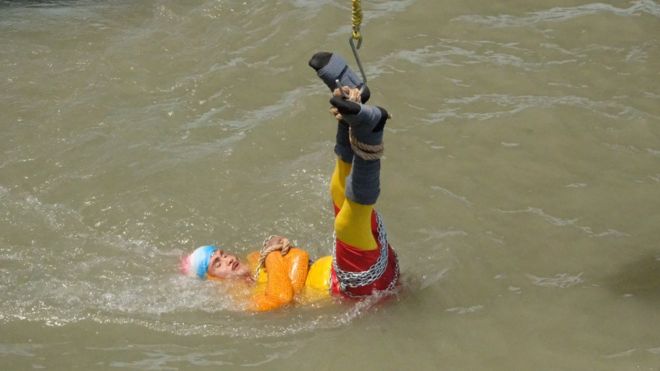
Image copyright EI SAMAYImage caption Chanchal Lahiri went by the stage name Mandrake
An Indian magician, who attempted to recreate Harry Houdini’s famed trick by jumping shackled into a river, is feared dead.
Chanchal Lahiri was meant to escape and swim to safety but did not emerge from the Hooghly river in West Bengal state.
Spectators who had gathered to watch him take the plunge on Sunday informed the police, who say they are searching for him.
Mr Lahiri, also known as Mandrake, was lowered into the river from a boat.
He was shackled with six locks and a chain as spectators on two boats watched him. Several people had also gathered by the shore and some stood on the landmark Howrah Bridge in Kolkata (formerly Calcutta).
Police and a team of divers canvassed the area but as of Sunday evening local time, they had been unable to find the magician. One officer told the Hindustan Times newspaper that Mr Lahiri could not be declared dead until the body was found.
Jayant Shaw, a photographer with a local newspaper, witnessed Mr Lahiri attempting the trick. He told the BBC that he spoke to him before the magician started his act.
“I asked him why he risked his life for magic,” Mr Shaw said. “He [Mr Lahiri] smiled and said, ‘If I do it right, it’s magic. If I make a mistake, it becomes tragic.'”
The magician told him that he wanted to do this trick in order “to revive interest in magic”.
This is not the first time that Mr Lahiri had attempted a risky underwater trick.
He was lowered into the same river inside a glass box more than 20 years ago but had managed to escape to safety.
Mr Shaw had also witnessed Mr Lahiri’s previous underwater trick.
“I never thought he would not come out of the water this time,” he said.












 CHINDIA ALERT: You'll be living in their world, very soon