Archive for ‘BBC’

02/03/2020

Coronavirus: South Korea church leader apologises for virus spread

Leader of the Shincheonji Church of Jesus holds press conference in South KoreaImage copyright EPA
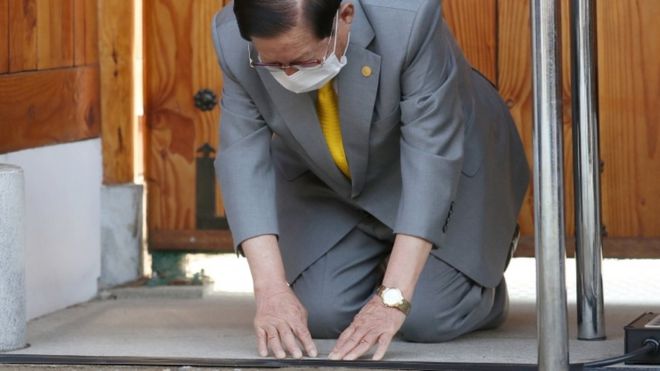
Image caption Lee Man-hee is the founder of the Shincheonji Church

The head of the religious sect that has been at the centre of the coronavirus outbreak in South Korea has apologised to the nation for the disease’s spread.

Lee Man-hee, the leader of the Shincheonji Church of Jesus, got on his knees and bowed at a news conference.

About 60% of the country’s more than 4,000 confirmed cases are sect members.

On Monday, South Korea – the biggest hotspot outside China – reported 476 new cases, bringing the total number to 4,212. It has recorded 26 deaths.

Prosecutors have been asked to investigate Mr Lee on possible charges of gross negligence.

“Although it was not intentional, many people have been infected,” said the 88-year-old leader. “We put our utmost efforts, but were unable to prevent it all.”
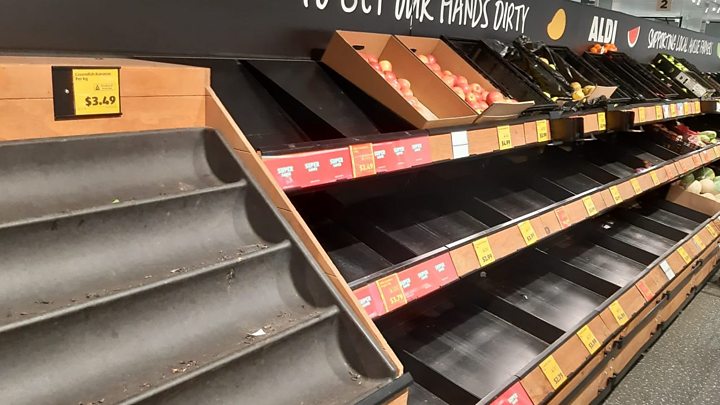
Media caption Empty shelves as coronavirus ‘panic-buying’ hits Australia

Of the confirmed cases, 3,081 are from the southern city of Daegu and 73% of these cases have been linked to the Shincheonji Church near there.

In the capital Seoul, the mayor urged the city’s 10 million residents to work from home and to avoid crowded places.

Why is the Shincheonji Church of Jesus in the spotlight?

Members of the fringe Christian group are believed to have infected one another and then travelled around the country, apparently undetected.

The group has been accused of keeping its members’ names secret, making it harder to track the outbreak.

But church spokesman Kim Shin-chang told the BBC they had provided a list of members, students, and buildings to authorities.

“We were worried about releasing this information because of the safety of our members,” Mr Kim said.
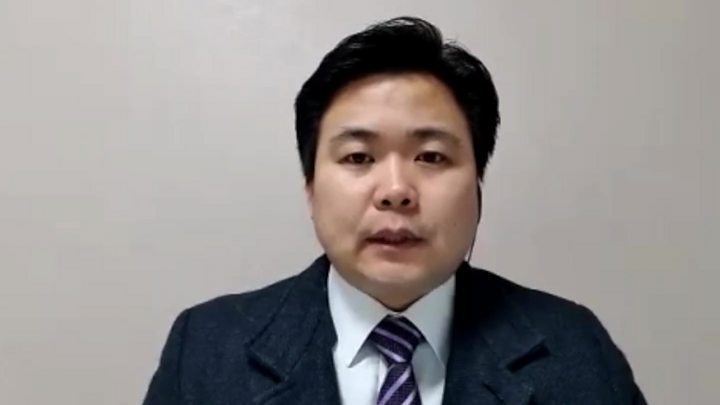
Media caption ‘We’re often persecuted’: Spokesman for virus-hit S Korean church defends secrecy

Mr Lee claims he is the second coming of Jesus Christ and identifies as “the promised pastor” mentioned in the Bible who will take 144,000 people to heaven with him.

The Shincheonji Church is labelled as a cult within South Korea and also in the Christian community, which results in the group often being discriminated against, persecuted or criticised, Mr Kim told the BBC.

What’s the global situation?

The number of people killed worldwide by the coronavirus has exceeded 3,000, as China reported 42 more deaths. More than 90% of the total deaths are in Hubei, the Chinese province where the virus emerged late last year.

But there have also been deaths in 10 other countries, including more than 50 in Iran and more than 30 in Italy.

Worldwide, there have been almost 90,000 confirmed cases, with the numbers outside China now growing faster than inside China.

In other developments:

  • In the UK, where there are 36 confirmed cases, Prime Minister Boris Johnson has called a meeting of the emergency Cobra committee on Monday
  • Indonesia – one of the world’s most populous countries – has announced its first confirmed cases of coronavirus, a 64-year-old woman and her 31-year-old daughter, currently being treated at a Jakarta hospital
  • Iceland and Andorra also reported their first confirmed cases on Monday
  • Share prices in Asia and in Europe rose after central banks pledged to intervene to help protect markets from the impact of the coronavirus. Concerns about the outbreak last week wiped more than $5tn (£3.9tn) from global stocks
  • US sportswear giant Nike has closed its European headquarters in Hilversum city in the Netherlands after an employee tested positive for the virus

In the European hotspot of Italy, the number of infections doubled in 48 hours, the head of the country’s civil protection body said on Sunday.

There have been at least 34 deaths and 1,694 confirmed cases. Amazon said two of its employees in Italy have the virus and are under quarantine.

Countries including Qatar, Ecuador, Luxembourg and Ireland all confirmed their first cases over the weekend. On Monday, Ecuador reported five new cases of the disease, bringing the total number of infected patients in the country to six.

The US state of New York has also confirmed its first case. The patient is a woman in her 30s who contracted the virus during a recent trip to Iran. Two people have died in the US, both in the state of Washington.

Presentational grey line

What do I need to know about the coronavirus?

Presentational grey line

What’s the situation in China?

China on Monday reported 42 more deaths, all in Hubei. There were also 202 confirmed new cases – only six of which were outside Hubei.

A total of 2,912 people have died inside China, with more than 80,000 confirmed cases of the virus.

A spokesman from China’s National Health Commission said the next stop would be to “focus on the risks brought by the resumption of work”.

China’s economy has taken a hit – with factory activity falling at a record rate.

On Monday, a man was sentenced to death by a Chinese court for fatally stabbing two officials at a virus checkpoint, news agency AFP reported.

Ma Jianguo, 23, refused to co-operate with officials – though it is not clear what he was told to do – and stabbed two checkpoint officials.
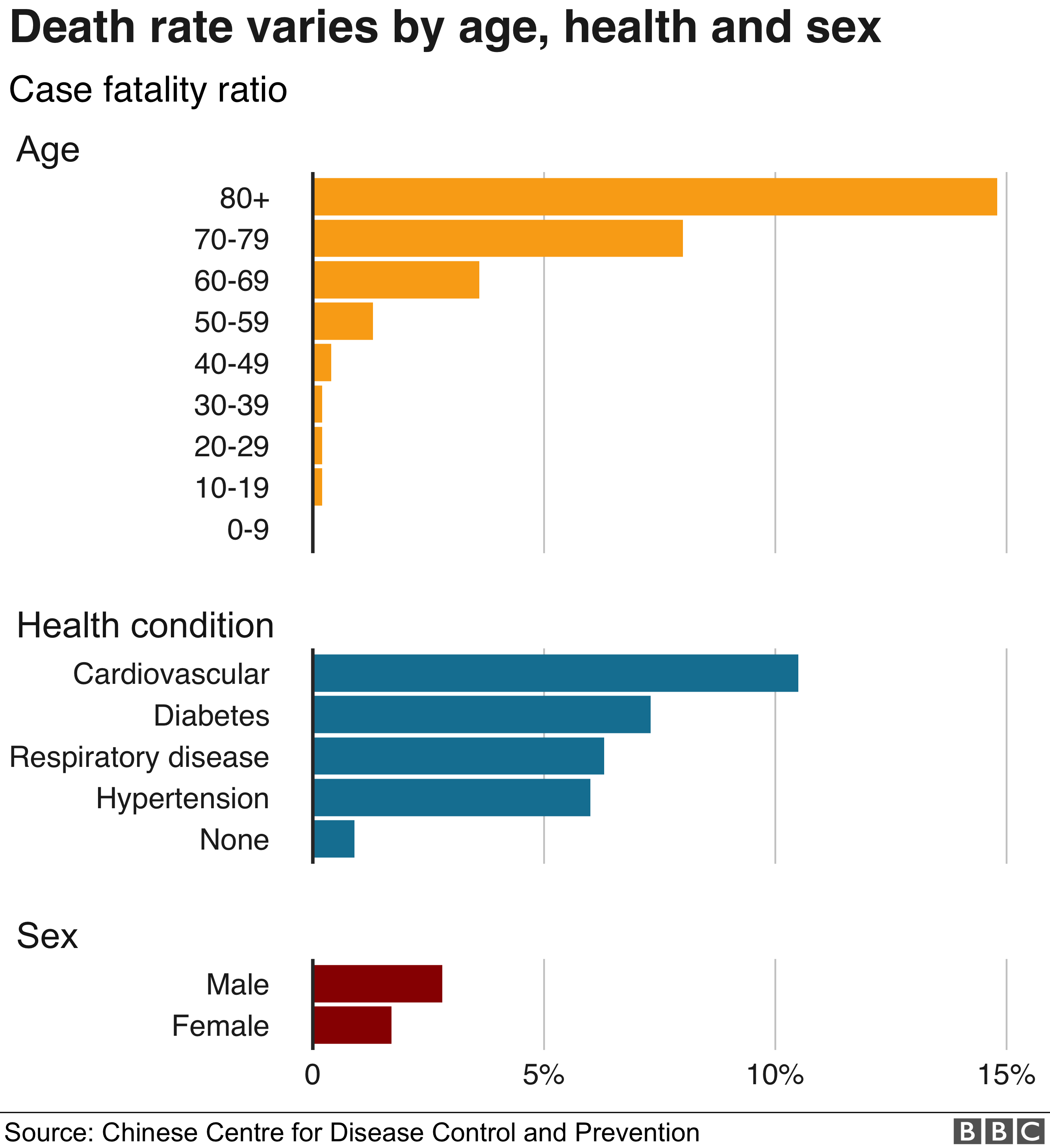

Death rates for different groupsPresentational white spaceWhat has the WHO said?

On Sunday, the World Health Organization (WHO) said the virus appears to particularly affect those over 60, and people already ill.

It urged countries to stock up on ventilators, saying “oxygen therapy is a major treatment intervention for patients with severe Covid-19”.

In the first large analysis of more than 44,000 cases from China, the death rate was 10 times higher in the very elderly compared to the middle-aged.

But most patients have only mild symptoms and the death rate appears to be between 2% and 5%, the WHO said.

By comparison, the seasonal flu has an average mortality rate of about 0.1%, but is highly infectious – with up to 400,000 people dying from it each year.

Other strains of coronavirus, such as Severe Acute Respiratory Syndrome (Sars) and Middle East Respiratory Syndrome (Mers), have much higher death rates than Covid-19.

Source: The BBC
21/02/2020

Coronavirus: South Korea ’emergency’ measures as infections increase

South Korea has stepped up measures to contain the spread of the deadly new coronavirus, as confirmed infections increased sharply for a second day.

PM Chung Sye-kyun said it was now an emergency as 100 new cases and the country’s second death were confirmed.

The southern cities of Daegu and Cheongdo have been declared “special care zones”. The streets of Daegu are now largely abandoned.

All military bases are in lockdown after three soldiers tested positive.

About 9,000 members of a religious group were told to self quarantine, after the sect was identified as a coronavirus hotbed.

The authorities suspect the current outbreak in South Korea originated in Cheongdo, pointing out that a large number of sect followers attended a funeral of the founder’s brother from 31 January to 2 February.

On Friday, a second person who contracted the coronavirus died.

The victim was a woman in her 50s. She died in the south-western city of Busan after being transferred there from a hospital in a nearby country, according to Yonhap news agency.

Reports say she had earlier been a patient at the same mental hospital in Cheongdo as the country’s first victim – an elderly man. Another 15 patients there have also tested positive.

On Thursday, 53 new cases were reported. South Korea now has a total of 204 cases making it the largest cluster outside mainland China and the cruise ship docked off Japan.

The new virus, which originated last year in Hubei province in China, causes a respiratory disease called Covid-19.

What measures are being taken?

From the 100 new cases reported on Friday, 86 were in Daegu, a city 300km (186 miles) south-east of the capital Seoul, and nearly all of those were from a cluster involving the religious sect.

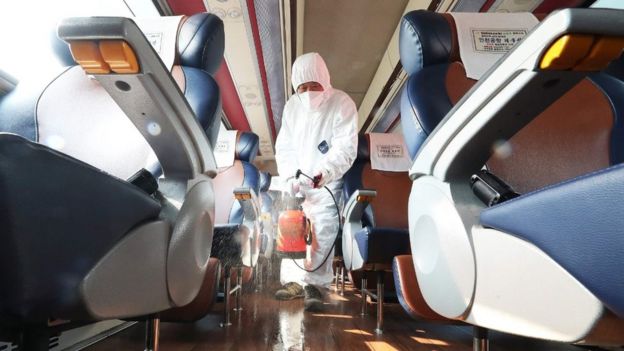
Worker disinfecting a trainImage copyright AFP
Image caption South Korea is trying hard to stop the local spread of the new coronavirus

Reacting to the quickly deteriorating situation, the government promised swift measures to prevent further spread of the virus.

“It is urgent to find people who have contacted infected people and cure patients,” PM Chung said, according to Yonhap.

He said the government was readying resources like sickbeds, medical equipment and health workers and warned the virus was now spreading locally.

“The government has so far focused on curbing infections coming from outside the country. From now on, the government will further prioritise preventing the virus from spreading locally.”

line

Health Minister Park Neung-hoo said authorities would allow hospitals to isolate respiratory patients from others in an effort to prevent any spread within medical institutions.

He also said that all pneumonia patients in Daegu hospitals would be checked for the virus.

What happened in Daegu?

The city’s biggest cluster appears to be at a branch of a religious sect which calls itself the Shincheonji Church of Jesus, Temple of the Tabernacle of the Testimony.

South Korean health officials believe these infections are linked to a 61-year-old woman who tested positive for the virus earlier this week.

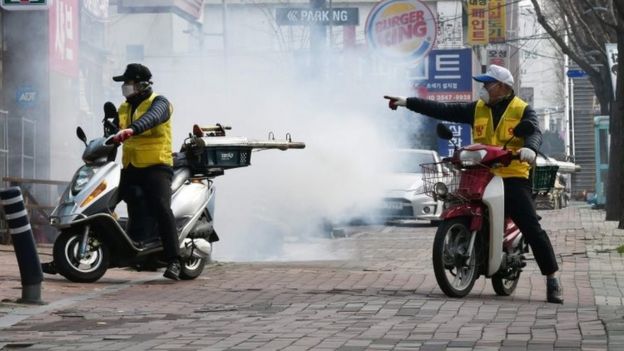
Workers on scooters disinfect the streets of Daegu, South Korea. Photo: 21 February 2020Image copyright AFP/GETTY IMAGES
Image caption Workers have been disinfecting the streets of Daegu, South Korea’s fourth-largest city

The Shincheonji, which has been accused of being a cult, said it had now shut down its Daegu branch and that services in other regions would be held online or individually at home.

As of Friday, more than 400 members of the church were showing symptoms of the disease, though tests were still ongoing, the city mayor said.

Can we answer your question on the coronavirus?

Here’s what others have been asking

Once you’ve had coronavirus, will you be immune?
Could the coronavirus become a pandemic?
Is the coronavirus worse than flu or Sars?

Daegu is the country’s fourth-largest city, with a population of 2.5 million people.

Residents are now being asked to remain at home after authorities described the church cluster as “super-spreading event”.

Presentational grey line

Hand sanitizers and warning signs

By Hyung Eun Kim, BBC Korean Service, Seoul

Many people in South Korea are wearing masks on a daily basis.

Hand sanitizers have been placed at public transport stops and building entrances.

Warning government signs are everywhere. They say: “Three ways to prevent further infection: wear a mask at all times; wash your hands properly with soap for more than 30 seconds; and cover yourself when coughing.”

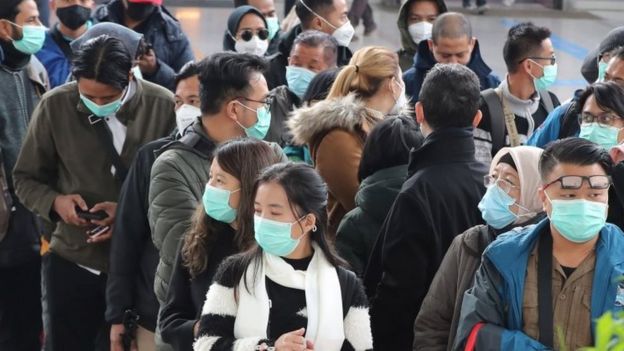
People wear masks in Seoul, South Korea. Photo: 21 February 2020Image copyright EPA
Image caption New norm: Mask-wearing crowd in Seoul

Koreans have also developed several apps and websites that tell you how much risk you face where you are. They show where the infected people are within a 10km radius.

“I can’t miss work, what I can do is minimise contact with others and stay at home during the weekend,” Seung-hye Lim, a Seoul resident, told the BBC.

“I do wonder if we reacted too laxly initially or if it really is because of the specific service practices of the Shincheonji sect.”

So-young Sung, a mother of two in Seoul, told the BBC: “It feels like my daily life is collapsing.”

She said she was struggling to find pharmacies that had masks.

She added that checking coronavirus-related alarms from her children’s schools and kindergartens was now a daily routine for her.

Presentational grey line

What about China and elsewhere?

The latest figures from China put the death toll from the disease at 2,236 people and total infections at more than 75,000.

The virus has now hit the country’s prison system, with more than 500 inmates confirmed infected.

Senior officials have already been sacked for mishandling management of the outbreak.

The virus has also spread around the globe with more than 1,000 cases and several deaths in the rest of Asia, in Europe, the Middle East, the US and Africa.

On Friday, Iran confirmed 13 new cases, saying that two of those infected had died.

Health ministry official Minou Mohrez was quoted by the state-run Iran news agency as saying the coronavirus has spread to several cities, including the capital Tehran.

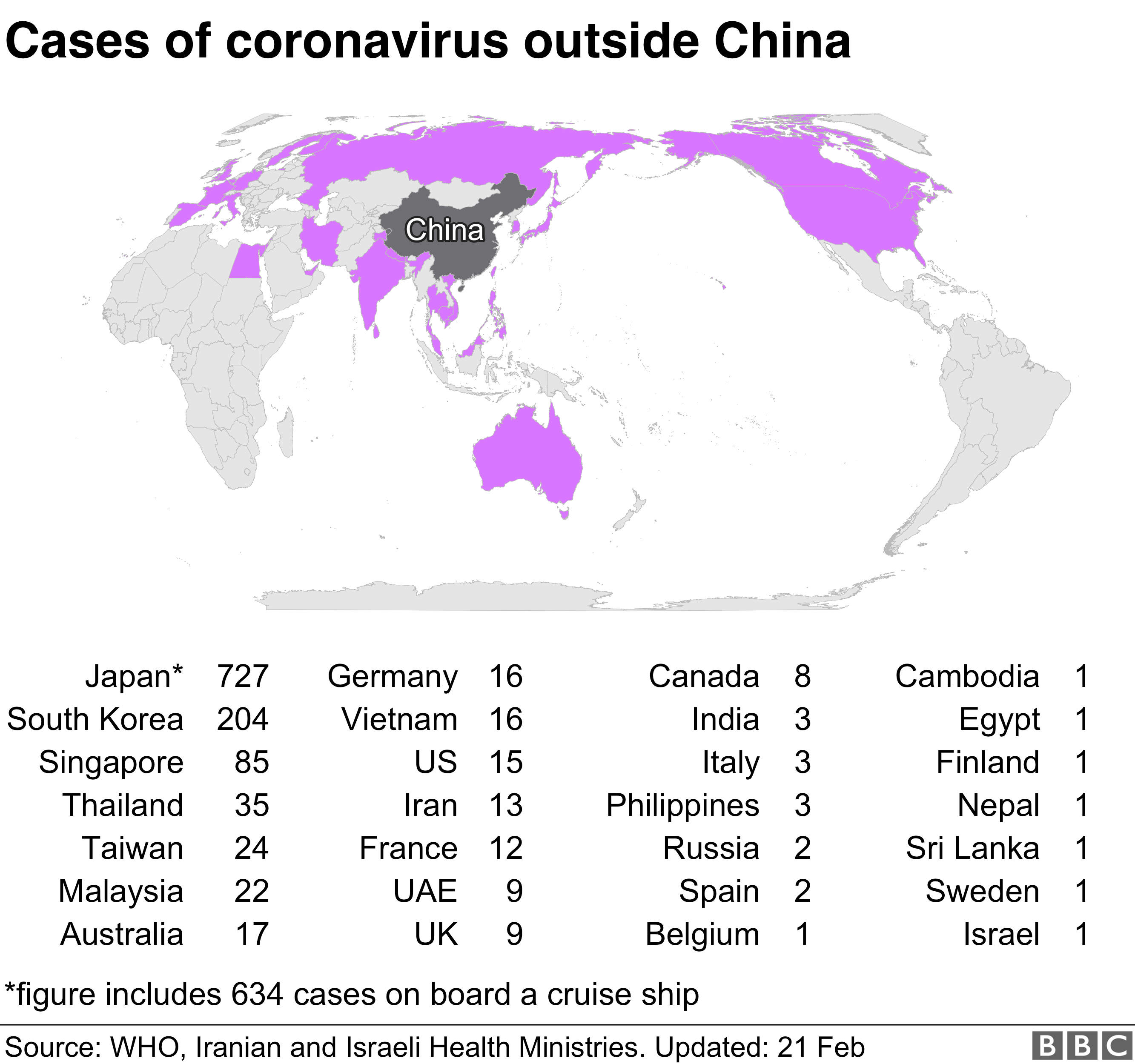
Cases of coronavirus outside China

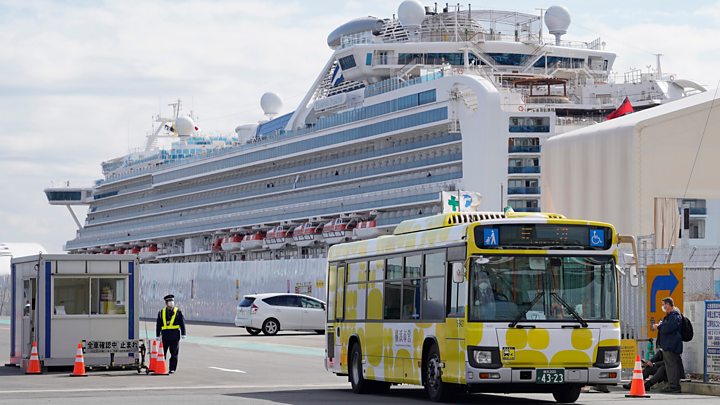
South Korea is now the worst affected country after mainland China and the more than 600 infections on a cruise ship docked in Japan.

Media caption Coronavirus: Quarantined passengers released from Japan ship

Passengers of the Diamond Princess who have tested negative continue to disembark the ship in Yokohama after more than 14 days quarantined on board.

More than 150 Australian passengers have been evacuated from the ship and have already arrived in Darwin, where they will begin two more weeks of quarantine.

Australian officials said on Friday that six people had reported feeling unwell on arrival in Darwin and were immediately tested.

Two of those people tested positive despite having received negative tests before leaving Japan.

The first batch of people from Hong Kong have also flown back to the city, where they will similarly be quarantined.

Source: The BBC
17/02/2020

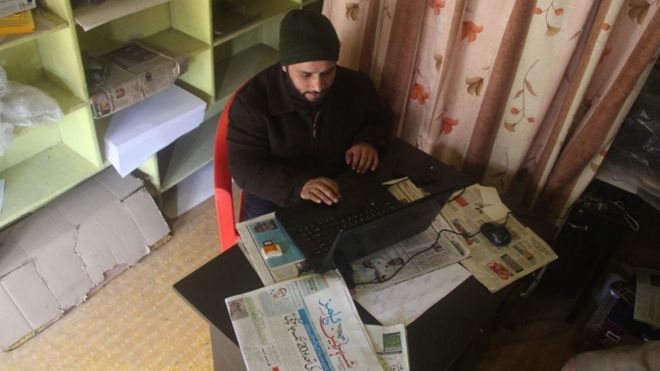
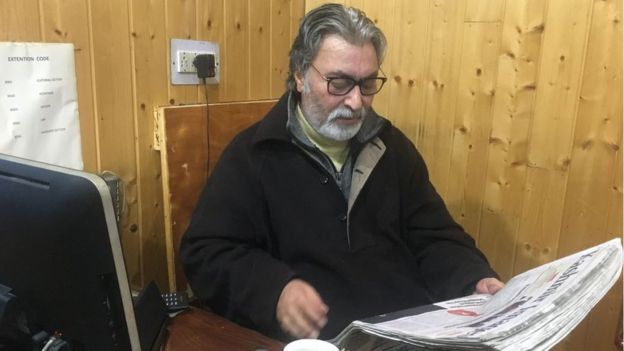
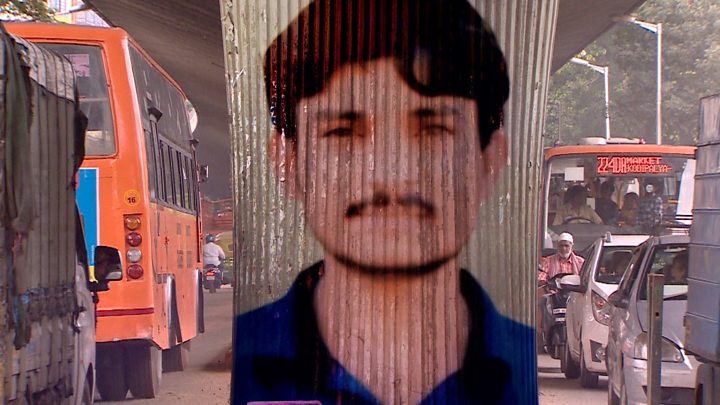
The Kashmir journalist forced into manual labour

Muneeb Ul IslamImage copyright MUKHTAR ZAHOOR
Image caption Muneeb Ul Islam can no longer afford to work as a journalist in Kashmir

Journalists in Indian-administered Kashmir are struggling to make ends meet amid a months-long communications blockade that has only partially been lifted. The BBC’s Priyanka Dubey visited the region to find out more.

Muneeb Ul Islam, 29, had worked as a photo-journalist in Kashmir for five years, his pictures appearing in several publications in India and abroad.

But the young photographer’s dream job vanished almost overnight in August last year, when India’s federal government suspended landline, mobile and internet services in Kashmir.

The government’s move came a day before its announcement that it was revoking the region’s special status – a constitutionally-guaranteed provision, which gave Kashmir partial autonomy in matters related to property ownership, permanent residency and fundamental rights.

The controversial decision catapulted the Muslim-majority valley into global news – but local journalists like Mr Islam had no way to report on what was going on. And worse, they had to find other things to do because journalism could no longer pay the bills.

By January, the region had not had access to the internet for more than 150 days, India’s longest such shutdown.

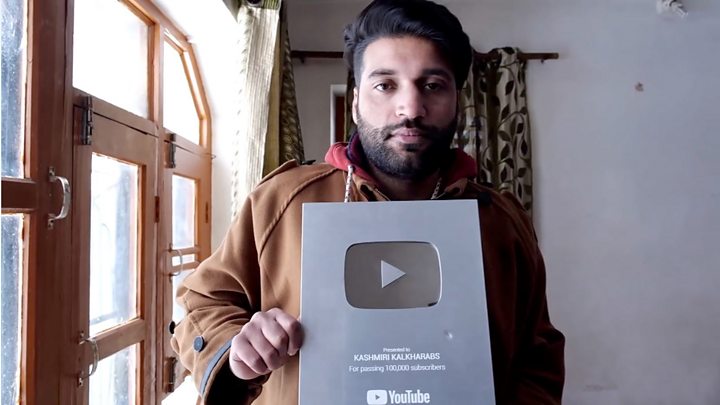
Media caption The silenced YouTube stars of Indian-administered Kashmir

“I chose journalism because I wanted to do something for my people,” Mr Islam explains. “I covered this conflict-ridden region with dedication until the loss of Kashmir’s special status put a full stop on my journey.”

In January, the government eased restrictions and allowed limited broadband service in the Muslim-majority valley, while 2G mobile coverage resumed in parts of the neighbouring Jammu region. But mobile internet and social media are still largely blocked.

India says this is necessary to maintain law and order since the region saw protests in August, and there has also been a long-running insurgency against Indian rule. But opposition leaders and critics of the move say the government cannot leave these restrictions in place indefinitely.

Meanwhile, journalists like Mr Islam are struggling.

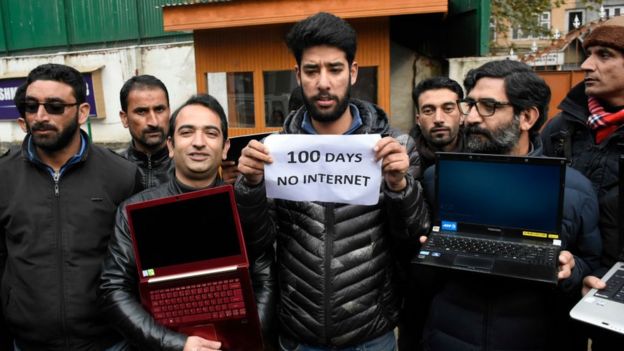
Kashmiri journalists protest against the continuous internet blockade for 100th day out Kashmir press club , Srinagar, Indian Administered Kashmir on 12 November 2019.Image copyright GETTY IMAGES
Image caption Kashmiri journalists protested after 100 days of no internet in the region

For months, Mr Islam says, he kept trying to report and file stories and photos.

In September, he even spent 6,000 rupees ($84; £65) of his own money to make two trips to the capital, Srinagar, for a story. But he soon ran out of funds and had to stop.

He then tried to file his stories on a landline phone: he would call and read them aloud to someone on the other side who could type it out. But, as he found out, his stories didn’t earn him enough money to cover the cost of travelling for hours in search of a working landline.

Presentational grey line

Read more on Kashmir

Presentational grey line

And Mr Islam was desperate for money because his wife was ill. So he eventually asked his brother for help, finding work carrying bricks on a construction site in his neighbourhood in Anantnag city. It pays him 500 rupees a day.

Mr Islam is not the only journalist in Kashmir who has been forced to abandon their career for another job.

Another journalist, who did not want to reveal his name, says he had been working as a reporter for several years, but quit the profession in August. He now plans to work in a dairy farm.

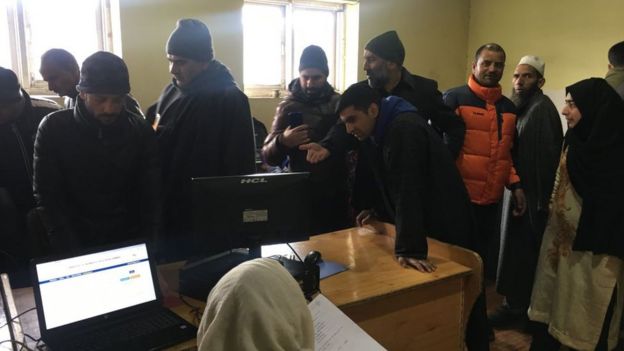
People at the Anantnag information officeImage copyright MUKHTAR ZAHOOR
Image caption Internet is available in some government offices

Yet another reporter, who also also wished to remain anonymous, says he used to earn enough to comfortably provide for his family. Now, he barely has money to buy petrol for his motorcycle.

“I have no money because I have not been able to file any story in the last six months,” a third reporter, who spoke to the BBC on the condition of anonymity, says. “My family keeps telling me to find another job. But what else can I do?”

In December, people were given limited access to the internet at a government office in Anantnag, but this hasn’t helped local journalists. The office, Mr Islam says, is always crowded and there are only four desktops for a scrum of officials, students and youngsters who want to log on to respond to emails, fill exam forms, submit job applications or even check their social media.

“We have access for only for a few minutes and the internet speed is slow,” he explains. “We are barely able to access email, forget reading the news.”

What’s more, Mr Islam says those who work at the office often ask customers to show them the contents of emails. “This makes us uncomfortable, but we don’t have a choice.”

Basheer Manzar, the editor of Kashmir ImagesImage copyright MUKHTAR ZAHOOR
Image caption Basheer Manzar runs Kashmir Images, a local newspaper

Many journalists say that they have been completely cut off from their contacts for months now, making it hard to to maintain their networks or sources.

They also speak of how humiliating it is to beg for wi-fi passwords and hotspots at the cramped media centre in Srinagar, which has less than two dozen computers for hundreds of journalists.

This has left publishers in the lurch too. “My reporters and writers are not able to file,” says Basheer Manzar, the editor of Kashmir Images.

He still publishes a print edition, he says, because if he doesn’t do so for a certain number of days in the month, he will lose the license.

But the website continues to struggle, he adds, because most of the readers in Indian-administered Kashmir have no access to the internet.

“I know what is happening in New York through news on the TV, but I don’t know what’s happening in my hometown.”

Source: The BBC
11/02/2020

The school play that sent a mother to prison

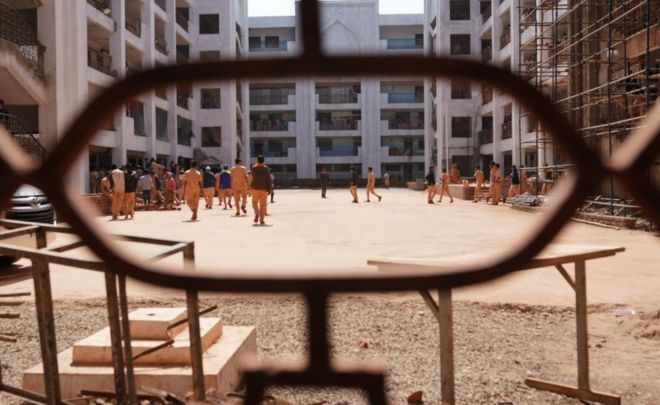
Shaheen School in Bidar
Image caption A play staged at Shaheen School has led to the arrest of a parent and a teacher

An Indian school play involving nine to 12-year-olds became the subject of national attention after it landed a young mother and a teacher in jail. BBC Telugu’s Deepthi Bathini reports.

“I’m not sure how I ended up here,” says 26-year-old Nazbunnisa, a single mother who did not give her last name and who works as a domestic help.

She was arrested on 30 January, along with Farida Begum, a teacher at her daughter’s school. The charge against them: sedition, which the women, both Muslim, deny.

They spoke to the BBC in a prison official’s office at Bidar district jail in the southern state of Karnataka. Both were on the verge of tears – they said they are trying to be “strong”, but their lives have suddenly turned “upside down”.

Their bail hearing is scheduled for Tuesday. Their lawyer says the charge of sedition is being misused.

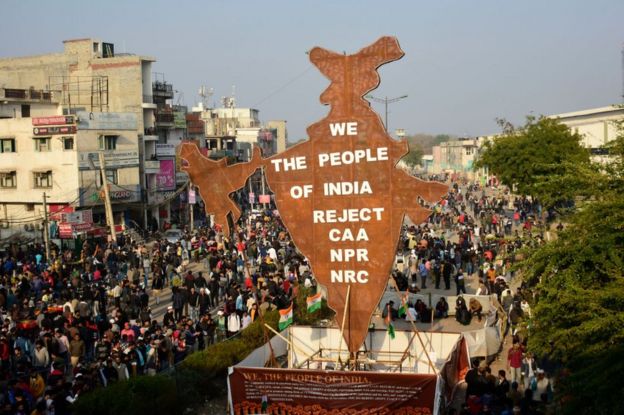
Indian people protest against the controversial Citizenship Amendment Act (CAA), the National Register of Citizens (NRC) and the National Population Register (NRP) in Shaheen bagh area of New Delhi, India on 02 February 2020.Image copyright GETTY IMAGES
Image caption The citizenship law has sparked huge protests

It stems from a colonial-era law that was used to quash dissent, but is still deployed liberally despite the Supreme Court’s attempt to limit it by making incitement to violence a necessary condition.

The two women are accused of spreading “false information” and of “spreading fear among [the] Muslim community” and of using children to insult India’s Prime Minister, Narendra Modi.

Their ordeal began with a play put on by the students and staff at Shaheen School in Bidar, where Ms Nazbunnisa’s daughter studies and Farida Begum, 52, teaches.

The play was about a controversial new citizenship law, which has polarised India since it was passed in December by the governing Hindu nationalist Bharatiya Janata Party (BJP).

The Citizenship Amendment Act (CAA), offers amnesty to non-Muslim immigrants from Pakistan, Bangladesh and Afghanistan. It sparked fear among India’s 200 million-plus Muslims as it came in the wake of the government’s plans to introduce a National Register of Citizens (or NRC) based on those who can prove their ancestors were Indian citizens.

Authorities are yet to clarify what documents would be needed to prove citizenship, but taken together, the measures have spurred massive protests – critics say the government is marginalising Muslims while offering a path to citizenship for people of other religious communities who fail to make it on to the NRC.

The governing BJP denies these charges, and insists India’s Muslims have nothing to worry about.

So, given the contentious subject, after one of the parents streamed the school play live on Facebook, the recording quickly went viral. Local resident Neelesh Rakshal was among those who watched it.

Mr Rakshal, who describes himself as a social activist, says he became furious over a scene where a man approaches an elderly woman and tells her that Narendra Modi wants Muslims to produce documents proving their Indian citizenship and that of their ancestors, and if they fail to do so, they will be asked to leave the country.

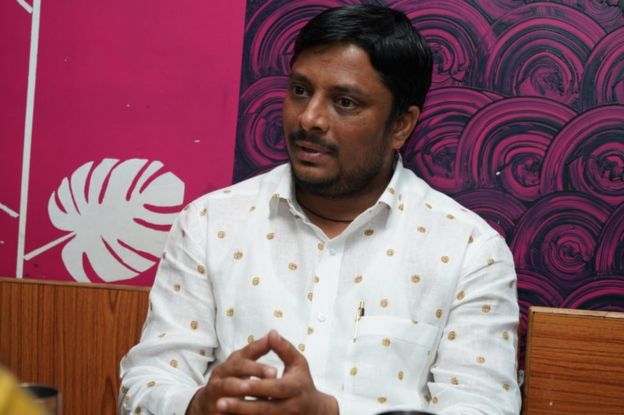
Neelesh Rakshal
Image caption Mr Rakshal says the play “spreads hatred”

The woman responds that she has been in India for generations and would have to dig up the graves of her ancestors to look for documents. She then says a “boy who was selling tea”, a reference to Mr Modi who has said he used to sell tea as a teenager, is now demanding that she show him her documents.

“I will ask him for his documents and if he doesn’t show them to me, I will hit him with slippers,” she adds.

Mr Rakshal says he immediately registered a police complaint against the school for “using children in a school play to abuse the prime minister and also for spreading hatred”.

The complaint named the school management and the parent who streamed the play. While several members of the school management and the president of the school have also been charged with sedition, police told the court they are still looking for them.

“We do not know for what reason sedition charges have been invoked against the school. It is beyond the imagination of any reasonable person. We will fight it in court,” the school’s CEO, Thouseef Madikeri, says.

A Muslim child in IndiaImage copyright GETTY IMAGES
Image caption School officials allege that they are being targeted because most of the students are Muslim

Police also questioned students – videos and screen grabs of CCTV footage showing them speaking to students were shared widely on social media, prompting criticism.

Mr Madikeri alleges that on one occasion, police in uniform questioned students, with no child welfare officials present – an accusation denied by police superintendent DL Nagesh.

“The students were questioned five times. It’s mental harassment to students and this may have an impact on them in [the] long run,” Mr Madikeri says.

The Karnataka State Commission for Protection of Child Rights has asked police to explain why they questioned students so many times. Police say it was because not all the students were available at the same time.

Mr Madikeri told the BBC it was the questioning of students that led to the arrest of Farida Begum and Ms Nazbunnisa.

One parent whose child was questioned says she is now scared of going to school.

“My daughter told me police repeatedly asked her to identify the teachers and others who might have taught them the [play’s] dialogues,” he said.

“I do not understand what was wrong in the play. Children have been seeing what has been happening around the country. They picked up the dialogues from social media.”

Mirza Baig
Image caption Farida Begum’s husband is worried about what will happen

Ms Nazbunnisa is also perplexed as to why she was arrested.

“My daughter was rehearsing for the play at home,” she says. “But I did not know what it was about, or what this controversy about CAA or NRC is about. I did not even go to see her play.”

Ms Nazbunnisa has met her daughter only once since she was jailed: “It was just for a few minutes, and even then only through a window. I held back my tears. I did not want to scare her further.”

The girl is staying with a friends of the family – they told the BBC she is having nightmares and often wakes up crying for her mother.

“She has been pleading that her mother not be punished for her mistake. She is sorry for what has happened,” one of them says.

Farida Begum, who suffers from high blood pressure, says she is “scared of what the future holds”. Her husband, Mirza Baig, says he fears that his wife being in jail will affect his daughter’s marriage prospects.

“Whatever is happening is not right,” he says.

Source: The BBC
18/10/2019

Does Huawei’s future lie with India after US ban?

HuaweiImage copyright GETTY IMAGES
Image caption The US says Huawei equipment has back doors that would enable Chinese surveillance

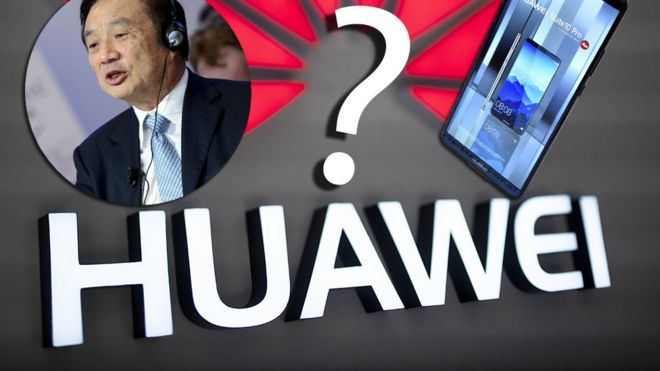
Chinese tech giant Huawei, which has been banned from selling 5G equipment to US telecom companies, is making an aggressive push to market itself in India.

“It’s been squeezed out of countries by a few governments already, and so a possible contract with India for 5G would be especially important,” Arun Sukumar, a tech analyst at the Observer Research Foundation, told the BBC.

“It’s worth noting that even though Huawei is comfortable at the moment, it will need to continue to invest across the world and into new markets in order to stay afloat – and what’s a bigger market than India?”

Huawei has also been banned in Australia, and several other countries are considering following suit.

The US says Huawei equipment contains back doors that would enable Chinese surveillance.

But the company has repeatedly denied claims that the use of its products poses security risks, and says it is independent from the Chinese government.

The size of India’s wireless market – dwarfed only by China – make it a vital market for any company, but the troubles Huawei is facing at present make could make India critical to its future.

The US has been pressurising India and its other allies to boycott the company and has not ruled out punitive measures against those who fail to do so.

US Commerce Secretary Wilbur Ross said during a visit to Delhi that the US hoped that its “geopolitical partner India does not inadvertently subject itself to untoward security risk”.

Jay Chen, CEO of Huawei India, told the BBC’s Devina Gupta that the company was even willing to sign an undertaking with the Indian government, promising that its equipment would contain no back doors as alleged by the US.

“We have read in the media that the US government is trying to lobby with the Indian government but I still believe that we should focus on what we can do and try our best,” he said.

Illuminated Huawei and 5G signs are on display during the 10th Global mobile broadband forum hosted by Chinese tech giant Huawei in Zurich on October 15, 2019.Image copyright GETTY IMAGES
Image caption The company provides technology infrastructure to launch 5G networks

India has not commented on US charges against Huawei and has invited it to participate in its upcoming 5G spectrum trials, although a date for this has not been announced yet.

Mr Sukumar told the BBC that to exclude Huawei from the 5G process could actually prove detrimental to India.

“No more than five companies have the infrastructure to launch 5G, and Huawei’s infrastructure is more affordable than other Western ones like Nokia and Erikson. India’s telecom industry is already struggling, so to ally with Huawei – which could provide the service at the lowest rate – is very attractive,” he said.

India does not have a homegrown alternative to Huawei’s technology – and the company is well aware of this.

Mr Chen told the Economic Times newspaper that Huawei was now a vital part of India’s digital ecosystem and that to exclude it at this stage would risk “breaking” it entirely.

“I think the loss will not only be financial but also about losing technology development,” the newspaper quoted him as saying.

Source: The BBC
02/09/2019

Pregnant India woman beaten over child kidnapping rumour

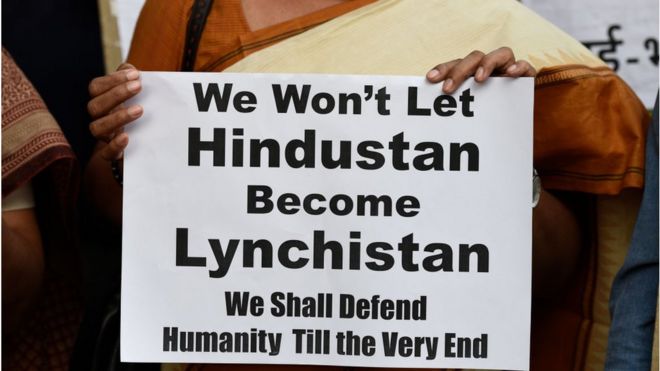
Members of All India Students Association (AISA) hold placards as they protest against the mob lynchings in the country, at Parliament street, on June 22, 2018 in New Delhi, IndiaImage copyright GETTY IMAGES

A pregnant woman has been beaten by people who suspected her of kidnapping a child in the Indian capital Delhi.

Police told the BBC that the woman, 25, was in a stable condition and that three people had been arrested.

It is the latest incident in a wave of attacks fuelled by rumours of child kidnapping in the capital and neighbouring states.

Last year, a similar spate of attacks saw several people beaten and killed over rumours of child kidnappings.

Footage of the incident shows the woman surrounded by a group of people. They can be heard accusing her of kidnapping children and beating her.

The highest number of such cases has been registered in the northern state of Uttar Pradesh, which borders Delhi.

“At least 46 cases have been reported until 29 August. In all cases, we found that there was no evidence of child trafficking,” director general of police OP Singh told the BBC.

“We appeal to the people to not believe in such rumours. If you are in doubt, just reach out to the police through phone [dial in number 100] or social media,” he added.

Media captionThe India WhatsApp video driving people to murder

In Ghaziabad district, which is on the outskirts of Delhi, six cases were registered in August.

“In one case, a group of people attacked a grandmother while she was out with her grandchild. People attacked her because her skin colour was different to her grandchild,” senior police officer Neeraj Jadaun said, adding that all suspects in the case had been arrested.

While incidents like this are being reported across India, it is not clear if kidnappings are on the rise.

Rumours of child kidnappings often spread over text messages or WhatsApp, according to reports.

Officials have urged people not to believe messages linked to child abductions and are yet to find any incidents of child abduction related to the spate of messages and videos being shared online.

Source: The BBC

13/08/2019

Hong Kong protests: Airport cancels flights as thousands occupy

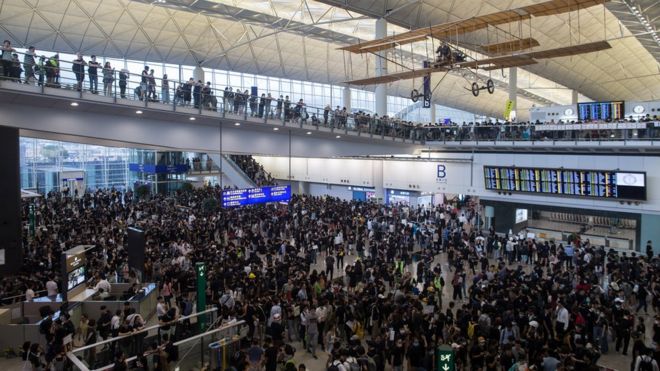
Protesters occupy Hong Kong Chek Lap Kok International Airport in Hong Kong, China,Image copyright EPA
Image caption Officials say about 5,000 gathered for the fourth day of protests at the airport

Hong Kong International Airport cancelled all departures on Monday, as thousands of anti-government protesters occupied and caused disruption.

Passengers have been told not to travel to the airport, which is one of the world’s busiest transport hubs.

In a statement, officials blamed “seriously disrupted” operations.

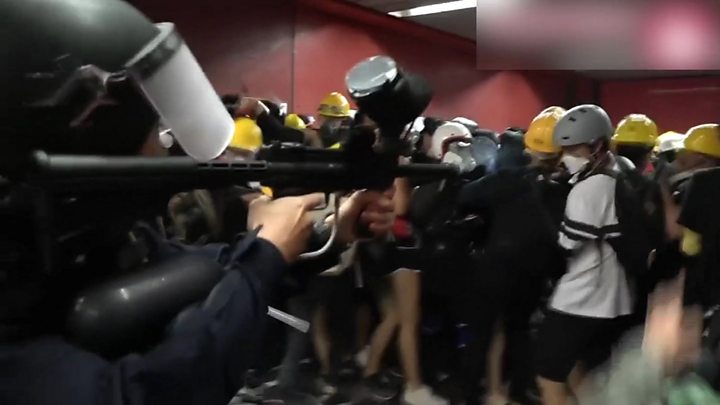
Many of those protesting are critical of the actions of police, who on Sunday were filmed firing tear gas and rubber bullets at close range.

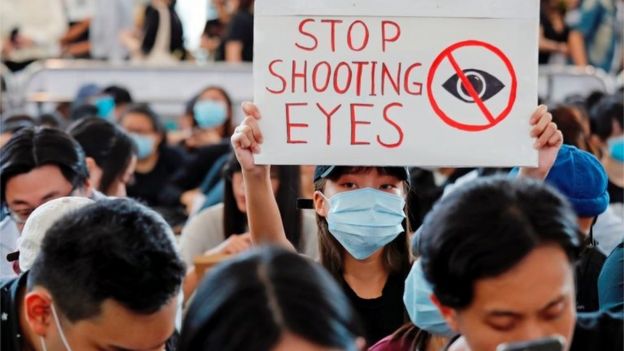
Some protesters wore bandages over their eyes in response to images of a woman bleeding heavily from her eye on Sunday, having reportedly been shot by a police projectile.

In a statement on Monday afternoon, Hong Kong’s Airport Authority said they were cancelling all flights that were not yet checked in.

More than 160 flights scheduled to leave after 18:00 local time (10:00 GMT) will now not depart.

Arrivals already heading into Hong Kong will still be allowed to land, but other scheduled flights have been cancelled.

Officials are now working to reopen the airport by 06:00 on Tuesday, a statement said.

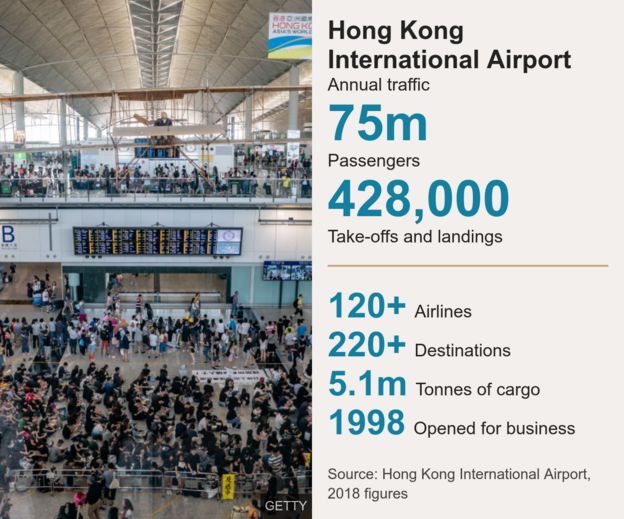
Graphic shows the scale of Hong Kong airport's operations
Some passengers expressed annoyance at the disruption. “It’s very frustrating and scary for some people,” one man from Pakistan told the BBC. “We’ll just have to wait for our next flight.”

Helena Morgan, from the UK, said she was set to return to the UK to get her exam results on Thursday. “I’m hoping we get back for them and we’re not on a flight,” she said.

But others were more understanding of the protests. “I was expecting something, given all the news,” one arrival, Gurinda Singh, told Reuters news agency.

As rumours spread that police plan to move in on protesters on Monday evening, thousands opted to leave on foot. There are large backlogs for transport back into the centre, local reports say.

The BBC’s Stephen McDonell, who is at the scene, says the airport has effectively shut down while authorities work out how to deal with the crisis.

Hong Kong’s mass demonstrations and unrest show no sign of abating, more than two months after they were sparked by a controversial extradition bill.

Beijing officials have strongly condemned Sunday’s violence and linked violent protesters to “terrorism”.

A protester in the airport holds a sign that says "stop shooting eyes"Image copyright REUTERS
Image caption Many of those who gathered carried signs condemning police conduct

What happened on Sunday?

On Sunday afternoon, a peaceful rally in the city’s Victoria Park led to clashes when protesters moved out of the area and marched along a major road despite a police ban.

There were confrontations in several central districts and police used rubber bullets in an attempt to disperse the demonstrators.

In the bustling central Wan Chai district, petrol bombs and bricks were thrown at police, who responded by charging at protesters.

A number of people, including a police officer, were injured in the clashes.

Videos on social media also showed officers storming enclosed railway stations and firing tear gas.

Footage inside another station showed officers firing what appeared to be rubber bullets at close range and several police officers beating people with batons.

Media caption Violence erupts in HK train stations

Local media outlets reported that suspected undercover police officers had dressed-up as protesters to make surprise arrests.

While protests in the city have turned increasingly violent, there were no reports of arrests during the three previous days of the airport sit-in.

What has the reaction been?

On Monday the Chinese authorities, who have not yet physically intervened to quell the unrest, used their strongest language yet to condemn violent protesters.

“Hong Kong’s radical demonstrators have repeatedly used extremely dangerous tools to attack police officers, which already constitutes a serious violent crime, and also shows the first signs of terrorism emerging,” Yang Guang, a spokesman for the Hong Kong and Macau Affairs Office (HKMAO), said at a press briefing.

“This wantonly tramples on Hong Kong’s rule of law and social order.”

Elsewhere, Cathay Pacific has warned staff they could be fired if they “support or participate in illegal protests” in Hong Kong. The development comes days after Beijing mounted pressure on the airline and a #BoycottCathayPacific campaign began to spread.

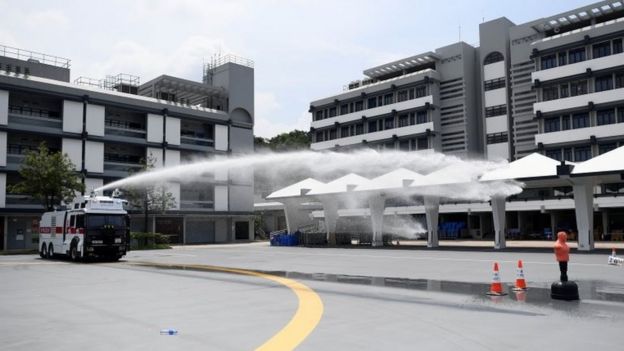
Hong Kong police have also unveiled a water cannon vehicle as a new tool to combat the protests.

Hong Kong Police demonstrate their new water cannon equipped vehicle at the Police Tactical Unit compound in Hong KongImage copyright AFP

Amnesty International has previously warned that the tool could cause serious injuries and inflame tensions.

Why are there protests in Hong Kong?

Demonstrations started in June in opposition to a proposed extradition bill, which would have allowed suspected criminals to be sent to mainland China for trial.

Critics said it would undermine Hong Kong’s legal freedoms, and could be used to silence political dissidents.

Although the government has now suspended the bill, demonstrators want it to be fully withdrawn.

Their demands have broadened to include calls for an independent inquiry into alleged police brutality, and an amnesty for all arrested protesters.

Hong Kong is part of China but its citizens have more autonomy than those on the mainland.

It has a free press and judicial independence under the so-called “one country, two systems” approach – freedoms which activists fear are being increasingly eroded.

Source: The BBC
23/05/2019

Ozone layer: Banned CFCs traced to China say scientists

home insulationImage copyright GETTY IMAGES
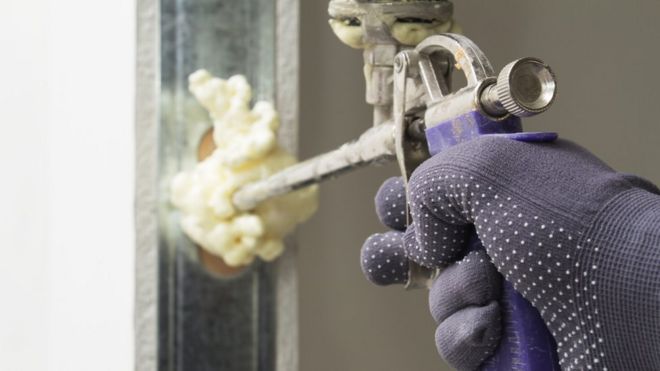
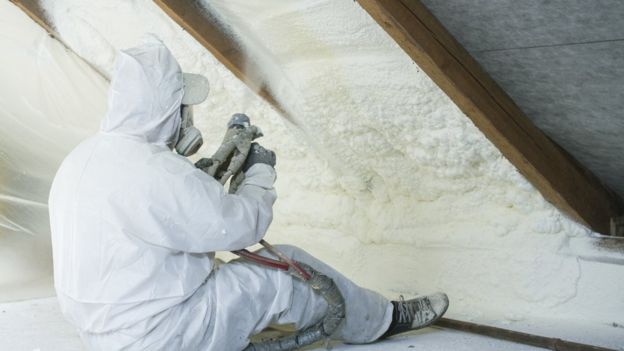
Image caption Much of the CFC-11 gas has been used in home insulation

Researchers say that they have pinpointed the major sources of a mysterious recent rise in a dangerous, ozone-destroying chemical.

CFC-11 was primarily used for home insulation but global production was due to be phased out in 2010.

But scientists have seen a big slowdown in the rate of depletion over the past six years.

This new study says this is mostly being caused by new gas production in eastern provinces of China.

CFC-11 is also known as trichlorofluoromethane, and is one of a number of chloroflurocarbon (CFC) chemicals that were initially developed as refrigerants during the 1930s.

However, it took many decades for scientists to discover that when CFCs break down in the atmosphere, they release chlorine atoms that are able to rapidly destroy the ozone layer which protects us from ultraviolet light. A gaping hole in the ozone layer over Antarctica was discovered in the mid 1980s.

Media caption Twenty-five years of ice loss in the Antarctic

The international community agreed the Montreal Protocol in 1987, which banned most of the offending chemicals. Recent research suggests that the hole in the Northern Hemisphere could be fully fixed by the 2030s and Antarctica by the 2060s.

When was the CFC problem discovered?

CFC-11 was the second most abundant CFCs and was initially seen to be declining as expected.

However in 2018 a team of researchers monitoring the atmosphere found that the rate of decline had slowed by about 50% after 2012.

graphic
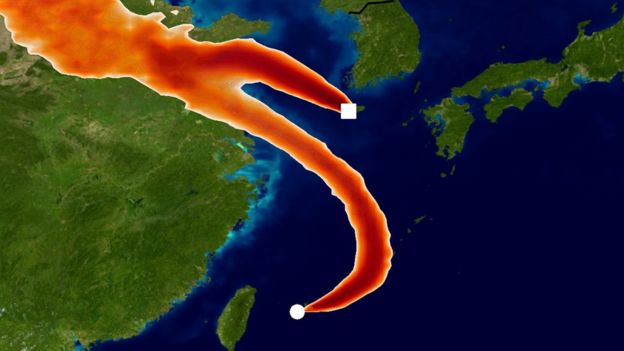
Image caption Monitoring stations in Korea and Japan were key to detecting the mystery sources of CFC-11

That team reasoned that they were seeing new production of the gas, coming from East Asia. The authors of that paper argued that if the sources of new production weren’t shut down, it could delay the healing of the ozone layer by a decade.

What did investigators find on the ground?

Further detective work in China by the Environmental Investigation Agency in 2018 seemed to indicate that the country was indeed the source. They found that the illegal chemical was used in the majority of the polyurethane insulation produced by firms they contacted.

One seller of CFC-11 estimated that 70% of China’s domestic sales used the illegal gas. The reason was quite simple – CFC-11 is better quality and much cheaper than the alternatives.

So what does this latest study show?

This new paper seems to confirm beyond any reasonable doubt that some 40-60% of the increase in emissions is coming from provinces in eastern China.

Using what are termed “top-down” measurements from air monitoring stations in South Korea and Japan, the researchers were able to show that since 2012 CFC-11 has increased from production sites in eastern China.

home insulationImage copyright GETTY IMAGES

They calculated that there was a 110% rise in emissions from these parts of China for the years 2014-2017 compared to the period between 2008-2012.

“This new study is based on spikes in the data on air that comes from China,” lead author Dr Matt Rigby, a reader at the University of Bristol, told BBC Inside Science.

“Using computer simulations of the transport of these gases through the atmosphere we can start to put numbers on emissions from different regions and that’s where we come up with this number of around 7,000 tonnes of extra CFC-11 emissions coming out of China compared to before 2012.

“But from the data, all we just see are the ultimate releases to the atmosphere, we don’t have any information on how that CFC-11 was used or where it was produced, it is entirely possible that it was manufactured in some other region, some other part of China or even some other country and was transported to the place where they are making insulating foams at which point some of it could have been emitted to the atmosphere.”

Where are the rest of the emissions coming from?

The researchers are not sure. It’s possible that the missing emissions are coming from other parts of China, as the monitoring stations just can’t see them. They could also be coming from India, Africa or South America as again there is very little monitoring in these regions.

Does this have implications for climate change?

Yes – the authors say that these CFCs are also very potent greenhouse gases. One tonne of CFC-11 is equivalent to around 5,000 tonnes of CO2.

“If we look at these extra emissions that we’ve identified from eastern China, it equates to about 35 million tonnes of CO2 being emitted into the atmosphere every year, that’s equivalent to about 10% of UK emissions, or similar to the whole of London.”

Will China clampdown on the production?

The Chinese say they have already started to clamp down on production by what they term “rogue manufacturers”. Last November, several suspects were arrested in Henan province, in possession of 30 tonnes of CFC-11.

Clare Perry from the Environmental Investigations Agency (EIA) said that the new findings re-affirmed the need to stamp out production.

“I think with this study, it is beyond doubt that China is the source of these unexpected emissions, and we would hope that China is leaving no stone unturned to discover the source of the CFC-11 production.

“Unless the production of the chemical is shut down it will be near impossible to end the use and emissions in the foam companies.”

The study has been published in the journal Nature.

Source: The BBC
14/03/2019

Anger over ‘disgusting’ food found in Chinese school kitchen

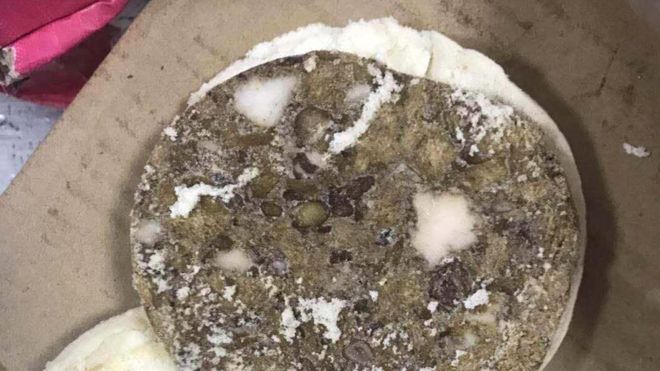
Rotten breadImage copyrightSUPPLIED
Image captionRotting bread was among the food found in the kitchen

One of China’s most prestigious high schools has been the target of public anger after piles of expired mouldy food were found in its canteen kitchen.

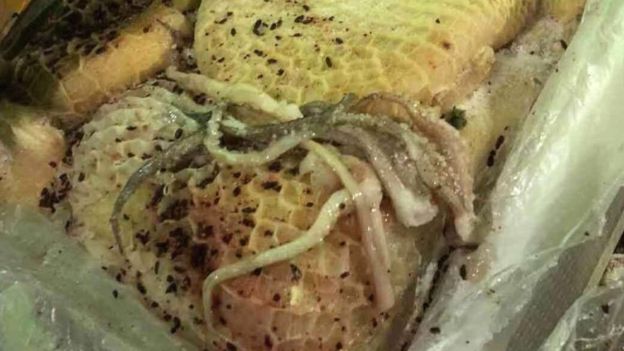
Mouldy bread, rotting meat and seafood were discovered at the Chengdu No 7 Experimental High School.

One parent told the BBC of his horror and disgust, saying the food was “stinky and disgusting” and compared it to pig slop.

The school has now apologised, saying it is deeply “embarrassed”.

Food safety scandals are not uncommon in China and they often leave authorities scrambling to defuse public outrage.

How did they discover the food?

The scandal first emerged when a small group of parents were on Monday invited to attend a tree planting event at the private high school in Chengdu, the capital city of China’s Sichuan province.

While at the school, a group of parents discovered mouldy bread, rotting meat and seafood items in the canteen kitchen canteen.

It is not clear why exactly they chose to stop by the kitchen, but one parent that the BBC’s Lulu Luo spoke to referenced an incident earlier last November where numerous school children came down with stomach-aches, constipation and various other ailments.

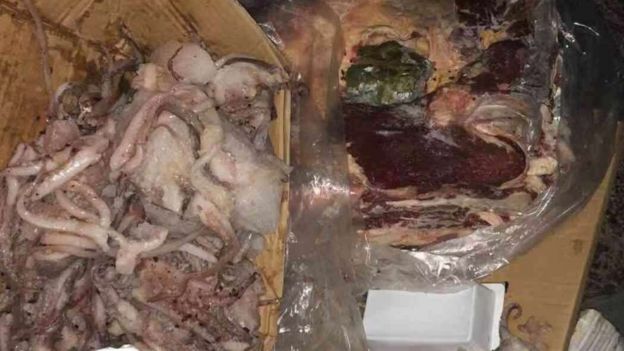
Rotten foodImage copyrightSUPPLIED
Image captionWhat looks like seafood and meat were seen in cardboard boxes

“[The items looked like they had] been in a freezer for years, [it looked] like zombie meat,” the father, who has a daughter and son enrolled in the school said.

“I smelled the pork, it was stinky. [There was] ginger, which looked disgusting too.”

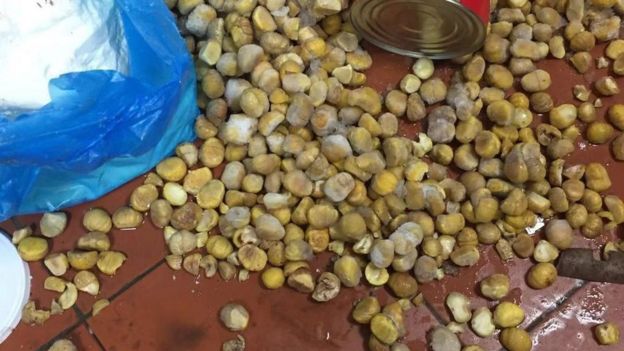
Food strewn on the groundImage copyrightSUPPLIED
Image captionAnd chestnuts were seen strewn on the floor
Rotten foodImage copyrightSUPPLIED
Image captionWhat appears to be tripe is also seen covered in dirt of some kind

According to the father, the private school costs 39,000 yuan (£4,380; $5,800) a year – about 20 times the amount a public school would cost.

“We don’t even let kids have leftover food at home… I spent tens of thousands of dollars and my kids are having pigwash there,” he said.

“I dare not tell my younger son… I’m worried he might not dare to eat canteen food after that. My daughter has been telling me she has a stomach-ache. I [told] her she might have just over exercised.

“It breaks my heart.”

How did parents react?

Horrified, the group of parents shared the pictures on social media, which were soon discovered by other parents.

According to the same parent, the school immediately transported the mouldy food away in two trucks.

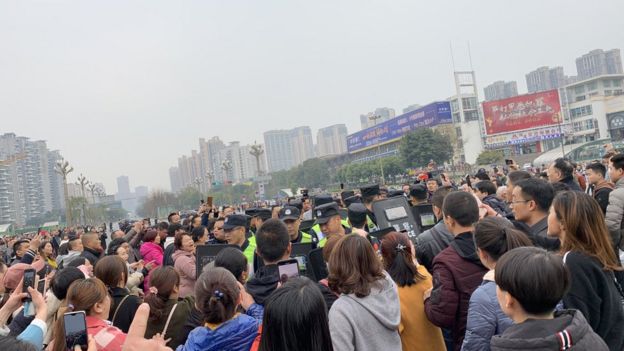
One truck was intercepted and stopped by a swarm of angry parents who showed up at the school in protest, he said.

Parents protestingImage copyrightSUPPLIED
Image captionHundreds of parents stormed the school in protest

Videos that emerged on social media on Wednesday showed hundreds of parents angrily protesting outside the school gates.

Police were seen using brute force against them, with one video showing a group of policemen slamming a man against the ground.

In another video, parents can be seen clutching their eyes in pain, with some local news outlets saying police used pepper spray against them.

Chengdu police later posted a statement on Weibo saying 12 people had been arrested.

It said the parents had “severely disrupted” traffic and insulted the police. They were later released on the same day.

Presentational grey line

‘Why should they be trusted with anything?’

Stephen McDonell, BBC China correspondent

People overseas sometimes mistakenly think that there are not many protests in China. Actually, acts of dissent break out quite often and can erupt suddenly.

If family members are harmed, especially when under the care of a school or a kindergarten or a hospital, then orderly, calm communities can transform with scenes of anger spilling out onto the streets.

Faulty medicine, tainted milk powder, investment scams and perceived abuse of students under the care of teachers have all triggered public anger directed at the officials whose job it is to keep the community safe.

If the Chinese Communist Party is not enormously worried about these incidents they have all led to collapse in public faith in the system.

If local officials cannot even manage to give school children lunch which is not covered in mould then why should they be trusted with anything?

Presentational grey line

What has the school said?

The Chengdu school later released an apology, and said it would stop taking food from its current supplier.

The school is one of the most prestigious in China and had in the past been named among China’s “Top 10 outstanding private schools”.

It said that those responsible would be dealt with by the law, saying it was “embarrassed” by the incident and that it would not happen again.

However, the parent the BBC spoke to said the case was not an “isolated incident”, saying that the same supplier catered to “over 100,000 students from across 20 schools”.

Wenjiang district government – the district in Chengdu that the school is in – issued a statement on Wednesday that said eight people responsible for food safety at the school were being investigated by authorities.

It said that 36 students from the school had been admitted into the local hospital for a check-up -all were later discharged.

The district government also said that the raw food would be sent for testing, adding that a “comprehensive and in-depth investigation” would be held into the matter.

Source: The BBC
10/03/2019

India and Pakistan: How the war was fought in TV studios

An Indian man watches live news channels broadcasting images of Indian Air Force (IAF) Wing Commander pilot Abhinandan Varthaman returning to India from the India-Pakistan Wagah border in New Delhi on March 1, 2019.Image copyrightGETTY IMAGES
Image captionAn Indian man watches the news broadcasting images of the released Indian pilot

As tensions between India and Pakistan escalated following a deadly suicide attack last month, there was another battle being played out on the airwaves. Television stations in both countries were accused of sensationalism and partiality. But how far did they take it? The BBC’s Rajini Vaidyanathan in Delhi and Secunder Kermani in Islamabad take a look.

It was drama that was almost made for television.

The relationship between India and Pakistan – tense at the best of times – came to a head on 26 February when India announced it had launched airstrikes on militant camps in Pakistan’s Balakot region as “retaliation” for a suicide attack that had killed 40 troops in Indian-administered Kashmir almost two weeks earlier.

A day later, on 27 February, Pakistan shot down an Indian jet fighter and captured its pilot.

Abhinandan Varthaman was freed as a “peace gesture”, and Pakistan PM Imran Khan warned that neither country could afford a miscalculation, with a nuclear arsenal on each side.

Suddenly people were hooked, India’s TV journalists included.

Indian Prime Minister Narendra Modi gestures as he speaks during the National Democratic Alliance (NDA) "Sankalp" rally in Patna in the Indian eastern state of Bihar on March 3, 2019.Image copyrightAFP
Image captionIndian PM Narendra Modi is accused of exploiting India-Pakistan hostilities for political gain

So were they more patriots than journalists?

Rajini Vaidyanathan: Indian television networks showed no restraint when it came to their breathless coverage of the story. Rolling news was at fever pitch.

The coverage often fell into jingoism and nationalism, with headlines such as “Pakistan teaches India a lesson”, “Dastardly Pakistan”, and “Stay Calm and Back India” prominently displayed on screens.

Some reporters and commentators called for India to use missiles and strike back. One reporter in south India hosted an entire segment dressed in combat fatigues, holding a toy gun.

And while I was reporting on the return of the Indian pilot at the international border between the two countries in the northern city of Amritsar, I saw a woman getting an Indian flag painted on her cheek. “I’m a journalist too,” she said, as she smiled at me in slight embarrassment.

Print journalist Salil Tripathi wrote a scathing critique of the way reporters in both India and Pakistan covered the events, arguing they had lost all sense of impartiality and perspective. “Not one of the fulminating television-news anchors exhibited the criticality demanded of their profession,” she said.

Media captionIndia and Pakistan’s ‘war-mongering’ media

Secunder Kermani: Shortly after shooting down at least one Indian plane last week, the Pakistani military held a press conference.

As it ended, the journalists there began chanting “Pakistan Zindabad” (Long Live Pakistan). It wasn’t the only example of “journalistic patriotism” during the recent crisis.

Two anchors from private channel 92 News donned military uniforms as they presented the news – though other Pakistani journalists criticised their decision.

But on the whole, while Indian TV presenters angrily demanded military action, journalists in Pakistan were more restrained, with many mocking what they called the “war mongering and hysteria” across the border.

In response to Indian media reports about farmers refusing to export tomatoes to Pakistan anymore for instance, one popular presenter tweeted about a “Tomatical strike” – a reference to Indian claims they carried out a “surgical strike” in 2016 during another period of conflict between the countries.

Media analyst Adnan Rehmat noted that while the Pakistani media did play a “peace monger as opposed to a warmonger” role, in doing so, it was following the lead of Pakistani officials who warned against the risks of escalation, which “served as a cue for the media.”

What were they reporting?

Rajini Vaidyanathan: As TV networks furiously broadcast bulletins from makeshift “war rooms” complete with virtual reality missiles, questions were raised not just about the reporters but what they were reporting.

Indian channels were quick to swallow the government version of events, rather than question or challenge it, said Shailaja Bajpai, media editor at The Print. “The media has stopped asking any kind of legitimate questions, by and large,” she said. “There’s no pretence of objectiveness.”

In recent years in fact, a handful of commentators have complained about the lack of critical questioning in the Indian media.

Indians celebrated on hearing news of the strikesImage copyrightAFP
Image captionIndians celebrated news of the strikes

“For some in the Indian press corps the very thought of challenging the ‘official version’ of events is the equivalent of being anti-national”, said Ms Bajpai. “We know there have been intelligence lapses but nobody is questioning that.”

Senior defence and science reporter Pallava Bagla agreed. “The first casualty in a war is always factual information. Sometimes nationalistic fervour can make facts fade away,” he said.

This critique isn’t unique to India, or even this period in time. During the 2003 Iraq war, western journalists embedded with their country’s militaries were also, on many occasions, simply reporting the official narrative.

Secunder Kermani: In Pakistan, both media and public reacted with scepticism to Indian claims about the damage caused by the airstrikes in Balakot, which India claimed killed a large number of Jaish-e-Mohammad (JeM) militants in a training camp.

Hamid Mir, one of the most influential TV anchors in the country travelled to the area and proclaimed, “We haven’t seen any such (militant) infrastructure… we haven’t seen any bodies, any funerals.”

“Actually,” he paused, “We have found one body… this crow.” The camera panned down to a dead crow, while Mr Mir asked viewers if the crow “looks like a terrorist or not?”

There seems to be no evidence to substantiate Indian claims that a militant training camp was hit, but other journalists working for international outlets, including the BBC, found evidence of a madrassa, linked to JeM, near the site.

A cropped version of a satellite image shows a close-up of a madrasa near Balakot, Khyber Pakhtunkhwa province, Pakistan, March 4, 2019. Picture taken March 4, 2019.Image copyrightPLANET LABS INC./HANDOUT VIA REUTERS
Image captionThe satellite image shows a close-up of a madrassa near Balakot in Pakistan’s Khyber Paktunkhwa

A photo of a signpost giving directions to the madrassa even surfaced on social media. It described the madrassa as being “under the supervision of Masood Azhar”. Mr Azhar is the founder of JeM.

The signpost’s existence was confirmed by a BBC reporter and Al Jazeera, though by the time Reuters visited it had apparently been removed. Despite this, the madrassa and its links received little to no coverage in the Pakistani press.

Media analyst Adnan Rehmat told the BBC that “there was no emphasis on investigating independently or thoroughly enough” the status of the madrassa.

In Pakistan, reporting on alleged links between the intelligence services and militant groups is often seen as a “red line”. Journalists fear for their physical safety, whilst editors know their newspapers or TV channels could face severe pressure if they publish anything that could be construed as “anti-state”.

Who did it better: Khan or Modi?

Rajini Vaidyanathan: With a general election due in a few months, PM Narendra Modi continued with his campaign schedule, mentioning the crisis in some of his stump speeches. But he never directly addressed the ongoing tensions through an address to the nation or a press conference.

This was not a surprise. Mr Modi rarely holds news conference or gives interviews to the media. When news of the suicide attack broke, Mr Modi was criticised for continuing with a photo shoot.

Imran KhanImage copyrightAFP
Image captionImran Khan was praised for his measured approach

The leader of the main opposition Congress party, Rahul Gandhi, dubbed him a “Prime Time Minister” claiming the PM had carried on filming for three hours. PM Modi has also been accused of managing his military response as a way to court votes.

At a campaign rally in his home state of Gujarat he seemed unflustered by his critics, quipping “they’re busy with strikes on Modi, and Modi is launching strikes on terror.”

Secunder Kermani: Imran Khan won praise even from many of his critics in Pakistan, for his measured approach to the conflict. In two appearances on state TV, and one in parliament, he appeared firm, but also called for dialogue with India.

His stance helped set the comparatively more measured tone for Pakistani media coverage.

Officials in Islamabad, buoyed by Mr Khan’s decision to release the captured Indian pilot, have portrayed themselves as the more responsible side, which made overtures for peace.

On Twitter, a hashtag calling for Mr Khan to be awarded a Nobel Peace Prize was trending for a while. But his lack of specific references to JeM, mean internationally there is likely to be scepticism, at least initially, about his claims that Pakistan will no longer tolerate militant groups targeting India.

Source: The BBC
Law of Unintended Consequences

continuously updated blog about China & India

ChiaHou's Book Reviews

continuously updated blog about China & India

What's wrong with the world; and its economy

continuously updated blog about China & India