Archive for ‘Beijing’

15/04/2019

What does the world’s largest single-building airport terminal look like?

The busiest airport in the world in terms of passenger numbers is in Atlanta, Georgia and no 2 is in Beijing, both with tens of millions more passengers every year than their nearest rivals.

So it might come as a surprise to hear that a new airport, set to open later this year, with what officials claim is the world’s largest terminal housed in a single building, is also in the Chinese capital.

This will give Beijing a breathtaking flight capacity, surpassing London’s six airports.

Until now the impressive structure has been under wraps but China Correspondent Stephen McDonell went along to have a look.

Source: The BBC

13/04/2019

IOC awards Xinhua certificate in recognition of international news agency

(SP)CHINA-BEIJING-IOC-XINHUA NEWS AGENCY-CERTIFICATE

Anthony Edgar (L), chairman of the IOC Press Commission and director of the Media Operations Department, presents the certificate to Yan Wenbin, vice president of Xinhua News Agency, in Beijing, on April 12, 2019. The International Olympic Committee (IOC) officially awarded Xinhua News Agency a certificate in recognition of its status as an international news agency here on Friday. (Xinhua/Cao Can)

BEIJING, April 12 (Xinhua) — The International Olympic Committee (IOC) officially awarded Xinhua News Agency a certificate in recognition of its status as an international news agency here on Friday.

On behalf of IOC President Thomas Bach, Anthony Edgar, chairman of the IOC Press Commission and director of the Media Operations Department, presented the certificate to Yan Wenbin, vice president of Xinhua News Agency, at a ceremony held at Xinhua’s headquarters in Beijing.

Yan expressed appreciation to the IOC for its trust, saying Xinhua’s coverage of the Olympic Games has entered a new stage after becoming an international news agency recognized by the IOC.

“Xinhua will strengthen cooperation with the IOC more closely, report on the Olympic Movement more comprehensively, objectively and truthfully, and play a more important role in promoting the progress and development of the Olympic cause in China and the world,” said Yan.

Speaking at the handover ceremony, Edgar said that the IOC attaches great importance to Xinhua News Agency and has high expectations on Xinhua in promoting the Olympic Movement across the globe in the future.

“The designation of Xinhua as an IOC recognized international news agency is a recognition of the importance and global reach of Xinhua’s domestic, regional and global news and sports coverage. It is a recognition of the role Xinhua now plays – and will play in the future of producing the best possible coverage of the Olympic Games, the IOC and the Olympic Movement,” he said.

Source: Xinhua

11/04/2019

Chinese ‘spies’ stole Dutch chip machinery giant’s secrets, newspaper says

  • Links between company accused of receiving confidential information and Beijing, according to report
  • Investigation follows US court ruling against six Chinese employees of semiconductor maker ASML
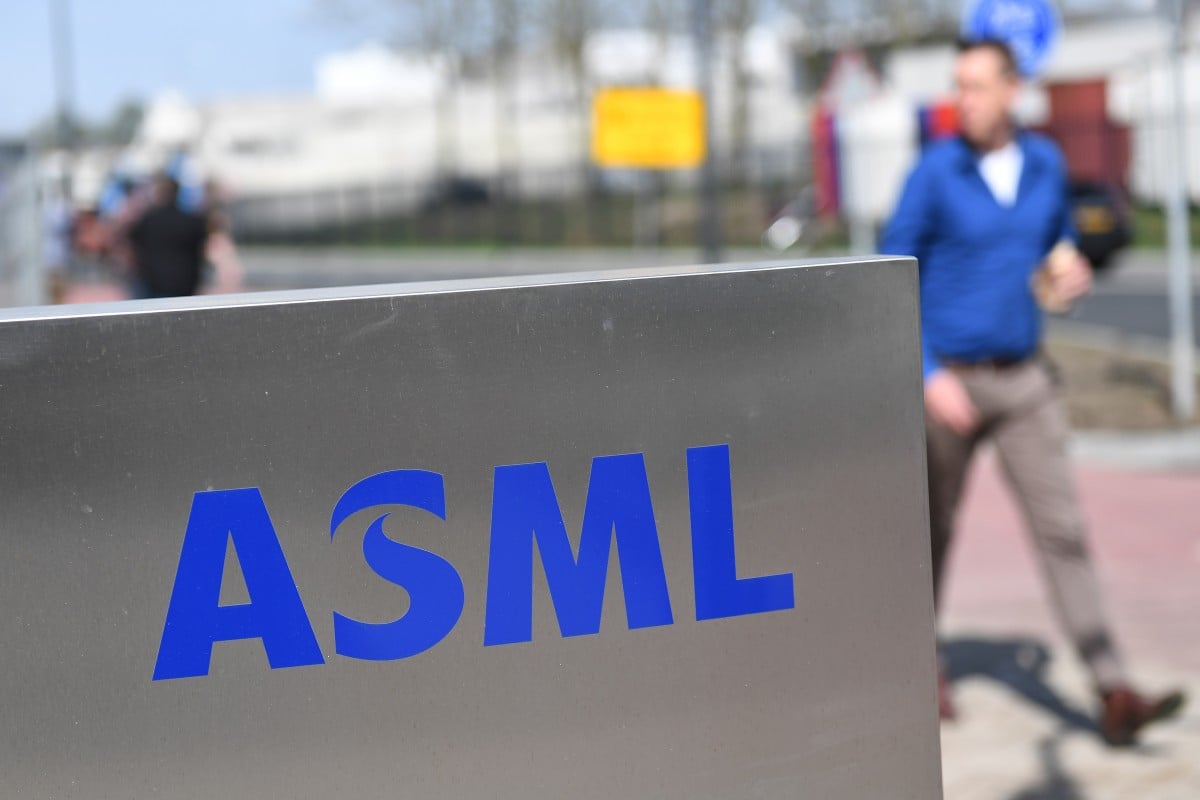
A newspaper in the Netherlands claims to have found evidence that six employees of Dutch semiconductor giant ASML passed corporate secrets to a company linked to the Chinese government. Photo: AFP
An investigation by a financial newspaper in the Netherlands has concluded that Chinese employees stole corporate secrets from Dutch semiconductor equipment giant ASML, resulting in hundreds of millions of dollars in losses.
The daily newspaper, Het Financieele Dagblad, reported on Thursday that ASML itself had “found no hard proof of involvement of the Chinese government” but that its own probe had determined that stolen technology had been ultimately leaked to a state-linked company.
According to the newspaper report, high-level Chinese employees in the research and development department of ASML’s US subsidiary were behind the breach.

An ASML spokeswoman said the company was aware of the report and was preparing a response.

The chip maker caught in US assault on China’s tech ambitions
ASML is the dominant maker of lithography systems, used to trace out the circuitry of semiconductor chips.
The newspaper based its report partly on company sources and partly on a November 2018 ruling by a California court in a suit between ASML’s US subsidiary and a subsidiary of a Chinese company, XTAL Inc.

The documents from the California Superior Court in Santa Clara show six former ASML employees, all with Chinese names, breached their employment contracts by sharing information on ASML software processes with XTAL, according to the report.

“The FDs investigation found XTAL’s Chinese parent company Dongfang Jingyuan has ties with the Chinese Ministry of Science and Technology,” the newspaper said.

The court awarded ASML US$223 million in damages and XTAL filed for bankruptcy a month later.

The Dutch intelligence agency has included warnings in its annual threat assessments for the past several years, saying that China is targeting tech companies in the Netherlands, as it does in other countries, for intellectual property theft.

In 2015, ASML disclosed a breach of its computer systems, but said at the time damage from the hack was limited and released few further details.

ASML’s sales to China doubled to 1.8 billion euros (US$2 billion) in 2018 from 919 million euros in 2017 as Beijing makes growth of its semiconductor industry a priority.

ASML CEO Peter Wennink said in January he saw no let-up in demand from China, despite an economic slowdown.

Source: SCMP

10/04/2019

Dalai Lama recovers from chest infection in hospital

NEW DELHI (Reuters) – The Tibetan spiritual leader, the Dalai Lama, was admitted to hospital in the Indian capital of New Delhi with a chest infection, but is doing fine, an aide said on Wednesday, as social media users prayed for the Buddhist monk’s fast recovery.

The 83-year-old Nobel peace laureate, who fled to India in early 1959 after a failed uprising against Chinese rule, lives in exile in the northern hill town of Dharamshala.

“His Holiness is doing fine now,” Tseten Samdup Chhoekyapa, the Dalai Lama’s press secretary, told Reuters, without giving details.

The Dalai Lama, who was diagnosed with a chest infection after being admitted to hospital on Tuesday, complaining of discomfort, will spend a few days in hospital, his personal secretary said.

A hospital official declined to comment on his medical condition, citing patient confidentiality.

Many of his supporters posted messages on social media wishing him a speedy recovery.

“Concerned that he has been hospitalised,” tweeted Naveen Patnaik, chief minister of India’s eastern state of Odisha.

“The world needs him.”

About 100,000 Tibetans live in India and many worry that their fight for a genuinely autonomous homeland would end with the Dalai Lama.

He told Reuters last month his incarnation could be found in India after he dies, and warned that any other successor named by China would not be respected.

But many Tibetans, whose tradition holds that the soul of a senior Buddhist monk is reincarnated in the body of a child on his death, suspect any Chinese role as a ploy to exert influence on the community.
In Beijing, foreign ministry spokesman Lu Kang told a regular news briefing he was not aware of the Dalai Lama’s physical condition, but added, “The reincarnation of the Dalai Lama should follow the relevant Chinese laws, regulations and religious rituals.”
Source: Reuters
09/04/2019

Assertive EU to face resistant China at trade-focused summit

BRUSSELS (Reuters) – Chinese Premier Li Keqiang and EU institution leaders meet in Brussels on Tuesday for an annual EU-China summit set to be overshadowed by differences over trade and investment.

After years of offering free access to its markets, the European Union has said it is losing patience with Beijing over the pace of liberalising reforms. It also has growing concerns over state-led Chinese companies’ dominance of some EU markets and acquisitions of strategic industries.

Like the United States, many EU countries want to crack down on industrial subsidies and forced technology transfers, although prefer dialogue to the trade war Washington has triggered.

The European Commission set out a 10-point action plan last month, seeing scope for greater cooperation in fields such as climate change, but demanding greater reciprocity, such as access for EU firms to Chinese public tenders.

“The old narrative is absolutely obsolete,” Commission Vice President Jyrki Katainen told Reuters.

Beijing and Brussels have been wrestling for weeks over the text of a joint declaration to be presented as the fruit of Tuesday’s summit between Li and Commission President Jean-Claude Juncker and European Council chief Donald Tusk.

“China aims to have a feel-good summit, whereas we aim to have a meaningful summit, with a meaningful outcome,” Peter Berz, acting Asia director at the Commission’s trade section, told the European Parliament last week.

EU diplomats said on Monday negotiators had made some progress, but were still short of an agreed text. Talks would continue until the summit, due to start at 1 p.m. (1100 GMT).

China points to a new foreign investment law due to take effect at the start of 2020. It includes provisions to ban forced technology transfers and ensure foreign companies have access to public tenders.

EU officials say the law lacks detail and question how effective it will be in reality in protecting foreign firms.
Li wrote in a German newspaper on Monday that China wanted to work with the European Union on issues including trade and denied Beijing was trying to split the bloc by investing in eastern European states.
Source: Reuters
08/04/2019

China to avoid debt burden for BRI participating countries: envoy

AMMAN, April 7 (Xinhua) — Li Chengwen, ambassador for China-Arab States Cooperation Forum Affairs of China’s Foreign Ministry, refuted on Sunday the criticism that China’s Belt and Road Initiative (BRI) will create so-called “debt trap” for some participating countries.

“China is trying to find mechanisms to avoid the ‘debt trap,'” Li said during a session on the second day of the World Economic Forum on the Middle East and North Africa 2019 held in the Dead Sea area of Jordan.

The Chinese envoy was responding to the criticism directed at the BRI by some people in the United States and Europe ahead of the second Belt and Road Forum for International Cooperation, due to be hosted by China later this month in Beijing.

The initiative, proposed by China in 2013, aims at building a trade and infrastructure network connecting Asia with Europe and Africa along the ancient trade routes of the Silk Road to seek common development and prosperity.

As of July 2018, more than 100 countries and international organizations had signed Belt and Road cooperation documents with China, extending the initiative’s scope from the Eurasian continent to Africa, Latin America and the Caribbean, and the South Pacific region.

Li pointed out that no participating country has complained of falling into the so-called “trap” of Chinese loans.

“The Belt and Road Initiative aims to increase the economic prosperity of a country. It does not aim at expanding the political and geographical authority of China in the world,” he said.

Many participants at the forum in Jordan agreed with Li’s comments.

“If you keep your interest first, you will not find China an unfair partner,” said Shandana Gulzar Khan, Pakistan’s parliamentary secretary for commerce. “But it depends on how well you do your homework.”

In Pakistan, a major BRI participating country, the China-Pakistan Economic Corridor has created tens of thousands of jobs and revived the economy of an entire region, Khan noted.

Speaking at the session, He Wenping, a research fellow of the Institute of West-Asian and African Studies, Chinese Academy of Social Sciences, echoed Li’s remarks.

“The biggest worry on the ‘debt-trap diplomacy’ should come from China’s side, not from outside. It is tax payers’ money,” the Chinese professor said.

“China is not waving the ‘China First’ flag,” she said.

The upcoming Belt and Road forum to be held in Beijing later this month could be an opportunity to kickstart a “second phase” of the initiative, she added.

Source: Xinhua

08/04/2019

China pledges to remove ‘unreasonable barriers and restrictions’ to help SMEs amid trade war

  • The mainland government will also seek to create a level playing field for businesses, most of which are privately-owned, in terms of market entry and regulation
  • Small and medium-sized firms are vulnerable to trade disputes and an economic slowdown even though they contribute the majority of growth and employment
China plans to make it easier and cheaper for businesses to access credit through subsidies and certain bank loans, according to a comprehensive policy guidelines jointly released by the Central Committee and the State Council on Sunday. Photo: Alamy
China will “remove all sorts of unreasonable barriers and restrictions” to help small and medium-sized enterprises which are seen as vital to help employment and economic growth amid the trade war with the United States.
Beijing plans to make it easier and cheaper for businesses to access credit through subsidies and certain bank loans, according to a comprehensive policy guidelines jointly released by the Central Committee of the Communist Party of China and the State Council on Sunday.
The mainland government will also seek to create a level playing field for businesses, most of which are privately-owned, in terms of market entry and regulation.

“Small and medium-sized enterprises is an dynamic power for national economic and social important and is critical for expanding employment, improving people’s livelihood, and to foster innovation,” the guidelines said. “For now, they are facing problems of rising production costs, difficulty in obtaining credit and insufficient capabilities to innovate – these issues demand high attention.”

China will “remove all sorts of unreasonable barriers and restrictions, trying to ensure fair competition and provide sufficient market in terms of market entry, licensing, bidding and the military-civil infusion,” it added.

While most of the policies are not completely new, the move to pull them together into a larger policy document, which will serve as a guideline for local authorities, shows China’s intention to stabilise the domestic economic situation as its trade disputes with the US continues.

Beijing has also designed a variety of financial policy tools, including targeted required reserve ratio cuts and the use of small and medium-sized enterprise loans as collateral for medium-term lending facilities granted by the central bank, meaning banks will have more incentives to offer financing.

To further boost lending, it will also offer some exemptions for interest received from value added tax, while also providing tax breaks for small firms and start-ups, a lower social security contribution ratio and an increase in government procurement, according to the guidelines.

Small and medium-sized enterprises is an dynamic power for national economic and social important and is critical for expanding employment, improving people’s livelihood, and to foster innovation.New guidelines

The need for the Chinese government to support small businesses became even more obvious last summer when it began its trade was with the US. Small private businesses are more vulnerable to trade disputes and an economic slowdown than state-owned enterprises, which are often bigger and enjoy favourable treatments from the government and banks, even though they contribute the majority of growth and employment.
Employment is the top priority on the agenda of Premier Li Keqiang this year, as shown in his government work report revealed last month. China has vowed to create 11 million new urban jobs this year and cap the surveyed urban unemployment rate at 5.5 per cent.
Morgan Stanley economists noted that China’s real gross domestic product growth may slow to 6.2 per cent in the first quarter.
“The main drag is slower investment growth, led by property construction and manufacturing [capital expenditure] amid still-subdued export and business sentiment,” Morgan Stanley economists Robin Xing, Jenny Zheng and Zhipeng Cai said.
The National Bureau of Statistics is due to release the first quarter economic data on April 17.
Source: SCMP
07/04/2019

East China city to open direct flights to Tokyo, Seoul

HANGZHOU, April 6 (Xinhua) — The city of Ningbo in east China’s Zhejiang Province will launch direct flights to Tokyo and Seoul this year, the city’s Lishe International Airport said.

Sources with the airport said it would also increase flights to domestic cities like Beijing and Qingdao in 2019.

Ningbo has one of the busiest ports in the world.

The airport is expanding its terminal facilities amid a surging passenger volume. The airport handled 11.7 million passengers in 2018, a yearly increase of 24.8 percent.

Source: Xinhua

07/04/2019

Greece says EU’s China concerns must not harm its economic interests

  • Deputy prime minister Yannis Dragasakis hopes ‘logic will prevail’ ahead of EU-China summit
  • Affirms Greek support for Beijing’s belt and road plan for global trade
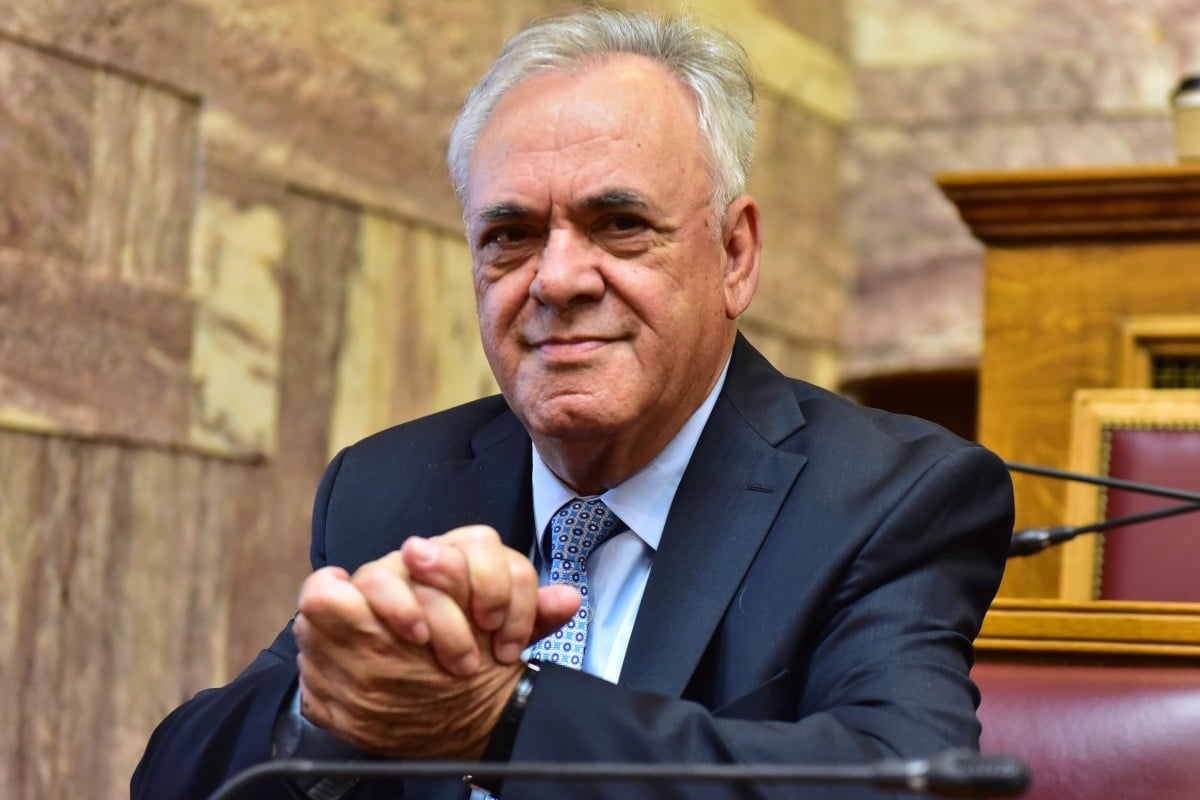
Greece’s deputy prime minister Yannis Dragasakis says the European Union’s suspicion about China is in danger of becoming a “self-fulfilling prophecy”. Photo: Alamy
The deputy prime minister of Greece has warned that European Union suspicion of China is in danger of becoming a “self-fulfilling prophecy” while reaffirming his country’s support for Beijing’s controversial “Belt and Road Initiative”.
In an exclusive interview with theSouth China Morning Post in Athens on Monday, Yannis Dragasakis said he hoped logic would prevail in the EU’s relationship with the world’s second-largest economy.
“We would like to see the EU having good relations with China,” he said.
“Seriously, we should start [the discussion about China] from the opposite end, which is, what are the needs and problems that we can work on with China?”
Dragasakis was speaking ahead of the annual summit between the EU and China in Brussels on Wednesday, which this year will take place against a backdrop of suspicion among some EU countries over Beijing’s political and commercial ambitions in the region.
Europe has been divided over whether to work with China’s enormous belt and road plan, which aims to link China by sea and land with southeast and central Asia, the Middle East, Europe and Africa, through an infrastructure network along the lines of the old Silk Road.
Italy becomes first G7 nation to sign up for China’s belt and road plan

Washington has criticised the scheme as a “vanity project”, and the EU looks set to refer to China as a “strategic rival”, with some European leaders fearing Beijing’s diplomatic manoeuvres could derail unity among member states.

Last month Italy, which is grappling with its third recession in a decade, became the first G7 nation to join the belt and road programme, in a bid to boost exports and upgrade its port facilities.

Last year Greece – ranked second lowest in economic competitiveness within the EU by the World Economic Forum in 2018 – signed up to the scheme, after years of relying on China to help it through its own financial crisis.

Chinese state-owned shipping company Cosco bought a 51 per cent stake in Pireaus Port, Greece’s most important infrastructure hub in 2016 with an option to buy another 16 per cent after five years.

China aims to make the port the “dragon head” of its belt and road programme, serving as a gateway for its cargo to Europe and North Africa.

Will Greece be China’s bridge to the rest of Europe?

With its warming relationship with Beijing, Athens has, at times, departed from EU positions on China.

In 2016, Greece helped stop the EU from issuing a unified statement against Chinese aggression in the South China Sea. The following year, Athens stopped the bloc from condemning China’s human rights record. Days later, it opposed tougher screening on China’s investments in Europe.

Dragasakis was clear that the EU should not devise any policies that may hinder Greece’s ability to revive its economy.

“Greece badly needs investment. We hope logic will prevail at the end of the day, which means we should take advantage of all opportunities and build on these prospects to further our collaboration,” he said.

“Greece will keep following a multidimensional policy, an inclusive policy, without excluding anyone.”

Dragasakis hit back at France and Germany for treating China as a geopolitical rival, while simultaneously signing up to trade agreements with Beijing.

Days before receiving Chinese President Xi Jinping in France last month, President Emmanuel Macron declared that the “time of European naivety” towards China was over – a remark the Greek deputy prime minister described as “interesting” during the interview.

“It’s so interesting, yes. Mr Macron, despite his statement, actually signed very large-scale agreements with China,” he said, adding: “Germany, the same”.

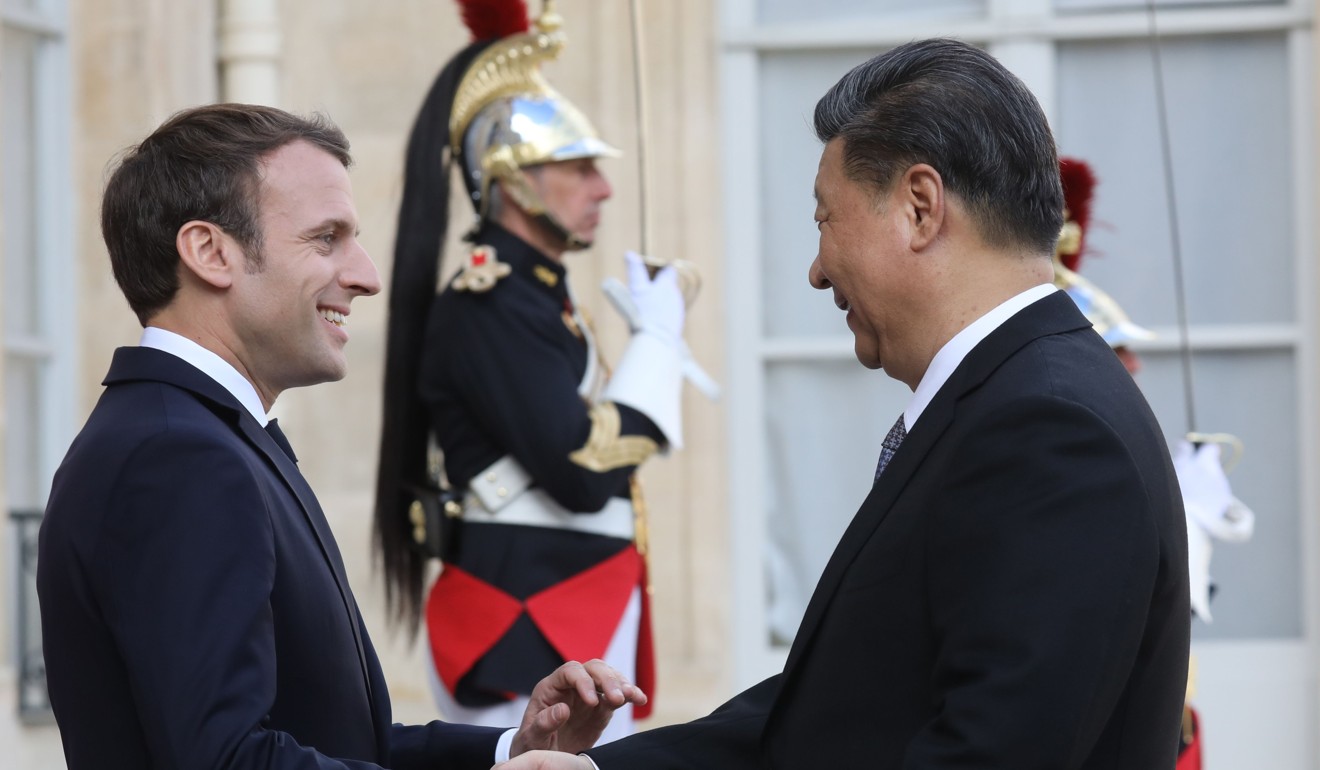
French President Emmanuel Macron welcomes Chinese President Xi Jinping to the Elysee Palace in Paris last month. Photo: AFP

Macron invited German Chancellor Angela Merkel and European Commission President Jean-Claude Juncker to his meeting in Paris with Xi, where the four sought to reassure each other over economic cooperation between the European trading bloc and China.

Dragasakis said Greece’s relations with China were based on “very solid ground” with the two countries sharing complementary interests, particularly through the belt and road plan.

Greek Prime Minister Alexis Tsipras is understood to be considering joining Foreign Minister George Katrougalos at the belt and road summit in Beijing, which will be hosted by Xi later this month.

More than 40 heads of state are expected to attend the summit, with China’s foreign ministry recently saying that Europe had started to see the value of the scheme.

If confirmed, Tsipras’ presence at the summit will be interpreted as an attempt by Greece to consolidate Chinese support in the wake of Italy’s joining of the scheme.

He will also need to mend ties with Beijing, following a recent decision by Greece’s archaeological body to block a plan by Cosco to upgrade facilities at the Piraeus port, throwing the future of the multimillion euro privatisation deal into uncertainty.

Portugal’s support for China’s belt and road plan ‘bad news’ for EU

Dragasakis said there were strong prospects for the future relationship between Greece and China because of the two countries’ reciprocal interest.

Relations with other Asian countries, while not yet as close as Greek ties with China, would continue to be developed, he said.

Dragasakis said Athens would not adopt discriminatory policies against any country as it looked to shore up foreign investments to boost its economy.

India, for instance, has set its sights on Greece as a potential business partner, with President Ram Nath Kovind becoming its first titular head of state to visit Greece last year.

“Relations with India are lagging behind – they are not at the same level as with China, but of course we are mulling further developments with India,” Dragasakis said, adding that Greece would also work more closely with Japan, South Korea and Vietnam.

EU leaders hold out olive branch to Chinese ‘rival’ by saying they want active role in Belt and Road Initiative

EU leaders hold out olive branch to China over belt and road

Read more

China will not divide Europe, senior diplomat says

China will not divide Europe, senior diplomat says

Read more

Beijing calls for ‘objective’ assessment of human rights record.


Source: SCMP

05/04/2019

China Focus: Funeral reform fosters new trends in China

BEIJING, April 5 (Xinhua) — “The air and environment in the cemetery have been notably improved, with less people burning joss paper,” said Wang Fang, a tomb sweeper from Yinchuan, Ningxia Hui Autonomous Region.

This year’s Tomb Sweeping Day, which falls on Friday, witnesses more changes, as China has made various efforts to reform funeral traditions in recent years, and ecological burial and environmentally friendly tomb sweeping practices are increasingly popular.

GREENER BURIAL

In a tea garden in Hangzhou in east China’s Zhejiang Province, there stands a hidden cemetery where burial plots are built under tea trees in a bid to enlarge its green area as well as conserve land.

“It would be good to return to nature here after I pass away,” said a local resident surnamed Wu.

China has seen progress in ecological burials in recent years, especially in developed cities. The first model ecological cemetery of Beijing has been built in Babaoshan Revolutionary Cemetery, with a green coverage rate of nearly 90 percent.

Currently, ecological burials in first-tier cities, including Beijing, Shanghai and Guangzhou, takes up more than 20 percent of the total. It is expected that by 2020, the share of ecological burial across the country reach over 50 percent.

In addition, tomb sweeping practices have become greener. Most tomb sweepers would rather present flowers at tombstones than burn joss paper to pay tribute to their deceased families and friends.

On Tomb Sweeping Day, some cemeteries hold cultural activities, such as calligraphy and painting exhibitions as well as poetry recitals as an alternative to tomb sweeping.

LAND CONSERVATIVE

Besides the “tea garden burial,” other ecological burial methods in China include tree, flower, wall and sea burials.

Replacing traditional tombstones with trees and flower beds, putting urns on shelves in walls or just dropping ashes into the sea requires less or even no land.

“At first people said it was for those in financial difficulties to save money, but as time changes, the popularity of ecological burials have increased,” said Zhao Quansheng, manager of a Yinchuan-based cemetery.

“A customer told us that his father voluntarily asked for an ecological burial to conserve land,” Zhao said.

Non-profit cemeteries are also thriving in places of separate burial traditions. In Yishui County, east China’s Shandong Province, 110 non-profit cemeteries have been built, leading to conservation of large areas of land that otherwise would be utilized for burial sites.

Xue Feng, Party secretary of Yishui, said it used to take about 20 to 27 hectares of land to accommodate all the private tombs in the county, but now it only needs 10 percent of that.

LESS MONEY

China has beefed up funeral infrastructure and public services, with the number of funeral parlours and cemeteries reaching 1,760 and 1,420, respectively.

Since 2009, the Ministry of Civil Affairs has pushed forward fee reduction in basic public funeral services as well as other preferential policies, benefiting low-income groups. For example, commercial cemeteries in Chongqing, Gansu and Ningxia were required to set aside part of their burial sites as non-profits for those with financial difficulties.

“Now the whole funeral is free, including the urn and burial site, which is a great help for households with low incomes like us,” said Yuan Li, a rural resident from Yishui, where funeral services have been free of charge since 2017.

Xue said the fee-reduction policy could save the public nearly 200 million yuan (about 30 million U.S. dollars) annually.

The Ministry of Civil Affairs issued a pilot plan for funeral reform in 2017, and released guidelines with another 14 authorities on further reform in 2018.

“The funeral reforms help encourage fine and up-to-date practices and trends, and make contributions to land and ecological conservation,” said Ma Guanghai, sociology professor of Shandong University. “It is an important aspect of social progress.”

Source: Xinhua

Law of Unintended Consequences

continuously updated blog about China & India

ChiaHou's Book Reviews

continuously updated blog about China & India

What's wrong with the world; and its economy

continuously updated blog about China & India