Archive for ‘Belt and Road Initiative (BRI)’

17/04/2019

Belt and Road Initiative presents Malaysia with exciting opportunities: deputy minister

KUALA LUMPUR, April 16 (Xinhua) — The Belt and Road Initiative (BRI) proposed by China presents Malaysia with numerous exciting opportunities especially in areas of strategic collaboration and joint ventures, Malaysian International Trade and Industry Deputy Minister Ong Kian Ming said on Tuesday.

Speaking at the Belt and Road Forum 2019 – Expectations and Opportunities for Malaysia, Ong said there were several strategic areas of focus for Malaysia within the context of BRI.

He listed the food industry, joint research and development in the high-tech sectors and the capitalisation of Malaysia’s strategic location to enhance the country’s connectivity with China, all as means to generate greater local interest and participation in BRI.

“Given the popularity of Malaysia’s food and Beverage (F&B) products among Chinese consumers, it is only natural that we would want to capitalize on this advantage so that more Malaysian made products can find their way into the Chinese market,” he said.

Ong added that it was imperative for Malaysian government to play a major coordination role so to ensure that companies in Malaysia, from large government linked ones to small and medium-sized enterprises, in order to take advantage of the opportunities available.

“There is much to be excited about with regard to the economic opportunities presented by BRI for all the parties and stakeholders involved. We can all play a proactive and productive role in building the ‘community of common destiny'”.

“This vision of a shared prosperity in the context of multilateral cooperation is more important now than ever, given the uncertainties surrounding the global economy and existing push back against multilateralism,” he said.

Proposed in 2013, the Belt and Road Initiative aims to build trade and infrastructure networks connecting Asia with Europe and Africa on and beyond the ancient Silk Road routes. It comprises the Silk Road Economic Belt and the 21st Century Maritime Silk Road.

15/04/2019

China, Japan hold 5th high-level economic dialogue

CHINA-BEIJING-JAPAN-HIGH-LEVEL ECONOMIC DIALOGUE (CN)

Chinese State Councilor and Foreign Minister Wang Yi co-chairs the fifth high-level economic dialogue between China and Japan with visiting Japanese Foreign Minister Taro Kono in Beijing, capital of China, April 14, 2019. (Xinhua/Li Tao)

BEIJING, April 14 (Xinhua) — Chinese State Councilor and Foreign Minister Wang Yi on Sunday co-chaired the fifth high-level economic dialogue between China and Japan with visiting Japanese Foreign Minister Taro Kono in Beijing.

Hailing that China-Japan relations has returned to the right track and yielded new achievements by the joint efforts of the two countries’ leaders and people of all social circles, Wang said the fourth high-level economic dialogue, which was restarted after an eight-year hiatus last April, facilitated policy communication and pragmatic cooperation effectively.

This year marks the 70th anniversary of the founding of the People’s Republic of China, while Japan will enter the new era “Reiwa”, Wang said, adding that the two countries should uphold the major consensus reached by the two countries’ leaders and jointly construct bilateral economic relations to meet the needs of the new era.

The two sides should make steady headway in promoting bilateral investments and trade cooperation, jointly build the Belt and Road, and actively explore third party market cooperation as well as local cooperation, Wang said.

He also called for consolidating the cooperation results in such areas as energy conservation and environment protection, science and technology innovation, high-end manufacturing, finance, sharing economy, medical care and elderly care industries.

Wang said that China and Japan should make joint efforts to promote trade and investment liberalization and facilitation, uphold a business environment of fairness, justice and non-discrimination, speed up negotiations on the Regional Comprehensive Economic Partnership and China-Japan-ROK free trade agreement, and safeguard multilateralism and free trade regime.

Kono said that economic cooperation has been an important foundation and driving force for Japan-China relations.

Facing a global situation of intense uncertainty, the two sides should jointly safeguard the multilateral trade mechanism based on rules, he said.

During the dialogue, senior foreign affairs and economic officials of both countries exchanged views and achieved a series of consensus on macroeconomic policies, bilateral economic cooperation and exchanges, regional economic integration, and global economic governance.

Before the dialogue, Wang and Kono jointly attended the opening ceremony of the “China-Japan Youth Exchange Promotion Year.”

Source: Xinhua

13/04/2019

China’s trade boom and building frenzy of ports help home-grown producers corner the world market of containers and cranes

  • Shanghai Zhenhua Heavy Industries now exports quay cranes, gantry cranes to more than 300 ports in 100 countries, with 70 per cent of the global market
  • China International Marine Containers Group (CIMC), took a little more than a decade to become the world’s largest maker of shipping containers
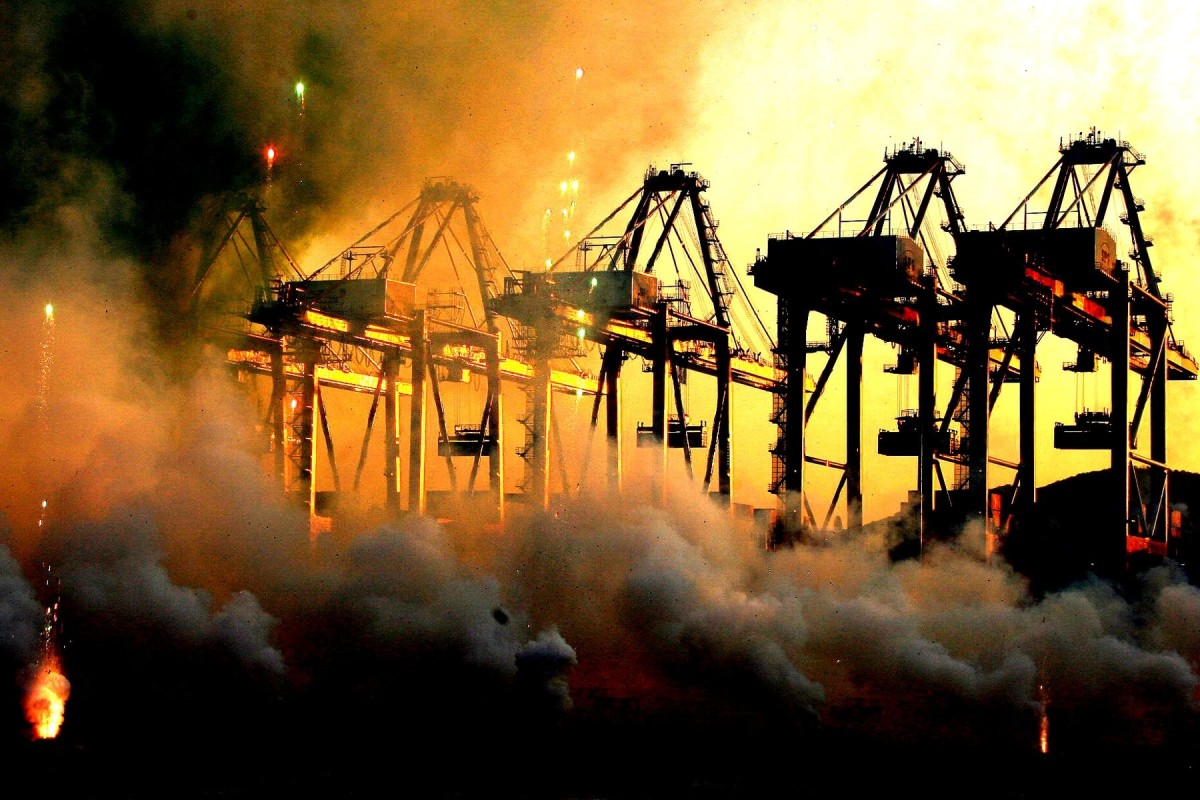
Quay cranes along a berth at the Yangshan deep-water port in Shanghai on September 14, 2011. Shanghai Zhenhua Heavy Machineries, established in 1992, has grown along with the explosive development of China’s ports to control 70 per cent of the global market for cranes, loaders and lifting equipment used in ports. Photo: Xinhua
The explosive growth of China’s container ports has turned one of the most important vendors in shipping into a best-in-class industry leader, whose cranes can now be found in 300 wharves in 100 countries, with 70 per cent of the global market share.
Shanghai Zhenhua Heavy Industries, a unit of China’s state-run construction behemoth China Communications Construction Company, makes quay cranes, gantry cranes, loaders and stackers used for loading and unloading shipping containers. It also developed the infrastructure for the automated berths in Phase IV of Shanghai’s Yangshan port, and in Qingdao.
Its net profit jumped 47.6 per cent last year to 443 million yuan, while sales was little changed at 21.8 billion yuan (US$3.25 billion).

“It is a major showcase of China’s manufacturing capability,” said Sun Can, a Chuancai Securities analyst. “The company has its own technologies and is a powerful player in the global port machinery industry.”

Why China now has six of the world’s 10 busiest container ports
Established in 1992, the company was formerly known as Zhenhua Port Machinery for its speciality in making lifting equipment on the harbourfront. Taking advantage of China’s low wages, Zhenhua quickly carved out a big chunk of the global market share by selling machines at lower prices than its competitors.
The company’s former chief executive Guan Tongxian, a confessed workaholic known for his hard-driving working ethic, retired at the age of 76 in 2009, the same year that the company renamed itself to reflect its forays into marine transport and installations, as well as the construction of special steel structures including the Las Vegas Ferris wheel, the San Francisco-Oakland Bay Bridge and Norway’s Hardangerfjord bridge.
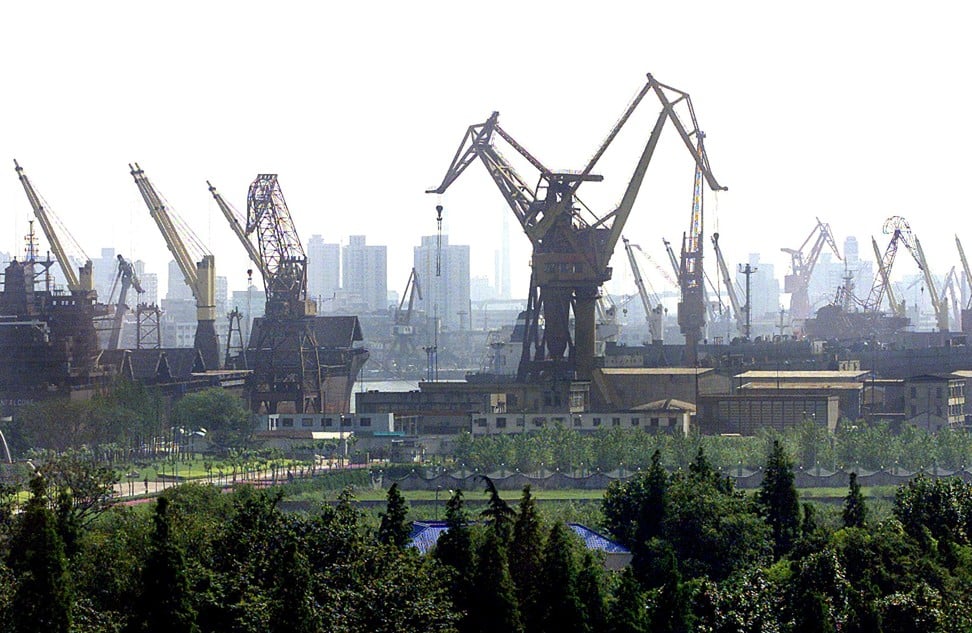
Rows of gantry cranes standing along the Huangpu River in Shanghai on 26 June 2002. A consortium of Chinese domestic banks provided a 17 billion yuan (US$2 billion) credit line toward the construction of Shanghai's Yangshan deep-sea container port. Photo: AFP
Rows of gantry cranes standing along the Huangpu River in Shanghai on 26 June 2002. A consortium of Chinese domestic banks provided a 17 billion yuan (US$2 billion) credit line toward the construction of Shanghai’s Yangshan deep-sea container port. Photo: AFP

Listed on the Shanghai exchange in 1997, Zhenhua’s shares have risen 41 per cent in the past 12 months, ending 2.1 per cent lower at 4.46 yuan on Friday. All three analysts who cover the stock recommend their clients either “buy” or “accumulate” the stock, expecting Zhenhua to be a major winner in China’s megaplan to build infrastructure along the old Silk Road in its Belt and Road Initiative (BRI).

Another major company that has emerged with China’s rising tide was China International Marine Containers (Group), or CIMC, a unit of the state-run conglomerate China Merchants Group. Established in 1980, the company took a little more than a decade to dominate the global industry, becoming the world’s largest maker of shipping containers since 1996.

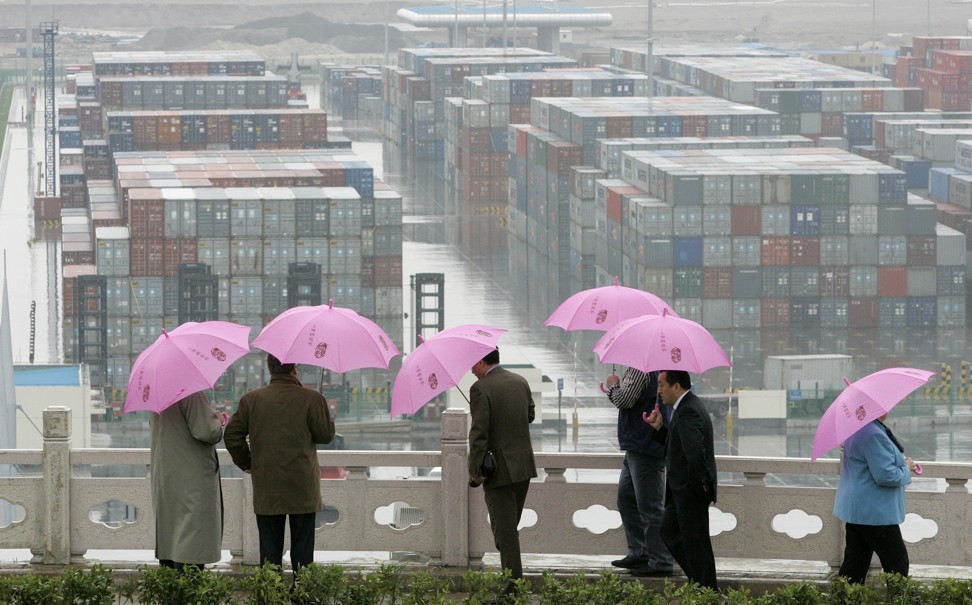
Visitors look at rows of containers at the Yangshan deep water port in Shanghai on April 6, 2006. Photo: AP

Guosen Securities said in a research report that CIMC would face lower profit margin this year amid rising raw material costs and fiercer competition from global rivals.

Its shares have risen 43.7 per cent in the past 12 months on the Shenzhen exchange to 15.20 yuan as of Friday.

Source: SCMP

11/04/2019

China to enhance BRI cooperation with Croatia: premier

CROATIA-ZAGREB-CHINA-LI KEQIANG-PM-TALKS

Chinese Premier Li Keqiang (L, front) attends a grand welcome ceremony held by Croatian Prime Minister Andrej Plenkovic (R, front) at the St. Mark’s Square in Zagreb, Croatia, April 10, 2019. Li held talks with Plenkovic in the Croatian capital of Zagreb on Wednesday. (Xinhua/Shen Hong)

ZAGREB, April 10 (Xinhua) — China is ready to enhance the synergy of the Belt and Road Initiative (BRI) with Croatia’s development strategies, Chinese Premier Li Keqiang said on Wednesday.

Li made the remarks when holding talks with Croatian Prime Minister Andrej Plenkovic in the Croatian capital of Zagreb.

Hailing the long-term friendship between the two countries, Li said China and Croatia have enjoyed a healthy and sound development of bilateral relations since the establishment of diplomatic ties.

He said China stands ready to work with Croatia to strengthen mutually beneficial and win-win cooperation and carry on friendship on the basis of mutual respect, equity and mutual trust, so as to explore new dimensions for bilateral relations and push forward bilateral cooperation to a new level.

On practical cooperation, Li said China is ready to expand the scale of two-way trade, boost the level of two-way investment, and increase the import of Croatian specialty products that suit the demands of the Chinese market, and deepen people-to-people exchanges including culture and tourism.

“China will support its companies to participate in the construction of Croatian ports and railways in line with market principles,” Li said.

The Chinese premier is scheduled to inspect the Peljesac Bridge project with his Croatian counterpart on Thursday. The bridge, which used European Union (EU) standards and funds, is contracted by a Chinese company through bidding.

“The Peljesac Bridge project is a model of tripartite cooperation among China, Croatia and the EU, and realizes mutual benefits and win-win results,” Li said.

Li stressed that the 16+1 cooperation mechanism has played an important role in enhancing cooperation between China and 16 Central and Eastern European Countries (CEEC) and cementing the European integration process.

China appreciates Croatia’s work on facilitating 16+1 cooperation and is ready to make joint efforts with Croatia toward a successful China-CEEC leaders’ meeting, Li said.

This is the first time ever by a Chinese premier to visit Croatia since the establishment of diplomatic ties.

Plenkovic welcomed Li on the visit and said Croatia stands ready to strengthen the understanding of China’s history and culture, share China’s development opportunities, support the building of the Belt and Road so as to benefit the two countries and peoples.

Noting the high-level development of bilateral relations, Plenkovic said Croatia and China will ink a series of cooperation documents during Premier Li’s visit, which demonstrates the latest achievements of practical cooperation between the two sides.

“The Peljesac Bridge is highly rated by the Croatian people and China is Croatia’s important partner on infrastructure construction,” said the Croatian prime minister, adding that Croatia is willing to further enhance cooperation with China in politics, economy, culture, tourism and port infrastructure.

Saying he is looking forward to co-chairing the eighth leaders’ meeting of China-CEEC, Plenkovic also commended positively the outcomes of the 21st China-EU leaders’ meeting and said as an EU member, Croatia stands ready to play an active and constructive role in cementing the development of EU-China ties.

After the meeting, Li and Plenkovic witnessed the signing of multiple bilateral cooperation documents in areas including trade and investment, tourism, quality inspection and sports. The two sides also released a joint communique between the two governments.

Prior to the meeting, Plenkovic held a grand welcome ceremony at the St. Mark’s Square for Li.

Source: Xinhua

09/04/2019

Diplomat stresses efforts to bring China-Barbados cooperation to new stage

BEIJING, April 8 (Xinhua) — Chinese ambassador to Barbados Yan Xiusheng has called for efforts to promote China-Barbados cooperation to a new stage.

In the article, carried by Monday’s People’s Daily, Yan said the two countries signed a Memorandum of Understanding (MOU) on jointly advancing the Belt and Road Initiative (BRI) in February, making Barbados the first new partner to join the BRI in 2019.

“The friendly and cooperative relations between the two countries have deepened in recent years, showing a good trend of upgrading quality and accelerating speed,” Yan said.

Political mutual trust between the two sides has been strengthened, pragmatic cooperation has been steadily advancing and people-to-people and cultural exchanges have seen many highlights, he explained.

As an important partner of China in the Caribbean, Barbados attaches great importance to international cooperation within the framework of the BRI, the article read.

The signing of the MOU between the two countries has brought new opportunities for further development of bilateral relations and practical cooperation in various fields, Yan noted.

Under the framework of the BRI and guided by the principle of consultation, collaboration and benefit for all, both sides will give full play to their comparative advantages and tap into their potential for cooperation in the fields including shipping, aviation, infrastructure and modern agriculture, he said.

Efforts will be made to achieve high-quality Belt and Road cooperation and push China-Barbados friendship and cooperation into a new stage, said the article.

Source: Xinhua

08/04/2019

China to avoid debt burden for BRI participating countries: envoy

AMMAN, April 7 (Xinhua) — Li Chengwen, ambassador for China-Arab States Cooperation Forum Affairs of China’s Foreign Ministry, refuted on Sunday the criticism that China’s Belt and Road Initiative (BRI) will create so-called “debt trap” for some participating countries.

“China is trying to find mechanisms to avoid the ‘debt trap,'” Li said during a session on the second day of the World Economic Forum on the Middle East and North Africa 2019 held in the Dead Sea area of Jordan.

The Chinese envoy was responding to the criticism directed at the BRI by some people in the United States and Europe ahead of the second Belt and Road Forum for International Cooperation, due to be hosted by China later this month in Beijing.

The initiative, proposed by China in 2013, aims at building a trade and infrastructure network connecting Asia with Europe and Africa along the ancient trade routes of the Silk Road to seek common development and prosperity.

As of July 2018, more than 100 countries and international organizations had signed Belt and Road cooperation documents with China, extending the initiative’s scope from the Eurasian continent to Africa, Latin America and the Caribbean, and the South Pacific region.

Li pointed out that no participating country has complained of falling into the so-called “trap” of Chinese loans.

“The Belt and Road Initiative aims to increase the economic prosperity of a country. It does not aim at expanding the political and geographical authority of China in the world,” he said.

Many participants at the forum in Jordan agreed with Li’s comments.

“If you keep your interest first, you will not find China an unfair partner,” said Shandana Gulzar Khan, Pakistan’s parliamentary secretary for commerce. “But it depends on how well you do your homework.”

In Pakistan, a major BRI participating country, the China-Pakistan Economic Corridor has created tens of thousands of jobs and revived the economy of an entire region, Khan noted.

Speaking at the session, He Wenping, a research fellow of the Institute of West-Asian and African Studies, Chinese Academy of Social Sciences, echoed Li’s remarks.

“The biggest worry on the ‘debt-trap diplomacy’ should come from China’s side, not from outside. It is tax payers’ money,” the Chinese professor said.

“China is not waving the ‘China First’ flag,” she said.

The upcoming Belt and Road forum to be held in Beijing later this month could be an opportunity to kickstart a “second phase” of the initiative, she added.

Source: Xinhua

07/04/2019

China textile overseas investment flows to BRI region

BEIJING, April 6 (Xinhua) — Countries and regions along the Belt and Road Initiative (BRI) have become major destinations for China’s overseas investment in the textile sector, an industry association has said.

Over 80 percent of the industry’s global investment has flown to the BRI region in the past five years, according to the China National Textile and Apparel Council (CNTAC).

The textile industry can help industrial development, as well as create national wealth and employment in BRI regions, said CNTAC deputy director Xu Yingxin.

The CNTAC will facilitate international textile production capacity partnership, especially the development of overseas cooperation zones, Xu added.

Industrial data showed that China’s textile and apparel export to the BRI region continued to grow in 2018, up 5.3 percent year on year.

Source: Xinhua

07/04/2019

China’s NPC delegation visits Armenia

ARMENIA-YEREVAN-CHINA-SHEN YUEYUE-VISIT

Shen Yueyue (R), vice chairwoman of the Standing Committee of the National People’s Congress (NPC) of China, meets with Armenian President Armen Sarkissian in Yerevan, Armenia, on April 4, 2019. (Xinhua/Li Ming)

YEREVAN, April 6 (Xinhua) — A delegation led by Shen Yueyue, vice chairwoman of the Standing Committee of the National People’s Congress (NPC) of China, wrapped up a three-day visit to Armenia on Saturday.

During the visit at the invitation of the National Assembly of Armenia from Thursday to Saturday, Shen met respectively with Armenian President Armen Sarkissian, Prime Minister Nikol Pashinyan, President of the National Assembly Ararat Mirzoyan and held talks with Vice President of the National Assembly Lena Nazaryan.

In recent years, China and Armenia both witnessed a healthy and steady growth of friendly ties, and closer cooperation in such areas as economy, trade, infrastructure, and people-to-people exchanges, Shen said during her meetings with the Armenian top leaders.

China respects Armenian people’s independent choice of development path, highly appreciates Armenia’s firm support on issues concerning China’s core interest and major concerns, and will join hands with Armenia to take the opportunity of jointly building the Belt and Road to deepen practical cooperation in all fields, so as to benefit peoples of the two countries, Shen said.

Shen also called on the legislative bodies of both countries to keep close contact and deepen cooperation, and to make positive contributions to the continuous advancement and further development of the bilateral ties.

The National Assembly and government of Armenia would firmly adhere to the one-China Policy and thanked China for its support to the economic and social development of Armenia in all these years.

They are willing to deepen cooperation with China in jointly developing the Belt and Road, further promote exchanges between parliaments at all levels and lift the bilateral ties to a new level.

Source: Xinhua

06/04/2019

China, CEEC see steady trade growth

BEIJING, April 6 (Xinhua) — China and Central and Eastern European Countries (CEEC) saw steady trade growth last year as cooperation between the two sides strengthened.

Bilateral trade reached 82.23 billion U.S. dollars last year, up 21 percent year on year, according to the Ministry of Commerce (MOC).

China’s exports to the CEEC totaled 59.19 billion dollars last year, while imports reached 23.04 billion dollars, up 19.6 percent and 24.6 percent respectively, said MOC spokesperson Gao Feng.

Investment between the two sides also expanded. Chinese firms have invested over 10 billion dollars in the CEEC, while receiving more than 1.5 billion dollars from them. Bilateral investment covers sectors including auto parts, chemicals, finance and medicine.

China is willing to deepen economic and trade cooperation with the CEEC and further align the Belt and Road Initiative with CEEC national development strategies to seek win-win partnership, Gao said.

Source: Xinhua

26/03/2019

EU leaders hold out olive branch to Chinese ‘rival’ with hint they are open to Belt and Road Initiative

  • Angela Merkel says Europe is still keen to participate in infrastructure scheme despite concerns about spread of Chinese influence
  • EU Commission chief Jean-Claude Juncker seeks to reassure Chinese leader Xi Jinping that view of China as ‘strategic rival’ is a compliment
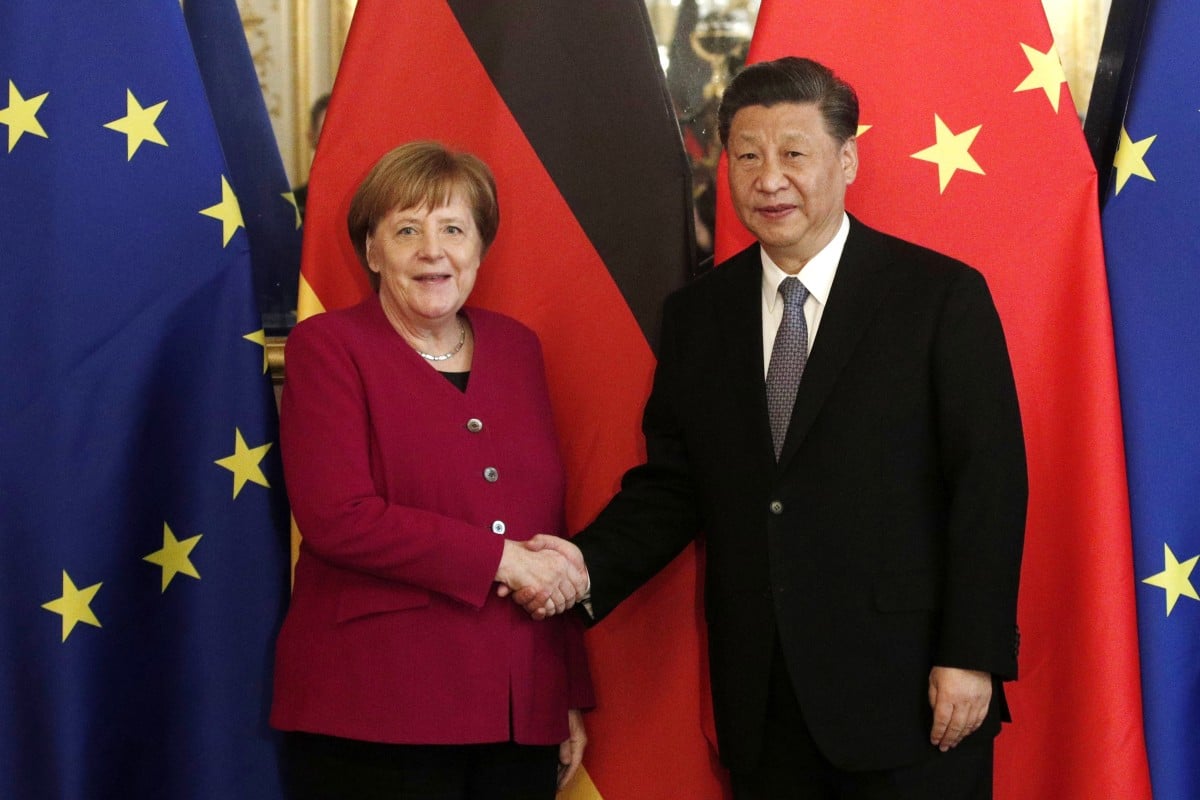
Xi Jinping and Angela Merkel and the Paris meeting. Photo: EPA-EFE

European leaders sought to reassure China over trade and cooperation on Tuesday by suggesting they were still open to joining China’s Belt and Road Initiative.

French President Emmanuel Macron, who is hosting his Chinese counterpart Xi Jinping on the final leg of his European tour, had invited German Chancellor Angela Merkel and European Commission President Jean-Claude Juncker to the meeting in Paris, where the four stressed their support for multilateralism and the pursuit of cooperation between major powers.

The visit took place amid growing European scepticism about China’s influence and follows a decision by Brussels to brand China a “systemic rival” in a policy paper earlier this month.

The scheme has caused increased concern in the West about the extent to which it will help spread Chinese influence, especially since Italy became the first G7 economy to join the project over the weekend.

But Merkel stressed it was an important project that Europeans still wanted to participate in.

She continued: “We, as Europeans, want to play an active part and that must lead to a certain reciprocity and we are still wrangling over that a bit.

“We are seeing the project as a good visualisation of interaction, interrelation and interdependence.”

Xi also said China’s process of opening up its economy to the world had allowed the country to achieve in the space of 40 years what the Europeans had managed over the course of the industrial revolution.

“We will continue to open up,” he said, “and to make the world a better open economy.”

“The Belt and Road Initiative has enriched the world’s multilateral system, we welcome all countries, including France, to join,” Xi said.

The US has also put increasing pressure on European countries to block the Chinese tech giant Huawei, which it sees as a security threat, from playing a role in European communications networks.

Despite her support for Xi’s stance on multilateralism, Merkel was still keen to express support for America’s role in upholding global order.

“The triangle between EU, China and US is very important. Without the US, we will not be able to have multilateralism. Our relations from the European side are obviously very important,” Merkel said.

However, she also noted that the trade war between the US and CHina was “hitting our German economy” and disturbing the balance.

Source: SCMP

Law of Unintended Consequences

continuously updated blog about China & India

ChiaHou's Book Reviews

continuously updated blog about China & India

What's wrong with the world; and its economy

continuously updated blog about China & India