Chindia Alert: You’ll be Living in their World Very Soon
aims to alert you to the threats and opportunities that China and India present. China and India require serious attention; case of ‘hidden dragon and crouching tiger’.
Without this attention, governments, businesses and, indeed, individuals may find themselves at a great disadvantage sooner rather than later.
The POSTs (front webpages) are mainly 'cuttings' from reliable sources, updated continuously.
The PAGEs (see Tabs, above) attempt to make the information more meaningful by putting some structure to the information we have researched and assembled since 2006.
Image copyright HONGXING NEWSImage caption A pet cafe in China’s Sichuan province lets people play with dogs dyed to look like pandas.
Animal cafes have been springing up all over the world for the last two decades as a place for animal lovers to enjoy a meal alongside their furry friends.
But a new “panda” cafe in Chengdu in south-western China – internationally known as the home of the giant panda – is raising eyebrows and a lot of concern.
According to the Chengdu Economic Daily, a cafe recently opened in Chengdu, seems at first glance to be home to six giant panda cubs.
But the “panda” cafe is – in fact – all bark and no bite because on closer inspection, it turns out they are actually the Chow Chow breed of dogs, which have been dyed to look like China’s national animal.
‘Could damage their fur and skin’
The owner of the cafe, Mr Huang, says that as well as serving food and drink, the cafe provides a dyeing service.
He tells Hongxing News that he imports his dye from Japan and has hired special staff for dyeing the dogs.
“Every time we dye it costs 1,500 yuan [$211; £163],” he says. “The dye is really expensive.” He says that this is to ensure the quality of the dye, and says that it in no way affects the animals.
Hongxing News says that a short video inside the cafe had raised awareness of it nationally and has boosted visitor figures.
But it has also raised a lot of concern. One vet, Li Daibing, told Hongxing News that he urged people not to dye their pets, saying: “This could damage their fur and skin.”
Image copyright VCGImage caption Chengdu has become a popular tourist site for seeing the vulnerable species, and national Chinese treasure: the giant panda.
‘Has become normal’
Dyeing pets became a full-blown craze in China in the early 2010s, first for competitions, but then amidst a domestic wave of “extreme dog pampering”.
Since, however, there has been a growing consciousness in China about animal ethics and testing. Many of the thousands of social media users commenting on the popular Sina Weibo microblog have voiced their concern about such treatments being used on animals.
Many call the idea “crazy” and note that hair dye can “damage people’s hair and scalp”, so could similarly affect a dog.
But others argue that “it’s really cute”, and say that they perceive animal dyeing “has become normal”.
Chengdu school teaches boys to build model rockets while girls learn about knitting
Handicrafts show at school prompts question, ‘Why can’t boys knit and girls build rockets?’
Pupils and staff at Chengdu Caotang Elementary School in Sichuan show off knitting from their Boys and Girls are Vastly Different class. Photo: Weibo
A school in southwest China that teaches boys to grow “heroically” and wants “tranquil feminine examples” for its girls has generated a heated debate about sexism.
Chengdu Caotang Elementary School in Sichuan province developed a course that teaches boys to build model rockets and girls to knit alongside mainstream subjects such as maths, languages and art, in the hope of “increasing their gender knowledge”.
The course, called Boys and Girls are Vastly Different, started last semester because school managers believed that “boys and girls have been shaped in the same way recently”, principal Fu Jin told the Chengdu Economic Daily on Monday.
That “led to boys lacking enough space to grow heroically and girls lacking gentle and tranquil feminine examples to follow, so there’s some gender dislocation”, she said.
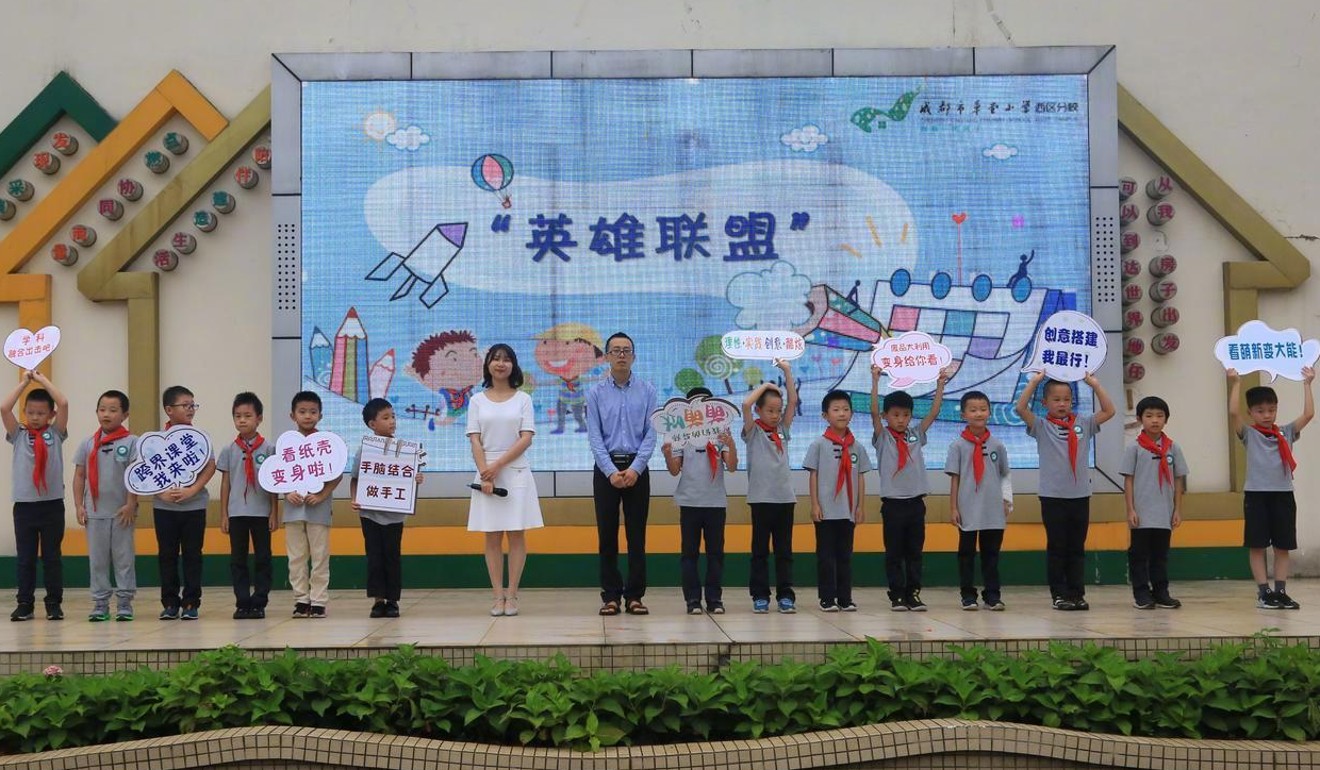
Chengdu Caotang Elementary School wants its boys to be “heroic” and its girls to be “tranquil”. Photo: Weibo
Last semester, pupils learned the differences between female and male bodies. This semester, boys are learning how to build model planes, rockets and cars, while the girls are being taught knitting by teachers and mothers who volunteer to help out in classes.
On Monday, a show of handicrafts and jumpers hosted by the school to promote the class led to a backlash on social media, with members of the public criticising the school for sexism and enforcing gender stereotypes.
“They are tying the hands of girls when young, and when these girls grow up, people would say there are only a few female scientists because girls are born unfit for that role,” a Weibo user said.
What Chinese summer camps taught teens about gender values
“It’s typical gender discrimination,” another said. “Why can’t boys knit and girls build rockets?”
Authorities cracked down on controversial classes for Chinese children after some extreme examples of gender education. In December, a Weibo account highlighted a lurid “virtue” class where a sobbing woman was seen on video confessing to teenagers at a summer camp in Wenzhou, eastern Zhejiang province that “promiscuous women got gangrene”.
“I dressed myself up in a fashionable and revealing way, and that’s an invitation for others to insult me and rape me,” she told her audience.
“Three drops of sperm are equal to poison, and they will hurt unclean women,” she said. “I’m afraid my body will rot, will stink and ache, and they’ll have to amputate my legs.”
The camp was condemned and shut down by the local government.
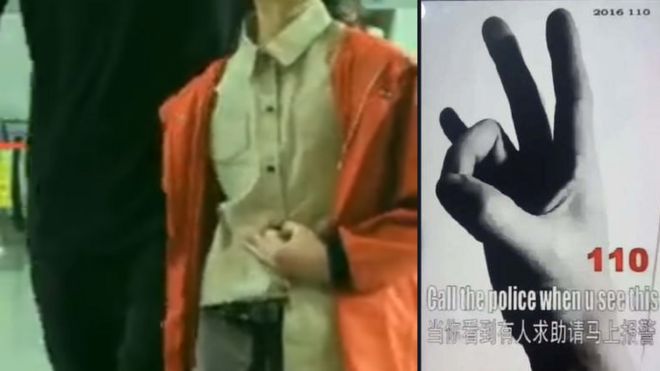
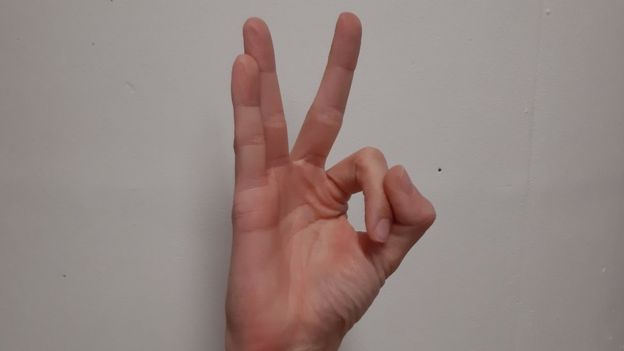
Image copyright TIKTOK/SINA WEIBOImage caption A video and associated posters went viral showing a girl making an OK signal as a subtle way of asking for help
A video showing a Chinese girl using a clever technique to signal she needs help has been widely shared on popular social network TikTok – and is making the authorities nervous.
She is shown being escorted away by a stranger in an airport. Unable to make a cry for help, she makes a subtle hand gesture that looks like the signal for “OK”.
This alerts a passerby, who immediately begins to argue with the man, and helps others recognise that the girl is being held against her will. She is then reunited with her parents.
So why has the video created such a big reaction on Chinese social media, and made the authorities so upset?
The hand gesture
Image caption The “OK” hand gesture reversed looks like the number sequence “110”
While the “OK” gesture is pretty widely understood around the world as a positive gesture, simply turning your hand so that you are facing your palm conveys a subtle message in China.
If two fingers are pressed together, your hand can look like the numbers “110” – which in China is the emergency contact number for the police.
Consequently, the video, which features actors, shows a subtle way that a child can get a message out if they are in trouble.
To push this message home, at the end of the video, a man tells viewers to “spread this gesture” so that people can signal if they are in need of help “in the event of coercion, kidnapping, or fear of your life”.
The authorities don’t like it
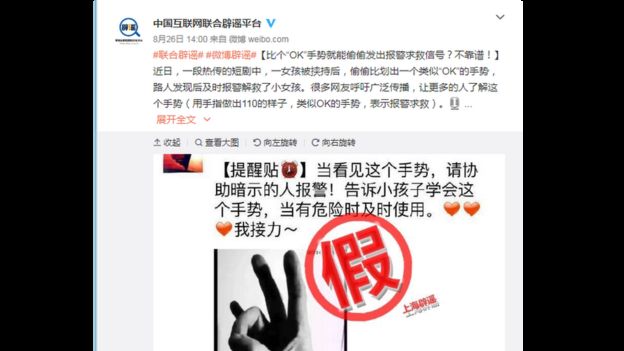
Image copyright PIYAOImage caption China’s top disinformation bureau said the ‘OK’ signal as a sign of distress was absolutely not OK
The video has the appearance of a public service announcement, so many social media users assumed it had the backing of the police.
The Chengdu Economic Daily says that videos being shared on TikTok predominantly attributed the footage to the police. However, the actual origins of the video are unknown.
Today, official media are spreading the message of China’s official disinformation platform Piyao, which criticises the video for being misleading, and says the police had no involvement with it.
“Such a gesture is meaningless as an alarm,” it says, and argues that it might actually be counter-productive in allowing an individual to find help if they need it.
It says that it has “never publicised or promoted such an alarm method in public”, and urges readers to follow the traditional method of calling the police if they need assistance or suspect someone else needs help.
Social media users think it’s a good idea
Despite the authorities distancing themselves from the footage and associated advertising campaigns that have suddenly sprung up on TikTok, a huge debate has broken out online about whether the simple signal might actually be effective in helping Chinese people understand if somebody is under duress.
Some on the popular Sina Weibo microblog say that “shouting for help is more practical than gestures”, and others note that the simple signal might “mislead people” and could lead to accidental interventions where none are necessary.
But in a country where tight authoritarian controls are in place and people are unable to freely speak openly, some are praising this seemingly small action to attract attention if someone’s under duress.
“In fact, this kind of gesture could really be promoted for help in the country”, one user says.
“As long as everyone is in agreement, we can still use it, it is still possible,” another says. “As long as we’re united in our understanding.”
Numbers as a symbol of rebellion
Image copyright TAOBAOImage caption Taylor Swift’s 1989 album caused problems for Chinese censors as the singer is popular, but the number “1989” is sensitive
Number sequences have long proven an effective way for social media users to criticise the authorities, without immediately alerting government censors, who regularly screen platforms for sensitive words.
People have found ways to talk about the Tiananmen Square massacre of 1989 – which the government has heavily censored for three decades – by using number sequences such as “46” (4 June), “64” (June 4) or “1989”.
The authorities have wised up to number sequences being used and are known for censoring many of these. But such strict censorship does mean that sometimes innocuous posts are removed by mistake.
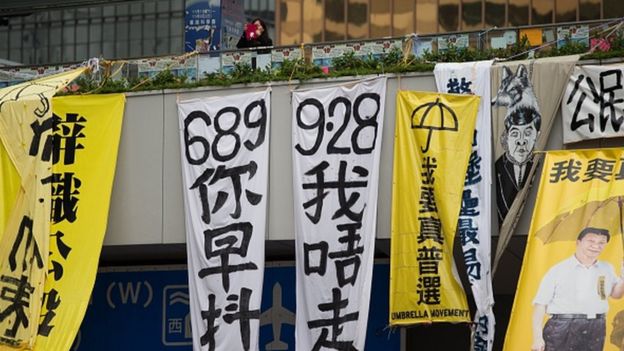
Image copyright AFPImage caption During the 2014 Hong Kong protests, demonstrators showed their anger for then-leader CY Leung by calling him “689”
Cryptic number sequences and hand gestures have proven particularly effective in helping protesters in Hong Kong unite on a shared message.
Online users have been able to voice criticism of their leadership in recent years by referring to them based on the number of votes that elected them into office.
Consequently, “777” has become a nickname for Hong Kong’s chief executive Carrie Lam. Her predecessor, CY Leung, was known as “689”.
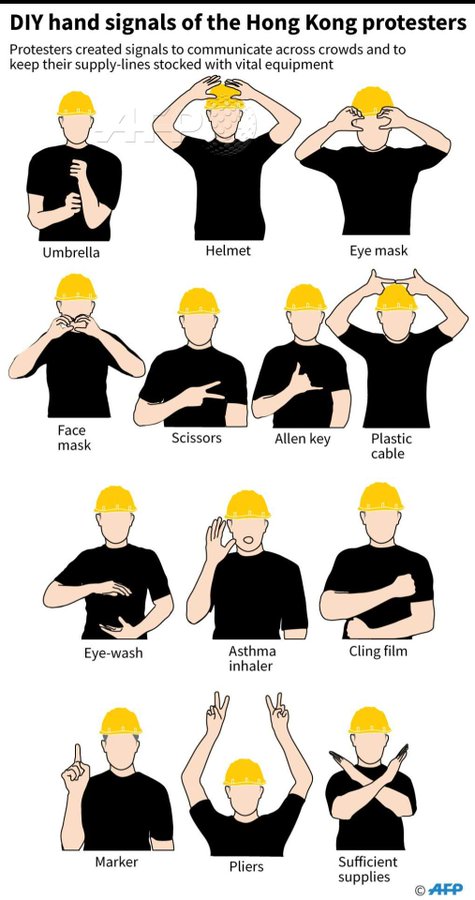
Graphic on hand signals used by protesters in Hong Kong to communicate and to keep their supply-lines stocked with vital equipment http://u.afp.com/Jsjm
As protests have dominated Hong Kong in recent months, it has also become apparent that demonstrators have been able to organise themselves by communicating subtle hand signals across crowds.
Graphics showing DIY hand signals that they can use if they need supplies such as eye masks, helmets or face masks, have circulated widely on platforms like Twitter.
Which is why a small, seemingly innocuous hand gesture, going viral in mainland China and getting huge public support, would undoubtedly unsettle the authorities.
Parents in Jiangsu province were shocked by a form that said a kindergarten class had been investigated and ‘no pupils were found to be involved in organised crime’
Officials fired or disciplined for ‘causing serious negative publicity’
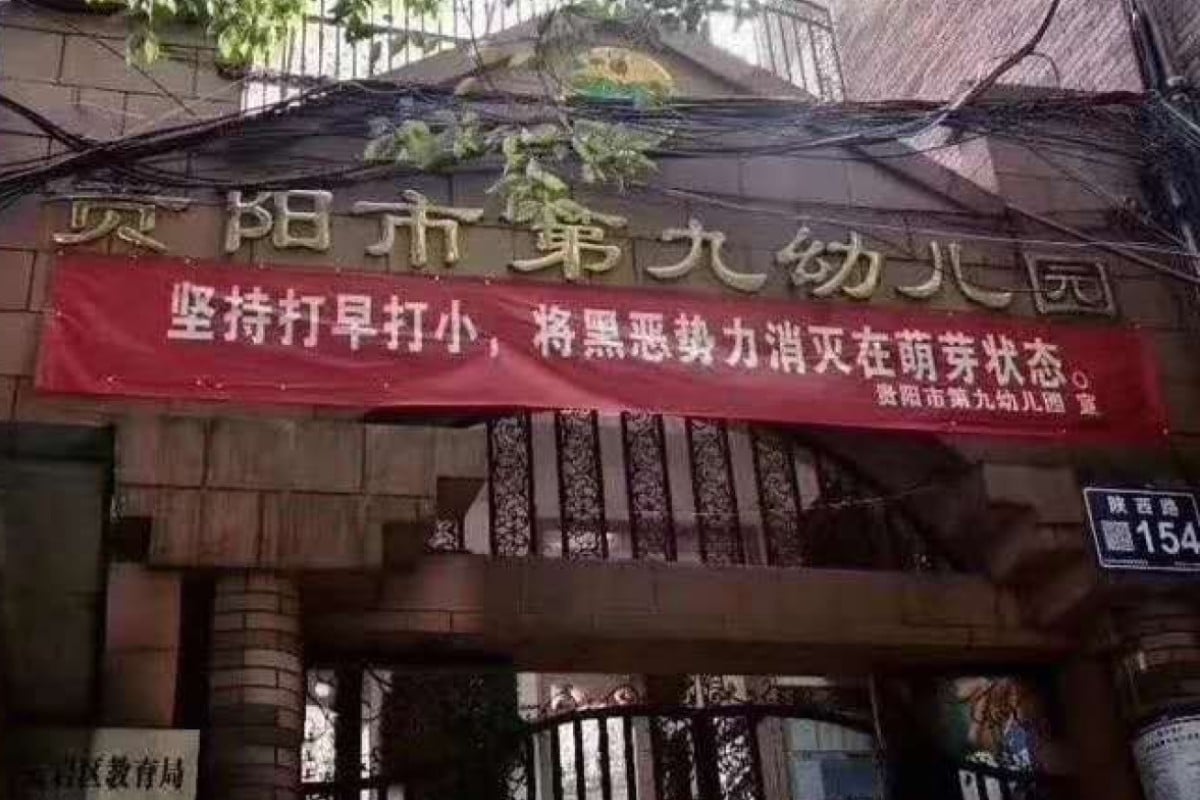
A kindergarten in Guiyang put up a banner on its entrance that read: “Crack down early and crack down young. Eliminate the dark and evil forces when they are still budding”. It was later removed. Photo: Weibo
Education officials in eastern China have been sacked or disciplined after targeting kindergarten pupils in a crackdown on organised crime.
Residents in Wuxi, a city in Jiangsu province, were shocked when a note saying that 35 pupils aged four and five at Xinguang Kindergarten had been investigated as part of the wider crackdown on mafia-style gangs was leaked online.
The form, signed by two teachers, concluded: “No pupils were found to be involved in organised crime”.
Copies of the document started circulating on social media, triggering a widespread backlash and ridicule.
Some social media users accused the kindergarten of box-ticking and questioned whether staff would have been capable of discovering whether any parents were involved in organised crime.
China’s war on organised crime, corrupt officials sees 79,000 people detained
One said that if officials really wanted to nip criminal tendencies in the bud, they were starting too late, adding: “Why not start when they are in the womb and crack down in the maternity hospital?”
But on Thursday the Wuxi government backed down and criticised education officials in Xishan district for misinterpreting the crackdown on organised crime and “putting on an unrealistic show”.
Three senior officials from the Xishan district authority were disciplined for their roles in “causing serious negative publicity”.
China’s fentanyl firms back crackdown on opioid
Feng Dongyan, the chief and party secretary of Xishan district education bureau, was given a party warning.
Wang Zhaoyu, director of the bureau’s general office, and Lu Zhongxian, the director in charge of education inspection of the bureau, lost their jobs and were given a serious party disciplinary warning.
Beijing started the campaign targeting grass-roots criminal organisations and their “protective umbrellas” last year.
More than 3,000 people have been punished so far, but the campaign has also been ridiculed for taking aim at the wrong targets.
Last month a kindergarten in Guiyang in Guizhou province put up a banner at its entrance reading: “Crack down early and crack down young. Eliminate the dark and evil forces when they are still budding”.
The kindergarten said the banner was “meant for the public” but took it down after an online backlash.


 Image copyright HONGXING NEWS
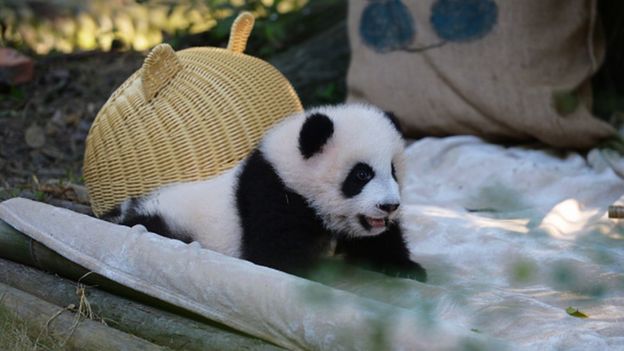 Image copyright VCG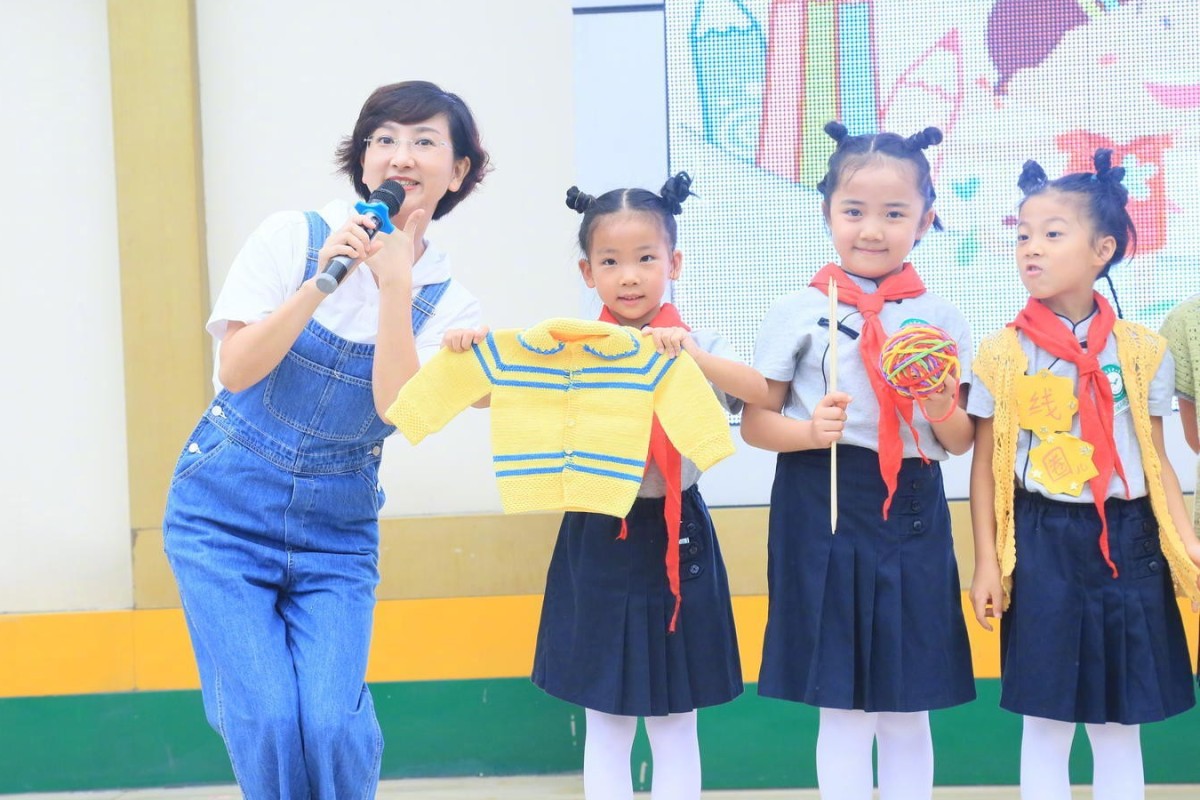



 CHINDIA ALERT: You'll be living in their world, very soon