Chindia Alert: You’ll be Living in their World Very Soon
aims to alert you to the threats and opportunities that China and India present. China and India require serious attention; case of ‘hidden dragon and crouching tiger’.
Without this attention, governments, businesses and, indeed, individuals may find themselves at a great disadvantage sooner rather than later.
The POSTs (front webpages) are mainly 'cuttings' from reliable sources, updated continuously.
The PAGEs (see Tabs, above) attempt to make the information more meaningful by putting some structure to the information we have researched and assembled since 2006.
The Chinese foreign ministry on Thursday released a statement in Chinese following the visit of vice-foreign minister Kong Xuanyou to Pakistan, lauding Islamabad’s response.
WORLDUpdated: Mar 07, 2019 16:42 IST
Sutirtho Patranobis
Hindustan Times, Beijing
Kong visited Pakistan as Islamabad faced pressure from global powers to act against groups carrying out attacks in India, including Jaish-e-Mohammed (JeM), which claimed responsibility for the February 14 attack that killed 40 CRPF personnel in Pulwama.(REUTERS File Photo)
China has praised Pakistan for its handling of the tense situation with India, appreciating Islamabad’s “restraint” in the aftermath of the Pulwama terror attack in Jammu and Kashmir in February.
The Chinese foreign ministry on Thursday released a statement in Chinese following the visit of vice-foreign minister Kong Xuanyou to Pakistan, lauding Islamabad’s response.
“China has paid close attention to the present situation between Pakistan and India, and appreciates Pakistan remaining calm and exercising restraint from the beginning, and persisting in pushing to lower the temperature with India via dialogue,” the foreign ministry statement said.
It paraphrased Kong’s discussions with Pakistan’s leadership comprising Prime Minister Imran Khan, army chief General Qamar Javed Bajwa and foreign minister Shah Mehmood Qureshi.
In turn, the statement quoted the Pakistani side thanking China’s “objective and fair position” on the situation and for its efforts to promote the “cooling” of the situation.
Kong visited Pakistan as Islamabad faced pressure from global powers to act against groups carrying out attacks in India, including Jaish-e-Mohammed (JeM), which claimed responsibility for the February 14 attack that killed 40 CRPF personnel in Pulwama.
The Pulwama suicide attack – the worst in Kashmir in decades – led to the most serious conflict in years between the nuclear-armed neighbours with India carrying out a strike on a JeM camp in Balakot and then a dogfight over the skies of Kashmir.
The crisis seems to have eased after Pakistan returned IAF Wing Commander Abhinandan Varthaman last Friday, nearly two days after he was captured.
Kong was quoted as telling the Pakistani leadership that China maintains that the sovereignty and territorial integrity of all countries should be earnestly respected and that Beijing is unwilling to see acts that violate the norms of international relations.
The statement quoted Kong as saying that China calls on Pakistan and India to refrain from taking actions to aggravate the situation, show goodwill and flexibility, launch dialogue as soon as possible, and work together to maintain regional peace and stability.
China is willing to continue to play a constructive role in this regard, Kong is quoted to have said.
According to the statement, the Pakistani leaders appreciated China’s objective and fair position on the situation in Pakistan and India and thanked China for its efforts to promote the cooling of the situation.
It added that the Pakistani side reiterated that it is unwilling to see an escalation of the situation and is willing to resolve the contradictions and differences between the two sides through dialogue and peacefully, and welcomes China and the international community to play an active role in this regard.
The incident comes less than a month after over 44 CRPF personnel were killed and many injured on February 14 in Jammu and Kashmir’s Pulwama.
SNS Web | New Delhi | March 7, 2019 12:47 pm
Security personnel carry out investigation at the site where a blast took place after a grenade attack by militants at the busy main bus terminus in Jammu and Kashmir, on March 7, 2019. (Photo: IANS)
One person was killed and 29, including a woman injured in a blast after a grenade was tossed at a bus in the general bus stand in the heart of Jammu on Thursday. The condition of five injured is said to be serious.
The killed youth has been identified as a 17-year-old Mohammad Sharik of Haridwar in Uttrakhand.
Minister of State for Defence Subhash Bhamre said a local investigation has been initiated into the incident. He further said the government has given complete liberty to the forces to take all necessary steps.
The Jammu and Kashmir Police has been rushed to the site of the blast.
The Chinese grenade exploded in the bus at about 12 noon. The driver and conductor were among the injured rushed to the Government Medical College, Jammu. The injured include passengers belonging to Bihar, Punjab, Haryana, Uttrakhand, Jammu and the Kashmir valley.
Visuals from the blast site showed the damaged bus of the J&K Road Transport Corporation (JKSRTC) in which the grenade exploded.
The area has been cordoned off by the security personnel. Nature and the cause is being ascertained, police said.
Fifteen suspects have been rounded up for interrogation.
The grenade attack has coincided with the shifting of detained separatist Yasin Malik to the Jammu’s Kot-Bhalwal jail.
Police suspected the JeM outfit behind the attack. Some radicals had threatened of revenge during the recent communal tension here when about six cars were burnt.
K Vijay Kumar and KK Sharma, both advisors to the Governor, visited the spot to take stock of the situation. The divisional commissioner, deputy commissioner and senior police and civil officers also visited the spot.
This is the third grenade attack in the bus stand during the past few months.
The blast comes at a time when Jammu and Kashmir is on a high alert following the heightened tensions between India and Pakistan in the wake of the Pulwama terror attack.
Former chief minister Mehbooba Mufti condemned the incident and called for unity to defeat terror elements in the state.
“I condemn this act of terror in the strongest possible terms. My prayers for speedy recovery of those injured. The perpetrators are out there to inflict pain and divide us. Our unity has to be our tool to defeat them,” Mufti tweeted.
The provincial president of National Conference, Devender Rana, visited the hospital to inquire about the wellbeing of injured persons.
The incident comes less than a month after over 44 CRPF personnel were killed and many injured on February 14 in one of the deadliest terror strikes in Jammu-Kashmir when a Jaish-e-Mohammad (JeM) suicide bomber blew up an explosive-laden vehicle near their bus in Pulwama district.
The bus was part of a convoy of 78 vehicles carrying around 2500 CRPF personnel from Jammu to Srinagar.
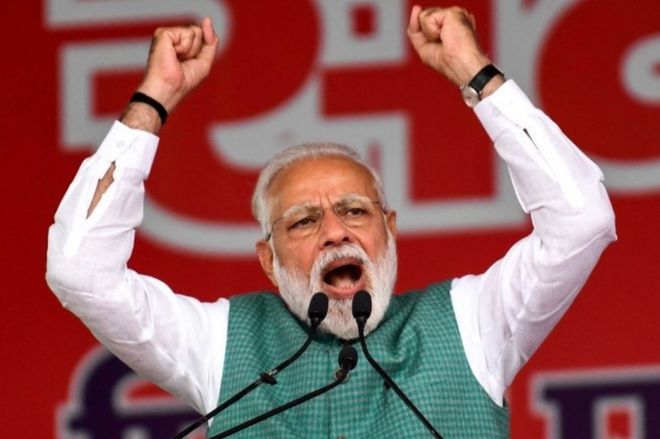
Image copyrightAFPImage captionMr Modi is accused of exploiting India-Pakistan hostilities for political gain
A gaffe is when a politician tells the truth, American political journalist Michael Kinsley said.
Last week, a prominent leader of India’s ruling Hindu nationalist Bharatiya Janata Party (BJP) appeared to have done exactly that. BS Yeddyurappa said the armed aerial hostilities between India and Pakistan would help his party win some two dozen seats in the upcoming general election.
The remark by Mr Yeddyurappa, former chief minister of Karnataka, was remarkable in its candour. Not surprisingly, it was immediately seized upon by opposition parties. They said it was a brazen admission of the fact that Prime Minister Narendra Modi’s party was mining the tensions between the nuclear-armed rivals ahead of general elections, which are barely a month away. Mr Modi’s party is looking at a second term in power.
Mr Yeddyurappa’s plain-spokenness appeared to have embarrassed even the BJP. Federal minister VK Singh issued a statement, saying the government’s decision to carry out air strikes in Pakistan last week was to “safeguard our nation and ensure safety of our citizens, not to win a few seats”. No political party can afford to concede that it was exploiting a near war for electoral gains.
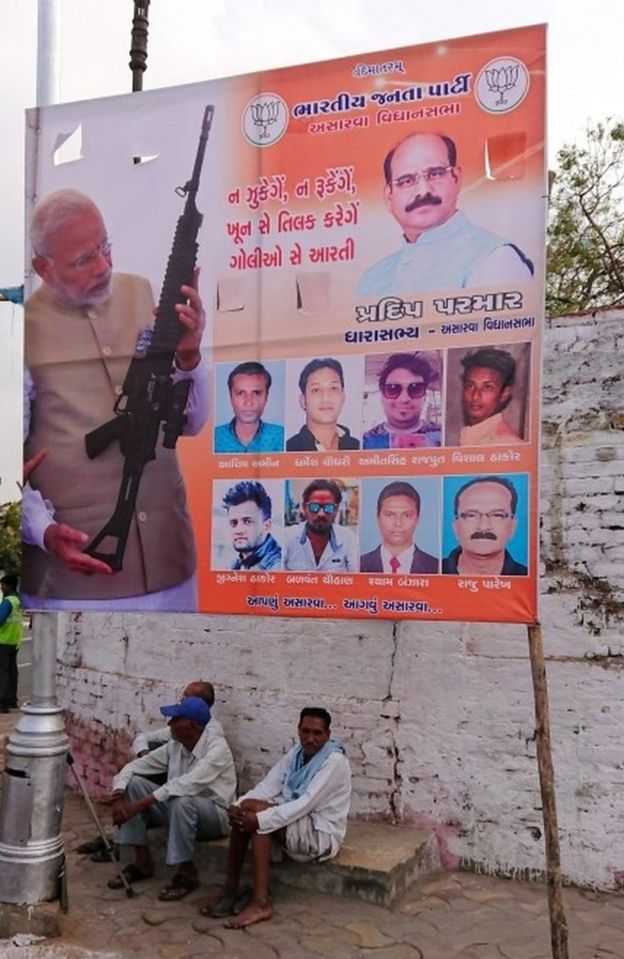
Image copyrightAFPImage captionThe BJP has put up election posters of Mr Modi posing with guns
Even as tensions between India and Pakistan ratcheted up last week, Mr Modi went on with business as usual. Hours after the Indian attack in Pakistan’s Balakot region, he told a packed election meeting that the country was in safe hands and would “no longer be helpless in the face of terror”. Next morning, Pakistan retaliated and captured an Indian pilot who ejected from a downed fighter jet. Two days later, Pakistan returned the pilot to India.
Mr Modi then told a gathering of scientists that India’s aerial strikes were merely a “pilot project” and hinted there was more to come. Elsewhere, his party chief Amit Shah said India had killed more than 250 militants in the Balakot attack even as senior defence officials said they didn’t know how many had died. Gaudy BJP posters showing Mr Modi holding guns and flanked by soldiers, fighter jets and orange explosions have been put up in parts of the country. “Really uncomfortable with pictures of soldiers on election posters and podiums. This should be banned. Surely the uniform is sullied by vote gathering in its name,” tweeted Barkha Dutt, an Indian television journalist and author.
Mr Modi has appealed to the opposition to refrain from politicising the hostilities. The opposition parties are peeved because they believe Mr Modi has not kept his word. Last week, they issued a statement saying “national security must transcend narrow political considerations”.
‘Petty political gain’
But can the recent conflict fetch more votes for Mr Modi? In other words, can national security become a campaign plank?
Many believe Mr Modi is likely to make national security the pivot of his campaign. Before last month’s suicide attack – claimed by Pakistan-based militants – killed more than 40 Indian paramilitaries in Kashmir, Mr Modi was looking a little vulnerable. His party had lost three state elections on the trot to the Congress party. Looming farm and jobs crises were threatening to hurt the BJP’s prospects.
Now, many believe, Mr Modi’s chances look brighter as he positions himself as a “muscular” protector of the country’s borders. “This is one of the worst attempts to use war to win [an] election, and to use national security as petty political gain. But I don’t know whether it will succeed or not,” says Yogendra Yadav, a politician and psephologist.
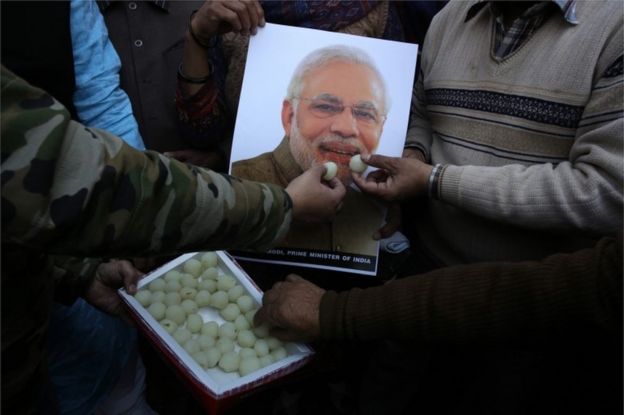
Image copyrightEPAImage captionMany Indians have celebrated India’s strike in Pakistani territory
Evidence is mixed on whether national security helps ruling parties win elections in India. Ashutosh Varshney, a professor of political science at Brown University in the US, says previous national security disruptions in India were “distant from the national elections”.
The wars in 1962 (against China) and 1971 (against Pakistan) broke out after general elections. Elections were still two years away when India and Pakistan fought a war in 1965. The 2001 attack on the Indian parliament that brought the two countries to the brink of war happened two years after a general election. The Mumbai attacks in 2008 took place five months before the elections in 2009 – and the then ruling Congress party won without making national security a campaign plank.
For one, he says, it comes just weeks ahead of a general election in a highly polarised country. The vast expansion of the urban middle class means that national security has a larger constituency. And most importantly, according to Dr Varshney, “the nature of the regime in Delhi” is an important variable. “Hindu nationalists have always been tougher on national security than the Congress. And with rare exceptions, national security does not dominate the horizons of regional parties, governed as they are by caste and regional identities.”
Bhanu Joshi, a political scientist also at Brown University, believes Mr Modi’s adoption of a muscular and robust foreign policy and his frequent international trips to meet foreign leaders may have touched a chord with a section of voters. “During my work in northern India, people would continuously invoke the improvement in India’s stature in the international arena. These perceptions get reinforced with an event like [the] Balakot strikes and form impressions which I think voters, particularly on a bipolar contest of India and Pakistan, care about,” says Mr Joshi.
Others like Milan Vaishnav, senior fellow and director of the South Asia Program at the Carnegie Endowment for International Peace, echo a similar sentiment. He told me that although foreign policy has never been a “mass” issue in India’s domestic politics, “given the proximity of the conflict to the elections, the salience of Pakistan, and the ability of the Modi government to claim credit for striking back hard, I expect it will become an important part of the campaign”.
But Dr Vaishnav believes it will not displace the economy and farm distress as an issue, especially in village communities. “Where it will help the BJP most is among swing voters, especially in urban constituencies. If there were fence-sitters unsure of how to vote in 2019, this emotive issue might compel them to stick with the incumbent.”
How the opposition counters Mr Modi’s agenda-setting on national security will be interesting to watch. Even if the hostilities end up giving a slight bump to BJP prospects in the crucial bellwether states in the north, it could help take the party over the winning line. But then even a week is a long time in politics.
GENEVA (Reuters) – U.N. human rights chief Michelle Bachelet warned India on Wednesday that its “divisive policies” could undermine economic growth, saying that narrow political agendas were marginalising vulnerable people in an already unequal society.
“We are receiving reports that indicate increasing harassment and targeting of minorities – in particular Muslims and people from historically disadvantaged and marginalised groups, such as Dalits and Adivasis,” Bachelet said in her annual report to the U.N. Human Rights Council in Geneva.
MUZAFFARABAD, Pakistan/SRINAGAR, India (Reuters) – A flare up between arch-foes India and Pakistan appeared to be easing on Saturday after Islamabad handed back a captured Indian pilot, but tensions continued to simmer amid efforts by global powers to prevent a war between the nuclear-armed neighbours
Wing Commander Abhinandan Varthaman, who became the face and symbol of the biggest clash between India and Pakistan in many years, walked across the border just before 9 p.m. (1600 GMT) on Friday in a high-profile handover shown on live television.
Shelling across the Line of Control (LoC) that acts as a de facto border in the disputed Kashmir region, a frequent feature in recent weeks, continued on Saturday.
Pakistan’s military said on Saturday its air force and navy “continue to be alert and vigilant”, while two of its soldiers were killed after exchanging fire with Indian troops along the Line of Control. India’s military said on Saturday that Pakistan was firing mortar shells across the LoC.
Pakistan touted Abhinandan’s return as “as a goodwill gesture aimed at de-escalating rising tensions with India” after weeks of unease that threatened to spiral into war after both countries used jets for bombing missions this week.
Global powers, including China and the United States, have urged restraint to prevent another conflict between the neighbours who have fought three wars since independence from Britain in 1947.
Tensions escalated rapidly following a suicide car bombing on Feb. 14 that killed at least 40 Indian paramilitary police in Indian-controlled Kashmir.
India accused Pakistan of harbouring the Jaish-e Mohammad group behind the attack, which Islamabad denied, and Prime Minister Narendra Modi promised a strong response.
Indian warplanes carried out air strikes on Tuesday inside Pakistan on what New Delhi called militant camps. Islamabad denied any such camps existed, as did local villagers in the area, but Pakistan retaliated on Wednesday with its own aerial mission, that led to both sides claiming to have shot down jets.
The stand off came at a critical time for Modi, who faces a general election that must be held by May and who had been expected to benefit from nationalist pride unleashed by the standoff.
Pakistani leaders say the ball is now in India’s court to de-escalate the tensions, though the Pakistani army chief told top military leaders of the United States, Britain and Australia on Friday that his country would “surely respond to any aggression in self-defence”.
“COLLIDE HEAD-ON”
The Indian pilot’s ordeal since being shot down on Wednesday had made him the focal point of the crisis and he returned to his homeland to a hero’s welcome, with crowds thronging the Wagah border crossing and waving Indian flags.
Before his release, Pakistani television stations broadcast video of Abhinandan in which he thanked the Pakistani army for saving him from an angry crowd who chased him after seeing him parachute to safety.
“The Pakistani army is a very professional service,” he said. “I have spent time with the Pakistan army. I am very impressed.”
On Friday, four Indian troops and one civilian were killed in a clash with militants in the Indian-administered Kashmir, where a further three people were killed and one wounded from Pakistani shelling.
Pakistan’s military said two civilians were killed and two wounded since Friday afternoon on Pakistan’s side of Kashmir from a barrage of Indian shelling.
In a sign of the unease, residents say they are afraid another conflagration is likely.
“The way situation is developing along the LoC makes me feel that both sides may collide head-on anytime now,” said Chaudhry Jahangir , a Pakistani resident of the Samahni sector in Kashmir.
Rahul Gandhi renewed his attack on PM Modi over Rafale deal controversy during his public rally in Jharkhand
INDIAUpdated: Mar 02, 2019 15:58 IST
HT Correspondent
Hindustan Times, Ranchi
Congress president Rahul Gandhi addressing a public rally in Jharkhand on Saturday.(Photo: Twitter/INCIndia)
Congress president Rahul Gandhi on Saturday renewed his attack on Prime Minister Narendra Modi reiterating his charge that he misled the people on the issues of providing corruption-free government, job creation and addressing farm distress. Gandhi said PM Modi’s image has changed from a leader who promised to bring “achchhe din” (better time) to “chowkidar chor hai” (the watchman is a thief).
Speaking at the Congress’s Parivartan Ulgulan Maha Rally at the Morahbad in Jharkhand, Gandhi said, “One chowkidar has defamed all chowkidars of India…All the chowkidars of India are honest…Everyone knows that when someone says chowkidar chor hai, it refers to Narendra Modi.”
The Congress president alleged that PM Modi “snatched” Rs 30,000 crore from the Indian Air Force (IAF), which protects the country, and the Hindustan Aeronautics Limited (HAL) and gave it to industrialist Anil Ambani in Rafale deal.
Gandhi has been targeting PM Modi over Rs 58,000-crore Rafale deal with France that India signed in 2016 for the purchase of 36 fighter planes. A similar deal was being negotiated when the Congress-led United Progressive Alliance (UPA) was in power before 0214 for the purchase of 126 Rafale jets.
The Modi government renegotiated the deal with France terming the previous one unworkable. The Congress and other opposition parties have alleged that commercial favouritism was done in Rafale deal.
Gandhi on several occasions has alleged that PM Modi personally ensured that Ambani’s firm, Reliance Defence gets contract in Rafale deal. Both the government and the Reliance Defence have rejected the allegation as baseless. Reliance Defence is an off-set partner of the Dassault Aviation, the manufacturer of Rafale fighter jets.
Addressing his first rally in Jharkhand since 2014, the Congress president repeated his charge against PM Modi saying, “It is a matter of shame that Indian Air Force protects the country, air force pilots sacrifice their lives but the prime minister steals money from the air force and puts it in Anil Ambani’s pockets.”
He claimed that in the upcoming Lok Sabha elections, the “chowkidar” will be defeated. He promised that if voted to power the Congress government will implement a minimum income guarantee programme for the poor.
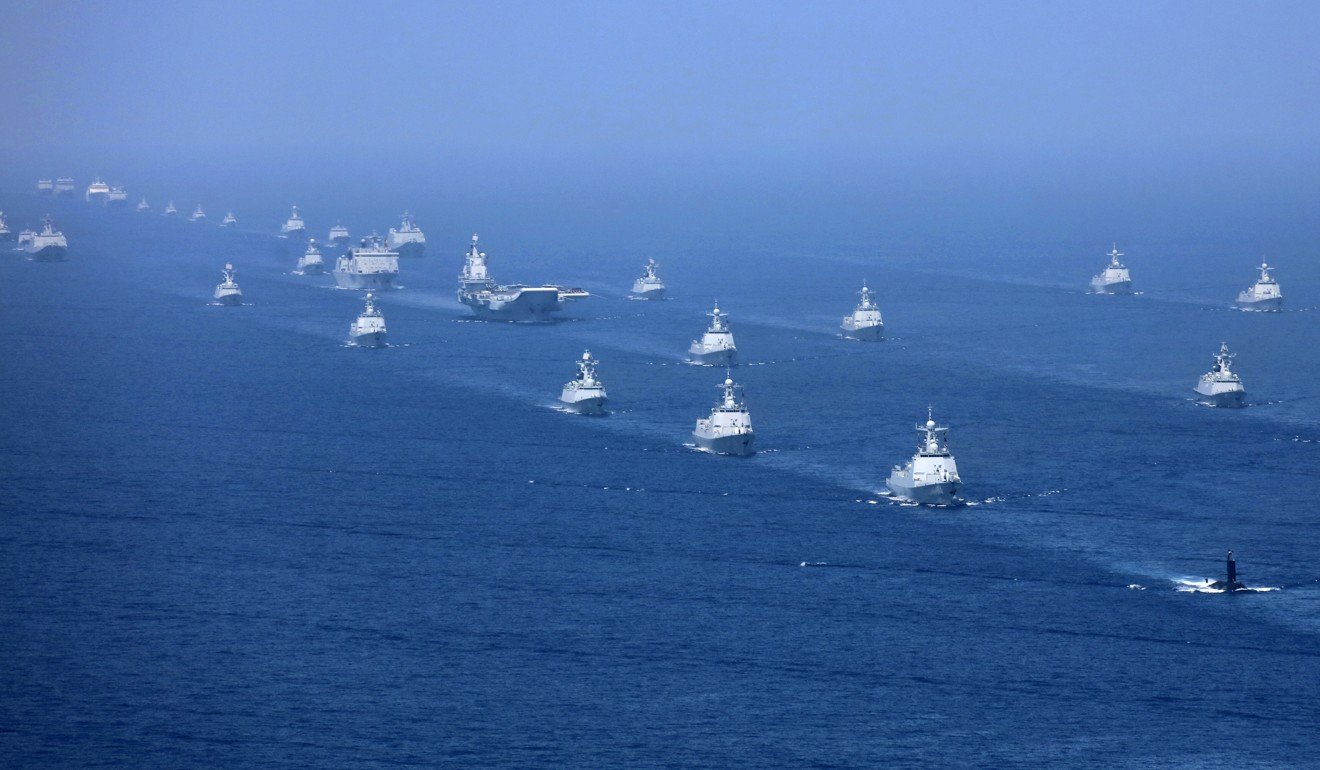
Next month’s nautical spectacle will allow country to show off its most advanced warships to an international audience
More than a dozen foreign navies are expected to join in, including the United States
Chinese navy’s 70th birthday parade showcases rising sea power
1 Mar 2019
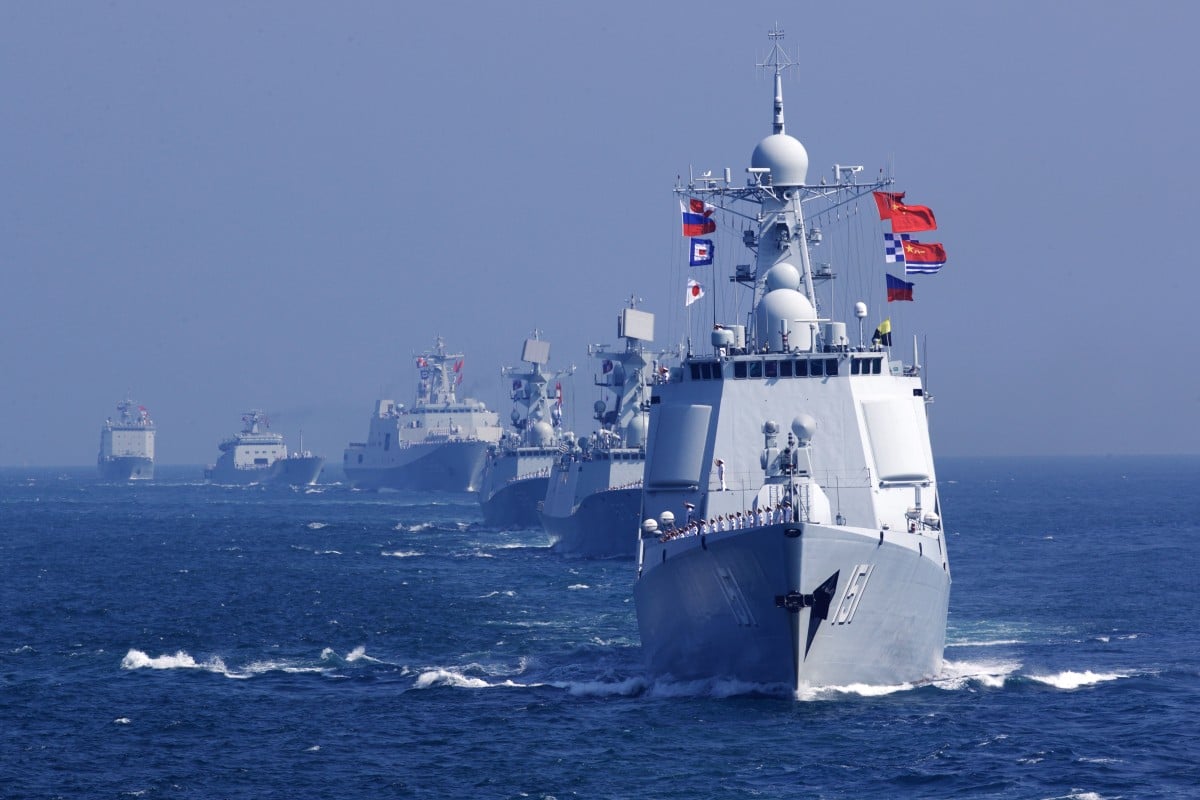
Chinese warships pictured at the end of joint exercise with the Russian navy in 2016. Photo: Xinhua
China will hold a naval parade next month to mark the 70th anniversary of the founding of the People’s Liberation Army Navy and will invite more than a dozen of foreign navies to participate.
The parade will take place on April 23 in the Yellow Sea off the coast of Qingdao in Shandong province, Ren Zhiqiang, a spokesman for the Ministry of National Defence, said on Thursday.
Ren did not provide further details of the parade but military analysts said the exercise would give the navy the opportunity to display its rapidly growing strength and show how that has increased in the past 12 months.
‘No-go zone’ in Yellow Sea for Chinese aircraft carrier sea trials
In April last year a naval review in the South China Sea featured a total of 48 vessels and 76 planes, including China’s first aircraft carrier, the Liaoning, its Type 094A and 095 nuclear submarines, 052D guided missile destroyers and J-15 fighter jets.
The experts expect that next month’s event will provide a showcase for several new and more powerful vessels including its home-grown aircraft carrier Type 001A, the Type 055 – Asia’s most powerful destroyer – and several nuclear submarines.
“The fact that China is holding the naval parade just one year after the South China Sea review shows the great importance [the leadership] attaches to the development of China’s maritime interests, the navy and its expansion,” navy expert Li Jie said.
Chinese President Xi Jinping joined the crew on the deck of the cruiser Changsha following last year’s naval review. Photo: Xinhua
Share:
China also held a major naval parade in 2009 to mark the navy’s 60th anniversary.
It was smaller in scale than the upcoming extravaganza with 25 PLA vessels and 31 fighter jets taking part.
Fourteen foreign navies sent ships to the 2009 parade, including the USS Fitzgerald from America and the guided-missile cruiser Varyag from Russia. France, Australia, South Korea, India and Pakistan also joined in the event.
More foreign countries are expected to join the party this year as the PLA has become more active internationally and China has sold more warships to foreign navies.
China’s new veterans’ law to be reviewed at National People’s Congress next week
“The parade is more like a birthday party for the PLA Navy and the participation of foreign navies is a matter of diplomatic courtesy with few military implications,” said Yue Gang, a former PLA colonel.
Yue said the US and its allies would attend despite the rising tensions between the two sides.
Since 2015 the US and Chinese navies have engaged in a series of confrontations in the South China Sea as China strengthens its military presence in the region and the US has sought to challenge Beijing’s claims to the waters by conducting what it describes as “freedom of navigation” operations.
“I don’t expect they will send any of the warships that have taken part in such operations [to the parade],” Yue said.
China has greatly expanded its naval capabilities in recent years. Photo: AP
Share:
It has been reported that the Japanese Maritime Self-Defence Force has expressed an interest in joining the parade and the Philippines – which has a rival claim to the South China Sea – is planning to send a vessel to the event for the first time.
Li said militaries such as the US and Japan would not want to miss the chance to observe the PLA Navy closely.
“In addition, greater transparency [through the parade] will also help reassure smaller regional partners such as the Philippines that China is a friendly power despite its growing military strength,” he said.
China held its first naval parade in 1957 and April’s display will be the sixth such event.
Sailors also took part in the parade through Tiananmen Square to mark the foundation of the People’s Republic on October 1 1949.
MUMBAI (Reuters) – With India and Pakistan standing on the brink of war this week, several false videos, pictures and messages circulated widely on social media, sparking anger and heightening tension in both countries.
The video of an injured pilot from a recent Indian air show and images from a 2005 earthquake have been taken out of context to attempt to mislead tens of millions on platforms like Twitter, Facebook and its messenger service, WhatsApp.
The spurt of fake news comes after New Delhi this week launched an air strike inside Pakistan, the first such move in over more than decades. India says the attack destroyed a militant camp run by the group that claimed responsibility for killing 40 paramilitary troops in Indian Kashmir on Feb 14. Pakistan denied there had been any casualties in the attack.
Tensions between the nuclear-armed nations peaked with both sides claiming they’d shot down each other’s fighter jets on Wednesday, and Pakistan capturing an Indian pilot.
As claims and counter claims poured in from both sides, social media became a hotbed of unverified news, pictures and video clips, according to fact checkers.
Partik Sinha, co-founder of one such fact-checking website, Alt News, said it had received requests to verify news from journalists and people on social media.
“It’s been crazy since Tuesday. There is so much out there that we know is fake, but we’re not able to fact-check all of it,” Sinha said.
A Facebook group that says it supports Amit Shah, the chief of India’s ruling Bharatiya Janata Party (BJP), posted images on Tuesday of the alleged destruction caused inside Pakistan by the Indian air strike.
Three photos posted on the group page showed debris from a destroyed building and bodies and have been shared hundreds of times.
Alt News said the pictures were from a 2005 earthquake in Kashmir.
India, where roughly 450 million people have smartphones, is already struggling with a huge fake news problem with misinformation having led to mass beatings and mob lynchings.
Facebook, WhatsApp and Twitter have begun to take steps to combat the issue, but as India heads toward general elections, due by May, fake news is getting more intensely politicized.
Another message circulated on a WhatsApp group supporting the BJP claimed the Indian jet was not shot down, but crashed due to a technical snag and blamed the opposition Congress party for failing to upgrade the jets during its tenure.
Similarly in Pakistan, a purported video of a second captured Indian pilot was being widely circulated. Fact-checking website Boom noted the clip was from an air show in the southern Indian city of Bengaluru, where two planes crashed on Feb. 19.
“Everyone has a role to play in ensuring misinformation doesn’t spread on the internet and we encourage people who use Twitter not to share information unless they can verify that it’s true,” a spokeswoman for Twitter said.
In a major peace gesture, Pakistan Prime Minister Imran Khan said that the Indian Air Force (IAF) fighter pilot, Wg Cdr Abhinandan Varthaman, who was captured by Pakistani Army on Wednesday, will be released on Friday.
SNS Web | New Delhi | February 28, 2019 4:58 pm
A handout photograph released by Pakistan’s Inter Services Public Relations on February 27, 2019, shows captured Indian pilot Wg Cdr Abhinandan in the custody of Pakistani forces in an undisclosed location. (Photo: AFP)
In a major peace gesture, Pakistan Prime Minister Imran Khan said that the Indian Air Force (IAF) fighter pilot, Wg Cdr Abhinandan Varthaman, who was captured by Pakistani Army on Wednesday, will be released on Friday.
“In our desire for peace, I announce that tomorrow, and as a first step to open negotiations, Pakistan will be releasing the Indian Air Force officer in our custody,” Pak PM Imran Khan said in the country’s parliament.
The Pak PM’s decision came just minutes ahead of a scheduled joint press conference by the three services of the Indian armed forces. The press conference now stands postponed at the time of writing.
The decision came after India said that it will not agree on any deal with Pakistan and demanded his unconditional and immediate release. The press conference now stands postponed at the time of writing.
Speaking about the IAF fighter pilot captured by Pakistan, the Ministry of Defence officials said that he was ill-treated by the Pakistan Army in violation of the Geneva Convention.
“The IAF pilot has to be repatriated unconditionally and immediately. There is no question of any deal,” a source was quoted as saying by PTI.
Government sources said that India has not asked for consular access but the immediate release of the IAF pilot.
Dismissing chances of any talks, the government sources stressed on “immediate, credible and verifiable action against terror is required before any conversation”.
“Imran Khan should now walk the talk on dealing with terrorism,” they added.
The announcement of Wg Cdr Abhinandan’s release came on the day when Pakistan Foreign Minister Shah Mahmood Qureshi told a Pakistani news channel that Imran Khan is ready for talks with Prime Minister Narendra Modi over phone and offer peace.
In an interview to Geo News, Qureshi said that Pakistan is willing to consider returning the Indian pilot if it helps in de-escalation of the current situation between the two nations.
“If there is de-escalation with the return of this [Indian] pilot, Pakistan is willing to consider this. We are ready for all positive engagement,” he said.
India had on Wednesday summoned the Pakistani envoy and handed over a demarche demanding the “immediate and safe return” of the pilot. It also strongly objected to Pakistan’s “vulgar display” of the pilot and said Pakistan “would be well advised to ensure that no harm comes to him”.
The IAF pilot was captured on Wednesday after an aerial combat between Indian and Pakistani fighter planes.
The Ministry of External Affairs (MEA) had on Wednesday evening said that the IAF lost a MiG 21 Bison aircraft in an engagement with Pakistani Air Force who had violated Indian airspace on Wednesday. The government had confirmed that a pilot was missing in action.
Pakistani Air Force jets violated Indian airspace in Jammu and Kashmir’s Rajouri sector on Wednesday morning and attempted to target Indian military installations, but missed their targets. They were immediately pushed back by Indian jets on air patrol, who also shot down a Pakistani F-16 whose wreckage fell on the other side of the LoC.
Following the incident, top Indian security and intelligence officials met Prime Minister Narendra Modi to discuss the security situation.
NSA Ajit Doval, senior officials of the Indian Navy, Army and the Air Force and other security officials, besides Home Minister Rajnath Singh and Defence Minister Nirmala Sitharaman, were present in the meeting.
The Prime Minister is scheduled to chair the Cabinet Committee on Security (CCS) meeting at his residence later today to take stock of the situation. A Union Cabinet meeting is also slated for 6.30 pm at the Prime Minister’s residence.
Chinese State Councilor and Foreign Minister Wang Yi (R) meets with Russian Foreign Minister Sergei Lavrov in Wuzhen of Tongxiang City, east China’s Zhejiang Province, Feb. 26, 2019. (Xinhua/Weng Xinyang)
HANGZHOU, Feb. 26 (Xinhua) — Chinese State Councilor and Foreign Minister Wang Yi and Russian Foreign Minister Sergei Lavrov on Tuesday vowed to enhance strategic communication and promote cooperation within the meeting of the foreign ministers of China, Russia and India (RIC).
The ministers made the remarks during their meeting on the sidelines of the 16th trilateral meeting of RIC foreign ministers in Wuzhen of east China’s Zhejiang Province.
Noting that this year marks the 70th anniversary of the establishment of diplomatic ties between China and Russia, Wang said the two countries should further deepen strategic communication and make new contributions to world peace and development.
It is of great significance for China, Russia and India to enhance communication, coordinate positions and deepen cooperation for the region and the world, Wang said.
China is willing to work together with Russia and India to strive for substantial outcomes in the meeting of RIC foreign ministers, he added.
Echoing Wang’s remarks, Lavrov said it was necessary for Russia and China to jointly safeguard the basic norms of multilateralism and international relations.
The 16th meeting of the foreign ministers of China, Russia and India will be held in Wuzhen on Wednesday.







 CHINDIA ALERT: You'll be living in their world, very soon