CHINDIA ALERT: You'll be living in their world, very soon

continuously updated blog about China & India

  • Home
    • HOME: Why Chindia?
    • Chindia sources
  • Historical Perspectives
    • 4,000 years of records
    • Before the Raj
    • China’s first-half 20C Timeline
    • India’s first-half 20C Timeline
    • 70 years from Liberation
    • 70 years from Independence
  • Social & Cultural Factors
    • India’s British influence
    • China is homogeneous
    • India is diverse
    • Very different mindsets
    • Chinese mindset
    • Indian mindset
    • Chinese body, mind and spirit
    • Indian body, mind and spirit
    • Uncanny similarities
    • Major events or changes in China – Social & Cultural 2013:
    • Major events or changes in India – Social & Cultural 2013
  • Economic Factors
    • Major Chinese Economic events or changes: 2013 – 2019
    • Major Indian economic events or changes: 2013 – 2017
    • Chinese overseas acquisitions / investments
    • China needs to rebalance her economy
    • China’s infrastructure
    • ‘Greening’ of China
    • China’s manufacturing
    • India changes gear in 1991
    • India’s services
    • Consumerism blossoms
    • Information Technology
  • Political Factors
    • Major Chinese Political events or changes: 2013 – 2017
    • Major Indian Political events or changes: 2013 – 2017
    • Intrinsic uncertainty and instability – China
    • Intrinsic uncertainty and instability – India
    • Geopolitics: Chinese
    • 2014 is a year of bumper harvest for China’s diplomacy, FM says
    • Geopolitics: Indian
  • Prognosis?
    • Will China be a superpower by 2038?
    • How close will India be in 2038?
    • China’s relationship with the Rest of the World
    • Chinese challenges?
    • Indian challenges?
    • How well will China and India innovate – to 2017?
  • In Closing
    • Eight ways China is changing your world
    • Ten forces forging China’s future
    • Reimagining India: Unlocking the Potential of Asia’s Next Superpower
  • ABOUT / Contact us
  • Chindia Alert: You’ll be Living in their World Very Soon

    aims to alert you to the threats and opportunities that China and India present. China and India require serious attention; case of ‘hidden dragon and crouching tiger’.

    Without this attention, governments, businesses and, indeed, individuals may find themselves at a great disadvantage sooner rather than later.

    The POSTs (front webpages) are mainly 'cuttings' from reliable sources, updated continuously.

    The PAGEs (see Tabs, above) attempt to make the information more meaningful by putting some structure to the information we have researched and assembled since 2006.

  • Follow CHINDIA ALERT: You'll be living in their world, very soon on WordPress.com
  • If you wish to read the material on the PAGES in an eBook format; here it is

    You will be living in their world, very soon

  • If you wish to read the material on China on the PAGES in a paperback format; here it is

    Beware the Waking Dragon

  • Categories

  • Beijing China China alert Chindia Alert Chinese President Xi Jinping coronavirus corruption COVID-19 Diplomacy Economics GeoPolitics Good news History Hong Kong India alert Internal politics Japan Manufacturing Military Neighbour conflict Pakistan Politics Pollution Shanghai Social & cultural Technology Uncategorized United States Washington Wuhan
  • Since July 21, 2012 free counters
  • Blogs I Follow

    • CCChang
    • Law of Unintended Consequences
    • ChiaHou's Book Reviews
    • What's wrong with the world; and its economy

Archive for ‘Chindia Alert’

« Older Entries  |   Newer Entries »
07/03/2019

The British woman who fought for India’s freedom

A portrait photo of Freda taken in Lahore in the early 1940
Image captionFreda Bedi’s is a remarkable story

Freda Bedi lived an unusual life. Born in a small town in England, she moved to India for love and ended up joining the independence movement. Her biographer, Andrew Whitehead, writes about her remarkable story.

“There are things deeper than labels and colour and prejudice, and love is one of them.”

These were the words of Freda Bedi, an English woman who overcame prejudice to marry an Indian Sikh and went on to challenge Indian notions about the role of a woman and a wife.

Freda and her boyfriend, Baba Pyare Lal Bedi (his friends called him BPL), met at Oxford where both were students.

This was the early 1930s and romances across the racial divide were rare – almost as rare as a girl from Freda’s background securing a spot at a top university. She was born, quite literally, above the shop in the city of Derby in England’s East Midlands, where her father ran a jewellery and watch repair business.

Freda could barely remember her father. He enlisted during the First World War and served in the Machine Gun Corps, where casualties were so high it was known as the “suicide club”. He died in northern France when his daughter was just seven years old. “This death shadowed my whole childhood,” she recalled – it shaped her political loyalties and prompted her lifelong spiritual quest.

Her years at Oxford were “the opening of the gates of the world”, as Freda once put it. She was part of “the Depression generation” – those who were students at a time of global crisis, mass unemployment and the rise of fascism.

She made firm friends at her college with young women who were rebellious by nature, and went with them to meetings of the Labour Club and the communist October Club.
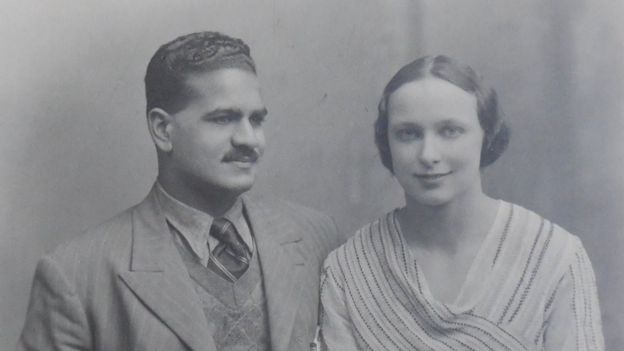
The engagement photo of Freda and BPL taken at Oxford in 1933
Image captionFreda and BPL met as students at Oxford University

Driven by curiosity and by sympathy with those struggling against the Empire, she also went along to the weekly meetings of the Oxford Majlis, where radicals among the university’s small number of Indian students asserted their country’s case for nationhood. BPL Bedi, a handsome and cheerful Punjabi, was a regular there. A friendship developed into intellectual collaboration and, within months, Freda and BPL were a couple.

In the early 1930s, women’s colleges at Oxford were obsessed with sex or rather with preventing it. If a male student came to have tea in a female student’s room, a chaperone had to be present, the door left wide open and the bed had to be taken into the corridor. Freda’s college did its best to derail her relationship – she was disciplined for visiting BPL without a chaperone in what she was convinced was a case of racial discrimination.

But she was fortunate in her student friends. Barbara Castle, who later became a commanding British woman politician of her era, was thrilled when Freda confided that she intended to marry her boyfriend. “Well, thank goodness”, Barbara exclaimed. “Now at least you won’t become a suburban housewife!” Freda’s mother didn’t see things that way though. Her family were sternly disapproving, until BPL made a visit to Derby and managed to charm them.

Freda commented that the engagement caused “a minor sensation” in Oxford. That was an understatement. She believed she was the first Oxford woman undergraduate to marry an Indian fellow student. Some didn’t hide their disapproval. The registrar who conducted the marriage ceremony pointedly refused to shake hands with the couple.

From the moment she married, Freda regarded herself as Indian and often wore Indian-style clothes. A year later, husband and wife and their four-month old baby, Ranga, set off by boat from Trieste, Italy, on the two-week journey to the western Indian city of Bombay (now Mumbai). “The nightmare was to get milk for myself to drink because I was feeding the baby”, Freda recalled. “And I remember the millions of cockroaches that used to come out at night in the ship’s kitchens – I used to go in and attempt to get milk.”

Presentational grey line

Read more stories by Andrew Whitehead

  • The forgotten English poet buried in India
  • Returning to Kashmir, where our parents were shot in front of us
  • Shujaat Bukhari: A man who epitomised the best of Kashmir
Presentational grey line

The couple had already been marked out by the British authorities as revolutionaries and potential trouble makers because of their student activism. When they disembarked in Bombay, their bags and cases were inspected for seven hours to check for left-wing propaganda. “Even Ranga’s little napkin was taken off and searched,” recalled Freda, “because they thought I might be carrying messages in it”.

The key test of Freda’s marriage was still to come – the first meeting with her Indian mother-in-law, a widow and matriarch known in the family as Bhabooji. From Bombay, the Bedis travelled non-stop for a couple of days to reach the small Punjabi city of Kapurthala, arriving at the family home close to midnight. Freda was wearing a white cotton sari – “not the ideal travelling dress, and nursing Ranga had not improved it”.

BPL bowed to touch his mother’s feet in the traditional expression of respect. “I copied him, feeling a little awkward,” Freda said, “but all my shyness disappeared when she smiled at us both with tears in her eyes, and embraced us and the child as if she could not hold us close enough.”

Although Freda was determined to fit in with her Indian extended family, her lifestyle was anything but conventional. BPL’s political stand extended to rejecting any share in his family’s wealth. They made their home in Lahore, one of the largest cities in Punjab, in a cluster of thatched huts without power or running water, keeping hens and a buffalo. It can’t have been the sort of life Freda had expected – nor would she have been used to the idea of sharing the household with her mother-in-law.

“Nowhere had I seen a white woman trying to be a typical Indian daughter-in-law”, commented Som Anand, a frequent visitor to the Bedis’ huts. “It surprised me to see Mrs Bedi coming to Bhabooji’s hut in the morning to touch her feet. In household matters she respected the old mother’s inhibitions. Her mother-in-law was an equally large hearted person; despite all her conservatism she had accepted a Christian into the family without a murmur.”
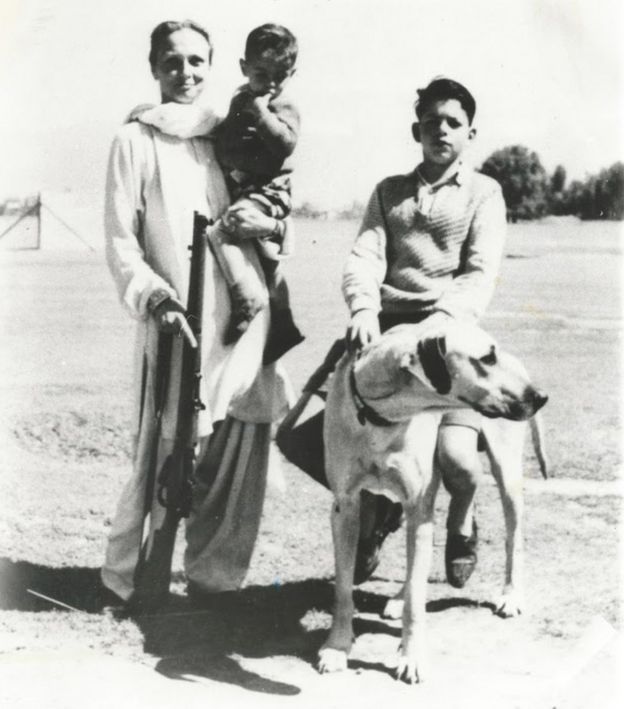
Freda with a rifle when she was living in Kashmir, probably 1948 - she is holding hr son, Kabir, while her older son, Ranga, is sitting on the family's pet dog.
Image captionFreda and BPL moved to Kashmir after 1947 and remained politically active

When World War Two broke out, both BPL and Freda were outraged that India was being dragged into supporting the British war effort. BPL was detained in a desert prison camp to stop him sabotaging military recruitment in Punjab. Freda decided to make her own stand against her motherland.

She volunteered as a satyagrahi, a seeker of truth, and was among those chosen by Indian independence leader Mahatma Gandhi to defy emergency wartime powers. She travelled to her husband’s home village of Dera Baba Nanak and announced that she would “break the law by asking the people not to support the military effort until India became democratic”. The authorities didn’t know how to respond to a white woman staging such a protest – they hurriedly sent an English police inspector to the village, deeming it inappropriate for an Indian policeman to arrest an Englishwoman.

Freda was brought before a visiting magistrate that same morning – she has left her own account of the trial:

It was finished in 15 minutes. The man on the other side of the table was quite young still, and looked as though he had been to Oxford. His face was red.

“I find this as unpleasant as you do,” he murmured.

“Don’t worry. I don’t find it unpleasant at all.”

“Do you want the privileges granted to an Englishwoman?”

“Treat me as an Indian woman and I shall be quite content.”

She was sentenced to six months in jail, which was fairly standard, and also to hard labour, which she regarded as vindictive.

  • How Shelley’s Indian ‘disciple’ changed copyright law
  • The woman who fought for the right to be a prostitute

That turned out to be no more onerous than supervising the prison gardens, where women imprisoned for criminal rather than political offences – many were locked up for killing their abusive husbands – did most of the work.

“It was my destiny to go to India,” Freda asserted. It was her destiny too to make history as an English woman who went willingly to jail in support of India’s demand for freedom.

The Bedis’ political prominence persisted after independence, when they moved to Kashmir – Freda joined a left-wing women’s militia and worked with the radical nationalists who gained power there. In the 1950s, her life changed utterly when, during a UN assignment in Burma, she encountered Buddhism for the first time and became an enthusiastic convert.
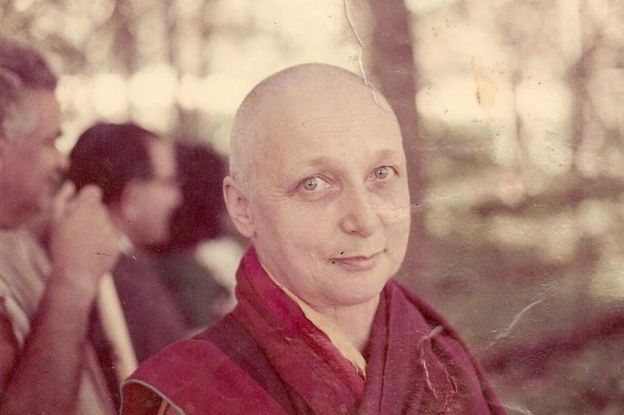
Freda as a nun, when she took the name Sister Palmo
Image captionFreda became a Buddhist nun in the 1950s

When thousands of Tibetans fled across the Himalayas in 1959 to escape Chinese oppression, Freda devoted herself to helping these “brave and wonderful” refugees. She became steeped in Tibetan spirituality. And once she felt that she had fulfilled her role as a mother (the film star Kabir Bedi is one of her three surviving children), she broke convention again by taking vows as a Tibetan Buddhist nun. In her sixties, she travelled relentlessly to spread the word about Buddhist teachings but never returned to live in the West.

“India is my womanhood and my wife-hood,” she once declared. “I too am ‘dust that England bore, shaped and made aware’. Yet I am living in an Indian way, with Indian clothes, with an Indian husband and child on Indian soil, and I cannot feel even the least barrier or difference in essentials between myself and the new country I have adopted.”

Throughout her life, Freda was determined not to be constrained by barriers of race, religion, nation or gender. She delighted in challenging convention and confounding expectations – that is what makes her story so beguiling.

Source: The BBC

Posted in 1959, Andrew Whitehead, Arrest, authorities, Baba Pyare Lal Bedi, Barbara Castle, Bhabooji, biographer, Bombay, BPL Bedi, break the law, British authorities, British woman, Buddhism, casualties, chaperone, Chinese oppression, Christian, communist October Club, convention, convert, curiosity, demand for freedom, democratic, Depression generation, Dera Baba Nanak, Derby, disembarked, East Midlands, emergency wartime powers, empire, England, English police inspector, Englishwoman, First World War, fought, Freda Bedi, global crisis, Himalayas, independence leader, independence movement, India alert, India's freedom, Indian policeman, Indian Sikh, Indian students, jewellery and watch repair business, Kabir Bedi, Kapurthala, Kashmir, Labour Club, left-wing propaganda, lifelong spiritual quest, Machine Gun Corps, mahatma gandhi, mass unemployment, midnight, mother-in-law, mumbai, northern France, Oxford, Oxford Majlis, prison gardens, privileges, Punjabi, racial discrimination, radicals, Ranga, revolutionaries, rise of fascism, satyagrahi, seeker of truth, student activism, suburban housewife, suicide club, sympathy, Tibetan Buddhist nun, Tibetans, trial, trouble makers, UN assignment in Burma, Uncategorized, woman politician, World War Two | Leave a Comment »

07/03/2019

China praises Pakistan for ‘restraint’ with India, Islamabad says thank you

The Chinese foreign ministry on Thursday released a statement in Chinese following the visit of vice-foreign minister Kong Xuanyou to Pakistan, lauding Islamabad’s response.

WORLD Updated: Mar 07, 2019 16:42 IST

Sutirtho Patranobis
Sutirtho Patranobis
Hindustan Times, Beijing
China,Pakistan,Islamabad
Kong visited Pakistan as Islamabad faced pressure from global powers to act against groups carrying out attacks in India, including Jaish-e-Mohammed (JeM), which claimed responsibility for the February 14 attack that killed 40 CRPF personnel in Pulwama.(REUTERS File Photo)

China has praised Pakistan for its handling of the tense situation with India, appreciating Islamabad’s “restraint” in the aftermath of the Pulwama terror attack in Jammu and Kashmir in February.

The Chinese foreign ministry on Thursday released a statement in Chinese following the visit of vice-foreign minister Kong Xuanyou to Pakistan, lauding Islamabad’s response.

“China has paid close attention to the present situation between Pakistan and India, and appreciates Pakistan remaining calm and exercising restraint from the beginning, and persisting in pushing to lower the temperature with India via dialogue,” the foreign ministry statement said.

It paraphrased Kong’s discussions with Pakistan’s leadership comprising Prime Minister Imran Khan, army chief General Qamar Javed Bajwa and foreign minister Shah Mehmood Qureshi.

In turn, the statement quoted the Pakistani side thanking China’s “objective and fair position” on the situation and for its efforts to promote the “cooling” of the situation.

Kong visited Pakistan as Islamabad faced pressure from global powers to act against groups carrying out attacks in India, including Jaish-e-Mohammed (JeM), which claimed responsibility for the February 14 attack that killed 40 CRPF personnel in Pulwama.

The Pulwama suicide attack – the worst in Kashmir in decades – led to the most serious conflict in years between the nuclear-armed neighbours with India carrying out a strike on a JeM camp in Balakot and then a dogfight over the skies of Kashmir.

The crisis seems to have eased after Pakistan returned IAF Wing Commander Abhinandan Varthaman last Friday, nearly two days after he was captured.

Kong was quoted as telling the Pakistani leadership that China maintains that the sovereignty and territorial integrity of all countries should be earnestly respected and that Beijing is unwilling to see acts that violate the norms of international relations.

The statement quoted Kong as saying that China calls on Pakistan and India to refrain from taking actions to aggravate the situation, show goodwill and flexibility, launch dialogue as soon as possible, and work together to maintain regional peace and stability.

China is willing to continue to play a constructive role in this regard, Kong is quoted to have said.
According to the statement, the Pakistani leaders appreciated China’s objective and fair position on the situation in Pakistan and India and thanked China for its efforts to promote the cooling of the situation.
It added that the Pakistani side reiterated that it is unwilling to see an escalation of the situation and is willing to resolve the contradictions and differences between the two sides through dialogue and peacefully, and welcomes China and the international community to play an active role in this regard.
Source: Hindustan Times

Posted in Balakot, China alert, CRPF, dialogue, dogfight, foreign minister, Foreign Ministry, General Qamar Javed Bajwa, IAF Wing Commander Abhinandan Varthaman, Imran Khan, India alert, Islamabad, Jaish-e-Mohammed (JeM), Jammu and Kashmir, Kashmir, Kong Xuanyou, nuclear-armed neighbours, Pakistan, Pakistan’s army chief, Prime minister, Pulwama, response, Shah Mehmood Qureshi, Uncategorized, vice-foreign minister | Leave a Comment »

07/03/2019

Days after Pulwama, 1 killed, 29 injured in grenade blast inside bus in Jammu

The incident comes less than a month after over 44 CRPF personnel were killed and many injured on February 14 in Jammu and Kashmir’s Pulwama.

SNS Web | New Delhi | March 7, 2019 12:47 pm

Security personnel carry out investigation at the site where a blast took place after a grenade attack by militants at the busy main bus terminus in Jammu and Kashmir, on March 7, 2019. (Photo: IANS)

One person was killed and 29, including a woman injured in a blast after a grenade was tossed at a bus in the general bus stand in the heart of Jammu on Thursday. The condition of five injured is said to be serious.
The killed youth has been identified as a 17-year-old Mohammad Sharik of Haridwar in Uttrakhand.
Minister of State for Defence Subhash Bhamre said a local investigation has been initiated into the incident. He further said the government has given complete liberty to the forces to take all necessary steps.
The Jammu and Kashmir Police has been rushed to the site of the blast.
The Chinese grenade exploded in the bus at about 12 noon. The driver and conductor were among the injured rushed to the Government Medical College, Jammu. The injured include passengers belonging to Bihar, Punjab, Haryana, Uttrakhand, Jammu and the Kashmir valley.
Visuals from the blast site showed the damaged bus of the J&K Road Transport Corporation (JKSRTC) in which the grenade exploded.
The area has been cordoned off by the security personnel. Nature and the cause is being ascertained, police said.
Fifteen suspects have been rounded up for interrogation.
The grenade attack has coincided with the shifting of detained separatist Yasin Malik to the Jammu’s Kot-Bhalwal jail.
Police suspected the JeM outfit behind the attack. Some radicals had threatened of revenge during the recent communal tension here when about six cars were burnt.
K Vijay Kumar and KK Sharma,  both advisors to the Governor, visited the spot to take stock of the situation. The divisional commissioner, deputy commissioner and senior police and civil officers also visited the spot.
This is the third grenade attack in the bus stand during the past few months.
The blast comes at a time when Jammu and Kashmir is on a high alert following the heightened tensions between India and Pakistan in the wake of the Pulwama terror attack.
Former chief minister Mehbooba Mufti condemned the incident and called for unity to defeat terror elements in the state.
“I condemn this act of terror in the strongest possible terms. My prayers for speedy recovery of those injured. The perpetrators are out there to inflict pain and divide us. Our unity has to be our tool to defeat them,” Mufti tweeted.
The provincial president of National Conference, Devender Rana, visited the hospital to inquire about the wellbeing of injured persons.
The incident comes less than a month after over 44 CRPF personnel were killed and many injured on February 14 in one of the deadliest terror strikes in Jammu-Kashmir when a Jaish-e-Mohammad (JeM) suicide bomber blew up an explosive-laden vehicle near their bus in Pulwama district.
The bus was part of a convoy of 78 vehicles carrying around 2500 CRPF personnel from Jammu to Srinagar.
Read More
Source; The Statesman

Posted in advisors to the Governor, Bihar, Chief Minister, CRPF, deputy commissioner, Devender Rana, divisional commissioner, explosive-laden vehicle, Government Medical College, grenade blast, Haridwar, Haryana, Hospital, India alert, injured, inside bus, investigation, J&K Road Transport Corporation (JKSRTC), Jaish-e-Mohammad (JeM), Jammu, Jammu and Kashmir, Jammu and Kashmir Police, JeM, K Vijay Kumar, killed, KK Sharma, Kot-Bhalwal jail, main bus terminus, Mehbooba Mufti, Minister of State for Defence, Mohammad Sharik, national conference, Pakistan, provincial president, Pulwama, Punjab, radicals, revenge, security personnel, senior police and civil officers, Srinagar, Subhash Bhamre, suicide bomber, Uncategorized, Uttarkhand, Uttrakhand | Leave a Comment »

06/03/2019

Belt and Road Initiative mutually beneficial: Rwandan foreign minister

RWANDA-KIGALI-FM-CHINA-BELT AND ROAD INITIATIVE

Rwandan Foreign Minister Richard Sezibera speaks at a press conference held by the Rwandan Ministry of Foreign Affairs and International Cooperation in Kigali, capital of Rwanda, March 5, 2019. The Belt and Road Initiative is a partnership that is mutually beneficial for Rwanda and addresses Rwanda’s development challenges, Rwandan Foreign Minister Richard Sezibera said here Tuesday. (Xinhua/Cyril Ndegeya)

KIGALI, March 5 (Xinhua) — The Belt and Road Initiative is a partnership that is mutually beneficial for Rwanda and addresses Rwanda’s development challenges, Rwandan foreign minister Richard Sezibera said Tuesday in Rwandan capital city Kigali.

The Belt and Road Initiative is a good initiative, which addresses development requirements of China’s partners, said Sezibera when responding to a question on the Belt and Road Initiative and second Belt and Road Forum for International Cooperation at a press conference held by Rwandan Ministry of Foreign Affairs and International Cooperation.

China is an important partner for Rwanda at all levels, and Rwanda welcomes the growing partnership with China, he said, adding that Rwanda and China have important relationships in infrastructure development, party-to-party and people-to-people exchanges, and at the political level.

The second Belt and Road Forum for International Cooperation is going to be held in April in Beijing.

Source: Xinhua

Posted in Beijing, Belt and Road Initiative, China alert, foreign minister, Kigali, Richard Sezibera, Rwanda, Rwandan capital city, Rwandan foreign minister, Rwandan Ministry of Foreign Affairs and International Cooperation, Uncategorized | Leave a Comment »

06/03/2019

China Focus: China to lower defense budget growth to 7.5 percent

BEIJING, March 5 (Xinhua) — China will lower its defense budget growth rate to 7.5 percent in 2019, from last year’s 8.1 percent, according to a draft budget report submitted to the annual session of the National People’s Congress (NPC) Tuesday.

The 2019 defense budget will be 1.19 trillion yuan (about 177.61 billion U.S. dollars), figures from the report show.

The rate marks the fourth straight year for the budgeted growth rate remaining single digit, following five consecutive years of double-digit increases.

China’s budgeted defense spending growth rate stood at 8.1 percent in 2018, 7 percent in 2017, and 7.6 percent in 2016.

“The Chinese government has always paid attention to controlling the scale of defense expenditure,” said He Lei, former deputy head of the Academy of Military Sciences.

Describing China’s defense budget increase as reasonable and appropriate, Zhang Yesui, spokesperson for the legislative session, said the rise aimed to “meet the country’s demand in safeguarding national security and military reform with Chinese characteristics.”

“China’s limited defense spending, which is for safeguarding its national sovereignty, security and territorial integrity, poses no threat to any other country,” Zhang said at a press conference Monday.

The expenditure has been mainly used for advancing defense and military reforms, supporting military training and diverse tasks, modernizing weapons and equipment, and improving welfare of service personnel, according to He, who is also a deputy to the NPC.

“The defense budget increase is appropriate against the backdrop of profound changes in the country’s overall strength, its security environment, and the global strategic situation,” He said.

China’s defense budget takes up a fairly small share of its GDP and national fiscal expenditure compared with other major countries, said He, noting that its military spending per capita and per soldier was also very low.

While the national defense spending in a number of major developed countries accounts for more than 2 percent of their GDP, the ratio was only about 1.3 percent for China in 2018.

The United States has increased its national defense expenditure for the fiscal year 2019 to 716 billion dollars, about four times the budget of China, the world’s second largest economy.

China’s military spending per capita is only about one-nineteenth of that of the United States.

“When it comes to whether a country poses a threat to other countries, the key is not that country’s national strength and armed forces, but the policies it adopts,” said Chen Zhou, research fellow with the Academy of Military Sciences.

“China has always been following the path of peaceful development and firmly adheres to a defense policy that is defensive in nature,” Chen said, noting that China’s development would not pose a threat to any other country.

He Lei highlighted China’s role in providing public security goods for the international community, saying the Chinese military had actively participated in UN peacekeeping missions, maintained security of marine passages, and engaged in international rescue and security cooperation.

“The growth in China’s defense spending is the growth of forces for world peace,” he noted.

Source: Xinhua

Posted in Academy of Military Sciences, armed forces, Chen Zhou, China alert, Chinese Characteristics, country's overall strength, defense budget, deputy to the NPC, GDP, global strategic situation, growth, He Lei, international community, international rescue and security cooperation, lower, military reform, national fiscal expenditure, National People's Congress (NPC), National security, peaceful development, policies, public security goods, research fellow, security environment, security of marine passages, spokesperson for the legislative session, UN peacekeeping missions, Uncategorized, world peace, Zhang Yesui | Leave a Comment »

06/03/2019

Xi stresses strategic resolve in enhancing building of ecological civilization

(TWO SESSIONS)CHINA-BEIJING-XI JINPING-NPC-PANEL DISCUSSION (CN)

Chinese President Xi Jinping, also general secretary of the Communist Party of China (CPC) Central Committee and chairman of the Central Military Commission, attends a panel discussion with his fellow deputies from Inner Mongolia Autonomous Region at the second session of the 13th National People’s Congress in Beijing, capital of China, March 5, 2019. (Xinhua/Xie Huanchi)

BEIJING, March 5 (Xinhua) — President Xi Jinping on Tuesday stressed efforts to maintain strategic resolve in enhancing the building of an ecological civilization and to protect the country’s beautiful scenery in the northern border areas.

Xi, also general secretary of the Communist Party of China (CPC) Central Committee and chairman of the Central Military Commission, made the remarks when attending a panel discussion with his fellow deputies from Inner Mongolia Autonomous Region at the second session of the 13th National People’s Congress, China’s national legislature.

The president called for intensified protection of the ecological system, urging people to fight resolutely against pollution.

The Party’s theory on an ecological civilization has been constantly enriched and improved since the 18th CPC National Congress in late 2012, Xi said.

All localities and departments should earnestly implement the Party’s arrangement and requirements for building an ecological civilization, pushing it to a new level, Xi said.

Building Inner Mongolia into an important shield for ecological security in northern China is a strategic position set with full consideration of the country’s overall development and a major responsibility the region must shoulder, Xi said.

Fundamentally speaking, environmental protection and economic development are closely integrated and complement each other, Xi said.

In the Chinese economy’s transition from the phase of rapid growth to a stage of high-quality development, pollution control and environmental governance are two major tasks that must be accomplished, he added.

The country should explore a new path of high-quality development that prioritizes ecology and highlights green development, Xi said.

With its diversified natural forms including forests, grasslands, wetlands, rivers, lakes and deserts, Inner Mongolia features a comprehensive ecological system formed over a long period of time. Integrated measures should be taken in ecological protection and rehabilitation in the region, he said.

Xi underlined a resolute and effective fight to prevent and control pollution, saying prominent environmental issues the people are strongly concerned about must be addressed properly.

Source: Xinhua

Posted in beautiful scenery, Central Military Commission, China alert, China's national legislature, Chinese President Xi Jinping, Communist Party of China (CPC) Central Committee, CPC National Congress, departments, deserts, ecological civilization, ecological system, fellow deputies, forests, General Secretary, grasslands, inner mongolia autonomous region, lakes, localities, National People's Congress, northern border areas, Pollution, rehabilitation, rivers, strategic resolve, Uncategorized, wetlands | Leave a Comment »

06/03/2019

China’s new huge solid rocket booster completes test

BEIJING, March 5 (Xinhua) — China announced Tuesday that the country’s new solid rocket booster, with 200-tonne thrust engine, completed hot firing tests, proving its readiness for commercial launches.

With a diameter of 2.65 meters, the booster engine is expected to be used on the modified version of the Long March-11 rocket. The rocket is the only series in the Long March family that uses solid propellants, and it can be launched within 24 hours.

Developed by the Academy of Aerospace Solid Propulsion Technology under the China Aerospace Science and Technology Corporation, it will be China’s most powerful rocket booster engine, delivering a maximum thrust of 200 tonnes and the ability to carry as much as 71 tonnes of fuel.

It will have a carrying capacity of 1.5 tonnes for sun-synchronous orbit.

In 2009, the academy took the lead in China in developing a rocket booster engine for the Long March-11. The previous-generation, covered with a steel shell, was 2 meters in diameter, capable of 120 tonnes of thrust and could carry 35 tonnes of fuel.

To increase its carrying capacity and market competitiveness, the new booster is made using filament winding composite material, which is better and can be applied more widely than a metal shell, said Wang Jianru, chief designer of the booster.

The successful tests mark a milestone in developing a more efficient booster engine with cost advantage for China’s new-generation rocket, according to the design team.

China’s first seaborne rocket launch is scheduled for mid-2019, with a Long March-11 carrier rocket set to blast off in the Yellow Sea.

Source: Xinhua

Posted in Academy of Aerospace Solid Propulsion Technology, chief designer of the booster, China Aerospace Science and Technology Corporation, China alert, commercial launches, Long March-11 rocket, solid rocket booster, Uncategorized, Wang Jianru, Yellow Sea | Leave a Comment »

06/03/2019

Commentary: China’s strategic resolve of green development unshakable

BEIJING, March 5 (Xinhua) — Despite increasing downward pressure on its economy, China is assuring the world of its firm resolution in the pursuit of green development with concrete and self-motivated efforts.

For China, green development is a critical element of modernizing its economy. The country sticks to a new development vision that features innovative, coordinated, green and open development for the benefit of all.

It is not at the request of others, but on the country’s own initiative.

With a large population, China is facing increasing resource constraints, severe environmental pollution and a deteriorating ecosystem. People are becoming increasingly aware of environmental problems.

The country’s leadership has made it clear that China must win the battle to ensure blue skies and clean water and soil.

The battle will not be won easily.

Facing a complicated and challenging domestic and international environment of a kind rarely seen in many years, China has two options: lowering standards of environmental protection in launching new projects to stimulate growth; finding fundamental solutions to address pollution and build an ecological civilization that will benefit generations to come.

China’s choice and actions reassure those who may doubt its seriousness about green development.

When China says it “puts ecological protection first,” it is not just lip service.

This year, China will cut the energy consumption per unit of GDP by around 3 percent. Sulfur dioxide and nitrogen oxide emissions will be cut by 3 percent, and there will be a continuous decline in PM2.5 density in key areas.

The central government will allocate 25 billion yuan (3.73 billion U.S. dollars) to prevent and control air pollution, an increase of 25 percent year on year, an evidence of the advantage of China’s governance system which can “concentrate resources to accomplish major undertakings.”

China will also strengthen green and environmental protection industries, and press ahead to conserve and restore the ecosystems of mountains, rivers, lakes, forests, farmland, and grassland.

Simple, moderate, green, and low-carbon ways of life are increasingly popular in China. It has become common sense among the public that “lucid waters and lush mountains are invaluable assets themselves.”

As a matter of fact, the country’s yearning for green growth, instead of dragging down the economy, will be a boon to the economy, for China and the rest of the world.

Chinese and foreign investors are embracing a new wave of opportunities in the market for environment-related products and services, such as thermal power and steel industry upgrading, the development of sewer networks and treatment facilities and the construction of eco-friendly buildings.

China is one of the first countries to sign the Paris Agreement on climate change. China has pledged to halt the rise in carbon dioxide emissions by around 2030.

Among the essence of traditional Chinese thinking is the concept that man and nature form a community of life. Only by observing the laws of nature can mankind avoid costly blunders in its exploitation.

China has embarked on this bumpy but promising road. Marching toward an era of green development, there will be no turning back.

Source: Xinhua

Posted in Central government, China alert, eco-friendly buildings, ecosystems, emissions, energy consumption, environment-related products and services, environmental protection industries, farmland, forests, GDP, governance system, grassland, green development, green growth, lakes, man and nature form a community of life, mountains, nitrogen oxide, Paris Agreement on climate change, rivers, sewer networks and treatment facilities, Sulfur dioxide, thermal power, Uncategorized | Leave a Comment »

06/03/2019

China’s February exports seen falling most in 2 years, imports down again – Reuters Poll

BEIJING (Reuters) – China’s exports likely contracted in February after a surprise bounce in January, while imports fell for a third straight month, a Reuters poll showed, heightening anxiety over whether Washington and Beijing can resolve deep differences over trade.

China’s exports in February are expected to have fallen 4.8 percent from a year earlier, according to the median estimate of 32 economists in a Reuters poll, following a 9.1 percent rise in January.

Such a drop would be the biggest since December 2016, and suggest a further weakening in global demand.

Imports in February are expected to have fallen 1.4 percent from a year earlier, compared with the previous month’s 1.5 percent decline.Stronger-than-expected imports could prompt some China watchers to say the economy is showing signs of bottoming out in response to a string of stimulus measures in 2018.

But most analysts typically caution that China’s data early in the year can be highly distorted by the timing of the Lunar New Year holidays, when some business rush out shipments or scale back output before shutting for a extended break. As such, analysts’ estimates for February varied widely.

TRADE DEAL NOT A SILVER BULLET

In recent weeks, the United States and China appear to have moved closer to a trade deal that would roll back tit-for-tat tariffs on each others’ goods, with Beijing making pledges on structural economic changes, a source briefed on negotiations said on Sunday.

But President Donald Trump will reject any pact that is not perfect, Secretary of State Mike Pompeo said this week.
Even if concrete steps such as dismantling tariffs are agreed, it would not be a panacea for all of China’s economic woes. Its exporters would have to piece supply chains back together, win back market share and contend with slowing demand globally.
Factory surveys have suggested exports and imports will remain weak in coming months, with February’s official gauge showing export orders fell to their weakest level since the global financial crisis.
China’s overall trade surplus is seen to have shrunk sharply to $26.38 billion in February from $39.16 billion the previous month, according to the Reuters poll.
In response to growing domestic and global pressure, China’s government this week unveiled a 2019 economic growth target of 6.0-6.5 percent, down from an actual 6.6 percent in 2018, the slowest pace in nearly 30 years.
https://queso-cdn.prod.reuters.tv/new/index.html?autoplay=false&muted=false&countdown=true&preroll=false&poster=https%3A%2F%2Fajo.prod.reuters.tv%2Fapi%2Fv2%2Fimg%2F5c7e7911e4b085d3632c5822%3Fwidth%3D640%26location%3DLANDSCAPE%26videoId%3DOVA4QVDL7&mid=OVA4QVDL7&title=China%20to%20slash%20taxes%2C%20boost%20lending%20to%20prop%20up%20slowing%20economy&suppress_ads=false&suppress_rtv=true&source=https%3A%2F%2Fuk.reuters.com%2Farticle%2Fuk-china-economy-trade%2Fchinas-february-exports-seen-falling-most-in-2-years-imports-down-again-reuters-poll-idUKKCN1QN16S&chartbeat_uid=52639&chartbeat_domain=preview.reuters.com&region=US&draggable=true&hide_title=false&basic=false&allow_collapse=true
China to slash taxes, boost lending to prop up slowing economy
Premier Li Keqiang told parliament on Tuesday that China will shore up the economy through billions of dollars in additional tax cuts and infrastructure spending, and will lower real interest rates.
“A set of pro-growth measures are planned despite positive progress in U.S.-China trade talks, which makes us think that either China doesn’t have full confidence in a trade truce or that the damages from the trade conflict cannot easily be undone,” said Iris Pang, Greater China economist at ING.
Source: Reuters

Posted in Beijing, bottoming out, China alert, down again, exports, Greater China economist, imports, infrastructure spending, ING, Iris Pang, Lunar New Year holidays, Mike Pompeo, parliament, Premier Li Keqiang, President Donald Trump, Reuters Poll, structural economic changes, tax cuts, tit-for-tat tariffs, trade negotiations, U.S.-China trade talks, Uncategorized, United States, US Secretary of State, Washington | Leave a Comment »

06/03/2019

‘War’ and India PM Modi’s muscular strongman image

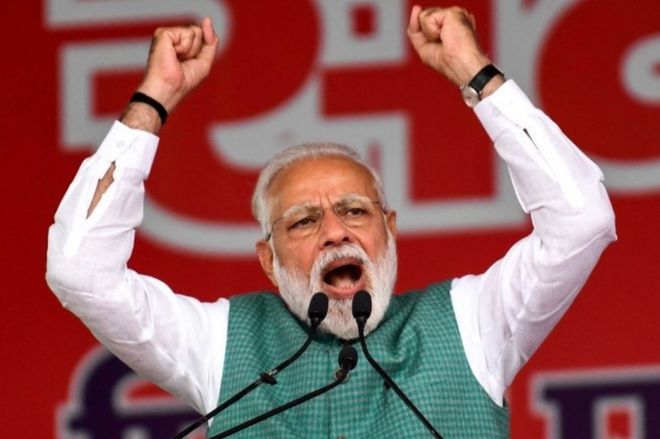
Indian Prime Minister Narendra Modi gestures as he speaks during the National Democratic Alliance (NDA) "Sankalp" rally in Patna in the Indian eastern state of Bihar on March 3, 2019.Image copyrightAFP
Image captionMr Modi is accused of exploiting India-Pakistan hostilities for political gain

A gaffe is when a politician tells the truth, American political journalist Michael Kinsley said.

Last week, a prominent leader of India’s ruling Hindu nationalist Bharatiya Janata Party (BJP) appeared to have done exactly that. BS Yeddyurappa said the armed aerial hostilities between India and Pakistan would help his party win some two dozen seats in the upcoming general election.

The remark by Mr Yeddyurappa, former chief minister of Karnataka, was remarkable in its candour. Not surprisingly, it was immediately seized upon by opposition parties. They said it was a brazen admission of the fact that Prime Minister Narendra Modi’s party was mining the tensions between the nuclear-armed rivals ahead of general elections, which are barely a month away. Mr Modi’s party is looking at a second term in power.

Mr Yeddyurappa’s plain-spokenness appeared to have embarrassed even the BJP. Federal minister VK Singh issued a statement, saying the government’s decision to carry out air strikes in Pakistan last week was to “safeguard our nation and ensure safety of our citizens, not to win a few seats”. No political party can afford to concede that it was exploiting a near war for electoral gains.

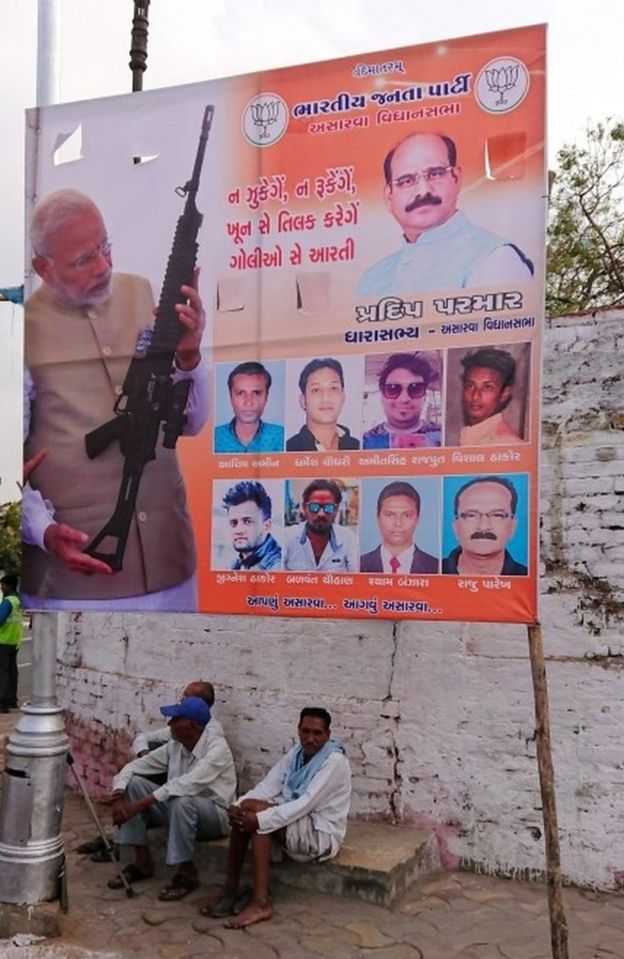
A billboard displaying an image of Indian Prime Minister Narendra Modi holding a rifle is seen on a roadside in Ahmedabad on March 3, 2019.Image copyrightAFP
Image captionThe BJP has put up election posters of Mr Modi posing with guns

Even as tensions between India and Pakistan ratcheted up last week, Mr Modi went on with business as usual. Hours after the Indian attack in Pakistan’s Balakot region, he told a packed election meeting that the country was in safe hands and would “no longer be helpless in the face of terror”. Next morning, Pakistan retaliated and captured an Indian pilot who ejected from a downed fighter jet. Two days later, Pakistan returned the pilot to India.

Mr Modi then told a gathering of scientists that India’s aerial strikes were merely a “pilot project” and hinted there was more to come. Elsewhere, his party chief Amit Shah said India had killed more than 250 militants in the Balakot attack even as senior defence officials said they didn’t know how many had died. Gaudy BJP posters showing Mr Modi holding guns and flanked by soldiers, fighter jets and orange explosions have been put up in parts of the country. “Really uncomfortable with pictures of soldiers on election posters and podiums. This should be banned. Surely the uniform is sullied by vote gathering in its name,” tweeted Barkha Dutt, an Indian television journalist and author.

  • India and Pakistan in ‘uncharted waters’
  • Narendra Modi v Imran Khan: Who won the war of perception?

Mr Modi has appealed to the opposition to refrain from politicising the hostilities. The opposition parties are peeved because they believe Mr Modi has not kept his word. Last week, they issued a statement saying “national security must transcend narrow political considerations”.

‘Petty political gain’

But can the recent conflict fetch more votes for Mr Modi? In other words, can national security become a campaign plank?

Many believe Mr Modi is likely to make national security the pivot of his campaign. Before last month’s suicide attack – claimed by Pakistan-based militants – killed more than 40 Indian paramilitaries in Kashmir, Mr Modi was looking a little vulnerable. His party had lost three state elections on the trot to the Congress party. Looming farm and jobs crises were threatening to hurt the BJP’s prospects.

Now, many believe, Mr Modi’s chances look brighter as he positions himself as a “muscular” protector of the country’s borders. “This is one of the worst attempts to use war to win [an] election, and to use national security as petty political gain. But I don’t know whether it will succeed or not,” says Yogendra Yadav, a politician and psephologist.

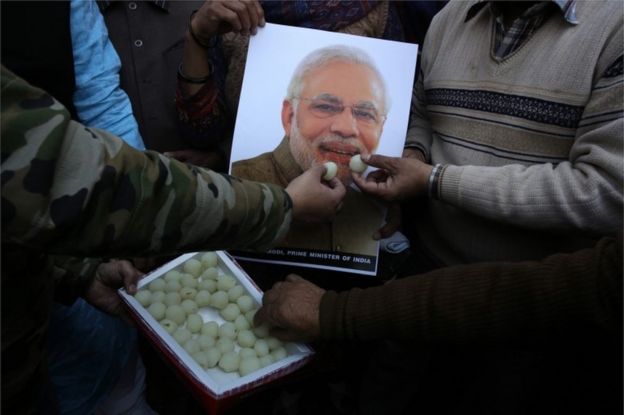
Indian people feed sweets to a poster of Indian Prime Minister Narendra Modi as they celebrate the Indian Air Force"s air strike across the Line of Control (LoC) near the international border with PakistanImage copyrightEPA
Image captionMany Indians have celebrated India’s strike in Pakistani territory

Evidence is mixed on whether national security helps ruling parties win elections in India. Ashutosh Varshney, a professor of political science at Brown University in the US, says previous national security disruptions in India were “distant from the national elections”.

The wars in 1962 (against China) and 1971 (against Pakistan) broke out after general elections. Elections were still two years away when India and Pakistan fought a war in 1965. The 2001 attack on the Indian parliament that brought the two countries to the brink of war happened two years after a general election. The Mumbai attacks in 2008 took place five months before the elections in 2009 – and the then ruling Congress party won without making national security a campaign plank.

Things may be different this time. Professor Varshney says the suicide attack in Kashmir on 14 February and last week’s hostilities are “more electorally significant than the earlier security episodes”.

For one, he says, it comes just weeks ahead of a general election in a highly polarised country. The vast expansion of the urban middle class means that national security has a larger constituency. And most importantly, according to Dr Varshney, “the nature of the regime in Delhi” is an important variable. “Hindu nationalists have always been tougher on national security than the Congress. And with rare exceptions, national security does not dominate the horizons of regional parties, governed as they are by caste and regional identities.”

Presentational grey line

Read more from Soutik Biswas

  • How India’s single time zone is hurting its people
  • Indian election 2019: Are fears of a mass hack credible?
  • The Indian journalist jailed for a year for Facebook posts
Presentational grey line

Bhanu Joshi, a political scientist also at Brown University, believes Mr Modi’s adoption of a muscular and robust foreign policy and his frequent international trips to meet foreign leaders may have touched a chord with a section of voters. “During my work in northern India, people would continuously invoke the improvement in India’s stature in the international arena. These perceptions get reinforced with an event like [the] Balakot strikes and form impressions which I think voters, particularly on a bipolar contest of India and Pakistan, care about,” says Mr Joshi.

Others like Milan Vaishnav, senior fellow and director of the South Asia Program at the Carnegie Endowment for International Peace, echo a similar sentiment. He told me that although foreign policy has never been a “mass” issue in India’s domestic politics, “given the proximity of the conflict to the elections, the salience of Pakistan, and the ability of the Modi government to claim credit for striking back hard, I expect it will become an important part of the campaign”.

But Dr Vaishnav believes it will not displace the economy and farm distress as an issue, especially in village communities. “Where it will help the BJP most is among swing voters, especially in urban constituencies. If there were fence-sitters unsure of how to vote in 2019, this emotive issue might compel them to stick with the incumbent.”

How the opposition counters Mr Modi’s agenda-setting on national security will be interesting to watch. Even if the hostilities end up giving a slight bump to BJP prospects in the crucial bellwether states in the north, it could help take the party over the winning line. But then even a week is a long time in politics.

Source: The BBC

Posted in American political journalist, Amit Shah, armed aerial hostilities, Ashutosh Varshney, Balakot, Barkha Dutt, Bhanu Joshi, Bharatiya Janata Party (BJP), Brown University, BS Yeddyurappa, campaign, Carnegie Endowment for International Peace, Caste, Chief Minister, China alert, congress party, country's borders, Delhi, domestic politics, downed fighter jet, ejected, farm distress, Federal Minister, foreign leaders, foreign policy, gaffe, general election, General VK Singh, Hindu nationalists, image, India alert, Indian Parliament, Indian pilot, international arena, international trips, Karnataka, Kashmir, Michael Kinsley, Milan Vaishnav, militants, mumbai, muscular, muscular strongman, National security, national security disruptions, northern india, opposition, Pakistan, paramilitaries, party chief, perceptions, PM Modi, polarised country, political considerations, political scientist, politician and psephologist, professor of political science, protector, regional identities, reinforced, scientists, senior fellow and director, sentiment, South Asia Program, stature, suicide attack, television journalist and author, Uncategorized, village communities, voters, war, Yogendra Yadav | Leave a Comment »

« Older Entries  |   Newer Entries »

Tags

air pollution Asia Barack Obama Beijing Bharatiya Janata Party Business China Chinese language climate Communist Party communist party of china Delhi Economic growth economy Economy of the People's Republic of China environment European Union Government Gross domestic product Hong Kong Hu Jintao India Japan Li Keqiang manmohan singh Mao Zedong Modi mumbai Narendra Modi New Delhi Pakistan politics President of the People's Republic of China prime minister of india Russia Shanghai Sina Weibo South China Sea South Korea State Council of the People's Republic of China technology transportation United States Xi JinPing Xinjiang

Creative Commons

Chindia Alert: forewarned is forearmed by Chindia Alert Unlimited is licensed under a Creative Commons Attribution-NonCommercial-ShareAlike 3.0 Unported License.

Archives

  • October 2023
  • June 2022
  • May 2022
  • April 2022
  • March 2022
  • June 2021
  • September 2020
  • August 2020
  • July 2020
  • June 2020
  • May 2020
  • April 2020
  • March 2020
  • February 2020
  • January 2020
  • December 2019
  • November 2019
  • October 2019
  • September 2019
  • August 2019
  • July 2019
  • June 2019
  • May 2019
  • April 2019
  • March 2019
  • February 2019
  • January 2019
  • December 2018
  • February 2018
  • January 2018
  • December 2017
  • November 2017
  • October 2017
  • September 2017
  • August 2017
  • July 2017
  • June 2017
  • May 2017
  • April 2017
  • March 2017
  • February 2017
  • January 2017
  • December 2016
  • November 2016
  • October 2016
  • September 2016
  • August 2016
  • July 2016
  • June 2016
  • May 2016
  • April 2016
  • March 2016
  • February 2016
  • January 2016
  • December 2015
  • November 2015
  • October 2015
  • September 2015
  • August 2015
  • July 2015
  • June 2015
  • May 2015
  • April 2015
  • March 2015
  • February 2015
  • January 2015
  • December 2014
  • November 2014
  • October 2014
  • September 2014
  • August 2014
  • July 2014
  • June 2014
  • May 2014
  • April 2014
  • March 2014
  • February 2014
  • January 2014
  • December 2013
  • November 2013
  • October 2013
  • September 2013
  • August 2013
  • July 2013
  • June 2013
  • May 2013
  • April 2013
  • March 2013
  • February 2013
  • January 2013
  • December 2012
  • November 2012
  • October 2012
  • September 2012
  • August 2012
  • July 2012
  • June 2012
  • May 2012
  • April 2012
  • March 2012
  • February 2012
  • January 2012

Meta

  • Create account
  • Log in
  • Entries feed
  • Comments feed
  • WordPress.com

Blog Stats

  • 253,737 hits
Blog at WordPress.com.
CCChang

Law of Unintended Consequences

continuously updated blog about China & India

ChiaHou's Book Reviews

continuously updated blog about China & India

What's wrong with the world; and its economy

continuously updated blog about China & India

Privacy & Cookies: This site uses cookies. By continuing to use this website, you agree to their use.
To find out more, including how to control cookies, see here: Cookie Policy
  • Subscribe Subscribed
    • CHINDIA ALERT: You'll be living in their world, very soon
    • Join 846 other subscribers
    • Already have a WordPress.com account? Log in now.
    • CHINDIA ALERT: You'll be living in their world, very soon
    • Subscribe Subscribed
    • Sign up
    • Log in
    • Report this content
    • View site in Reader
    • Manage subscriptions
    • Collapse this bar